ISSN 2250-3153
Does microcredit affect poverty reduction in Macedonia?
Vjolca Hasani Limani, Ph.D. c.*, Prof. Dr. Seadin Xhaferi**
*
Department of Finance, Faculty of Economics University of Tetova **
Department of Finance, Faculty of Economics University of Tetova
DOI: 10.29322/IJSRP.8.9.2018.p8179 http://dx.doi.org/10.29322/IJSRP.8.9.2018.p8179
Abstract
Microcredit has shown positive effects on poverty reduction in many countries. Considering the fact, that we faced a lack of studies about this topic in Macedonia, this paper will have a great impact on informing the researchers, institutions and society about this issue. This will affect the improvement of policies and programs for poverty reduction.
The main question addressed in this study is, has microcredit affected poverty reduction in Macedonia? The problem is treated through incomes and expenditures of the households. The study is based on a survey conducted with 199 households, while the result depends on the vectors of household characteristics.The sample was divided into two groups: households treated with microcredits and households that have not been treated with microcredits.
In order to obtain an accurate result, firstly we have used descriptive statistics (mean, standard deviation and p-value). We have used fixed-effect regression models on panel data, to analyze the dependent variables. The results obtained from these models suggest that, microcredit has not shown a significant positive impact on poverty reduction, respectively in the increase of household incomes. Households that were treated with microcredit have an increase in income but a decrease of living expenditures. Households that have received consumption credit have increase on income and on expenditures, but these results do not differ much from the income and expenditures of households that have not received loans.
Key words: Microcredit; poverty; household; income; expenditure; Macedonia.
I. INTRODUCTION
Poverty is one of the greatest challenges of humanity, but it is not initited by the poor. It has come as a result of non-inclusive policies and financial institutions, who have excluded the poor from access to financial resources and raising capital to generate income.
Microfinance as an economic notion has started to be recognized since the 1990s, as well as some attempts similar to the functional mechanisms of microfinance, have begun to be used since then. Since the beginning of the application of these mechanisms for borrowing financial funds that have been initiated by microfinance, many studies and researches have been conducted by researchers, in different countries of the world, whose results have often been different from one another. So, there are many researchers who accept the effects of microfinance on poverty reduction, other authors who express scepticism, but some even express their contradiction to this microfinance theory. Microfinance has been proven as an effective and powerful mechanism for poverty reduction. However, like many of the other development tools, it has not penetrated enough into the poorest sections of society.
Given that the most common and most used microfinance mechanism is microcredit itself, this study will analyze its impact in income, consumption expenditures, and living standards of households in Macedonia. Some elements of microfinance are present in Macedonia, even though there is no legal basis to regulate their functioning. Also, the basis for the functioning of microfinance institutions in the country is still not much clearly regulated. Although microfinance is applied in Macedonia, there is still a gap in literature, studies and publications that will address the results which have emerged from the application of microfinance in the country.
One of the biggest problems, we have faced while studying microfinance through empirical models, is the fact that in Macedonia there is a lack of detailed survey data. In fact, this paper is among the few studies that have been conducted in Macedonia, because we have faced a lack of literature or publications on this topic.
I.1 Literature review
ISSN 2250-3153
microcredits, and types of microcredit can be viewed as a broad spectrum of microfinance institution services. While (Khavul S., 2010)[3], says that microfinance provides some innovative solutions to avoid problems which may come as a result of adverse selection, moral hazard, and transaction costs. Charity is not a solution to poverty; it creates dependence and lowers self confidence, says (Alam M. & Getubig M., 2010) [4] in his study. He further points out that microcredit can create self-employment almost immediately, while women have the highest rate of poverty and suffer most from its consequences, but on the other hand they are factors that have the most direct impact on their families. The study of (Branjeree A. et.al., 2015) [5] concludes that microfinance affects job offer solutions, here we note that households that have access to credit, noticeable engagement is seen in their businesses, while in other conditions they have been forced to shorten the jobs. Thus, microcredit plays its role as a financial product, in an environment where access to credit and savings is limited for the poor.Based on the survey, in his study (Khandker S.R., 2005) [6] has found strong results at the levels of micro economy and macro economy, thus microcredit has contributed to poverty reduction among poor borrowers, as well as within local economy. Impact seems to be greater for families who have been very poor. (Chemin M., 2008) [7], found that microfinance has had a positive impact on participant’s spending on microcredit programs, on labor supply, and on education, for both men and women. According to (Imai K. & Azam SH., 2012) [8], it can be inferred from the obtained results that the loans offered by microfinance institutions have had significant effects in poverty reduction, particularly in income and consumption of households.
According to the study of (Boateng G. et.al., 2015) [9], the results showed that microfinance has had a positive impact on all the variables under consideration, not including the participants of the religions and social activities that were initiated from other non-financial factors. Also according to a study by (Swain R. & Floro M., 2012) [10], microfinance has resulted as an opportunity that provides additional sources for reducing consumption, thereby reducing variability and differentiation in consumption levels. On the other hand (Imai, Arun & Annim, 2010) [11] have proven positive impact, with particular emphasis on productive loans. These effects were more common in rural areas than in urban areas. Also the study of (Akotey & Adjasi, 2016) [12], it has been shown that families who have used microcredit in combination with micro-insurance have had higher results in terms of improving their well-being. They point out that credit is good, but the benefits may be higher and more stable for the poor if the risk is covered by micro-insurance. (Moll H.A.J) [13], say that there are two opposing views on microfinance; loans for target groups and postponement of the financial limit; which can be joined to a new approach for formulation of new policies, such as stability and expansion. In the meanwhile (Mazumder & Lu, 2015) [14] have found that microfinance has shown an impact on the growth of fundamental rights, thus has improved the livelihoods and well-being of respondents. Also, (Brau J. & Woller G., 2004) [15] among others say that, tools, models and frameworks in existing financial literature, can be supportive to tackle the world poverty problem, and have the potential to move forward, as the theory also the microfinance practice. This because microfinance provides a fairly good financial opportunity, in order to enable significant positive changes in the lives of millions of poor people.
I.2 Poverty and Microfinance in Macedonia
Macedonia is the last state that has emerged from the former Republic of Yugoslavia, and has since passed through a period of transition and development. In recent years, Macedonia is considered a developing country. The World Bank, puts Macedonia on the group of upper mid-income states, which has made great strides in reforming its economy over the last decade. Much more efforts are still needed to generate economic growth and improve living standards for all. Poverty is estimated to have fallen in 2016. Using poverty line for middle-income countries ($ 5.5/day in 2011 on on purchasing power parity [PPP]), poverty rate has fallen in 22%, continuing a downward trend that has been present since 2009. It is thought that an increase of employment and wage growth, particularly in the labor force sectors, has contributed to poverty reduction in 2016 and early 2017. In 2015, the country had 447.1 thousand poor people, or 21.5% of the population. About 4.9% of the population live below the poverty line of $ 1.9/day, while 24.8% of the population live below the $ 5.5/day poverty line. According to the World Bank's portal (WB, Poverty and Equity, 2017) [16], the consumption growth of the botom 40% population was only 6.2%. Growth in income at the bottom of the distributtion has been stronger than in higher income distribution, for 4.3 percentage points. In fact, this distribution has been the most important in reducing poverty, while economic growth has played a minimal role. Although there is a significant increase, however, the difference in income between the population strata puts Macedonia in the most unequal places in the European Union.
The State Statistical Office of Macedonia, in their report on poverty trends through Laeken indicators (State Statistical Office, 2017b) [17], points out that in 2016 the poverty rate in Macedonia was 21.9%. Analyzed by the type of economy of the household, the poverty rate of households, consisting of two adults with two dependent children was 20.2%. According to the status of economic activity, the poverty rate of employed persons in 2016 was 9%, while for poorer pensioners 7.1%. The measurement of inequality in income distribution, Gini coefficient is 33.6 points.
Table 1. Indicators of Poverty and Social Inclusion in Macedonia in the period 2014-2016.
Poverty and social exclusion indicators, 2014-2016 (final data)
2014 2015 2016 At-risk-of-poverty rate, % of population 22.1 21.5 21.9 Number of persons below at-risk-of-poverty
ISSN 2250-3153
At-risk-of-poverty threshold of single-person
household - annual equivalent income in denars 71 925 78 362 82 560 At-risk-of-poverty threshold of four-person
household (2 adults and 2 children aged less than 14) - annual equivalent income in denars
151 043 164 560 173 376
At-risk-of-poverty rate before social transfers and
before pensions, % of population 41.7 40.5 41.6 Inequality of income distribution, S80/S20, % 7.2 6.6 6.6 Inequality of income distribution, Gini coefficient,
% 35.2 33.7 33.6
Source: The table is processed in Ms.Excel. Data from the Statistical Office of Macedonia, (State Statistical Office, 2017b) [17].
According to the data from the table, we note that in the last three years, the average poverty rate in Macedonia was about 21.8% of the total population. About 453.2 thousand people live below the poverty line, while around 173.376 thousand four-member families live in poverty. The uneven distribution line of income has been downward, so in 2016 it has fallen to 33.6%.
These facts are presented, to prove that there is a high poverty rate in the country, and that there is a need for different economic and social interventions, in order to provide income access and reduction of income inequality for the entire population.
Therefore, we consider that microfinance is a mechanism, which is very necessary to be applied in Macedonia, with the aim of reducing poverty and developing Micro Small and Medium Enterprises. Microfinance and access to finance for the poor, for self-employment and the opportunity of income generation through establishment of small businesses, will be a good and stable solution for the Macedonian population, as it has been proven in other countries in the world.
In Macedonia, microfinance as an economic mechanism is not regulated by a special law. The Law of Banks regulates also the savings houses as one of non-bank financial institutions (deposit receivers). While the Law on Associations and Foundations and the Law on Obligations forms the legal basis for microfinance organizations (not receivers of deposits). The Law on financial companies regulates these companies, as the third type of microfinance providers. The Central Bank is the main institution that supervises savings houses, microfinance institutions and organizations. On the other hand, the Ministry of Finance monitors financial companies. Therefore, taking all into account, we can say that microfinance has not been developed as much as it has been propagated, neither by associations and federations, but also the government, has not created opportunities to develop this financing alternative.
In her study (Hasani V., 2013) [18], emphasizes that microfinance and methods of helping poor businesses and individuals are very necessary for the country. Over the years, some efforts have been made to introduce the microfinance system in Macedonia, to alleviate the situation of small businesses and poor people, but we are witnessing the fact that these efforts have not been successful or have not been properly implemented. Likewise the European Microfinance Network experts report that they have not seen any changes, in terms of legal regulation of microfinance in Macedonia. According to the report, (E.M.N, 2017) [19], although there are no specific legal regulations on microcredit in Macedonia, however, some non-governmental organizations (in the form of associations and foundations), savings houses and financial companies operate on the field of microfinance. According to a study conducted in Macedonia by (Hadzimustafa & Cipusheva, 2013) [20], it turns out that there is a very small number of microfinance studies in the country and the existing ones are only evaluations of some special cases. Their study results that, the percentage of those who have received loans from the MFIs over the past 12 months is very low, i.e. only 2% of the sample. According to the data from the field, in a study by (Idrizi S., 2012) [21], of roma communities, it is noted that the roma in Macedonia are not sufficiently familiar with the possibilities of microfinance services, as an instrument which directly or indirectly can affect poverty reduction and self-employment. Microcredits in Macedonia are provided through banks, savings houses and foundations, which imply the demand for collateral, that poor roma are unable to offer.
II. METHODOLOGY
The researchers of this topic have used different methods, to analyze the impact of microcredit on reducing poverty, increasing the standard of living and narrowing the gap of income. Some authors have used cross sectional analysis, while some have used panel data models with Fixed Effect or with Random Effects. Authors such as (Fattah Sh., 2014) [22], (Bhuiya et.al., 2016) [23], (Imai &Azam, 2012) [24], (Berhane & Gardebroek, 2011) [25], who have had similar samples as our study, have used different models. Based on sample features and based on the models used by researchers of this topic, in this study we will use the Fixed-Effects Regression method on Panel Data.
II.1 Survey preparation
ISSN 2250-3153
The sample of this paper was generated based on the survey of individuals, but including only those who are household heads or responsible for income and expenditures of the household. The collected data have characteristics of panel-data, which will enable a study of the differences in income and expenditure of households, depending on their characteristics. In the part of the questionnaires, we paid attention to the characteristics of families and household heads. The first part of the questionnaire, which was filled out by the head of the household, included questions about: gender, age, nationality, religion, level of education and occupation of the household head. In the second part, we asked about the characteristics of the households, which included: number of family members, number of children under 15, number of employed family members, monthly incomes and expenditures of the family, property registered in the name of the family. At the same time, in the third part of the questionnaire, we asked questions about access to microcredit, including questions: whether they have received loans in the last 5 years, the amount and purpose of the loan, the duration of the loan repayment, wheather the banks have requested colateral for the credits granted, as well as the interest rate.
II.2 Selection and explanation of variables
Based on the purpose of this study, and that is analysis of the impact of microcredit on poverty reduction, income growth and living standards, which have interrelated effects with each-other. Thus, when income increases, it is meant to increase living standards, reduce poverty, increase welfare, and increase consumption. Therefore, the impact of microcredit will be measured through income and living expenditures (consumption).
This is the explanation of variables which show characteristics of the family like: gender, age, nationality, religion, level of education and occupation of the head of household. We assume that this data will have a minimal impact on the microcredit utilization rate. From the aforementioned characteristics, it is assumed that the level of education and occupation of the household head should have high impact on the decision of micro credits for income generation and improvement of well-being.
At the part of explanation of the number of family members, the number of children under 15 (who are dependent on the family), the number of family members who are employed, the monthly income and expenditure of the family, the property registered in the name of family. It is assumed that all these variables have an impact on reducing poverty and increasing welfare. Also, families with the highest number of employed members have more opportunities to generate income, while households with high dependency ratio or dependency ratio are more likely to be poorer and to have income generating problems.
Two groups of households were treated in this study: the first group, those who received micro credits, and the second group, those who did not receive micro credits. In the credits section we have put other variables, such as loan amount, interest rates, property ownership and collateral.
II.3. Descriptive Statistics
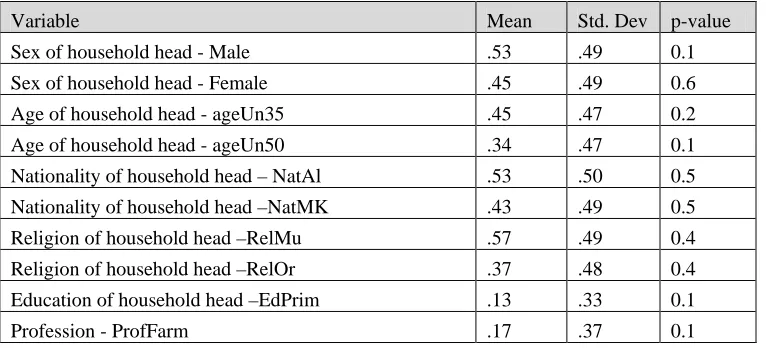
From the random sampling results in this analysis, the table below shows that in Macedonia there is no major difference of household management in terms of gender, as about 53% of household heads are male and 45% are female. Also in the analysis of the age aspects, the majority of household heads responding to the survey were younger than 35 years. In terms of religion, we have more answers from the household heads of Muslim religion. From he interviewed heads of households, it is noticed that about 13% of them have primary and secondary education, while 87% have completed advanced secondary education. Of these, a small percent are working in agriculture, while most of them carry out administrative work. Families in Macedonia live in wider communities, so 50% of them have up to 5 members, while 31% of households have up to 3 members, the rest have up to 7 members in the family. On average 47% of households have up to 2 employees, while 42% have up to 2 children under 15 years old.
[image:4.612.117.500.571.745.2]Regarding microcredit characteristics, the surveyed households showed that around 80% of them have received loans, while on average 64% of them have used microcredits for consumption. In the most of cases, the duration of microcredit treatment lasted about 18 months, while the most frequent interest rate was 5% to 10%.
Table 2. Means, standard deviation and p-value of variables (for households treated with microcredit)
Variable Mean Std. Dev p-value
Sex of household head - Male .53 .49 0.1
Sex of household head - Female .45 .49 0.6 Age of household head - ageUn35 .45 .47 0.2
Age of household head - ageUn50 .34 .47 0.1 Nationality of household head – NatAl .53 .50 0.5 Nationality of household head –NatMK .43 .49 0.5
ISSN 2250-3153
Profession - ProfAdm .52 .50 0.1
Family size - Family3 .31 .46 0.0
Family size - Family5 .50 .50 0.0
Dependency ratio - Child2 .42 .49 0.1
Dependency ratio - Child5 .09 0.2 0.1
Emplyment ratio - Empl1 .28 .45 0.1
Emplyment ratio - Empl2 .47 .50 0.1
Emplyment ratio - Empl3 .14 0.35 0.1
Average income of the family - LowIncom .29 0.39 0.3
Average income of the family -MedIncom .28 .45 0.0 Average expenditures of the family - LowExp .26 .36 0.3 Average expenditures of the family - MedExp .29 .45 0.0 Household head who owns property - ProperY .46 .49 0.0 Aim of the microcredit - CrCons .64 .48 0.1 Duration of the microcredit programme - Duration18 .90 .28 0.2 Interest rate of the microcredit - Interest5to10 .47 .50 0.2
Source: Author's calculations based on sample data, in STATA12.
II.4. Model specification
The analysis will be performed using econometric models with fixed-effect regression for panel data. The selection of the model was based on econometric models, used by the authors of the studies in this field, mentioned before. Based on this, the following part contains two econometric models:
𝐘𝐈𝐢𝐭=𝛃𝟎+𝛃𝟏𝐅𝐢𝐭 + 𝛃𝟐𝐂𝐢𝐭 + 𝛃𝟑𝐓𝐢𝐭 + 𝛃𝟒𝐃𝐢𝐭 + 𝛍𝐢𝐭 (1)
𝐘𝐄𝐢𝐭 = 𝛃𝟎 + 𝛃𝟏𝐅𝐢𝐭 + 𝛃𝟐𝐂𝐢𝐭 + 𝛃𝟑𝐓𝐢𝐭 + 𝛃𝟒𝐃𝐢𝐭 + 𝛍𝐢𝐭 (2)
YIit – is the dependent variable, which represents the monthly income of the family; YEit – is the dependent variable, which represents the monthly expenditures of the family; Fit – is a vector of family characteristics; Cit – is a vector of microcredit characteristics; Tit – is the duration of micro credit treatement; Dit – is the 'dummy' variable that marks with 1 households that have been treated with microcredits; 𝜇𝑖t – is the term error that represents variables that are not included in the model; β0, β1, 𝛽2, 𝛽3, 𝛽4 – are the coefficients to be calculated in the model.
III. RESULTS AND DISCUSSION
Since we are dealing with a study that can be analized in two aspects, at first we tested for heteroscadicity between the random-effect and the fixed-effect model, using the Hausman test, in order to evaluate the most suitable model for this analysis. The test showed a p-value of 0.00 for both models in terms of income and expenditures, thus we can say that I give priority to the fixed-effect model.
From the analysis of the fixed-effect regression model, we have estimated the impact of microcredit on incomes and expenditures of the households, observed on the sample. According to the results we can say that some of the characteristics analyzed in this model have not played any significant role in terms of changing household income or expenses, as a result of micro credit treatment. For example, we see from the table that gender has not made any differences on income, among female headed households. We can see that microcredit has contributed to income growth by 4%, while monthly expenditures have decreased by 8%.
If the head of household is under the age of 30, we see more impact on incomes and expenditures than those with an age up to 50 years. The characteristics of nationality and religion have had no impact on our variables. The level of education has influenced the increase of revenues and expenditures by 11% after treatment with microcredit. The highest impact was observed for the incomes of household heads who work in agriculture and farming, by approximately 19%, while for household heads who work in administrative jobs, a rise by approximately 17%. For households with lower dependency ratio, there was a positive impact on income, while for households with higher dependency ratios, it has shown a negative impact on income and expenditures.
ISSN 2250-3153
on income and living expenditures. Thus the results of the study confirmed that microcredit has not shown a significant positive impact on income growth for the families of our sample.
Table 3. The results of econometric models with Fixed-effect regression - household incomes and expenditures.
Treated with Microcredit Not treated with Microcredit
Independent variables Household monthly income Household monthly expenditures Independent variables Household monthly income Household monthly expenditures
Coef. t test Coef. t test Coef. t test Coef. t test
Female .04849 0.68 -.08165 -1 Female .48872 0.68
-.10829 -1.2 AgeUn30 .06871 0.78 .26568 2.7 AgeUn30 .07313 0.81 .26844 2.73 AgeUn50 .01809 0.25 .18617 1.78 AgeUn50 .01769 0.19 .18705 1.79
NatAlb
.17909 1.00 -.21265
-1.12 NatAlb .17078 1.03
-.21203 -1.2
NatMac .16871 0.87 -.16125
-0.75 NatMac .16466 0.87 -.16124
-0.75 RelMus .15458 0.63 .01468 0.70 RelMus .11714 0.64 .01551 0.7
RelOrth .08576 0.55 -.05143
-0.29 RelOrth .08636 0.56 -.05048
-0.29 EdPrim .11713 1.00 .11253 0.96 EdPrim .11489 0.98 .10295 0.77
ProfAdm .17258 2.40 .0903 1.09 ProfAdm .17302 2.41 .00917 1.1 ProfFarm .19905 1.90 .0474 0.4 ProfFarm .19835 1.89 .00369 0.3
Family3 -.05455
-0.57 .22752 1.89 Family3 -.0574
-0.54 .22652 1.88 Family5 .00596 0.66 .10307 1.03 Family5 .0618 0.71 .10526 1.06
Child2 .05377 0.78 -.09436
-1.17 Child2 -.05649 -0.8 -.0978 -1.21
Child5 -.1512
-1.32 -12182
-0.89 Child5 -.16201 -1.35
-.12503 -0.9
Empl1 .15522 1.25 -.05572 -0.3 Empl1 .15722 1.26 -.05589
-0.39 Empl2 .0325 0.31 .02181 0.6 Empl2 .03643 0.32 .0229 0.18
Empl3 -.01225 0.23 .08105 0.56 Empl3 -.01530
-0.12 .07938 0.55
ProperYES -.0318
-0.51 -.02417
-0.48 ProperYES -.02817
-0.45 .00422 0.6
CreditYES .02719 0.1 -.14074
-0.98 CreditNO n/a n/a n/a n/a CrCons .0983 0.79 .0553 0.4 CrCons n/a n/a n/a n/a
Duration -.20740
-0.92 -.0832
-0.80 Duration n/a n/a n/a n/a
InterestR .11553 1.13 -.4355
-1.12 InterestR n/a n/a n/a n/a
_cons -.43113
-1.57 .29132 1.03 _cons -.18234
-0.69 .15066 0.50
F 29.79 0 F 29.83 0
R squared 0.27 0.23 R squared 0.22 0.23
Time Fixed
Effects YES YES
Time Fixed
ISSN 2250-3153
Obs 199 199 Obs 199 199
P>|t|for all
variables 0 0
P>|t|for all
variables 0 0
Wald chi2(RE) 88.2 59.87 Wald chi2 (RE) 87.77 59.71 Source: Authors calculations, based on the econometric models, in STATA12
IV. CONCLUSIONS
It is proven by many authors that microcredit has had a positive impact on household income and has contributed to poverty reduction, by helping them generate additional financial resources through self-employment and start-up businesses. In fact, income growth, growth of living standards and poverty reduction, have shown cross-cutting effects. So, when income increases, it is meant to increase living standards, reduce poverty, increase welfare, and increase consumption. Therefore, the impact of microcredit is estimated through income and living expenditures (consumption). Given the lack of data from surveys, for Macedonia, the sample of this paper was generated on the basis of a survey. The study was carried out through a Fixed-Effects regression model with panel data. We were able to analyze the changes of income and expenditure of households, depending on their characteristics. The results obtained from the models, with regard to the impact of microcredit in reducing poverty in Macedonia, showed an undesired but expected situation, based on the sample. Within the models, we took into consideration some variables which show the characteristics related to the household head, the household characteristics, and credit-related characteristics also.
Families that have received microcredit have an increase of income, but also a decrease of living expenses. On the other hand, households that have not been treated with microcredit have an increase in income and living expenditures. Households that have used the credit for consumption, have had an increase in income and expenses, but the result is not significantly different from the families who have not used credit. Hereupon, we can conclude that the results of this study confirmed, that microcredit does not have very significant positive impact on income growth and poverty reduction for the familiesin this study. Thus we say that the level of poverty has remained the same after the use of microcredit, or with minor changes for some families. This may come as a result of a poor financial management of the households, because the financial funds obtained from microcredit, have not been used for income generation. This is confirmed by the fact, that consumption credits are the most common credits of the sample, as we explained on the methodology section. This situation can only change if households become aware and change their objectives, when they have access to microcredit. They must use microcredit to establish start-up businesses, self-employment or other forms for income generation. This study is one of the few studies that have been carried out in Macedonia, and it presents a good empirical basis for future researchers. Of course it opens up the path for new studies by different authors in the future. The next studies should specifically analyze the reasons for this outcome, and provide suggestions, on how microcredit has to be used, in order to increase welfare and reduce the poverty in Macedonia. As a recomendation we can say that a good management of microfinance funds, and a beter access to finances for poor people, will be a good and stable solution for the households in Macedonia, same as it has been proven elsewhere in the world. But this will only come to light, if microcredit would be used in order to create self-employment opportunities and generate income, through establishing and development of small businesses owned by the poor households.
REFERENCES
[1] Morduch J. & Hailey B. (2002). Analysis of the Effects of Microfinance on Poverty Reduction. NYU Wagner, 5-170. Retrieved from http://www.nyu.edu/wagner/workingpapers.html
[2] Rodman D. & Qureshi U. (2006). Microfinance as Business. Washington: Center for Global Development. Retrieved from www.cgdev.org
[3] Khavul S. (2010). Microfinance: Creating Opportunities for the Poor? Academy of Management Journal, 24(3), 58-72. Retrieved from http://amp.aom.org
[4] Alam M. & Getubig M. (2010). Guidelines for Establishing and Operating Grameen-Style Microcredit Programs. USA: Grameen Foundation. Retrieved from www.grameenfoundation.org
[5] Branjeree A. et.al. (2015). The Miracle of Microfinance? Evidence from a Randomized Evaluation. American Economic Journal: Applied Economics, 71, 22-53. doi:http://dx.doi.org/10.1257/app.20130533
[6] Khandker S.R. (2005). Microfinance and poverty: evidence using panel data from Bangladesh. The World Bank Economic, 19(2), 263-286.
[7] Chemin M. (2008). The benefits and costs of microfinance: evidence from Bangladesh. Journal of Development Studies, 44(4), 463-484.
[8] Imai K. & Azam SH. (2012). Does Microfinance Reduce Poverty in Bangladesh? New Evidence from Household Panel Data. Journal of Development Studies, 48(5), 633-653. doi:http://dx.doi.org/10.1080/00220388.2012.661853
[9] Boateng G. et.al. (2015). Microfinance and Poverty Reduction in. Review of Business and Finance Studies in Ghana: Evidence from Policy Beneficiaries, 6(1), 99-108. Retrieved from http://ssrn.com/abstract=2497152.
ISSN 2250-3153
[11] Imai, Arun & Annim. (2010). Microfinance and Household Poverty Reduction: New Evidence from India. World Development, 38(12), 1760-1774. doi:10.1016/j.worlddev.2010.04.006
[12] Akotey & Adjasi. (2016). Does Microcredit Increase Household Welfare in the Absence of Microinsurance? World Development, 77, 380-394. doi:10.1016/j.worlddev.2015.09.005.
[13] Moll H.A.J. (n.d.). Microfinance and Rural Development- A Long-Term Perspective. Journal of Microfinance, 7(2), 13-30. [14] Mazumder & Lu. (2015). What Impact Does Microfinance Have on Rural Livelihood? A Comparison of Governmental and Non-Governmental Microfinance Programs in Bangladesh. World Development, 68, 336-354. doi:10.1016/j.worlddev.2014.12.002
[15] Brau J. & Woller G. (2004). Microfinance: A Comprehensive Review of the Existing Literature. Journal of Entrepreneurial Finance and Business Ventures, 9(1), 1-28. Retrieved from http://digitalcommons.pepperdine.edu/jef/vol9/iss1/2.
[16] WB, Poverty and Equity. (2017). Country Profile Brief, Macedonia, FYR. World Bank Group. Retrieved from www.worldbank.org/poverty
[17] State Statistical Office. (2017b). Лаекен Индикатори за Сиромаштијата во 2016 година - дефинитивни податоци. Skopje:
Makstat. Retrieved from http//www.stat.gov.mk
[18] Hasani V. (2013). Mikrofinancimi, Financimi i Ndwrmarrjeve tw Vogla dhe tw Mesme - Rasti i Maqedonisw. Mater thesis. Tetovo: South East European University, Fakulty of Economy and Business.
[19] E.M.N. (2017). Legislative Mappin Report, Macedonia. Brussels: European Microfinance Network. Retrieved from
www.european-microfinance.org.
[20] Hadzimustafa & Cipusheva. (2013). Microfinancing as a Poverty Reduction Tool. CEA Journal of Economics, 37-52.
[21] Idrizi S. (2012). Микрофинансирање и Финансиски Одлуки во Сиромашните Домаќинства. Skopje: Center for Economic Analyses. Retrieved from www.cea.org.mk
[22] Fattah Sh. (2014). The Effect of Microcredit on Standards of Living in Bangladesh. Columbia University Journal of Politics and Society, 27-43.
[23] Bhuiya et.al. (2016). Impact of Microfinance on Household Income and Consumption in Bangladesh: Empirical Evidence from a Quasi-experimental Survey. The Journal of Developing Areas, 50(3), 305-318. doi:10.1353/jda.2016.0111
[24] Imai &Azam. (2012). Does Microfinance Reduce Poverty in Bangladesh? New Evidence from Household Panel Data. Journal of Development Studies, 48(5), 633-653. doi:10.1080/00220388.2012.661853
[25] Berhane & Gardebroek. (2011). Does Microfinance Reduce Rural Poverty? Evidence Based on Household Panel Data from Northern Ethiopia. American Journal of Agricultural Economics, 93(1), 43-55. doi:10.1093/ajae/aaq126.
AUTHORS
First Author – Vjolca Hasani Limani Ph.D.c. Faculty of Economy, University of Tetova. Second Author – Prof. Dr. Seadin Xhaferi, Faculty of Economy, University of Tetova.