Factors Affecting Timely Completion of Public
Construction Projects in Trans-Nzoia County
Silas Harun Murithi
*,
Dr. Elizabeth Nabuswa Makokha (PhD)
**,
Dr. Calvin Otieno (PhD)
*** Department of Leadership and Management, Jomo Kenyatta University of Agriculture and Technology **
Department of Computing and Information Technology, Jomo Kenyatta University of Agriculture and Technology
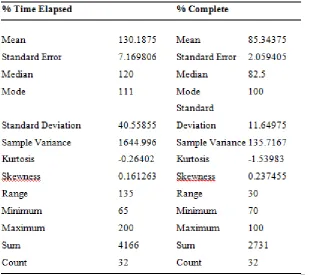
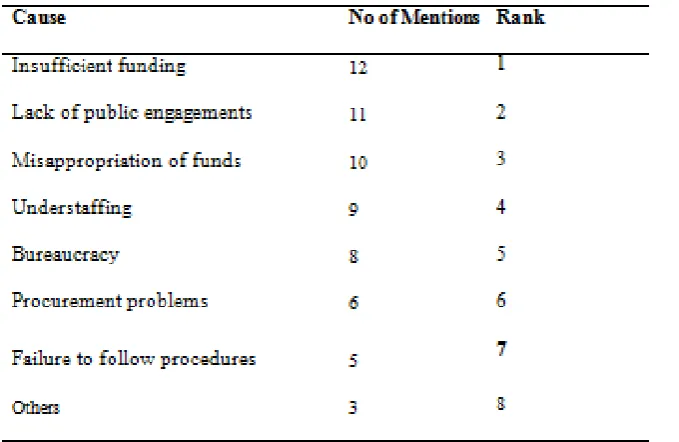
Abstract- There are a good number of construction projects at different stages of implementation in Trans-Nzoia County; Kenya. However, there are conflicting views on the schedule performance of most of the projects with some stakeholders especially the intended users arguing that they are delayed while the implementers believe that they are on course. Although schedule delays are common features in all construction projects the identification of the main causes of schedule delays and the implementation of actions that prevent these delays are fundamental steps for resolving delay related issues. This research aimed to achieve the following four objectives; to examine the role of resource allocation on timely completion of public construction projects, to find out the role of project leadership on timely completion of public construction projects, to establish the effects of project planning on timely completion of public construction projects and to determine the effects of project monitoring on timely completion of public construction projects in Trans Nzoia County. This research was significant because the knowledge that will be generated from it will assist in informing policy formulation by relevant authorities in project planning process and implementation. T he research was guided by the following theories; contingency theory, general systems theory, the ADKAR model and the utility theory. This research used survey research with a sample of 32 projects drawn from a list of 85 projects that were being undertaken by the county government or that had already been implemented over the last four years of the first county government. Upon completion of the data collection exercise, all completed research instruments were assembled, coded, summarized, entered into the computer; and analyzed using the statistical package for social science (SPSS). Both descriptive and inferential statistics were used for analysis. Qualitative data was analysed using content analysis. Multiple regression analysis was used to determine whether independent variables can be used to test the relationship between the variables of the study. The study shows that 6% of the surveyed projects had time overruns of over 200% while most of the projects (81%) had time overruns of between 100 and 200%. Only 13 percent of the projects were completed before the projected time. Most respondents mentioned insufficient funding (12) as a major hindrance to timely project completion. This was followed closely by mention of lack of public engagements represented by 11 respondents as a factor causing delay in project completion. Misappropriation of funds at 10 mentions attracted more passionate explanations together with lack of public engagement. The study determined that project monitoring and timely project completion were highly correlated (r = 0.942), (P < 0.05). The study concludes that adequate resource allocation, strong project leadership and close project monitoring are essential elements in timely project delivery. The performance of public construction projects had a negative relationship with project planning. These results implied that performance of public construction projects may be low despite there being a very good project plan. The most significant predictor of whether a project will be completed in time is project monitoring according to the model developed by the study. Timely project completion is fairly better than the national average obtained by studies done by Munano (2012) and MOPW (2012). The study concluded that it is an improved performance going forward. This could be attributed to the devolution of functions to county government brought about by the constitution of Kenya 2010. From the conclusions arrived at, the following three recommendations were made. First, the county government should ensure adequate resource allocation for all the projects they are undertaking, develop and implement avenues for reporting corruption and be committed towards zero tolerance to corruption. Secondly, the county government should form agencies to deal with project implementation with responsibilities like those of agencies like KENHA. These agencies will ensure that there is professionalism in project implementation and reduce political interference, ensure that project planning is above board. Thirdly, the county government should provide adequate and factual information to the public about the progress and the expected impact of all the projects under implementation.
Index Terms- project, project management
I. INTRODUCTION
1.1. Background of the study
project can be viewed as a temporary endeavor to create a unique product, service or result (PMBoK 2013). Construction projects usually include the design and build of a new structure (Zwikael 2006). The project schedule is the tool that communicates what work needs to be performed, which resources of the organization will perform the work and the timeframes in which that work needs to be performed (PMBoK, 2013). According to Shi et al cited in Yang et al (2013) the concept of a delayed activity refers to delays in the completion of the activity in question; these delays may result from unanticipated extensions in activity duration and/or activity start times that are later than expected (Shi, et al 2001). Timely project completion is
the projected completion time as in the contract for the construction of the project (Munano, 2012). Trans Nzoia County is one of the 47 devolved units of governance created by the constitution of Kenya 2010.
A project is delayed because the critical activities of the project were delayed. A delayed critical activity implies that the completion of the activity has been delayed because the activity was started later than expected and/or because the activity required an unexpectedly extensive duration to complete. Therefore, the causes of project delays can be identified through an examination of the causes that produce these delayed start times or extended durations (Yang et al 2013). According to Menches and Hanna (2006) timely completion is an important aspect in determining project success. However, public construction projects are frequently behind schedule due to various uncertainties. According to Al-saggat cited in Yang et al (2013) identifying the causes that affect the critical path and consequently the completion of a project is the most important aspect of delay analysis. In other words, although schedule delays are common features in all construction projects the identification of the main causes of schedule delays and the implementation of actions that prevent these delays are fundamental steps for resolving delay related issues.
According to PMI 2006 cited in Zwikael (2006) a project life cycle has five processes/phases a) the initiation is the phase of formally authorising a new project. b) Planning processes define and refine objectives and select the best of the alternative courses of action to attain the objectives that the project was undertaken to address. c) Executing processes that involve coordination of people and other resources (which can be seen to as project leadership and resource allocation functions), such as equipment and material, to carry out the plan in order to perform the project. d) Monitoring and controlling processes ensure the high-quality achievements of the project plan and updating it when necessary. e) Closing processes formalize acceptance of the project by its customers and other stakeholders and bring it to an orderly conclusion.
1.1.1. Global Factors Affecting Timely Project Completion
The building industry is important for both the developing and developed economies. It contributes 10% towards GDP for developed economies and more than 4% for the developing countries (Gwaya et al, 2014).Construction time has always been used as one of the benchmarks for assessing the performance of a project and the efficiency of an organization. There are severe criticisms of the industry when projects take far longer than planned (Jagboro & Ogunsemi, 2006). Chan and Kumaraswamy (1996) found out that seven eighths of the projects surveyed in Australia in the late 1960s were completed after schedule while in Hong Kong, 70% of the building projects were delayed. In Saudi Arabia Al-Khahil and Al-Ghafly (1999) observed that contractors agreed that 37% of all their projects were delayed while seven out of ten projects in Nigeria suffered delays during their execution (Jagboro & Ogunsemi, 2006).
In Jordan, Al-Momani identified the main causes of project delay as poor project design, change orders and weather. Change orders refer to design changes by the owner or his agent during the course of the construction. In Malaysia Yau et al identified improper planning, poor site management and inadequate contractor experience while in Hong Kong, Tung et al identified inadequate resources due to lack of capital, unforeseen ground conditions and exceptionally low bids as the major factors that cause project delay. Over several years, a great deal of attention around the world has been devoted to attempts to identify the potential causes of construction project delays and thereby facilitate the efforts of project management teams to address these possible delays. For instance, a previous study investigated the causes of delays in building projects in the United States by conducting a survey of architects, engineers, and contractors. From the survey results, weather, labor supply, and subcontractors were the primary causes of construction delays (Baldwin & Manthei, 1971) Many researchers have identified additional delay causes for various types of projects in different countries. All of the delay causes can be classified into two categories: universal causes, such as change orders ( Momani, 2000) and local causes, such as the effects of social and cultural factor (Assaf & Al-Hejji, 2006). A previous study concluded that improper planning, public interruptions, resource shortfalls caused by contractor issues or deficiencies in capital, setbacks during the preparation and approval of drawings, the financial difficulties of contractors, and change orders are the most severe delay causes in various countries (Long et al., 2008;Yang et al,
2013).
Improvement methods are necessary actions to minimize losses. Proper planning and payment of the contractor are the basic measures that can be put in place to avoid project delay. Mamon et al (2014) in their investigation on how to improve time performance in construction projects in Malaysia through a quantitative research targeting contractors identified, proper work planning, committed leadership and management, close monitoring sending clear and complete messages to workers and hiring skilled workers as the main improvement methods among the 13 that they identified.
1.1.2. Regional Factors Affecting Timely Project Completion
Kikwasi (2012) investigating the causes of delay and disruptions in construction projects in Tanzania, through questionnaire found that only 22%, 30% and 44% of the projects were completed on estimated time according to clients, consultants and contractors respectively while the maximum time overrun was 78%, 70% and 56% for clients, consultants and contractors respectively. Frimpong in his study on the causes of delay in construction of ground water projects in Ghana observes that monthly payment difficulties from agencies, poor contractor management and material procurement are the critical factors causing project delay, (Huang et al, 2012).
ongoing work and the delay of both critical activities and the completion of the construction project as a whole. Design changes is another cause of delay that he established that arises if the original scope of the work in a contract has been changed for example if the size and scope of a project have been expanded without allowances for extended scope (Yang
2013).
1.1.3. Local Factors Affecting Timely Project Completion
Kenya is a developing country still at the stage of providing infrastructures such as health, education, agriculture and administrative as well as living facilities for its rapidly growing population (Vision 2030, 2007; Gwaya et al, 2014). Munano (2012) did a study on factors that influence timeliness of project completion for public sector in Kenya. Of the sampled projects, completion time exceeded by a mean of 209.8% and the projects were at an average of 87.54% of completion. According to the study the project that had the minimum percentage elapsed was 91% while the maximum was 481%. This indicates that a project could take up to a maximum of five times the expected time.
The ministry of public works which is mandated to provide and maintain projects for the public sector (2012) gives 38.60% as the average percentage project completion rate for 2005-2011. The overall observations on the reasons for delayed delivery given earlier by the chief architect in the ministry include additional work, inadequate funding, delayed engagements of sub-contractors, delayed payment, to the contractor and slow decision making (MOPW, 2009). Msafiri (2015) in his study on factors causing delays in road construction projects in Kenya using a survey on consultants found out that the overall top causes of delay are; delayed payment by the client, slow decision making and bureaucracy in client organization, inadequate planning/scheduling and rain. Munano identifies inadequate resources, non-performance by the contractor and delayed payments as the major issues affecting project delivery in Kenya.
The county government of Trans Nzoia through the ministry of lands housing, physical planning and urban development lists the following as the challenges that is affecting timely project completion, i) litigation issues; ii) limited funding; iii) lack of comprehensive legislations to guide the housing sector; iv) slow adoption and application of Appropriate Building Technology (ABT); v) weak mainstreaming of monitoring and evaluation in projects implementation; vi) rapid rate of urbanization leading to proliferation of informal settlements; vii) high cost of housing inputs; viii) environmental degradation as a result of infrastructural development; ix) lack of maintenance culture in the built- environment; x) increasing landlessness in the county; xi) inadequate capacity of the county land office; xii) uncoordinated land administration between Nairobi headquarters, the county land office and offices at the sub county level (CIDP 2013-2017).
According to the report of the auditor-general on the financial operations of Trans Nzoia County Executive for the period 1 July 2013 to 30 June 2014 payments totaling over 140 million were made to various firms for bush clearing, heavy roads grading and other road maintenance in various county wards. However, the report concludes that in all cases, there were no documents to support how the firms were identified and the contract sums determined. In addition, the list of roads that were to be graded, road contract sums allocated to each contractor and the necessary supporting documents were not availed for audit review. This assertion points to corruption and incompetence on the part of the county officials in ensuring that projects are implemented in an effective and efficient environment for the benefit of the residents.
Vision 2030 envisions providing cost-effective world-class infrastructure facilities and services. Vision 2030 report points out that poor infrastructure was identified under ERS as a major constraint to doing business and a necessity to improving the livelihoods of people. Infrastructure is also important in improving our security. It therefore calls for a considerable shift in the manner in which Kenya deploys her resources to acquire the necessary capacity and access to infrastructure service s (transport, telecommunications, energy, water, sewerage and sanitation and meteorological services) by firms and citizens in their wealth-creation efforts.
NCA is established and mandated by the National Construction Authority Act 2011 to carry out among others the following roles: (a) Promote and stimulate the development, improvement and expansion of the construction industry; (b) Advise and make recommendations to the Minister on matters affecting or connected with the construction industry; (c) Undertake or commission research into any matter relating to the construction industry; (d) Prescribe the qualifications or other attributes required for registration as a contractor under this Act; (e) Provide consultancy and advisory services with respect to the construction industry; (f) Promote quality assurance in the construction industry; (f) Encourage the standardization and improvement of construction techniques and materials; (g) Initiate and maintain a construction industry information system; (h) Provide, promote, review and co-ordinate training programmes organized by public and private accredited training centers for skilled construction workers and construction site supervisors; (i) Accredit and register contractors and regulate their professional undertakings; and (l) Accredit and certify skilled construction workers and construction site supervisors (G.O.K., 2011).
regulator, corruption in the regulation process, lack of adequate sensitization about NCA rules and regulations, inadequate NCA capacity leading to poor enforcement of regulations, and Inadequate contractor capacity to ensure compliance to regulations. She also found out from NCA itself after interviewing its officials that the main challenges they face in registration and regulation of contractors were: inadequate capacity to detect errant behaviour in contractors by conducting frequent random surveys, inadequate NCA capacity leading to poor enforcement of regulations, lack of adequate sensitization about NCA rules and regulations, lack of prosecutorial powers, poor attitude towards the NCA as a government regulator, inadequate contractor capacity to ensure compliance to regulations, and inadequate use of ICT in the process of triggering timely inspection.
From her findings she recommends that; (a) NCA sets up fully equipped and staffed offices in all 47 counties to supplement the 10 regional offices currently in operation, (b) The NCA should conduct rigorous sensitization programs to educate contractors on the rationales for the NCA regulations and code of conduct and possible means of compliance, (c) The NCA should make proposals for the revision of the NCA Act in order to provide the Authority with prosecutorial power. (d) The NCA should come up with programs to fund upcoming contractors in order to enhance contractor capacity to comply with NCA regulations. What is evident is however that there have been failures from different sources and that a solution is required.
1.2. Statement of the Problem
There are a good number of construction projects in Trans Nzoia County at different stages of implementation (CIDP 2013-2017). For instance the county official website list the referral hospital and the construction of a modern bus park and modern parking bays as some of the ongoing flagship project for the county. There are however, conflicting views on the schedule performance of most of the projects with some stakeholders especially the intended users arguing that they are delayed while the implementers believe that they are on course (The Star, June 2016; The Standard, December 2014). According to Nixon citing Lim and Mohamed, for those involved with a project, project success is normally thought of as the achievement of some pre‐
determined project goal (Nixon et al 2012). Lim and Mohamed suggest that project success needs to be considered from the perspectives of stakeholders and they identified two perspectives: a macro perspective, which aggregates all stakeholders and a micro perspective, which considers only those directly involved with the execution of the project.
According to the county integrated development plan 2013-2017 the county has a total road network of 4,060.94 kilometers comprising of 154 kilometers of bitumen roads, 167.07 kilometers of gravel, and 786.37 kilometers earth roads and 2953.5 kilometers of rural access roads. The report continues to state that most of the roads are in poor condition and are usually impassable during the rainy season and therefore a major bottleneck to development in the County which is rich in agricultural produce (CIDP 2013-2017). The number of trading centres in the County is 169 with Kitale as the county headquarters and the main market centres being Kiminini, Kachibora, Endebess, Gitwamba, Maili Saba, Sikhendu, Mucharage, Sibanga, and Kesogon. The integrated plan notes that the development of markets and urban centres have led to an influx of people and increase in economic activities thereby leading to higher demand for facilities and services therefore exerting pressure on available facilities and space.
The court cases filed by the major public transport providers against the county government in 2015 against unlawful eviction from their former sites of operation without appropriate alternative is a pointer to an urgent need for fast tracking these projects (Business Daily, May 2015). In addition there is a significant growth in retail, estate, entertainment and lifestyle facilities, modern office parks and hotel space attributed to expansion of the middle class across the country (Deloitte, 2016). This therefore necessitates infrastructural development that matches the felt needs of this generation and future generations. There is an expected infrastructural growth that is currently not in place or requires to be hastened.
According to Kenya Economic Report (2014) infrastructure forms the bedrock of national growth and development and plays a critical role in determining the nations competitiveness. Vision 2030 (2007) observes that infrastructure is important in improving the livelihoods of people and security of the country. One of the goals for 2012 (Vision 2030, 2007) was improving efficiency and effectiveness of the infrastructure development process at all levels of planning, contracting and construction. In pursuit of this goal the strategy was to strengthen institutional framework and accelerate speed of project completion. Raising efficiency and quality of projects and increasing the pace of implementation of projects so that they are completed in specified time frames (Vision 2030, 2007). However, according to Muriungi (2011), various organizations have been crying foul over the many projects whose performances fall below target and scarce resources go down the drain. The number of projects that have so far proved defunct and futile ventures in relation to their objectives is terribly alarming (Munano, 2012; Muriungi, 2011). The purpose of this research therefore was to evaluate the factors affecting timely completion of public construction projects in Trans-Nzoia County and to propose actions that can be implemented to prevent and resolve delay related issues.
1.3. Research Objectives
The study was guided by the following objectives.
1.3.1. The General Objective
The overall objective of the study was to evaluate the factors affecting timely completion of public building projects in Trans Nzoia County.
1.3.2. Specific Objectives
b) To find out the role of project leadership on timely completion of public construction projects in Trans Nzoia County. c) To establish the role of project planning on timely completion of public construction projects in Trans Nzoia County. d) To establish the role of project monitoring on timely completion of public construction projects in Trans Nzoia County.
1.4. Justification of the Study
Delayed completion of a project has serious consequences including cost overruns and delayed use of the project which may lead to the project not meeting the set objectives. If the county fails to meet set objectives, realizing the strategic plan may not be possible which would eventually impact negatively on the vision, mission and core mandate. This would affect the service delivery to the residents thus violating their constitutional right to better and quality services. Further this research was important because the knowledge that was generated from it will assist in informing policy formulation by relevant authorities in project planning and implementation process.
1.5. Scope of the Study
The study was confined to construction projects implemented or in the process of implementation by Trans Nzoia County government in the last three years that the county governments have been in existence. The county covers an area of 2,496 Km2. The county has five constituencies namely Endebess, Cherangany, Saboti, Kwanza and Kiminini and 25 Wards (County Integrated Plan 2013-2017).
1.6. Limitations of the Study
Several respondents were unreliable in providing adequate information in time. Some could not return the questionnaire even after several follow ups. Some respondents provided inaccurate information especially when asked to state the expected date of completion and the percentage already complete for the project. The researcher later realize that some projects that were declared as complete or obtained a certain percentage of completion were not actually in that position. These problems were solved by giving the questionnaire to a more reliable person since what was sampled was the projects and not respondents themselves.
II. LITERATUREREVIEW
2.1. Introduction
This chapter reviews literature with particular attention to project schedule and project planning. The chapter has the following sections; conceptual framework/empirical review, critique of the existing literature relevant to the study, research gaps and summary.
2.2. Theoretical Framework
This study was guided by four management theories namely contingency theory, general systems theory, the ADKAR model and the utility theory.
2.2.1. Contingency Theory
Theory by Fred Edward Fiedler asserts that when managers make a decision, they must take into account all aspects of the current situation and act on those aspects key to the situation at hand. Each construction project is unique and with its own complexities and therefore should be managed according to its specific characteristics and environment in that particular period of time (Sawega 2015). The contingency theory recognizes this aspect and attempts to identify practices that best suit the unique demands of different projects. This theory rejects the idea of one best way to manage projects because of the varying management situations. According to Mutema (2013), contingency theory takes into account the interaction and interrelation between the organization and the environment.
This theory recognizes that there are a range of contextual variables also referred to as risk factors which influence the project objectives differently. Examples of these variables are: external environment, technology, organizational structure and size, cost, culture, people involved and strategy. Contingencies for both budgets and schedules provide the project manager with the estimating caution they need to protect their projects from cost and time overruns (PMI 2006). Effectively allocating these contingencies can help project managers control much of the projects uncertainties.
2.2.2. General Systems Theory
Theory by Bertalanffy Ludwig Von (1971) asserts that a system is a collection of parts unified to accomplish an overall goal. If one part of the system is removed, the nature of the system is changed as well. For example, a functioning car is a system if you remove the carburetor you no longer have a working car. A project can also be viewed as a system with inputs, processes and outputs. Any project success is dependent on the harmonious interaction of its parts and therefore the project team must be able to put this into perspective. Improvement methods by Memon et al (2013) indicates that failure of different parties to a project to work seamlessly leads to infighting that eventually derail the completion of a project.
2.2.3. The ADKAR Model of Change
ADKAR is an acronym for: A – Awareness of the need for change, D – Desire to support and participate in the change, K – Knowledge of how to change, A – Ability to implement the required skills and behaviors, R – Reinforcement to sustain change. All the five elements of the ADKAR model are sequential. When bringing about change it is important that everyone understands the need for change because the natural reaction of employees or project team to change is to resist. The precondition for implementing change is sound and extensive knowledge, learning new skills and steering towards a different behavior. After change has been implemented it is important that this change is sustained in order to prevent a lapse into the former behavior. Project management institute (PMI, 2012) states that 73% of the organizations using project management use change management. Successful project management largely depends on the ability of the project team to manage change (Hornstein, 2010). Projects do not only generate change but also can be used to formally manage change (Fieldler 2010, Lundy and Morin 2013).
2.2.4. Utility Theory
Utility is a measure of desirability or satisfaction; a degree of satisfaction or welfare coming from an economic activity. Value of a project depends on its utility while utility depends on the specific circumstances of the stakeholders. The criteria of projects success should include longer term aspects of the project outcome such as its impact. Utility theory should therefore be considered as an important element in the definition of project lead time (Al- Carlos, 2014). According to PMI (2006) the project manager can use a utility- based approach to develop a long-range contingency allocation plan, an approach informed by the relationship between expected utility and the challenges in allocating a project‟s cost and time contingencies. This relates utility theory to contingency allocation to improve performance. Delay in project completion impacts negatively to the expected users in that it denies them the utility they would have had from the project were it complete on time.
2.3. Conceptual Framework
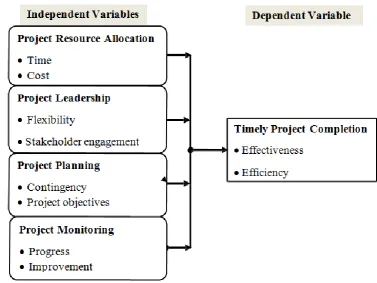
[image:6.596.82.460.382.665.2]According to Mugenda & Mugenda (2003) cited in Sawega (2014), a conceptual framework is a diagrammatical representation of hypothesized relationship between independent and dependent variables of the study. From the literature reviewed project resource allocation, project leadership, project planning and project monitoring are the independent variables that make project timeliness more likely while the dependent variable was timely project completion.
Figure 2. 1 The Conceptual Framework
2.4. Review of Variables
This section will review each of the four independent variables and demonstrate how they influence timely project completion.
2.4.1. Project Resource Allocation
2010; Conchuir 2011). It involves estimating the type and quantities of material, human resources and equipments required to perform each activity. Wrong resource estimation is hypothesized to affect negatively project schedule because the duration estimation depends in a big way on availability and correct estimation of resources. This in effect affects timely project completion. These estimates have to be as accurate as possible.
The Machakos 33km Road is a good example to illustrate the importance of efficient resource allocation and utilization. The road that was built by the county government of Machakos is a critical linkage cutting across the county and joining Garissa Road to Machakos-Kitui Road. The road was built in a record three months, from 18th March, 2014 to 18th June, 2014. The original cost estimate by KENHA which is the agency that deals with national highways was 1.6 billion. However, the road was constructed for 650 million (Standard July, 2014). The project was completed three days before schedule and had road signage, street lights, and CCTV cameras covering its entire length (The Star June, 2014; Standard July, 2014). This must be a result of proper planning, focused leadership and adequate resource allocation.
The road has opened Machakos for engagement with other counties and eased the problem of transportation in the county (Standard July, 2014). There are several concerns however that the road was substandard and was already peeling off three wee ks after commissioning. This has been difficult to verify because of the political overtones that have surrounded the project after completion. In addition there is no authoritative report or publication from a formal evaluation that justifies the project as a failure. It can also be argued that a tarmacked road cannot be compared with one that is undone.
A sufficiently well allocated resource is one of the success factors of a project (Fortune & White, 2006 cited in Ballard, 2014). There is a problem of scarce resources and therefore, a combination of resource utilization for competitive advantage and minimization of costs of resource requirements in projects subject to fixed completion time is necessary. According to Feng et al (2000), traditional time-cost trade-off analysis assumes that the time and cost of an option within an activity are deterministic. However, in reality the time and cost are uncertain. Therefore, in analysing the time-cost trade-off problem, uncertainties should be considered when minimizing project duration or cost.
According to Piet Joubert (2010 cited in Yatich, 2016), resources are the means we use to achieve project objectives. The primary resource is people with applicable skills and competencies. The other main grouping of resources includes capital, facilities, equipment, material and information. In order to ensure a cost effective application of required resources a proper needs analysis in order to define the project goals and objectives needs to be done. The project’s baseline that must be resourced will be known after a requirement specification has been completed. The WBS is the base document for determining resource requirements. The requirement specification will spell out the real requirements to achieve through the project.
PMI (2013) explain the resource requirements using the following processes; plan cost management which is the process that establishes the policies, procedures, and documentation for planning, managing, expending, and controlling project costs to provide guidance and direction on how the project costs will be managed throughout the project, resource estimation which is a structured prediction of the cost and other resources required to execute a task to establish a control basis, budgeting which is the process of aggregating the estimated costs of individual activities or work packages to establish an authorized cost baseline against which project performance can be monitored and controlled and costs control which is the process of monitoring the status of the project to update the project costs and managing changes to the cost baseline to provides the means to recognize variance from the plan in order to take corrective action and minimize risk.Therefore the more accurate the estimation, the more reliable the control system becomes.
Yatich (2016) citing Talbot (1982) identifies resource acquisition as another process which refers to the process of physically securing the necessary inputs. All resources required have to be paid for. The resources which may be required in a project include those which are limited on a period-to-period basis such as skilled labour, as well as money, which are consumed and constrained over the life of the project. At the planning stage the user of resource-constrained project scheduling with time-resource trade-offs approach is permitted to identify several alternative ways of accomplishing each job in the project. The financing of a project therefore plays an essential role in the acquisition process. The acquisition process must be managed properly to take care of possible seasonal shortages, labour disputes, equipment breakdowns, competing demands, delayed deliveries and other things that may go wrong. The project plan may have to be modified to accommodate or work around supply problems. The same analysis appears to point to resource leveling as another important aspect which ensures resource demand does not exceed resource availability and vice versa. If you are forced to reschedule a task on the critical path it would influence the completion dates of successive tasks.
2.4.2. Project Leadership
According to Müller and Turner (2010) leadership competency profiles and stakeholder management (Turner and Müller, 2004) are important success factor in project management. Kalsen et al (2014) suggested how project managers can influence and encourage team members in order to achieve successful results. They based their argument on positive psychology theory that is an optimistic human vision. They listed use of signature strength, positive meaning, positive emotions and positive relations to create positive results. The project manager leads and influences his/her employees by influencing their thought, meaning and self-talk. A culture is required where everyone uses their competence and resources to maximize project performance rather than trying to advocate for own interest in the project. This can be done by promoting appealing project visions, goals and milestones.
completed in July 27, 2011. It was however, completed in November 2012 at a cost of Ksh 31 billion (Business Review Nov, 2012). The cost increased by 35% (KARA, 2012) and the reasons for increased costs were given as; increased cost of construction materials, inflation and additional features that changed the design work. Although with various misgivings the project has been hailed as a success with many positive impacts. It has eased traffic congestion and frequent road accidents and also reduced time of travel between Nairobi and Thika. The road connects Nairobi to Marsabit, Isiolo, Moyale and Mandera; primary commercial centres of Kenya (AfDB, 2012). The road has also opened up urban areas along the stretch to unprecedented growth (KARA 2012).The road was a project with great importance to the political leaders of the time and the residents in and around Nairobi and therefore enjoyed goodwill from the leadership.
Ballard et al (2014) using three case studies found that use of an adaptive management approach may lead to successful results. They observed that aligned governance and the adopted contract strategy serves as a foundation for project execution. A good interaction created both inside the project, among partners and with the external stakeholders is a success factor. External stakeholders include the local community and the national government. Meetings by stakeholders and discussions in the local community creates trust and secure commitment and acceptance from local decision makers. In addition well developed governance and procedures as well as proven tools that includes project tools and risk management are important for successful accomplishment of project tasks. Muller (2012) observe that project governance is the most important environmental factor impacting the effectiveness of the applied project management approach while stakeholder management and change management are impacted most by environmental factors.
Lundy and Morin (2013) citing Pinto et al (1998) contend that numerous authors have considered leadership skills to be essential to project success and adds that successful transformation is 70% to 90% leadership and only 10% to 30% management. The International Project Management Association (IPMA) specifically addresses leadership as one of 46 competencies seen as instrumental to project managers’ success (ICB-IPMA, 2006; PMI, 2007; Lundy and Morin 2013).
According to Nixon et al (2012), in considering the effect of leadership performance on the success or failure of a project observes that it is important to understand the differences between project management and project leadership. Citing Anantatmula (2010) he suggests that project management refers to the planning and organizing of project activities, through decision‐making processes that improve the efficiency and effectiveness of a project. Leadership, conversely, is about guiding others towards the attainment of project objectives, motivating and guiding people to realize their potential and achieve tougher and challenging organizational goals. Successful leadership convinces people of the need to change, stimulates new ways of thinking and problem solving, and then encourages them to work together in order to accomplish project objectives in difficult work environments (Keller, 1992; Anantatmula, 2010; Nixon et al 2012).
Traditionally, it was believed that leaders were born based on the great man theory however in modern times this theory has been discarded. There are different schools of leadership theory in which transformational leadership can be found amongst the most contemporary perspectives (Keegan and Den Hartog, 2004; Turner and Müller, 2005). Transformational leadership has been defined by the ability of the leader to create a shared vision and a strong identification with team members that is based on more than just rewarding completion of project activities (Bass, 1985; Keegan and Den Hartog, 2004). Through this shared vision, the transformational leader is then able to mobilize commitment and improve the performance of both the individual and the project as a whole. Such leaders are said to show charisma, as a means of motivating others to integrate into the collective vision, and a strong consideration of and support for individual team member needs (Keegan and Den Hartog, 2004). Developing connections between the leader and individual team members is also thought to help individuals achieve their full potential
2.4.3. Project Planning
Planning is an institutionalized activity comprising of a series of predetermined and coordinated actions and processes for carrying out operations for the identification, preparation, appraisal and implementation of projects (Nyandomo and Kongere, 2010). The PMBoK Guide identifies five processes in the project’s life cycle (PMI 2004, cited in Zwikael 2009). The processes are the initiation phase that formally authorizes a new project; planning that define and refine objectives and select the best course of action to attain project objectives; executing that coordinate people and other resources to carry out the plan; monitoring and controlling that ensures high-quality achievements of the project plan and closing that formalizes acceptance of the project by its customers and other stakeholders and bring the project to an orderly conclusion. Project planning is the establishment of a set of directions in sufficient detail to tell the project team exactly what must be done, and what resources to use in order to produce the deliverables of the project successfully (Meredith and Mantel 2006). The major benefits of planning are to eliminate or reduce uncertainty, improve efficiency, obtain better understanding of project objectives and to provide basis for monitoring and controlling of work (Kerzner 2006).
London Olympic Games 2012 is a good example to illustrate the impacts of good project planning. The London Olympic Games project was intended to develop infrastructure for the Olympic Games scheduled in August, 2012 in London. Olympic Games is an example of a megaproject which is time critical in that it has a definite day to finish and cannot be delayed. Without counting the bidding process the project took seven years to plan and execute (Al-Carlos, 2013). The initial budget was £ 2.4 billion but shot to about £11 billion (Committee of Public Accounts UK, 2011). This was after recalculations and consideration of contingencies (Boykoff, 2012). The infrastructure was ready one year before the beginning of the games. The ninth report of the session 2006-2007, House of commons 2007, observes that there was strong governance and delivering structures, clearly and effectively managed budget, effective procurement practices, planning, effective progress monitoring and risk management (Munano 2012)
networks which indicate various activities in their proper order of implementation and therefore provide a clear picture of the relationships between the activities. The networks also indicate how the time schedule will affect the system behavior.
According to Wolf (1985) the Critical Path Method (CPM) is one of the major techniques for dealing with project scheduling. It uses schematic diagrams to represent the sequence and the interrelationships of the project activities. It is possible to analyze the completion time of each activity and to determine its effects on the completion of the overall project and the relevant project cost (PMI, 2010; Wolf et al 1985). This information can be used to achieve optimal time/cost allocations. The CPM assumes that the activity times and costs are deterministic, that is, they can be reliably predicted without significant uncertainty. Huang et al (2008) believes that the Program Evaluation and Review Technique (PERT) is a more useful method for project planning under uncertainty than the CPM because PERT uses probabilistic time estimates, which require three time estimates of the duration of each activity from people who are most conversant with the activity at hand (Wolf et al, 1985; PMI, 2010).
The Project Management Institute (2010) observes that the optimal critical path time can be reduced by crashing the network, that is, one or more activities can be performed in less time, but normally at a higher cost (also known as fast tracking). The additional cost can be estimated and used to decide whether, and/or how a project should be crashed. Critical planning process is a key factor that significantly improves project success. Zwikael and Globerson (2006) cited in Zwikael (2009) identified six planning processes that highly contribute to project success as: definition of activities to be performed, schedule development, organizational planning, staff acquisition, communications and development of a project plan.
According to Thiruvengadam, (2004), the fast-tracking delivery method has received considerable attention over the last decade, and its time saving feature has placed it as a possible alternative to the traditional more sequential method. Along with its benefits, however, fast-tracking also has greater potential to impact the project development process than the traditional method. This is usually attributed to the increased level of uncertainty and research on fast-tracking has mainly focused on uncertainty reduction. A closer observations of the project development process suggest that to effectively handle uncertainty and minimize the negative impact of fast tracking, the feedback processes involved in fast-tracking need to be identified, and the dynamic behaviour of construction resulting from those feedback processes needs to be dealt with in a systematic manner.
2.4.4. Project Monitoring
The project manager must regularly ensure that the planned work is proceeding according to schedule. The purpose here is to ensure that the project is being implemented as planned and acting to resolve problems. The Gantt chart and the schedule network are updated continually (PMI 2010, Conchuir 2011). Performance measurement is a basic requirement for tracking cost, time and quality of a project (Yang et al 2010). Narbaev (2013) citing Pewdum et al. (2009) observes that the primary purpose of managing a facility construction project is to complete it on time and within the budget while conforming to the established requirements and specifications (Pewdum et al., 2009). To achieve that objective he argues, substantial effort on managing the constr uction process must be provided and could not be done without an effective performance monitoring system. No matter how perfect the construction project plan is, if no regular and timely reviews are performed during the project execution, neither the project progress nor the effectiveness of the plan can be evaluated (Cleland and Ireland, 2007; Narbaev 2013). Project monitoring allows to determine what has happened and to foresee what may happen in the future if previous performance is expected to continue or if there are no changes in the management of a project. There are three metrics that any project team tries to keep on track: cost, time, and scope of work. Monitoring compares actual to planned performance and take preventive and corrective actions based on the finding. Late corrections are ineffective and can cause cost and time overrun (Narbaev 2013).
Earned value management is a powerful quantitative technique for objectively monitoring the physical project progress. It enables the actual work performance to be compared with the agreed plan (PMI 2005). It can therefore be argued that any project with a significant time overrun misses the steps early in the project implementation but the project manager does not realize it until it is too late. When the problem is realized too late in the day the ability to recover the project to achieve its planned objectives is already diminished (Alvarado et al, 2004).
The key practice of EVM includes two steps: first, establishing a performance measurement baseline (PMB) and, second, measuring and analyzing a projects performance against the PMB. Steps to effectively build a PMB includes decomposition of work scope to a manageable level, assigning responsibilities, developing a time-phased budget for each work task, and maintaining PMB integrity throughout the project. Performance measurement and analysis comprises recording resource usage during the project execution, objectively measuring the actual physical work progress, analyzing and forecasting cost/schedule performance, reporting performance problems, and taking corrective actions (PMI, 2011).
Though universally accepted as a benchmark for cost and time estimates at completion these two fundamental formulae have been largely reviewed and criticized with regard to CPI accuracy and SV and SPI reliability respectively. The problem with schedule relates not only to TEAC itself, but also to its determinants: SV and SPI. In general, EVM method has one mental hurdle: defining these schedule indicators not in units of time but in units of currency, e.g. dollar. EVM is not directly connected to schedule; as far as these schedule indicators are in units of currency there is no way to evaluate the project progress thus leading to false conclusions with regard to schedule performance assessment. This lack of EVM can be seen when there are some activities that may be accomplished out of sequence. Some activities which have less value but critical can be behind schedule while more costly tasks are completed ahead of schedule (Lipke, 2005; Russell, 2008). Thus, both measures are entirely associated with cost performance only and no time constraint is taken into account as it relates to the execution of a project in a chronological sequence (Howes, 2000).
The other defect to schedule assessment is that as far as a project progresses to its end the SV tends to 0 and the SPI to 1 even if the project is behind schedule meaning the project is on time without delay even if there is a delay. At some point to a project completion both SV and SPI lose their management value in most projects regardless nature and structure. These indicators are only useful when a project is from15 to 20 percent complete until 60-70 percent. Thus, to overcome these two weaknesses an extension to the EVM theory, named earned schedule (ES) was created by Lipke (2003). The ES method is based on two new variables: actual time (AT) and ES. Here, ES is determined by comparing BCWP to BCWS, and the value of ES is determined by projecting BCWP at a certain point in time (AT) to BCWS curve which represents ES: a point in time when the current BCWP should actually have been achieved. This point can be before or after AT depending on whether a project is ahead or behind schedule. Then, the technique renames the two traditional SV and SPI into SV ($) and SPI ($) that is clearly in units of currency. The uniqueness of the ES concept is that both SV (t) and SPI (t) behave suitably reasonable throughout the project life. Respectively, ES and TEAC (t) are defined as per equations (3) and (4):
where C is the number of whole time increments of the PMB for which
BCWP≥ BCWS:
2.4.5. Timely project Completion
Timely project completion is the projected completion time as in the contract for the construction of the project (Munano, 2012). Construction time has always been used as a benchmark for assessing the performance of a project and the efficiency of the implementing organization. It is very important to the stakeholders especially the users because they are waiting to use the product as soon as possible. Timely completion therefore as observed earlier in this study is a success factor. Project success is a term that has elicited enormous research with differing views on various aspects of it. Its definition has changed over the years for instance in the 1960s, project success was measured in technical terms. However later, project success was stated in terms of meeting the following objectives: completed within planned time, planned budget and the required quality level (Kerzner 1998 cited in Gwaya et al, 2014). According to Gwaya (2014) all the three objectives are internal to the project and do not necessarily indicate the preference of the client. After the TQM, a project was considered to be a success by not only meeting the above three objectives but also making sure that the project is accepted by the client. For a project to be said to be a success therefore, it needs to be completed on a schedule that is satisfactory to the client.
According to Conchuir (2011) there are six key time management processes, five of which are in the planning process group and one in the monitoring and controlling (PMI 2010).The first process is to identify each activity that has to be carried out, then base the time estimates on these components of work. This helps to communicate with the stakeholders objectively, to ensure that all activities are included and to bring understanding of what has to be done. Once the activities have been defined, the next step is to define their order. This uses the complete list of activities together with enough detail about each to work out relationships between them. Sequencing process sorts the various activities into the order in which they will be implemented (PMI, 2010; Conchuir, 2011). Failure to follow the sequence may be too costly. The major tools and techniques used at this level are the schedule network diagrams like the CPM diagrams.
The fourth step is to determine which resources in terms of labour, equipment; facilities etc are needed for each activity (PMI, 2010; Conchuir 2011). These estimates have to be as accurate as possible. This process uses various tools and techniques according to the Project Management Institute that includes bottom-up estimating and use of the project management software. Once all the activity durations and their sequence have been determined they are used to create the project schedule (order) (PMI, 2010, Conchuir, 2011). This tells us when every activity will take place. The Project Management Institute list schedule network analysis as one of the tools and techniques to develop schedule. The project manager must regularly control that the planned work is proceeding according to schedule. The purpose here is to ensure that the project is being implemented as planned and acting to resolve problems.
2.5. Critique of the Existing Literature Relevant to the Study
In previous studies researchers have identified various causes of schedule delay among them, improper planning and inadequate resource allocation due to lack of capital (Huang, 2013). Improvement methods identified include proper work planning, committed leadership and management and close monitoring. However, the analysis of each cause and determination of ways to prevent them has been missing in the literature. The literature has also identified an extensive list of causes of project delay however, what seems missing is the assessment of projects based on the urgency of the project. Urgently required projects require greater attention because their delayed delivery has greater ramifications to the stakeholders. There is also a failure to consider circumstances that projects operate in when determining causes of project delay. In addition, most of the traditional publications on project management present approaches to project management that in some cases are stretched to the limit or are deemed ineffective (Al- Carlos 2014).
Project schedule performance is one of the major factors that have been used to determine project success. Difficulties occur when we try to identify which schedule is being referred to: the initial schedule approved in the initial plan or the modified schedule as approved by the client or owner as the project progresses through its life cycle (Thomas et al 2008). Schedule performance of construction projects undertaken by Trans Nzoia County government have seldom been assessed by research. To the extent that the above statement is true, the role of schedule performance has been given less importance than it ought to.
2.6. Research Gaps
According to Menches and Hanna (2006) schedule performance is an important aspect in determining project success, however there has been little research done on schedule performance of construction project in Trans Nzoia County. In addition, most of the traditional publications on project management present approaches to project management that in some cases are stretched to the limit or are deemed ineffective (Al-Carlos 2014). It is important therefore to look for adaptive project management approaches that best fit our unique environment.
2.7. Summary
The reviewed literature examined the various business and project management theories that support the conceptualized variables. The review identified project resource allocation, project leadership, project planning and monitoring as the main variables affecting timely project completion. Critique of the relevant literature observed that schedule performance of construction projects undertaken by Trans Nzoia County government has been given less importance than it ought to.
III. RESEARCHMETHODOLOGY
3.1. Introduction
This chapter of the study covers the methodology that was applied in carrying out the research project. The chapter is structured within the following topics: research design, target population, sampling frame, sampling design, instruments, data collection procedures, pilot testing and finally concludes with data processing and analysis.
3.2. Research Design
This research used survey research design. Survey research design is appropriate when the target population is large (Kothari, 2004) like in this case where the target population is the entire construction projects being undertaken by the county government of Trans Nzoia. The reason for this being to save on cost and increase accuracy since the researcher will have a better control of data collection errors (Mugenda and Mugenda2003). Survey research uses questionnaires or interviews to collect data from a sample that has been selected to represent a population to which findings can be generalized (Kothari, 2004).
3.3. Target Population
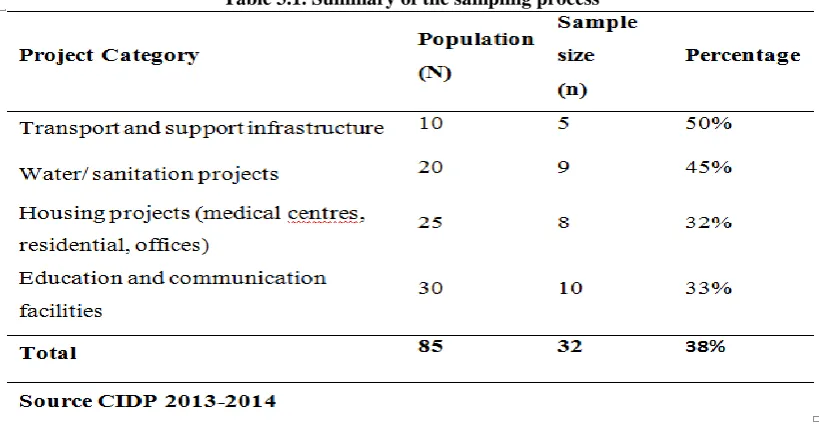
According to Kenya Institute of Management (2009), target population defines all the subjects in the research study. For the purpose of this research the target population was 10 construction projects in transport and support infrastructure,
20 in water/ sanitation projects, 25 housing projects (medical centres, residential offices) and 30 education and communication facilities (County Integrated Plan 2013-2017).
3.4. Sampling Frame
projects drawn from a list of projects being undertaken by the county government or that has already been implemented over the last three years (County Integrated plan 2013-2017).
3.5. Sample and Sampling Techniques
Sampling design describes a case where a representative sample is drawn from the entire population where the elements can be generalized (Kothari, 2004). Random sampling to pick projects from the list of 85 was employed. Random sampling ensures that each member of the population has the same chance of being included in the sample KIM (2009). Convenience sampling was used to determine the respondents’ list, meaning the respondents who have the best knowledge of the research subject. This was repeated until saturation is achieved. This will enable the research to answer questions that meet the objectives of the study.
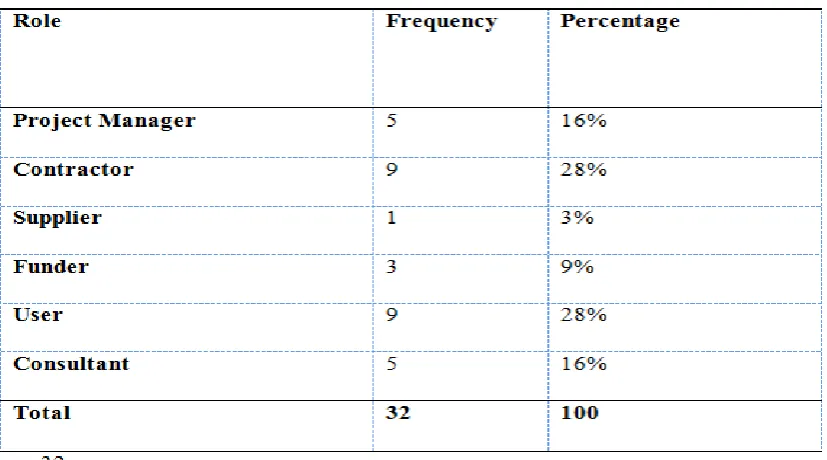
[image:12.596.92.502.230.444.2]According to Mugenda and Mugenda (2003) 10% is a sizeable representation of the population but since 10% 0f this population is too small and would therefore not result into an unbiased estimate, the researcher undertook to interview 32 respondents such that 𝑛 ≥ 30.
Table 3.1. Summary of the sampling process
After determining the sample size sampling was done by first serializing all the 85 projects and then subjecting the list to Microsoft Excel Version 2010 random sampling formula to pick the 32 numbers to represent the 85.
3.6. Data Collection Instruments
Interviews were conducted through questionnaires with various project stakeholders. The questionnaire documents were structured to facilitate easy and short answering of questions by the respondents and respondents were given enough time to give their feedback.
3.7. Data collection Procedures
Data collection was conducted in two steps. The first involved, as a requirement, that prior to actual data collection the researcher secure a letter of introduction from the university; stating the intention to carry out a study and requesting those concerned to give permission to conduct the approved research. The researcher then sought a permit to carry out the empirical research from the National Council for Science, Technology and Innovation (NACOSTI). The researcher then proceeded to inform the management of the ministry and the institutions about the intended research. Their authorization letters was collected by the researcher before administering the instruments.
The researcher self-administered the questionnaires to the respondents and conducted interviews with the assistance of trained research assistants. The data for the study was obtained from both primary and secondary sources. According to (Leed & Ormrod, 2005) data is said to be primary if it is collected firsthand by researcher for a determined purpose. The primary data was collected by use of semi-structured questionnaires that was administered to selected respondents. The respondents were expected to possess the requisite knowledge of the subject matter.
3.8. Pilot Testing
This refers to mini versions of a full-scale study as well as the specific pre- testing of a particular research instrument such as a questionnaire or interview schedule. Prior to using the questionnaire therefore, there was a pilot testing to refine it to ensure that respondents do not have problems answering and that there was no problems recording the data. According to Borg and Gall (2003), piloting of research instruments is important for validity and reliability tests of the instruments. For pilot purposes the questionnaire was administered to ten respondents.
3.8.1. Validity of the Research Instruments
A research instrument is said to be valid if it measures what it is supposed to measure (Borg and Gall 2003). The draft questionnaires were given to an expert in research to ascertain the items suitability in obtaining information according to research objectives of the study. This process assisted in eliminating any potential problems of the research instrument and to test the validity and workability of the instrument.
3.8.2. Reliability of the Research Instruments
Reliability of instruments concerns the degree to which a particular instrument gives similar results over a number of repeated trials (Mugenda and Mugenda, 2003). Pilot test was done to check the questionnaire structure and the sequence, meaning and ambiguity of questions. This was supplemented by Cronbachs alpha 0.7 which have been proven to give a more reliable score (Nunnaly, 1978 cited in Kiiru, 2015; Cooper and Schindler, 2008).
3.9. Data Processing and Analysis and the Regression Model
Upon completion of the data collection exercise, all completed research instruments were assembled, coded, summarized, entered into the computer; and analyzed using the statistical package for social science (SPSS). Both descriptive and inferential statistics were used for analysis. Descriptive statistics consisted of computation of sums, means, standard deviations, frequencies and percentages.
The analyses was further amplified by subjecting selected results to use of graphical and tabular techniques allowing some of the results to be presented in form of tabular matrices and pie/bar charts for clarity and to make it more visible and easy to interpret. Qualitative data was analysed using content analysis. This provided ways of discerning, examining, comparing and contrasting, and interpreting meaningful patterns or themes from data (Miles and Huberman, 1994 cited in Sawega, 2015). Meaningfulness was determined by the particular objectives of the research study. Qualitative approaches to data analysis tend to focus on the descriptive or theoretical aspects of the transcript data.
The study adopted factor analysis in order to reduce the number of indicators or factors under each research variable, retain the indicators capable of explaining the factors that affect timely completion of public projects in Trans- Nzoia County. Multiple regression analysis was used to determine whether the independent variables notably, X1 = project resources, X2 = project leadership, X3 = project planning and X4 project monitoring critically affects timely project completion. As a result, this subsection will examine whether the multiple regression equation could be used to explain the nature. Multiple regression model presented below was used to test on the relationship between the variables of the study:
Where:
Y -Timely Project Completion
β 0 -The constant
X1 -Project resources
X2 -Project leadership
X3 -Project planning β1, β2, β3 & β4 - Coefficients
X4 -Project monitoring
Ɛ -Error term
IV. RESEARCHFINDINGSANDDISCUSSION
4.1. Introduction
This chapter presents the results obtained from the findings of the research study. It includes the general information of the respondents that were targeted in the study. The presentation provides raw data first followed by discussions. Analysis was based on the research objectives and the independent variables. The data was analyzed and presented in frequencies and converted into percentages and thereafter presented into tabular forms to make it is easy to understand and interpret. The total number of questionnaires administered for the study was 32 and all of them were returned. Reasons that relate to the high return rate were that contact persons were appointed individuals of good repute and were reminded through their email addresses. In case one failed to return the questionnaire it was given to a more reliable person.
4.2 Bio Data of the Respondents
Finding out the general information of the respondents is very important because it enables the researcher to gauge the reliability and validity of the data received and to know the type of people that he/she is dealing with. This information includes years or period in operation.
4.2.1 Distribution by Gender
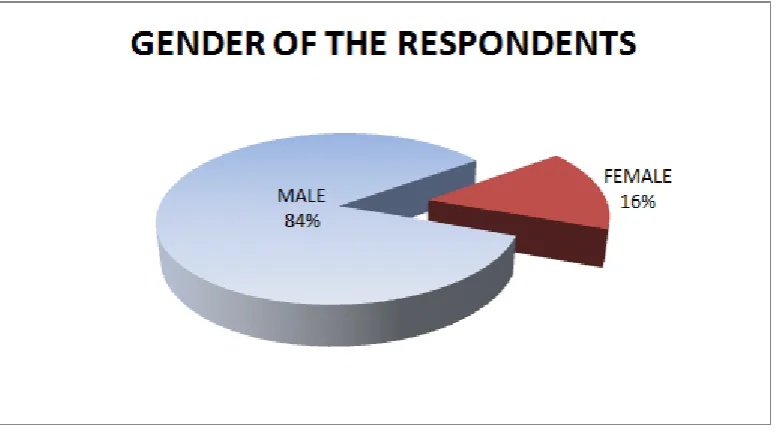
[image:14.596.43.435.267.486.2]The respondents were asked to state their gender to determine whether each gender is fairly represented in issues of project implementation.
Figure 4. 1 Gender of the Respondents
84% of those interviewed were male with only 16% were female. This was even made worse by the fact that not a single woman was involved as a contractor in the projects that were sampled. This is despite the fact that at least one thirds of any gender should be involved in all government activities as provided for in the constitution of Kenya 2010.
4.2.2 Distribution by Age
The researcher found that it was important to collect data on the age of the respondents. Age plays a critical role in understanding how people of different ages view the implementation of projects, to a larger extent an older employee is more experienced and is likely to relate issues more directly than relatively younger employees, while the younger employees are perceived to be more receptive to new technologies in the work place. It was also meant to determine whether the respondents were young, mature or old.