www.ijsrp.org
Performance Analysis of MANET with Low Bandwidth
Estimation
DharamVir*, Dr. S.K. Agarwal**, Dr. S.A.Imam***
* Department of Electronics Engg , YMCA University of Science & Technology, Faridabad, India **Department of Electronics Engg , YMCA University of Science & Technology, Faridabad, India
*** Department of Electronics & Comm. Engg, JamiaMilliaIslamia, New Delhi, India.
Abstract- A Mobile Ad-hoc network (MANET) is a self-organizing and adaptive in environment. A MANET consists of a set of mobile nodes that have to collaborate, interact and communicate to complete an assigned operation. These applications have need of Quality of Service (QoS) parameters such as: minimum hop path, minimum transmitted energy path, residual energy, bandwidth, throughput and power to be adequate so that a reliable and trustful connection between participating nodes is maintained. The proposed work on the performance analysis of low bandwidth and power constraints of nodes, being used in the mobile ad hoc network and design its basic structure and evaluates the outcome of same; on a designed simulator in MATLAB-7.0 and studies its performance on various inputs, like as number of nodes, transmission range, transmission radius of each node throughput and number of iterations. Simulation results show that the number of hop-counts decreases as we increase the percentage of low down bandwidth nodes in the network, it was also concluded that the throughput rate decreases as we increases the number of low down bandwidth nodes in the network.
Index Terms- Ad-hoc Network, Bandwidth, Battery Power Transmission range, Matlab 7.0
I. INTRODUCTION
he bandwidth estimation is a basic function that is required to provide QoS in Mobile Ad-hoc Networks [1]. It is a way to determine the data rate accessible on a network path. It is of curiosity to users wishing to optimize end-to-end transport performance, overlay network routing, and peer-to-peer file distribution [2].
Techniques for accurate bandwidth estimation are also necessary for traffic engineering and capacity development support. Because of an Ad-Hoc network is a collection of wireless mobile hosts forming a temporary network without aid of any centralized administration. Mobile Ad- Hoc Networks has a new structure in the field of wireless Communication network. They do not require any fixed infrastructure for instance a base station to work. The nodes themselves address topology changes due to the mobility, the entrance or the exits of nodes. These networks use a radio medium. The technology gives the user a freedom to move freely any were in the communication range and it has become independent of its infrastructure [6] [15]. This freedom from existing infrastructure has made Mobile Ad-Hoc Networks more flexible, affordable and easily deployable in all environments including military and rescue operations. There are two types of mobile network namely Mobile IP and MANET.
MANET consists of nodes that are cable to communicate wirelessly among them. MANETs consist of a group of wireless mobile nodes which dynamically exchange data among themselves without the reliance on a fixed base station or a wired backbone network [3].
MANET nodes are typically differentiated by their limited power, processing, and memory resources as well as high degree of mobility. In MANETs, the wireless mobile nodes may dynamically enter in the network as well as leave the network. Because of the limited transmission range, minimum hop path, minimum transmitted energy path, minimum normalized residual energy used, minimum absolute residual energy used, bandwidth, throughput, hop-count and power to be adequate so that a reliable and trustful connection between participating nodes is maintained of wireless network nodes, multiple hops are generally required for a node to exchange information with any other node in the network [4]. Multi-path routing permits the formation of multiple paths between one source node and one destination node. We have used the means of simulation using MATLAB (7.0), a simulator is being designed in MATLAB 7.0. It gathers data about number of hop-count (number of nodes between source and destination for successful routes) and throughput rate (total number of packets received by the destination to the total number of packets send by source). The simulator uses dijkstra algorithm to implement shortest path routing. To evaluate the effectiveness of MANET for nodes having lower bandwidth, the nodes were made unreachable by assigning low bandwidth to a group of some specified percentage nodes in the network [5].The rest of the paper is organized as: the Section II contains the related work in Manet protocols. Section III. Literature review and bandwidth allocation algorithm for Manet and simulation and results in Section IV.Conclusion is in Section V.
II. RELATEDWORKINMANETPROTOCOLS
The key issue with ad-hoc networking is how to send a message from one node to another with no direct link. The nodes in the network are moving around randomly, and it is very difficult that which nodes are directly linked together. Same time topology of the network is constantly changing and it is very difficult for routing process. Another key issue is the problem of bandwidth allocation in wireless networks. Even if the progress is being made for high-speed wireless communications, such as the introduction of 3G and WLAN, bandwidth is still the major bottleneck in wireless networks due to the physical limitation of wireless media [3] [5]. This kind of system in my application
www.ijsrp.org
brings up the effective management of bandwidth which provides transmission range to transfer the packets of data between several nodes within the network.
III. BANDWIDTH ALLOCATION ALGORITHM FOR MANET A. Literature review
In an ad hoc network, a host’s available bandwidth refers to amount of bandwidth available to the node to send packets to the network. Bandwidth estimation can be done using various methods for example; bandwidth estimation in a cross-layer design of the routing and MAC layers and the available bandwidth is estimated in the MAC layer and is sent to the routing layer for admission control. Therefore, bandwidth estimation can be carried out in various network layers [1] [8]. All the information of MANET which include the History of ad hoc, wireless ad hoc, wireless mobile approaches and types of MANETs, and then they present more than 13 types of the routing Ad Hoc Networks protocols were proposed. They give description of routing protocols, analysis of individual characteristics and advantage and disadvantages to collect and compare, and present all the applications or the Possible Service of Ad Hoc Networks [8].
Present bandwidth estimation tools measure more than three related metrics: capacity, available bandwidth,hop count, throughput, and bulk transfer capacity etc. Currently available bandwidth estimation tools utilize a various strategies to measure these metrics.These issues of multipath routing in MANETs were particularly examined. They also discuss the application of multipath routing to support application constraints such as reliability, load-balancing, energy-conservation and QoS [7]. An improved mechanism was proposed to estimate the available bandwidth in IEEE based ad hoc networks. In 802.11-based ad hoc networks, few works deal with solutions for bandwidth estimation.In a distributed ad hoc network, a host’s available bandwidth cannot decided only by the unprocessed channel bandwidth, but also by its neighbour’s bandwidth usage and interference caused by other sources, each of which reduces a host’s available bandwidth for transmitting data. Therefore, applications cannot properly optimize their coding rate without knowledge of the status of the entire network [12] [13].
An incorporating QoS into routing, and introduce bandwidth estimation by propagating bandwidth information through “Hello” messages and. A cross-layer approach, including an adaptive feedback scheme and an admission scheme to give information to the application about the network position, are implemented. According to the simulations show that their QoS-aware routing protocol can improve packet delivery ratio greatly without impacting the overall end-to-end throughput, while also decreasing the packet delay and the energy consumption significantly [9] [14].
The problem in available bandwidth estimation was reorganize in IEEE 802.11 based ad hoc networks. According to them estimation accuracy is increased by improving the calculation accuracy of the prospect for two adjacent nodes idle period to overlap [10].
In a scattered ad hoc network, a host’s available bandwidth cannot decided only by the unprocessed channel bandwidth, but also by its neighbour’s bandwidth usage and interference caused
by other sources, each of which reduces a host’s available bandwidth for transmitting data. Therefore, applications cannot properly optimize their coding rate without awareness of the status of the entire network. The problem in available bandwidth estimation was reorganize in IEEE 802.11 based ad hoc networks [10]. According to them estimation precision is increased by improving the calculation accuracy of the prospect for two neighboring nodes inactive period to overlap.
B. Bandwidth constraints
The purpose of the MANET is to homogenize IP routing protocol functionality is appropriate for the wireless routing application within both dynamic and static topologies with raised dynamics because of node motion and other factors [11]:
• Dynamicity: Every host can randomly change position. The topology is generally unpredictable, and the network position is inaccurate.
• Non-centralization: There is no centralized organization in the network and, therefore, network possessions cannot be assigned in a predetermined approach.
• Radio properties: The wireless channel can suffer from multi-patheffects,fading and time variation, etc.
C.Bandwidth Estimation Methods
Estimating precise available bandwidth allows a node to make optimal decision before transmitting a packet in networks. It is therefore clear that the available bandwidth estimation enhances the QoS in wired and wireless Networks [15]. Measuring available bandwidth in ad hoc networks is challenging issue in MANET and calculating the residual bandwidth using the IEEE 802.11 MAC is still a challenging problem, because the bandwidth is shared among neighboring hosts, and an individual host has no knowledge about other neighboring hosts’ traffic status and battery power. Two methods for estimating bandwidth are used below [12]:
Intrusive Bandwidth Estimation Techniques
The intrusive approaches techniques are based on end-to-end probe packets to estimate the available bandwidth along the length of a path [13].
Passive Bandwidth Estimation Techniques
The passive approaches techniques uses local information on the used bandwidth and that may exchange this information via neighborhood broadcast [13].
IV. SIMULATIONANDRESULTS
A. Setup Parameters:
www.ijsrp.org
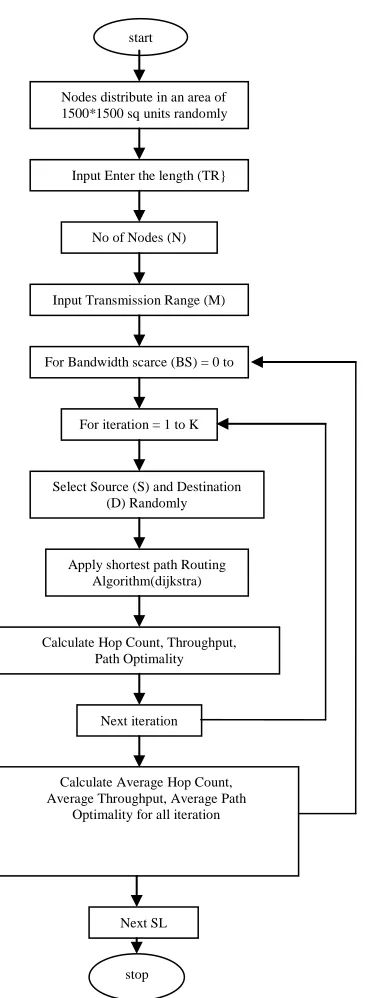
Fig. 1 Flow chart for design simulator
B. Simulation Model:
We have used a comprehensive simulation model based on MATLAB 7.0, for system protocol modeling. MATLAB is a high-performance language for technological computing. It integrates computation, visualization, and programming in an easy-to-use environment, where problems and solutions are expressed in familiar mathematical notation. Typical uses include math and computation algorithm development data acquisition modeling etc.
Table 1: Simulation set up parameters
Parameters Values
Area 1500*1500
Number of Nodes 50 Transmission Range (TR) 300m Nodes PlacementStrategy Random Numberofiteration 25 Percentage of nodes having low bandwidth
Varies from 0 to 100 percentage (with a interval of 10)
C. Snapshots:
[image:3.612.330.559.60.145.2]The figures mentioned below are the variety of outcomes which came during the simulation running process.
[image:3.612.324.567.188.514.2]Fig. 2 Snapshots of simulator producing input data.
Fig. 3 Number of minimum hop in a shortest path
Fig. 4 Snapshots of simulator producing output data. start
Nodes distribute in an area of 1500*1500 sq units randomly
No of Nodes (N)
Input Transmission Range (M)
For Bandwidth scarce (BS) = 0 to 100
For iteration = 1 to K Input Enter the length (TR}
Select Source (S) and Destination (D) Randomly
Apply shortest path Routing Algorithm(dijkstra)
Calculate Hop Count, Throughput, Path Optimality
Next iteration
Calculate Average Hop Count, Average Throughput, Average Path
Optimality for all iteration
for all iteration
Next SL
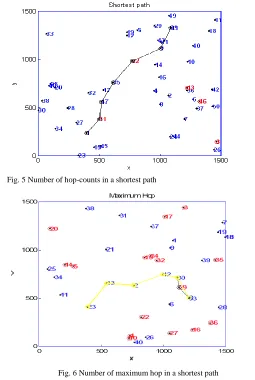
[image:3.612.325.567.533.688.2]www.ijsrp.org Fig. 5 Number of hop-counts in a shortest path
Fig. 6 Number of maximum hop in a shortest path
D. Impact of Low bandwidth on hop-count:
The Fig. 7 shows that as we gradually increases the percentage of low bandwidth nodes form 10 to 40number of nodes and than on going up to 100, then hop-count decreases; It shows that the routes which required more intermediate nodes are not forming in the network. Simply longer routes were not being established with the growth of low bandwidth nodes.
Bandwidth Vs Hop count
0 0.2 0.4 0.6 0.8 1 1.2
0 10 20 30 40 50 60 70 80 90 100
Number of Nodes
A
v
e
ra
g
e
H
o
p
c
o
u
n
t
[image:4.612.331.560.70.206.2]Bandwidth with out consideration Bandwidth with consideration
Fig. 7 Number of hop-counts in a shortest path
E. Impact of Low bandwidth on throughput:
Throughput of a network is the ratio of number of packets received by the destination to the total number of packets send by source. Here in this study as shown in Fig 8.
Throughput Vs number of nodes
0 1 2 3 4 5 6 7 8
0 20 40 60 80
100
Number of Nodes
Th
rou
gh
pu
t
Bandwidth with out consideration Bandwidth with consideration
Fig. 8 Number of hop-counts in a shortest path
The throughput rate is going to decrease from level of 50 nodes to the level 100 in proportionate to increasing percentage of low bandwidth nodes in the network and it reaches to level 0 with 100% low bandwidth nodes.
F. Impact of Low bandwidth on path optimality:
Path Optimality Vs number of nodes
0 0.2 0.4 0.6 0.8 1 1.2 1.4
0
10 20 30 40 50 60 70 80 90
100
Number of Nodes
Pa
th
o
p
ti
m
a
li
ty
[image:4.612.321.560.275.415.2]Bandwidth with out consideration Bandwidth with consideration
Fig. 9 Number of hop-counts in a shortest path
Fig. 9 shows the impact of simulation of path optimality of nodes path length on the percentage of packets dropped. There is no remarkable change in the percentage packet dropped in between 0 to 50, when the node concentration is up to 30. It reaches to a maximum value of nearly 60 nodes then the bandwidth decreased.
V. CONCLUSION
[image:4.612.55.280.539.671.2]www.ijsrp.org
throughput rate (total number of packets received by the destination to the total number of packets send by source). This information later on is being analyzed with nodes having normal/ideal bandwidth, for which comparative graph have been discussed above in the paper. There is almost 45% decrease in values of hop count, throughput, and path optimality in the varying number of nodes. In future, the scope for this paper can be found in designing routing protocols where bandwidth utilization of each node is required in advance.
ACKNOWLEDGMENT
The authors wish to acknowledge Varinder Singh and Vijay Kumar, YMCA University of Science & Technology, Faridabad, India, for its continual support to carry out this work.
REFERENCES
[1] Murthy, S. and J.J. Garcia-Luna-Aceves, “An Efficient Routing Protocol for Wireless Networks”, ACM Mobile Networks and App. J., Special Issue on Routing in Mobile Communication Network , Oct. 1996, pp. 183-97.
[2] L. Chen and W.B. Heinzelman, “QoS-Aware Routing Based on Bandwidth Estimation for Mobile Ad Hoc Networks,” IEEE J. Selected Areas in Comm., vol. 23, no. 3, pp. 561-572, Mar. 2005.
[3] C-K. Toh, “Minimum Total Power Routing in Ad-Hoc Mobile Computing, “Proceeding of the 1996 IEEE Fifteenth Annual International Phoenix Conference on Computers and Communication, pp, 480-486, March 1996. [4] Cheikh Sarr, Claude Chaudet, Guillaume Chelius amd Isabelle Gu´erin
Lassous, “A node-based available bandwidth evaluation in IEEE 802.11 ad hoc networks”, International Journal of Parallel, Emergent and Distributed Systems Vol. 00, No. 00, July 2005, 1–21.
[5] K. Mohideen Vahitha Banu, “Improving Ad Hoc Network Performances by Estimating Available Bandwidth”, (IJCSE) International Journal on Computer Science and Engineering, Vol. 02, No. 08, 2010, 2589-2592. [6] Stephen Mueller, Rose P. Tsang, and Dipak Ghosal, “Multipath Routing in
Mobile Ad Hoc Networks:Issues and Challenges”.
[7] Cheikh Sarr, Claude Chaudet, Guillaume Chelius, and Isabelle Gue´ rin Lassous, “Bandwidth Estimation for IEEE 802.11-Based ad Hoc Networks”, IEEE Transactions on Mobile Computing, Vol. 7, No. 10, October 2008.
[8] Lei Chen, Student Member, IEEE, and Wendi B. Heinzelman, Member, IEEE, “QoS-Aware Routing Based on Bandwidth Estimation for Mobile Ad Hoc Networks”, IEEE Journal on Selected Areas in Communications, Vol. 23, No. 3, March 2005.
[9] Deepak VidhateAnita Patil Supriya SarkarCommunications in Computer and Information Science, and , “Bandwidth Estimation Scheme for Mobile Adhoc Network”, Volume 70, 2010, DOI: 10.1007/978-3-642-12214-9_23, 130-135.
[10] J. Li, C. Blake, D. D. Couto, H. Lee, and R. Morris, “Capacity of ad hoc wireless networks,” in “Proc. 7th ACM Int. Conf. Mobile Comput. Netw. (MobiCom’01)”, 2001, pp. 61–69.
[11] Perkins, D., Hughes, H., Owens, C., 2002, “Factors effecting the Performance of Ad hoc Networks”, IEEE International Conference on Communications, IEEE Press, 2048-2052.
[12] Abdullah, J., Parish, D., 2007, “Impact of QoS Routing Metrics for MANETs in the Pervasive Computing Environment”; International Conference on Wireless and Optical Communications Networks 2007, 2-4 July, 1-5.
[13] Mayhew, G.L., 2007, “Quality of Service in Mission Orientated Ad-hoc Networks”, IEEE Aerospace Conference, 3-10 March, 1-9.
[14] Saleh Ali K.Al-Omari, Putra Sumari, “An Overview of Mobile Ad hoc Networks for the Existing Protocols And Applications”, International Journal on Applications of Graph Theory in Wireless Ad hoc Networks and Sensor networks (Graph-Hoc), Vol.2, No.1, March 2010.
[15] R.D. Haan, R.J. Boucherie, J.K.V. Ommeren, “The Impact of Interference on Optimal Multi-path Routing in Ad Hoc Networks”, Proceedings of 20th International Teletraffic Congress (ITC), LNCS 4516, pp. 803-815, June 2007.
AUTHORS
DharamVir ([email protected]) received the M.Tech Degree form MDU Rothak (Haryana) and B.E Degree in Electronics and Communication
Engg.fromJamiaMilliaIslamia, Central
University, New Delhi 2008, 2004 respectively. He started his carrier as R&D Engineer in the field of computers and networking, since 1992, he is the part of YMCA University of Science & Technology as Head of Section (Electronics & Inst. Control) in the Department of Electronics Engineering. He is pursuing Ph.D in the field of Power aware routing in Mobile Ad hoc Networks. Presently he is working in the field of performance improvement in MANET routing (Power aware routing protocol), his current interest in power control in wireless network system, wireless communication, computer networks.
Dr. S.K. Agarwal ([email protected] ) received the
M.Tech Degree from Delhi Technical
University.New Delhi and PhD degree in
Electronics Engg.fromJamiaMilliaIslamia
Central University. New Delhi in 1998 and 2008, respectively, Since 1990. He has been part of YMCA University of Science & Technology Faridabad (Haryana), as Dean and Chairman in Department of Electronics Engineering. He has more than 30 publications in journals and conf. of repute. His current research interests are in the field of Control System, electronics and biosensors, Analog Electronics, wireless communication and digital circuits.
Dr. SayedAkthar Imam ([email protected]) received the B.E Engg. degree (Electrical Engg) from JamiaMilliaIslamia, M. Tech (Instrumentation & Control System) from AMU, Aligarh and PhD degree in Electronics & Comm. Engg from JamiaMilliaIslamia (a Central University), New Delhi, in 1990, 1998, and 2008, respectively.
Since 1990, he has been part of