
Chemistry Theses Department of Chemistry
8-7-2018
The Energetics and Reversibility of Oxyanions
Adsorption/Desorption on Pure and
Aluminium-Substituted Ferrihydrite
Alireza Namayandeh [email protected]
Follow this and additional works at:https://scholarworks.gsu.edu/chemistry_theses
This Thesis is brought to you for free and open access by the Department of Chemistry at ScholarWorks @ Georgia State University. It has been accepted for inclusion in Chemistry Theses by an authorized administrator of ScholarWorks @ Georgia State University. For more information, please [email protected].
Recommended Citation
Namayandeh, Alireza, "The Energetics and Reversibility of Oxyanions Adsorption/Desorption on Pure and Aluminium-Substituted Ferrihydrite." Thesis, Georgia State University, 2018.
FERRIHYDRITE
by
ALIREZA NAMAYANDEH
Under the Direction of Nadine Kabengi, PhD
ABSTRACT
This work examines the adsorption, desorption, and reversibility of five oxyanions
(chloride, nitrate, sulfate, phosphate and arsenate) with ferrihydrite (Fh) using mostly
thermodynamics data acquired from flow microcalorimetry. In addition, the role of aluminum
incorporation on the physical and chemical properties of Fh is investigated. The adsorption of
phosphate, sulfate, arsenate, chloride, and nitrate by Fh was examined at pH 5.6, and the enthalpy
of interaction (∆H) was found to follow a positive Hofmeister series such as (∆HCl−= ∆HNO3− <
∆HSO42−< ∆HPO4−< ∆HAsO
4
2− ). The ∆H values and reversibility of adsorption mirrored their modes of surface complexation. The adsorption/desorption and reversibility of sulfate on three Fh samples
precipitated with 0, 12 and 24 mol % Al were examined at both pH 5.6 and 3.0. Results show an
increase in the heat of exchange, irreversibility, and a fraction of inner-sphere complexes with
increasing Al concentration and decreasing pH values.
INDEX WORDS: Oxyanion adsorption, Calorimetry, Sulfate, Aluminum substitution,
THE ENERGETICS AND REVERSIBILITY OF OXYANIONS
ADSORPTION/DESORPTION ON PURE AND ALUMINIUM-SUBSTITUTED
FERRIHYDRITE
by
ALIREZA NAMAYANDEH
A Thesis Submitted in Partial Fulfillment of the Requirements for the Degree of
Master of Science, Chemistry
in the College of Arts and Sciences
Georgia State University
Copyright by Alireza Namayandeh
FERRIHYDRITE
by
ALIREZA NAMAYANDEH
Committee Chair: Nadine Kabengi
Committee: Kathryn Grant
Michael L. Machesky
Electronic Version Approved:
Office of Graduate Studies
College of Arts and Sciences
Georgia State University
DEDICATION
ACKNOWLEDGMENTS
I thank my family and friends for unwavering support and love. I would also like to thank
my advisor, Dr. Nadine Kabengi, for offering her knowledge and guidance and also all the
members of her group who helped me during my studies.
The SSA and electron microscopy work were supported by the Virginia Tech National
Center for Earth and Environmental Nanotechnology Infrastructure (NanoEarth), a member of the
National Nanotechnology Coordinated Infrastructure (NNCI), supported by NSF (ECCS
1542100). I would also like to thank Mrs. Deborah Berti and Dr. Weinan Leng from NanoEarth.
The zeta potential measurement was conducted in Daniel Environmental Engineering
Laboratory in Georgia Tech University. Special thanks to Dr. Yongsheng Chen and his Ph.D.
student Bopeng Zhang who helped me with their lab’s facilities.
I also would like to thank Dr. Daniel Deocampo and Dr. Crawford Elliott for helping to
run my samples on the X-ray diffractometer and David Davis who assisted me during the analysis.
Not to be forgotten is Professor Michael Hochella who helped me to get this opportunity
TABLE OF CONTENTS
ACKNOWLEDGMENTS ... II
LIST OF TABLES ... VII
LIST OF FIGURES ... VIII
LIST OF ABBREVIATIONS ... IX
1 INTRODUCTION ... 1
1.1 Adsorption... 1
1.2 Ferrihydrite Structure ... 1
1.3 Aluminum Substituted Fh ... 3
1.4 Oxyanions ... 4
1.5 Overview ... 6
2 THE ENERGETICS OF OXYANION SORPTION ON FERRIHYDRITE STUDIED USING FLOW MICROCALORIMETRY ... 7
2.1 Introduction ... 7
2.2 Materials and Methods ... 9
2.2.1 Chemicals ... 9
2.2.2 Characterization ... 10
2.2.3 Experiments ... 12
2.3.1 Energetics of Exchange and Adsorption... 13
2.3.2 Desorption and Reversibility ... 17
2.4 Conclusion ... 19
3 THE ROLE OF ALUMINUM SUBSTITUTION INTO FERRIHYDRITE ON THE MECHANISMS OF THE SULFATE ADSORPTION/DESORPTION. ... 20
3.1 Introduction ... 20
3.2 Materials and Methods ... 23
3.2.1 Mineral Synthesis ... 23
3.2.2 Sample Characterization ... 23
3.2.3 Calorimetric Measurements ... 24
3.3 Results ... 27
3.3.1 Characterization ... 27
3.3.2 Chloride and Nitrate Exchange: Pre-Sulfate Treatment ... 27
3.3.3 Sulfate Sorption... 29
3.3.4 Chloride and Nitrate Exchange: Post-Sulfate Treatment ... 32
3.4 DISCUSSION ... 35
3.4.1 Surface Charge ... 35
3.4.2 Sulfate Adsorption... 36
3.4.3 Sulfate Desorption and Reversibility ... 37
4 CONCLUSIONS ... 42
4.1 Future Work ... 44
REFERENCES ... 46
APPENDICES ... 54
Appendix A ... 54
Appendix A.1. Oxyanion specific properties ... 54
Appendix B ... 55
Appendix B.2. Representative X-ray Diffraction Pattern for Ferrihydrite ... 55
Appendix B.3. Representative High-Resolution Transmission Electron Micrograph of the Ferrihydrite Sample ... 55
Appendix B.4. Instrumentation and Basic Operational Procedure for the Flow Microcalorimeter ... 56
Appendix B.5. a) Peaks Obtained From a Series of Heat Pulses, and b) The Associated Calibration Curve. ... 57
Appendix C ... 58
Appendix C.1. Representative X-ray Diffraction Pattern for Different Aluminum Ferrihydrite ... 58
Appendix C.2. Zeta Potential Data for Ferrihydrite(0AlFh), and Al-ferrihydrite (12AlFh and 24AlFh) ... 58
LIST OF TABLES
Table 2.1. Experimental conditions for the adsorption experiments. ... 10
Table 2.2. The speciation of the oxyanions under the experimental conditions. ... 11
Table 2.3. Summary of the heat of exchange values corresponding to the adsorption of
oxyanions. ... 15
Table 2.4. The heat of exchange for the representative pretreatment [C/N], the first posttreatment
[C/N] and the equilibrium posttreatment. ... 18
Table 3.1. A summary of the physical and chemical properties of the samples ... 28
Table 3.2. The heat of exchange for the representative pretreatment [C/N], the first posttreatment
[C/N] ... 29
Table 3.3. The heat of adsorption and enthalpy of sulfate adsorption on various AlFh and pHs . 31
Table 3.4. The heat of exchange for the representative pretreatment [C/N], the equilibrium
posttreatment and the volume of solution used to reach the equilibrium posttreatment ... 34
LIST OF FIGURES
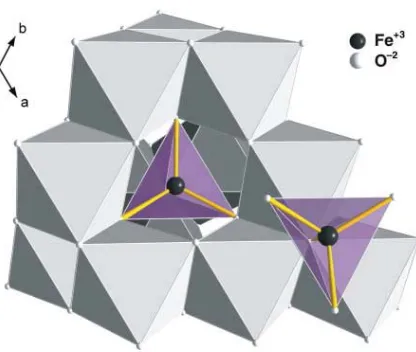
Figure 1.1. The basic structural motif of the ideal ferrihydrite structure. The central FeO4
tetrahedra are surrounded by 12 FeO6 octahedra (Michel et al 2007) ... 2
Figure 1.2. Keggin moiety of the ideal ferrihydrite structure (Heimestra 2013) ... 3
Figure 2-1. The calorimetric signal for a) chloride and nitrate exchange, b) sulfate adsorption and
c) phosphate and arsenate adsorption. . ... 14
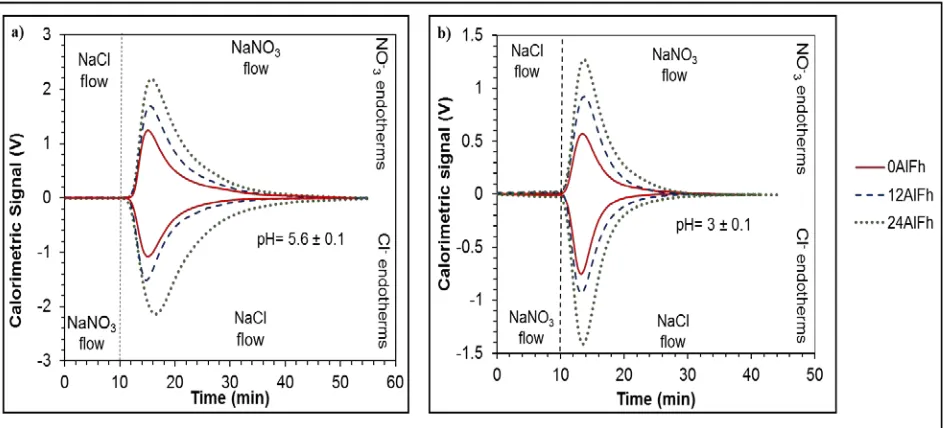
Figure 3.1. The calorimetric signals for chloride and nitrate exchange for 0AlFh, 12 AlFh, and
24AlFh at a) pH 5.6 and b) pH 3. . ... 28
Figure 3-2. The calorimetric signal for sulfate adsorption for 0AlFh, 12 AlFh, and 24AlFh at a)
pH 5.6and b) pH 3. ... 30
Figure 3-3. Representative calorimetric signals for [C/N] and [N/C] cycles before and after
sulfate treatment.. ... 33
Figure 3.4. Qualitative estimation of the variation in reversibility of sulfate desorption with Al
concentration and pH.. ... 39
LIST OF ABBREVIATIONS
FAMC Flow Adsorption Microcalorimetry
ΔHads Enthalpy of Adsorption
HRTEM High-Resolution Transmission Electron Microscopy BET Brunauer–Emmett–Teller
Qads Heat of Adsorption
ICP-OES Inductively Coupled Plasma Optical Emission Spectroscopy PDF X-ray Pair Distribution Function analysis
Fh Ferrihydrite
XRD X-ray Diffraction
[C/N] Nitrate Replacing Chloride [N/C] Chloride Replacing Nitrate [C/S] Sulfate Replacing Chloride [S/C] Chloride Replacing Sulfate
[C/P] Phosphate Replacing Chloride
[C/AS] Arsenate Replacing Chloride
PZC Point of Zero Charge
EXAFS X-ray Absorption Fine Structure
SCM Surface Complexation Modeling
SSA Specific Surface Area
EDS Energy Dispersive X-ray Spectroscopy
1 INTRODUCTION
1.1 Adsorption
Adsorption is a critical mechanism by which natural and anthropogenic contaminants are
transported in aquatic and terrestrial systems 1-4. The extent to which adsorption mechanisms
control the fate and transport of contaminants depends on the chemistries of the aqueous phase and
the nature, size, and reactivity of the mineral surfaces present 1-5. Because of their relatively high
specific surface areas and reactivity, iron oxides and oxyhydroxides are some of the most important
minerals controlling the adsorption of contaminants. Iron hydroxides are ubiquitous in nature
existing as relatively pure minerals such as goethite (Goe; α-FeOOH)) and hematite (Hm; α
-Fe2O3), and as ferrihydrite (Fh; Fe10O15 9H2O), a poorly crystallized hydrous phase which is
arguably the most pervasive and relevant phase in different surface environments. 3, 5-8.
1.2 Ferrihydrite Structure
Fh occurs in soils and sediments where it occurs both naturally and as a result of
anthropogenic activities such as acid mine drainage. It's in situ precipitation creates nanoparticles
(1–3 nm in size) of very high specific surface areas, for which values as high as ~1250 m2/g have
been reported 9-12.
Recently, there has been focused attention on the structure of Fh. In the past, several
standard models have been suggested for the structure of Fh 13-14. Drits et al. 15 formulated the
standard model for the structure of Fh which was the most acceptable model until recently. This
model includes three intermingled phases composed of octahedrally coordinated Fe with variable
stacking sequences of the iron octahedra. In 2007, Michel et al. 9 overturned this model by
proposing a new crystal structure for Fh based on one phase, the isostructural akdalaite
(PDF) found that besides having Fe in hexacoordination, Fh contains Fe in tetrahedral coordination
as well. Based on the ideal form of this structure, Fe10O14(OH)2 has been suggested as the chemical
formula for Fh 9. Figure 1.1 shows the basic structural motif of the model which comprises 13
iron atoms and 40 oxygens. As seen, there is a central tetrahedrally coordinated Fe attached to 12
outer octahedrally coordinated Fe atoms 9. Accordingly, three types of Fe sites have been
considered for the ideal structure of Fh. Fe1 and Fe2 are hexa-coordinated and occupy 60% and
20% of the structure, respectively, whereas Fe is tetrahedrally coordinated and occupies 20% of
the structure. In Figure 2, the tetrahedrally coordinated Fe (Fe) can be observed in the center of a
𝛿𝛿-Keggin moiety as a part of the Fh structure 11, 16.
Figure 1.1. The basic structural motif of the ideal ferrihydrite structure. The central FeO4
[image:16.612.218.426.344.520.2]Figure 1.2. Keggin moiety of the ideal ferrihydrite structure (Heimestra 2013)
The reactivity of Fh vis-à-vis adsorption of ions and molecules can then be rationalized
based on the new structural model and will hence depend mostly on the existence of singly
coordinated surface functional hydroxyl groups. Two types of singly-coordinated surface groups
interact with ions at the surface of Fh. The first type forms the edge of exposed Fe octahedra
suitable for the formation of bidentate inner-sphere complexes, while the other type located at a
single corner of two adjacent Fe octahedra provides appropriate sites for double-corner bidentate
complexes 10.
1.3 Aluminum Substituted Fh
In natural environments, pure Fh is uncommon since it readily reacts with impurities that
are often incorporated in the structure through co-precipitation, structural substitution, and surface
adsorption, which leads to variable chemical compositions and surface properties. Aluminum (Al)
is one of the most common substituents and co-precipitates with Fh 3, 17-19. The incorporation of
Al(III) in the Fh structure causes a critical impact on the structure, composition, and sorptive
properties of Fh leading to substantial variability in surface reactivity of Fh 18-31. Recently, the
that up to 20-30 mol % of Al(III) can be substituted in Fh structure, while with more than 30 mol
% of Al(III), a secondary Al(III) hydroxide phase, such as gibbsite, is formed by co-precipitation
21, 32-33.
1.4 Oxyanions
A chemical compound with the general formula AxOYz- is called an oxyanion (or oxoanion)
where A and O denote a chemical element and an oxygen atom, respectively 2, 34. These compounds
composed of non-metal elements in the group IIIA to VIA form in aqueous solutions. The pH and
dissociation constants of any particular oxyanion determine their negative charge 35. Some of the
oxyanions commonly found in the natural environment are: borate (BO33-), carbonate (CO32-),
nitrate (NO3-), phosphate (PO42-), sulfate (SO42-), chromate (CrO42-), arsenate (AsO43-), nitrite
(NO2-), arsenite (AsO33-), etc 3, 36. In this study, we have chosen to study chloride, nitrate,
phosphate, sulfate, and arsenate (Appendix A.1). This choice was guided by their environmental
relevance, their expected interaction strength, and their expected effect on the surface as these
oxyanions have been reported to exhibit markedly different interactions with Fh surfaces. The
observed surface complexes are outer-sphere complexes for chloride and nitrate 3, 36-37, a mixture
of outer-sphere/inner-sphere for sulfate 19, 38-40 and inner-sphere for phosphate and arsenate 40-44.
Arsenic is a toxic element for animals, plants, and humans, and can be leached to the groundwater
and contaminate both soils and water bodies. 45. The mobility and bioavailability of geogenic and
anthropogenic arsenic are controlled to a great extent by its sorption to natural minerals 46-47.
Arsenate with plus five oxidation state (+V) is one of two primary inorganic forms of arsenic that
is dominant under oxic conditions. The other form of arsenic is arsenite with plus three oxidation
Among all the oxyanions, phosphate has the most similar chemical properties to arsenate.
Both of them are tetrahedral oxyanions from Group V elements and compete for adsorption sites
on aluminum oxides, iron oxides, and 1:1 silicate clays (e.g., kaolinite) 51-53. Despite their chemical
similarity, the biological behaviors of phosphate and arsenate are significantly different since
phosphate is not known as a natural or anthropogenic contaminant. Although the excessive
phosphorus in aquatic environment may result in eutrophication, it is an essential nutrient for plant
growth and is considered a macronutrient 42, 52. Phosphate with three OH groups exhibits a complex
speciations distribution of H3PO4, H2PO4-, HPO42-, and PO43- depending on the solutions
chemistry and pH 35, 54.
Sulfur is also an essential nutrient for plant growth. The dominant form of sulfur is sulfate
which is also less toxic and problematic than arsenate. However, sulfate is a common
acid-producing contaminant prevalent in acid-mine drainage and impacting the quality of soil and water
resources 48. In the aquatic environment, sulfate minerals such as CaSO4(s) and MgSO4(s) can be
readily dissolved and release sulfate to surface or ground waters 3. Similarly to arsenate and
phosphate, sulfate competes with other oxyanions for the available sites on mineral surfaces.
Adsorption of sulfate can impact many processes that happen at the water-mineral interface such
as the dissolution of iron oxides, the activity of catalysts, and electrochemical properties of
minerals 55. The fate and transport of base cation nutrients such as Ca2+ and Mg2+ in forest soil are
also controlled by sulfate adsorption where sulfate acts as an indirect conserver of these cations 54.
Nitrogen is the most critical macronutrient required by plants 56. Nitrate, ammonium, and
dinitrogen are the available inorganic forms of nitrogen in the soil 57. However, nitrate is the
primary source of nitrogen in many soils and is critical for plant growth 58. The variation in nitrate
spring or massive seasonal rain events may give rise to depletion of nitrate in the soil and transport
to surface and ground waters 56. The excessive amount of highly soluble and stable nitrate in the
aquatic environments lead to eutrophication of water bodies endangering marine life and humans
and animals drinking those waters 57, 59.
Another anion studied in this project is chloride (Cl-). It has similar chemical properties to
those of nitrate as they are both monovalent and compete with each other for surface sites.
Chloride and nitrate are considered exchangeable ions in mineral-water interface systems and can
easily replace each other 3, 36, 60-61. In soil systems, chloride is the only stable oxidation state and is
not as critical as nitrate for plant growth but may also be considered as a micronutrient for higher
plants 62.
1.5 Overview
The overall objective of this work is to examine the interaction, adsorption/desorption, and
reversibility of five oxyanions on Fh using mostly the thermodynamic data acquired by flow
microcalorimetry. In addition, the role of Al(III) incorporation on the physical and chemical
properties of Fh is investigated.
In Chapter 2, the adsorption of phosphate, sulfate, arsenate, chloride, and nitrate on Fh is
examined at pH 5.6 and the enthalpy of the interaction is calculated for each anion. In Chapter 3,
the adsorption/desorption and reversibility of sulfate on three different Fhs with varied aluminum
concentration are examined at both pH 5.6 and 3.0 to indirectly assess the role of Al(III)
2 THE ENERGETICS OF OXYANION SORPTION ON FERRIHYDRITE STUDIED
USING FLOW MICROCALORIMETRY
2.1 Introduction
Adsorption is one of the most important mechanisms by which nutrients, pollutants, and
other solutes are distributed in natural environment between solid, aqueous, and gas phases 2-5, 36.
Adsorption occurs as a substance is accumulated at the interface between two phases particularly
in the solid-liquid interface2, 36, 63 and controls a wide variety of processes such as mineral
weathering kinetics64, nucleation and crystal growth65, natural organic matter stabilization, and
solute transport66.
Oxyanions are common metals and metalloids of high ionic potential from the group IIIA
to VIA of the formula AXOy. They are formed in aqueous solutions in which their charged species
are determined by the solution chemistry (pH, ionic strength, and composition) and their
dissociation constants. Oxyanions possess a high affinity for sorption on surfaces of metal (hydr)
oxides such as those of Al and Fe, particularly in acidic to intermediate pH values where these
surfaces are dominated by a positive charge2. For example, ferrihydrite (Fh), a semicrystalline iron
(hydr) oxide, provides enough positive surface charge for oxyanions adsorption in soil and
groundwater to promote either electrostatic adsorption or ligand exchange through complex
formation2, 6-8, 40.
The oxyanions chosen for this work are chloride, nitrate, sulfate, phosphate, and arsenate,
a choice guided by their environmental relevance and their placement along the well-known
Hofmeister series. The mechanisms and binding mode of the adsorption of these oxyanions on iron
67-73. On Fh, an electrostatic (outer-sphere) adsorption is usually reported for chloride and nitrate3,
36-37, 74, and inner-sphere complexation dominated by bidentate surface complexes for phosphate
and arsenate42-44, 50. Sulfate has been found to form both outer-sphere and inner-sphere
complexes19, 38-39.
Despite the extensive research investigating the surface complexation of these oxyanions
on aluminum and iron oxide surfaces, very few studies have sought to determine the energetics
and thermodynamics of their interactions, particularly studies that have directly measured these
values in a systematic and consistent way. When available, these data have been inconsistent. For
instance, using the temperature dependence of sorption isotherms, phosphate adsorption was
reported to be endothermic in some studies75-76 and exothermic in others 77-78.There are limited
studies using calorimetry to directly measure the energetics and enthalpies of adsorption (∆Hads)
for some of these oxyanions. For instance, Kabengi et al. 69 recently published a study combining
flow adsorption microcalorimetry (FAMC) with attenuated total reflection infrared (ATR FTIR)
spectroscopy and density functional theory (DFT) calculations to study chromate complexation on
hematite (Hm) and ferrihydrite (Fh). The authors reported that chromate binds exothermically in
an inner-sphere mode on both solids, with a ΔHads of −6.3 kJ/mol and −7.38 kJ/mol, for Hm and
Fh respectively. Similarly, other studies also using flow microcalorimetry have published molar
enthalpies of adsorption for several other oxyanions on a range of minerals, e.g., amorphous
aluminum hydroxide37, 61, 79, boehmite80, mixed Al (III)–Fe (III) hydr (oxide)74, and hematite81-82.
The ΔHads values for oxyanions adsorption on amorphous aluminum hydroxide were found to be
+2.9 ± 1.4 kJ/mol for sulfate and −6.5 ± 3 kJ/mol for phosphate79, and ranging from −3.0 to − 66
These inconsistencies in the thermodynamics values and the piecemeal nature of the very
few ΔHads measured underscore the need to conduct a systematic study of the adsorption of
oxyanions on one surface to allow for a direct comparison absent of variability factors from either
the solid or aqueous phase. To that end, this work will use flow microcalorimetry (FMC), to
directly measure the energetics and enthalpies of adsorption of chloride, nitrate, sulfate, phosphate,
and arsenate on freshly synthesized 2-line Fh samples. These anions are expected to exhibit a suite
of complexation mechanisms varying from electrostatic outer-sphere surface complexes on one
end to inner-sphere complexation on the other. Our hypothesis is that the strength of their
interactions will be reflected in the values measured and by their effect on the positive surface
charge. To our understanding, this is the first experimental study that encompasses this range of
oxyanions adsorbed on the same solid.
2.2 Materials and Methods
2.2.1 Chemicals
The oxyanions used in this study include chloride (NaCl, 99.0 %+), nitrate (NaNO3, 99.8
%), sulfate (Na2SO4. 99.7%), phosphate (Na2H2PO4. H2O, 99.6%), and arsenate (Na2HAsO4.
7H2O, 98.0%). All salts, acids, and bases used were ACS reagent grade chemicals and used as
received except for the two anhydrous salts (NaNO3 and NaCl) that were kept in a dry oven at 65
°C. Solutions were freshly prepared in 18.2 MΩ water and adjusted to pH 5.6 ± 0.1 using dropwise additions of 0.1 M HNO3 or 0.1 M NaOH that had a negligible impact on the ionic strength of the
solutions.
All solutions were made in a background of NaCl keeping the total concentration of Na+ at
0.05 M and the ionic strength constant. The concentrations of the oxyanion and NaCl for each
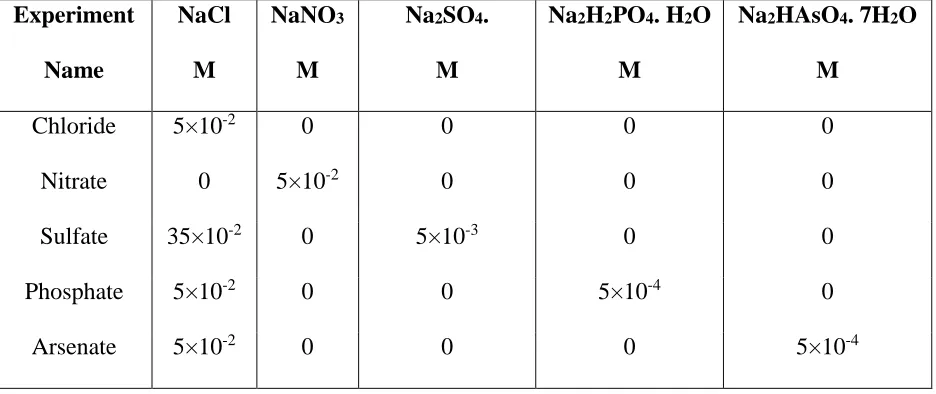
Table 2.1. Experimental conditions for the adsorption experiments.
Experiment
Name
NaCl
M
NaNO3
M
Na2SO4.
M
Na2H2PO4. H2O
M
Na2HAsO4. 7H2O
M
Chloride 5×10⁻² 0 0 0 0
Nitrate 0 5×10⁻² 0 0 0
Sulfate 35×10-2 0 5×10⁻³ 0 0
Phosphate 5×10⁻² 0 0 5×10⁻⁴ 0
Arsenate 5×10⁻² 0 0 0 5×10⁻⁴
These values were chosen based on results from preliminary tests and prior work to ensure
that the adsorption reaction would come to completion in a reasonable time frame and that an
accurate mass balance would be possible.
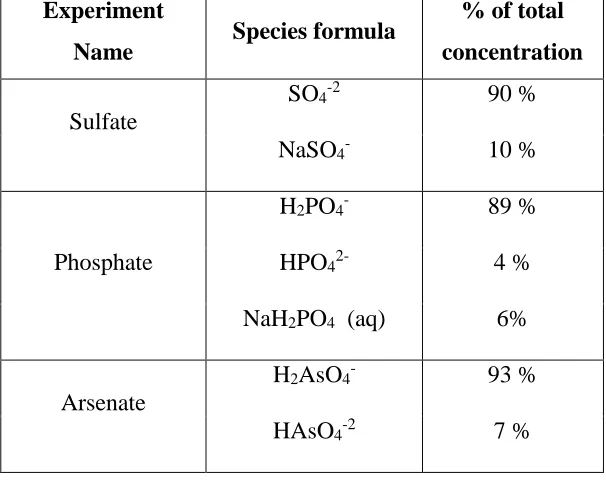
The chemistries of sulfate, phosphate, and arsenate solutions outlined in Table 2.1 were
modeled using Visual Minteq. Visual Minteq indicated that the solution containing sulfate should
have SO42- as the dominant sulfate species (90 %), the solution containing phosphate should have
H2PO4- as the dominant species (89 %), whereas H2AsO4- was the dominant species (93 %) in the
solution containing arsenate (Table 2.2).
2.2.2 Characterization
The Schwertmann and Cornell’s protocol was used to synthesize 2-line Fh 83. Accordingly,
a solution of 0.2 M Fe (NO3)3 (ACS grade, Fisher Scientific) was titrated to pH 7.5 through the
addition of a 150 mL of a 1 M KOH solution. The resulting suspension was centrifuged and
Table 2.2. The speciation of the oxyanions under the experimental conditions.
Experiment
Name Species formula
% of total
concentration
Sulfate
SO4-2 90 %
NaSO4- 10 %
Phosphate
H2PO4- 89 %
HPO42- 4 %
NaH2PO4 (aq) 6%
Arsenate
H2AsO4- 93 %
HAsO4-2 7 %
dropped below 20 µS.cm-1. The suspension was then air-dried under the hood for 24 hours and
ground into fine powders using an agate mortar and pestle. The Fh used in each experiment was
freshly synthesized and utilized within 1-2 days.
Fh synthesis and X-ray diffraction (XRD) patterns were obtained from a Panalytical XPert
Pro MPD instrument using CuK𝛼𝛼 radiation at generator settings operating at 45 kV and 40 mA
which indicated the sample was amorphous (Appendix B.1). Samples were out-gassed for 12 h at
50 ºC to remove any adsorbed volatile compounds from the surface and BET surface analysis
(Quantachrome AS1Win, Quantachrome Instruments) was conducted using N2 gas. The specific
surface area was determined to be 368 m2/g. The morphology and size of the Fh nanoparticles
were characterized by high resolution transmission electron microscopy (HRTEM; JEOL 2100F
operating at 200 kV) and revealed no well-defined crystal faces and a particle size of roughly 3 nm
2.2.3 Experiments
The flow microcalorimeters (FMC) used to conduct the experiments were custom-designed
and fabricated in the Kabengi laboratory at Georgia State University. The description of the
instrument and basic experimental procedures have been discussed in previous publications 37, 61,
84 and are included in Appendix B.4.
A known mass of Fh sample (~ 45.5 mg for sulfate and ~ 5.0 mg for all other oxyanions)
was packed in the sample holder of the instrument’s column and flushed with 0.05 M NaCl until
a steady baseline representing thermal equilibrium was reached. The input solution was then
switched to 0.05 M NaNO3, and the calorimetric signal associated with NO3- exchanging with Cl
-([C/N]) on the surface was recorded. After the calorimetric signal returned to the original baseline,
the solution was switched back to 0.05 M NaCl and the calorimetric signal of Cl- replacing NO3-
([N/C]) obtained. This cycle was repeated over 2 days until the heat of exchange (Qexch) for 3–5
replicates of each exchange leg ([C/N] and [N/C]) was constant indicating the surface was
equilibrated and ready for further experiments.
Both Cl- and NO3- have been reported to undergo a reversible outer-sphere ion exchange
reaction on Fh 3, 36-37, 61, 69, 74 and are therefore excellent in situ calorimetric probes of the surface
positive charge. Thus, in addition to measuring the energetics of their interactions with the Fh
sample, the exchange cycles of Cl- and NO3- were used to measure the reversibility of the
interaction of the other oxyanions (sulfate, arsenate, and phosphate) as described below.
For each experiment, once the Qexch of C/N and N/C cycles had stabilized, a stable baseline
was obtained in 0.05 M NaCl. The input solution was then switched to 0.035 M NaCl + 0.005 M
Na2SO4, 0.05 M NaCl + 0.0005 M Na2H2PO4, and 0.05 M NaCl + 0.0005 M Na2HAsO4 for sulfate,
interactions with the Fh. After the completion of these reactions as indicated by a return to the
initial baseline, the solution was reverted back to 0.05 M NaCl, and additional [C/N] and [N/C]
cycles were conducted as described above until no further change in the magnitude of 5
consecutive cycles was detected. Throughout the Fh exposure and subsequent C/N and N/C
cycles, effluent samples were collected and the total aqueous concentration of oxyanions
determined using High-Performance Liquid Chromatography – Ion Conductivity (Metrohm, 881
compact IC pro). The mass of oxyanions retained and subsequently desorbed from the surface was
determined by a mass balance calculation between the mass injected, and that recovered in all
effluents.
2.3 Results and Discussion
2.3.1 Energetics of Exchange and Adsorption
The calorimetric signals and Q for all the oxyanions exchanging with chloride were
exothermic while the heat of exchange (Qexch) of [N/C] was endothermic (Figure 2.1).
Additionally, the reactions of these anions with the Fh surface took different times to reach thermal
equilibrium. For [C/N] and [N/C] the reaction time was 30 min, for sulfate ([C/S]) it took around
40 min, as for phosphate ([C/P]) and arsenate ([C/As]) the return to baseline was significantly
Figure 2-1. The calorimetric signal for a) chloride and nitrate exchange, b) sulfate adsorption and c) phosphate and arsenate adsorption. An increase in voltage resulting in a positive peak corresponds to a release of energy and hence an exothermic reaction. Conversely, a decrease in voltage resulting in a negative peak corresponds to energy consumption and hence an endothermic reaction. The concentrations of each oxyanion in solutions are 0.05 M chloride and nitrate, 0.005 M for sulfate and 0.0005 M for phosphate and arsenate. The mass of solid used for sulfate is ~ 45 mg, and between 3 to 5 mg for the other oxyanions.
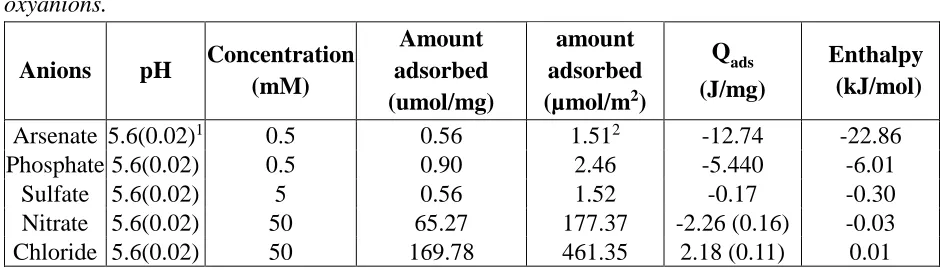
The heats of exchange (Qexch) for all reactions are summarized in Table 2.3. Qexch for [C/N]
and [N/C] were similar in magnitude at - 2.26 ± 0.16 for [C/N] and 2.18 ±0.11 for [N/C]. The
correspondence of their Qexch and their reactions times and peak areas further confirm that the
exchange of Cl- and NO3- is indeed reproducible and reversible as previously reported 37, 79, 84. On
the other hand, as hypothesized Qexch/ads for the other oxyanions did reflect the strength of their
interactions with Qads measured at 12.74 mJ/mg for arsenate, 5.440 mJ/mg for phosphate and
[image:28.612.76.542.70.380.2]Table 2.3. Summary of the heat of exchange values corresponding to the adsorption of oxyanions.
Anions pH Concentration (mM) Amount adsorbed (umol/mg) amount adsorbed (µmol/m2)
Qads
(J/mg)
Enthalpy (kJ/mol)
Arsenate 5.6(0.02)1 0.5 0.56 1.512 -12.74 -22.86
Phosphate 5.6(0.02) 0.5 0.90 2.46 -5.440 -6.01
Sulfate 5.6(0.02) 5 0.56 1.52 -0.17 -0.30
Nitrate 5.6(0.02) 50 65.27 177.37 -2.26 (0.16) -0.03
Chloride 5.6(0.02) 50 169.78 461.35 2.18 (0.11) 0.01
1Numbers in parenthesis correspond to the standard error
2The specific surface area used to calculate the surface excess (µmol/m2) is 368 m2/ g
The mass adsorbed and surface excess of each oxyanion are presented in Table 2.3 and
demonstrate that in each case a different adsorbed mass is required to reach surface saturation.
Although at different initial solution concentrations, for both sulfate (0.005 M) and arsenate
(0.0005 M), 0.560 µmol/mg of the injected mass was adsorbed. The adsorbed mass was higher
for phosphate (0.0005 M) as 0.900 µmol PO42-/mg of the mass injected was retained at the surface.
Whereas for chloride (50 mM) and nitrate (50 mM), there was significantly more adsorbed as we
measured 62.27 µmol NO3-/mg and 169.78 µmol Cl-/mg for chloride. The ΔH values (kJ/mol) at
maximum coverage were -22.86 kJ/mol for arsenate, -6.01 kJ/mol for phosphate, -0.30 kJ/mol for
sulfate, 0.03 kJ/mol for nitrate, and 0.01 kJ/mol for chloride adsorption on the surface, and hence
increased following a positive Hofmeister series such that ∆HCl−= ∆HNO
3
− < ∆HSO
4
2−< ∆HPO4−<
∆HAsO42−. As already stated, the energetics and enthalpies of the adsorption of these oxyanions on
Fh have not been largely studied. However, there are some works that have studied these
mechanisms on some other solids. For example, Appel et al. 79 reported the molar heats of sorption
of sulfate and phosphate on aluminum hydroxide at +2.9 ± 1.4 kJ/mol and −6.5 ± 3 kJ/mol,
hydroxide which was from −3.0 to −66 kJ/mol. Machesky et al. 85 also measured the enthalpy of
adsorption of phosphate on goethite which was from -15 to – 25 KJ/mol in different surface
coverage.
Although it is necessary to conduct more experiments to ensure the numbers obtained are
significantly representative of a larger set of Fh samples, these values qualitatively provide insights
into the adsorption mechanisms of different anions on the Fh surface. Both phosphate and arsenate
have been reported to complex strongly via inner-sphere complexes 40, 42-44and their ΔH
ads values,
which are in good agreement with our results, are the most exothermic among all the oxyanions
studies. Antelo et al. 42 showed that the adsorption of phosphate on Fh at pH values between 5 to
6 is slightly higher than that of arsenate, which is also consistent with our findings. However, the
reason for the higher value of ∆H for arsenate than phosphate is not well known. Thisdiscrepancy may be attributed to the difference between the ratio of monodentate and bidentate complexes
formed by arsenate and phosphate. Arsenate is mostly bound to Fh as bidentate corner sharing
complexes, and the formation of the monodentate complex is not significant (~ 15%) and even
decreases with increasing pH 42, 86. However, a mixture of monodentate and bidentate binuclear
species have been reported for complexation of phosphate on iron hydroxides in acidic to
intermediate pHs 40, 87-88. Arai and Sparks 43 suggested bidentate binuclear complexes co-existing
with monodentate mononuclear species at pH >7.5 for phosphate. On the other end of the
spectrum, chloride and nitrate complex through outer-sphere electrostatic mechanisms and they do
indeed possess a very small, almost negligible enthalpy as expected.
Conversely to other oxyanions, a mixture of inner-sphere and outer-sphere species has been
suggested for sulfate complexation 19, 38-40, 73. The contribution of outer-sphere species to sulfate
proposed that for air-dried Fh samples, with increasing pH and decreasing ionic strength, the
outer-sphere species increases such that for pH values between 5 to 6 and ionic strength (I) of 0.02 M,
more than 70% of sulfate is bound as outer-sphere species through electrostatic interactions and a
smaller fraction exists as bidentate-binuclear inner-sphere complexes. As such, at the pH 5.6 and
the ionic strength 0.05 M used in this work, the predominant mode of complexation for the sulfate
adsorption was likely outer-sphere complexes which is consistent with the very low molar enthalpy
measured for sulfate adsorption.
2.3.2 Desorption and Reversibility
As stated, the reactions of both chloride and nitrate with Fh surface are reversible, and as
such, they are excellent probes of the surface positive charge and the effect of the other oxyanions
adsorption on it. This is achieved by comparing the magnitudes of Qexch before and after exposing
the surface to the other oxyanions. Furthermore, the changes in Qexch with time, if any, as the
surface is exposed to increasing volumes of solution through additional exchange cycles, are good
indicators of the adsorption reversibility. The magnitude of the calorimetric signals for [C/N]
cycles of all the experiments decreased since the oxyanions occupy the same charge-bearing
functional groups which are no longer available for ion exchange (Table 2.4). The reduction in the
first post-treatment Qexch of [C/N] was not similar for all oxyanions studied. Compared to the
pre-treatment Qexch, the observed reduction was by 74.3 % for arsenate, by 60.6 % after phosphate and
42.3 % post sulfate. However, with subsequent [C/N] and [N/C] exchange cycles, the Qexch values
gradually increased back. We considered the point in time where no further change in the Qexch of
5 consecutive peaks was observed to represent post-treatment equilibrium. Furthermore, the
volumes required to reach post-treatment equilibrium were different. The posttreatment
Table 2.4. The heat of exchange for the representative pretreatment [C/N], the first posttreatment [C/N] and the equilibrium posttreatment.
Anions
Qexch for the
pretreatment [C/N] (mJ/mg)
Qexch for the
first posttreatment [C/N] (mJ/mg)
Reduction in Qexch for
the first posttreatment
[C/N] %
Qexch of
equilibrium posttreatment [C/N] (mJ/mg) Qexch of equilibrium posttreatment [C/N] %
Arsenate -2.430 (0.267)1,2 -0.65 73.3 -1.080 (0.108) 44.4 Phosphate -2.934 (0.176) -1.156 60.6 -1.488 (0.210) 50.7 Sulfate -1.980 (0.06) -1.143 42.3 -1.960 (0.100) 99.0
1Numbers in parenthesis corresponds to the standard error
2Heats of exchange in this table are listed as negative numbers as the heat of exchange of nitrate
replacing chloride was used as it is the first exchange after adsorption which can be compared with the pretreatment values.
for sulfate, 50.7% for phosphate and 44.4% for arsenate.
The desorption of phosphate, arsenate, and sulfate by chloride and nitrate was slower
compared to their adsorption and was incomplete even after 40-50 times more volume of NaCl,
and NaNO3 solutions was passed through the cell compared to the volume required to reach surface
saturation during the adsorption process. For sulfate experiments, it took ~ 750 mL of cumulative
volume to recover 99 % of the Qexch after sulfate, 54 mL to recover 50.7 % of Qexch after phosphate
and 170 mL to recover 44.4% after arsenate.
The reversibility data is in a good agreement with the results from the energetics of
exchange and adsorption as with increasing ∆Hads values, the reduction in the first posttreatment
Qexch of [C/N] and irreversibility increases. In general, the energetics and the impact on the surface
charge strongly mirrored the previously reported strength and mode of binding of the oxyanions
with the Fh surface functional groups. The electrostatic interactions showed a constant and
reversible Qexch over repeated measurements, while the Qexch values for anions interacting through
fraction of arsenate adsorption was irreversible as it binds in inner-sphere bidentate binuclear
complexes. The fraction of irreversible complexes decreases for phosphate as the fraction of
monodentate mononuclear increases, and for sulfate which forms a significant fraction of
outer-sphere complexes. On the other end, chloride and nitrate bind only as outer-outer-sphere complexes and
their reactions are entirely reversible.
2.4 Conclusion
Flow microcalorimetry was utilized in this work to obtain thermodynamic data for
oxyanion adsorption on the Fh surface. The calorimetric signals for all of the oxyanions exchange
and adsorption were exothermic, while an endothermic heat of exchange was detected for chloride
replacing nitrate. The reactions of both the [C/N[ and [N/C] with Fh surface were reversible, while
other oxyanions showed irreversible reaction such that 99 % of the sulfate, 50.7% of phosphate
and 44.4 % arsenate were desorbed from the surface after subsequent C/N and N/C cycles. The
molar enthalpy of the oxyanions adsorption on Fh increased following a positive Hofmeister series
and mirrored the strength and mode of surface complexation (i.e., Cl-<NO3-<SO42-< H2PO4-<
H2AsO4-) from electrostatic outer-sphere in Cl-<NO3-, a mixture of outer-sphere and inner-sphere
complexations in <SO42- , monodentate-bidentate inner-sphere in <H2PO4- to bidentate
inner-sphere in H2AsO4-. Also, the reduction in first posttreatment heat of exchange and irreversibility
followed the same trend, increasing with increasing molar enthalpy across the oxyanions. Overall,
based on the results obtained in this work, it can be concluded that the energetic and reversibility
3 THE ROLE OF ALUMINUM SUBSTITUTION INTO FERRIHYDRITE ON THE
MECHANISMS OF THE SULFATE ADSORPTION/DESORPTION.
3.1 Introduction
Ferrihydrite (Fh) is one of the most reactive nanocrystalline iron (hydr) oxides in abiotic
and biotic environments 89-92. Because of its high specific surface area and high density of reactive
surface-sites, Fh plays a critical role in determining the fate and transport of nutrients and
contaminants 19, 39, 92-93. Recently, Michel et al. 9 proposed a new model for the structure of Fh
revealing that in addition to having Fe in hexacoordination, Fh contains Fe in tetrahedral
coordination (~ 20%) as well. Based on this model, Hiemstra 11 developed a quantitative surface
depletion (SD) model to elucidate the surface structure and composition of Fh evaluating type and
number of reactive surface sites, corresponding proton affinities and point of zero charge (PZC).
In aquatic and terrestrial environments, Fh readily reacts with impurities, such as aluminum
(Al), to form variably substituted chemical compositions. The substitution of Al (III) in the Fh
structure impacts its structure, composition, and sorptive properties causing substantial variability
in terms of reduction potential 7, 27, 94, Fe (III) bioavailability 27, 29, 95, secondary mineralization to
hematite and goethite 26, 29, 96, desorption of aqueous contaminants 25, 97-98, solubility 28, 53, 99 as
well as sorption reactions 19, 21, 25. Cismasu et al. 100 sampled and characterized naturally-occurring
ferrihydrites from an acid mine drainage site to study the impact of impurities such as Aluminum
(Al3+), Silicon (Si4+), and organic matter on Fh structures. These researchers found that 1) Si4+ is
complexed at the surface of Fh and affects its crystallinity, 2) Al3+ substitution does occur for Fe3+,
ferrihydrite. Adra et al. 97 showed that in an area affected by an arsenic-rich acid mine drainage,
Fh has a particular role in removing the arsenic from a river bed sediments with approximately
neutral pH. Characterizing the natural Fh associated with Al (III), and comparing it with the
synthetic Al-substituted samples indicated inner-sphere surface complexes of As (V) on both the
natural and synthetic Al-substituted Fh. Cismasu and co-workers 18, 21, 101 studied properties of
impurity-bearing Fh by synthesizing Al-bearing Fh samples containing from 5% mol Al (III) to
40% mol Al precipitated in two modes: a slow and a fast titration. They then used a suite of
laboratory and synchrotron-based techniques (X-ray Pair Distribution Function analysis (d-PDF)
analysis, scanning transmission X-ray microscopy(STXM), Al K-edge X-ray absorption near edge
structure Al K-edge XANES spectroscopy) to characterize the structural properties of the solids
obtained. Although a small amount of separate aluminous phases (<6%) was detected by NMR
for 15 mol% Al (III) samples, they concluded that regardless of the titration speed
octahedrally-coordinated Al (III) is substituted in the Fh structure in samples with a concentration up to 20-30
mol%, while at higher Al content gibbsite, a secondary Al (III) hydroxide phase, is formed by
co-precipitation. Similarly, Manceau and Gates 33 proposed that in agreement with Pauling’s
distortion rule, Al-Al avoidance governs the saturation limit of Al (III) substitution in the Fh
structure, and predicted this substitution to occur up to 25 molar % for Fh and 30 molar % for
goethite. The impact of Al (III) substitution in Fh on the surface interactions with primary cationic
and anionic contaminants have also been investigated, albeit to a lesser extent. There have been
several studies investigating the adsorption of oxyanions on Fe (III) oxyhydroxy minerals19, 38-39,
74, 102-106. Among all oxyanions sulfate, for example, is of particular interest as it is a common anion
in soils and impacts the bioavailability of sulfur to plants, adsorption of other organic and inorganic
contaminants, and element cycling 39-40, 67, 71, 107-119.
Generally, a mixture of inner-sphere and outer-sphere species has been reported for the
complexation of sulfate on Fh 19, 38-40, 73. Zhu et al. 120 used infrared spectroscopic analysis, sulfur
K-edge extended X-ray absorption fine structure (EXAFS) spectroscopy, and d-PDF analysis to
study the structure of sulfate adsorption complexes on air-dried Fh samples. They reported both
inner-sphere bidentate −binuclear and outer-sphere species were adsorbed. Gu et al. 39 combined
sulfur K-edge XANES and EXAFS spectroscopy, quantum chemical calculations, and surface
complexation modeling (SCM) and found that the relative fractions of inner-sphere and
outer-sphere complexes depend on the pH,ionic strength (I), and whether the sample is either air dried
or kept wet. Some of their specific conclusions are that the relative fraction of inner-sphere
complexes is constant at different ion strengths, whereas it decreases with increasing pH. In
contrast, outer-sphere complexes vary with both I and pH. The authors also demonstrate that the
inner-sphere complexation is more favored in samples that have been air dried, whereas, in the
presence of hydration, more outer-sphere complexes are formed. Thus, the dehydration state of the
sample affects the ratio of outer-sphere to inner-sphere complexes. Johnston and Chrysochoou 19
used in situ ATR-FTIR spectroscopy to study the adsorption mechanism of sulfate and two other
oxyanions, selenate, and chromate, on Al-ferrihydrites, and reported that regardless of pH, the
increase in the Al (III) concentration significantly enhances outer-sphere complexation for all the
oxyanions studied.
The goal of this work is to use sulfate as a probe to study the impact of Al (III) substitution
in Fh on its sorptive capacity. Sulfate has been chosen since it allows us to investigate both
systematically measure the energetics of sulfate adsorption/desorption, as well as its impact on the
surface charge to further understand the mechanisms by which Al (III), and potentially other
impurities, affects the specific modes of complexation of potential contaminants in natural
environments. To our knowledge, there is only one published paper studying the adsorption of
sulfate on AlFh 19 and, as far as thermodynamic data is concerned, only one other paper
investigated the energetics of sulfate adsorption on amorphous aluminum hydroxide 79.
3.2 Materials and Methods
3.2.1 Mineral Synthesis
Al-substituted ferrihydrites were prepared according to a modified Schwertmann and
Cornell’s protocol 83 for the synthesis of 2-line Fh. Specifically, 0.2M Fe(NO3)3 and 0.2M
Al(NO3)3 (ACS grade, Fisher Scientific) solutions were prepared and mixed to obtain 200 mL
solutions at Al molar percentages of 0, 12 and 24. While continuously monitoring the pH, these
mixed Fe and Al solutions were titrated to pH 7.5 with the addition of a 1 M KOH solution that
was prepared the same day. This titration resulted in the total addition of 150 mL KOH in
approximately 25 minutes and is considered a slow titration (Cismasu et al., 2013). The resulting
suspensions were centrifuged and dialyzed against ultra-pure water (18.2 MΩ) for several days
until the conductivity of the solutions dropped below 20 µS cm-1. The suspensions were air-dried for 24 hours and ground into fine powders using an agate mortar and pestle to yield three samples:
0AlFh (pure ferrihydrite), 12AlFh (12 mol % Al) and 24AlFh (24 mol %). For each experiment,
samples were freshly prepared and used within 2 days.
3.2.2 Sample Characterization
The chemical elemental composition of the samples was determined by Inductively
The samples were digested using the standard EPA 3050 method 121. X-ray diffraction (XRD)
patterns were obtained on a Panalytical XPert Pro MPD instrument operating at 45 kV and 40 mA
using CuK𝛼𝛼 radiation, a 1/4° programmable divergence slit and a graphite monochromator on the
diffracted beam at generator settings operating at 45 kV and 40 mA. To obtain specific surface
areas (SSAs) of air-dried samples, multipoint Brunauer-Emmet-Teller (BET) N2 adsorption
isotherms were conducted using a Quantochrome NovaWin surface area analyzer. The general
morphology of the samples was studied by high resolution transmission electron microscopy
(HRTEM) using a JEOL 2100F instrument operating at 200 kV (JEOL, Ltd. Tokyo Japan).
Samples were deposited on a copper specimen grid coated with an ultrathin layer of carbon (Ted
Pella, Inc.) and kept in a hood to evaporate excess methanol. Energy dispersive X-ray spectroscopy
(EDS; Oxford detector) was used to obtain information on the elemental composition of the
samples, while their crystallinity and mineral identity were verified by capturing electron
diffraction patterns from selected areas of the samples.
Zeta potential measurements (Malvern Nano) were conducted on all three samples as a
function of pH. Suspensions (0.5 g/L) were prepared in 0.05 M NaNO3 and their pH adjusted with
aliquots of 0.1 M NaOH to achieve pHs from 6.5 to 11. After a 24 h equilibration on a shaker, the
zeta potential and the suspension pH were determined in triplicate.
3.2.3 Calorimetric Measurements
The flow microcalorimeters (FMC) used in this study are custom-designed and were built
in the Kabengi laboratory at Georgia State University. The instrumentations’ description and
operational procedures have been previously published 37, 61, 84 and are included in section A.4 of
The impact of Al substitution on the mechanism of sulfate sorption was evaluated by
measuring 1) the energetics of the interaction with the three AlFh samples at two pHs, (3.0 ± 0.1
and 5.6 ± 0.1, and 2) the change, if any, in the positive surface charge resulting from sulfate
complexation as it occurs on the same charge-bearing surface hydroxyl functional groups. This
change was measured using two anions, chloride (Cl-) and nitrate (NO3-), that have been
previously reported to undergo reversible outer-sphere ion exchange reaction on different Al- and
Fe-oxides 37, 61, 74, and as such are excellent probes of the positive surface charge (Sabur et al.,
2015; Kabengi et al., 2017). These anion exchange cycles were obtained as follows.
A known mass of AlFh sample (~ 5.0 mg for experiments at pH 3.0 and ~ 45.0 mg for
those conducted at pH 5.6) was packed in the sample holder and flushed with 0.05 M NaCl until
thermal equilibrium was achieved as indicated by a steady baseline. The input solution was then
switched to 0.05 M NaNO3, and the calorimetric signal corresponding to the displacement of Cl
-by NO3- ([C/N]) on the surface recorded. At the completion of the exchange, the solution was
switched back to 0.05 M NaCl and the calorimetric signal of Cl- exchanging with NO3- ([N/C])
obtained. These two solutions were cycled through until the surface was equilibrated and the heat
of exchange (Qexch) became constant for 3–5 replicates of each exchange cycle ([C/N] and [N/C]),
which typically took 2-4 days. Because these exchange cycles are inherently time-based
measurements, they were also used to assess the reversibility of the sulfate surface complexes. To
that end, after exposing the samples to sulfate, additional [C/N] and [N/C] cycles were obtained
until no further change in the magnitude of 5 consecutive cycles was detected.
Samples were exposed to sulfate by switching the input solution from 0.05 M NaCl to
0.035 M NaCl + 0.005 M Na2SO4. i.e. one in which 5 × 10⁻⁴ M NaCl has been replaced with 5 ×
constant. After the thermal signature of the sulfate reaction has ended, which took between 60 -
140 min depending on the sample composition and pH, the input solution was reverted to 0.05 M
NaCl. During the sulfate treatment and all subsequent chloride and nitrate exchange cycles,
effluent samples were collected at a rate of 1 sample/5 min for chemical analysis. The total aqueous
concentration of sulfate was determined using High-Performance Liquid Chromatography - ion
conductivity (Metrohm,881 compact IC pro). The chemistries of the 0.005 M Na2SO4 + 0.035 M
NaCl M solution was modeled using Visual Minteq and indicated that the solution containing
sulfate should have SO42- as the dominant sulfate species (90 %).
The mass of sulfate retained at and subsequently desorbed from the surface was determined
by a mass balance calculation between the mass of sulfate injected and that recovered in all
effluents.
All salts used in microcalorimetry experiments were ACS certified and were used as
received. All solutions were prepared using ultra-pure water (18.2 MΩ), were weakly buffered,
and in equilibrium with pCO2 in the atmosphere. The solution pH values were adjusted daily using
dropwise additions of 0.1 M NaOH, 0.1 M HCl, 0.1 M HNO3 for pH 5.6 ± 0.1 and 1 M HCl, and
1M HNO3 for pH 3.0 ±0.1 experiments. These adjustments had a negligible impact on the
3.3 Results
3.3.1 Characterization
A summary of the physical and chemical properties of the samples is shown in Table 1.
Bulk XRD patterns (Appendix C.1) indicated that all samples were amorphous and that despite
the increasing Al (III) content, there was no crystalline Al-(hydro) oxide phase, e.g., gibbsite. This
finding is in line with previous studies where no gibbsite was detected below an Al (III) content
of 30% 18-19. A qualitative analysis of transmission electron micrographs revealed that increasing
Al (III) content caused no significant variation in the general morphology and particle size that
was roughly estimated at 3 nm in all three samples (Appendix C.3). EDS results obtained from
multiple spots and particles from each sample presented consistent elemental profiles suggesting
the Al (III) to be distributed homogeneously across the particles (Appendix C.3). The BET SSAs
were 368 ± 14 m2/g, 358 ± 28 m2/g, and 363 ± 34 m2/g for the 0AlFh, 12AlFh, and 24AlFh samples
respectively. Theisoelectric points (IEP) occurred at pH 8.0, 8.5 and 9.0 for the 0AlFh, 12AlFh,
and 24 AlFh samples respectively (Appendix C.2). These values are in good agreement with the
literature values obtained for Fh 11, 21, and for aluminum-bearing ferrihydrites 21, 99.
3.3.2 Chloride and Nitrate Exchange: Pre-Sulfate Treatment
Consistent with prior work 69, 82, 122, [C/N] exchange was exothermic and [N/C] exchange
endothermic (Figure 3.1). The thermal responses associated with [C/N] and [N/C] cycles were
similar in terms of reactions times, peak areas, and enthalpic sign confirming that the exchange of
these two anions is indeed reproducible and reversible. It is noteworthy to remember that
experiments at pH 3.0 were conducted with ~ 5 -6 mg of sample compared to ~ 40 - 45 mg for
Table 3.1. A summary of the physical and chemical properties of the samples
Sample
(wt. %) pH
Fe/(Al + Fe)/ mol %
Al/(Al + Fe)/ mol %
Surface Area
m²/g
Density (g/L)
0AlFh 5.6 (0.02)1 99.97 (0.3) 0.03 (0.00) 368.0 (14) 28.83 (2.09)2
12AlFh 5.6 (0.02) 89.14 (0.01) 10.86 (0.01) 358.0 (20) 26.01 (1.63) 24AlFh 5.6 (0.02) 77.91(0.09) 22.09 (0.02) 363.0 (24) 25.10 (1.63) 0AlFh 3 (0.03) 99.96 (0.3) 0.04 (0.00) 368.0 (14) 28.83 (2.09) 12AlFh 3 (0.03) 89.09 (0.3) 10.91 (0.01) 358.0 (20) 26.01 (1.63) 24AlFh 3 (0.07) 77.89 (0.06) 22.11 (0.01) 363.0 (24) 25.10 (1.63)
1 Numbers in parenthesis correspond to the standard error
2 The density measured for the suspension of the fresh synthesized samples before air-drying
decreased with increasing Al
[image:42.612.75.549.337.551.2]not be directly compared.
While the enthalpic sign was consistent across pHs and Al (III) contents, the magnitudes
of the heats (Qexch) were not. Qexch increased with increasing Al and decreasing pH values. For
instance, Qexch for [C/N] increased from – 1.980 ± 0.1 mJ/mg for 0AlFh to -2.940 ± 0.05 for 12AlFh
and 5.830 ± 0.1 mJ/mg for 24AlFh at pH 5.6 ± 0.1, and from 5.548 ± 0.1 mJ/mg for 0AlFh to
-8.380 ± 0.15for 12 AlFh and -14.681 ± 0.15 mJ/mg for 24AlFh at pH 3.0 ± 0.1 (Table 3.2. See
[image:43.612.75.508.285.448.2]Appendix C.4 for the graph of the Qexch (mJ/mg) vs Al% for various AlFhs).
Table 3.2. The heat of exchange for the representative pretreatment [C/N], the first posttreatment [C/N]
Sample pH Qexch of [C/N] (mJ/mg)
Qexch for the first posttreatment [C/N] (mJ/mg)
Reduction in Qexch for the first posttreatment
[C/N] %
0AlFh 5.6 (0.02)1 -1.98 (0.06)2 -1.143 42.27
12AlFh 5.6 (0.02) -2.947 (0.02) -0.9690 67.13
24AlFh 5.6 (0.02) -5.083 (0.09) -1.491 70.66
0AlFh 3 (0.03) -5.548 (0.08) -0.9720 82.48
12AlFh 3 (0.03) -8.385 (0.1) -0.5080 90.00
24AlFh 3 (0.07) -16.59(0.2) -0.8544 95.00
1Numbers in parenthesis corresponds to the standard error
2Heats of exchange in this table are listed as negative numbers as the heat of exchange of nitrate
replacing chloride was used as it is the first exchange after adsorption which can be compared with the pretreatment values.
3.3.3 Sulfate Sorption
Figures 3.2 and 3.3 show the heat signals for continuously flowing a sulfate solution over
the AlFh samples at both pH 5.6 and 3, respectively. The reaction of sulfate with the three surfaces
at both pHs was exothermic and took around 50 – 60 min to reach thermal equilibrium. As evident
in the figure, the exotherm for sulfate reaction with the 24 AlFh at pH 5.6 exhibited a different
shape in that the initial heat evolution was followed by one occuring at a slower rate. Although not
The first solution after the sulfate treatment is NaCl and it is supposed to result in chloride
replacing sulfate (a [S/C] reaction). The Cl- endotherms following the sulfate treatment on all
samples were very small and in most instances never returned to the baseline such that it was
impossible to integrate them. At first glance, we would have interpreted their much smaller size
[image:44.612.79.534.209.433.2]relative to the sulfate peaks as an indication of a high degree of irreversibitlity in sulfate sorption.
Figure 3-2. The calorimetric signal for sulfate adsorption for 0AlFh, 12 AlFh, and 24AlFh at a) pH 5.6and b) pH 3. The concentrations of sulfate is 0.005 M. The mass of solid used for pH 5.6 and 3 is ~ 45 mg and ~ 5 mg, recpectively.
However, a considerable amount of sulfate was detected in the effluent collected during
this [S/C] cycle, and therefore it is hypothesized that the amounts of sulfate desorbed in this cycle
correspond to a pool of sulfate complexes that are reversible to chloride. The [C/N] following the
[S/C] is significantly smaller than that of the pre-sulfate treatment, and thus this pool that desorbs
first to Cl represents only a fraction of the sulfate adsorbed. This will be discussed further in the
The impact of Al and pH on sulfate sorption was similar to that observed on anions
exchange increased as Al content increased and pH decreased. Qads values were -0.1670 mJ/mg
for 0AlFh, -0.5020 mJ/mg for 12 AlFh, and -0.7410 mJ/mg for 24AlFh at pH 5.6 , and -12.32
[image:45.612.78.541.198.341.2]mJ/mg for 0AlFh, -19.14 mJ/mg for 12AlFh, and -45.44 for 24 AlFh at pH 3 (Table 3.3).
Table 3.3. The heat of adsorption and enthalpy of sulfate adsorption on various AlFh and pHs
Sample
ID pH
Sulfate adsorbed (µmol/mg)
Surface Area (m2/g)
Sulfate adsorbed (µmol/m2)
Energy of sulfate (mJ/mg)
Enthalpy (kJ/mol)
0AlFh 5.6 (0.02)1 0.5610 368.0 (14) 1.545 -0.1670 -0.29702
12AlFh 5.6 (0.02) 0.7450 358.0 (20) 2.052 -0.5020 -0.6740 24AlFh 5.6 (0.02) 1.007 363.0 (24) 2.774 -0.7410 -0.7360 0AlFh 3 (0.03) 5.096 368.0 (14) 14.039 -12.33 -2.280 12AlFh 3 (0.03) 6.828 358.0 (20) 18.810 -19.78 -2.897 24AlFh 3 (0.07) 12.65 363.0 (24) 34.835 -45.44 -3.617
1Numbers in parenthesis corresponds to the standard error
2The enthalpy was calculated suing the heat of interaction (kJ) divided by the amount of sulfate
adsorbed (mol).
Because exposure of the 24AlFH sample to solutions at pH 3 resulted in a faint yellow
effluent 4 days into the experiments which suggested possible dissolution of the solid, the
experimental protocol for these conditions was slightly modified. The pH of the solutions used
was gradually decreased from 3.5 to 3.2 over a period of 3 days, after which the sample was
exposed to the sulfate solution at pH 3.0. This modification circumvented any solid dissolution as
the effluent which was carefully monitored remained clear. Additionally, the Qexch of [C/N] and
[N/C] at pH 3.2 were not significantly different from those obtained at pH 3.0 prior to the solid
dissolution.
The values for the mass of sulfate retained on the surface at the end of the reaction, as
indicated by the return of the heat signal to the original baseline, are presented in Table 3.3. They
values (Γ2) were 1.450, 1.928 and 2.534 µmol/m2 for the 0, 12 and 24AlFh respectively at pH 5.6
and 13.06, 17.50 µmol/m2, and 32.40for the 0, 12, and 24 AlFh respectively at pH 3.0 ± 0.1.
The enthalpy (kJ/mol) of the sulfate reaction with the AlFh’s surfaces was obtained using
the heat of interaction (kJ) and the amount of sulfate adsorbed (mol). The enthalpy values showed
the same trends as the energies and increased with increasing Al content and decreasing pH which
pointed out a fact that having more Al incorporated in the Fh and lower pH during the reaction
augmented the amount of energy produced per mole of sulfate adsorbed on Fh’s surface (Table
3.3).
3.3.4 Chloride and Nitrate Exchange: Post-Sulfate Treatment
The magnitude of the C/N exchange, taken as a proxy for positive surface charge, was
used to assess the impact of sulfate on the positive charge and the reversibilty of sulfate adsorption.
Sulfate sorption on all samples decreased the calorimetric peaks associated with both the [C/N]
and [N/C] exchange as compared to the pre-sulfate peaks. This decrease indicates a loss of positive
charge as sulfate sorption occurs predominantly on the same charge-bearing functional groups that
are no longer “available” for ion exchange (Fig 3.3). The observed reduction in Qexch was not
consistent for all samples. When compared to the pre-sulfate value, the Qexch for the first
posttreatment [C/N] decreased by 42% for 0AlFh, 67% for 12AlFh, and 71 % for the 24AlFh
samples at pH 5.6. Similarly, the decrease in Qexch varied among samples at the lower pH. At pH
3, the Qexch of the first postreatment [C/N] was lower by 82% for the 0AlFh, by 90% for the
Figure 3-3. Representative calorimetric signals for [C/N] and [N/C] cycles before and after sulfate treatment. The experiment was conducted on ~ 45 mg 24AlFh at pH 5.6.
The large decrease in Qexch across samples and pHs was not permanent. With subsequent C/N and
N/C cycles, the peaks areas and Qexch progressively increased back to stabilize at equilibrium
values representing a fraction of their pre-sulfate values. These fractions were 99.03% for 0AlFh,
87.75% for 12AlFh, and 59.65 % for the 24AlFh samples at pH 5.6, and 56.031 % for 0AlFh,
53.09 % for 12AlFh, and 36.62 % for the 24AlFh samples at pH 3.0 (Table 3. 4). Therefore, the
amount of the surface charge that was lost and not recovered over time or in other words the
amount of sulfate that could not be desorbed from the surface increased with increasing Al content
and decreasing pH.
The initial decrease and following rebound of the Qexch values suggest sulfate is
progressively desorbing from the surface and additional functional group sites are available to
participate in C/N and N/C exchange. This desorption was further corroborated as sulfate was


![Table 2.4. The heat of exchange for the representative pretreatment [C/N], the first posttreatment [C/N] and the equilibrium posttreatment](https://thumb-us.123doks.com/thumbv2/123dok_us/9055357.977101/32.612.74.541.103.234/table-heat-exchange-representative-pretreatment-posttreatment-equilibrium-posttreatment.webp)
![Table 3.2. The heat of exchange for the representative pretreatment [C/N], the first](https://thumb-us.123doks.com/thumbv2/123dok_us/9055357.977101/43.612.75.508.285.448/table-heat-exchange-representative-pretreatment-c-n.webp)

