Georgia State University
ScholarWorks @ Georgia State University
Public Health Theses School of Public Health
Summer 8-7-2018
Evaluating a Measles and Rubella Multiplex Bead
Assay for Countries in the WHO Global Measles
and Rubella Laboratory Network
Alexandria R. Mitchell
Centers for Disease Control and Prevention
Follow this and additional works at:https://scholarworks.gsu.edu/iph_theses
This Thesis is brought to you for free and open access by the School of Public Health at ScholarWorks @ Georgia State University. It has been accepted for inclusion in Public Health Theses by an authorized administrator of ScholarWorks @ Georgia State University. For more information, please contact [email protected].
Recommended Citation
Mitchell, Alexandria R., "Evaluating a Measles and Rubella Multiplex Bead Assay for Countries in the WHO Global Measles and Rubella Laboratory Network." Thesis, Georgia State University, 2018.
ABSTRACT
EVALUATING A MEASLES AND RUBELLA MULTIPLEX BEAD ASSAY FOR COUNTRIES IN THE WHO GLOBAL MEASLES AND RUBELLA LABORATORY NETWORK
By
ALEXANDRIA R. MITCHELL
INTRODUCTION: Measles and rubella are highly contagious viral diseases. Measles remains one of the leading causes of vaccine-preventable deaths, and rubella during pregnancy can cause congenital rubella syndrome. The enzyme immunoassay (EIA) is most frequently used to determine antibody responses to measles and rubella, and the plaque reduction neutralization assay (PRN) is considered the gold standard for determining measles immunity. A measles and rubella multiplex bead assay (MBA) is currently being evaluated at the Centers for Disease Control and Prevention for its utility in serosurveillance within the World Health Organization Global Measles and Rubella Laboratory Network, and the MBA has several benefits over these assays. The MBA requires a smaller sample volume, measures several diseases simultaneously, is faster, and has less technician-dependency than the PRN.
AIM: Study objectives are to compare accuracy of measles serological status from both the MBA and EIA when compared with the PRN, and to evaluate whether country or participant age are associated with test accuracy.
METHODS: Samples for participants of varying ages from the United States, Tajikistan, and Bangladesh (n=300) that had been tested by each assay were used. Results were dichotomized as positive or negative according to respective assay cutoff values. Logistic regression models were applied to estimate point estimates and confidence intervals for sensitivity and specificity of the MBA and EIA with relation to the PRN gold standard.
RESULTS: Across the three age groups and countries, EIA has higher median values (mIU/ml) compared with MBA and PRN (582.55, 399.28, and 378.95, respectively, for Tajikistan participants aged 13 and older). McNemar’s Test of Agreement comparing MBA and PRN suggests disagreement (p<0.0001). This is also shown with EIA and PRN (p<0.0001), but not when MBA and EIA were compared (p=0.4669). MBA and EIA have similar overall sensitivities, with 97.29% (94.09, 98.76) and 97.76% (94.73, 99.06) when each compared to the gold standard PRN. MBA and EIA sensitivities were high, and specificity improved from 42.86% and 40.26%, to 73.02% and 65.56%, respectively, when source country was added. They further improved to 77.55% and 73.69%, respectively, when age was added to the model. For the United States, sensitivity for the MBA is higher for 0-5 and 13+ year age groups at 87.22% and 95.64%, respectively, compared with 84.37% (p=0.8650) and 94.29% (p=0.8103) for EIA. DISCUSSION: When compared with the PRN, the MBA has similar accuracy to the EIA with regards to sensitivity and specificity, and in several groupings of country and age, these
i EVALUATING A MEASLES AND RUBELLA MULTIPLEX BEAD ASSAY FOR COUNTRIES IN THE WHO
GLOBAL MEASLES AND RUBELLA LABORATORY NETWORK
by
ALEXANDRIA R. MITCHELL
B.A., EMORY UNIVERSITY
A Thesis Submitted to the Graduate Faculty of Georgia State University in Partial Fulfillment
of the
Requirements for the Degree
MASTER OF PUBLIC HEALTH
ii APPROVAL PAGE
EVALUATING A MEASLES AND RUBELLA MULTIPLEX BEAD ASSAY FOR COUNTRIES IN THE WHO GLOBAL MEASLES AND RUBELLA LABORATORY NETWORK
by
ALEXANDRIA R. MITCHELL
Approved:
Matthew J. Hayat, PhD Committee Chair
Ruiyan Luo, PhD Committee Member
Melissa Coughlin, PhD Committee Member
Bettina Bankamp, PhD Committee Member
iii Acknowledgments
v TABLE OF CONTENTS
ACKNOWLEDGMENTS ...iii
LIST OF TABLES AND FIGURES.……….……...vi
INTRODUCTION...1
1.1 Background….………..……….………...1
1.2 Statistical Framework……….………..……..4
1.3 Study Aims………..….4
REVIEW OF THE LITERATURE...4
METHODS AND PROCEDURES………...8
3.1 Sample Preparation…………...8
3.2 Statistical Methods...11
RESULTS...13
DISCUSSION AND CONCLUSIONS...16
5.1 Discussion of Research Questions...16
5.2 Study Strengths and Limitations...16
5.3 Implications of Findings...17
5.4 Recommendations and Future Strategies………..………..18
5.5 Conclusions……….18
REFERENCES...20
vi List of Tables
Table 1. Descriptive Statistics of Country by Assay
Table 2. Descriptive Statistics of Country and Age by Assay
Table 3. Sensitivity and Specificity of MBA compared to PRN and EIA compared to PRN
Table 4. Sensitivity and Specificity of MBA compared to PRN and EIA compared to PRN, with
Country Effect
Table 5. Sensitivity and Specificity of MBA compared to PRN and EIA compared to PRN, with
Country and Age Effects
List of Figures
Figure A. Distribution of Age by Country
Figure B. Scatterplot of MBA and PRN
1 1 INTRODUCTION
1.1 Background
Measles and rubella are highly contagious viral diseases most often associated with
fever, runny nose, cough, conjunctivitis (red eyes), and a rash. In 2009, the WHO recommended
a two-dose measles, mumps, and rubella (MMR) vaccine for children (Rota et al., 2016), but
measles remains one of the leading causes of vaccine-preventable deaths. An estimated
100,000 or more children die annually from measles (Rota et al., 2016), with an estimated
89,780 measles deaths in 2016 (Dabbagh, 2017). Rubella also remains a global threat, and can
cause congenital rubella syndrome (CRS) during pregnancy, with an estimated 300 children
globally who are born daily with lifelong cardiac and ocular diseases, or hearing impairments
(Dabbagh, 2017). Despite vaccination campaigns and efforts, outbreaks and vaccine failures can
still occur; serosurveillance methods are used to monitor and confirm a country’s disease
elimination status (Durrheim, Orenstein, & Schluter, 2018; Mulders et al., 2016).
Currently, the enzyme immunoassay (EIA) is most frequently used to determine
antibody responses to measles and rubella. However, the EIA is a single-antigen platform
limited to only measuring one disease at a time. As such, it can be time consuming and costly;
the EIA also uses a large volume (10ul, ZEUS Scientific, Inc.) of sample. The plaque reduction
neutralization assay (PRN) is the gold standard (reference) in measuring seroprotection, but is
technician-dependent and time consuming, and requires more volume (60ul) than the EIA.
Seroprotection refers to the antibody response sufficient to protect a person from getting the
disease; samples that are not seroprotected could be seropositive or seronegative, and those
2 to neutralizing antibody concentrations above 120mIU/ml (Chen et al., 1990). Due to the
training and time required for the PRN, there are few countries with the resources and
personnel available to use the PRN for analyzing samples, making this platform impractical for
serosurveillance studies. Concerning susceptibility of disease in these studies, it is meaningful
to determine measles seroprotection for separate age categories. If any age groups have
lowered immunity this will be apparent with separation of ages. Children under 6 years are
within the CDC recommended period to receive the two-dose MMR vaccine (CDC, 2018); the
first dose is recommended for ages 12 to 15 months, and the second dose between four and six
years of age. Adults aged 21 and older are more likely to have already developed antibodies
against measles either from natural disease or from receiving the vaccine. Countries may have
different vaccination recommendations and dose requirements, which are based on the
likelihood of contracting the disease. In an urban area of low measles vaccine coverage,
infection usually occurs in infants and young children. As coverage increases, the average age of
infection shifts towards adolescents and adults who may not have received the vaccine and
were not infected as children (Moss, 2017).
At the United States Centers for Disease Control and Prevention (CDC), a Measles and
Rubella Multiplex Bead Assay (MBA), sometimes referred to as a multiplex immunoassay (MIA),
is currently being evaluated for its utility in generating serosurveillance data. The assay was
originally developed at National Institute for Public Health and the Environment (RIVM) in the
Netherlands for country serosurveillance (Smits, van Gageldonk, Schouls, van der Klis, &
Berbers, 2012), and was then transferred to CDC for evaluation and optimization. The measles
3 Laboratory and Global Specialized Laboratory, and aims to assess the MBA for implementation
in countries within the World Health Organization (WHO) Global Measles and Rubella
Laboratory Network. The MBA is a Luminex flow cytometry-based platform that allows for
multiplexing of antigens; this enables researchers to test for the presence of antibodies against
several diseases simultaneously, which is cost-effective (Elshal & McCoy, 2006) for
serosurveillance studies. The MBA is a direct-antigen assay using microsphere beads covalently
bonded to either measles or rubella whole virus antigen. If IgG antibodies to measles or rubella
are present in human serum samples, they will “attach” to the antigen on the beads. A
fluorescently-tagged secondary antibody added will adhere to IgG antibodies present in the
serum sample, and based on a standard curve, the fluorescence unit is converted into the
observed concentration of antibodies present in the sample. When a serum sample is assessed
with the Luminex machine, the output is given as the observed concentration of antibodies to
measles and rubella, respectively. Compared to the PRN and EIA, the MBA requires a much
smaller volume of sample (1ul), and is less technician dependent, regarding interpretation of
results, than the PRN. Because of its cost-effectiveness, time and sample-efficiency, and
multiplex design, the MBA could be implemented as an alternative platform for the EIA or PRN.
Previous studies of other diseases have shown the MBA compares well with the EIA (Binnicker,
Jespersen, & Rollins, 2011; Gwyn et al., 2017; Reder, Riffelmann, Becker, & Wirsing von Konig,
2008; Smits et al., 2012), but this study seeks to compare the MBA from CDC to both the EIA
and the PRN, and additionally assess whether a sample’s country of origin or age influences the
4 1.2 Statistical Framework
Differences across source countries can be difficult to describe or quantify, and include
varying natural disease prevalence rates, vaccination campaigns, coverage, and failure, disease
elimination status, sample collection and storage, access to healthcare, population immunity,
vaccination recommendations, and inaccurate or incomplete data (Durrheim et al., 2018).
These differences could hypothetically influence the MBA’s performance (Fujii et al., 2014).
Three serum panels consisting of samples run on the MBA, PRN, and EIA are evaluated in this
study, and these panels have varying countries of origin and age information, which are
included in the analysis. A logistic regression framework is the most appropriate statistical
methodology to use (Agresti, 2007), as this allows for examining the predictive value of country
and age, and simultaneous comparison of the MBA and EIA to the gold standard PRN.
1.3 Study Aims
Objectives for this study are to compare the MBA and EIA each with the gold standard PRN
platform. The concentration of measles antibodies in human serum samples run on each assay
will be used for this comparison. Logistic regression models will be fit to understand how
seroprotection by MBA and EIA relates to that of PRN. Sample country and age will be included
in the models to assess the predictive value of each on assay comparison.
2 REVIEW OF LITERATURE
Several statistical methodologies have been applied to examine measles immunity,
5 EIA was found at the time of this study. Only a study using a Markov chain Monte Carlo (MCMC)
approach to estimate the effect of vaccination campaigns on the disease burden of measles
(Trentini, Poletti, Merler, & Melegaro, 2017) was found in terms of similarity. The MCMC study
utilized an innovative statistical methodology using outcomes of previous measles vaccine
studies to estimate future study outcomes. However, this assay comparison study will serve as
a pilot or feasibility study, guided by previous studies comparing the MBA and EIA, and EIA and
PRN found in the literature.
After development of the MBA at RIVM, the assay was compared to the in-house
Enzyme-Linked Immunosorbent Assay (ELISA), which is a form of EIA. The MBA and ELISA show
a strong positive correlation (R² = 0.98) with a correlation curve to plot antibody concentration
on a log-scale [(Smits et al., 2012) and unpublished data by Coughlin, M, 2016]. Another study
(Dorigo-Zetsma et al., 2015) used four EIA kits to determine vaccine-induced measles immunity
and evaluated these results against PRN and a measles MIA. Results showed “limitations in the
usefulness of current EIA assays for determining protective measles antibodies in persons with
a vaccination history.” When compared to the PRN, the MBA also showed a strong correlation
(unpublished data by Coughlin, M, 2016). A measles, mumps, rubella, and varicella (MMRV)
MIA, has also shown good similarity when compared to the EIA platform, with 93% overall
agreement in a shorter time span of 1.7 hours compared to 5.5 hours by EIA (Binnicker et al.,
2011)].
MBA and ELISA comparative studies have also been conducted for other vaccine
antigens. A newly-developed MBA for detection of tetanus, diphtheria, and pertussis toxins
6 with the ELISAs (Reder et al., 2008). For tetanus and pertussis toxins the MBA had a positive
association with the ELISA, with regression coefficients of 0.910 and 0.905, respectively. For
diphtheria toxin, the MBA and ELISA had a regression coefficient of 0.938; these examples all
considered samples originating from a single country (pg. 746-747). While this can be
advantageous, the measles and rubella MBA will be used in a range of countries and to test
whether performance is consistent across these, data from multiple countries should be
evaluated. Additionally, using a single country could hypothetically limit information provided
about the assay and samples, because it assumes underlying characteristics are the same for all
countries.
Other MBA and ELISA comparisons in the literature utilize sensitivity and specificity of
each assay to assess overall agreement. For the neglected tropical disease trachoma caused by
the Chlamydia trachomatis bacterium, the MBA has a sensitivity of 93.2% and specificity of
97.4% (Gwyn et al., 2017). Sensitivity and specificity for the ELISA freshly-coated with antigen is
93.2% and 98.1%, and these were estimated using receiver operator characteristic (ROC) curve
analyses on positive and negative reference samples. Using cutoff values generated from the
ROC curve, the MBA and ELISA had 86.1% agreement for positive samples and 92.8%
agreement for negative samples. Additionally, the two platforms were compared with a lateral
flow assay (LFA), where antibodies to trachoma bind to a conjugate pad rather than a bead or
plate. Because there is no gold standard for serologic testing to determine disease status for
trachoma, the MBA and ELISA platforms were compared further using latent class analysis
(Wiegand et al., 2018). This modeling approach uses disease status given by each assay to
7 disease latent classes. The model with these three classes had the best fit for the data and had
similar estimates for sensitivity and specificity of the MBA and ELISA. Sensitivity and specificity
of the MBA estimated in the latent class model are both 98%, and for the freshly-coated ELISA
90% and 97%, respectively. These values are higher, and have wider confidence intervals, when
the data are fit using a modeling approach compared with the prior application of a ROC curve.
This is most likely because there is no gold standard for serologic testing for the bacterium
Chlamydia trachomatis to determine trachoma disease status, and the latent class modeling
allows for consideration of the uncertainty. The studies for trachoma considered samples with
three different countries of origin and three assay platforms, which is similar to the study
described in this project. However, in this assay comparison study the PRN is a serologic gold
standard for determining measles antibody concentration, and separate logistic regression
models can be fit to compare the accuracy of the MBA and EIA platforms with PRN. Additional
models can be fit to evaluate country and age their respective influence on this accuracy.
A study concerning vaccination coverage of children in India utilized a multinomial
logistic model to compare vaccination status, and better understand the predictive value of
socioeconomic status and effects like sociodemographic characteristics (Shrivastwa, Gillespie,
Kolenic, Lepkowski, & Boulton, 2015). Comparisons were based on Universal Immunization
Program (UIP) recommended single dose of bacillus Calmette–Guérin, single dose of measles
containing vaccine, and three doses of diphtheria–pertussis–tetanus, with fully-, under-, and
non-vaccinated categories. Under-vaccination and non-vaccination categories were compared
to the fully-vaccination category, and the authors found religion and caste fixed effects were
non-8 vaccinated compared to being fully-vaccinated is 2.2 times higher for Muslim children and the
odds of being under-vaccinated compared with fully vaccinated is 1.42 times higher.
Several studies have also compared measles IgG antibody levels by the EIA to the gold
standard PRN, using several EIA kits. The Measelisa kit for EIA was compared with PRN, and had
99.0% sensitivity and 100% specificity (Neumann, Weber, Jessamine, & O'Shaughnessy, 1985).
Similarly, the EIA has demonstrated high sensitivity and specificity (100% and 90.7% for the
Enzygnost [Siemens] kit (Ratnam et al., 1995)) when using 120mIU/ml as a cutoff for
seroprotection (Chen et al., 1990). Using the Enzygnost (Siemens) kit, the EIA was also
evaluated against the PRN at CDC (Bellini & Helfand, 2003). With the 120mIU/ml PRN cutoff for
seroprotection, the EIA had 100% sensitivity and 91.0% specificity. And in a separate study of
the Virion/Serion and IBL kits, the EIA demonstrated a relatively strong, statistically significant
correlations of 0.878 (p<0.01) and 0.850 (p<0.01), respectively, with PRN (Mao, Zhu, & Jiang,
2009).
3 METHODS AND PROCEDURES
3.1 Sample Preparation
Human serum samples from Tajikistan, the United States (US), and Bangladesh were
used in this project, and data for each sample was acquired for the PRN, EIA, and MBA
platforms. Samples from the US were residual diagnostic samples that were de-identified and
approved for use by the National Center for Immunization and Respiratory Diseases (NCIRD)
human research protections. Samples from Tajikistan were part of a 2010 serosurveillance
9 and 4 weeks later for second dose, according to WHO immunization guidelines for children
(WHO, 2018). The Tajikistan study protocol was reviewed by the Human Subjects research
coordinator at NCIRD and determined to be “program evaluation” and exempt from
institutional review board approval. The protocol was also reviewed by the Ministry of Health in
Tajikistan. Bangladesh samples were from a vaccine study on the administration of rotavirus
vaccine with MMR (Zaman et al., 2016). Samples were acquired from patients before and after
vaccination, in children between 9 months and 4 years; the first dose is administered at 9
months, and the second at 15 months (CDC, 2017). Approval was given by the Western
Institutional Review Board and the International Center for Diarrheal Disease Research,
Bangladesh (ICDDR,B), and post-vaccination samples are utilized for this assay comparison
study. The MBA data for Bangladesh was run on the Luminex machine by Alexandria Mitchell,
who prepared and ran the samples according to standard operating procedure as follows.
All sera were diluted into serum dilution buffer (3% bovine serum albumin [SIGMA], and
0.1% Tween 20 in phosphate buffered saline (PBS)) the day of or the day prior to running the
MBA. The international rubella standard serum RUBI-1-94 (National Institute for Biological
Standards and Control, NIBSC) was diluted in a 10 step 3-fold serial dilution starting at 1/400 for
the standard curve, and control serum were diluted in a single point dilution of 1/800. The
RUBI-1-94 standard was calibrated against the international standard serum for measles (WHO,
NIBSC), and a standard curve is generated for measles. Tajikistan and U.S. samples were diluted
at both 1/200 and 1/4000, and Bangladesh samples were diluted at 1/800. Non-magnetic
microsphere beads covalently bound with measles antigen were used, with 4000 beads per
10 inactivated before being bound to the beads. Beads and serum were combined in a
MultiScreen-BV filter Plate (Millipore®) and incubated at room temperature in the dark with
shaking at approximately 800 revolutions per minute (rpm) for 45 minutes. A plate vacuum was
used to remove liquid from the wells, while allowing the beads to remain. PBS was added to
each well, and the beads were incubated at 1000rpm for one minute. The PBS was removed
using a plate vacuum, and this wash step was repeated twice more. After washing, diluted
secondary antibody (R-phycoerythrin conjugated Goat anti-human IgG, Jackson
Immunoresearch) is added to each well, and the plate is again wrapped in aluminum foil and
incubated at 800rpm at room temperature. During this 30 minute incubation the
fluorescently-tagged secondary antibody binds to any measles IgG antibodies in the samples. After
incubation, the plate is washed three times as previously described. In the final step of sample
and plate preparation, wash buffer is added to each well, and incubated at room temperature
in the dark for five minutes at 1000rpm.
When the final incubation is complete, the plate is run using the Luminex machine. All
samples were run on the Bio-Plex 100 or the Bio Plex 3D, which are both from the manufacturer
Bio Rad (Hercules, CA). In the machine, the green “reporter” laser identifies secondary
detection antibody, and the red “classify” laser distinguishes beads using internal dye of the
beads. The measles antigen is covalently bound to microspheres, and as the beads are
registered by the machine, the red laser detects the beads and the green laser reports
secondary antibody. Beads that fall within the correct region are used to measure the
fluorescence of the secondary antibody. The output pertinent to this project is the observed
11 the fluorescence units of the secondary antibody into milli-international units per milliliter
(mIU/ml). Results of the PRN are also based on a conversion against a standard, and values are
reported in mIU/ml as well. Samples from the PRN and EIA were assessed using published
methods (Albrecht, Herrmann, & Burns, 1981; ZEUS Scientific, 2017). All samples were tested
by PRN by Sun Bae Sowers on the measles serology team, in the National Measles and Rubella
Reference Laboratory at CDC. Tajikistan EIA data were assessed by the Siemens kit in Tajikistan;
this kit is calibrated with the WHO standard, and results are converted and expressed in
mIU/ml. EIA data for the United States and Bangladesh panels, run by Nobia Williams and Lijuan
Hao, respectively, who are also on the serology team at CDC, were output using the Wampole
kit (ZEUS Scientific, Inc.), which reports Immune Status Ratio (ISR) for each sample. ISR values
are calculated by comparing the optical density (OD) of each EIA sample at a wavelength of 450
nanometers with a cutoff value calculated from the cutoff control in the kit. This kit is not
calibrated to the WHO standard which would allow for conversion of these ISR values into
mIU/ml.
3.2 Statistical Methods
For the statistical analysis, data were used from the gold standard PRN, MBA, and EIA.
The accuracy of the two comparing assays were evaluated using sensitivity, that corresponds to
true positives and specificity, that corresponds to true negatives. Using logistic regression, the
accuracy of probability of successes and failures was estimated by separate models comparing
MBA to PRN and EIA to PRN. Country of origin was recorded for each sample, using data from
12 recorded for each sample and both country and age were evaluated as covariates. A total of
300 samples were used for this analysis, and two samples from the United States panel had
missing MBA data. PRN and MBA observed concentration results for all countries are
continuous. All EIA data are continuous as well, and ISR values from the Wampole kit range
from 0-5+, with negative values (0-1.0 ISR), positive values (>1.1 ISR). Because of the large
range in measles antibody concentration for each assay, in addition to having different units for
the EIA data, all assay results were dichotomized using respective assay cutoff values. Results
were either positive (greater than; seroprotected) or negative (less than; non-seroprotected) by
PRN (cutoff= 120.00mIU/ml) and MBA (cutoff= 136.50mIU/ml). The cutoff value for the MBA
was calculated using ROC curve analysis with results determined by the gold standard PRN by
Dr. Melissa Coughlin, using GraphPad Prism 6 software. Tajikistan EIA data were dichotomized
as positive or negative using a cutoff of 120.00mIU/ml, as given by the Siemen’s kit. EIA results
for the United States and Bangladesh samples were distinguished as positive (equal to or
greater than) and negative (less than) using the cutoff of 1.1 ISR. Positive sample results for all
assays were designated with a “1” and negative sample results with a “0”.
Age is a continuous variable and was categorized into three groups: 0 to 5 years, 6 to 12
years, and 13 years and older. This is because individual sample ages were not given for
Bangladesh samples, but all subjects range between infancy and 4 years of age. A boxplot was
used to examine the distribution of age data for each country, and a scatterplot of PRN and
MBA continuous data was created to show the wide range of possible values for both assays.
Frequency tables were generated to compare dichotomous data from the MBA and EIA
13 used for determining descriptive statistics as well as calculating positive predictive values (PPV)
and negative predictive values (NPV). Additionally, McNemar’s Test of Agreement was used to
test for agreement between MBA and PRN, EIA and PRN, and MBA and EIA. Statistical modeling
with logistic regression was used to estimate sensitivity and specificity for the MBA and EIA
platform with PRN as the gold standard. Logistic regression models were fit for outcomes of
both MBA and EIA to assess predicted probabilities with PRN, and for country as a fixed effect
for MBA and EIA. Additional statistical models were fit with age included as a covariate for MBA
and EIA. Results were considered statistically significant when p-value<0.05, and all statistical
analyses were conducted using SAS, version 9.3.
4 RESULTS
Age had Mean= 8.79 years, SD= 10.21, and ranged from 0.25 years (three months) to 65
years across all countries. All samples from Bangladesh ranged from 0-4 years old, although
individual sample ages were not known. Tajikistan sample ages ranged from 1-24 years (Mean=
9.62 years, SD= 7.04), and the United States sample ages ranged from 0.25-65 years (Mean=
25.87 years, SD= 16.65). Samples were distributed unequally across the three age categories:
0-5 years (n=208), 6-12 years (n=23), 13 years and older (n=68). The boxplots of the distribution
of age by country (Figure A) also reflects this inequality in the range of ages for each country.
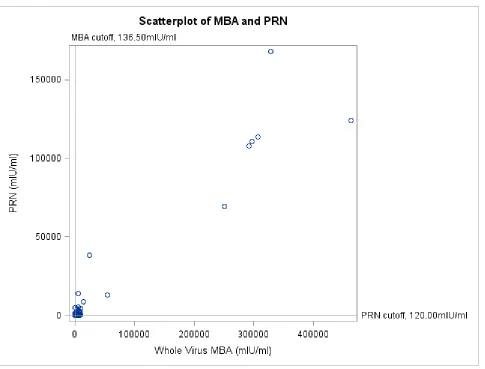
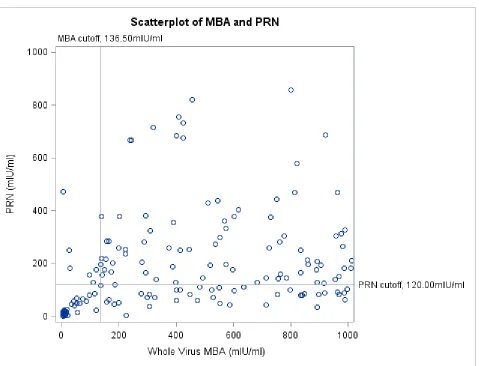
The US has the largest range of ages, followed by Tajikistan and Bangladesh. Figure B depicts
continuous MBA and PRN data with lines for respective cutoff values, and outlying values as
high as 400,000mIU/ml. Most of the measles sample concentrations fall below 100,000mIU/ml
14 samples are contained within the bottom left quadrant, indicating a “negative” result by both
assays (n=33), and in the upper right quadrant, indicating a mutually “positive” result (n=215). A
considerable portion of samples (n=44) lay in the bottom right quadrant, signifying a “negative”
result by PRN, but “positive” result by MBA (false positives), and a few samples were falsely
negative by MBA in the upper left quadrant (n=6).
All sample observed concentrations were extremely right-skewed, and descriptive
statistics of median and inter-quartile range values were used to compare country data in Table
1. For Tajikistan, the median antibody concentration for PRN and MBA are 203.72mIU/ml and
283.67mIU/ml, respectively; the Tajikistan median for EIA was higher than PRN, at
435.82mIU/ml. For Bangladesh, the MBA and PRN median results are 1247.23mIU/ml
compared with 232.50mIU/ml for PRN. Table 2 shows these descriptive statistics when country
and age group are evaluated. MBA and PRN median values for Tajikistan samples aged 13 years
and older are 399.28mIU/ml and 378.95mIU/ml, respectively. Across the three age groups and
countries, EIA are 582.55mIU/ml, 399.28mIU/ml, and 378.95mIU/ml, respectively, for Tajikistan
participants aged 13 and older. Following dichotomization, PRN had 74.33% (n=223) positive
and 25.67% (n=77) negative samples, MBA had 86.91% (n=259) positive and 13.09% (n=39)
negative samples, and EIA had 88.00% (n=264) positive and 12.00% (n=36) negative samples.
McNemar’s Test of Agreement comparing MBA and PRN suggests disagreement between
assays (p<0.0001). This is also shown with EIA and PRN (p<0.0001). When MBA and EIA were
compared with McNemar’s Test of Agreement, the result was not significantly different
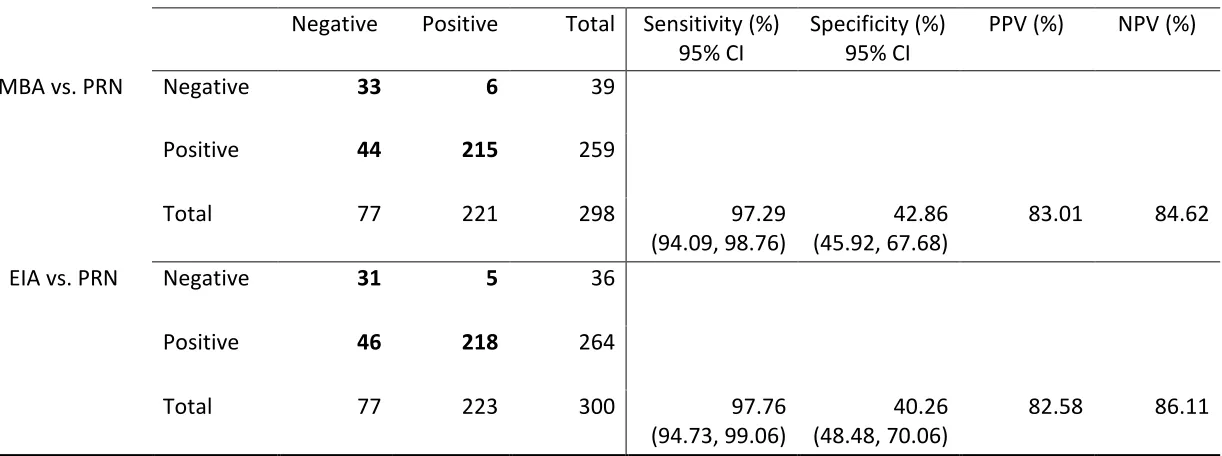
15 The results of the logistic regression model with assay (Table 3) show the MBA and EIA
have similar overall sensitivities with 97.29% (94.09, 98.76) and 97.76% (94.73, 99.06) when
each compared to the gold standard PRN (p=0.7114). Specificities of MBA and EIA were
comparable as well (p=0.5157). Positive predictive value is similar for the MBA at 83.01%
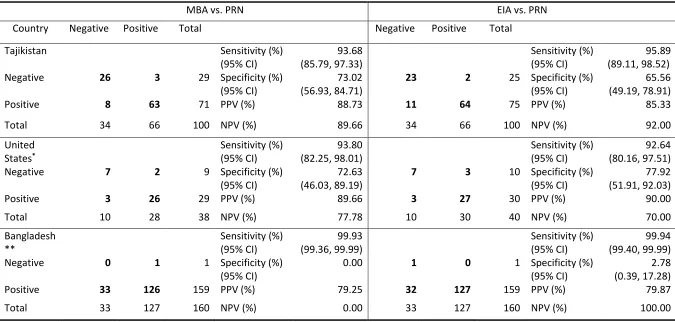
compared to 82.58% (p=0.8887) for EIA. When country effect is added (Table 4), these
similarities are largely maintained. EIA sensitivity is higher for Tajikistan than MBA, with 95.89%
compared to 93.68% (p=0.4839). However, specificity for the MBA is better for this country,
with 73.02% compared to 65.56% (p=0.2543). For the United States, negative predictive value
for the MBA is also higher than the EIA, at 77.78% compared to 70.00% (p=0.4354), and positive
predictive values for Bangladesh are very close, with 79.87% for EIA and 79.25% (p=0.9045) for
MBA. MBA sensitivity for Tajikistan and the United States is close as well (p=0.9761), but when
MBA sensitivities for Tajikistan and the United States are each compared with that of
Bangladesh, they are significantly different at p=0.0016 and p=0.0022, respectively. In Table 5,
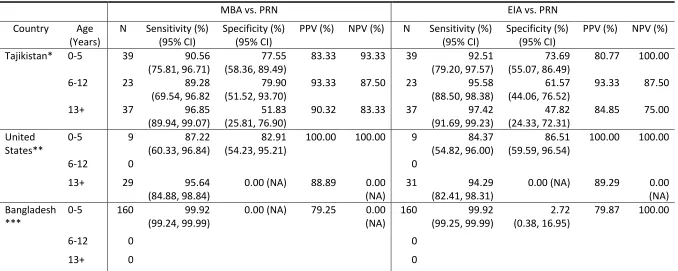
the United States’ sensitivity for the MBA is higher for 0-5 and 13+ year age groups at 87.22%
and 95.64%, respectively, compared with 84.37% (p=0.8650) and 94.29% (p=0.8103) for EIA.
There were no statistically significant differences between the sensitivities of MBA and EIA for
the first age category (0-5 years) for Tajikistan (p=0.7566), the United States (p=0.8650), and
Bangladesh (p=1). Between countries, MBA accuracy was not significantly different for
Tajikistan and the United States (p=0.7642), but was significantly different when Bangladesh
was compared with these two countries (p=0.0001 and p<0.0001, for Tajikistan and the US,
respectively). For Tajikistan, positive predictive values and negative predictive values were the
16 MBA specificity in the model without age and country versus in the model with country
(Tajikistan) were significantly different (p<0.0001), although sensitivity was not (p=0.0942).
MBA sensitivity and specificity in the country and age model (Tajikistan, 0-5 years) and the
model with country only (Tajikistan) were not significantly different (p=0.5222 and p=0.5823,
respectively). However, when the country and age model (Tajikistan, 0-5 years) and the model
without age and country were compared, MBA sensitivity and specificity were both significantly
different (p=0.0316 and p<0.0001, respectively).
5 DISCUSSION AND CONCLUSIONS
5.1 Discussion of Research Questions
In this study, the aims were to compare both the MBA and EIA with the gold standard
PRN. Given the observed concentration of measles antibodies from samples run on each assay,
these results were dichotomized according to each assay’s respective cutoff value. Separate
logistic regression models were used to evaluate the accuracy of MBA and EIA, when compared
to the PRN. Source country for the samples was included in a model to understand its effect on
this comparison, and age was added to the model to determine whether assay accuracy
changed from one age group to another.
5.2 Study Strengths and Limitations
Study strengths included having multiple countries, and that samples from these
countries consisted of slightly varying ages. Another strength was that this study is a pilot or
feasibility study, as nothing in the literature would suggest a comparison of this nature has
17 comparison of this type could give insight into assay performance, and its accuracy in relation
to results from a gold standard. The study is therefore not without limitations, which include
not having individual age data for the Bangladesh samples, EIA values from two different kits
resulting in different units for reporting concentrations, and the lack of equality in the number
of positive and negative samples after dichotomization by cutoff values for Bangladesh.
5.3 Implications of Findings
The MBA sensitivity is very high with low specificity when the data are not distinguished
by country or age, and specificity percentages appear to improve as more information is added
to the model, in the form of country and age information. By including additional sample
information, MBA specificity was significantly different compared to that from models without
country or age as fixed effects. However, because post-vaccination samples were used from
Bangladesh, there was a lack of non-seroprotected samples to analyze; this makes specificity
difficult to estimate. When compared with the PRN, the MBA performs similarly overall to the
EIA with regards to sensitivity and specificity and in several groupings of country and age, these
percentages are higher for the MBA. However, missing values, under-representation of age
groups, and a small sample of source countries makes this difficult to infer. The positive and
negative predictive values for MBA were relatively high and consistent for all models fit, and
this is the same for EIA as well. Many of the benefits of the MBA over conventional assays (that
it is faster, requires much less sample volume, and can multiplex several antigens
simultaneously), have led to its increased application in research and this should be considered.
This study demonstrates the comparability of the MBA with the EIA, through comparability of
18 Although the EIA is currently the most commonly used assay for determining measles antibody
concentration, results from this study suggest the MBA is a suitable alternative.
5.4 Recommendations and Future Strategies
Recommendations and future strategies are to compare both the MBA and EIA to PRN
with a larger overall and country-specific sample size, an increased number of countries, and
with more demographic sample information if possible. Possible benefits and disadvantages of
implementing the MBA in place of the EIA or PRN should be evaluated, and this includes the
cost of the MBA, how to improve MBA specificity, whether MBA use is situation specific, what
other antigens if any can be multiplexed with the MBA, and how to incorporate the MBA into
research settings unfamiliar with the technology. Logistic regression models can then be fit to
compare the assays and assess sensitivity and specificity. This will allow for more representative
samples and stronger conclusions to be inferred.
5.5 Conclusions
When compared to PRN, MBA sensitivity was high, and by including Bangladesh,
specificity appeared to improve when additional sample information of source country and age
were added to the model. Country and age did not have significant effects on MBA and EIA
accuracy for Tajikistan and the US. However, the lack of non-seroprotected Bangladesh samples
in the analysis may be influencing the significant difference in MBA specificity across models
with and without fixed effects, and the significant difference of MBA sensitivity between
countries. For datasets containing ample seroprotected and non-seroprotected samples,
including country and age information in the models may affect MBA specificity differently.
19 recommendations, this could also affect how age data are interpreted. For serosurveillance, age
data is important to include because low measles concentrations by MBA could be an indication
that certain age groups were missed during vaccination. In conclusion, the MBA performed
similarly with EIA, and these results suggest the MBA can be used in settings where the EIA is
currently used. This was a pilot study, and if weaknesses and implications are addressed, future
studies can re-evaluate this comparison of assays and include more information to make more
20 REFERENCES
Agresti, A. (2007). An Introduction to Categorical Data Analysis (Second ed.). New Jersey: Wiley.
Albrecht, P., Herrmann, K., & Burns, G. R. (1981). Role of virus strain in conventional and enhanced measles plaque neutralization test. J Virol Methods, 3(5), 251-260.
Anderson, N. W., Klein, D. M., Dornink, S. M., Jespersen, D. J., Kubofcik, J., Nutman, T. B., . . . Theel, E. S. (2014). Comparison of three immunoassays for detection of antibodies to Strongyloides stercoralis. Clin Vaccine Immunol, 21(5), 732-736. doi:10.1128/cvi.00041-14
Baker, H. N., Murphy, R., Lopez, E., & Garcia, C. (2012). Conversion of a capture ELISA to a Luminex xMAP assay using a multiplex antibody screening method. J Vis Exp(65). doi:10.3791/4084
Bellini, W. J., & Helfand, R. F. (2003). The challenges and strategies for laboratory diagnosis of measles in an international setting. J Infect Dis, 187 Suppl 1, S283-290. doi:10.1086/368040
Binnicker, M. J., Jespersen, D. J., & Rollins, L. O. (2011). Evaluation of the Bio-Rad BioPlex Measles, Mumps, Rubella, and Varicella-Zoster Virus IgG multiplex bead immunoassay. Clin Vaccine Immunol, 18(9), 1524-1526. doi:10.1128/cvi.05207-11
CDC. (2017). Progress Toward Measles Elimination — Bangladesh, 2000–2016. Retrieved from
CDC. (2018). Measles, Mumps, and Rubella (MMR) Vaccination: What Everyone Should Know. Retrieved from
https://www.cdc.gov/vaccines/vpd/mmr/public/index.html
Chen, R., E. Markowitz, L., Albrecht, P., A. Stewart, J., Mofenson, L., R. Preblud, S., & Orenstein, W. (1990). Measles Antibody: Reevaluation of Protective Titers (Vol. 162).
Dabbagh, A. P., MK; Dumolard, L; Gacic-Dob, M; Mulders, MN; Okwo-Bele, J; Kretsinger, K; Papania, MJ; Rota, PA; Goodson, JL. (2017). Progress Toward Regional Measles Elimination — Worldwide, 2000–2016. Retrieved from
Dorigo-Zetsma, J. W., Leverstein-van Hall, M. A., Vreeswijk, J., de Vries, J. J., Vossen, A. C., Ten Hulscher, H. I., . . . Binnendijk, R. S. (2015). Immune status of health care workers to measles virus: evaluation of protective titers in four measles IgG EIAs. J Clin Virol, 69, 214-218. doi:10.1016/j.jcv.2015.06.095 Durrheim, D. N., Orenstein, W. A., & Schluter, W. W. (2018). Assessing population immunity for measles
elimination – The promise and peril of serosurveys. Vaccine.
doi:https://doi.org/10.1016/j.vaccine.2018.04.036
Elshal, M. F., & McCoy, J. P. (2006). Multiplex Bead Array Assays: Performance Evaluation and Comparison of Sensitivity to ELISA. Methods (San Diego, Calif.), 38(4), 317-323. doi:10.1016/j.ymeth.2005.11.010 Fujii, Y., Kaneko, S., Nzou, S. M., Mwau, M., Njenga, S. M., Tanigawa, C., . . . Mondal, D. (2014). Serological
Surveillance Development for Tropical Infectious Diseases Using Simultaneous Microsphere-Based Multiplex Assays and Finite Mixture Models. PLoS Negl Trop Dis, 8(7), 1-15.
doi:10.1371/journal.pntd.0003040
Gwyn, S., Cooley, G., Goodhew, B., Kohlhoff, S., Banniettis, N., Wiegand, R., & Martin, D. L. (2017).
Comparison of Platforms for Testing Antibody Responses against the Chlamydia trachomatis Antigen Pgp3. Am J Trop Med Hyg, 97(6), 1662-1668. doi:10.4269/ajtmh.17-0292
Khetsuriani, N., Zakikhany, K., Jabirov, S., Saparova, N., Ursu, P., Wannemuehler, K., . . . Martin, R. (2013). Seroepidemiology of diphtheria and tetanus among children and young adults in Tajikistan: nationwide population-based survey, 2010. Vaccine, 31(42), 4917-4922. doi:10.1016/j.vaccine.2013.07.015
Lukman, N., Salim, G., Kosasih, H., Susanto, N. H., Parwati, I., Fitri, S., . . . Williams, M. (2016). Comparison of the Hemagglutination Inhibition Test and IgG ELISA in Categorizing Primary and Secondary Dengue Infections Based on the Plaque Reduction Neutralization Test. Biomed Res Int, 2016, 5253842. doi:10.1155/2016/5253842
Mao, N. Y., Zhu, Z., & Jiang, X. H. (2009). [Comparison and evaluation of enzyme-linked immunization assay kits with plague reduction neutralization test for detection of measles IgG antibody]. Zhongguo Yi Miao He Mian Yi, 15(3), 215-218.
21 Mulders, M. N., Rota, P. A., Icenogle, J. P., Brown, K. E., Makoto, T., Rey, G. J., . . . Goodson, J. L. (2016).
Global measles and rubella laboratory network support for elimination goals, 2010-2015. Weekly Epidemiological Record, 91(18), 240-246.
Neumann, P. W., Weber, J. M., Jessamine, A. G., & O'Shaughnessy, M. V. (1985). Comparison of measles antihemolysin test, enzyme-linked immunosorbent assay, and hemagglutination inhibition test with neutralization test for determination of immune status. J Clin Microbiol, 22(2), 296-298.
Ratnam, S., Gadag, V., West, R., Burris, J., Oates, E., Stead, F., & Bouilianne, N. (1995). Comparison of commercial enzyme immunoassay kits with plaque reduction neutralization test for detection of measles virus antibody. J Clin Microbiol, 33(4), 811-815.
Reder, S., Riffelmann, M., Becker, C., & Wirsing von Konig, C. H. (2008). Measuring immunoglobulin g antibodies to tetanus toxin, diphtheria toxin, and pertussis toxin with single-antigen enzyme-linked immunosorbent assays and a bead-based multiplex assay. Clin Vaccine Immunol, 15(5), 744-749. doi:10.1128/cvi.00225-07 Rota, P. A., Moss, W. J., Takeda, M., de Swart, R. L., Thompson, K. M., & Goodson, J. L. (2016). Measles. Nature
Reviews Disease Primers, 2, 16049. doi:10.1038/nrdp.2016.49
https://www.nature.com/articles/nrdp201649#supplementary-information
Shrivastwa, N., Gillespie, B. W., Kolenic, G. E., Lepkowski, J. M., & Boulton, M. L. (2015). Predictors of vaccination in India for children aged 12-36 months. Vaccine, 33 Suppl 4, D99-105.
doi:10.1016/j.vaccine.2015.09.034
Smits, G. P., van Gageldonk, P. G., Schouls, L. M., van der Klis, F. R., & Berbers, G. A. (2012). Development of a bead-based multiplex immunoassay for simultaneous quantitative detection of IgG serum antibodies against measles, mumps, rubella, and varicella-zoster virus. Clin Vaccine Immunol, 19(3), 396-400.
doi:10.1128/cvi.05537-11
Trentini, F., Poletti, P., Merler, S., & Melegaro, A. (2017). Measles immunity gaps and the progress towards elimination: a multi-country modelling analysis. The Lancet Infectious Diseases, 17(10), 1089-1097.
doi:https://doi.org/10.1016/S1473-3099(17)30421-8
WHO. (2018). WHO recommendations for routine immunization - summary tables. Retrieved from
http://www.who.int/immunization/policy/immunization_tables/en/
Wiegand, R. E., Cooley, G., Goodhew, B., Banniettis, N., Kohlhoff, S., Gwyn, S., & Martin, D. L. (2018). Latent class modeling to compare testing platforms for detection of antibodies against the Chlamydia trachomatis antigen Pgp3. Sci Rep, 8(1), 4232. doi:10.1038/s41598-018-22708-9
Zaman, K., Fleming, J. A., Victor, J. C., Yunus, M., Bari, T. I., Azim, T., . . . Neuzil, K. M. (2016).
Noninterference of Rotavirus Vaccine With Measles-Rubella Vaccine at 9 Months of Age and Improvements in Antirotavirus Immunity: A Randomized Trial. J Infect Dis, 213(11), 1686-1693.
doi:10.1093/infdis/jiw024
ZEUS Scientific, I. (2017, December 20). Measles IgG Test System. Retrieved from
22 APPENDICES
Appendix A
MPH Core Competencies
Upon completion of the MPH degree, all students will have a mastery of appropriate theory, knowledge and skills in applied public health and public health research as evidenced by the graduate’s ability to:
1. Describe the roles biostatistics serves in the discipline of public health and the function of ethics in biostatistics practice.
2. Describe basic concepts of probability, random variation and commonly used statistical probability distributions.
3. Apply basic (univariate and bivariate) descriptive and inferential techniques commonly used with public health data.
4. Critically evaluate the application, presentation, and interpretation of statistical analyses in the public health studies.
5. Describe major environmental and occupational contaminants including biological, chemical and physical agents and discuss effects of exposure to these contaminants on human health. 6. Identify important susceptible human sub-populations with respect to environmental exposures and the sources of variability.
7. Analyze approaches to assessing, preventing and controlling environmental hazards that pose risks to human health.
8. Calculate and interpret common epidemiologic measures to draw appropriate inferences. 9. Critically evaluate strengths and weaknesses of epidemiologic methods.
10. Communicate epidemiologic concepts in both technical and lay language by explaining trends and patterns of health-related events and the importance of epidemiology in health policy, disease prevention, and health promotion.
11. Identify and critically discuss the organization and financing of the health services and public health systems in the United States, with emphasis on the consequences for vulnerable populations.
12. Apply evidence-based principles to critically evaluate current policies and practices in
healthcare delivery and in public health systems including present and future healthcare reform proposals to address the quality, accessibility and cost of our health systems.
13. Describe how social and behavioral risk factors contribute to individual and public health outcomes.
14. Develop and evaluate social and behavior interventions, especially through community participatory research in diverse communities.
23
MPH Biostatistics Concentration Competencies
Students in the Master of Public Health program with a concentration in Biostatistics will be expected to demonstrate competence in the following areas:
BSTP 1. Apply advanced (multivariate) descriptive and inferential techniques used with public health data.
BSTP 2. Describe preferred methodological alternatives to commonly used statistical methods when assumptions are not met.
BSTP 3. Distinguish among the different measurement scales and the implications for selection of statistical methods to be used based on these distinctions.
BSTP 4. Apply basic informatics techniques (storage, access, management, organization, visualization, and evaluation of public health data) in public health research.
BSTP 5. Describe different public health study designs, measures, and the appropriate statistical analyses for answering particular research questions.
BSTP 6. Interpret results of statistical analyses found in public health studies.
24 Figure A. Distribution of Age by Country (Bangladesh n=160, Tajikistan n=100, US n=40)
27 Table 1. Descriptive Statistics of Country by Assay
Measles Antibody Concentration
Country N Median Interquartile Range
(25th, 75th)
PRN Tajikistan (mIU/ml) 100 203.72 (62.26, 551.35)
United States (mIU/ml) 40 1161.00 (133.50, 13580.50)
Bangladesh (mIU/ml) 160 232.50 (131.00, 396.50)
MBA Tajikistan (mIU/ml) 100 283.67 (112.78, 764.50)
United States (mIU/ml) 38 788.75 (166.02, 9479.88)
Bangladesh (mIU/ml) 160 1247.23 (890.16, 2022.05)
EIA Tajikistan (mIU/ml) 100 435.82 (129.02, 1781.60)
United States (ISR) 40 2.22 (1.17, 4.91)
28 Table 2. Descriptive Statistics of Country and Age by Assay
Measles Antibody Concentration
Country Age (Years) N Median IQR (25th, 75th)
PRN Tajikistan (mIU/ml) 0-5 39 175.20 (26.64, 285.49)
6-12 23 181.09 (44.90, 444.18)
13+ 37 378.95 (138.68, 687.63)
United States (mIU/ml) 0-5 9 8.00 (2.00, 16.00)
6-12 0
13+ 31 1797.00 (375.00, 69225.00)
Bangladesh (mIU/ml) 0-5 160 232.50 (131.00, 396.50)
6-12 0
13+ 0
MBA Tajikistan (mIU/ml) 0-5 39 157.60 (19.30, 537.71)
6-12 23 225.00 (55.02, 1009.48)
13+ 37 399.28 (198.17, 1129.88)
United States (mIU/ml) 0-5 9 8.98 (6.29, 22.24)
6-12 0
13+ 29 1320.63 (349.49, 24082.25)
Bangladesh (mIU/ml) 0-5 160 1247.23 (890.16, 2022.05)
6-12 0
13+ 0
EIA Tajikistan (mIU/ml) 0-5 39 434.58 (133.72, 1628.43)
6-12 23 435.82 (129.02, 1781.60)
13+ 37 582.55 (249.73, 2157.48)
United States (ISR) 0-5 9 1.03 (0.22, 1.73)
6-12 0
13+ 31 2.74 (1.58, 8.70)
Bangladesh (ISR) 0-5 160 1.93 (1.61, 2.19)
6-12 0
29 Table 3. Sensitivity and Specificity of MBA compared to PRN and EIA compared to PRN
Comparison with PRN (Gold Standard)
Negative Positive Total Sensitivity (%) 95% CI
Specificity (%) 95% CI
PPV (%) NPV (%)
MBA vs. PRN Negative 33 6 39
Positive 44 215 259
Total 77 221 298 97.29
(94.09, 98.76)
42.86 (45.92, 67.68)
83.01 84.62
EIA vs. PRN Negative 31 5 36
Positive 46 218 264
Total 77 223 300 97.76
(94.73, 99.06)
40.26 (48.48, 70.06)
82.58 86.11
[image:37.792.83.694.130.358.2]30 Table 4. Sensitivity and Specificity of MBA compared to PRN and EIA compared to PRN, with Country Effect
MBA vs. PRN EIA vs. PRN
Country Negative Positive Total Negative Positive Total
Tajikistan Sensitivity (%)
(95% CI) 93.68 (85.79, 97.33) Sensitivity (%) (95% CI) 95.89 (89.11, 98.52)
Negative 26 3 29 Specificity (%)
(95% CI)
73.02 (56.93, 84.71)
23 2 25 Specificity (%)
(95% CI)
65.56 (49.19, 78.91)
Positive 8 63 71 PPV (%) 88.73 11 64 75 PPV (%) 85.33
Total 34 66 100 NPV (%) 89.66 34 66 100 NPV (%) 92.00
United States* Sensitivity (%) (95% CI) 93.80 (82.25, 98.01) Sensitivity (%) (95% CI) 92.64 (80.16, 97.51)
Negative 7 2 9 Specificity (%)
(95% CI)
72.63 (46.03, 89.19)
7 3 10 Specificity (%)
(95% CI)
77.92 (51.91, 92.03)
Positive 3 26 29 PPV (%) 89.66 3 27 30 PPV (%) 90.00
Total 10 28 38 NPV (%) 77.78 10 30 40 NPV (%) 70.00
Bangladesh ** Sensitivity (%) (95% CI) 99.93 (99.36, 99.99) Sensitivity (%) (95% CI) 99.94 (99.40, 99.99)
Negative 0 1 1 Specificity (%)
(95% CI)
0.00 1 0 1 Specificity (%)
(95% CI)
2.78 (0.39, 17.28)
Positive 33 126 159 PPV (%) 79.25 32 127 159 PPV (%) 79.87
Total 33 127 160 NPV (%) 0.00 33 127 160 NPV (%) 100.00
31 Table 5. Sensitivity and Specificity of MBA compared to PRN and EIA compared to PRN, with Country and Age Effects
MBA vs. PRN EIA vs. PRN
Country Age (Years)
N Sensitivity (%) (95% CI)
Specificity (%) (95% CI)
PPV (%) NPV (%) N Sensitivity (%) (95% CI)
Specificity (%) (95% CI)
PPV (%) NPV (%)
Tajikistan* 0-5 39 90.56
(75.81, 96.71)
77.55 (58.36, 89.49)
83.33 93.33 39 92.51
(79.20, 97.57)
73.69 (55.07, 86.49)
80.77 100.00
6-12 23 89.28
(69.54, 96.82
79.90 (51.52, 93.70)
93.33 87.50 23 95.58
(88.50, 98.38)
61.57 (44.06, 76.52)
93.33 87.50
13+ 37 96.85
(89.94, 99.07)
51.83 (25.81, 76.90)
90.32 83.33 37 97.42
(91.69, 99.23)
47.82 (24.33, 72.31)
84.85 75.00
United States**
0-5 9 87.22
(60.33, 96.84)
82.91 (54.23, 95.21)
100.00 100.00 9 84.37
(54.82, 96.00)
86.51 (59.59, 96.54)
100.00 100.00
6-12 0 0
13+ 29 95.64
(84.88, 98.84)
0.00 (NA) 88.89 0.00 (NA)
31 94.29
(82.41, 98.31)
0.00 (NA) 89.29 0.00 (NA) Bangladesh
***
0-5 160 99.92
(99.24, 99.99)
0.00 (NA) 79.25 0.00 (NA)
160 99.92
(99.25, 99.99)
2.72 (0.38, 16.95)
79.87 100.00
6-12 0 0
13+ 0 0
*Age data missing for one Tajikistan subject **US missing 2 MBA subject results for Age 13+ category ***Non-seroprotected samples were not analyzed for Bangladesh