Closed loop traffic signal controller
Reshmi Banerjee
Electrical Engineering Department, Guru Nanak Institute of Technology
Abstract- In our daily life traffic signal controller plays a vital role in channeling the vehicles from one corner of the city to the other. This system not only maintains a systematic approach in terms of “vehicle management” but also reduces accidents and rushes in peak hours. The disadvantage of open loop system is poor “time management”. So the poor time management of open loop system is rectified by closed loop system, keeping in mind both efficiency and cost of the system.
Index Terms- Closed loop system, Open loop, Time
management, Traffic signal controller.
I. INTRODUCTION
n today’s world time is very - very important and often in open loop system we lose much of our precious time. Suppose a road is programmed to be open for 1 minute and it is seen that after the initial passing of vehicles for 10 seconds there is no other vehicle within 20 meters mark. As a result of which when the next vehicle comes, we have already lost important time. Benefits of traffic signal controller : i) Increasing the traffic handling capacity of roads. ii) Reducing collisions, both vehicular and pedestrian. Encourages travel within the speed limit to meet green lights. iii) Reducing unnecessary stopping and starting of traffic – this in turn reduces fuel consumption, air pollution, noise and vehicle wear and tear. iv) Improve journey time. v) Reducing driver frustration and ‘road rage’.
The IC555 timer in astable mode is used here for developing the 60 seconds and 8 seconds delay. The basic block diagram is given below:
LDR depends for its operation on the inner photoelectric effect. The incident light controls the reverse current of a photodiode.
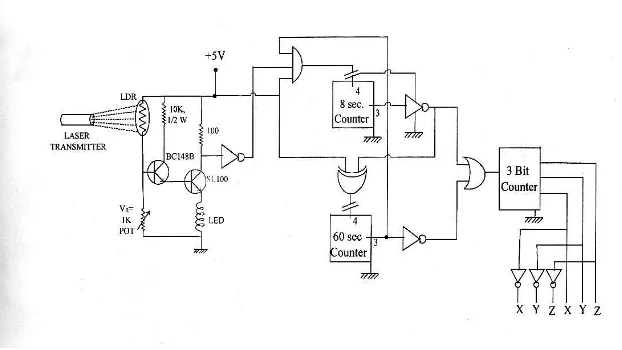
The laser receiver consists of a darlington pair,a LDR,a variable resistance and a fixed resistance.
Research Elaborations – The basic idea behind closed loop system is efficient time management in addition to good vehicle management. In open loop system there was no feedback for determining the density of vehicle; this major drawback is eliminated in design of closed loop system.
Here the control mechanism will open a specific sequence of road for suppose t1 time. Within this t1 time we will be receiving a signal from the road depending on vehicle density. Whenever the density is low / nil and the signal is fed back to the controller for a time t2 (t2 < < t1), it will automatically change to the next sequence of traffic control. Thus efficient time management is achieved by closed loop system.
Here only four lanes B, D, F and H are responsible for release of vehicles, so we are placing laser mechanism at the
laser receiver is 1 and the immediate vehicle is behind 20 meters mark from the laser a second delay will complete its time period and eventually resets the first delay (60 seconds) and changes on to the next sequence. This action will stop the vehicle behind 20 meters mark from crossing the laser. We have seen practically that a vehicle crossing a four way junction of roads always keep the speedometer at 10 km per hour. So to cross a 20 meters mark a car requires round about 8 seconds. If we set the second delay at 8 seconds so that it can automatically stop the vehicles, which are behind the 20 meters mark.
For figure 2, 3, 6 and 7 as both roads are working simultaneously then the transition of sequence will occur if delay – 1 (60 seconds) has completed its cycle or delay – 2 (8 seconds) of both the roads have completed their cycles.
Here we are designing two delays (60 seconds and 8 seconds) with IC555 and couple it to the 3 – bit binary counter. But here a problem arises, how we are going to synchronize the delays? As for road sequence 1, 4, 5 and 8 both the delays are ORed i.e. whenever one delay completes its time period the 3-bit counter changes to the next state but when the road sequence 2, 3, 6 and 7 are in operation both the 8 seconds delays of two roads are ANDed i.e. they can change the sequence only when density of vehicle in both roads are low; the ANDed operation in finally ORed to the 60 seconds delay. Simply we can show :
SEQUENCE = > [DELAY – 1] OR [DELAY – 2] (I,4,5,8)
SEQUENCE = > [DELAY – 1] OR [DELAY – 2 AND DELAY – 2 ]
(2,3,6,7)
Here two delay – 2 are represented for road B and F (sequence 2,3) and D and H (sequence 6, 7).
For convenient operation we are ANDing the output of laser receiver of path B & F and also of path D & H. Again we are ANDing both the outputs of the previous two AND gates and the output of the 3rd AND gate is given to 8 seconds delay at pin 4 (reset pin). From pin 3 (output terminal) we give one input to a OR gate and the same input is being given to 60 seconds delay at pin 4 to reset it. Likewise from pin 3 of 60 seconds delay we give input to the OR gate and the same being given to pin 4 of 8 seconds delay. Thus 8 seconds delay will be reset whenever 60 seconds delay completes. The output of the OR gate is given to a 3 – bit binary counter which generates 8 states and works on the same principle as of a open loop system. For closed loop system both 8 seconds and 60 seconds delays are important, as whenever one completes its time period we will go to the next sequence. Both delays are reset the other one for a smooth operation. Here one important fact is that the 8 seconds delay forcefully changes the sequence when we are in a 60 seconds slot.
The laser circuit is giving a high output when laser falls on to the LDR whereas the output is low if the laser is obstructed. In the first case vehicle is absent whereas vehicle is present in the second case. Now for synchronizing the two delays we are considering three cases :
i) 60 second is on, 8 second is off, 60 second changes the
state : 8 second is only off, when vehicle is present in between
laser transmitter and laser receiver i.e. the laser output terminal is low. So the 3 input AND gate output terminal is low, making 8 seconds delay off. But the NOT gate at 8 seconds output terminal will be giving high output and for that reason we are giving the
input terminal of pin 4 of 8 seconds delay to pin 14 of NOT gate. This will make the IC7404 to be at ground potential and gives low output, which is fed back to XOR gate and then given to pin 4 of 60 seconds delay. This will help the 60 seconds delay to remain ON and changes the state after its time period.
ii) 60 second is on,8 second starts and stops within 8
second,60 second changes the state: Here the 3-input AND gate
output terminal is high and starts the 8 second delay and thus the NOT gate is getting its required +V(CC).But still the output terminal of NOT gate is low and within 8 second slot the delay stops(due to presence of vehicle).Thus the NOT gate is at ground potential and still its output is low. Thus 60 second delay is ON and changes the state.
iii) 60 second is on,8 second starts and completes,8 second
changes the state: If 8 second delay completes its time period
Fig. 3 : Operation of 3 – bit binary counter
For giving practical low and high values to pin 4 of both delays relays have been used, which are operated by a transistor. The relay operated as a NOT gate.
[image:5.612.150.461.63.238.2]Whenever a particular sequence (overall 8 sequence) of road opens, the 60 seconds delay starts on its own. If traffic density is high it will continue its time period upto 60 seconds and then gives a pulse to the 3-bit binary counter to change its state. The roads which are closed will give a “high” output to the ANDed input terminal and the road/roads which are open will give a “low” output if density of road is high. When density of road is low it will give a “high” output and thus the ANDed combination will only work then and starts the 8 seconds delay. The 8 seconds delay can be reset whenever the output of the specific road is “low”.
Fig. 4 : Model of the Project
For road sequence 2,3,6,7 both roads B & F and D & H will have to go through a dual checking of road density and only when both the laser output of the roads are “high”, then only 8 seconds delay will start.
8 seconds delay forcefully changes the 3-bit binary counter to change its state whenever the time period is complete.
Whether the 8 seconds or the 60 seconds delay has completed its time period it will change the 3-bit binary counter to next state and the same output will reset the other delay. Both the delay output terminals are ORed and then given to the 3-bit binary counter.
II. CONCLUSIONS
i) The system will never fail as there is a separate 60 seconds delay which only depends on the change of state of the 3-bit binary counter. So even if the laser mechanism or the 8 seconds delay fails to operate, the 60 seconds delay will continue to operate and thus the closed loop system converts into an open loop system and reduces all chances of accidents.
ii) Here we only apply one special condition in the road. From head of a road there will be zebra crossing, then the laser
REFERENCES
[1] I.J. Nagrath, “Control Systems Engineering”, New Age International. [2] S. Hasan Saeed, “Control Systems”, SK Kataria & Sons.
[3] Forrest M. Mims iii, “Timer,Op Amp & Optoelectronic Circuits & Projects”, Master Publishing Inc.
[4] Anil K. Maini, “Digital Electronics:Principles,Devices and Applications”, Wiley.