Handwritten Character Recognition – A Review
Surya Nath R S*, Afseena S**
*
Computer Science, College of Engineering Karunagappally
**
Computer Science, College of Engineering Karunagappally
Abstract- In the field of pattern recognition, HCR is one of the most intricate and tricky area. Plenty of works were proposed for foreign languages but a few works exists for south Indian languages due to the complex shape and varying writing styles of individuals. This paper introduces a review of offline and online recognition of different natural languages. HCR is an optical character recognition, which convert the textual document in to machine readable format. To attain 99.9 % accuracy in the field of HCR is very difficult. The efficiency of HCR depend the features extracted and the classifier used.
Index Terms- Adaboost, Artificial Neural Network, Contourlet, Curvelet, Gabor filter, K-Nearest Neighbor, MQDF, Ridgelet, Support Vector Machine.
I. INTRODUCTION
Reading of written or printed document is easy for human being, this ability can be induced in machine using OCR (Optical Character Recognition) technique. OCR is the identification of both handwritten and printed document using computer. In OCR technique, digital camera or a scanner is used to capture different types of documents like paper documents, PDF files and character images and convert all these documents into machine editable format like ASCII code.
Advantage of OCR systems is that it can reduce the data entry time, storage space required by documents. Fast retrieval is an alternative advantage. OCR can be used in diverse fields like banking field where checks can be processed without human interruption and to digitize paper documents in legal industries.
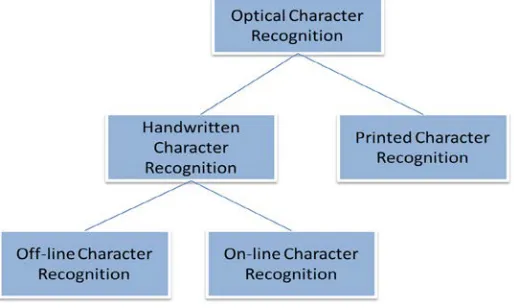
[image:1.612.315.572.163.317.2]OCR can be classified into two categories based on text type and acquisition of documents (Figure 1). On the basis of text type OCR is of two types HCR, (Handwritten Character Recognition) recognition of intelligible handwritten input from source such as paper documents and PCR, (Printed Character Recognition) recognition of printed documents. Main reason for high recognition complexity in HCR is due to the varying writing styles of different peoples. Even in same individual also the writing style and format are different. OCR is divided in to Off-line and On-Off-line recognition systems based on acquisition of documents. In Off-line systems already written document is scanned and is taken as input for recognition. But in the case of On-line systems character is recognized at the time of writing, where characters are captured by a tablet digitizer. Electronic pen is used to write the character on the digitizer and based on the pen movement character can be recognized.
Figure 1. Classification of Optical Character Recognition
Stages of OCR systems broadly divided in to pre-processing, segmentation, feature extraction and classification (Figure 2).
A. PREPROCESSING
Preprocessing is an important step in character recognition, which includes noise removal, binarization, skeletonization and normalization [14].
Noise removal
Noise is the unwanted intensity values in an image that has no significance in the output. Different types of noises such as impulse noise, gaussian noise, speckle noise and photon noise are added to the character image during image acquisition. Noise removal is the technique required to eliminate this unwanted bit patterns. Linear and non linear filtering can be used for noise removal. Median filter is a non linear filter very effective in removing salt and pepper noise, which is an impulse noise present in image as small black and white dots [19]. Median filter sort all the pixels in a particular area and replace the centre pixel with the median of sorted values.
Binarization
variance. The optimal threshold is choosen in such a way that which has minimum interclass variance.
Skeletonization
It is a morphological operation which converts the image in to one pixel wide representation without affecting their connectivity. Thinning required to obtaining the skeleton of an image by eliminating pixels that have more than two neighbours.
Normalization
Process of converting image into some standard form. Normalization includes size and skew normalization [18]. Size normalization converts image in to fixed size. Bilinear and bicubic interpolation can be used. Skew may introduce in the image at the time of scanning, which is the deviation of text from base line. To align this text skew detection and corrections are required.
B. SEGMENTATION
Segmentation is the process of converting input image in to individual characters. Which include line segmentation, word segmentation and character segmentation.
C. FEATURE EXTRACTION
Feature extraction is the main phase in character recognition. Which extract most relevant features. Recognition accuracy is mainly depends on extracted features. Different feature extraction methods described are Contourlet transform [6][1], Ridgelet transform [2], Curvelet transform [7][8], Gabor filter [10][4], Directional features [17][3], Gradient and curvature [9], Gradient alone is used as feature in [12][1], zonal feature [18][5], Count, position of horizontal and vertical intensity lines [16] and boundary tracing [15].
D. CLASSIFICATION
Classification is the decision making stage of character recognition. The extracted features are used for recognizing characters. The classification of relevant features are done by using different classifier that are neural network [1][4][13][16][5], SVM [2][9][10][12], MQDF [3], Adaboost [6], KNN [7][8][11], Multilayer perceptron [14], Decision tree [15], Genetic algorithm [17].
II. LITERATURE REVIEW
[image:2.612.401.512.56.223.2]This section gives a review of Handwritten Character Recognition in different languages. A brief sketch of preprocessing, feature extraction and classification methods for several works are summarized below.
Figure 2. Stages of Optical Character Recognition 1) Global thresholding is used to convert the input image
in to bilevel form. Erosion, dilation and thinning are the morphological operations. To obtain the skeleton thinning is used. Line segmentation, word segmentation and character segmentation used for segmenting input image in to individual characters. After all these preprocessing the character image is given to the feature extraction phase for extracting relevant features. Contourlet transform is the feature extraction method. Total 32 features are obtained by four level decomposition of Contourlet, aspect ratio, ratio of horizontal and vertical grid values. The extracted features are classified by feed forward neural network. Using the 32 features yield 97.3% accuracy.
2) Hassiba Nemmour et al [2] had taken care of handwritten Arabic word recognition. Two approaches for word recognition such as analytic and holistic approaches are explained. Ridgelet transform is used for feature extraction. Advantage of using ridgelet is to highlight the line singularities in the handwritten words. SVM is used as the classifier. This work gives 84% efficiency.
4) Nusaibath C et al [4] in offline handwritten character recognition the input image is acquired by digital camera and scanner. Preprocessing is done to correct the input image, binarization and skeletonization is used for this purpose. Line segmentation, word segmentation and character segmentation are used to segment the characters. Most relevant features are identified by Gabor filtering. Additional features taken are aspect ratio, ratio of horizontal and vertical grid values. Neural network is used for classification. Recognition efficiency obtained is 96.80%.
5) Pritpal Sigh et al [5] presented handwritten character recognition for Gurumukhi numerals. Here the stages of character recognition include preprocessing, feature extraction and classification. The filtered image binarised and normalized to 32 X 64. Features are taken as the wavelet coefficients. In addition to this wavelet feature zonal features are also consider here. Zonal density is obtained by dividing the normalized image in to 16 zones. Aspect ratio is the final feature value for making the feature vector. Multi layer neural network that uses back propagation algorithm as the classifier. Recognition rate of 88.8% is obtained.
6) G Y Chen et al [6] suggested invariant pattern recognition. Invariant means features must be independent. Features that are invariant under translation, rotation, scaling is obtained by Fourier transform. For palm print classification Contourlet transform extract the features and invariant feature is obtained by taking Fourier of the Contourlet coefficients. Classifier used is the adaptive classifier Adaboost. For handwritten numerals also Fourier is applied to Contourlet coefficients and invariant features are classified using Adaboost.
7) Mamatha H R et al [7] is the recognition of Kannada numerals. Kannada is the official language of state Karnataka. It is derived from the southern Bramhi lipi. To preprocess the image binarisation and thinning done. To overcome the limitations of wavelet a new approach is introduced called curvelet transform. So the features are curvelet coefficients and standard deviation is the dimension reduction technique. For the classification of characters KNN used. This paper gives accuracy of 90.5%.
8) Angshul Majumdar et al [8] focus on the recognition of Bangali characters. Curvelet coefficients are taken
as the feature values. Here two thinned and thickened version of the image is considered. The fundamental concept is that if the character can’t recognize with original image it will be recognized with morphologically altered variations. For testing and training five variations of input image is taken and classified using KNN. Overall accuracy of 96.80% is obtained.
9) Jomy John et al [9] propose a handwritten character recognition system for Malayalam language. Gradient and curvature are calculated in feature extraction. Directional information from the arc tangent of gradient is used as gradient feature. Strength of gradient in curvature direction is used as the curvature feature. It uses a combination of gradient and curvature feature in reduced dimension as the feature vector. Support Vector Machine used as classifier.
10) Sukhpreet Singh et al[10] propose Handwritten Gurmukhi character recognition for isolated characters. The preprocessing stage reduces noise and distortion, removes skewness and performs skeletonization of the image. Word segmentation and character segmentation is used as segmentation stages. Gabor Filter based methods are used for feature extraction. The extracted features are given to SVM for classification and achieves accuracy of 94.29%
11) Alvaro Gonzalez et al[11] presents an easy and fast method to recognize individual characters in images of natural scenes that is applied after locating text on such images. Feature can be extracted by using Gradient feature. The recognition is based on a gradient direction feature. KNN for classification. The efficiency of this work is 85.8%.
13) Karanbir Kaur et al [13] had taken care of English handwritten character recognition. Introduce image cropping, gray the image and binarization as preprocessing steps. 40-point feature extraction is introduced for extracting the features of the handwritten alphabets. ANN is used for classification.
14) Anita Pal et al [14] focus on the recognition of English handwritten character using neural network. Input character is acquired by scanning. Skeletonization and normalization are used as preprocessing steps. The features are extracted from the handwritten character by using boundary tracing along with Fourier Descriptor. Multilayer Perceptron Network is used for the classification of extracted feature.
15) Abdul Rahiman M et al[15] introduces Malayalam handwritten character recognition by using vertical and horizontal line positional analyzer algorithm. Image were acquired by scanning is converted to gray scale. Noise removal, skeletonization are used for preprocessing. Line segmentation and character segmentation are used to separate individual character. Count and position of vertical and horizontal lines are taken as relevant features. The characters are classified based on the extracted feature using decision tree.
16) Sumedha B. Hallale et al [16] had taken care of directional feature extraction for handwritten character recognition. Noise removal, skeletonization and normalization are used as preprocessing to prepare the input image. Directional features are extracted using sobel mask. Relevant feature extracted are given to neural network for classification.
17) VedPrakash Agnihotri et al [17] Presented zone based features for the recognition of Devanagari script. Enhance the input image using binarization, noise removal, edge detection and dilation. For getting the zonal feature divide the enhanced image in to 54 equal zones. So 54 features are obtained from each character. The extracted features are classified using genetic algorithm.
III. CONCLUSION
This paper presents detailed review of character recognition in different languages and studies various algorithms for recognition. From this review it can be observed that recognition
accuracy depends on the feature extraction and classification methods used. The best recognition accuracy was reported for [1], uses Binarization, Noise removal, Skeletonization and Normalization as preprocessing methods. Contourlet extract the significant features and are classified using feed forward neural network.
REFERENCES
[1]Aji George and Faibin Gafoor,”Contourlet Transform Based Feature Extraction For Handwritten Malayalam Character Recognition Using Neural Network”, IRF International Conference Chennai, pp: 107-110, 2014.
[2] Hassiba Nemmour and Youcef Chibani,”Handwritten Arabic Word Recognition based on Ridgelet Transform and support Vector Machines”, IEEE, pp: 357-361, 2011.
[3] Bindu S Moni and G Raju,”Modified Quadratic Classifier and Directional Features for Handwritten Malayalam Character Recognition”, IJCA Special Issue on”Computer Science-New Dimensions and Perspectives”, pp: 30-34, 2011.
[4]Nusaibath C and Ameera Mol P M,”Off-line Handwritten Malayalam
Character Recognition using Gabor Filters”, International Journal of Computer
Trends and Technology, pp: 2476-2479, 2013.
[5]Pritpal Singh and Sumit Budhiraja,”Offline Handwritten Gurmukhi Numeral
Recognition using Wavelet Transforms”, I. J Modern Education and Computer
Science, pp: 34-39, 2012.
[6]G. Y. Chen and B. Kegl,”Invarient Pattern Recognition using Contourlets and Adaboost”, Pattern Recognition Society Elsevier, pp: 1-13, 2012.
[7]Mamatha H. R, Sucharitha S and Srikanta Murthy K,”Handwritten Kannada Numeral Recognition based on the Curvelets and Standard deviation”, International Journal of Processing Systems, pp: 74-78, 2013.
[8]Angshul Majumdar,”Bangala Basic Character Recognition Using Digital Curvelet Transform”, Journal of Pattern Recognition Research, pp: 17-26, 2007. [9]Jomy John,Kannan Balakrishnan and Pramod K. V, ”A system for Offline
Recognition of Handwritten Characters in Malayalam Script”, I.J.IGSP,
pp:53-59, 2013.
[10] Sukhpreet Singh, Ashutosh Aggarwal and Renu Dhir,”Use of Gabor Filters
for Recognition of Handwritten Gurmukhi Character”, International Journal of
Advanced Research in Computer Science and Software Engineering, pp: 234-240, 2012.
[11] Alvaro Gonzalez, Luis M. Bergasa, J. Javier Yebes and Sebastian Bronte”A Character Recognition Method in Natural Scene Images”, Pattern Recognition (ICPR), pp: 621-624, 2012.
[12]Ashutosh Aggarwal, Rajneesh Rani and RenuDhir,”Handwritten Devanagari Character Recognition Using Gradient Features”, Pattern Recognition (ICPR), pp: 621-624, 2012.
[13] Karanbir Kaur and Naresh kumar Garg,”Use of 40-point Feature Extraction for Recognition of Handwritten Numerals and English Characters”, IJCTA, pp: 1409-1414, 2014.
[14] Anita Pal and Davashankar Singh,”Handwritten English Character Recognition Using Neural Network”, International Journal of Computer Science and Communication, pp: 141-144, 2011.
[15] Abdul Rahiman M and Rajasree M S,”An Efficient Character Recognition System for Handwritten Malayalam Characters Based on Intensity Variations”, International Journal of Computer Theory and Engineering, pp: 369-374, 2011. [16] Sumedha B. Hallale and Geeta D. Salunke,”Twelve Directional Feature Extraction for Handwritten English Character Recognition”, International Journal of Recent Technology and Engineering, pp: 39-42, 2013.
[17]Ved Prakash Agnihotri”Offline Handwritten Devanagari Script Recognition”, I. J Information Technology and Computer Science, pp: 37-42, 2012.
[19] Rohit Verma and Jahid Ali,”A comparative study of Various Types of Image
Noise and Efficient Noise Removal Techniques”, International Journal Of
Advanced Research in computer Science and Software Engineering, pp: 617-622, 2013.
[20] Daniel X. Le and George R. Thoma,”Document Skew Angle Detection
Algorithm”, Proc.1993 SPIE Symposium on Aerospace and Remote
Sensing-Visual Information Processing II, pp: 251-262, 1993.
Authors
First Author – Surya Nath R S, M Tech Student In Image Processing, College of Engineering Karunagappally, [email protected].