www.ijsrp.org
Stability indicating UPLC Method for the Estimation of
Telmisartan Related Substances in Tablets Formulation
V. Bhavani
1*, T. Siva Rao
1, SVN Raju
3, B.Madhusudan
3, Jamelunnisa Begum
2 1) Dept of inorganic and analytical chemistry, Andhra University, Visakhapatnam2) Dept. of Chemistry, St. Theresas College, Eluru, Andhra Pradesh, India 3) Dept. of Chemistry, Dr. Reddys Lab, Hyderabad, India
*Corresponding author: E-mail ID: [email protected] Tel.: +91 40 44346285; Mobile: +91 9866471036
Fax: +91 40 44346285
Postal address: V.Bhavani, C/O Seetal apartments, Maruthinagar, D.NO-4-111, Flat no-302, Malkajgiri, Secunderabad (AP), India
Abstract:
A simple, precise, accurate stability-indicating gradient reverse phase ultra-performance liquid chromatographic (RP-UPLC) method was developed for the quantitative estimation of purity of Telmisartan drug substance and drug products in bulk samples and pharmaceutical dosage forms in the presence of its degradation products and impurities. The present method was developed using Waters Aquity BEH C18 (100 mm x 2.1 mm, 1.7 µ) column with mobile phase containing a gradient time programme of the solvents A and B. The wave length selected for monitoring eluted compounds were monitored at 290 nm, the run time was within 10 min, which Telmisartan and its seven impurities were well separated. Telmisartan was found to degrade significantly in acid stress condition when it was subjected for various stress conditions. The degradation products were well separated from main peak and its impurities, proving the stability-indication of the method. The present method was validated as per international conference on harmonization (ICH) guidelines with respect to precision, specificity, linearity, limit of detection, limit of quantification, accuracy, and robustness.
Index Terms: Telmisartan; UPLC method; Validation; Stability indicating; Tablets formulation
I. INTRODUCTION
elmisartan is an angiotension receptor blocker that shows high affinity for the angiotension II type 1 receptors, has a long time duration of action, and has the longest half life of an ARB. In addition to the blocking the Renin Angiotensin System [RAS], the present drug telmisartan acts as a selective modulator of Peroxisome proliferator activated receptor gamma [PPAR-γ], a central regulator of insulin and glucose metabolism. In the present study Telmisartan in a tablet formulation was used to evaluate the chromatographic separation of Telmisartan and its related impurities by using uplc, because as per the literature there was no uplc method.
Literature reveals few RP-HPLC methods (Kiran R. Patil et al., 2008) and is not capable of producing proper resolution between impurity F and impurity E and also (Ch. Phani Kishore., 2010) RP-HPLC method is not capable of producing better resolution between Tel2 and Dimer acid. The main objective is to develop and validate a simple, rapid effective and reproducible UPLC method for the determination of Telmisartan related impurities in tablet formulation with short runtime and more resolution, less consumption of solvents. So It is therefore felt necessary to develop a new stability-indicating method for the related substance determination and quantitative estimation of impurities of telmisartan also by UPLC. An attempt was made to determine whether UPLC can reduce analysis times with increase in resolution, accuracy, sensitivity and also with out using buffer as diluent to increase column lifetime. Hence, a reproducible stability-indicating RP-UPLC method was developed for the quantitative estimation of telmisartan and its seven impurities. This method was validated successfully according to the
International Conference Harmonization guidelines [Validation of Analytical Procedures: Test and Methodology Q2]. The proposed
method is found to be sensitive, precise, rapid, reproducible, limit of quantification (LOQ) and good limit of detection (LOD) and offers good column life time with better separation.
www.ijsrp.org
II. EXPERIMENTAL
Standards and samples
Telmisartan (purity-99.0%) and impurities A, B, C, D, E and F are official in European Pharmacopoeia. impurity C is a process related impurity and impurity D is unspecified impurity. dimer acid, Chloro analogue impurity and TEL2 are in-house impurities. Impurity E and impurity F are obtained from synpure laboratories. Telmisartan, Telmisartan 80mg tablets,
Impurity - A, impurity- B, dimer acid, Chloro analogue impurity and TEL2 are obtained from Dr.Reddy’s laboratories Ltd. Specification limit for all impurities- 0.1%.
Reagents
Triethyl amine, ortho phosphoric acid are of AR grade and milli-Q water was used during analysis. Acetonitrile, Methanol used were of HPLC grade.
UPLC Instrumentation and chromatographic conditions
All analytical works performed on waters aquity UPLC quarternary gradient pump with photo diode array detector. Detection was carried out with Empower 2 software , aquity UPLC-BEH C-18 column (100mm X 2.1 mm, 1.7 µ particle size) as stationary phase, a calibrated electronic single pan balance Mettler toledo, and ultra sonicater Bandelin sonorex also used during the analysis. The solvent A contains a mixture of 10mM Ammonium acetate with addition of 1mL triethyl amine, pH adjusted to 3.9 with ortho phosphoric acid and Acetonitrile in the ratio 90:10 (v/v); and the solvent B contains acetonitrile respectively. Mobile phases are filtered through a 0.22 µm PVDF membrane filter (Millipore, India). The binary gradient programme was as follows [time (min) / mobile phase A (%) / mobile phase B (%)]: 0.01/65/35, 1.0/65/35, 7.0/30/70, 7.5/5/95, 9.0/5/95, 9.5/65/35, 10/65/35. The column oven temperature was maintained at 40°C, and injection volume 4µl. Eluent with flow rate of 0.3 mL / min was monitored at 290 nm with the PDA detector. Methanol was used as the diluent for all preparations. The run time optimized was found to be 10 minutes. System suitability solution preparation
Standard stock solution (1000μg/mL) was prepared in methanol. About 50mg of the working standard was transferred into 50mL volumetric flask, dissolved in methanol with sonication and diluted to volume, 2.0mL of the stock solution was pipette to 100mL volumetric flask and diluted to volume with diluent. 5.0 mL the above solution pipette to 100mL and diluted to volume with diluent to achieve a concentration of 1μg/mL. The system suitability test was performed by injecting this solution two times and getting the area ratio between 0.98 to 1.02, with tailing factor <1.2.
Sample preparation
The drug was extracted from tablet formulation of 80mg label claim using the diluent. About 100mg equivalent of the Telmisartan was taken into 100 mL volumetric flask, 60mL diluent was added and sonicated for 15minutes and cooled to room temperature. Diluted to volume with diluent to achieve a target concentration of 1000μg/mL then filtered with Randisc PVDF 0.22µm filter.
Spiked sample preparation
The drug was extracted from tablet formulation of 80mg label claim using the diluent. About 100mg equivalent of Telmisartan was taken into 100 mL volumetric flask, 60mL diluent was added and sonicated for 15minutes and cooled to room temperature. 1mL of each impurity stock solution (100μg/mL) added to the above solution. Diluted to volume with diluent to achieve a target concentration of 1000μg/mL for Telmisartan and 1 μg/mL for impurities, Diluted to volume with diluent and then filtered with Randisc PVDF 0.22µm filter.
III. RESULTS AND DISCUSSION
Optimization of Chromatographic conditions
www.ijsrp.org Acetonitrile in the ratio 90:10 (v/v); and the solvent B contains acetonitrile respectively. Mobile phases are filtered through a 0.22 µm PVDF membrane filter (Millipore,
India).The binary gradient programme was as follows [time (min) / mobile phase A (%) / mobile phase B (%)]: 0.01/65/35, 1.0/65/35, 7.0/30/70, 7.5/5/95, 9.0/5/95, 9.5/65/35, 10/65/35. The column oven temperature was maintained at 40°C, and injection volume 4µl. Eluent with flow rate of 0.3 mL/min was monitored at 290 nm with the PDA detector. Methanol was used as the diluent for all preparations. The run time optimized was found to be 10 minutes.
So with this gradient elution it was found good separation of all impurities with main peak and tailing factor less than 2.0 and resolution > 2.0. Finally the praposed method was subjected to method validation according to the International conference on Harmonization guidelines, with consideration of sample concentration to achieve an LOQ below reporting threshold of the impurities. Buffer Selection
Different buffers such as potassium phosphate, sodium per chlorate, ammonium acetate were evaluated for system suitability parameters and overall chromatographic performance. In the sequential trials Ammonium acetate was found to be suitable for effective separation of parent peak and impurities. Ammonium acetate buffer ranging from 5 mM to 25mM were tried . It was observed that change in the buffer concentration did not offer significant changes in the elution pattern and resolution, but 10mM concentration increased the sensitivity of the method.
Effect of pH
The pH had an effect on the retention times of the Telmisartan and its related compounds. Resolutions and peak symmetry are found good at pH 3.9
Effect of additive
The usage of additive like tri ethyl amine reduces the tailing factor in order to gave a better resolution between main peak and related substances.
Drug extraction from formulations
The extraction of the drug from formulation tried with different solvents such as Acetonitrile, methanol, methanol with water. The complete extraction of drug was achieved with methanol. Telmisartan has solubility in methanol.
Forced degradation studies
The Forced degradation of formulation was carried out as per ICH guidelines (ICH Q2B) and photolysis. The acid, base, and oxidation stress conditions were studied out by refluxing API for 6hrs with 5mL of 5N HCl, 5N NaOH and 3% hydrogen peroxide at 60°c respectively. The thermal degradation was carried out by heating the drug powder at 105◦Cfor about 24hrs and, degradation by humidity was performed by exposing the drug material to 90%RH-25°C about 10days, and the sunlight degradation was performed exposing the drug material 55 hrs to sunlight, UV light degradation was performed by exposing the drug material at 254nm-7days. All the stress conditions with purity angle and purity threshold are reported in (Table 2).
Telmisartan was found to degrade significantly in acid stress condition and the impurity formed was found to be Dimer acid, stable in base, oxidative, UV, Sunlight and Thermal degradation conditions. The degradation peaks were well separated from main peak as well as from all impurities, providing the stability indication of the method.
Method validation
System Suitability
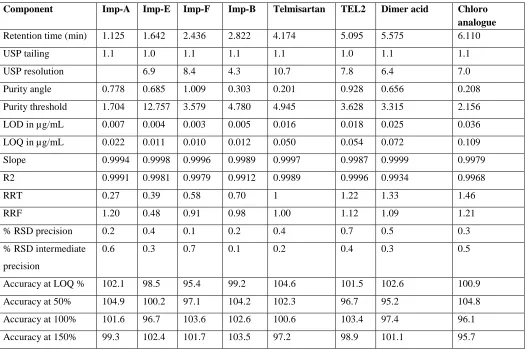
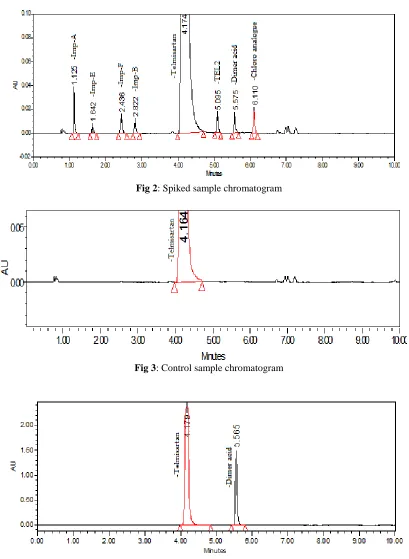
System suitability parameters were measured so as to verify the system, method and column performance. Results of system suitability parameters such as tailing factor and similarity factor . Tailing factor for Telmisartan peak in standard solution is not more than 2.0, and similarity factor (between two System suitability solution injections) is not less than 0.98 and not more than 1.02. Results the similarity factor between two standard injections found to be 0.99 and the tailing factor 1.0, Fig. 1. The values are presented in Tab.1.
Precision
Method precision was established by a set of six sample preparations. To demonstrate the method precision, all impurities were spiked at the 0.1% level into six sample preparations as shown in Fig. 2. The percentage of RSD for the area of Telmisartan, and all its seven impurities were within +2.0% and tailing factor for all peaks <2.0, conforming good precision of the method. To check reproducibility of the method intermediate precision study has been performed with another person another day another system and column. The values are presented in Tab. 1.
Limit of detection and Limit of quantification:
www.ijsrp.org individual preparations, and calculated the %RSD of the area for each individual impurity and Telmisartan. Determination of limit of detection and quantification of all the impurities and Telmisartan are reported in Tab. 1.
Linearity:
The result shows an excellent correlation between the peak area of the telmisartan and the areas of all impurities. Linear calibration plot for the related substances method was obtained over the calibration ranges tested , i.e. LOQ to 150% of the drug and impurities, specification level for all impurities considering 0.1% as 100% level, and for drug considering test sample concentration as 100%. The result shows an excellent correlation between the peak area of the telmisartan and the areas of all impurities. Correlation coefficient obtained was greater than the 0.999, slopes were mentioned in Tab. 1.
Accuracy:
The recovery of impurities and Telmisartan were determined by spiking each impurity and main drug at different levels starting from LOQ Level to 150% of specification level of the all impurities. The recovery range for all impurities and Telmisartan was found to be between 95 to 105%, the percentage of RSD for three preparations at each level was found to be with in 2% results were mentioned in Tab. 1.
Specificity
This study was carried out in terms of different force degradation studies. Samples were stressed with different conditions and injected into UPLC. From these studies it was found that Telmisartan was undergoing more degradation under acidic condition and the impurity formed was found to be Dimer acid. All degraded peaks were well separated from main peak and impurities. The purity angle was within the purity threshold limit obtained in all stressed samples and demonstrates the analyte peak homogeneity. Assay of stressed samples were calculated by comparison with standards and the mass balance for stressed samples was calculated. With different stress conditions percentage of degradation are listed in Tab. 2. Chromatogram were shown in Fig. 3 & 4.
Solution stability and mobile phase stability
No significant changes were observed in the content of impurities during mobile phase stability and solution stability studies when performed using the related substance method. The solution stability and mobile phase stability experiment data confirms that the sample solutions and mobile phases used during related substance determination were stabl e for 120 hrs.
Robustness
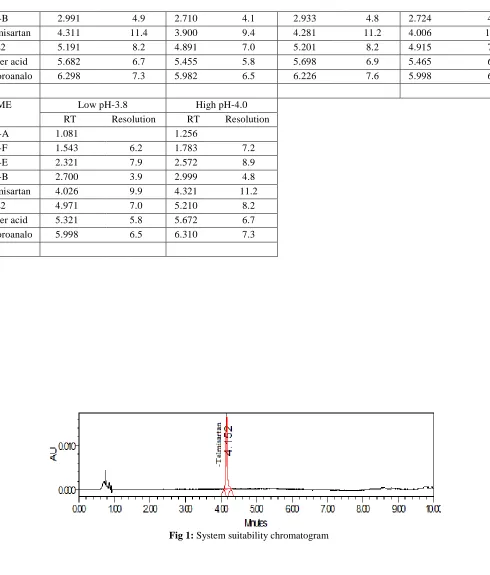
In all the deliberate varied chromatographic conditions Flow rate, pH, Column temperature, the results showed with all change d conditions, values of the related impurities for the test preparation were found to be in accordance w ith the values obtained in the method precision study. Hence the analytical method can be considered to be robust. Detailed information is given in Tab. 3.
IV. CONCLUSION
The method provides selective quantification of Telmisartan impurities without interfere nce of blank, there by affirming stability-indicating nature of the method. The proposed method is highly selective, reproducible, speci fic and rapid with more accuracy, less runtime and with less consumption of solvents. The developed method is robust in the separation and quatification of Telmisartan related impurities. This method can be used in the routine analysis of production samples. The information presented here in could be very useful for quality monitoring of bulk samples and as well employed to check the drug product quality during stability studies.
ACKNOWLEDGEMENTS
www.ijsrp.org
Table 1: System suitability, precision, Accuracy, Linearity, LOD, LOQ, RRF, RRT of Telmisartan and impurities
Component Imp-A Imp-E Imp-F Imp-B Telmisartan TEL2 Dimer acid Chloro
analogue
Retention time (min) 1.125 1.642 2.436 2.822 4.174 5.095 5.575 6.110
USP tailing 1.1 1.0 1.1 1.1 1.1 1.0 1.1 1.1
USP resolution 6.9 8.4 4.3 10.7 7.8 6.4 7.0
Purity angle 0.778 0.685 1.009 0.303 0.201 0.928 0.656 0.208
Purity threshold 1.704 12.757 3.579 4.780 4.945 3.628 3.315 2.156
LOD in µg/mL 0.007 0.004 0.003 0.005 0.016 0.018 0.025 0.036
LOQ in µg/mL 0.022 0.011 0.010 0.012 0.050 0.054 0.072 0.109
Slope 0.9994 0.9998 0.9996 0.9989 0.9997 0.9987 0.9999 0.9979
R2 0.9991 0.9981 0.9979 0.9912 0.9989 0.9996 0.9934 0.9968
RRT 0.27 0.39 0.58 0.70 1 1.22 1.33 1.46
RRF 1.20 0.48 0.91 0.98 1.00 1.12 1.09 1.21
% RSD precision 0.2 0.4 0.1 0.2 0.4 0.7 0.5 0.3
% RSD intermediate
precision
0.6 0.3 0.7 0.1 0.2 0.4 0.3 0.5
Accuracy at LOQ % 102.1 98.5 95.4 99.2 104.6 101.5 102.6 100.9
Accuracy at 50% 104.9 100.2 97.1 104.2 102.3 96.7 95.2 104.8
Accuracy at 100% 101.6 96.7 103.6 102.6 100.6 103.4 97.4 96.1
[image:5.612.65.552.480.630.2]Accuracy at 150% 99.3 102.4 101.7 103.5 97.2 98.9 101.1 95.7
Table 2: Data of Degradation studies
Condition Time % of
degradants
% Assay of active
Mass balance Purity flag
UV light at-254nm 7 days NA 99.3 99.3 No
Humidity-90%RH-25°C 10days 0.72 99.1 99.8 No
Sun light 55 hrs NA 99.5 99.5 No
Thermal-105°c 24hrs 0.35 99.1 99.5 No
3%H2O2_60°C 6hrs 0.79 99.2 99.9 No
5N HCl_60°C 6hrs 19.76 79.0 98.8 No
5N NaOH 60°C 6hrs 0.41 98.5 98.9 No
Table 3: Data of robustness study
NAME Low flow rate-0.25ml/min High flow
rate-0.35ml/min
Low temp-35°C High temp-45°C
RT Resolutio
n
RT Resolution RT Resolutio
n
RT Resolutio
n
Imp-A 1.251 1.100 1.231 1.001
Imp-F 1.762 7.2 1.514 6.6 1.716 7.1 1.513 6.2
[image:5.612.43.579.665.739.2]www.ijsrp.org
Imp-B 2.991 4.9 2.710 4.1 2.933 4.8 2.724 4.1
Telmisartan 4.311 11.4 3.900 9.4 4.281 11.2 4.006 10.3
TEL2 5.191 8.2 4.891 7.0 5.201 8.2 4.915 7.5
Dimer acid acid
5.682 6.7 5.455 5.8 5.698 6.9 5.465 6.1
Chloroanalo gue anaanalogue
6.298 7.3 5.982 6.5 6.226 7.6 5.998 6.7
NAME Low pH-3.8 High pH-4.0
RT Resolution RT Resolution
Imp-A 1.081 1.256
Imp-F 1.543 6.2 1.783 7.2
Imp-E 2.321 7.9 2.572 8.9
Imp-B 2.700 3.9 2.999 4.8
Telmisartan 4.026 9.9 4.321 11.2
TEL2 4.971 7.0 5.210 8.2
Dimer acid acid
5.321 5.8 5.672 6.7
Chloroanalo gue anaanalogue
5.998 6.5 6.310 7.3
[image:6.612.57.547.54.629.2]www.ijsrp.org
Fig 2: Spiked sample chromatogram
Fig 3: Control sample chromatogram
Fig 4: Acid degraded sample chromatogram
REFERENCES
[1] Srinivasan, V., Sivaramakrishnan, H., Karthikeyan, B. Detection, isolation and characterization of principle synthetic route indicative impurity in Telmisartan, (2012) Arabian Journal of Chemistry, .Article in Press.
[image:7.612.97.506.56.615.2]www.ijsrp.org [3] Mhaske, R.A., Garole, D.J., Mhaske, A.A., Sahasrabudhe, S.RP-HPLC method for simultataneous determination of amlodipine Besylate, Valsartan, Telmisartan, Hydrochlorothiazide and Chlorthalidone: Application to commercially available drug products, (2012) International Journal of Pharmaceutical Sciences, 3 (1), 141-149.
[4] Nageswara Rao, R., Guru Prasad, K., Gangu Naidu, C., Maurya, P.K.Development of a validated liquid chromatographic method for determination of related substances of telmisartan in bulk drugs and formulations, (2011) Journal of Pharmaceutical and Biomedical Analysis, 56 (3), 471-478.
[5] Mukhopadhyay, S., Kadam, K., Sawant, L., Nachane, D., Pandita, N.Simultaneous determination of related substances of telmisartan and hydrochlorothiazide in tablet dosage form by using reversed phase high performance liquid chromatographic method (2011) Journal of Pharmacy and Bioallied Sciences, 3 (3), 375-383. [6] Nalwade, S., Reddy, V.R., Rao, D.D., Rao, I.K.Rapid simultaneous determination of Telmisartan, Amlodipine besylate and Hydrochlorothiazide in a combined
poly pill dosage form by stability-indicating ultra performance liquid chromatography (2011) Scientia Pharmaceutica, 79 (1), 69-84.
[7] Geneva, Switzerland: ICH; 2005. International Conference on Harmonization (ICH) Q2 (R1): Validation of Analytical Procedures-Test and Methodology. [8] United State Pharmacopeia Convention, System Suitability Testing. 30th ed. Rockville, USA: 2007. The United State Pharmacopeia.
[9] Washington, USA: Center for Drug Evaluation Research (CDER); 1994. FDA, Reviewer Guidance: Validation of Chromatographic Methods.
[10] Phani Kishore Ch, Bhanuprakash Reddy V, Dhanashri M Kale. Development and Validation of stability indicating HPLC method for the estimation of Telmisartan related Substances in tablets formulation. www.ijrps.pharmascope.org, ISSN: 0975-7538
[11] Kiran R. Patil, Vipul P. Rane, Jaiprakash N. Sangshetti and Devanand B. Shinde , journal Of Chromatographia, 2008, 67:455-459
[12] Wienen W, Entzeroth M, Meel JC, Stangier J, Busch U, Ebner T, et al. A review on telmisartan: A novel, longacting angiotensin II-receptor antagonist. Cardiovasc Drug Rev. 2000, 18:127–56. Doi: 10.4103/0975-7406.84441
[13] Unger T. Significance of angiotensin type 1 receptor blockade: why are angiotensin II receptor blockers different. Am J Cardiol. 1999, 84: 9–15. [14] Dollery C. 2nd ed. United Kingdom: Churchill Livingstone; 1999.Therapeutic Drugs; pp. 52–7.
[15] 6th ed. Strasbourg: 2006. European Pharmacopoeia, Telmisartan; p. 3851.
[16] The Directorate for the Quality of Medicines of the Council of Europe. 4th ed. 2002. European Pharmacopoeia; pp. 1352–4.
[17] Palled MS, Chatter M, Rajesh PM, Bhat AR. Difference spectrophotometric determination of telmisartan in tablet dosage forms. Indian J Pharm Sci. 2006, 68:685. doi: 10.4103/0250-474X.29653
[18] Bhat L, Godge R, Vora A, Damle M. Validated RP-HPLC Method for Simultaneous Determination of Telmisartan and Hydrochlorothiazide in Pharmaceutical Formulation. J Liq Chromatogr Related Techno. 2007, 30: 3059–67.
[19] Tamai S, Yamamura N, Sarashina A, Yong CL, Igarashi T, Tanigawa Y. Pharmacokinetic Comparison of an Angiotensin II Receptor Antagonist, Telmisartan, in Japanese and Western Hypertensive Patients Using Population Pharmacokinetic Method. Drug Metab Pharmacokinet. 2004, 19: 15–23.
[20] Muthu AK, Sankhla R, Gupta S, Smith AA, Manavalan R. Development and Validation of a Reversed Phase HPLC Method for Simultaneous Determination of Amlodipine and Telmisartan in Pharmaceutical Dosage Form. J Applied Chem Res. 2010, 12:43–52.doi:10.5402/2012/815353
[21] Xu M, Song J, Liang Y. Rapid determination of telmisartan in pharmaceutical preparations And serum by linear sweep polarography. J Pharm Biomed Anal. 2004, 34:681–7.PMID: 15127824
[22] Yan T, Li H, Deng L, Guo Y, Yu W, Fawcett JP, et al. Liquid chromatographic-tandem Mass spectrometric method for the simultaneous quantitation of telmisartan and hydrochlorothiazide in human plasma. J Pharm Biomed Anal. 2008, 48:1225–9.
[23] Rockville, USA: Centre for Biologics Evaluation and Research (CBER); 2000. FDA, Guidance for Industry, Analytical Procedures and Method Validation (Chemistry, Manufacturing and Controls Documentation), Center for Drug Evaluation and Research (CDER)
[24] Bakshi M, Singh S. Development of validated stability-indicating assay methods -critical review. J Pharm Biomed Anal. 2002, 28: 1011–40. Doi: 10.1016/j.jpba.2009.05.038
[25] USA: ICH; 2003. International Conference on Harmonization (ICH) Q1A (R2): Stability Testing of New Drug Substances and Products.