http://www.scirp.org/journal/ijcm ISSN Online: 2158-2882
ISSN Print: 2158-284X
Meta-Analysis of Invasive versus Non-Invasive
Techniques to Predict Fluid Responsiveness by
Passive Leg Raising in the Critically Ill
Xiang Si
1, Daiyin Cao
2, Jianfeng Wu
1, Juan Chen
1, Zimeng Liu
1, Minying Chen
1,
Ouyang Bin
1, Xiangdong Guan
1*1Department of Surgical Intensive Care Unit, The First Affiliated Hospital of Sun Yat-sen University, Guangzhou, China 2Department of Critical Care Medicine, The Sixth Affiliated Hospital of Sun Yat-sen University, Guangzhou, China
Abstract
Objective: To analyze the accuracy and specificity of recent studies to compare the ability of predicting fluid responsiveness with Passive Leg Raising (PLR) by using in-vasive or non-inin-vasive techniques during passive leg raising. Data Sources: MEDLINE, EMBASE and the Cochrane Database of Systematic Reviews were syste-matically searched. Study Selection: Clinical trials that reported the sensitivity, speci-ficity and area under the receiver operating characteristic curve (AUC) between the responder and non-responder induced by passive leg raising and Volume Expansion (VE) in critical ill patients were selected. 246 studies were screened, 14 studies were included for data extraction, which met our inclusion criteria. Data Extraction: Data were abstracted on study characteristics, patient population, type and amount of VE, time of VE, definition of responders, position, techniques used for measuring he-modynamic change, number and percentage of responders, the correlation coeffi-cient, sensitivity, specificity, best threshold and area under the ROC curve (AUC). Meta-analytic techniques were used to summarize the data. Data Synthesis: A total of 524 critical ill patients from 14 studies were analyzed. Data are reported as point es-timate (95% confidence intervals). The pooled sensitivity and specificity of invasive techniques were 80% (73% - 85%) and 89% (84% - 93%) respectively with the area under the sROC of 0.94. While, the pooled sensitivity and specificity of non-invasive techniques were 88% (84% - 92%) and 91% (86% - 94%) respectively with the area under the sROC of 0.95. The pooled DOR of invasive techniques was 32.2 (13.6 - 76.8), which was much lower than that of non-invasive techniques with the value of 64.3 (33.9 - 121.7). Conclusions: The hemodynamic indexes changes induced by PLR could reliably predict fluid responsiveness. Non-invasive hemodynamic techniques with their accuracy and safety can benefit the daily work in ICUs. Because the
num-How to cite this paper: Si, X., Cao, D.Y., Wu, J.F., Chen, J., Liu, Z.M., Chen, M.Y., Bin, O.Y. and Guan, X.D. (2016) Me-ta-Analysis of Invasive versus Non-Invasive Techniques to Predict Fluid Responsiveness by Passive Leg Raising in the Critically Ill. International Journal of Clinical Medicine, 7, 736-747
http://dx.doi.org/10.4236/ijcm.2016.711080
Received: October 11, 2016 Accepted: November 19, 2016 Published: November 22, 2016
Copyright © 2016 by authors and Scientific Research Publishing Inc. This work is licensed under the Creative Commons Attribution International License (CC BY 4.0).
http://creativecommons.org/licenses/by/4.0/
ber of patients included in the present trials was small, further studies should be un-dertaken to confirm these findings.
Keywords
Invasive, Non-Invasive, Fluid Responsiveness, Meta-Analysis
1. Introduction
Fluid therapy is an essential part in Intensive Care Unit (ICU) to survive patients with hypovolemia. In fact, that’s not easy. Studies have shown that about 50% of critically ill patients do not exhibit the desired effect [1]. How to assess intravascular volume accu-rately has been a critical problem.
Passive Leg Raising (PLR) is a reversible maneuver that mimics rapid Volume Ex-pansion (VE) by shifting venous blood from the lower limbs toward the intrathoracic compartment [2]. Thus, PLR increases the cardiac preload. PLR has been validated to predict fluid responsiveness, but it requires the determination of CO or its surrogates with a fast-response device, because the hemodynamic changes may be transient [3] [4].
There are a lot of “fast-response devices” and all of them can be divided into 2 cate-gories: invasive and non-invasive. Invasive hemodynamic techniques such as trans-pulmonarythermodilution (PiCCO), Vigileo, arterial BP transducer, pulmonary artery catheter are widely used in intensive units. Over the past few years, new techniques as-sessed for rapid and non-invasive prediction of fluid responsiveness have been intro-duced in clinical practice. Transthoracic echocardiography (TTE), transesophageal echocardiography (TEE), transthoracic Doppler ultrasonography (USCOM), Bioreac-tance technology-based system (NICOM), Continuous Non-invasive Arterial Pressure (CNAP) have been developed to predict fluid responsiveness.
Evidence shows that various studies have confirmed the ability of predicting fluid responsiveness by these techniques, but the predictive value of the hemodynamic re-sponse after PLR as a dynamic index of fluid responsiveness between invasive and non- invasive techniques has not been compared yet. The aim of this systematic review is to answer the question: can non-invasive techniques be better than invasive ones to be used as a tool for predicting volume responsiveness in critically ill during PLR ma-neuver and VE?
Data reporting conformed to the Standards for Reporting of Diagnostic Accuracy (STARD) [5].
2. Materials and Methods
2.1. Search Strategy
“Passive leg raising” AND (fluid therapy OR fluid responsiveness OR fluid expansion OR fluid load* OR volume therapy OR volume responsiveness OR volume expansion).
2.2. Study Selection
Only full-text articles in indexed journals were included. Reviews, chapter, case reports, reference network and studies published in abstract form were excluded. No language restriction was imposed. We included only studies with patients admitted in intensive care unit (ICU). Children and pregnant women would be excluded. Articles were col-lected by one reviewer and crosschecked by another reviewer and references of in-cluded papers were examined to identify other studies of interest.
2.3. Inclusion Criteria
We included full-text studies with the following criteria: 1. PLR was performed and followed with VE; 2. the number of patients and boluses had been counted; 3. the ref-erence standard of predicting fluid responsiveness had been described; 4. the number of responsive patients and non-responsive patients had been counted; 5. sensitivity, speci-ficity and the threshold of the index in identifying those patients who subsequently re-sponded to VE (responders) had been calculated.
2.4. Data Extraction and Quality Assessment
Data were extracted using a structured data collection sheet including the following items: authors, year of publication, study setting, population, age of patients, number of patients included, ventilation mode, cardiac rhythm (sinus vs. arrhythmias), type and amount of VE, time of VE, definition of responders, position, assessments used for measuring hemodynamic change, number of VE administered, number and percentage of responders, sensitivity, specificity, best threshold and area under the ROC curve (AUC). We use QUADAS-2 (quality assessment of diagnostic accuracy-2) [6] to assess the quality of included studies on diagnostic accuracy in systematic reviews. The check-list was structured with 4 parts: patient selection, index test, reference standard and flow and timing.
2.5. Statistical Analysis
We used RevMan 5.2 (Cochrane Collaboration, Oxford, UK) to make the QUADAS-2 scale to assess quality of studies on diagnostic accuracy to be included in systematic re-views. To calculate pooled values of sensitivity, specificity, diagnostic odds ratio (DOR) and area under summary receiver operating characteristic (sROC) curve we used Me-taDiSC 1.4 (Unit of Clinical Biostatisticsteam of the Ramon y Cajal Hospital, Madrid, Spain). P-values of less than 0.05 were considered statistically significant. Publication bias was performed by STATA statistical software 12.0 (StataCorp, College Station, TX).
heterogenerity significantly and a random effect model was used to perform meta- analysis. For sensitivity and specificity, the Spearman correlation coefficient between those two parameters was calculated to evaluate a threshold effect determining hetero-geneity [8].
For each study, sensitivity, specificity, positive likelihood ratio (+LR), negative like-lihood ratio (−LR), and DOR were calculated after constructing a 2 × 2 contingency ta-ble. Pooled estimates with 95% confidence intervals (CIs) were calculated using a ran-dom-effects model. A summary receiver operating characteristic (sROC) curve was drawn according to the regression model proposed by Moses et al. [9] and it was per-formed to assess the interaction between sensitivity and specificity. The area under the sROC curve (AUC) was obtained to assess the diagnostic performance of hemodynamic techniques. Potential presence of publication bias was tested using the Egger [10] and Begg test [11].
3. Results
3.1. Process of Study Selection
The initial search yielded 246 articles after the first query in the three databases. Among them, 86 were excluded for not directly concerning item of interest. In the 160 full-articles, 103 were excluded because they were reviews, chapters or abstracts. 16 were excluded because they didn’t perform PLR and another 14 were excluded because they didn’t use VE. 13 were excluded because they didn’t satisfy our inclusion criteria. Therefore, 14 studies [12]-[25] were included for final analysis.
3.2. Characteristics of Included Studies
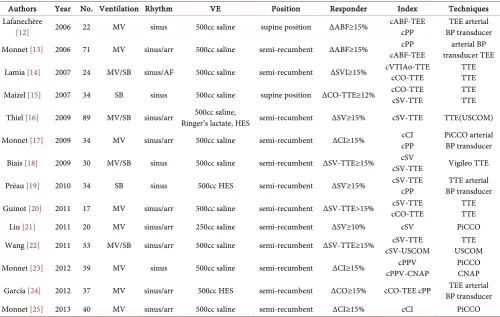
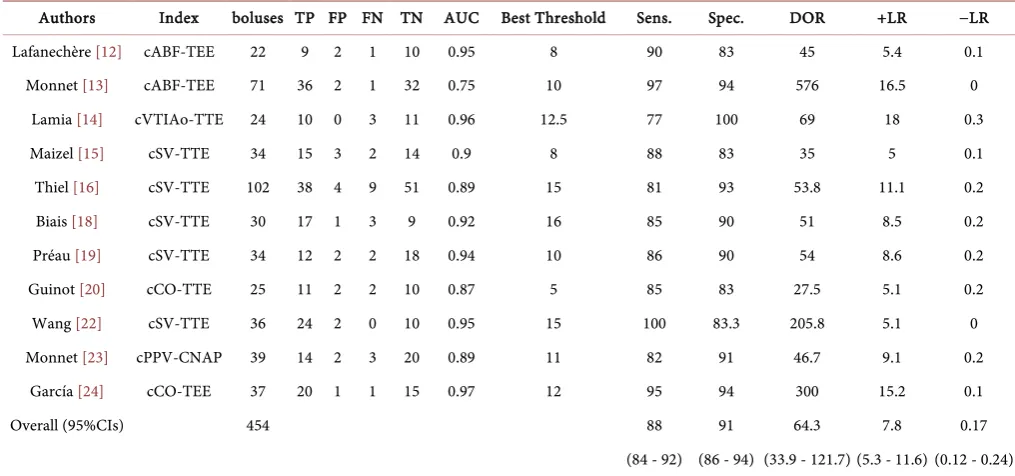
[image:4.595.202.549.578.684.2]The clinical characteristics of the 14 included studies were summarized in Table 1 and main results were reported in Table 2 and Table 3. The results of QUADAS-2 were showed in Figure 1. All the included 14 studies were prospective studies with enroll-ment of patients with sign of inadequate tissue perfusion. We found good compliance with appropriate population selection, index test adequately described, appropriate ref-erence standard, and adequate flow and timing. Population selection bias was mini-mized, as the inclusion criteria of the patients were close. However, no study described the blinding of the assessors to the outcome measurement of the results. 2 out of the 14 included studies didn’t report the lasting time of PLR.
Table 1. Main characteristics of the included studies.
Authors Year No. Ventilation Rhythm VE Position Responder Index Techniques
Lafanechère
[12] 2006 22 MV sinus 500cc saline supine position ΔABF≥15% cABF-TEE cPP BP transducer TEE arterial Monnet [13] 2006 71 MV sinus/arr 500cc saline semi-recumbent ΔABF≥15% cABF-TEE cPP transducer TEE arterial BP
Lamia [14] 2007 24 MV/SB sinus/AF 500cc saline semi-recumbent ΔSVI≥15% cVTIAo-TTE cCO-TTE TTE TTE
Maizel [15] 2007 34 SB sinus 500cc saline supine position ΔCO-TTE≥12% cCO-TTE cSV-TTE TTE TTE
Thiel [16] 2009 89 MV/SB sinus/arr Ringer’s lactate, HES semi-recumbent 500cc saline, ΔSV≥15% cSV-TTE TTE(USCOM)
Monnet [17] 2009 34 MV sinus/arr 500cc saline semi-recumbent ΔCI≥15% cCI cPP PiCCO arterial BP transducer
Biais [18] 2009 30 MV/SB sinus 500cc saline semi-recumbent ΔSV-TTE≥15% cSV-TTE cSV Vigileo TTE
Préau [19] 2010 34 SB sinus 500cc HES semi-recumbent ΔSV≥15% cSV-TTE cPP BP transducer TTE arterial
Guinot [20] 2011 17 MV sinus/arr 500cc saline semi-recumbent ΔSV-TTE>15% cCO-TTE cSV-TTE TTE TTE
Liu [21] 2011 20 MV sinus/arr 250cc saline semi-recumbent ΔSV≥10% cSV PiCCO
Wang [22] 2011 33 MV/SB sinus/arr 500cc saline semi-recumbent ΔSV-TTE≥15% cSV-USCOM cSV-TTE USCOM TTE
Monnet [23] 2012 39 MV sinus 500cc saline semi-recumbent ΔCI≥15% cPPV-CNAP cPPV PiCCO CNAP
García [24] 2012 37 MV sinus/arr 500cc HES semi-recumbent ΔCO≥15% cCO-TEE cPP BP transducer TEE arterial
Monnet [25] 2013 40 MV sinus/arr 500cc saline semi-recumbent ΔCI≥15% cCI PiCCO
MV: mechanical ventilation, arr: arrhythmia, AF: atrial fibrillation, VE: volume expansion, min minutes, BP: blood pressure, Δ: variation; c: PLR-induced changes, TTE: transthoracic echocardiography, TEE: transesophageal echocardiography, CI: cardiac index, CO: cardiac output, SV: stroke volume, PP: pulse pressure, PPV: pulse pressure variation, ABF: aortic blood flow, VTIAo: aortic velocity-time integral, USCOM: transthoracic Doppler ultrasonography, CNAP: continuous non- invasive arterial pressure.
Table 2. Pooled results for predictive capacity of invasive hemodynamic techniques.
Authors Index Boluses TP FP FN TN AUC Best Threshold Sens. Spec. DOR +LR −LR
Lafanechère [12] cPP 22 7 1 3 11 0.78 12 70 92 25.7 8.4 0.3
Monnet [13] cPP 71 22 5 15 29 0.96 12 60 85 8.5 4 0.5
Monnet [17] cCI 34 21 0 2 11 0.94 10 91 100 197.8 21.5 0.1
Biais [18] cSV 30 20 2 0 8 0.96 13 100 80 139.4 4.3 0
Préau [19] cPP 34 11 3 3 17 0.86 9 79 85 20.8 5.2 0.3
Liu [21] cSV 46 12 2 3 29 0.85 12.5 80 93.5 58 12.4 0.2
Monnet [23] cPPV 39 15 2 2 20 0.89 10 88 91 75 9.7 0.1
García [24] cPP 37 14 3 7 13 0.73 11 67 81 8.7 3.6 0.4
Monnet [25] cCI 40 20 1 1 18 0.98 15 95 95 360 18.1 0.1
Overall (95% CIs) 353 80 89 32.2 5.8 0.2
(73 - 85) (84 - 93) (13.5 - 76.8) (3.8 - 8.8) (0.1 - 0.4)
[image:5.595.44.556.480.671.2]Table 3. Pooled results for predictive capacity of non-invasive hemodynamic techniques.
Authors Index boluses TP FP FN TN AUC Best Threshold Sens. Spec. DOR +LR −LR
Lafanechère [12] cABF-TEE 22 9 2 1 10 0.95 8 90 83 45 5.4 0.1
Monnet [13] cABF-TEE 71 36 2 1 32 0.75 10 97 94 576 16.5 0
Lamia [14] cVTIAo-TTE 24 10 0 3 11 0.96 12.5 77 100 69 18 0.3
Maizel [15] cSV-TTE 34 15 3 2 14 0.9 8 88 83 35 5 0.1
Thiel [16] cSV-TTE 102 38 4 9 51 0.89 15 81 93 53.8 11.1 0.2
Biais [18] cSV-TTE 30 17 1 3 9 0.92 16 85 90 51 8.5 0.2
Préau [19] cSV-TTE 34 12 2 2 18 0.94 10 86 90 54 8.6 0.2
Guinot [20] cCO-TTE 25 11 2 2 10 0.87 5 85 83 27.5 5.1 0.2
Wang [22] cSV-TTE 36 24 2 0 10 0.95 15 100 83.3 205.8 5.1 0
Monnet [23] cPPV-CNAP 39 14 2 3 20 0.89 11 82 91 46.7 9.1 0.2
García [24] cCO-TEE 37 20 1 1 15 0.97 12 95 94 300 15.2 0.1
Overall (95%CIs) 454 88 91 64.3 7.8 0.17
(84 - 92) (86 - 94) (33.9 - 121.7) (5.3 - 11.6) (0.12 - 0.24)
TP: true-positive, FP: false-positive, FN: false-negative, TN: true-negative, AUC: area under the receiver operating characteristics curve, 95% CIs: 95% confidence intervals, Sens: sensitivity, Spec: specificity, DOR: diagnostic odds ratio, SV: stroke volume, ABF: aortic blood flow, VTIAo: aortic velocity-time integral, TTE: trans-thoracic echocardiography, TEE: transesophageal echocardiography, CNAP: continuous non-invasive arterial pressure.
A total of 524 patients were enrolled (range 17 - 89 for single paper) and a total of 574 VE were administered. The mean responder rate was 52.8%.
All studies were conducted in intensive care units (ICU) on patients with hypovole-mia, whose attending physician decided to perform a fluid challenge. 2 study [15] [19]
enrolled patients had spontaneous breathing without mechanical ventilator in sinus rhythm. The others [12] [13] [14] [16] [17] [18] [20]-[25] enrolled patients with me-chanical ventilation and/or arrhythmias. The reference standard for definition of res-ponders after fluid bolus as CO or its surrogates ranged between 10 and 15%. 11 out of 14 studies [12] [13] [14] [15] [17] [18] [20] [21] [22] [23] [25] used saline for volume expansion (VE). 2 studies [19] [24] used hetastarch for VE. Only 1 study used either sa-line, ringer’s lactate or hetastarch for VE. PLR was starting from a supine position in 2 studies [12] [15], and from semi-recumbent position in 12 studies [13] [14] [16]-[25]. 9 studies [12] [13] [17] [18] [19] [21] [23] [24] [25] used invasive hemodynamic tech-niques like PiCCO, Vigileo and arterial BP transducer and 11 studies [12] [13] [14] [15] [16] [18] [19] [20] [22] [23] [24] used non-invasive techniques, such as TEE, TTE, NICOM, USCOM and CNAP.
3.3. Diagnostic Accuracy of Invasive Techniques
We first divided the 14 studies into 2 groups: invasive group [12] [13] [17] [18] [19] [21] [23] [24] [25] and non-invasive group [12] [13] [14] [15] [16] [18] [19] [20] [22] [23] [24]. Then we meta-analyzed all papers into each group. Results were reported in
[12] [13] [18] [19] [23] [24], the indices of both techniques could be included. When a study reported analysis for two indices of the same category [14] [15] [17] [20] [21] [22] reported by the same technique only one was included in the meta-analysis in or-der to avoid duplication of sample size.
There were 9 papers (327 patients, 353 boluses) in the invasive group. The results I2 =
[image:7.595.198.543.359.681.2]39.6% (<50%) and p = 0.1037 (>0.05) showed that heterogeneity was not significant among the trials. Forest plots of the pooled sensitivity and specificity were shown in
Figure 2. The sensitivity ranged from 60% - 100% (pooled sensitivity 80%, 95% CI: 73% - 85%), while specificity ranged from 85% - 100% (pooled specificity 89%, 95% CI: 84% - 93%). DOR was 32.2 (95% CI: 13.5 - 76.8). Pooled values for positive likelihood ratio (+LR) and negative likelihood ratio (−LR) were 5.8 (95% CI: 3.8 - 8.8) and 0.2 (95% CI: 0.1 - 0.4). The threshold for predicting fluid responsiveness varied between 9% and 15%.
After excluded the threshold effect with spearman correlation coefficient = 0.233 and
p = 0.546 (>0.05), we used Moses-Shapiro-Littenberg method to draw the symmetrical summary ROC curve (SROC) with AUC of 0.94.
3.4. Diagnostic Accuracy of Non-Invasive Techniques
There were 11 papers (430 patients, 454 boluses) in the non-invasive group. The results
Figure 2. Forest plots of pooled sensitivity between invasive and non-invasive techniques. Sensitivity
0 .2 .4 .6 .8 1
Lafanechère (11) 0.70 (0.35 - 0.93)
Monnet (12) 0.59 (0.42 - 0.75)
Monnet (16) 0.91 (0.72 - 0.99)
Biais (17) 1.00 (0.83 - 1.00)
Préau (18) 0.79 (0.49 - 0.95)
Liu (20) 0.80 (0.52 - 0.96)
Monnet (22) 0.88 (0.64 - 0.99)
García (23) 0.67 (0.43 - 0.85)
Monnet (24) 0.95 (0.76 - 1.00)
Sensitivity (95% CI)
Pooled Sensitivity = 0.80 (0.70 to 0.90) Chi-square = 26.83; df = 8 (p = 0.0008) Inconsistency (I-square) = 70.2 %
Specificity
0 .2 .4 .6 .8 1
Lafanechère (11) 0.92 (0.62 - 1.00)
Monnet (12) 0.85 (0.69 - 0.95)
Monnet (16) 1.00 (0.72 - 1.00)
Biais (17) 0.80 (0.44 - 0.97)
Préau (18) 0.85 (0.62 - 0.97)
Liu (20) 0.94 (0.79 - 0.99)
Monnet (22) 0.91 (0.71 - 0.99)
García (23) 0.81 (0.54 - 0.96)
Monnet (24) 0.95 (0.74 - 1.00)
Specificity (95% CI)
I2 = 0.0% (<50%) and p = 0.809 (>0.05) showed that heterogeneity was not significant.
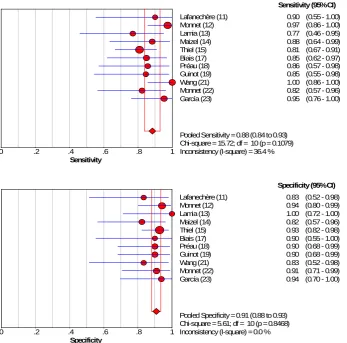
Forest plots of the pooled sensitivity and specificity were shown in Figure 3. The sensi-tivity ranged from 77% - 100% (pooled sensisensi-tivity 88%, 95% CI: 84% - 92%), while spe-cificity ranged from 83% - 100% (pooled spespe-cificity 91%, 95% CI: 86% - 94%). DOR was 64.3 (95% CI: 33.9 - 121.7). Pooled values for positive likelihood ratio (+LR) and negative likelihood ratio (−LR) were 7.8 (95% CI: 5.3 - 11.6) and 0.2 (95% CI: 0.1 - 0.2). The threshold for predicting fluid responsiveness varied between 5 and 15%.
After excluded the threshold effect with spearman correlation coefficient = 0.361 and
p = 0.276 (>0.05), we drew the symmetrical summary ROC curve (SROC) (Figure 4), with AUC of 0.95.
3.5. Publication Bias
The result of Egger test and Begg test showed that the potential publication bias was significant (P > 0.05), which indicated a potential for publication bias.
4. Discussion
[image:8.595.202.550.343.686.2]The main finding of our systematic review are as follows: (1) The result of pooled sensi-
Figure 3. Forest plots of pooled specificity between invasive and non-invasive techniques. Sensitivity
0 .2 .4 .6 .8 1
Lafanechère (11) 0.90 (0.55 - 1.00)
Monnet (12) 0.97 (0.86 - 1.00)
Lamia (13) 0.77 (0.46 - 0.95)
Maizel (14) 0.88 (0.64 - 0.99)
Thiel (15) 0.81 (0.67 - 0.91)
Biais (17) 0.85 (0.62 - 0.97)
Préau (18) 0.86 (0.57 - 0.98)
Guinot (19) 0.85 (0.55 - 0.98)
Wang (21) 1.00 (0.86 - 1.00)
Monnet (22) 0.82 (0.57 - 0.96)
García (23) 0.95 (0.76 - 1.00)
Sensitivity (95% CI)
Pooled Sensitivity = 0.88 (0.84 to 0.93) Chi-square = 15.72; df = 10 (p = 0.1079) Inconsistency (I-square) = 36.4 %
Specificity
0 .2 .4 .6 .8 1
Lafanechère (11) 0.83 (0.52 - 0.98)
Monnet (12) 0.94 (0.80 - 0.99)
Lamia (13) 1.00 (0.72 - 1.00)
Maizel (14) 0.82 (0.57 - 0.96)
Thiel (15) 0.93 (0.82 - 0.98)
Biais (17) 0.90 (0.55 - 1.00)
Préau (18) 0.90 (0.68 - 0.99)
Guinot (19) 0.90 (0.68 - 0.99)
Wang (21) 0.83 (0.52 - 0.98)
Monnet (22) 0.91 (0.71 - 0.99)
García (23) 0.94 (0.70 - 1.00)
Specificity (95% CI)
Figure 4. Summary receiver operating characteristics curve for the ability of non-invasive tech-niques discriminate between responders and non-responders.
tivity and specificity between invasive and non-invasive techniques are 80% (73% - 85%) vs. 88% (84% - 92%) and 89% (84% - 93%) vs. 91% (86% - 94%), which cannot conclude inferior or superior; (2) The results of pooled DOR between invasive and non-invasive is 32.2 (13.6 - 76.8) vs. 64.3 (33.9 - 121.7), which indicate using non-inva- sive techniques have better discriminatory test performance with higher DOR values
[8].
Knowing that dynamic indexes such as CO, CI, SV, ABF, SVV, PPV make use of provoked cardiac reaction assessed with fluid bolus and postural change can predict fluid responsiveness. A recent analysis by Vallee F shows that increase in thermodilu-tion CO following a fluid bolus can predict fluid responsiveness [26]. The invasive techniques such as PiCCO, Vigileo, and arterial BP transducer are widely used in ICU to assess the patients’ volume statue. Also, a systematic review by Mandeville et al. [27]
was achieved 97 percent of the time when used in the evaluation of shock [28].
Strengths and Limitations
The strengths of our meta-analysis lie in the methods adhering to recent guidelines for diagnostic reviews [6] [29] [30], as well as in the advanced statistical methods used [31], which analyze all reported thresholds, sensitivity, specificity and their correlated results simultaneously. Also no other review has compared the ability to predict fluid respon-siveness between these 2 groups of hemodynamic techniques. The results of our review could guide the using of the techniques to assess patients’ volume statue in our clinical practice.
Limitations still exist in our meta-analysis. First, the pooling of diagnostic accuracy data inevitably contributed to sources of bias [7], which could be revealed in the signif-icant amount of statistical heterogeneity across studies. Second, the number of patients included in the present trials was small (14 studies, 524 patients). A better review needs larger sample of studies. Third, the criteria of the included studies are based on clinical manifestation and the confounding factors such as cardiac function, respiratory func-tion, severity of disease have not been analyzed.
5. Conclusion
The hemodynamic indexes induced by PLR can well discriminate between fluid res-ponders and non-resres-ponders regardless of arrhythmia and ventilation mode. Non-in- vasive hemodynamic techniques with their accuracy and safety can benefit the daily work in ICUs.
References
[1] Michard, F. and Teboul, J.L. (2002) Predicting fluid responsiveness in ICU patients: a criti-cal analysis of the evidence. Chest, 121, 2000-2008.
http://dx.doi.org/10.1378/chest.121.6.2000
[2] Rutlen, D.L., Wackers, F.J. and Zaret, B.L. (1981) Radionuclide assessment of peripheral intravascular capacity: A technique to measure intravascular volume changes in the capa-citance circulation in man. Circulation, 64, 146-152.
http://dx.doi.org/10.1161/01.CIR.64.1.146
[3] Marik, P.E., Monnet, X. and Teboul, J.L. (2011) Hemodynamic Parameters to Guide Fluid Therapy. Annals of Intensive Care, 1, 1.http://dx.doi.org/10.1186/2110-5820-1-1
[4] Monnet, X. and Teboul, J.L. (2008) Passive Leg Raising. Intensive Care Medicine, 34, 659- 663. http://dx.doi.org/10.1007/s00134-008-0994-y
[5] Bossuyt, P.M., Reitsma, J.B., Bruns, D.E., et al. (2003) The STARD Statement for Reporting Studies of Diagnostic Accuracy: Explanation and Elaboration. Annals of Internal Medicine, 138, W1-W12. http://dx.doi.org/10.7326/0003-4819-138-1-200301070-00012-w1
[6] Whiting, P.F., Rutjes, A.W.S., Westwood, M.E., et al. (2011) QUADAS-2: A Revised Tool for the Quality Assessment of Diagnostic Accuracy Studies. Annals of Internal Medicine, 155, 529-536. http://dx.doi.org/10.7326/0003-4819-155-8-201110180-00009
An-nals of Internal Medicine, 140, 189- 202.
http://dx.doi.org/10.7326/0003-4819-140-3-200402030-00010
[8] Devillé, W.L., Buntinx, F., Bouter, L.M., et al. (2002) Conducting Systematic Reviews of Diagnostic Studies: Didactic Guidelines. BMC Medical Research Methodology, 2, 9.
http://dx.doi.org/10.1186/1471-2288-2-9
[9] Moses, L.E., Shapiro, D. and Littenberg, B. (1993) Combining independent Studies of a Di-agnostic Test into a Summary ROC Curve: Data-Analytic Approaches and Some Additional Considerations. Statistics in Medicine, 12, 1293-1316.
http://dx.doi.org/10.1002/sim.4780121403
[10] Egger, M., Smith, G.D., Schneider, M. and Minder, C. (1997) Bias in Meta-Analysis De-tected by a Simple, Graphical Test. BMJ, 315, 629-634.
http://dx.doi.org/10.1136/bmj.315.7109.629
[11] Begg, C.B. and Mazumdar, M. (1994) Operating Characteristics of a Rank Correlation Test for Publication Bias. Biometrics, 1088-1101. http://dx.doi.org/10.2307/2533446
[12] Lafanechere, A., Pene, F., Goulenok, C., et al. (2006) Changes in Aortic Blood Flow Induced by Passive Leg Raising Predict Fluid Responsiveness in Critically Ill Patients. Critical Care, 10, R132. http://dx.doi.org/10.1186/cc5044
[13] Monnet, X., Rienzo, M., Osman, D., Anguel, N., Richard, C., Pinsky, M.R. and Teboul, J.L. (2006) Passive Leg Raising Predicts Fluid Responsiveness in the Critically Ill. Critical Care Medicine, 34, 1402-1407. http://dx.doi.org/10.1097/01.CCM.0000215453.11735.06
[14] Lamia, B., Ochagavia, A., Monnet, X., et al. (2007) Echocardiographic Prediction of Volume Responsiveness in Critically Ill Patients with Spontaneously Breathing Activity. Intensive Care Medicine, 33, 1125-1132. http://dx.doi.org/10.1007/s00134-007-0646-7
[15] Maizel, J., Airapetian, N., Lorne, E., et al. (2007) Diagnosis of Central Hypovolemia by Us-ing Passive Leg RaisUs-ing. Intensive Care Medicine, 33, 1133-1138.
http://dx.doi.org/10.1007/s00134-007-0642-y
[16] Thiel, S., Kollef, M. and Isakow, W. (2009) Non-Invasive Stroke Volume Measurement and Passive Leg Raising Predict Volume Responsiveness in Medical ICU Patients: An Observa-tional Cohort Study. Critical Care, 13, R111. http://dx.doi.org/10.1186/cc7955
[17] Monnet, X., Osman, D., Ridel, C., et al. (2009) Predicting Volume Responsiveness by Using the End-Expiratory Occlusion in Mechanically Ventilated Intensive Care Unit Patients.
Critical Care Medicine, 37, 951-956. http://dx.doi.org/10.1097/CCM.0b013e3181968fe1
[18] Biais, M., Vidil, L., Sarrabay, P., et al. (2009) Changes in Stroke Volume Induced by Passive Leg Raising in Spontaneously Breathing Patients: Comparison between Echocardiography and Vigileo/FloTrac Device. Critical Care, 13, R195. http://dx.doi.org/10.1186/cc8195
[19] Préau, S., Saulnier, F., Dewavrin, F., et al. (2010) Passive Leg Raising Is Predictive of Fluid Responsiveness in Spontaneously Breathing Patients with Severe Sepsis or Acute Pancreati-tis. Critical Care Medicine, 38, 819-825. http://dx.doi.org/10.1097/CCM.0b013e3181c8fe7a
[20] Guinot, P.G., Zogheib, E., Detave, M., et al. (2011) Passive Leg Raising Can Predict Fluid Responsiveness in Patients Placed on Venovenous Extracorporeal Membrane Oxygenation.
Critical Care, 15, R216. http://dx.doi.org/10.1186/cc10451
[21] Liu, Y., Lu, Y.H., Xie, J.F., Qiu, X.H., et al. (2011) Passive Leg Raising Predicts Volume Responsiveness in Patients with Septic Shock. Chinese Journal of Surgery, 49, 44-48. [22] Wang, H.L., Liu, H.T. and Yu, K.L. (2011) Clinical Observation of Passive Leg Raising
[23] Monnet, X., Dres, M., Ferre, A., et al. (2012) Prediction of Fluid Responsiveness by a Con-tinuous Non-Invasive Assessment of Arterial Pressure in Critically Ill Patients: Comparison with Four Other Dynamic Indices. British Journal of Anaesthesia, 109, 330-338.
http://dx.doi.org/10.1093/bja/aes182
[24] García, M.I.M., Cano, A.G., Romero, M.G., et al. (2012) Non-Invasive Assessment of Fluid Responsiveness by Changes in Partial End-Tidal CO2 Pressure during a Passive Leg-Raising
Maneuver. Annals of Intensive Care, 2, 9. http://dx.doi.org/10.1186/2110-5820-2-9
[25] Monnet, X., Bataille, A., Magalhaes, E., et al. (2013) End-Tidal Carbon Dioxide Is Better than Arterial Pressure for Predicting Volume Responsiveness by the Passive Leg Raising Test. Intensive Care Medicine, 39, 93-100. http://dx.doi.org/10.1007/s00134-012-2693-y
[26] Vallee, F., Mari, A., Perner, A. and Vallet, B. (2010) Combined Analysis of Cardiac Output and CVP Changes Remains the Best Way to Titrate Fluid Administration in Shocked Pa-tients. Intensive Care Medicine, 36, 912-914. http://dx.doi.org/10.1007/s00134-010-1831-7
[27] Mandeville, J.C. and Colebourn, C.L. (2012) Can Transthoracic Echocardiography Be Used to Predict Fluid Responsiveness in the Critically Ill Patient? A Systematic Review. Critical Care Research and Practice, 2012,Article ID: 513480.
http://dx.doi.org/10.1155/2012/513480
[28] Jensen, M.B., Sloth, E., Larsen, K.M., et al. (2004) Transthoracic Echocardiography for Car-diopulmonary Monitoring in Intensive Care. European journal of Anaesthesiology, 21, 700- 707. http://dx.doi.org/10.1097/00003643-200409000-00006
[29] Irwig, L., Tosteson, A.N., Gatsonis, C., Lau, J., Colditz, G., Chalmers, T.C., et al. (1994) Guidelines for Meta-Analyses Evaluating Diagnostic Tests. Annals of Internal Medicine, 120, 667-676. http://dx.doi.org/10.7326/0003-4819-120-8-199404150-00008
[30] Khan, K.S., Dinnes, J. and Kleijnen, J. (2001) Systematic Reviews to Evaluate Diagnostic Tests. European Journal of Obstetrics & Gynecology and Reproductive Biology, 95, 6-11.
http://dx.doi.org/10.1016/S0301-2115(00)00463-2
[31] Riley, R.D. (2009) Multivariate Meta-Analysis: The Effect of Ignoring Within-Study Corre-lation. Journal of the Royal Statistical Society: Series A, 172, 789-811.
http://dx.doi.org/10.1111/j.1467-985X.2008.00593.x
Submit or recommend next manuscript to SCIRP and we will provide best service for you:
Accepting pre-submission inquiries through Email, Facebook, LinkedIn, Twitter, etc. A wide selection of journals (inclusive of 9 subjects, more than 200 journals)
Providing 24-hour high-quality service User-friendly online submission system Fair and swift peer-review system
Efficient typesetting and proofreading procedure
Display of the result of downloads and visits, as well as the number of cited articles Maximum dissemination of your research work
Submit your manuscript at: http://papersubmission.scirp.org/