Munich Personal RePEc Archive
Banking services in terms of changing
environment: the case of Macedonia
Nenovski, Tome and Delova Jolevska, Evica and Andovski,
Ilija
October 2011
Online at
https://mpra.ub.uni-muenchen.de/45929/
Tome Nenovski Phd
1, Evica Delova Jolevska Phd
2, Ilija Andovski Msc
31
University American College, Skopje, [email protected]
2
University American College, Skopje, [email protected]
3
National Bank of the Republic of Macedonia, [email protected]
BANKING SERVICES IN TERMS OF CHANGING
ENVIRONMENT: THE CASE OF MACEDONIA
Abstract--The aim of this paper is to elaborate the impact of the changing environment on the services that the banking sector is providing. The trends in the international banking will be analyzed also from the perspective of the banking activities on Macedonian banks. Speaking of changes, there are two tendencies that can be determined in the international banking: 1) increased competition that influence on the banking products and pricing, 2) technology improvements that affects the distribution channels of selling and the operating cost on the banking activities. Increased competition and sharing the same target market along with other financial institutions affects the banks' market share and prices of their products. In developed economies there is a trend of suppression of banks from certain market segments and reducing their market share. This trend is mostly expressed in USA and is less pronounced in EU. Also rapid technology development and penetration of Internet in everyday life doesn’t leave immune nor the banking sector. The technological improvements affect the banking industry through introduction of new products, increasing efficiency in terms of operating costs and developing new distribution channels. Banks are forced to adapt their products to a new generation that is coming and who grew up in the Internet Age. The biggest changes have been made in terms of payment methods by allowing transactions to be made 24 hours a day from anywhere. The development of technology also affects on the improvement of data bases which enable better assessment of credit risk to individual products and customers. Banks along with other financial institutions are joining in collecting and sharing of customer data that enables better assessment of the credit risk.
Index terms‐‐ banking services, increased competition, technology improvements, credit cards, internet,
credit assessment tools
1. INTRODUCTION
The banking activities and products are changing rapidly. These changes are induced mainly from the
increased competition in the financial sector and the technology improvements. These two factors
affect simultaneously and are interrelated. Their impact will be subject on analyze in this paper. In the
part of technology improvement special attention will be given to credit cards, internet and credit
assessment tools.
Namely, the increased competition in the financial sector affects on the market share of the banking
industry and is forcing it to create new products and to increase efficiency. The best way to achieve
these goals is through greater use of new technologies and new distribution channels. According to Digal
[1], technological changes relating to telecommunications and data processing have spurred financial
applied statistics cost‐effectively has markedly altered the process of financial intermediation. The
technological changes also have impact on the assessment tools that are used in risk management. The
bigger data warehouses allow building new models for assessment of the risks that banks are taking.
That enables more precise measurement of the risks that are taken and better product development.
The new marketing philosophy requires any product to be available at any time, anywhere which implies
increased use of electronic banking in the banking activities which turns banks into shops with 24 hour
service.
2. INCREASED COMPETITION IN THE FINANCIAL SECTOR
As a consequence of deregulation of the financial market the position of the banks is changed. There is terminal decline of commercial banks and their long-standing deposit taking and loans functions. This tendency is especially distinctive for USA, where for example, the commercial banks’ share of total assets in financial institutions has fallen from over 70% in 1900 to barely 30% hundred years later [2]. The banks’ share of corporate debt has fallen from 19% in the 80-ties to 14% in the 90-ties. So competition on both sides of the balance sheet has increased. The main drivers of changes on the liability side were the new technologies and deregulation that gave access to mutual funds and others types of alternatives. On the asset side of the balance sheet the growth of money and bond markets and commercial paper has given companies alternative ways of borrowing money. The banks can respond in two ways: 1) bigger risk appetite or 2) improve the products and services and reduce costs. Competition affects the value of bank franchises. Faced with difficulties, banks might, in the presence of imperfect monitoring by the regulators and the markets, can further enhancing risk taking, hoping that positive outcomes will materialize. The relative attractiveness of these options depends on the regulatory framework and the scope for moral hazard, but also on the value of bank franchises.
The second manner in which a bank can respond in increased competition is to improve its products and services and to reduce the costs. This is strongly associated with the use of new technologies and distributive cannels. The first and the most obvious change which will affect retail banks is that the new technology will drastically reduce branch numbers. The increased use of credit cards, internet payments and other forms of payment will result with staff reduction and smaller operative expenses. According to Crédit Lyonnais the new alternatives of payment in UK will result with 5% decrease in the number of employees per year and total annual savings of 1.677 million pounds
[3]. Also, in changing environment the development of new distribution channels has become a key strategy in improving value added and satisfying customer requirements. The former marketing philosophy of “the right product must be available at the right time” has been replaced by “any product must be available at any time, anywhere”.
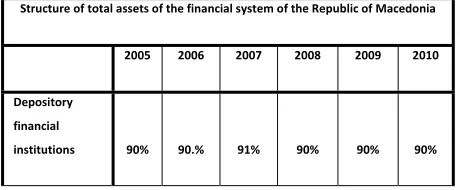
The Macedonian banking sector is still not affected by increasing competition from the other financial companies, as can be seen in Table1. The share of the banks in the total assets of the financial system is stable and it is around 90%
[4]. Compared with the EU area average where banks and saving houses have 61% share in the total financial assets
[5], the depositary financial institutions in Macedonia have very dominant share.
[image:3.612.192.422.618.713.2]One of the factors that have influence on the small share of the other financial institutions in total assets is certainly the low sophistication of the customers. As their interest awareness is growing probably this tendency of decreasing market share on the banks in the total structure of financial assets will be case in Macedonia too.
Table 1. Structure of total assets of the financial system of the Republic of Macedonia
Structure of total assets of the financial system of the Republic of Macedonia
2005 2006 2007 2008 2009 2010
Depository financial
Country Assets/GDP Loans/GDP
Romania 75% 43%
Poland 88% 57%
Lithuania 98% 72%
Slovakia 86% 49%
Hungary 136% 79%
Bulgaria 112% 78%
Czech rep. 117% 58%
Slovenia 153% 102%
Estonia 155% 114%
Latvia 161% 70%
Cyprus 822% 341%
Malta 721% 373%
EU 334% 141%
R.Macedonia 72% 44%
Banks 88% 88% 90% 89% 88% 89%
Saving houses 2% 2% 1% 1% 2% 1%
Nondepository
financial
institutions 10% 10% 9% 10% 10% 10%
Source: National Bank of the Republic of Macedonia
Another aspect that has impact on the banks activities and products is the level of financial intermediation. The financial intermediation in the Republic of Macedonia (Table 2) is on the lowest level relative to some countries from the European Union, the EU average and the Euro zone average [6]. The financial intermediation measured through the credits and GDP ratio in the banking systems in Romania and the Republic of Macedonia are almost at the same level. The small level of financial intermediation decrease considerable the efficiency of the banking sector. The small level of financial intermediation has negative effects on the real economy development.
Table 2. Financial intermediation level in the Republic of Macedonia and EU countries
Source: National Bank of the Republic of Macedonia
The structure of the Banks’ assets and liabilities
structure indicates that the Macedonian banks business
model is traditional. On the liabilities side the deposits of
non‐financial entities with 70% are dominant source of
financing. The assets side is dominated by loans on non‐
financial entities whose share in the total assets is 55%.
[7]
Important characteristic of the Macedonian banking sector that influence on the products that are
offered and their pricing is the concentration. The measurement with the Herfindahl index points that
the banking system is highly concentrated in all the banking activities, especially in the household
deposits. The Herfindahl indexes (Table 3) assert that this condition is very rigid and there aren’t any big
movements in the concentration of the banking sector[7].
Table 3. Herfindahl index on the Macedonian banking sector
Source: National Bank of the Republic of Macedonia
Total assets
Household credits Enterprises credits Household deposits Enterprises deposits
2007 1,625 2,001 1,819 2,084 1,780
2008 1,579 1,953 1,859 2,097 1,642
2009 1,637 2,064 1,937 2,098 1,312
2010 1,578 2,050 1,855 2,079 1,598
With three main competitors that hold more than 65% of the market, the biggest three banks are
market leaders and are main innovators in banking services. This practically oligopoly structure has
strong influence on the pricing of the banking activities. The three leading banks are price makers and
the other banks follow the actions of the big banks.[8] Тhe size of the assets of banks and market share,
indicate extensive use of market power of banks in determining interest rates and lending spreads.
These variables can be treated as "key" variables, i.e variables with the greatest effect. The growth of
banks' assets and reducing the market share of certain banks (i.e. the growth of competition), can lead
to further reduction of lending interest rates and narrowing spreads. Considering the current structure
of the banking system, a relatively high concentration and relatively large number of banks, there is
need for consolidation of the banking system through acquisitions and / or mergers in the segment to
other banks and thereby creating larger banks, which will increase the level of competition and
contribute to reducing interest rates and spreads.As far as the global trend of reducing the banking
network, the number of business units in Macedonia is stable [9]. The banks network in 2010 includes
436 business units (including banks' headquarters) and is spread in almost all towns in the country.
However compared with the average of all EU member countries (EU‐27) the indicator for number of
residents to which a single bank in the Republic of Macedonia can render its services is almost double.
The lack of competition in Macedonia does not affect the scope of banking services, but their prices. The
development of new banking products is determined by the development of technology and innovations
that are primary promoted by the parent banks.
3. THEIMPACTOFTECHNOLOGYCHANGESONBANKINGACTIVITIES
Retailers have long recognized that it takes more than just good products to bring in customers and
keep them in the store. The most sophisticated retailers have become very adept at designing their
stores around the needs of their customers, with the goal of making them “destinations” — some place
that customers want to visit as opposed to some place they have to endure. Bank branches, on the
other hand, have typically been designed as transaction centers, aiming for speed and efficiency as
opposed to creating a positive and memorable customer experience, that attracts customers. Branches
will have little choice but to leverage technology to its fullest, if not to manage operating costs, then to
meet the expectations of its younger counterparts who view technology as an integral way of life. Gone
are the days when technology was only seen and used by trained branch staff, remote from ordinary
customers. Today bank branches around the world are creatively using technology to construct a new
image for their branches, inform consumers about products and services enhance customers’ branch
experience, and give them an opportunity to execute basic banking services without queues.
The major changes in banking services are reflected in innovations on the methods of payment. The
methods of making payments have shifted considerable with a strong trend towards automated
settlement and away from paper transactions. This trend is expected to continue with gains in bank
profitability as customers move from high cost transaction, such as cheques, to low cost methods of
payment such as debit cards. The main changes in the payment methods can be summarized as
0% 10% 20% 30%
0% 50% 100% 150%
2006 2007 2008 2009 2010
annual rate of change of exposure of households to credit cards (right axes)
credit cards share in total household exposure (left axes
- The extensive use of plastic cards for various purposes
- The application of automation to special payment circuits for regular small value payments.
3.1 Credit cards
This is one of the most standardized methods of payment, standardized that is to size and shape. Perhaps the most important characteristic of credit cards is that they are very versatile and adaptive. They can be use to withdraw banknotes from ATMs but also to pay for purchases at a distance quoting the holder’s card number over the telephone. There are benefits to customers and merchants from the credit card use. The main benefit to each customer is convenience. Compared to debit cards and cheques, a credit card allows small short-term loans to be quickly made to a customer who need not calculate a balance remaining before every transaction, provided the total charges do not exceed the maximum credit line for the card. For merchants, a credit card transaction is often more secure than other forms of payment, because the issuing bank commits to pay the merchant the moment the transaction is authorized, regardless of whether the consumer defaults on the credit card payment. In most cases, cards are even more secure than cash, because they discourage theft by the merchant's employees and reduce the amount of cash on the premises.
[image:6.612.71.287.299.449.2]This trend of increased use of credit cards can be confirmed in the Macedonian banking sector. Starting from 2006 until 2010 the number of credit cards has increased for 400% [11] and its share in the total household exposure for 7 percentage points. (Fig 1).
Fig 1. Annual credit card growth in R. Macedonia Source:National Bank of the Republic of Macedonia
Banking sector also constantly strengthens the infrastructure for credit card use through increasing of the POS and ATM terminals. As can be seen from fig.2 the growth to credit cards exposure is accompanied by growth in the number of POS and ATM terminals [12]. Once the infrastructure is set the growth rate of POS and ATM terminal decreased and the number of terminals is stable.
Fig 2. Number of POS and ATM terminals and their annual dynamics Source:National Bank of the Republic of Macedonia
62.10% 87.10%
62.50%
7.90%0.30%
0.00% 20.00% 40.00% 60.00% 80.00% 100.00%
-10,000 20,000 30,000 40,000
2006 2007 2008 2009 2010
number of POS and ATM terminals
[image:6.612.73.286.538.662.2]However more forthrightly analysis is showing that although the number of credit cards has increased, they are not used directly in merchants network but mainly for cash withdraw. According to the National Bank of Macedonia, at the end of 2010 the country has over 1.4 million credit cards, most of them debit, or about 1.048 thousand. But this fact it's not surprising as the fact that over 81 percent of the value of the transactions were made only to raise cash[13]. This shows that the habits of the clients also have a major role in introducing new products. However there is a positive trend of increased number of credit cards and increased value of payments made with them. Compare to 2006 the number of transactions with credit cards is increased for 500% and the value of payment transactions for 4.2 times.
3.2 The Internet
The internet has attracted the attention of economist because of his possibilities for selling all sorts of goods and services. Behind all these commercial uses for the Internet lies the question of payment for the goods and services purchased. As a result of this need Internet banking was developed. The internet banking has a lot of advantages: 1) the operating costs are lower, resulting in a redundancy of employees, 2) its saves time and money on the clients because it can be used from home at any time, 3) it can be used for cross selling of other bank products. There are several methods in existence that can be used for internet payments. One criterion against which all will be judged is that of security, protection against hackers either intervening in the transaction or obtaining information that could be used in fraudulent transactions. One obvious method is to use credit cards. But because its involves giving a credit card number it enables a hacker to collect the numbers and to use them fraudulently. Although encryption is used for the number the level of protection isn’t that high to prevent all possible hacker attracts. Other method is the use of electronic money. The money consists of unique numbers in digital, binary form. Although as method of payment are more secure than the credit cards the use of e-money has been relatively low-scale. According to De Young (2005) [14], the first bank websites were launched in 1995 and by 2002 nearly one-half of all U.S. banks and thrifts operated transactional websites. As of 2007, bank call report data suggests that 77% of commercial banks offer transactional websites (and these banks control 96.8% of commercial bank deposits). Turning to online bank performance, De Young, Lang, and Nolle (2007) [15] report that internet adoption improved U.S. community bank profitability – primarily through deposit-related charges. In a related study, Hernando and Nieto (2007) find that, over time, online banking was associated with lower costs and higher profitability for a sample of Spanish banks. Both papers conclude that the internet channel is a complement to – rather than a substitute for – physical bank branches. Gonzales and Guerrero (2004) note the results of a survey by Pricewaterhouse Coopers and the Confederation of British Industry, that, 83% of the UK financial institutions expected e-business would reshape the banking industry, while the rest claimed that it would have a significant impact on the banking sector. [16]
The Macedonian banks are aware that new changes are fundamental for their performance improvement. Almost all Macedonian banks offer internet banking. Particularly important is that this method of payment has more and more customers. There is 45% increase on year basis at the number of legal and 37% of retail customers who use internet banking in the last two years [17]. The number of internet transaction is increased for 33% yearly in the last two years.
3.3 The impact of technology on credit assessment tools
The technology improvement and data base building have great influence on the credit assessment process. Especially at the retail segment it’s a world wide practice the assessment to be done by scoring system. Retail loan applications are now routinely evaluated using credit scoring tools, rather than using human judgment.And to build a good scoring system a data base with quality data for sufficient period of time is of crucial importance. Such an approach makes underwriting much more transparent to third parties and hence facilities secondary markets for retail credits. Another important use of data bases in the credit approval process is through the information provided by the credit bureaus. All these opportunities have influence on processes that are carried in a bank. They make the approval process less human intensive and the pricing is more correct. In that way the banks are decreasing their operative expenses and in the same time are decreasing the default rates of its products.
prescriptions. After the technology was deployed, its results may present users with hitherto unavailable options, but technology itself greatly reduces the role of human agency during the process of achieving those results.
According to Akos Rona-Tast the package of decisions is justified in three ways[18]: by its functionality, architectural coherence and autonomy. Functionality is the first and most important consideration. Here the claim is that the technology achieves its goals in some optimal fashion. Architectural coherence, on the other hand, points to how each decision depends on others. Here the claim is that even though each element may not directly promote functional optimality in the context of the architecture of the technology, the other choices designers made, it is the best technical solution, and i.e. replacing it with another part would harm functionality. Finally, a technology has to be easy to apply, otherwise it needs other technologies. If a technology is not autonomous and requires other technologies to work, it is incomplete and must expand to incorporate its complementary technological requisites. The strong claim for a technology is that it is functionally optimal (it achieves best results compared to available alternatives), architecturally coherent (its component decisions are a seamless whole), and it is autonomous (it functions in most contexts).
The credit scoring should be viewed as a process. This process is supported by IT technology and fulfills the three conditions: is optimal, coherent and autonomous. It is claimed to provide the best prediction of the applicant behavior and everything in the process to be chosen to promote that. It is also alleged to be autonomous, to be applicable anywhere, anytime by just about anyone. The technology of predicting credit behavior has been a great success despite the fact that its functionality is hard to gauge, its internal architecture often follows computational convenience at the expense of functionality and its application depends on other, complex technologies that can have crucial effect on its performance. So why is it spreading so fast in lending? The expansion of credit scoring does not depend on its superior ability of vaticination. It is driven by its other advantages: that it is cheaper, faster than its alternative, expert judgment. It also gives more control for top managers over their subordinates and the lending process, in general, and provides legitimacy both legal and professional.
Another use of the opportunities that the modern data bases are providing is through a credit bureau. A credit bureau is a company that collects information from various sources and provides consumers’ or businesses’ credit information on individual consumers/businesses for a variety of uses. Credit bureaus ordinarily prepare and issue reports for lending institutions and stores that investigate the financial reliability of an applicant for credit prior to the execution of the credit agreement. This helps lenders assess credit worthiness, the ability to pay back a loan, and can affect the interest rate and other terms of a loan. Interest rates are not the same for everyone, but instead can be based on risk-based pricing, a form of price discrimination based on the different expected risks of different borrowers, as set out in their credit rating. Consumers with poor credit repayment histories or court adjudicated debt obligations like tax liens or bankruptcies will pay a higher annual interest rate than consumers or businesses that do not have these factors. This is another way for the banking industry to get more accurate assessments on the credit risk and to decrease the operating expanses and the default rate. In Macedonia there is law for credit bureaus from 2008 and one credit bureau is already established. This bureau started with its operations from January 2011. Therefore the type and quality of information that provides is yet to be assessed and it is still early to assess the usefulness of the date in the risk management process.
4. CONCLUSION
changing environment the banking industry is enhancing the existing products and there is a permanent process of promoting new products in order to maintain the market share and to make the products more accessible to clients.
These world trends are applied by the Macedonian banks in order better to satisfy the customer needs and to provide better market position. The number of cards is increasing every year. Still there is high increase of the value of payment transactions since 2006 which means that the citizen habits are changing in positive way. Also, Macedonian bank accept the international practices for increased use of internet in banking. Almost all Macedonian banks offer internet banking. And it is increased the number of legal, as well as retail customers who rapidly use internet banking in the last two years. Further increase in the number of services in the Macedonian banking system, as well as enhancing their quality can be achieved through further enlargement of the banks, strengthening their capital base that will result in increased competition between them.
5. REFERENCES
[1]Digal Birenjan:Technological Change & Financial Innovation in Banking, Institute of Management Studies,pp1
[2] Deloitte center for banking solutions: Adapting to a changing environment - Evolving models of retail banking distribution, pp 7
[3] Edward M. P. Gardener, Peter C. Versluijs: Bank Strategies and Challenges in the New Europe, Palgrave Macmillan (September 22, 2001), p1-4
[4] National Bank of the Republic of Macedonia:Financial Stability Report for the Republic of Macedonia in 2010, pp 58
[5] Bank of Slovenija: Financial stability review, 2010, pp 47
[6] National Bank of the Republic of Macedonia: Report on Banking System and Banking Supervision of the Republic of Macedonia in 2010, pp 14
[7] National Bank of the Republic of Macedonia: Report on Banking System and Banking Supervision of the Republic of Macedonia in 2010, pp 11
[8] Mihajlo Vaskov, Ljupka Georgievska, Riland Kabasi, Nora Manova Trajkovska and Ana Mitrevska: Determinants of lending interest rates and interest spreads in R.Macedonia, pp.17, 2010
[9] National Bank of the Republic of Macedonia: Report on Banking System and Banking Supervision of the
Republic of Macedonia in 2010, pp 7
[10] Edward M. P. Gardener, Peter C. Versluijs: Bank Strategies and Challenges in the New Europe, Palgrave Macmillan (September 22, 2001), pp7
[11] National Bank of the Republic of Macedonia:Financial Stability Report for the Republic of Macedonia in 2010, pp 101
[12] National Bank of the Republic of Macedonia: Report on Banking System and Banking Supervision of the Republic of Macedonia in 2010, pp 3
[13] National Bank of the Republic of Macedonia: Report on the usage of payment cards and the devices at which they are used in the country
[14] DeYoung R. (2005) “The performance of internet-based business models: evidence from the banking industry”, Journal of Business, vol.78, n.3, pp. 893-947.
[15]DeYoung, Lang, and Nolle, 2007, \How the Internet Aspects Output and Performance at Community Banks" Journal of Banking & Finance 2007(4): 1033-1060
[16]Maria Victoria Roman Gonzalez, Mario Martinez Guerrero, New competitors in banking services, Journal of Financial Services Marketing, 2004
[17] National Bank of the Republic of Macedonia: Reports on the usage of the payment instruments for 2010
[18]Akos Rona-Tas, University of California, San Diego:Credit assessment as formalized vaticination, pp 3, 2010