ISSN Online: 2156-8502 ISSN Print: 2156-8456
Hydrolysis Lignin as a Sorbent and Basis for Solid
Composite Biofuel
Huo Po
1, Savitskaya Tatsiana
2, Reznikov Ivan
2, Hrynshpan Dzmitry
3, Tsygankova Nadejda
3,
Telysheva Galina
4, Arshanitsa Alexandr
41College of Biology and Environmental Engineering, Zhejiang Shuren University, Hangzhou, China 2Faculty of Chemistry, Belarusian State University, Minsk, Belarus
3Research Institute for Physical and Chemical Problems, Minsk, Belarus 4Latvian State Institute of Wood Chemistry, Riga, Latvia
Abstract
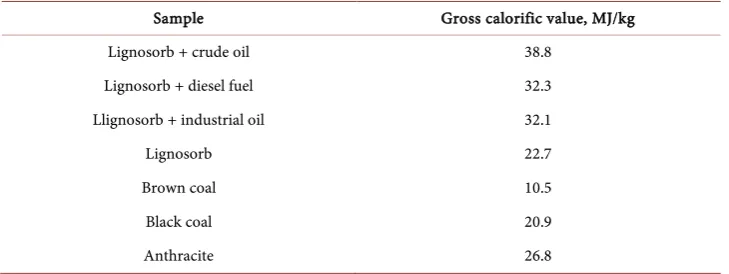
New powdered sorbent Lignosorb based on the hydrophobized hydrolysis lignin has been developed at the Belarusian State University. Hydrolysis lignin is a commercial waste product of biomass processing in the hydrolysis production of ethanol. In spite of the various proposals for hydrolysis lignin usage, the wide application has not found yet. Special area of hydrophobized hydrolysis lignin usage as a sorbent for oil spills removal and oil products waste recovery is discussed. Lignosorb, thanks to the rather high bulk density, can be applied manually or mechanically by conventional sprayers. It does not sink after oil adsorption and transforms liquid oil film on the water surface into the solid mass. The solid product is a complete mass and is easily collected from the surface of water. Lignosorb when blended with oil products waste in the volume forms the granular free-running product. The rheological properties of the Lignosorb suspensions in oil products at different sorbent to oil product ratio have been estimated. Saturated by different oil products Lignosorb one can granulate or pellet and utilize as a composite solid fuel including the co-firing regime of com-bustion. It has the higher heating value of 32.1 - 38.8 MJ/kg while the coal has 20.9 - 30.1 MJ/kg. It has been shown that composite fuel burning has less longstanding in-flammation stage, more long stable burning stage and less longstanding phase of smoldering in the comparison to wood and Lignosorb burning.
Keywords
Lignin, Sorbent, Oil Spills, Oil Products Waste, Composite Fuel
1. Introduction
Oil is one of the most dangerous pollutants for the environment because of its capacity
How to cite this paper: Po, H., Tatsiana, S., Ivan, R., Dzmitry, H., Nadejda, T., Galina, T. and Alexandr, A. (2016) Hydrolysis Lig-nin as a Sorbent and Basis for Solid Compo-site Biofuel. Advances in Bioscience and Bio- technology, 7, 501-530.
http://dx.doi.org/10.4236/abb.2016.711046
Received: September 19, 2016 Accepted: November 27, 2016 Published: November 30, 2016
Copyright © 2016 by authors and Scientific Research Publishing Inc. This work is licensed under the Creative Commons Attribution International License (CC BY 4.0).
http://creativecommons.org/licenses/by/4.0/
to thin the lipid layers of the cells membrane and the huge scale of usage. The impact of oil spills on water ecosystem cannot be overemphasized. One liter of oil when poured into water denudes forty liters of it of oxygen and can work the ruin more than one million of larval or hatchling fish and other sea organisms [1]. According to the United States National Research Council reports up to ten million oil tons fall into rivers, lakes and global ocean annually. Risk of crude oil and refined products pollution coming from spills and leakages at transportation, transfers and accumulation of oil effluent at different oil field operations will increase in future as oil consumption increases [2]. However, the story is not complete, because of the fact that Russian scientists discov-ered the oil at the age of fifty that can be tolerated as the evidence of its renewability [3].
Although to date numerous oil spills and waste cleanup recovery technologies have been developed, the problem in general is not considered as totally solved. Common solutions and projects include in-situ burning of oil on water, mechanical tools (booms, skimmers and novel devices as powerful hydrodynamic laser [4], use of chemical dis-persants, steam flushing, solidifiers, different kind of sorbents, involving, inter alia, carbon nanofiber and nanocellulose aerogels [5][6], and biodegradation agents that are effective on shorelines or land.
Among these items, the sorption methods are important in allowing us to provide the desired degree of oil removal, even of oil traces, easy for automating and call for low operating cost. Sorbent materials are attractive for some applications because of the possibility of collection and complete removal of the oil from the oil spill site or the waste storage. The ideal sorbent material needs to be both oleophilic and hydrophobic to have high rate uptake and capacity, retention over time, oil recovery from the sor-bent, reusability and biodegradability. Some of these properties have overlapping as-pects. While all are desirable for a sorbent, ultimate selection of the best material will involve a comparison between the most essential properties and other factors such as material availability, use experience in practice, available equipment for distribution and harvesting, oil product nature, location, etc. Of primary interest are the buoyancy retention, oil sorption capacity and easy separation of oil for use or cost efficient re-covery [7].
Because of the increasing number of oil spill accidents and the volume of petroleum products wastes the considerable attention has been paid to the development of effec-tive, inexpensive, ecologically friendly oil sorbents taking into account the amount of solid waste generated after a cleanup operation and safety aspects of attempting to re- use.
Research Institute for Physical and Chemical Problems has developed the method of the initial lignin hydrophobization. This procedure includes mixing of high wet sam-ples of lignin with dried ones. Hydrophobized hydrolysis lignin (HHL) can be used for oil products recovery. In this article, we report on the results of the evaluation of hy-drophobized hydrolysis lignin as the oil sorbent, colloidal-chemical properties of lig-nin-in-oil products dispersions, and the characteristics of the composite solid fuel based on the oil saturated hydrolysis lignin.
2. Materials and Methods
2.1. Materials
The hydrolysis lignin (acid hydrolysis) obtained from the dumps of the Republic of Be-larus Unitary Enterprise “Rhechitskii Pilot-Production Plant” and Open Joint Stock Company “Bobruisk Plant of Biotechnologies” were used as the main samples to study (sample 1 and 2). For the comparison study the enzymatic hydrolysis lignin (Sweden, sample 3) and organosolv lignin (ALCELL, Sweden, sample 4) were taken as well. Lig-nins’ characteristics were estimated and are given in Table 1.
The mass fraction of acids expressed in terms of sulphuric and acetic acids corres-ponds to 0.8% and 3.6% for samples 1 and 2 consequently. The humidity of the initial lignins was no more than 70%, after hydrophobization by drying in special regime the moisture content varied under 25%.
The characteristics of oil products under study are given in Table 2.
2.2. Procedure of Oil Products—Lignin Systems Preparation
Oil dispersions of lignin with a content of the dispersed phase from 5 to 46 wt.% were prepared for study by the gravimetric method with subsequent agitation in an IKA WERKE mechanical impeller agitation (Germany) for 10 min with a velocity of 500 rpm just before rheological measurements. Mixing of lignin with oil layer on the water surface was made by manually spraying of lignin that spontaneously mixes up with oil.
2.3. Procedure of Combined Fuel Pellets Based on Oil Products and
Lignin
The samples of lignin saturated by oil product were pressed with a 5 × 10⁷ Pa hydraulic
Table 1. Characteristics of lignin samples.
Sa
m
ple
Content of
Klason lignin, %
Bulk density,
kg/m3
Absolute density by
helium, kg/cm3
Functional group
content, % Content of elements, % OCH3 OHacet OHphen OHalif C H N S
Table 2. Characteristics of the oil products.
Kind of oil product Density, g/cm3 Surface Tension,
σ∙103 N/m Viscosity, mPa∙s Content of sulpha, %
Crude oil 0.81 28.6 134.97 0.28
Diesel Fuel 0.8 30.8 5.9 0.15
Industrial oil
(SAE 15 W-40) 0.83 27.75 319.01 1.5
Gasoline 0.78 21.15 0.56 0.05
The worked out engine oil BMW Original was used as well.
press. The final pressure for sample production of 10 GPa was reached at a controlled pressing rate of 100 MPa/s. Cylinder shaped pellets with a diameter of 15 mm and a typical thickness of 10 - 20 mm were produced.
2.4. Applied Methods and Procedures for Studying Oil
Products—Lignin Systems
2.4.1. Rheological Method
The “Rheotest-2” rheoviscosimeter (Germany) was used for the evaluation of the rheo-logical properties of diluted and middle concentrated lignin dispersions in the range of shear stresses 4 - 800 Pa. “Brookfield” rotary rheometer (USA) with Rheo3000 software and a measuring system with CC25 coaxial cylinders was under study in the area of 11.4 - 1140 Pa for the dispersions with a lignin content over 40%. The hysteresis at a temperature of 298 ± 1 K was studied in the regime of increasing and decreasing shear stress with the same rate. The duration of the experiment with measurement in one di-rection was 2 min with the use of “Rheotest-2” rheometer and 20 s with the use of the “Brookfield” rheometer. The obtained data were presented as flow curves.
2.4.2. BET Analysis
Specific surface area and pore size distributions were measured using a Gemini 2360 (Micromeritics, USA) through nitrogen adsorption at 77 K in the range of relative pressure (P/P0) of 10−6 - 1. Sample preparation involved degassing the samples
over-night (16 hours) at 120˚C under vacuum. The samples were subjected to 99-point BET surface area analysis and full adsorption isotherms were collected for all samples. In addition, micropore and mesopore volume distribution as a function of pore size were calculated based on the Horvath-Kawazoe (HK) and Barret, Joyner and Halenda (BJH) method, respectively.
2.4.3. Thermal Analysis
Sensitivity of DSC is 1mkVt, the measurement error is 7%; TG sensitivity—1 × 10⁻⁷ g,
the measurement error of weight loss is 1 × 10⁻⁶ g.
2.4.4. Contact Angles Measurement
Static and dynamic contact angles were measured using a FTA200 computer-controlled, video-based instrument (First Ten Angstroms, USA). The instrument is built around rapid video capture of images and automatic image analysis. The instrument includes a CCD video camera, a frame grabber, an adjustable sample stage and a LED light source. A drop (1 μl) of test liquid (water, diesel, hydraulic oil or engine oil) was allowed to fall onto the sample from a syringe tip to produce a sessile drop. The drop was dispensed from a syringe pump driven by a stepper motor. Images were captured at a rate of 10 frames per second for 10 s. In this study, single images (a snapshot) as well as image sequences (a movie) were captured.
2.4.5. Dispersion Analysis
The method of laser scattering was used for dispersion analysis. The measurement of particle size was performed on Mastersizer 3000 together with Aero S disperser (both— “Malvern”). In order to provide enough data for statistical analysis, the sample weight appeared to be 10 g.
2.4.6. Solidity Test
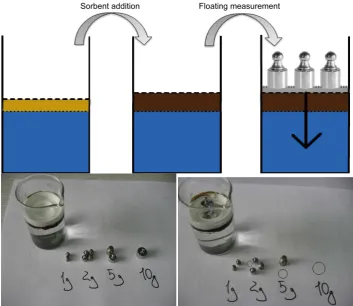
Water waves in an ecological real-life model experiment, described below were gener-ated by KS 260 control shaker (IKA). A found rpm frequency-wave height dependence allowed to simulate the behavior of the composite on the water surface. In addition, we placed certain weights on the solidified oil layer to measure the floating ability and the strength of the solidified layer. The total mass of weights reached 17 grams per 7.5 cm2
without the breakdown of the compact layer.
2.4.7. Determination of Moisture Content
To determine the moisture content of the sample, a mass of 0.5 g (accuracy of weighing 0.0002 g) was adjusted to a constant mass weighing bottle. An open weighing bottle was heated in an oven at (378 ± 5) K for 2 hours, followed by cooling in a desiccator with calcined CaCl2. Drying process was performed to constant weight [10].
Moisture content of the sample was calculated according to the formula:
(
m2 m1)
100w
m
− ⋅
=
where m2—mass of initial sample, g;
m1—mass of the sample after drying, g.
2.4.8. Determination of Fractional Composition of Lignin
accuracy up to 0.02 g.
The content of a fraction of the sorbent particles (X) was calculated according to the formula: 100 i m X M ⋅ =
where М—mass of non-fractioned sorbent, g;
mi—sorbent mass on i-tray after sieving, g.
2.4.9. Determination of Bulk Density
Dried to constant weight lignin was poured into a pre-weighed measuring vessel with a height of 100 mm above its top edge to form a cone over the top of the vessel, which was removed by a metal ruler (without tight packing of the sample) and weighed.
The bulk density of the sorbent (ρb) in kg/m3 was determined with an accuracy up to
10 kg/m3 according to the formula:
1 2
b
m m
V
ρ
= −where m1—weight of the vessel with the filler, kg;
m2—weight of the vessel, kg;
V—volume of the vessel, m3.
The bulk density of the sorbent was calculated as the arithmetic mean of the results of four determinations.
2.4.10. Determination of Oil Absorption Capacity
(
2 1)
1 c m m w m − =
A certain mass sample was placed into a cylinder (diameter 20 mm, height 50 mm), made of a metal net with openings h = 0.1 mm. The cylinder was tightly capped and placed in a vial with the model oil composition at T = 25˚C, so that the liquid level above the top of the cylinder was not less than 20 mm above the sorbent. In this posi-tion, the sample was kept for 24 hours. The cylinder has been removed from the vessel followed by the drainage of unabsorbed oil for 1 hour. After a dry cloth was used to wipe away the surface of the cylinder. The net was weighed with an error less than 0.1 g. Oil absorption capacity Wc was calculated according to the formula:
where m1—the mass of dry sample, g;
m2—the mass of the sample after oil adsorption, g.
The result was determined as an arithmetic mean of the three independent results.
2.4.11. Determination of the Retention Time on the Water Surface of the Sorbent in Oil-Saturated State
In laboratory glasses V = 100 cm3 50 cm3 of water was poured together with 2 - 5 cm3 of
3. Results and Discussion
Lignin is one of the three major compounds of biomass along with cellulose and hemi-cellulose. Biosphere has an estimated 3 × 10¹¹ metric tons of lignin with a 2 × 10¹⁰
me-tric tons annual biosynthesis rate. Lignin has complicated chemical and topological structure. The main buildings block of lignin isconiferyl, sinapyl and coumaryl alcohol
[10], shown on Figure 1.
The fragments are randomly conglomerated together to compose cell walls of plants and maintain the integrity of the cellulose/hemicellulose/pectin matrix [11].
An important point is the structure of lignin macromolecules. Novel hypothesis was put forward that is concerned the existence of different universal lignin classes having diversity of topological structures [12]. This means that the molecules of lignin ex-tracted from different kinds of plants have their own structure. They have different shapes including coil, linear structure, star, dendrites, and so on.
Computational results obtained using software programs from Dassault Systèmes BIOVIA. The ab initio calculations were performed with the DMol3 program, and graphical displays generated with BIOVIA Materials Studio. The Nimz lignin fragment
[13] was geometrically optimized using the MNDO method. The complex surface structure is shown in Figure 2.
It is seen from Figure 2(a) that oxygenatomcontent (highlighted with red color) is quite high (14.6% by number, 30.5 wt.%). Being the negative charged atoms in lignin fragment, it is though seen, that the interpolated charge map (Figure 2(b)) does not completely match with the figure abovementioned (Figure 2(a)). The Solvent Excluded surface (or Connolly surface) is defined as the locus of the inward-facing probe sphere as it rolls over the van der Waals surface of the molecule. This surface can be consi-dered as a continuous sheet consisting of two parts: the contact surface and the re- entrant surface.
The contact surface is a part of the van der Waals surface that is accessible to a probe sphere. The re-entrant surface is the inward-facing surface of the probe when it touches two or more atoms. Both surfaces were created in Discovery Studio 2.5 using 1.4 A Connoly radius and vdW factor 1.
As different colors on Figure 2(b) represent different charge, one can see, that blue color, consisted of only C and H atoms, represent the hydrophobic part of the fragment.
(a)
(b)
Figure 2. Connoly surfaceof alignin fragment structure [13] with probe radius 1.4A. (a) Colored by atom; (b) By interpolated charge.
Compared to hydrophilic red “spots”, hydrophobic areas are grouped together, allow-ing interactions with large organic hydrophobic molecules. This lead to the possibility of both sorbing polar and non-polar molecules.
The following computer aproximation allows to presume the fact that the certain material can be a sorbent, as one can surmise the hydrophobization process decrease the “polar” area of the structure due to volatilization of weakly bound groups.
which do contain sugar units. HL, which is still in its solid form after lignocellulosic ethanol production, has different spheres for use: in energy sector for the production of briquettes, pellets; pyrolysis bio-oil and fuel gas; in chemical industry as a sorbent for purification of industrial effluents; in agriculture for the production of fertilizers, herbi-cides, and so on.
An up-growing interest to biofuels prompted the investigations on lignin fermenta-tion and chemical biological transformafermenta-tions to low-molecular-weight organic matter. Unfortunately, the initial role of lignin in nature is to protect cell wall polysaccharides from microbial degradation. Thus, it is not surprising that the biodegradability of lignin appears to be quite low, and the only palisade wood-destroying fungi causing of the white rot (Coriolus versicolor, Fomes fomentarius) and some nesting basidimycetes (Collybria, Marasmius, Mycena) activated the degradation of lignin [14]. There are some trends of research on the alternative uses of lignin including the production of ac-tivated carbon, carbon fibers and phenols as well. Lignin based products are very at-tractive because of REACH as a possible barrier for future European market develop-ment is not specific to them [15].
3.1. Dispersion Analysis
The hydrophobized HLunder study was a deep dark brown powder mass with rather wide distribution of particles by size that differs from the narrower distribution of the lignin samples obtained by the enzymatic hydrolysis or the organosolv process (Figure 3).
Figure 3. The diagrams of the particle sizes distribution for lignin samples (1-4). 0
10 20 30 40 50 60 70 80 90 100
1 2 3 4
Per
cen
ta
ge,
%
Diameter, mm
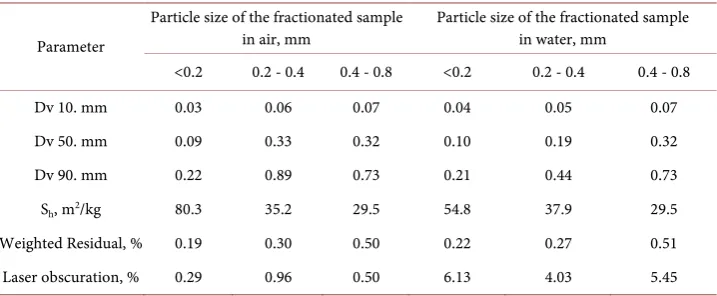
By the laser diffraction method, the statistic parameters of the particle size distribu-tion were determined for HL samples 1. 2. Table 3 presents the difference in dispersity for the samples from different producers.
It has been shown on the lignin fraction sample (0.4 - 0.8 mm) that the particle size distribution in water as a dispersed media as compared to the dispersion with the air dispersed media becomes wider according to the aggregation of the lignin particles in water (see Table 4).
3.2. Hydrolysis Lignin Structure and Sorption Capacity
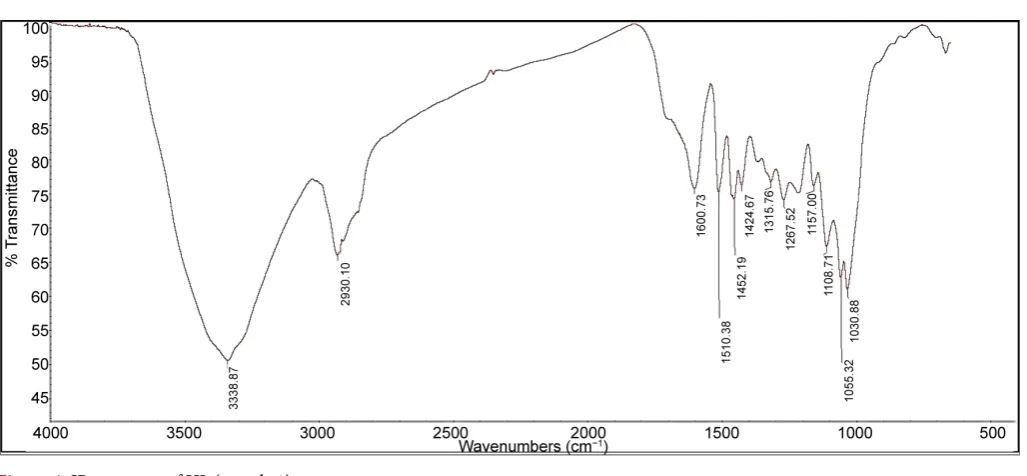
Figure 4 illustrates the IR spectrum of HL (sample 1). Judging by the IR spectrum data the sample contains significant amounts of carbohydrates. The evidence is the intense absorption bands in the 1000 - 1200 cm−1 range. The content of functional groups in
the sample was shown earlier (Table 1).
[image:10.595.195.554.372.512.2]The characteristics of the porous structure for different lignin samples: specific sur-face and pores sizes distribution was calculated by the software for Costech sorptome-tru KELVIN 1042 device according to the low temperature nitrogen sorption-desorp- tion isotherms. The isotherms (Figure 5) correspond to the type II according to IUPAC classification. They are similar to the isotherms for the adsorbents with macro porous
Table 3. The calculated ANOVA parameters for hydrophobized HLsamples.
Parameter (“Rhechitskii pilot-production plant”) Lignin Sample 1
Lignin
(“Bobruisk Plant of Biotechnologies”) Sample 2
Dv 10. mm 0.43 0.06
Dv 50. mm 0.71 0.33
Dv 90. mm 1.13 0.89
Sh, m2/kg 10.2 35.2
Weighted Residual, % 0.76 0.35
[image:10.595.194.553.554.702.2]Laser obscuration, % 17.3 3.09
Table 4. ANOVA parameters for suspensions of different fractions of lignin particles in air and water media.
Parameter
Particle size of the fractionated sample
in air, mm Particle size of the fractionated sample in water, mm <0.2 0.2 - 0.4 0.4 - 0.8 <0.2 0.2 - 0.4 0.4 - 0.8
Dv 10. mm 0.03 0.06 0.07 0.04 0.05 0.07
Dv 50. mm 0.09 0.33 0.32 0.10 0.19 0.32
Dv 90. mm 0.22 0.89 0.73 0.21 0.44 0.73
Sh, m2/kg 80.3 35.2 29.5 54.8 37.9 29.5
Weighted Residual, % 0.19 0.30 0.50 0.22 0.27 0.51
Figure 4. IR spectrum of HL (sample 1).
[image:11.595.195.549.165.568.2]
(a) (b) (c)
Figure 5. Isoterms of nitrogen sorption-desorption for lignin samples 1 (a), 3 (b) and 4 (c).
structure or with non-porous structure at the low inner surface but strong interaction adsorbent-adsorbat. There is a plato at the isotherm for hydrolysis lignin that points out to the multilayer adsorption and the occurrence of mesopores in its structure.
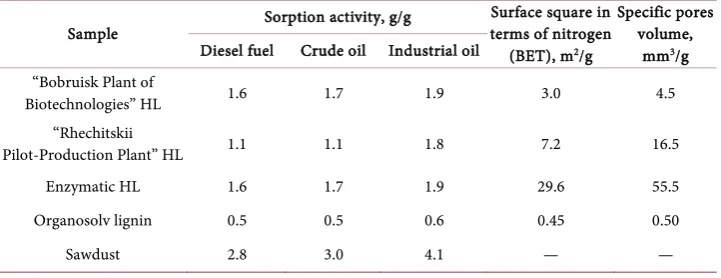
Isotherms are well described by BET equation at the interval of 0.05 - 0.30 relative pressure of nitrogen that allows calculating the porous structure parameters (Table 5).
As follows from the table data the HL (sample 1 and 2) have higher specific surface
0 3 6 9 12 15
0 0.5 1
V[
cc
/g
]
p/p0
0 25 50 75 100 125 150 175
0 0.5 1
V[
cc
/g
]
p/p0
0 0.05 0.1 0.15 0.2 0.25
0 0.5 1
V[
cc
/g
]
Table 5. Specific surface square and pores volume along with fuel sorption capacities for lignin samples.
Sample Sorption activity, g/g terms of nitrogen Surface square in (BET), m2/g
Specific pores volume,
mm3/g Diesel fuel Crude oil Industrial oil
“Bobruisk Plant of
Biotechnologies” HL 1.6 1.7 1.9 3.0 4.5
“Rhechitskii
Pilot-Production Plant” HL 1.1 1.1 1.8 7.2 16.5
Enzymatic HL 1.6 1.7 1.9 29.6 55.5
Organosolv lignin 0.5 0.5 0.6 0.45 0.50
Sawdust 2.8 3.0 4.1 — —
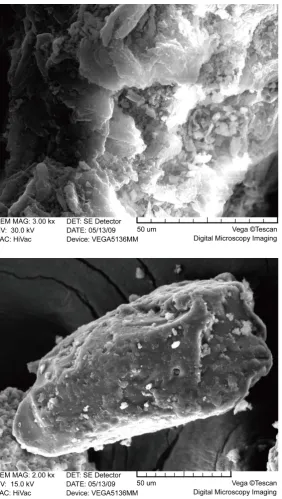
and pores volume than organosolv lignin (sample 4), but lower than the enzymatic one (sample 3). SEM images demonstrate that the HL particle surface has the complicated relief in contrast to the smooth surface of the organosolv lignin particle (Figure 6).
These morphological and structural features correlate with the lignin samples sorp-tion activity (Table 5).
It is evident from the Table 6 that the higher the drying temperature the lower the surface square and the higher the most probable diameter of the pores and their volume as well. It connects with the influence of the evaporation velocity increase following by the increase of the water vapors pressure that makes the particle structure more crum-ble [16]. However, it influences on the sorption capacity moderately.
As follows from Table 7 and Table 8, hydrophobized HL sorption activity slightly depends on the samples humidity but the particles’ size influences on it.
HL samples has the following characteristics as a sorbent: specific surface 3.7 - 7.2 m2/g (by N
2), total pore volume 4.5 - 16.5 mm3/g; methylene blue sorption capacity 120
- 170 mg/g; iodine sorption capacity 245 - 330 mg/g, and oil products sorption capacity 1.2 - 2.8 g/g. Compared to other oil sorbents Lignosorb has the lowest sorbent price and the lowest cost of the sorbent required for the sorption of a ton of crude oil (Table 9).
Lignosorb takes up the crude oil and refined products rapidly in the contrast to water that the contact angle study proves (Figure 7).
Hydrophobized HL (Lignosorb) has very good buoyancy in the oil saturated state (1 - 15 days depending on the weather) and can form solid mass with oil products. It can be easy to remove from the water surface (Figure 8). The ratio of Lignosorb:oil product has to be between 60 ± 5 : 40 ± 5 for different systems and environmental conditions.
The attack of the artificial waves on the solidified oil layer was used as a test for its solidity. It was found that the waves up to 5 cm couldn’t destroy the continuity of composite that has been formed on the water mirror with the square 400 cm2 at 2 mm
Figure 6. SEM images of lignins’ samples: HL (upper) and organosolv (down).
high waves at that water region (Figure 9).
The floating capacity and the strength of the solidified layer of the oil product (where oil product = Diesel Fuel, Industrial Oil and Light Crude Oil) was performed, as ac-cording to scheme at Figure 10.
Table 6. Porous structure and sorption activity of dried Hl samples.
Drying temperature, ˚C
Integrated surface square for pores in terms of nitrogen, m2/g
Integrated pores
volume, mm3/g Pore diameter, nm Diesel fuel sorption, g/g
20 - 25 13.82 75.9 21.99 1.28
100 22.97 147.6 25.69 1.30
150 22.28 149.0 26.76 1.31
200 22.14 155.4 28.07 1.30
[image:14.595.193.555.260.388.2]200 (at stirring) 21.51 150.0 27.90 1.29
Table 7. Influence of HL (sample 1) humidity on bulk density and sorption activity.
Humidity hydrolytic
lignin, % Bulk density, g/сm3
Sorption activity, g/g
Diesel fuel Industrial oil Crude oil
5 0.381 1.28 1.43 1.56
10 0.392 1.27 1.33 1.48
15 0.404 1.24 1.26 1.45
20 0.414 1.19 1.24 1.41
25 0.432 1.16 1.20 1.39
Table 8. Sorption activity of fractionated hydrophobized HL (sample 2).
Lignin fraction,
mm
Fraction
content, % Humidity, % Bulk density, kg/m3
Oil capacity, g/g
Gasoline Diesel fuel Oven fuel Mazut M-100
>0.8 - 5.2 240 1.6 1.8 1.9 2.1
0.4 - 0.8 30.5 4.0 260 1.9 2.4 2.4 2.5
0.25 - 0.4 23.5 4.4 270 2.1 2.2 2.2 2.8
<0.25 44.2 4.4 290 1.6 1.7 2.0 1.9
Table 9. Comparison of the sorbents for crude oil.
Sorbent Bulk weight, kg/m3
Bouyancy in oil-saturated
state
Sorption, g/g
Sorbent mass for sorption of crude
oil kg/ton
Sorbent price, $/kg
Cost of sorbent required for sorption of crude
oil, $/ton
Penoporum 12 5/5 ~20 50 ~30 ~1500
Moss ~70 2/5 ~10 100 ~4 ~400
Ecotorf ~70 1/5 ~5 200 ~2 ~400
[image:14.595.195.555.423.543.2] [image:14.595.194.557.578.702.2]Figure 7. Microphotographs of water and diesel fuel droplets on the surface of the sample 1 of HL.
Figure 8. The illustration of the solidifying effect of Lignosorb on the diesel fuel layer.
best-time solidifying ability.
[image:15.595.209.543.392.618.2]Figure 9. The appearance of the solidified oil layer after waves exposure during 1 hour.
Figure 10. The illustration of the solidifying activity of lignin in reference to light crude oil.
Figure 11. The solidification time of different oil product—Lignosorb composites with their ratio equals to 45:55versuslayer’s thickness.
Figure 12.The solidification time of diesel fuel—Lignosorb compositesfor different layer’s thick- ness versus Lignosorb content.
3.3. Composite Fuel Processing and Properties
According to the proposed technology, the composite fuel can be produced in the form of granules or pellets. The technology developed and widely exploited for the produc-tion of fuel pellets from wood- and plant-based biomass was used for processing of hy-drophobized HL due to the ability of the latter to the transition in plastic state under influence of high pressure. Pressure is not used in the case of granulated fuel produc-tion. Oil product—Lignosorb mixture can be formed at the oil spill removal upon lig-nin pouring on the surface of oil or by mixing of oil products waste with liglig-nin in any storage capacity.
[image:17.595.197.553.294.464.2]“combustion of wood”. Only few examples: lignin is burned either as powder or as slurry (mixed with oil and water). The average composition of the slurry was 40% lig-nin, 41% water and 19% oil. A surfactant is added too (0.1% - 0.2%). The tests showed that the temperature and the calcinations fields with powder or slurry were similar. Studies done at Energy & Environmental Research Centre (EERC), USA where lignin is used as additive to coal [17]. With its characteristics of high dispersion and fluidity, the fine particulate of lignin, down to nanometers range, through adoption of an innovative activation technology can be evenly mixed with diesel oil to form a kind of quasi-liquid fuel of a state in between liquid and solid, and thus become a partial substitute for di-esel oil [18].
As indicated by the thermal analysis data, composite fuel Lignosorb—industrial oil is characterized by the more complete combustion of lignin. It is obvious from Figure 13
(a)
[image:18.595.235.512.270.672.2](b)
that lignin thermally decompose over a broad temperature range. DTG curve of lignin has three peaks at 78˚C, 316˚C and 421˚C. Peak at 78˚C is related to the loss of lignin moisture. Decomposition of lignin has two stage and begins at 280˚C. The main process occurring around 400˚C with the formation of aromatic hydrocarbons, phe-nolics, hydrohyphenolics and quaiacyl/syringyl-type compounds, most products having phenolic -OH groups [19]. The residue of mass is 19.07%. The mixture of lignin:Indus- trial oil = 1:1 differs in the loss of mass at the first stage: it composes up to 70% unlike 30% for the lignin. The residue of mass becomes 8.74% in this case and it decreases up to 5.39% for the mixture of lignin:industrial oil with the composition 3:1 that indicates the combustion in larger degree.
Table 10 shows the highest calorific values (HCV) of different types of composite fuel for the conventional solid fuels including the pellets of the hydrophobized lignin itself (Lignosorb).
The parameters regulated by ASTM, DIN, ONORM, CN/TS 335 international stan-dards: elemental composition (C, H, N) and calorific value were determined at the la-boratory of Lignin chemistry at the Latvian State Institute of Wood Chemistry (Riga, Latvia). The comparison of the experimental values and the calculated ones was done and the results are presented in Table 11.
Table 10. The highest calorific values for different types of the solid fuels.
Sample Gross calorific value, MJ/kg
Lignosorb + crude oil 38.8
Lignosorb + diesel fuel 32.3
Llignosorb + industrial oil 32.1
Lignosorb 22.7
Brown coal 10.5
Black coal 20.9
[image:19.595.193.550.550.708.2]Anthracite 26.8
Table 11. Characteristics of pelleted fuel humidity and calorific value*.
Sample Humidity,%
Calorific value using the working mass (experiment),*
MJ/kg
Calorific value calculated using the experimental mass
calculation according to e quation,* MJ/kg,*
HCV LCV HCV LCV
Wood granules 7.9 17.9 16.5 18.3 16.9
Lignin 11 18.8 17.4 17.3 16
Lignooil
7.4 22.6 21.2 17.9 16.5
(lignin + oil) Determination
For the calculation of the highest calorific value (HCV) the following equation [20]
was used:
2
3.55 232 2230 51.2 131 20600,
HCV = ⋅C − ⋅ −C ⋅ +H ⋅ ⋅ +C H ⋅ +N
where HVC—highest calorific value, kJ/kg;
С, Н, N—the content of the elements in the sample, %.
Lowest calorific value was calculated as well by the following equation:
(
)
0.0251 9 LCV =HCV− ⋅ H+W
where H—content of organic hydrogen, %;
W—relative humidity, %;
2510—specific water evaporation heat, kJ/kg.
As follows from the data of Table 11, carbon content per dry fuel mass without ash is higher in composite fuels than in wood. The reason is the removal of the part of hy-drocarbons during the pyrolysis.
The experimental data of HCV for Lignooil are 26% higher than the calculated ones. Absence of the pre-drying before testing may be suggested as the reason of that.
The process of burning of the fuel pellets was conducted by the original unit with the camera of the gasification and the camera of burning of volatile products pyrolysis/ biomass gasification (Figure 14). Each camera has their own water-cooled heat-ex- change unit with two thermopairs connected to the electronic plates of PC for input and output stream of the water. The measurements of water stream temperature and the calculation of the absorption heat quantity was carried out in the on-line regime (1 count per second). The propane burner with the capacity of 1.2 KW was used for the
Figure 14. Main view of the unit for the estimation of biomass burning (a) and its principle scheme (B): 1—gasifier, 2—propane burner, 3—heat-exchanger jacket of the burning camera, 4 - 5 —system of air supply, 6 - 7—delivery pipe for water supply, 8—electronic plate, 9—PC, 10 - 11—effluent gases analyzer Testo 350XL, 12—ash collector.
[image:20.595.194.547.435.649.2]initiation of the burning. The content of О2, СО2, СО, NOx in the combustion products
and temperature of the exhaust gases screen were hold by the analyzer of effluent gases Testo 350XL in the on-line regime (1 data point per second).
Three stages of the burning process: stage of inflammation, stage of stable burning and stage of smoldering have been studied. Lignin burning has more longstanding in-flammation stage, more short burning stage and more longstanding phase of smolder-ing. The stage of inflammation was determined as an interval of time between the be-ginning of the propane flame contact with biomass and the moment of reduce of oxy-gen content in the burning products from 20.9% to 10.5%. It corresponds to the excess of air α = 2.0. The stage of stable burning was determined as the interval of time when α
≤ 2. The stage of smoldering was determined as the time interval between the second stage and the moment when the oxygen content in the burning products reaches 20.9%.
Figure 15(a) shows that the time of the inflammation of composite fuel is reduced with the including of the oil products into the composition of the lignin pellets. It is lower than the corresponding value of the wood. Stable burning stage time is increased and the stage of smoldering is reduced for composite fuel.
However, the time of smoldering in the absolute values and in the percentage ratio exceeds the same one for wood (Table 12). Average burning velocity (velocity of mass loss) has increased in 12% according to the Lignin pellets but it was lower than for wood pellets. Clearly, the oil product burns down with rather high velocity but at later time the lignin burning runs with the characteristic species of the elongated smoldering stage like lignin itself.
The amount of СО2 in the exhaust gases has been shown to reduce for Lignin pellets
as compared to wood and Lignooil pellets. As this takes place, the CO amount was the lowest (Table 13) as well. This parameter was higher for combine fuel pellets (Figure 15). One conceivable reason for higher concentration of СО2 is the large amount of the
volatile pyrolysis products coming to the zone of burning in the covered period of time. The highest average temperature in the active burning zone also proves it.
Owing to the high calorific value, special features of the burning stages composite solid fuel based on lignin and waste of oil products are the perspective kinds of the solid fuels.
3.4. Rheological Properties of Lignin—Oil Products Dispersions
(a)
(b)
[image:22.595.266.482.69.475.2](c)
Figure 15. Variation of the oxygen content in the products of burning and the coefficient α of air excess (a) and changing of the composition of fuel gases for the pelleted fuel combustion (CO2— b, O2—c).
Table 12. Duration of the different burning stages and the average velocity of the mass loss for fuel pellets.
Sample
Inflammation Stable burning* Smoldering*
Velocity of the mass loss, g/min **
duration duration duration
seconds % * seconds %* seconds %*
Wood 256 15 1240 73 274 12 7.2
Lignin 687 31 1053 48 467 21 5.3
Lignooil
(lignin + oil) 183 10 1224 69 362 21 6.0
[image:22.595.194.554.571.694.2]Table 13. Average characteristics of the composition of combustion gases, of the fuel gases and their temperature (Tg) and the temperature in the zone of stable combustion (Tc) of the test pellets.
Pellet sample Air consumption, g/к Average concentration Тc, К Тg, К α primary secondary О2, % СО, ppm
Wood 0.61 0.94 6.45 112.0 1326 781 1.4
Lignin 0.77 1.27 8.45 59.5 1316 727 1.6
Lignooil 0.77 1.27 5.60 89.7 1385 796 1.3
Figure 16. Flow curves for the lignin: industrial oil dispersions at different lignin contents: for n < 10. where n is the number of the curve, lignin:fuel ratio can be find from [(n − 1) * 0.05]:[1.05 − 0.05n]; curve 10 represents the ratio 42:58; curve 11—the ratio 44:56.
linearly increase shear rate from minimum (50 s−1) to a maximum value (500 s−1), and
then to return with the same rate to 50 s−1. The more the lignin content the larger the
loop square. Hysteresis loop test is used for the thixotropy estimation.
There are some definitions in the history of thixotropy in literature [22]. According to one of them thixotropy is a viscosity decrease under shearing, followed by a gradual recovery when the shear is removed. The time is the key factor in thixotropy, as if the viscosity reduces and returns after shearing immediately it means that the system has no need in relaxation time and the studied material is called “shear thinning”, not thix-otropic. Otherwise, the process of relaxation takes some time, and there is a gap before the system returns to its initial state. The larger the area of the hysteresis loop the
0 200 400 600 800 1000 1200 1400 1600
50 150 250 350 450
τ, P
a
γ [s-1]
1 2 3
4 5 6
7 8 9
10 11 -1 -0.8 -0.6 -0.4 -0.2 0 0.2 0.4 0.6 0.8 1
200 250 300 350 400 450 500
lg
η
γ [s-1]
1 3 4
6 7 9
stronger the system is destroyed, so the larger thixotropy it has.
Loops due to the fact that after mechanical destruction the dispersion structure is restored thixotropically more slowly with time, and in the given regime of deformation the coagulation contacts between the dispersion structure elements have no time to be restored completely. In this case, the degree of thixotropy increases with increasing the concentration of lignin in the dispersion, which is correlated with the hysteresis on the viscosity rheograms. Dispersions have been found to lose the flow capacity to become solid at different components ratio depending on the lignin and oil products characte-ristics, and their concentration. But there is the interruption of discontinuity in con-centration profile of the loops square for some systems near the area of solidification.
Hysteresis loops on flow curves for crude oil and different oil products—lignin sus-pensions at one and the same component ratio in the narrow interval of the oil content are shown in Figure 17.
According to the obtained data, it was noticed that dispersions of lignin in the indus-trial oil proved to be the most structured largely due to initial high viscosity of industri-al oil that prevents quick structurindustri-al disordering (Table 14).
[image:24.595.198.547.330.552.2]Diesel Fuel Industrial Oil Light Crude Oil
Figure 17. Hysteresis loops for flow curves of lignin dispersions in diesel fuel (a), industrial oil (b) and light crude oil (c) at oil product percentage: 60% (1), 58% (2), 56% (3).
Table 14. Hysteresis loop square ratio for different oil product—lignin dispersions at oil product percentage: 60% (1), 58% (2), 56% (3).
n Diesel Fuel Industrial Oil Light Crude Oil
1 0.05 0.71 0.58
2 0.17 0.75 0.70
[image:24.595.192.555.631.703.2]For crude oil—lignin systems [20] having been studied before we assumed that due to the action of the capillary forces a solid bound dispersed systems, a quasi-gel, is formed at definite components ratio. Figure 18 illustrates the solidification of the lig-nin—diesel fuel dispersion: separate particles turn into the system with restricted par-ticles. The system’s integrity is probably determined by the appearance of a capillary contracting force between lignin-swollen particles with occluded oil. This force arises at
(a)
(b)
[image:25.595.272.476.175.685.2](c)
the definite amount of the liquid oil between particles that provide meniscus curvature in the form of cup. As a result, of the force action, the particles are attracted to each other and the structured system is formed. This makes it possible to remove easily and practically without loss the oil-saturated sorbent from the surface of the water.
Particle size influence on the rheology behavior of the dispersion was also studied. It was found that it is not the size that has influence on the rheological behavior, but the distribution and more specifically the width of the peak of the size distribution. Figure 19 demonstrates the particle size distribution curves for fractions of hydrophobized HL (sample 2).
It can be seen from Figure 20 that the hysteresis loop appears at the definite ratio oil —lignin. The criterion to determine the content of oil (w1), when the hysteresis loop is
clearly expressed, was the area of the loop (the last content, before Sloop ≥ 20000). At the
same time w2 represents the maximum of lignin content in oil product -lignin
disper-sion (Table 15) when it able to flow.
The data for sorption capacity of lignin fractions are shown in Table 16.
[image:26.595.195.555.455.684.2]The output of Table 16 data is the following: almost all oil products and crude oil can be absorbed by HHL; there is no simple correlation between sorption capacity and oil product viscosity, density or surface tension and the same to solidifying activity. Nevertheless, for fuels, that have high values of viscosity and surface tension (crude oil) the sorption capacity would be expected the largest, so the higher the values, the larger the sorption capacity. As for benzene (low surface tension, low viscosity) the smallest capacity has been determined. For fuels that have either high viscosity or high surface tension average sorption capacity between crude oil and benzene is observed. Further research are needed for establishing the optimal conditions for oil polluted systems treatment and regime of the effective combustion.
Figure 19. Particle size distribution curves for the fractions of the HHL sample 2.
0 1 2 3 4 5 6 7 8 9 10
1 10 100 1000
Pe
rc
en
ta
ge
, %
Size, mkm
Figure 20. Hysteresis loop square via oil percentage for fractionate lignin—industrial oil dispersions.
Table 15. Oil content in fractioned lignin—industrial oil dispersion that corresponds to the hys- teresis loop appearance and dispersion solidification.
Dx 50 = 93.6 fraction Dx 50 = 134 fraction Dx 50 = 531 fraction
Oil percentage w1 75% 70% 75%
w2 54% 54% 56%
4. Conclusions
[image:27.595.197.555.503.552.2]Table 16. Characteristics for oil products, fractionate lignin and their mixtures.
Density, g/cm3
Surface Tension, σ∙103 N/m
Viscosity, mPa∙s
Sorbtion Capacity, g/g
Wstructure, % lignin Particle size
(Mode),
mkm Capacity Average
CrudeOil
(light) 0.81 28.60 134.97
531 1.76
1.68 44.50
134 1.75
93.6 1.53
Diesel Fuel 0.8 30.80 5.90
531 1.67
1.56 41.50
134 1.55
93.6 1.45
IndustrialOil 0.83 27.75 319.01
531 1.58
1.55 43.00
134 1.52
93.6 1.55
Benzine 0.78 21.15 0.56
531 1.47
1.40 ≈40
134 1.4
93.6 1.34
Water 1.00 72.80 0.90 531 1.34 1.77 -
of them suppose lignin modification: use of lignin derivatized by the fibrous composite (wool shoddy, consisting of 25% of viscose, 50% of wool, and 25%—polyamide) [23]
and so on. Nanosized hydrolytic lignin can be evenly mixed with diesel oil to form a kind of quasi-liquid fuel of a state in between liquid and solid, and thus become a par-tial substitute for diesel oil [24]. As distinguished from these sorbent materials, the pro- cess of Lignosorb production is simple and cost effective.
Hydrophobized HL removes more than 90% of oil products at the hydrophobized HL:oil product ratio 3:1. Increase the ratio up to 1:1 allows removing almost 100%. The buoyancy of the hydrophobized HL sorbent saves for a month in the dependence of the environment conditions. Owing to the high calorific value, much reduced cost, and real horizons for the increase of combustion efficiency the proposed composite lignin-based fuel is the perspective kind of the solid biofuel reducing carbon dioxide footprints. The worked out oil products from several Belarusian enterprises allowed for using as fuels have been successfully overworked by hydrophobized HL into composite fuel pellets.
to capillary forces the nonflowing structured (bonded dispersed) system is formed. The process of solid mass formation depends on the viscosity of the dispersion medium and the particle size of the dispersed phase.
Saturated by different oil products Lignosorb one can granulate or pellet and utilize as a composite solid fuel. The higher calorific value is 32.1 - 38.8 MJ/kg in the compar-ison with 20.9 - 30.1 MJ/kg for coal. The co-firing regime of combustion is possible as well. Less longstanding inflammation stage, more long stable burning stage and less longstanding phase of smoldering in the comparison with wood and Lignosorb burning makes the composite fuel pellets very attractive for using and them to be attached to the line of renewable biofuels. The production of Lignosorb in industrial scale started at the “Bobruisk Plant of Biotechnologies”.
Acknowledgements
The authors would like to thank Science and Technology Department of Zhejiang Pro- vince, State Administration of Foreign Experts Affairs, Zhejiang Administration of Fo- reign Experts Affairs and Zhejiang Shuren University for financial support.
References
[1] Murygina, V. (2007) Microbes against Oil Spots. Chemistry and Life, 6, 10-15.
[2] Dave, D. and Ghaly, A.E. (2011) Remediation Technologies for Marine Oil Spills: A Critical Review and Comparative Analysis. American Journal of Environmental Science, 7, 423-440.
https://doi.org/10.3844/ajessp.2011.423.440
[3] Galimov, E.M., Sevast’yanov, V.S., Karpov, G.A., Kamaleeva, A.I., Kuznetsova, O.V., Ko-nopleva, I.V. and Vlasova, L.N. (2015) Hydrocarbons from a Volcanic Area. Oil Seeps in the Uzon Caldera, Kamchatka. Geochemistry International, 53, 1019-1027.
https://doi.org/10.1134/S0016702915120046
[4] Katz, C. and Gauthie, R. (2007) Oil Spill Response Technology Initiation Decision Report to the Pollution Abatement Ashore Program Technical Document, 33 p.
[5] Nguyen, S.T., Feng, J.D., Le, N.T., Le, A.T.T., Hoang, N., Tan, V.B.C. and Duong, H.M. (2013) Cellulose Aerogel from Paper Waste for Crude Oil Spill Cleaning. Industrial & En-gineering Chemistry Research, 52, 18386-18391. https://doi.org/10.1021/ie4032567
[6] Wang, B., Karthikeyan, R., Lu, X.-Y., Xuan, J. and Leung, M.K.H. (2013) Hollow Carbon Fibers Derived from Natural Cotton as Effective Sorbents for Oil Spill Cleanup. Industrial & Engineering Chemistry Research, 52, 18251-18261. https://doi.org/10.1021/ie402371n
[7] Spotkina, E. and Novoselova, L. (2005) Materials for Adsorptions Purification of Water from Petroleum and Oil Products. Chemistry for Sustainable Development, 13, 359-375. [8] Rabinovich, M.L. (2014) Lignin By-Products of Soviet Hydrolysis Industry: Resources,
Characteristics, and Utilization as a Fuel. Cellulose Chemistry and Technology, 48, 613-631. [9] Nenkova, S., Herzog, M., Gancheva, V. and Garvanska, L. (2008) Study of the Sorption Properties of Technical Hydrolysis Lignin and Wood Shoddy towards Oil Pollutions. Jour-nal of the University of Chemical Technology and Metallurgy, 43, 217-222.
[10] Sarkanen, K. and Ludwig, C. (1971) Lignin: Occurrence, Formation, Structure and Reac-tions. Wiley-Interscience, New York, 916 p.
[12] Karmanov, A., Beliaev, V. and Kocheva, L. (2010) Research of the Lignins Molecules Struc-ture. Chemistry of Plant Raw Material, 1, 27-34.
[13] Nimz, H. (1974) Beech Lignin—Proposal of a Constitutional Scheme. Angewandte Chemie International Edition in English, 13, 313-321. https://doi.org/10.1002/anie.197403131
[14] Kvasnikov, E. and Klushnikova, T. (1981) Microorganisms Is a Destructors of Oil in Water Basins. Kiiv, Naukovadumka, 132 p.
[15] Gosselink, R., Guran, B. and Abeherli, A. (2004) Co-Ordination Network for Lignin— Standardisation, Production and Applications Adapted to Market Requirements (EURO- LIGNIN). Industrial Crops and Products, 20, 121-129.
[16] Levin, B. Influence of Drying Conditions on Lignin Structure. Wood Journal, 4, 24-29. [17] Zygarlicke, C., Pavlish, J., Gunderson, J. and McCollor, D. (2000) Ash Behavior and
Com-bustion Performance during the Cofiring of Rice Straw Lignin and Coal. Proceedings of the
9th Biennial Bioenergy Conference: Moving Technology into the Marketplace, Buffalo, 15-19 October 2000, 12 p.
[18] Qin, C.D. and Phil, D. (2009) Lignin as Alternative Renewable Fuel. The Alternative Energy e Magazine, 6.
[19] Brebu, M. and Vasile, C. (2010) Termal Degradation of Lignin—Review. Cellulose Chemi-stry and Technology, 44, 353-363.
[20] Friedl, A., Padouvas, E., Rotter, H. and Varmuza, K. (2005) Prediction of Heating Values of Biomass Fuel from Elemental Composition. Analytica Chimica Acta, 544, 191-198.
https://doi.org/10.1016/j.aca.2005.01.041
[21] Savitskaya, T., Reznikov, I., Scheglov, V., Tsygankova, N., Telysheva, G. and Grinshpan, D. (2011) Rheological Properties of Dispersed Systems on Hydrolysed Lignin and Oil. Journal of Engineering Physics and Tthermophysics, 85, 611-616.
[22] Barnes, H. (1997) Tixotropy—A Review. Journal of Non-Newtonian Fluid Mechanics, 70, 353-363.
[23] Nenkova, S. (2007) Sorption of Oil by the Lignin Fiber Composites. Bioresources, 2, 408- 418.
Submit or recommend next manuscript to SCIRP and we will provide best service for you:
Accepting pre-submission inquiries through Email, Facebook, LinkedIn, Twitter, etc. A wide selection of journals (inclusive of 9 subjects, more than 200 journals)
Providing 24-hour high-quality service User-friendly online submission system Fair and swift peer-review system
Efficient typesetting and proofreading procedure
Display of the result of downloads and visits, as well as the number of cited articles Maximum dissemination of your research work
Submit your manuscript at: http://papersubmission.scirp.org/