Copyright to IJIRSET www.ijirset.com 485 ISSN (Online) : 2319 - 8753
ISSN (Print) : 2347 - 6710
International Journal of Innovative Research in Science, Engineering and Technology
An ISO 3297: 2007 Certified Organization, Volume 2, Special Issue 1, December 2013Proceedings of International Conference on Energy and Environment-2013 (ICEE 2013)
On 12th to 14th December Organized by
Department of Civil Engineering and Mechanical Engineering of Rajiv Gandhi Institute of Technology, Kottayam, Kerala, India
PERFORMANCE EVALUATION OF BUILDING
HAVING DIFFERENTTYPES OF SOLAR SHADES
Jerry Davis T, Dr. N Asok kumar
Thermal Science, Department of Mechanical Engineering, College of Engineering, Trivandrum-696016, India Professor, Department of Mechanical Engineering, College of Engineering, Trivandrum-696016, India
Abstract: Numerical investigations have been performed to study the cooling load reduction of office buildings by using different types of solar shades and find out the most efficient type of shade. In this paper simple indices were proposed to compare the thermal efficacy of different types of solar shadings in non-residential buildings. The building cooling load influenced by sunlight and outside weather. An auditorium in the campus is analyzed and recommend an optimized length of shade using Google sketch and Energy Plus software.
Keywords:- Shades, simulation, building energy, width o f shades, weather data, Green building.
NOMENCLATURE Symbols
d Width of shade ,m
h Height of window, m
ºC Degree celsius
GJ Giga Joule
KW Kilo Watts
Abbreviations
wmo World Metrological organization
idf Input data file
ISHRAE Indian Society of Heating Refrigeration and air conditioning Engineers
Ind India
HVAC Heating ventilation and air conditioning
GenOpt Generic Optimizer
EPlus Energy Plus
1. INTRODUCTION
Copyright to IJIRSET www.ijirset.com 486 inside the building and thus decrease the cooling capacity of air conditioning. The capital cost of installation and the operating time of air conditioning systems can be reduced or avoided if solar shading is combined with architectural design features such as cross natural ventilation. As reduction of the energy consumption of the building sector constitutes now a priority objective, consideration of natural lighting also is essential. Finding building energy performance problems is a critical step in improving energy efficiency in buildings and in reaching a building’s performance goals established during design
As buildings become more energy efficient, not only does their total energy use decrease, but there is also a shift in the distribution of energy end uses, such that occupant behavior plays an increasing role. These actions also add considerable uncertainty in predicting how a building will perform, during design. Window shading devices, which include roller shades, venetian blinds, vertical blinds or louvers, and which can be interior, exterior, or between window panes, provide significant control over day lighting, thermal and visual comfort, views and privacy, while also affecting heating and cooling loads.
1.1 Energy plus
Using Energy Plus software, one can predict type of shading having least total energy consumption. Since the simulation is fast one can optimize the dimensions of solar shade. Simulations can done for existing as well as future buildings EPlus is a new building energy simulation program that combines the best features of the BLAST and DOE–2 programs along with many new capabilities. Connectivity and extensibility were overriding objectives in the design and development process to facilitate third party interface and module development. Energy Plus not only combines the best features of the BLAST and DOE–2 programs, but also represents a significant step forward in terms of computational techniques and program structures. As load calculation and energy simulation methods become more accurate, more detailed models must be created to include the effects of different architectural components and systems in the calculations. Energy Plus software is mainly developed to simulate the performance of the buildings. It is a thermal load and energy analysis simulation software. Based on user inputs for building itself and operational properties, it calculates heating and cooling loads to maintain temperature set points year round. The design of a building or the analysis of an existing building with the software will show how efficient the building is or will be, and also helps finding the best efficient choice of the whole building system. For building drawings and envelope details as windows, doors or shading, Google Sketch-up tools are used .Building Parameters such as location (latitude, longitude), orientation are entered at the very beginning. Internal loads (occupancy, lighting, equipment etc.) that differ as per building shall be inputted by the user; although solar loads and conduction loads are calculated by the program itself regarding the location, orientation and time of day, also outdoor weather properties. Loads and schedules are to be defined in order to simulate building’s behavior throughout the desired time period.
M. David et al[1] were proposed to compare the thermal and visual efficacy of different types of solar shadings in non-residential buildings. These indices can be derived from the results of numerical simulations that include thermal and day lighting analysis such as the Energy Plus software.
William O’Brien et al[2]This paper provides a comprehensive and critical review of experimental and study methodologies for manual shade operation in office buildings.
F.A. Ansari, et al[3] The cooling load calculation described in the present paper is simply based on the rule of thumb. It may be called a computer version of cooling load estimation form.
Copyright to IJIRSET www.ijirset.com 487 real building data and also there are some limitations in the predecessor simulation software of Energy plus.
Natasa Djuric[5] on his doctoral thesis Real-time supervision of building HVAC system performance. This thesis presents techniques for improving building HVAC system performance in existing buildings generated using simulation-based tools and real data.
Kemal Ozgen Birol[6] in his master thesis aims to present efficient technologies providing energy savings in buildings, to present green building concept and alternative energy simulation software.
Waters [7] have demonstrated the importance of selecting a proper model for indoor convection in accurately performing load calculations.
In this work, Numerical investigations have been performed to study the cooling load reduction of office buildings by using different types of solar shades and find out the most efficient type of shade. By varying the width of shades for different types of solar shades an optimal value of width of shade is obtained.
2. NUMERICAL MODELING AND ANALYSIS
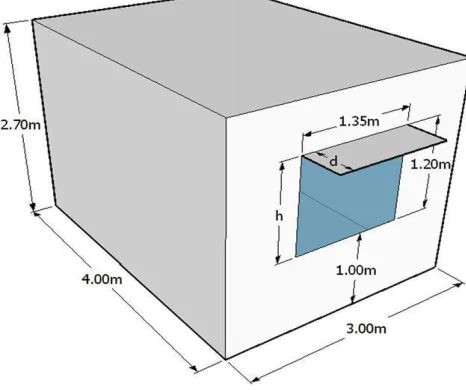
The modeling the office and simulation is done by Google sketch and Energy Plus version 7.2.0. Geometry of the case study is shown in fig.1
Fig 1: Geometry of study 2.1 Geometry
Building size: 3m x 4m x 2.7m Window size: 1.35m x 1.2m Shade Thickness: 3.5cm
2.2 The weather conditions
For my study the weather data of Trivandrum is used. The weather data are arranged by world
metrological organization. The weather file .epw is obtained from Asian wmo region 2-Ind-Trivandrum 433710 (ISHRAE).
2.3. Materials of wall, floor, roof
Copyright to IJIRSET www.ijirset.com 488 2.4 Heating and cooling set point Heating set point20°C and cooling set point 25°C.Constant set point thermostat.
2.5. Methodology
In this thesis simple indices were proposed to compare the thermal load and shading efficacy of different types of shades types of solar shadings in non-residential buildings Numerical procedure was done using, Google sketch coupled with EnergyPlus software. The physical geometry consists of an office building with dimensions 3m x 4m x 2.7m and a window on north side building having dimensions 1.35m x 1.2m.The building geometry was created in Google sketch is simulated in Energy Plus software. The required weather file of Trivandrum city is obtained from Energy Plus weather data file. The input file used for simulation is idf. By using Energy Plus different cooling loads obtained for each type of shades also simulate by varying the shade length and finds the optimum length where the load is minimum.
2.6. Simulation
Energy Plus software allows study of the solar efficiency of the solar shading as well as thermal loads of room The sky radiance distribution is based on an empirical model based on radiance measurements of real skies. Even if Energy Plus uses a zonal model to solve the thermal balance, the solar radiation distribution on the building is spatially defined. The shadow of a solar protection is accurately taken into account for evaluating the solar gains through windows. An ideal load air system is set up in order to evaluate the cooling load. This object of the Energy Plus program permits to assess the theoretical thermal loads needed to achieve the thermal balance at any time step of the simulation
The case study (Fig.1) is a typical office of 12 m2.The window-to-wall ratio is 20%.This ratio corresponds to the recommend opening area for office buildings in Trivandrum, Kerala. Here we obtain the result of annual energy consumption of building for different types of solar shades Solar shading is the over-riding design feature needed to avoid overheating inside the building and thus decrease the cooling capacity of air conditioning. The present work is aimed to conduct a numerical and experimental study on different types of solar shadings and its efficacy and to obtain a building with less energy consumption
3. RESULTS AND DISCUSSIONS
3.1 Validation
The results from Energy plus software is compared with the results in F.A Ansari et al[3] Here the author used Window with shading carrier software to obtain the Gross cooling load with no shading and the value is 16.91KW.Building dimension for our validation is 15m x 7m x 3m In our numerical simulation of same building using Energy plus obtained a value of 20.5KW. The error may be due to Ideal air system used in energy plus for easiness of HVAC design load. The closeness of the values indicates the trustworthiness of Energyplus software.
3.2 Types of shades
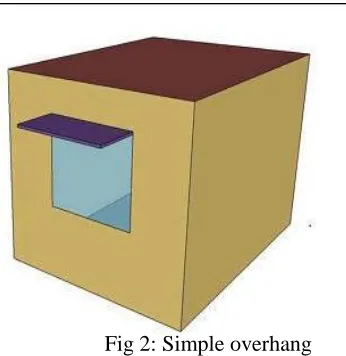
1. Simple Overhang
2. Simple Overhang with 45 Degree inclination 3. Vertical side fin
4. Rectangular side fin 5. Arc+ Triangular side fin 6. Triangular.
Copyright to IJIRSET www.ijirset.com 489 Fig 2: Simple overhang
Table 1: Annual Total Energy of building of Simple overhang
Width of shade Total building energy (GJ)
d=0.3m 7.06
d=0.6m 6.99
d=0.9m 6.97
d=1.2m 6.95
d=1.5m 6.93
d=1.8m 6.925
d=2.1m 6.924
d=2.4m 6.921
Copyright to IJIRSET www.ijirset.com 490 Table 2: Annual Total Energy of building of Vertical side fin
Width of shade
Total Building energy (GJ)
d=0.3m 7.14
d=0.6m 7.09
d=0.9m 7.01
d=1.2m 6.98
d=1.5m 6.97
Fig 4: Rectangular side half fin
Table 3: Annual Total Energy of building of Rectangular side half fin
Width of shade
Total Building energy (GJ)
d=0.3m 6.93
d=0.6m 6.87
d=0.9m 6.8
d=1.2m 6.72
d=1.5m 6.68
d=1.8m 6.678
Copyright to IJIRSET www.ijirset.com 491 Fig 5: Arc + Triangular side fin
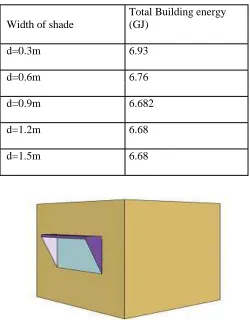
Table 4: Annual Total Energy of building of Arc +Triangular side fin
Width of shade
Total Building energy (GJ)
d=0.3m 6.93
d=0.6m 6.76
d=0.9m 6.682
d=1.2m 6.68
d=1.5m 6.68
Copyright to IJIRSET www.ijirset.com 492 Table 5: Annual Total Energy of building of Triangular shade
Width of shade
Total Building energy (GJ)
d=0.3m 6.77
d=0.6m 6.682
d=0.9m 6.68
d=1.2m 6.75
d=1.5m 6.674
3.3DIAMOND JUBILEE HALL COLLEGE OF ENGINEERING TRIVANDRUM - case study 2
Fig 7: Diamond Jubilee Hall at College of Engineering
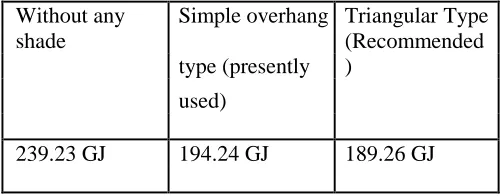
Copyright to IJIRSET www.ijirset.com 493 Table 6: Compare the effect of triangular shade
Without any Simple overhang Triangular Type
shade
type (presently
(Recommended )
used)
239.23 GJ 194.24 GJ 189.26 GJ
4. CONCLUSION
Trivandrum-case study 2(with simple shade)
From case study 1
From case study 1
1. North side window gives least energy consumption of building.
2. In the present numerical study it can be concluded that solar shade of simple overhang with
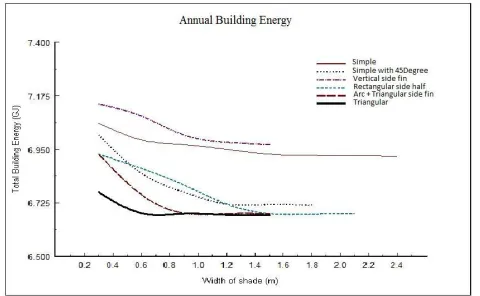
triangular finsgives least energy consumption.
3. A Triangular shade with width of shade d= 0.6m is the optimal shade width at which minimum energy of 6.68 GJ.
4. Arc + Triangular and Rectangular shade also gives minimum energy to building at shade width of 0.9m and 1.5m respectively. But extension of shade cannot be taken as long so triangular shade is apt one.
From Case study 2
1. Simulation using Energy plus at Diamond Jubilee Hall at College of engineering Trivandrum; triangular shade reduces building heat gain by 2.56% than currently used simple shade.
REFERENCES
[1] M. David , M. Donn, F. Garde , A. Lenoir .Assessment of the thermal and visual efficiency of solar shades 2011.
[2] William O’Brien Konstantinos Kapsis b, Andreas K. Athienitis Manually-operated window shade patterns in office buildings: A critical review 2012.
[3] F.A. Ansari , A.S. Mokhtar, K.A. Abbas and N.M. Adam A Simple Approach for Building Cooling Load Estimation
[4] Hema Sree Rallapalli A Comparison of EnergyPlus and eQUEST Whole Building Energy Simulation Results for a Medium Sized Office Building,
[5] Natasa Djuric Real-time supervision of building HVAC system performance; 2005-2008.
[6]Kemal Ozgen Briol Design And Analysis Of Energy Saving Buildings Using The Software Energy Plus
[7] Waters JR. The experimental verification of a computerized thermal model for Building Services Engineering Research and Technology 1980;1(2): 76e82
[8]Perez R, Ineichen P, Seals R, Michalsky J, Stewart R. Modeling daylight availability and irradiance components
[9] Jordan Clark, Leen Peeters, Atila Novoselac Experimental study of convective heat transfer from windows with Venetian blinds. [10]ASHRAE Handbook CD, ASHRAE; 2000-2003 buildings.
[11]ASHRAE. Engineering analysis of experimental data. Guideline-2. Atlanta: ASHRAE; 2000