Munich Personal RePEc Archive
Technical change in a combined Classical
- Evolutionary multi-sector economy:
Causes, Effects and implications for
economic and social policy
Rainer, A.
Graz Schumpeter Centre
2012
Online at
https://mpra.ub.uni-muenchen.de/43298/
The Graz Schumpeter Centre is named after the famous Austrian social scientist Joseph A. Schumpeter, who taught and did his research in Graz from 1911 to 1921. It provides a platform of international cooperation and reach for young
GRAZ
SCHUMPETER
CENTRE
GSC Discussion Paper Series
Paper No. 02
Technical change in a combined Classical - Evolutionary
multi-sector economy:
Causes, Effects and implications for economic and social policy
Andreas Rainer
11
Graz Schumpeter Centre
University of Graz
RESOWI-Zentrum, F4
A-8010 Graz, Austria
Abstract
The causes and effects of technical change are investigated in a multi-sector economy. The underlying modelling framework is a hybrid of Classical economic thinking as introduced by Ricardo (1821) and formalised by Sraffa (1960), and of Evolutionary economics following Schumpeter (1934) and Nelson & Winter (1982). The special case of one sector is elaborated at length, leading to several implications concerning economic and legal policy in the presence of ongoing technical change. This includes technological unemployment and technologically induced wage inequalities which are either temporary or persistent, and also the problem of effective demand in a dynamic economic environment is discussed. Within the model business cycles as a consequence of innovative general purpose technologies with subsequent technical progress can be illustrated.
Acknowledgement: This paper was supported by the Austrian Science Fund (FWF): P 24915 – G11.
Technical change in a combined Classical - Evolutionary
multi-sector economy: Causes, Effects and implications
for economic and social policy
Andreas Rainer October 5, 2012
Abstract
The causes and effects of technical change are investigated in a multi-sector economy. The underlying modelling framework is a hybrid of Classical economic thinking as introduced by Ricardo (1821) and formalised by Sraffa (1960), and ofEvolutionary
economics following Schumpeter (1934) and Nelson & Winter (1982). The special case of one sector is elaborated at length, leading to several implications concerning economic and legal policy in the presence of ongoing technical change. This includes technological unemployment and technologically induced wage inequalities which are either temporary or persistent, and also the problem of effective demand in a dynamic economic environment is discussed. Within the model business cycles as a consequence of innovativegeneral purpose technologies with subsequent technical progress can be illustrated.
1
Introduction
Looking at economic growth patterns throughout the past centuries, one can identify a
take-off of per-capita gross domestic product at the end of the 18th and the beginning of the 19th century, a time which is labelledindustrial revolution. The term stems from the observation of a number of important inventions at that time, which fostered the subsequent development of technological knowledge and its application. These activ-ities, including the respective institutional environment, are often put centre stage in
since the take-off of the industrial revolution. The causal relationship between technical change and economic growth challenged economists since Adam Smith’s (1723–1790)
Inquiry into the Nature and Causes of the Wealth of Nations (1776). It was David Ricardo (1772–1823) in his book Principles of political economy and taxation (1821), who made the choice-of-technique problem explicit, asking for the economic and social causes and effects concerning the use of different modes of production. His thinking was concerned with the long-period position of an economy. This was formalised by Piero Sraffa (1898–1983) in his influential bookProduction of Commodities by Means of Com-modities (1960) and further elaborated by Kurz & Salvadori (1995). The complementary approach, dealing with short-run effects of technical change, is provided byevolutionary economics launched by Nelson & Winter (1982). This strand of economic literature heavily relies on the analysis of Joseph A. Schumpeter (1883–1950) concerning the
eco-nomic effects of innovations (see Dopfer, 2005, for a recent stocktaking of this field of research). What gets apparent as a consequence of the bounded rationality-assumption of evolutionary economics is the time-lag between the emergence of some innovation and its adoption due to uncertainty. On empirical grounds, this effect is investigated by diffusion research (Rogers, 2003), which provides insights into the importance of the institutional setting influencing the emergence of innovations as well as the pace of the diffusion of some new technology. Diffusion research also acknowledges and studies
the social consequences of this process, since economic dynamics triggered by technical change necessarily induce structural change within a social system.
This article adds to the existing literature on economic and social causes and con-sequences of the diffusion of innovations by setting up a theoretical framework to study inter-sector feedback effects of the emergence ofprocess innovations. It connects the con-cept of along-period position (Kurz & Salvadori, 1995) with evolutionary ideas provided by the concept ofreplicator dynamics as utilised by evolutionary game theory (Weibull, 1997; Metcalfe, 1998). The stated problem is closely related to Schumpeter’s (1934) dynamic approach to economic development and is accomplished by a fusion of classical and evolutionary thinking as indicated by Kurz (2008). The discrete-time one-sector
analysis of Steedman & Metcalfe (2011) provides the intellectual starting-point for this article, whereas the presented framework introduces an extension to multiple sectors in
a time-continuous setting.
the diffusion of innovations. This includes the clarification of causes of sustained techno-logical unemployment and its compensation, as well as the exposition of both transitory
and permanent technologically induced wage inequality. Social and fiscal policy mea-sures such as taxation and unemployment benefits are introduced and evaluated, as they can relieve the frictions resulting from wage inequality and unemployment. Furthermore,
in a multi-sector setting frictions concerning effective demand necessarily arise out of the dynamics caused by technical change. Within the presented framework an analysis of
the emergence of business cycles and recessions is provided.
To accomplish the announced program, the article proceeds in three steps. Firstly, the static framework of a multi-sector economy with heterogeneous labour is introduced
in section 2 to clarify price and quantity determination in the long-period position. Next, section 3 augments the static model by introducing evolutionary aspects, including the
diffusion of innovations through the economic system. The concluding section 4 applies the presented framework to the analysis of the emergence of social and economic frictions
in the presence of technical change.
2
Static model
Technical change induces a non-trivial dynamic element into economic systems. To facilitate the understanding of this dynamism, first of all the static properties of the
respective system (i.e. in the presence of fixed technologies) have to be scrutinised. The difference between these two methodological approaches, namely static and dynamic
economic modelling, and their interdependence was stressed by Schumpeter inter alia in his influential book Theorie der wirtschaftlichen Entwicklung (1934, ch. 2). Following his suggestion and content-related approach, this section deals with static pre-work to
pave the way for dynamic considerations in the following section 3. The partitioning into subsection 2.1 focusing on prices and quantities and subsection 2.2 addressing wages and
wage inequalities is owed to the importance of economic growth on the one hand, and of questions concerning social inequality on the other hand.
2.1 Prices and quantities in the long-period position
To facilitate the understanding of economic dynamics in the presence of technical change,
economic concept. A circular flow is defined by the three characteristic features private property, division of labour and free markets. These aspects are necessary to allow for a benchmark-description of production and of barter, which are the two basic kinds of economic activity. The latter arises out of the division of labour in the sense Schumpeter uses this concept, implying that different sectors exist, each one producing some specific
good. The respective commodities are then traded between these sectors. Formalising this idea, a number N ∈ N+ of sectors exists, each sector n ∈ [1, N] producing one
specific product. Smith (1776, Book I, ch. I) also mentions the division of labour, but in a different context. He introduced it as a diversification of labour within the production process of a single sector. Hence, different skills are needed for some specific production
process. Formally, K ∈ N+ skills exist, which in the argumentation of Smith (1776,
Book I, ch. X) may be remunerated differently for several reasons, such as severeness or
extraordinary skill. Wage premia can also be shown to exist on empirical grounds (see e.g. Grogger & Eide, 1995), and it is additionally justified by contemporary principle-agent
theory (Bolton & Dewatripont, 2005). Relative wages in this case can be represented by some vectoru∈RK+ withkuk= 1,and by the overall wage levelw >0 . Real wages are
given byw=w u, withwk denoting the remuneration of one unit of labour of skillk.
In the argumentation of Schumpeter, the circular flow is characterised by well-defined behaviour of all economic agents of the system, which accrues from habit formation. In
this respect, not conscious economic calculation, but habitude build the basis for eco-nomic action. This is true both for producers as well as for consumers. The latter have
to decide, which (aggregate) commodity bundley∈RN+ they buy, where yndenotes the
final demand of goodn. The firms have two different choices to make: Firstly, the tech-nology they utilise, and secondly, the quantity of output they produce. These choices are
co-determined by the economic environment, especially by prevailing prices. Hence, by constructing a static economic model, prices and quantities have to be chosen coherently.
The classical view implies some circularity within the production process: Commodities are produced by means of commodities (Sraffa, 1960). Thus, the production process of some specific sector is characterised by coefficients anm (n, m= 1, . . . , N) of the capital
input matrix A∈RN+×N, denoting the input of commoditymwhich is needed to produce
(on average) one unit of output of goodn. Obviously,anm∈[0,1] and 1−Pmanm ≥0
has to hold. The coefficientslnk (n= 1, . . . , N,k= 1, . . . , K) of thelabour input matrix
To get coherent habits of firms, characterised by the modes of production (A, L) and output x(xn is the total output of sectorn), themarket clearing condition
ATx+y=x (1)
has to hold on the goods markets, and labour demand LTx must not exceed the total
workforce of the economy. The left-hand-side of equation (1) represents the partition of
the aggregate expenditures of the households of the economy into savings ATx (which
equal investments into production) and final consumption y.
Next, also prices have to be determined properly. Capital inputATxis remunerated by some rate of profits 1 +r, which equals the prevailing rate of interest. In the present setting,r is exogenously given. It can be assumed to be determined by monetary policy
or by financial market conditions. Wageswon the other hand are paid for labour input
LTx. Costs of production are determined by prices of input factors, and prices of output
equal costs of production. The price vector p, with (p)n ≡ pn denoting the price of
commodityn, is therefore given by
(1 +r)Ap+Lw=p (2)
if the period of production is normalised to one for all sectors. In monetary terms, the (aggregate)budget contraint
xTp=xT [Lw+ (1 +r)Ap] =yTp+xTAp (3)
has to hold. Equations (3) indicate that the nominal value xTp of total output is consumed by aggregate wage incomexTLwand by aggregate capital income (1+r)xTAp.
Total expenditures of the economy are partitioned into nominal gross domestic product
(nGDP)yTpand nominal valuexTApof capital investments, as indicated by the market
clearing condition (1). On average, the rate of profits 1 +r is equalised across sectors by means of a no-arbitrage argument, which prevails in the presence of free markets. Accordingly, both equity capital as well as debt capital have to yield the same returns.
2.2 Wages and wage-inequality
Given relative wages u and the uniform rate of profit 1 +r, prices are derived from equation (2) as
p=w[I−(1 +r)A]−1Lu>0. (4) Non-negativity of prices holds as a consequence of thePerron-Frobenius Theorem (Kurz & Salvadori, 1995, ch. A.3). Introducing a num´eraire d ∈RN+ by dTp = 1, the wage
levelw can be determined from (4):
w= 1
dT [I−(1 +r)A]−1
Lu (5)
This is the w−r relationship already discussed by Ricardo (1821) and explicated by (Kurz & Salvadori, 1995, p. 98).
Social inequality can be studied with respect to the distribution of wealth between labourers and capitalists or by investigating wage inequalities within the group of
work-ers. Since in the present setting wage earners, by means of savings, also receive capital-income, the two groups cannot be separated straightforwardly and hence this article
focusses on the latter. Let ˆu ∈ RK++1 be the normalised vector (i.e. kuˆk = 1) of
wage income after tax deduction and subsidy payments, where the zeroth entry ˆu0 (by
abuse of mathematical notation) denotes unemployment payments, and ˆuk ≥ uˆk−1 for
i = 1, . . . K. If skill level k receives subsidies, then uk < ukˆ ; if taxes have to be paid, thenuk>uˆk. Unemployment U is straightforwardly defined by
U = 1−
K
X
i=k
xTL
k≥0,
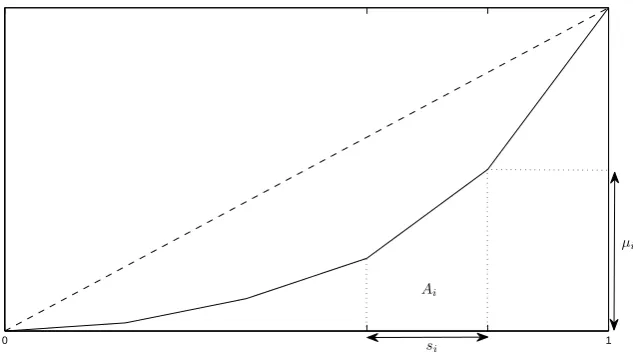
if the work force is normalised to one (no population growth is considered). The GINI index as a measure of wage-inequality reads
GIN I = 1−
K
X
k=0
sk
µk+µk−1
µK . (6)
sk = xTL
k for k= 1, . . . , K denotes the amount of skill-k-labour which is employed,
and s0 =U. µk = wPki=0uˆisi is the aggregate disposable income of all workers up to
0 1
Ai
si
[image:9.595.151.468.112.294.2]µi
Figure 1: Calculating the GINI-coefficient in case of K wage levels.
Proof of equation (6). Calculating the areasAi =si(µi+µi−1)/2 in figure 1, the GINI
index is determined by
GIN I =
1 2µK−
PK
i=0Ai 1
2µK
.
Rearranging terms yields the proof of expression (6).
To get a first idea of the meaning of the general expression (6), it can be analysed for the special case of two different skills remunerated by u = (u1, u2)T. Full employment
impliess1+s2 = 1, leading to
GIN I = (1−s2)
(u−1)s2
1 + (u−1)s2
. (7)
u−1 = (u2 −u1)/u1 > 1 denotes the wage premium of skill 2. Higher wage premia
therefore lead to higher inequality, as the GINI index in (7) is positively related to u. The case of total equality, defined by GIN I = 0, can only be obtained for the trivial cases that all workers provide the same skill to the labour market, i.e. either s1 = 0 or
s2= 0, or if both skill levels are remunerated with the same wage, i.e. u= 1. Maximal
inequality
GIN I∗
=
√
u−1
√u+ 1
can be calculated by differentiation of (7) with respect to s2 and is obtained by a share
s∗
2 = 1−s
∗
1=
1
√
of workers employed at the higher wage level. Wage inequality in this case is technolog-ically and polittechnolog-ically co-determined, since s2 is defined by the labour input matrix L,
and u can be altered by re-distributional measures.
3
Evolutionary dynamics in the presence of technological
change
Deviating from the static view of the economy in the preceding section, several different processes are introduced in every sector. Each process is characterised by its input
coefficients and the respective costs of production. Firms producing cheaper than average will gain extra profits, and therefore grow, whereas non-innovative firms face ongoing losses, as prices converge towards the lower costs of production. Hence, firms are forced
to be innovative or they are driven out of the market (creative destruction; Schumpeter, 1954, ch. 7). The respective model is formulated for a multi-sector economy in section
3.1, whereas the one-sector case is analysed in depth in section 3.2.
3.1 Evolutionary model of technological diffusion
As in section 2, let N be the number of different sectors and K the number of different skills. For each sector n a finite set In ⊂ N+ of different production processes exists.
Processin∈ Inproduces some outputxin
n, and total outputxnof the sector is determined
by
xn=
X
in∈In xin
n.
Once a new process is invented, In is enlarged by one element. An invention jn ∈ In
is an innovation if and only if xjn
n > 0. Each production process in of sector n is
characterised by input vectors ain
n ∈ RN+ and linn ∈ R+K. ainmn = (ainn)m denotes the
amount of commodity m utilised by process in to produce one unit of commodity n.
Analogously,lin nk = (li
n
n)k ≥0 denotes labour-input of skill kfor the unit-production of
goodn. Different processes are employed, and therefore also unit costs of production
cin
n = (1 +r)(ai n
n)Tp+w(li n
n)Tu (8)
of processes in ∈ In in sector n may differ. In the presence of free markets, only one
each sectornthe aggregate budget constraint
xnpn= X
in∈In xin
nci n
n (9)
holds, indicating that innovative firms can sell above their costs of production, whereas
non-innovative firms have to sell with a loss. In terms of sharesqin n ≡xi
n
n/xn of output
of some specific processin, one gets the pricepnof commodityndetermined byaverage unit costs of production, namely
pn=
X
in∈In qin
n ci n
n. (10)
Inserting the individual costs of production (8) of the respective processes into the price equation (10) for all sectors n, one can collect terms and formally define some average
technology
¯
an = Pin∈Inq in n ainn
¯ln = P
in∈Inq in n linn,
leading to
pn= (1 +r)(¯an)Tp+w(t)(¯ln)Tu. (11)
Combining all N sectors, themean technology of the economy is represented by A,¯ L¯ ,
where ¯aTn is the n-th row of matrix ¯A ∈ R+N×N and ¯lTn is the n-th row of matrix ¯L ∈ RN×K+ . Equation (11) concisely can be written as
(1 +r) ¯Ap+wL¯u=p, (12)
which is the dynamically determined price system, replacing equation (2) of the static
model.
Technical progress can temporarily change the average rates of profit of the innovative
sector. The respective extra profitsρin
n, which can be gained by technology in in sector n, are implicitly defined by
1 +r+ρin n
(ain
n)Tp+w(t)(li n
n)Tu=pn. (13)
These extra profits influence both the decision of firms which technology to use, and depending on the choice in of some firm it determines its growth potential. Hence, two
channels can be identified of how the market share qin
n of some technology in within
Diffusion by choice: On the one hand, firms have the freedom to choose between
processes given byIn. Uncertainty, financial constraints or ignorance prevent an
instan-taneous switch of all firms to the new technology. Hence, the diffusion of information and of confidence (Rogers, 2003) play a role in the process of the diffusion of some superior (cheaper) technology. This phenomenon is the underlying idea of theBrass-model (sur-veyed for example by Mahajan et al., 2000), which in the presence of two technologies can be stated as
˙
q(t) =Q q(t)[1−q(t)] +M [1−q(t)], (14)
ifq denotes the share of output produced by the cheaper process. The second term on the right-hand-side of equation (14) indicates the influence of mass-media, calibrated
by some parameter M > 0. It leads to a first innovative push within the system as a consequence of newly available information, and it fades out as more and more firms apply the best-practice technology. As soon as a positive share of output is produced by
the innovative technology, information networks, characterised by some parameter Q, start to operate, since knowledge is passed on from innovative firms to those firms still
applying the old technology. This is indicated by the first term on the right-hand-side of equation (14), which models word-of-mouth information diffusion by some epidemic mechanism. q(t)[1−q(t)] is the probability that two firms meet, where one is a laggard (sticking to one of the expensive processes) and one is an innovator (using the best-practice technology). With some probability Q ∈ [0,1] the non-innovative firm gets convinced to switch to the innovative process, if it meets an innovator.
More generally, assume that at each timettwo infinitesimally small firms meet, with
firm 1 using processinand firm 2 using processjn, respectively. They know about their unit costs of production and about their extra profits (or losses) ρin
n and ρ
jn
n . Meeting
each other leads to a transfer of knowledge of production process. Firm 1 will switch to
processjnif and only if it is convinced that extra profits can be increased by this action, i.e. if ρjn
n > ρin
n. Let f(ρ jn n −ρin
n) denote the probability with which firm one believes
in ρjn n > ρin
n. Otherwise, firm two switches to process in, which induces a symmetric
situation if beliefs are the same across firms. Sinceqin
n denotes the probability to draw
a firm using processin out of the continuum of firms, one gets
˙
qin n =qi
n n
X
jn∈In qjn
n
2 f ρin n −ρj
n n
−1
(15)
denotes the transition rates of some Markov jump process (Rainer & Sch¨utz, 2012).
Proof of equation (15). Sinceqin
n is the probability that firm 1 uses processin,q jn n is the
probability that firm 2 uses processjn, andf(ρjn n −ρin
n) is the probability that process inis superior to process jn, equation (15) is a consequence of
˙
qin n =qinn
X
jn∈In qjn
n f ρinn−ρjnn
− X
jn∈In qjn
n 1−f(ρinn−ρjnn)
.
Following Aoki & Yoshikawa (2006, ch. 3), it is outlined in Rainer & Sch¨utz (2012,
ch. 3.2) that if ρin
n −ρ
jn
n is normally distributed with variance σ, then
f(ρin n −ρj
n n ) =
1 2
"
1 + erf ρ
in
n −ρ
jn n √ 2σ !# . (16)
With this specification, equations (15) yield a well-defined system of differential
equa-tions describing the diffusion process of different technologies as the result of inter-personal communication in the presence of uncertainty. For the special case of σ = 0, i.e. if ρjn
n is known to firm 1, and if in is the most profitable technology of the sector,
equation (15) becomes the logistic equation
˙
qin n =qi
n
n 1−qi n n
(17)
as a special case of the Bass model (14) with Q= 1 andM = 0. Equation (17) holds, because f(ρjn
n −ρin
n) = 1 for in 6= jn and = 0 for in = jn. Otherwise, as long as
profit differentials are small, i.e. ρin
n ≈ρ
jn
n , and additionally uncertainty prevails (ifσ is
sufficiently large), thenf in equation (16) can be approximated with sufficient accuracy by its first order Taylor expansion
f(ρjn n −ρi
n n)≈
1 2 +
1
σ√2π(ρ in n −ρj
n n ).
The diffusion process (15) is then described by the system
˙
qin
n =Q qi n n ρi
n n −ρ¯n
, Q= 1
σ√π. (18)
¯
ρn =P
in∈Inq in
nρinn denotes the average profit which can be attained in sectorn as the
result of innovative activity. Equations (18) provide a system of PN
equations determining the diffusion of different technologies throughout the economic system, where one equation in each sector can be replaced by P
in∈Inq in n = 1.
The derivation of equation (18) solely was based on the assumption of contagion by means of knowledge transfer within a community of infinitesimally small firms, which decide according to their beliefs, characterised by varianceσ, which technology to apply.
However, this approach can be augmented by introducing q as an externality: The more firms use some technology, the more reliable the result is for others. This leads
to a variance which depends on q, i.e. σ = σ(q(t)) with ∂qσ < 0, and consequently
Q=Q(q(t)) in equation (18). It was also assumed that the probability that two firms which meet each other are randomly drawn out of a common pool.
Diffusion by growth: The second way of thinking about diffusion of technologies is
the consideration of growth possibilities of firms employing some cheaper process. To
abstract from decision processes of firms, producers stick to the technology they use at timet= 0. Depending on whether extra profits are positive or negative, a firm grows or
shrinks, depending on the technology it applies. Formally, the output of some process
in∈ In evolves according to
˙
xin n(t) xin
n(t)
=ρin
n(t). (19)
Consequently, from ˙xn=P
in∈Inx˙ in
n, one can derive the overall growth rate of sectorn
as
˙
xn(t)
xn(t) = ¯ρn(t). (20)
By differentiation ofxnqin
n =xinn with respect to time and acknowledging equation (20),
equation (19) can be rewritten in terms of growth rates of sharesqin n as
˙
qin n (t) qin
n (t)
=ρin
n(t)−ρ¯n(t). (21)
Equation (21), which is a result of firm growth, is similar (up to some factorQ) to equa-tion (18), which arose out of decision processes of firms within a social communicaequa-tion
network. One can keep this formal similarity in mind and potentially take some general proportionality factor Q into account, which influences the speed of diffusion. If the
more pronounced as the result of gold-rush moods as a result of major technological im-provements, equation (21) can be replaced by its more general version (18) with Q <1
orQ >1, respectively.
Within the framework just introduced, equation (18) is taken as a starting point for analysing economic dynamics in the presence of technical change. They are of additional
interest, since they straightforwardly resemble the replicator dynamics of evolutionary game theory (Weibull, 1997) and, hence, provide an intuitive interpretation of the model. In the biological analogy of equation (18), technologiesinare different populations which compete in sectornfor market sharesqin
n. Extra profits multiplied by some factorQare
a measure of the fitness of the respective population, whereas the growth rate of some population is given by the difference between its own fitness and the average fitness of the ecosystem.
3.2 A partial model: the case of one sector and two processes
Diffusion research as surveyed by Rogers (2003) deals with the time-path of the share
of an innovation, which enters some economic system. It is therefore the natural field of application of the modelling framework of this article. As diffusion research is first
and foremost concerned with single markets, in a first step the multi-sector model with multiple technologies is reduced to a one-sector model with only two technologies. An
application of the multi-sector approach, which allows for the investigation of inter-sector feedback effects, is performed by Strohmaier & Rainer (2012). There the influence and the diffusion of newgeneral purpose technologies (Helpman, 1998) on connected sectors are empirically analysed and theoretically substantiated by a two-sector version of the proposed model.
To begin with, take one sector and two processes (ai, li) with i = 1,2. Prices are
normalised to p= 1, implicitly determining extra profits ρi (i= 1,2) by
(1 +r+ρi(t))ai+w(t)li = 1. (22)
For some arbitrary constant parameterQ, equation (18) reduces to
˙
q(t)
q(t) =Q(1−q(t)) ρ
2
(t)−ρ1
(t)
. (23)
i= 2 evolves according to
˙
q(t) =Q q(t) (1−q(t))
1
a2 −
1
a1
+w(t)
l1
a1 −
l2
a2
. (24a)
From thew−r relationship (5), wages are determined by
w(t) = 1−(1 +¯ r)¯a(t)
l(t) =
1 +z(t)−(1 +r)[a1+z(t)a2]
[l1+z(t)l2]
with the relative market sharez≡q/(1−q) of the innovative process as a new variable. Differential equation (24a) then reads
˙
z(t)
z(t)
l1
+z(t)l2
µ1+z(t)µ2 =Q (24b)
with the auxiliary parameter µi defined by
µi li =R2
1− wi
W2
−R1
1− wi
W1
.
1 +Ri ≡ 1/ai is the maximal attainable rate of profit some process i can achieve if it is operated alone and if no wages are paid (w = 0). This can be seen by calculating
r from the then valid price equation (1 +r)ai = 1 (Kurz & Salvadori, 1995, p. 46).
Wi ≡(1−ai)/li is the maximal wage (for r = 0), and wi = (1−(1 +r)ai)/li denotes
the wage which prevails, if only process iis operated. The general solution z(t) of the
diffusion process can now implicitly be derived as
z(t) µ1
+µ2
zD
=CeQt, D= µ
1
l2
µ2l1 −1, C=z0(µ
1
+µ2
z0)D, (25a)
or, in terms of the shareq(t) of the innovative technology i= 2,
q(t)¯µ(t)
(1−q(t))1+D =Ce
Qt (25b)
with ¯µ= (1−q)µ1+qµ2. z
0 ≡(1−q0)/q0 is the initial condition, where q0 is the share
of firms which adopt the new process at timet= 0.
Equations (25a) and (25b) in the interpretation of diffusion as a consecutive adoption
of some new technology by firms show that increasing certainty about extra profits increases the speed of diffusion, since in this case Q = 1/(σ√π) also increases and therefore zrespectively q grow at a faster pace.
0 1 2 3 4 5 6 7 0
0.1 0.2 0.3 0.4 0.5 0.6 0.7 0.8 0.9 1
time
[image:17.595.139.452.111.296.2]q(t)
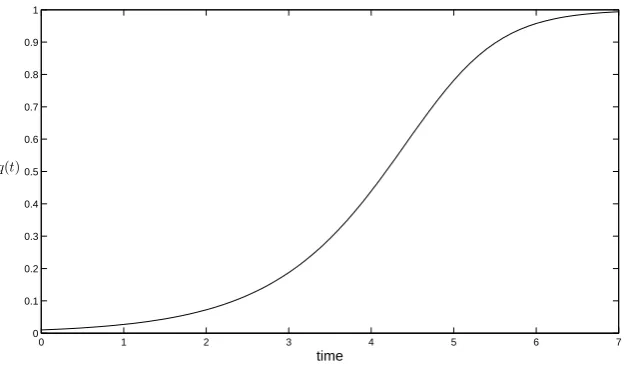
Figure 2: The diffusion of labour saving technical progress
(a1
< a2
and l1
> l2
) is illustrated in figure 2 with the special values G= 1, a1
= 0.3,
a2 = 0.4, l1 = 0.3, l2 = 0.2, r = 0.1 and q(0) = 0.01. The time path of q(t) with its
slow start and sudden take-off including the flattening at the end of the diffusion process resembles the diffusion patterns as found by many cases of technology diffusion which were investigated by diffusion research (Rogers, 2003).
Total outputxof the aggregate sector grows according to equation (20), i.e. ˙x/x= ¯ρ, and from market clearing (1) one getsy(t) = (1−¯a(t))x(t), leading to the growth rate
˙
y y = ¯ρ−
q(1−q)
q− 1−a1
a1−a2
1
a2 −
1
a1
+w
l1
a1 −
l2
a2
(26)
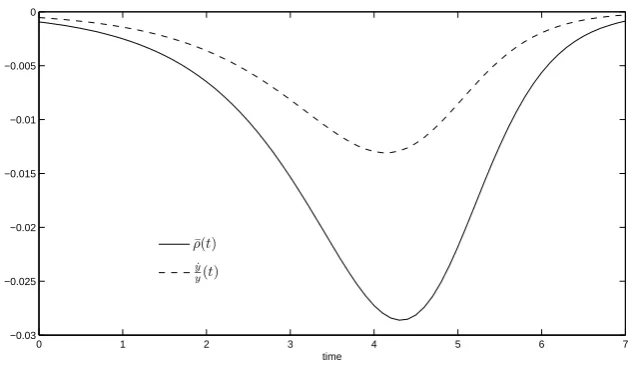
of GDP. Both growth rates are depicted for the just stated numerical case in figure 3.
One striking result of this one-sector example is the negative growth rate in the presence of technical progress, as more capital input is needed. Positive growth rates can be
obtained in case of pure labour-saving technical progress, as indicated by the right-hand-side of equation (26). That this scenario is realistic is suggested by the research
ongeneral purpose technologies (GPT), such as the steam engine, semiconductors or IT innovations. One special feature which can be observed is a downturn after a new GPT emerges, followed by sustained growth (Helpman, 1998). The respective explanation
capital-0 1 2 3 4 5 6 7 −0.03
−0.025 −0.02 −0.015 −0.01 −0.005 0
time
¯
ρ(t)
˙
[image:18.595.138.455.110.295.2]y y(t)
Figure 3: Negative GDP growth
saving technical progress. Hence, a one-time invention in some basic sector is capable of starting an avalanche of successive innovations in other sectors, which are both
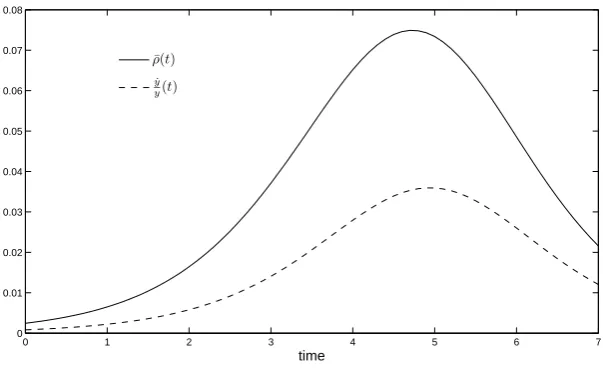
capital-saving and labour-capital-saving. Figure 4 illustrates the situation of capital- and labour-capital-saving technical progress with the same parameters as above, just interchanginga1
and a2
. If full employment is considered att= 0, i.e. ifx(0)l1= 1, then in the course of the
diffusion process some positive rate of unemployment u(t) = 1−x(t)¯l(t) > 0 emerges, both becausex(t) shrinks and ¯l(t) decreases in case of labour-saving technical progress.
This kind of technological unemployment can be compensated either by accompanying technical progress which leads to positive growth, or by re-distributional measures of
the government in terms of unemployment benefits. Taxing wage income with a fixed tax rate β and redistributing the tax revenues to the unemployed imply a disposable per-capita income of (1−β)w(t). The total amount βw(t)(1−u(t)) of aggregate tax income of the government is distributed to the unemployed part u(t) of the population, inducing a disposable income ofβw(t)(1−u(t))/u(t) of the unemployed. Consequently, wage inequality as a result of labour-saving technical progress is indicated by the GINI index
GIN I =u(t)−β 1−u(t)
.
in-0 1 2 3 4 5 6 7 0
0.01 0.02 0.03 0.04 0.05 0.06 0.07 0.08
time
¯
ρ(t)
˙
[image:19.595.148.450.111.298.2]y y(t)
Figure 4: Positive GDP growth
equality, which arises if new skills are needed for the innovative process (see section 2.2 as well as Strohmaier & Rainer (2012), where an empirical analysis is included). In the
latter case there is a rising GINI-coefficient, which again diminishes towards the com-pletion of the diffusion process. Crucial for this result is the assumption that workers in the old process get lower wages compared to those employed in the new process. The
wage premium and the fact that the innovation is not instantaneously adopted by all firms lead to the observation that wage inequality disappears only when the diffusion
process is completed.
4
Conclusions
Technical change and social frictions: Technical circumstances in several ways
influence the economic and social situation of the members of the system. As discussed
at the end of section 2.2, wage inequality prevails as soon as some technology is used which employs workers of different skill levels. Depending on the wage premia of better
paid workers and influenced by the relative amount of low-skill labour compared to high-skill labour, the GINI index varies and suggests government action in form of
discussion of this feature in section 2.2, contract theory (e.g. Bolton & Dewatripont, 2005) indicates that as soon as different skill levels are employed within one specific
production process, wage differentials arise as a result of moral hazard and adverse selection. Another factor influencing wage differentials and, hence, wage inequality are variations of supply and demand of different skills, since not every worker can easily
switch between different tasks according to labour demand. Higher wages for skills with excess demand are the consequence of this observation. Government action in both cases
can be identified to lie within the educational system, providing labour supply for those skills, which are demanded by firms.
Another kind of long-run wage inequality arises in the presence of labour-saving
technical progress, as discussed at the end of section 3.2. In the course of the diffusion of some labour-saving technology, assuming a constant labour force, less labour input
implies a mismatch of aggregate labour supply and demand. Things get even worse, if, as investigated in section 3.2, capital intensity rises and, hence, total net output gets
reduced (or not increased accordingly) in the course of the diffusion process (figure 3, see also Kalmbach & Kurz, 1992). The introduction of some new technology therefore may be astep back, to take a run-up to sustained economic growth, nourished by subsequent and sustained technical progress. Policy action in this case can be evaluated with respect to three aspects. Firstly, sustaining disposable income of the population can be one goal.
This can be accomplished by redistribution, as wages are taxed and unemployment benefits are paid. A second focus can lie on the attempt to bring the unemployed back
to work, which can be managed by overall economic growth or by a stimulation of labour intensive production processes. As the old process is labour intensive and the new process promotes growth, one policy advice would be the targeted prolongation of the diffusion
process such that innovation-induced growth can compensate the technologically induced displacement of labour. Thirdly, technological wage inequality is only transitory, if a
newly diffusing technology utilises differently remunerated labour compared to the old technique. As soon as the innovation takes over the market completely, the GINI index also vanishes again (Strohmaier & Rainer, 2012). In case of a single innovation the
problem exists only temporarily, whereas it is a long-run phenomenon if there is ongoing technical progress within an economy. Social friction in this case can be relieved by
The suggestions of how policy should influence the diffusion process of some inno-vation for the case of technological unemployment and for the case of transitory wage
inequality are opposed to each other. Hence, it is important to identify the needs to act socially responsible, and it is another research task to identify possible ways to accelerate or to decelerate the diffusion of certain technologies. Additionally, one has to understand
the relation between labour-saving technical progress and the necessity to enhance eco-nomic growth to keep social friction at a minimum. Institutions and the legal setting
in this context are of importance. An appropriate patent law and bankruptcy law for example can enhance innovative behaviour as indicated by the discussion in section 3.1 of how uncertainty influences the diffusion of innovations. Van Waarden (2001) more
specifically investigates the influence of law and, more generally, of institutions on the innovativeness of firms. Also the different strands of economic literature on
Institution-alism as surveyed by Hall & Taylor (1996) are of interest in this context, as there is a strong relationship between technical change and the institutional setting of a society.
Technical change and uncleared markets: There is one crucial assumption of the
proposed model of this article, which easily can be imagined to be violated, namely the dynamic version
y(t) = I−A¯T(t)x(t)
of the market clearing condition (1). Effective demand in this context may pose a problem, if one sector n, supplying others with factors of production, innovates and
changes its outputxn(especially if final demandyndoes not match the residual quantity (I−A¯T(t))nxn). Even in the one-sector case of section 3.2 problems may arise if effective
demand ˆy does not meet effective supplyy, i.e. if
ˆ
y < y= (1−¯a(t))x(t). (27)
If inequality (27) holds for a sustained period of time, stock levels increase. This
situation can be triggered by some gold-rush mood of the innovative sector, including
herd behaviour as pointed out by Keynes (1936) and discussed by Scharfstein & Stein (1990). A bubble both in the real economy and on the financial markets is the result, and its burst leads to recession, depression or crisis depending on its intensity. One way out the dilemma of over-production is the opening up of new markets by means of exporting.
huge losses eventuate and may lead to a turmoil. To avoid this situation, governments have different tools at hand. Demand can be held high by greater government spending
or by subsidies for the producers (or for consumers to increase their willingness to buy). But to solve this special crisis, a structural change within the producing industry has to take place simultaneously. Also importing countries can be subsidised by the innovative,
exporting country, something which was done by the USA in the aftermath of World War II (WW II) by means of the Marshall plan, and it can be regarded as the underlying reason why China offers help to the struggling European Union in the present crisis. Both the USA after WW II as well as China at the beginning of the 21st century can be regarded as examples fitting this picture, which is reinforced by the observation that,
once a sector of some country becomes an exporter as the result of past productivity gains, this situation prevails as the consequence of some lock-in effect. Therefore, even after completing the diffusion process of innovations the dependence of the now non-innovative sector on exports remains. This problem can be tackled for example by a
directed downsizing of some sector. Hence, economic policy is not only necessary for holding output high, but also to reduce output in a socially tenable way in certain sectors, perhaps by fostering sectors with growing final demand to take the pressure off
the labour market.
Concluding remarks: As a result of the above discussion, the emergence of major
technical advances since the industrial revolution is understood as a source of both economic and social prosperity as well as of economic and social frictions. Purposeful policy measures can help promoting the former and curbing the latter. The presented
modelling framework introduced in this article investigates the inter-sector consequences of the diffusion of innovations and therefore facilitates the evaluation of economic and
social policy action, concerned with the effects of ongoing technical change.
References
Acemoglu, D. 2008. Introduction to Modern Economic Growth. Princeton University Press.
Statistical Physics and Combinatorial Stochastic Processes. Cambridge University Press.
Bolton, P., & Dewatripont, M. 2005. Contract Theory. MIT Press.
Dopfer, K. 2005. The Evolutionary Foundations of Economics. Cambridge University Press.
Grogger, J., & Eide, E. 1995. Changes in college skills and the rise in the college wage
premium. Journal of Human Resources,30(2), 280–310.
Hall, P.A., & Taylor, R.C.R. 1996. Political Science and the Three New Institutionalisms.
Political Studies,44(5), 936–957.
Helpman, E. (ed). 1998. General Purpose Technologies and Economic Growth. MIT Press.
Kalmbach, P., & Kurz, H.D. 1992. Chips und Jobs: Zu den Besch¨aftigungswirkungen des Einsatzes programmgesteuerter Arbeitsmittel. Metropolis-Verlag.
Keynes, J.M. 1936. The general theory of interest, employment and money. London: Macmillan.
Kurz, H.D. 2008. Innovations and profits: Schumpeter and the classical heritage.Journal of Economic Behavior & Organization,67(1), 263–278.
Kurz, H.D., & Salvadori, N. 1995. Theory of Production: A Long-Period Analysis. Cambridge University Press.
Mahajan, V., Muller, E., & Wind, Y. 2000. New-Product Diffusion Models. Springer.
Metcalfe, J. 1998. Evolutionary Economics and Creative Destruction. Taylor & Francis.
Mokyr, J. 1992. The Lever of Riches:Technological Creativity and Economic Progress: Technological Creativity and Economic Progress. Oxford University Press, USA.
Rainer, A., & Sch¨utz, M. 2012. The legacy of Veblen and Schumpeter in interpreting mathematical aspects of economic diffusion processes. Paper presented at the ESHET Conference 2012, St. Petersburg.
Ricardo, D. 1821. On the principles of political economy, and taxation. John Murray.
Rogers, E.M. 2003. Diffusion of Innovations, 5th Edition. Free Press.
Scharfstein, D.S., & Stein, J.C. 1990. Herd behavior and investment. The American Economic Review,80(3), 465–479.
Schumpeter, J.A. 1954. Capitalism, socialism and democracy. Unwin University Books.
Schumpeter, Joseph Alois. 1934. The Theory of Economic Development: An Inquiry Into Profits, Capital, Credit, Interest, and the Business Cycle. Transaction Books.
Smith, A. 1776. An inquiry into the nature and causes of the wealth of nations. London: Printed for W. Strahan; and T. Cadell, in the Strand.
Sraffa, P. 1960. Production of Commodities by Means of Commodities: Prelude to a Critique of Economic Theory. University Press.
Steedman, I., & Metcalfe, S. 2011.Herr Schumpeter and the classics. Tech. rept. Papers on economics and evolution.
Strohmaier, R., & Rainer, A. 2012. The Impact of General Purpose Technologies on
Labor Productivity: A Sectoral Approach. Discussion paper.
Van Waarden, F. 2001. Institutions and innovation: the legal environment of innovating firms. Organization Studies,22(5), 765–795.