ISSN Online: 2152-7199 ISSN Print: 2152-7180
Context-Dependent Recognition Is Related to
Specific Processes Taking Place at Encoding
and at Retrieval
Tamar Silberg1,2, Eli Vakil3
1Department of Psychology, Bar-Ilan University, Ramat-Gan, Israel
2The Edmond and Lily Safra Children’s Hospital, Tel-Hashomer, Ramat-Gan, Israel
3Department of Psychology and Leslie and Susan Gonda (Goldschmied) Multidisciplinary Brain Research Center, Bar-Ilan
University, Ramat-Gan, Israel
Abstract
Context Effect (CE) refers to the facilitation of memory for target information due to the similarity of contextual information available during both learning and retrieval. Many studies have attempted to identify variables that influence this effect, producing inconsistent findings due to differences in how target and context information are defined and measured. In the current study, rec-ognition memory for faces was tested under different learning instructions and diverse context-recognition conditions. When memory instructions were used, recognition rates proved higher for the original target-context pairs than for all other possible target-context conditions. A different CE profile was ob-served for attentional instructions while old, yet not necessarily original, tar-get-context faces yielded better results than other context conditions. These findings indicate that memory instructions lead to CE based on the formation of a specific association between target and context information, while in-structions focusing on attentional resources lead to CE based on familiarity judgments. The double dissociation reported here is that memory instructions yield binding as opposed to familiarity type of CE, while attention instructions yield familiarity and not binding type of CE, supporting the claim that CE is not homogeneous and involves a number of cognitive processes.
Keywords
Context-Effect, Learning, Memory, Attention
1. Introduction
As a rule, humans perceive and are affected by not only the discrete objects and How to cite this paper: Silberg, T., &
Vakil, E. (2017). Context-Dependent Rec-ognition Is Related to Specific Processes Taking Place at Encoding and at Retrieval. Psychology, 8, 335-349.
https://doi.org/10.4236/psych.2017.83020
Received: December 17, 2016 Accepted: February 11, 2017 Published: February 14, 2017
Copyright © 2017 by authors and Scientific Research Publishing Inc. This work is licensed under the Creative Commons Attribution International License (CC BY 4.0).
336
events at the focus of their attention, but also a wide range of factors that form the context of that information. Such contextual elements affect the interpreta-tion of the stimuli of interest, put them in a particular perspective, and often in-fluence the probability that they will be remembered later on (Foos & Goolka-sian, 2008). The phenomenon described above is well known in cognitive litera-ture as the context effect (CE) (Dennis & Humphreys, 2001;Murnane & Phelps, 1993, 1994;Russo, Ward, Geurts, & Scheres, 1999).
Findings regarding CE in recognition memory are inconsistent. Some studies suggest that context facilitates target memory (Hollingworth, 2006; Parker & Gellatly, 1997), whereas others fail to demonstrate this effect (Murnane & Phelps, 1993, 1994). Several interpretations are offered to explain the inconsis-tencies. For example, Murnane and Phelps (1994) suggested that CE would emerge only when totally new contexts are contrasted with old contexts for both targets and foils and Russo et al. (1999)posited that CE emerge in recognition only for novel stimuli, since for very familiar items existing representations may be employed to construct a strong episodic trace at encoding, obviating the need for contextual information. In addition, Vakil, Raz, and Levy (2007) emphasized the importance of the different context-retrieval conditions to the emergence and magnitude of CE on recognition. In this study we address two major factors that might be related to these inconsistencies: how target and context informa-tion are defined, and how they are measured at retrieval.
1.1. Definitions of Target and Context Information
The way that “target” and “context” stimuli are operationally defined in various laboratory studies1 could be one of the factors affecting the abovementioned
consistencies. The CE literature showed that at encoding, specific learning in-structions can help distinguish target from context information(Hirst & Volpe, 1984; Steyvers & Malmberg, 2003). Two different types of instructions can be identified as reflecting different elaborative approaches during encoding: (I) re-membering the target (hereafter, the memory approach), and (II) directing at-tention to the target without an explicit instruction to remember (hereafter, the attention approach). According to the memory approach, the instruction to re-member is the critical component that defines particular information as a target. Information that accompanies the target stimulus at the learning phase but that is not expected to be remembered is defined as context (Baddeley, 1982; Badde-ley & Woodhead, 1982;Davies & Milne, 1982;Priestley & Mayes, 1992;Watkins, Ho, & Tulving, 1976). Other studies followed the attention approach and fo-cused on attention rather than on memory processes in order to differentiate target from context. For example,Mayes, MacDonald, Donlan, Pears, and Meu-dell (1992) defined context as “information that falls on the periphery of atten-tion” (p. 268). Although the two approaches emphasize different elaboration processes for the target and context information, they seem to share a common
feature. In both, target and context information differ in the cognitive resources allocated to them; that is, relatively more cognitive resources are allocated to the target information than to the context information(Dennis & Humphreys, 2001; Jacoby, 1991;Steyvers & Malmberg, 2003).
However, target and context information can be determined not only at the encoding phase, as described above, but also at the retrieval phase. In some stu-dies, better recognition of either member of an equally and jointly processed pair of stimuli (i.e., Pair Associate Learning: PAL) is viewed as a legitimate case of CE (Bower & Karlin, 1974; Clark & Gronlund, 1996; Feenan & Snodgrass, 1990; Humphreys & Bain, 1983; Reingold & Goshen-Gottstein, 1996; Watkins et al., 1976). Thus, when target and context are defined at retrieval, the way target in-formation is measured is usually by directly presenting one stimulus as a cue for the recall of the other (e.g.,Meltzer & Constable, 2005;Vakil & Oded, 2003) or by executing a recognition test in which original and recombined pairs are to be discriminated (e.g.,Giovanello, Keane, & Verfaellie, 2006;Giovanello, Verfaellie, & Keane, 2003; Stark & Squire, 2003). Although these conditions of equal processing at encoding are not considered canonical target-context relation-ships, they are certainly of interest. In such PAL paradigms, the way the target stimulus is highlighted during retrieval has an impact on the target-context rela-tionship and, as a result, influences the emergence of CE.
1.2. Different Context-Retrieval Conditions
condi-tions may have qualitatively different effects on target memory. For example, Winograd and Rivers-Bulkeley (1977) found a benefit of interactive T-C encod-ing of faces (which they call unitization) for the Repeat condition only relative to the New condition, but not relative to the None condition. Similarly, Tulving and Thomson (1971) found that for strongly associated word pairs, the None condition yielded poorer memory than the New condition, while for weakly as-sociated word pairs, the opposite result obtained.
In the present study, we used pairs of faces as the stimuli. Many CE studies use target and context stimuli that are perceptually equivalent (e.g., pairs of faces or words;Murnane & Phelps, 1994;Reder et al., 2002;Smith, 1979). These stu-dies are of special interest because there is no a-priori reason to allocate more cognitive resources to one stimulus than to the other, unless a specific instruc-tion was given. The advantage of such paradigms is that the designainstruc-tion of a stimulus as a target or context is controlled. Moreover, using pairs of faces, which are rich in information, increases resemblance in elaboration efforts and reduces variability in encoding strategies between participants(Foos & Goolka-sian, 2008;Taconnat, Froger, Sacher, & Isingrini, 2008).
According to the above, in the present study we examined two major factors possibly related to the inconsistencies described in the CE literature: the way the target and context information are defined, and the way they are measured at retrieval. We compared how context-dependent target recognition was affected by the different learning instructions (memory vs. attention) for target and con-text stimulus and by the stage of definition (encoding vs. retrieval [PAL]). Dur-ing the test phase, we compared the advantage of CE for recognition of exact target-context pairs (Repeat condition) with its advantage while recalling targets that were recombined with contexts that were seen previously but paired with different targets (Re-pair condition). In addition, based onVakil et al. (2007), we included two different context-negative conditions: the New condition, in which targets were accompanied by new faces that had not been seen during the study phase and in which we preserved the stimulus-array structure by presenting another face-pair structure, and the None condition, in which a single target face was presented without a context face.
and this may serve as a purer measure of memory processes.
2. Methods
2.1. Participants
Sixty undergraduate students at Bar-Ilan University, Central Israel (34 females; mean age 23, range 19 - 34), self-reportedly in good health, took part in the ex-periment to fulfill their academic requirements. Written informed consent was obtained from all participants for a protocol approved by the Bar-Ilan University Institutional Review Board.
2.2. Stimuli
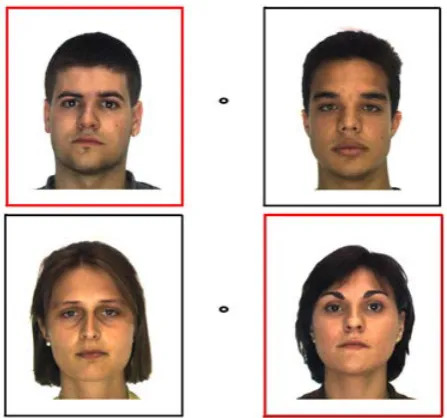
[image:5.595.262.486.504.713.2]Ninety-six head-and-shoulder color portrait photographs (48 females and 48 males) were taken from the AR Face database (Martinez & Benavente, 1998; see Figure 1 for an example of study stimuli). All images present a frontal view with neutral facial expressions and controlled background and illumination condi-tions. The stimuli were randomly arranged in same-gender pairs to form 24 study pairs (12 female pairs, 12 male pairs) and an additional 24 pairs for the various retrieval-pair combinations. Same-gender pairs were used to rule out gender bias in face recognition, which could arise due to subjective preference of participants to either the male or female picture within the pair(Lovén, Herlitz, & Rehnman, 2011;Wright & Sladden, 2003). The order of presentation of stimu-li in both the learning and retrieval phases was randomized between partici-pants.
The experimental design was a 2 × 2 × 4 mixed analysis of variance (ANOVA) with type of Learning-instruction (memory vs. attention) and target Defini-tion-phase (encoding vs. retrieval) as the between-subjects factors, and the Con-text-retrieval conditions (Repeat, Re-pair, New, and None) as the within-subject factor. Participants were randomly assigned to one of the four learning conditions
with respect to extraneous factors such as age and gender. No significant differ-ences were found for age and gender between the experimental groups (F(3,59) = 0.63, p = 0.6; X2 (3, 60) = 1.36, p = 0.72, respectively). All participants were told
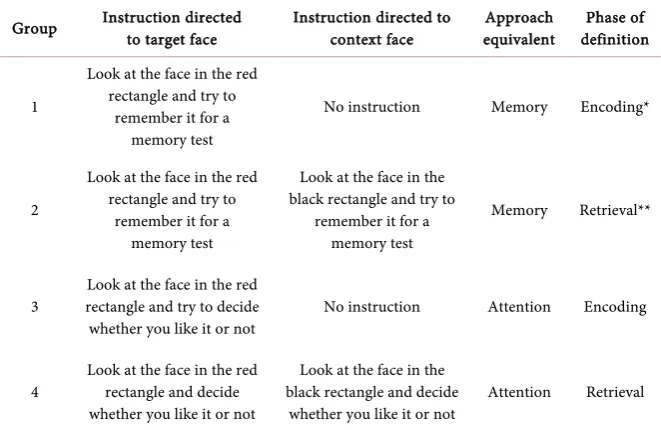
that they would see pairs of faces. Each group was given a different combination of learning instructions for the target and context stimuli (see Table 1 for de-scription of the different learning instructions according to the four experimen-tal groups).
2.3. Procedure
During the learning phase, 24 face-pairs were presented on a computer screen for 4 seconds each, using SuperLab (Cedrus, Inc.) software. Between the pairs, a filler image containing a fixation point was presented for 1 second to reduce se-quential effects related to the position of the target face in the previous pair. Each slide contained two faces, 8.5 × 10 cm each, 4 cm apart with a fixation point exactly in the middle. The faces were presented side by side, each with a rectangular border. The target faces were bordered with a red rectangle, and the context faces were bordered with a black rectangle. Target faces were counterba-lanced between the left and right sides of the computer screen. The position of the red and black borders was held constant between encoding and retrieval; that is, if a target face (red border) was presented at the right side of the screen dur-ing encoddur-ing, it was presented in the identical position at retrieval. This exact repetition was done for all different retrieval conditions.
[image:6.595.209.540.492.707.2]The identities of all faces were balanced across the different conditions, veri-fying the equal likelihood of the faces used as new, Repeat Re-pair, and No con-text. Thus, all stimuli were similar between participant groups. Each participant
Table 1. Description of the different learning instruction conditions, by experimental group.
Group Instruction directed to target face Instruction directed to context face equivalent Approach definition Phase of
1
Look at the face in the red rectangle and try to
remember it for a memory test
No instruction Memory Encoding*
2
Look at the face in the red rectangle and try to
remember it for a memory test
Look at the face in the black rectangle and try to
remember it for a memory test
Memory Retrieval**
3
Look at the face in the red rectangle and try to decide
whether you like it or not No instruction Attention Encoding
4
Look at the face in the red rectangle and decide whether you like it or not
Look at the face in the black rectangle and decide
whether you like it or not Attention Retrieval
performed four practice trials before beginning the experiment. The trials were not included in the results analysis. After the study phase, participants in all learning conditions were asked to wait for 1 hour in a separate, quiet room for the second part of the experiment, in which they performed an identical recog-nition test. While they were waiting, the researcher asked them to provide de-mographic information.
During the retrieval phase, participants were asked to indicate whether the face with the red border had been presented during the study phase or not. Spe-cifically, participants were told to answer “yes” if the face presented to them at retrieval was the face that appeared with a red border during the study phase. Responses were recorded using the SuperLab (Cedrus, Inc.) program. Two stickers indicating “Yes” and “No” were pasted on the “A” and “L” keys on the keyboard. None of the faces that appeared in black borders during encoding were used as target faces during retrieval.
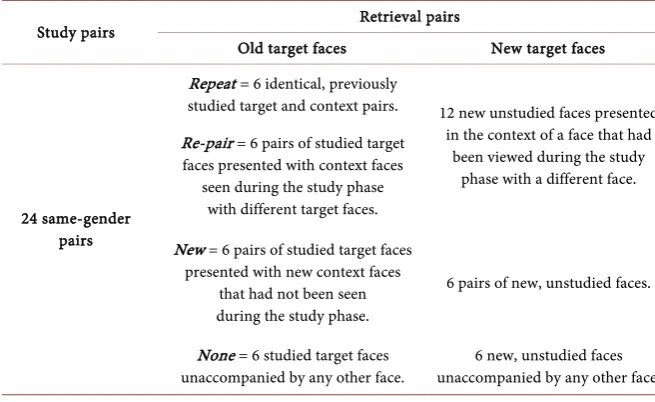
Seven types of retrieval pairs, each forming a different retrieval-context condi-tion, were presented to all participants in random order. Four types of pairs dis-played an original target face with different combinations of context faces, and three types of pairs displayed new target faces with the same combinations of context faces (see Table 2 for a detailed description of retrieval-context condi-tions).
Statistical analyses were performed using SPSS version 19.0 for Windows (SPSS-19). G*Power 3 software, was used to calculate the sample size required for achieving power greater than 0.95.
2.4. Data Analysis
[image:7.595.206.534.539.740.2]A repeated-measure ANOVA was conducted with Type of Learning-instruction (memory vs. attention) and Definition-phase (encoding vs. retrieval) as the be-tween-subjects factors and the Context-retrieval conditions (Repeat, Re-pair, New, and None) as the within-subject factor.
Table 2. Detailed description of all retrieval-context conditions.
Study pairs Retrieval pairs
Old target faces New target faces
24 same-gender pairs
Repeat = 6 identical, previously
studied target and context pairs. 12 new unstudied faces presented in the context of a face that had
been viewed during the study phase with a different face. Re-pair = 6 pairs of studied target
faces presented with context faces seen during the study phase
with different target faces.
New = 6 pairs of studied target faces presented with new context faces
that had not been seen during the study phase.
6 pairs of new, unstudied faces.
None = 6 studied target faces
According to the two-high threshold model(Snodgrass & Corwin, 1988), the measure of discrimination rate, commonly known as the corrected-hits score, was used as the dependent variable as it represents the difference between hits and FA rates (Pr = Hits − FA). The upper-bound value for Pr is 1.
3. Results
Discrimination-Rate (Corrected Hits) Analysis
A significant main effect for Context-retrieval conditions was found, F(3, 168) = 8.42, p < 0.001, η2 = 0.13. However, this finding should be interpreted with
cau-tion due to the significant interaccau-tion found between the Type of Learn-ing-instruction and the Context-retrieval Conditions, F(3, 168) = 4.43, p < 0.005, η2 = 0.07.
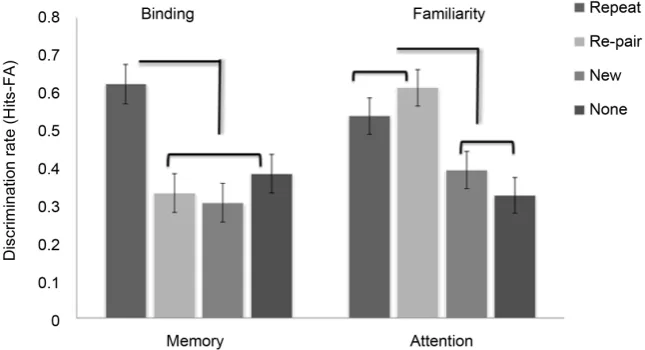
To examine the source of this interaction, we conducted separate analyses for each Learning-instruction group. These analyses revealed a different profile for each Context-retrieval condition (see Figure 2):
1) In the Memory-learning instruction group, we found a significant differ-ence between the Repeat and all other retrieval conditions (Re-pair, F(1,29) = 7.81, p < 0.001; New, F(1, 29) = 3.92, p < 0.001; None, F(1,29) = 3.97, p < 0.01). No significant differences were found between all other Context-retrieval condi-tions (p > 0.05).
2) In the Attention-learning instruction group, we found significant differ-ences between the Repeat and New conditions (F(1, 29) = 2.86, p < 0.01) and between the Re-pair and New and None conditions (F(1, 29) = 3.27, p < 0.01; F(1, 29) = 2.02, p < 0.05). No significant differences were found between the other Context-retrieval conditions (p > 0.05).
[image:8.595.214.537.501.676.2]Significant main effects for the type of Learning-instruction and the Defini-tion-phase conditions were also found. Higher discrimination rates were found
in the Memory-learning instruction condition (M = 0.49; SD = 0.3), compared with the Attention-learning instruction condition (M = 0.38; SD = 0.3) (F(1, 56) = 5.58, p < 0.05, η2 = 0.09). Subsequently, higher discrimination rates were found
for the Encoding-phase (M = 0.49; SD = 0.31) compared with the Retriev-al-phase condition (M = 0.38; SD = 0.31), F(1, 56) = 6.2, p < 0.05, η2 = 0.12.
We found no significant interaction between type of Learning-instruction and Definition-phase, F(1, 56) = 0.75, p > 0.05, η2 = 0.02, or between the
Learn-ing-instruction, Definition-phase, and Context-retrieval conditions, F(3, 168) = 1.83, p > 0.05, η2 = 0.001.
4. Discussion
This study was motivated by the underlying assumption that target and context are dissociated on the basis of different encoding and retrieval processes. We examined whether different definitions of target and context information and the phase in which these definitions are made would affect the emergence of CE during recognition tests. Pairs of faces were used as study stimuli. All partici-pants were tested under various contextual conditions. Our most significant finding was that different definitions of target and context information yielded different patterns of CE as measured using different context-retrieval conditions. This supports our hypothesis regarding the contribution of these two factors (i.e., target-context definition and various measures of CE) to the inconsistent reports in the CE literature.
We manipulated different kinds of learning instructions for target and context information as well as the definition phase in which target faces were distin-guished from context faces (Table 1). Analyses were conducted using the sensi-tive measure of discrimination rate (Pr).
using a recollect-to-reject strategy (Rotello & Heit, 2000).
The specific target-context binding effect was not found under the atten-tion-learning instruction condition, thus supporting the abovementioned mem-ory-induced binding hypothesis. When attention-learning instructions were given, a familiarity-based CE pattern (i.e., Repeat = Re-pair > New, None) was found. These results are not in line with the conclusions presented by Hayes, Nadel, and Ryan (2007) in which binding of object and context stimuli occurred under both intentional and incidental conditions (corresponding respectively to the memory and attention conditions in the current study). They suggested that binding of an object and context is relatively automatic, impervious to the inten-tions of the participant. A possible explanation for the incompatibility between the two studies is that the stimuli used by Hayes et al. consisted of objects and scenes that may be integrated and encoded as a single visual scene, enhancing binding between the two. The faces used in the current study apparently did not cause such automatic binding.
We found that the overall recognition score was higher under the encod-ing-phase condition compared with the retrieval-phase condition. The current results highlight the different underlying processes that take place during en-coding compared with those apparent at retrieval. More specifically, it can be assumed that the contribution of context information to later recognition mem-ory depends on the effortful processing allocated to target as opposed to context at encoding(Hirst & Volpe, 1984). The relationship between the two paradigms is quite informative, although to our knowledge no direct comparison between the two types of learning paradigms has been made to reveal these unique un-derlying processes. This argument extends beyond theoretical concern. Com-parisons of this kind could help develop a better understanding of the unique contribution of each type of learning to later memory performance in our de-manding environment.
The comparison between the different learning instructions under the various retrieval conditions, using discrimination rate analysis, enabled us to evaluate when CE emerges under the suggested theoretical approaches (memory vs. at-tention) and in what way. Our results support the difference between the two approaches. Although CE did emerge when both approaches were tested, the different CE profiles found highlight the possibility of different retrieval proper-ties related to specific encoding conditions. Had we compared only part of the possible context-retrieval conditions as reported in previous studies (Hayes et al., 2007), it is certainly possible that not all of the different CEs would have been revealed.
remember (i.e., incidental learning) (Armstrong & McKelvie, 1996; Foos & Goolkasian, 2008). In their seminal research on this question, Craik and Lock-hart (1972) argued that the level of processing (LoP) of stimulus material is the direct determinant of how well that material will be remembered, regardless of intent to remember it. The current results further support Koriat and Melkman (1987) that claim that the information that is committed to memory may be represented and organized in many alternative forms, and thus it is important to determine which factors affect the organization method.
The current study has several limitations. First, the results presented here are preliminary with a relatively small sample, and although the effects presented were robust as indicated by the moderate-to-high effect sizes, further analysis should be conducted using larger sample sizes. Second, using additional learning instruction conditions, such as the unitization or grouping of face stimuli under the different learning and definition conditions (Yonelinas et al., 1999) could help clarify the different elaboration mechanisms involved in recognition mem-ory. Such conditions could help determine the extent of the effect various learn-ing instructions have on the unique CE profile(Ahmad & Hockley, 2014). Third, we used typical, sensitive measures of memory performance that have been re-ported in previous studies as representing different recognition strategies (Fer-nandes & Guild, 2009; Gillund & Shiffrin, 1984). Yet, in order to illustrate a more sensitive accuracy measure in accordance with modern signal-detection theories, participants should have indicated their level of confidence when re-cognizing stimuli as old or not(Busey, Tunnicliff, Loftus, & Loftus, 2000; Tun-ney, Mullett, Moross, & Gardner, 2012). Finally, although our study manipulated the learning instructions, we could not guarantee that participants followed the instructions they received when encoding both target and context faces. Further studies using more sensitive measures (i.e., eye-tracking devices) might shed light on how participants encode visual information for different experimental manipulations such as the one reported here.
Although preliminary, the current results serve as a point of departure for CE literature and are of significant theoretical importance, as they further support the claim that the CE is not homogeneous but rather involves a number of cog-nitive processes. The double dissociation reported here—that memory instruc-tions yielded a binding as opposed to a familiarity type of CE whereas attention instructions yielded a familiarity as opposed to a binding type of CE—support the multifactorial model of CE proposed by Vakil et al. (2007). The results pre-sented here demonstrate the independence of the binding and familiarity types of CE proposed by this model.
References
Ahmad, F. N., & Hockley, W. E. (2014). The Role of Familiarity in the Associative Recog-nition of Unitized Compound Word Pairs. Quarterly Journal of Experimental
Psy-chology, 67, 2301-2324. https://doi.org/10.1080/17470218.2014.923007
Mem-ory for Voices. The Journal of General Psychology, 123, 259-270.
https://doi.org/10.1080/00221309.1996.9921278
Baddeley, A. D. (1982). Domains of Recollection. Psychological Review, 89, 708-729.
https://doi.org/10.1037/0033-295X.89.6.708
Baddeley, A. D., & Woodhead, M. (1982). Depth of Processing, Context, and Face Recog-nition. Canadian Journal of Psychology, 36, 148-164.
https://doi.org/10.1037/h0080635
Bower, G. H., & Karlin, M. B. (1974). Depth of Processing Pictures of Faces and Recogni-tion Memory. Journal of Experimental Psychology, 103, 751-757.
https://doi.org/10.1037/h0037190
Busey, T. A., Tunnicliff, J., Loftus, G. R., & Loftus, E. F. (2000). Accounts of the Confi-dence-Accuracy Relation in Recognition Memory. Psychonomic Bulletin & Review, 7,
26-48. https://doi.org/10.3758/BF03210724
Clark, S. E., & Gronlund, S. D. (1996). Global Matching Models of Recognition Memory: How the Models Match the Data. Psychonomic Bulletin & Review, 3, 37-60.
https://doi.org/10.3758/BF03210740
Craik, F. I. M., & Lockhart, R. S. (1972). Levels of Processing: A Framework for Memory Research. Journal of Verbal Learning and Verbal Behavior, 11, 671-684.
https://doi.org/10.1016/S0022-5371(72)80001-X
Davies, G., & Milne, A. (1982). Recognizing Faces In and Out of Context. Current
Psy-chological Research, 2, 235-246. https://doi.org/10.1007/BF03186766
Dennis, S., & Humphreys, M. S. (2001). A Context Noise Model of Episodic Word Rec-ognition. Psychological Review, 108, 452-478.
https://doi.org/10.1037/0033-295X.108.2.452
Feenan, K., & Snodgrass, J. G. (1990). The Effect of Context on Discrimination and Bias in Recognition Memory for Pictures and Words. Memory & Cognition, 18, 515-527.
https://doi.org/10.3758/BF03198484
Fernandes, M., & Guild, E. (2009). Process-Specific Interference Effects during Recogni-tion of Spatial Patterns and Words. Canadian Journal of Experimental Psychology, 6,
24-32. https://doi.org/10.1037/a0012870
Foos, P. W., & Goolkasian, P. (2008). Presentation Format Effects in a Levels-of- Processing Task. Experimental Psychology, 55, 215-227.
https://doi.org/10.1027/1618-3169.55.4.215
Gillund, G., & Shiffrin, R. M. (1984). A Retrieval Model for Both Recognition and Recall.
Psychological Review, 91, 1-67. https://doi.org/10.1037/0033-295X.91.1.1
Giovanello, K. S., Keane, M. M., & Verfaellie, M. (2006). The Contribution of Familiarity to Associative Memory in Amnesia. Neuropsychologia, 44, 1859-1865.
https://doi.org/10.1016/j.neuropsychologia.2006.03.004
Giovanello, K. S., Verfaellie, M., & Keane, M. M. (2003). Disproportionate Impairment in Associative Recognition Relative to Item Recognition in Global Amnesia. Cognitive,
Affective & Behavioral Neuroscience, 3, 186-194.
https://doi.org/10.3758/CABN.3.3.186
Gruppuso, V., Lindsay, D. S., & Masson, M. E. J. (2007). I’d Know That Face Anywhere!
Psychonomic Bulletin & Review, 14, 1085-1089. https://doi.org/10.3758/BF03193095
Hayes, S. M., Nadel, L., & Ryan, L. (2007). The Effect of Scene Context on Episodic Object Recognition: Parahippocampal Cortex Mediates Memory Encoding and Retrieval Suc-cess. Hippocampus, 17, 873-889. https://doi.org/10.1002/hipo.20319
Neuropsy-chologia, 22, 631-634. https://doi.org/10.1016/0028-3932(84)90029-0
Hockley, W. E. (2008). The Effects of Environmental Context on Recognition Memory and Claims of Remembering. Journal of Experimental Psychology: Learning, Memory
& Cognition, 34, 1412-1429.https://doi.org/10.1037/a0013016
Hollingworth, A. (2006). Scene and Position Specificity in Visual Memory for Objects.
Journal of Experimental Psychology: Learning, Memory, and Cognition, 32, 58-69.
https://doi.org/10.1037/0278-7393.32.1.58
Humphreys, M. S., & Bain, J. D. (1983). Recognition Memory: A Cue and Information Analysis. Memory and Cognition, 11, 583-600. https://doi.org/10.3758/BF03198283
Hunt, R. R. (2003). Two Contributions of Distinctive Processing to Accurate Memory.
Journal of Memory and Language, 48, 811-825.
https://doi.org/10.1016/S0749-596X(03)00018-4
Jacoby, L. L. (1991). A Process Dissociation Framework: Separating Automatic from In-tentional Uses of Memory. Journal of Memory and Language, 30, 513-541.
https://doi.org/10.1016/0749-596X(91)90025-F
Koriat, A., & Melkman, R. (1987). Depth of Processing and Memory Organization.
Psy-chological Research, 49, 173-181. https://doi.org/10.1007/BF00308684
Lovén, J., Herlitz, A., & Rehnman, J. (2011). Women’s Own-Gender Bias in Face Recog-nition Memory. Experimental Psychology, 58, 333-340.
https://doi.org/10.1027/1618-3169/a000100
Macken, W. J. (2002). Environmental Context and Recognition: The Role of Recollection and Familiarity. Journal of Experimental Psychology: Learning, Memory, and
Cogni-tion, 28, 153-161.https://doi.org/10.1037/0278-7393.28.1.153
Martinez, A. M., & Benavente, R. (1998). The AR Face Database. CVC Technical Report No. 24.
Mayes, A. R., MacDonald, C., Donlan, L., Pears, J., & Meudell, P. R. (1992). Amnesics Have a Disproportionately Severe Memory Deficit for Interactive Context. Quarterly
Journal of Experimental Psychology, 45, 265-297.
https://doi.org/10.1080/14640749208401327
Meltzer, J. A., & Constable, R. T. (2005). Activation of Human Hippocampal Formation Reflects Success in Both Encoding and Cued Recall of Paired Associates. NeuroImage, 24, 384-397. https://doi.org/10.1016/j.neuroimage.2004.09.001
Murnane, K., & Phelps, M. P. (1993). A Global Activation Approach to the Effect of Changes in Environmental Context on Recognition. Journal of Experimental
Psychol-ogy: Learning, Memory, and Cognition, 19, 882-894.
https://doi.org/10.1037/0278-7393.19.4.882
Murnane, K., & Phelps, M. P. (1994). When Does a Different Environmental Context Make a Difference in Recognition? A Global Activation Model. Memory & Cognition, 22, 584-590. https://doi.org/10.3758/BF03198397
Murnane, K., Phelps, M. P., & Malmberg, K. (1999). Context-Dependent Recognition Memory: The ICE Theory. Journal of Experimental Psychology: General, 128, 403-415.
https://doi.org/10.1037/0096-3445.128.4.403
Parker, A., & Gellatly, A. (1997). Movable Cues: A Practical Method for Reducing Con-text-Dependent Forgetting. Applied Cognitive Psychology, 11, 163-173.
https://doi.org/10.1002/(SICI)1099-0720(199704)11:2<163::AID-ACP427>3.0.CO;2-1
Priestley, N. M., & Mayes, A. R. (1992). Preservation of Priming for Interactive Context in Amnesics. Cortex, 28, 555-574. https://doi.org/10.1016/S0010-9452(13)80227-4
Di-rect Tests of Memory: The Role of Contextual Fan. Memory & Cognition, 30, 312-323.
https://doi.org/10.3758/BF03195292
Reingold, E. M., & Goshen-Gottstein, Y. (1996). Separating Consciously Controlled and Automatic Influences in Memory for New Associations. Journal of Experimental
Psy-chology: Learning, Memory, and Cognition, 22, 397-406.
https://doi.org/10.1037/0278-7393.22.2.397
Rotello, C. M., & Heit, E. (2000). Two-Process Models of Recognition Memory: Evidence for Recall-to-Reject? Journal of Memory and Language, 40, 432-453.
https://doi.org/10.1006/jmla.1998.2623
Russo, R., Ward, G., Geurts, H., & Scheres, A. (1999). When Unfamiliarity Matters: Changing Environmental Context between Study and Test Affects Recognition Mem-ory for Unfamiliar Stimuli. Journal of Experimental Psychology: Learning, Memory,
and Cognition, 25, 488-499. https://doi.org/10.1037/0278-7393.25.2.488
Smith, S. M. (1979). Remembering in and out of Context. Journal of Experimental
Psy-chology: Human Learning and Memory, 5, 460-471.
https://doi.org/10.1037/0278-7393.5.5.460
Smith, S. M., & Vela, E. (2001). Environmental Context-Dependent Memory: A Review and Meta-Analysis. Psychonomic Bulletin & Review, 8, 203-220.
https://doi.org/10.3758/BF03196157
Snodgrass, J. G., & Corwin, J. (1988). Pragmatics of Measuring Recognition Memory: Applications to Dementia and Amnesia. Journal of Experimental Psychology: General, 117, 34-50. https://doi.org/10.1037/0096-3445.117.1.34
Stark, C. E., & Squire, L. R. (2003). Hippocampal Damage Equally Impairs Memory for Single Items and Memory for Conjunctions. Hippocampus, 13, 281-292.
https://doi.org/10.1002/hipo.10085
Steyvers, M., & Malmberg, K. J. (2003). The Effect of Normative Context Variability on Recognition Memory. Journal of Experimental Psychology: Learning, Memory, and
Cognition, 29, 760-766. https://doi.org/10.1037/0278-7393.29.5.760
Taconnat, L., Froger, C., Sacher, M., & Isingrini, M. (2008). Generation and Associative Encoding in Young and Old Adults: The Effect of the Strength of Association between Cues and Targets on a Cued Recall Task. Experimental Psychology, 55, 23-30.
https://doi.org/10.1027/1618-3169.55.1.23
Tulving, E., & Thomson, D. M. (1971). Retrieval Processes in Recognition Memory: Ef-fects of Associative Context. Journal of Experimental Psychology, 87, 116-124. https://doi.org/10.1037/h0030186
Tunney, R. J., Mullett, T. L., Moross, C. J., & Gardner, A. (2012). Does the Butch-er-on-the-Bus Phenomenon Require a Dual-Process Explanation? A Signal Detection Analysis. Frontiers in Psychology, 3, 208. https://doi.org/10.3389/fpsyg.2012.00208
Vakil, E., & Oded, Y. (2003). Comparison between Three Memory Tests: Cued Recall, Priming and Saving Closed-Head Injured Patients and Controls. Journal of Clinical
and Experimental Neuropsychology, 25, 274-282.
https://doi.org/10.1076/jcen.25.2.274.13637
Vakil, E., Raz, T., & Levy, D. A. (2007). Multifactorial Context Effects on Visual Recogni-tion Memory. Quarterly Journal of Experimental Psychology, 60, 916-923.
https://doi.org/10.1080/17470210701357568
Watkins, M. J., Ho, E., & Tulving, E. (1976). Context Effects in Recognition Memory for Faces. Journal of Verbal Learning & Verbal Behavior, 15, 505-517.
https://doi.org/10.1016/0022-5371(76)90045-1
Remem-bering Faces. Journal of Experimental Psychology: Human, Learning and Memory, 3,
397-405.https://doi.org/10.1037/0278-7393.3.4.397
Wright, D. B., & Sladden, B. (2003). An Own Gender Bias and the Importance of Hair in Face Recognition. Acta Psychologica, 114, 101-114.
https://doi.org/10.1016/S0001-6918(03)00052-0
Yonelinas, A. P., Kroll, N. E. A., Dobbins, I. G., & Soltani, M. (1999). Recognition Mem-ory for Faces: When Familiarity Supports Associative Recognition Judgments.
Psy-chonomic Bulletin & Review, 6, 654-661.https://doi.org/10.3758/BF03212975
Submit or recommend next manuscript to SCIRP and we will provide best service for you:
Accepting pre-submission inquiries through Email, Facebook, LinkedIn, Twitter, etc. A wide selection of journals (inclusive of 9 subjects, more than 200 journals)
Providing 24-hour high-quality service User-friendly online submission system Fair and swift peer-review system
Efficient typesetting and proofreading procedure
Display of the result of downloads and visits, as well as the number of cited articles Maximum dissemination of your research work