10
Dimensions of Personality of Women in Chennai using
CETD Matrix
A. Victor Devadoss
Head & Associate Professor PG & Research Department of MathematicsLoyola College, Chennai-34, India
M. Clement Joe Anand
Ph. D Research ScholarPG & Research Department of Mathematics Loyola College, Chennai-34, India
ABSTRACT
The objective of this paper to find out the peak age of women gets anger in Chennai, for that we have studied the Dimensions of personality of women. It has been classified in to five factors as Openness, Conscientiousness, Extraversion, Agreeableness, and Negative Emotion. Each Dimension has six facets. For the first time in the year 1998 matrix theory was developed by W.B. Vasantha and V. Indira to study the passenger transportation problem. To study this problem, they divided and defined four types of matrices are called Initial Raw Data Matrix, Average Time Dependent Data matrix (ATD Matrix), Refined Time Dependent Data matrix (RTD Matrix) and Combined Effect Time Dependent Data Matrix (CETD Matrix). In the year 2003 the same technique was used by W.B. Vasantha to study the migrant laborers who were affected by HIV/AIDS. In 2004 W.B. Vasantha and A. Victor Devadoss used to study the agriculture laborers. Now we use this model to study of Dimensions of personality of women.
Keywords
Personality of Women, OCEAN, ATD Matrix, RTD Matrix, CETD Matrix,
1.
INTRODUCTION
This paper has four sections. In the first section we just recall the methods of applications of CETD matrix. In section two we describe the dimensions of personality. The section three we apply the six facets of dimensions of personality of women by using CETD model to find out the peak age of group of OCEAN. In final section we derived conclusions and gives suggestion based on our study.
1.1
The method of application of CETD
matrix.
We give a very simple but a very effective technique on the collected data. From that data we recognized the dimension of personality of women. Based on the words, emotions and sentiments given by the women, six attributes are chosen and the entries are recorded in a form of matrix by taking ages along the columns and the emotion along the rows.
1.1.1
Average Time Dependent (ATD) matrix
Raw data transform it into a raw time dependent data matrix by taking along the rows the age group and along the columns emotions and sentiments using the raw data matrix we make it into the Average Time Dependent Data (ATD) matrix (aij) by dividing each entry of the raw data matrix by the number of years i.e., the time period. This matrix represents a data, which is totally uniform. At the third stage we find the
average and Standard Deviation (S.D) of every column in the ATD matrix.
1.1.2
Refined Time Dependent (RTD) matrix
Using the average µjof each j th
column and σj the S.D of the each jth column we chose a parameter α from the interval [0,1] and the Refined time dependent Matrix (RTD matrix),
Using the formula
aij ≤ (µj – α* σj) then eij = -1 else if aij ∈ (µj – α* σj, µj + α* σj) then eij = 0 else
if aij ≥ (µj + α* σj) then eij = 1
We redefine the ATD matrix into the Refined time dependent fuzzy matrix for here the entries are -1, 0 or 1. Now the row sum of this matrix gives the maximum age group.
1.1.3
Combined Effective Time Dependent Data
(CETD) matrix
We also combine the above RTD matrices by varying the αϵ[0,1], so that we get the Combined Effective Time Dependent Data (CETD) matrix. The row sum is obtained for CETD matrix and conclusions are derived based on the row sums. All these are represented by graphs and graphs play a vital role in exhibiting the data by the simplest means, which can be even understood by a layman.
2.
DIMENSIONS OF PERSONALITY
2.1
Personality
Personality models are needed; since people with different personalities may react differently to same situations. Personality is that that patterns of characteristics thoughts, feelings and behaviors that distinguish one person from another and that persist over time and situation. It is sum biologically based and learnt behavior which makes the person response to environmental stimuli exclusively. In contemporary psychology, personality is specified as a function of thirty attributes-each of which called personality facet. The personality facets are clustered in five groups –each called a personality trait or personality factor. The five personality factors are also referred to as “the big five” [5], [13]. The value of each personality factor is determined by the values of its six facets. The five clusters of personality factors are also referred to by letter designation [1], [13], [14], [15]. Acton refers to a thing them as the OCEAN model [1]. In the OCEAN model, the letters stands for the following meanings:
O: Openness, culture, Originality, or intellect.
C: Conscientiousness, consolidation, or will to achieve.
E: Extraversion.
A: Agreeableness or accommodation.
11
2.2
Personality Traits
2.2.1
Openness
“Openness to experience is tendency to be intellectual, interested in the arts, emotionally aware and liberal” [2]. “Openness refers to the number of interests to which one is attracted and the depth to which those interests are pursued. It is also referred to culture, originality or intellect. It is about creativity”.
2.2.2
Conscientiousness
“Conscientiousness is tendency to set high goals, to accomplish work successfully, and to behave dutifully and morally”[2]. Furthermore, “conscience is the awareness of a moral or ethical aspect to one‟s conduct together with the urge to prefer right over wrong”.
2.2.3
Extraversion
“Extraversion is trait associated with sociability and positive effect,” [2]. It refers to the number of relationships with which one is comfortable because the distribution of the factor scores is normal and not bimodal; the practice of dichotomizing respondents for example into extraverts and introverts is unjustified.
2.2.4
Agreableness
“Agreeableness is tendency to be a nice person” [2]. It is also referred to as accommodation.
2.2.5
Negative Emotion
Negative emotionality, neuroticism, or need for stability is the trait associated with emotional instability and negative affect [2]. “Negative emotionality refers to the number and strength of stimuli required to elicit negative emotions in a person”.
3.
DESCRIPTION OF THE PROBLEM
In this research we give an algebraic approach to the dimensions of personality of women in Chennai. For that we have interviewed and recorded 100 women in different ages in Chennai. First by the term, each five dimension has six facets. In which we mainly concentrate the negative emotion among the five dimensions. We approach the dimensions of personality of women by determining the peak age group. In which they are maximum being Openness, Conscientiousness, Extraversion, Agreeableness, and Negative Emotion.
We analyze these problem using fuzzy matrix, we call the RTD Matrix as fuzzy matrix for that take their entries from the set {-1, 0, 1}. So the terms RTD matrix or fuzzy matrix mean one and the same matrix.
One of the major and broad its heads of the study negative emotions of women among the five dimensions. In this research will discuss six facets of each dimensions of personality of women. Which are taken as the columns of the initial row data matrix the age group in years, 10-17, 18-24, 25-29, 30-39, 40-49, 50-59 and 60-75. The estimation of the maximum age group is five-stage process. In the first stage we give the matrix representation of the raw data. Entries corresponding to the intersection of rows and columns are values corresponding to the live network. The 3 x 6 matrix is not uniform i.e. the number of individual years in each interval may not be the same. So in the second stage we in order to obtain an unbiased uniform effect on each and every data so collected, transform this initial matrix into an Average Time Dependent Data (ATD) matrix. To make the
calculations easier and simpler we in the third stage using the simple average techniques convert the above average time dependent data matrix in to a matrix with entries eij ϵ {-1,0,1}. We name this matrix as the Refined Time Dependent Data Matrix (RTD Matrix) or as the fuzzy matrix. The value of eij corresponding to each entry is determined in a special way described. At the fourth stage using the fuzzy matrices we obtain the Combined Effect Time Dependent Data Matrix (CETD Matrix), which gives the cumulative effect of all these entries. In the final stage we obtain the row sums of the CETD matrix. The tables given are self-explanatory at each stage. The graph of the RTD matrix and CETD matrix are given.
3.1 Estimation of maximum age group of
women being Openness by using 7 x 6
matrices
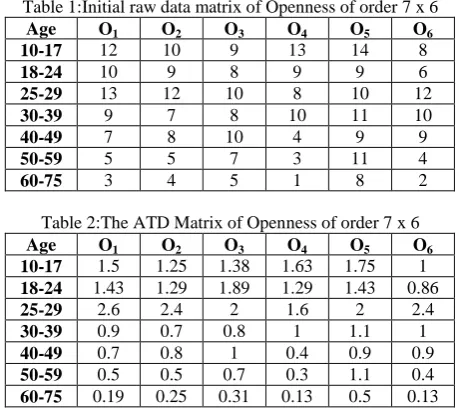
[image:2.595.313.543.301.508.2]In this section we apply six facets i.e., O1-Fantasy, O2-Aesthetics, O3-Feelings, O4-Actions, O5-Ideas and O6-Values of openness of women to the CETD model.
Table 1:Initial raw data matrix of Openness of order 7 x 6
Age O1 O2 O3 O4 O5 O6
10-17 12 10 9 13 14 8
18-24 10 9 8 9 9 6
25-29 13 12 10 8 10 12
30-39 9 7 8 10 11 10
40-49 7 8 10 4 9 9
50-59 5 5 7 3 11 4
60-75 3 4 5 1 8 2
Table 2:The ATD Matrix of Openness of order 7 x 6
Age O1 O2 O3 O4 O5 O6
10-17 1.5 1.25 1.38 1.63 1.75 1
18-24 1.43 1.29 1.89 1.29 1.43 0.86
25-29 2.6 2.4 2 1.6 2 2.4
30-39 0.9 0.7 0.8 1 1.1 1
40-49 0.7 0.8 1 0.4 0.9 0.9
50-59 0.5 0.5 0.7 0.3 1.1 0.4
[image:2.595.313.542.444.744.2]60-75 0.19 0.25 0.31 0.13 0.5 0.13
Table 3:Average and S.D of the above given ATD Matrix
Average 1.12 1.03 1.15 0.91 1.25 0.96
S.D 0.81 0.71 0.62 0.63 0.51 0.88
We have taken the value α = 0.1, 0.3, 0.5 and 0.7 to find the CETD matrix
The RTD matrix for α=0.1 row sum matrix
1 1 1 1 1 0
1 1 1 1 1 1
1 1 1 1 1 1
1 1 1 1 1 0
1 1 1 1 1 0
1 1 1 1 1 1
1 1 1 1 1 1
34 6 5 5 6 6
The RTD matrix for α=0.3 row sum matrix
1 1 1 1 1 0
1 1 1 1 1 0
1 1 1 1 1 1
0 1 1 0 0 0
1 1 0 1 1 0
1 1 1 1 0 1
1 1 1 1 1 1
5 5 6 2 4 5 6
12
The RTD matrix for α=0.5 row sum matrix
0 0 0 1 1 0
0 0 1 1 0 0
1 1 1 1 1 1
0 0 1 0 0 1
1 0 0 1 1 0
1 1 1 1 0 1
1 1 1 1 1 1
2 2 6 0 3 5 6
The RTD matrix for α=0.7 row sum matrix
0 0 0 1 1 0
0 0 1 0 0 0
1 1 1 1 1 1
0 0 0 0 0 0
0 0 0 1 0 0
1 1 1 1 0 0
1 1 1 1 1 1
2 1 6 0 1 4 6
Graph 1: Depicting maximum age group of women being Openness for α = 0.1
Graph 2: Depicting maximum age group of women being Openness for α = 0.3
Graph 3: Depicting maximum age group of women being Openness for α = 0.5
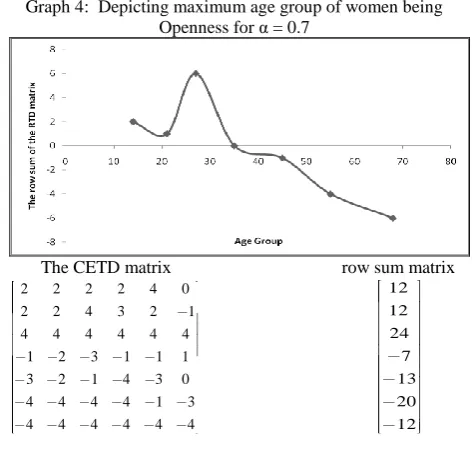
Graph 4: Depicting maximum age group of women being Openness for α = 0.7
The CETD matrix row sum matrix
2 2 2 2 4 0
2 2 4 3 2 1
4 4 4 4 4 4
1 2 3 1 1 1
3 2 1 4 3 0
4 4 4 4 1 3
4 4 4 4 4 4
12 12 24 7 13 20 12
Graph 5: Depicting maximum age group of women being Openness for CETD matrix
3.2 Estimation of maximum age group of
women being Conscientiousness by using
7 x 6 matrices:
[image:3.595.311.548.74.300.2]In this section we apply six facets i.e. C1-Competence, C2-Order, C3-Dutifulness, C4-Achievement Striving, C5-Self Discipline and C6-Deliberation of Conscientiousness of women to the CETD model.
Table 4: Initial raw data matrix of Conscientiousness of order 7 x 6
Age C1 C2 C3 C4 C5 C6
10-17 5 3 3 7 6 3
18-24 6 9 5 10 7 6
25-29 8 12 8 13 10 10
30-39 6 11 10 10 11 12
40-49 4 12 12 12 10 11
50-59 3 10 10 9 9 9
60-75 2 2 3 7 3 4
Table 5: ATD Matrix of Conscientiousness of order 7 x 6
Age C1 C2 C3 C4 C5 C6
10-17 0.63 0.38 0.38 0.88 0.75 0.38
18-24 0.83 1.29 0.71 1.43 1 0.86
25-29 1.6 2.4 1.6 2.6 2 2
30-39 0.6 1.1 1 1 1.1 1.2
40-49 0.4 1.2 1.2 1.2 1 1.1
50-59 0.3 1 1 0.9 0.9 0.9
[image:3.595.53.280.474.599.2]13
Table 6: Average and S.D of the above given ATD Matrix
Average 0.65 1.07 0.87 1.21 0.99 0.96
S.D 0.48 0.73 0.48 0.68 0.54 0.57
We have taken the value α = 0.1, 0.3, 0.5 and 0.7 to find the CETD matrix
The CETD matrix row sum matrix
0 4 4 2 2 4
2 2 2 2 0 1
4 4 4 4 4 4
1 0 1 2 1 2
3 1 3 0 0 1
4 0 1 2 1 1
4 3 4 4 4 4
16 3 24
1 1 7 23
Graph 6: Depicting maximum age group of women being Conscientiousness for CETD matrix
3.3
Estimation of maximum age group of
women being Extraversion by using 7 x 6
matrices.
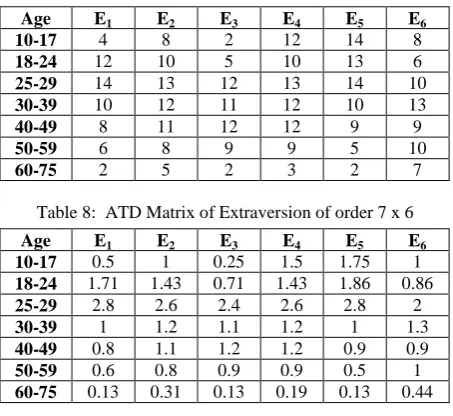
[image:4.595.54.281.263.390.2]In this section we apply six facets i.e. E1-Warmth, E2-Gregariousness, E3-Assertiveness, E4-Activity, E5-Excitement Seeking and E6-Positive Emotions of Extraversion of women to the CETD model.
Table 7: Initial raw matrix of Extraversion of order 7 x 6
Age E1 E2 E3 E4 E5 E6
10-17 4 8 2 12 14 8
18-24 12 10 5 10 13 6
25-29 14 13 12 13 14 10
30-39 10 12 11 12 10 13
40-49 8 11 12 12 9 9
50-59 6 8 9 9 5 10
60-75 2 5 2 3 2 7
Table 8: ATD Matrix of Extraversion of order 7 x 6
Age E1 E2 E3 E4 E5 E6
10-17 0.5 1 0.25 1.5 1.75 1
18-24 1.71 1.43 0.71 1.43 1.86 0.86
25-29 2.8 2.6 2.4 2.6 2.8 2
30-39 1 1.2 1.1 1.2 1 1.3
40-49 0.8 1.1 1.2 1.2 0.9 0.9
50-59 0.6 0.8 0.9 0.9 0.5 1
60-75 0.13 0.31 0.13 0.19 0.13 0.44
Table 9: Average and S.D of the above given ATD Matrix
Average 1.08 0.96 0.96 1.29 1.28 1.07
S.D 0.91 0.76 0.75 0.73 0.91 0.48
We have taken the value α = 0.1, 0.3, 0.5 and 0.7 to find the CETD matrix
The CETD matrix row sum matrix
3 0 4 2 3 1
3 3 3 2 3 2
4 4 4 4 4 4
0 2 1 1 2 2
2 1 3 1 2 2
3 1 0 3 4 1
4 4 4 4 4 4
3 6 24
2 3 12 24
Graph 7: Depicting maximum age group of women being Extraversion for CETD matrix
3.4 Estimation of maximum age group of
women being Agreeableness by using 7 x 6
matrices:
In this section we apply six facets i.e. A1-Trust, A2-Straight Forwardness, A3-Altruism, A4-Compliance, A5-Modesty and A6-Tender Mindness of Extraversion of women to the CETD model.
Table 10: Initial raw data matrix of Agreeableness of order 7 x 6
Age A1 A2 A3 A4 A5 A6
10-17 13 14 3 8 4 8
18-24 8 4 6 7 13 4
25-29 6 8 8 6 15 5
30-39 10 10 12 10 12 6
40-49 9 13 10 11 10 8
50-59 7 10 9 8 8 11
[image:4.595.310.544.451.721.2]60-75 3 8 4 5 6 10
Table 11: ATD Matrix of Agreeableness of order 7 x 6
Age A1 A2 A3 A4 A5 A6
10-17 1.63 1.75 0.38 1 0.5 1
18-24 1.14 0.57 0.86 1 1.86 0.57
25-29 1.2 1.6 1.6 1.2 3 1
30-39 1 1 1.2 1 1.2 0.6
40-49 0.9 1.3 1 1.1 1 0.8
50-59 0.7 1 0.9 0.8 0.8 1.1
60-75 0.19 0.5 0.25 0.31 0.38 0.63
Table 12: Average and S.D of the above given ATD Matrix
Average 0.97 1.10 0.88 0.91 1.25 0.81
S.D 0.45 0.48 0.46 0.29 0.91 0.22
[image:4.595.54.281.496.704.2]14
The RTD matrix for α=0.1 row sum matrix
1 1 1 1 1 1
1 1 0 1 1 1
1 1 1 1 1 1
0 1 1 1 0 1
1 1 1 1 1 0
1 1 0 1 1 1
1 1 1 1 1 1
2 1 6 0 1 3 6
The RTD matrix for α=0.3 row sum matrix
1 1 1 1 1 1
1 1 0 1 1 1
1 1 1 1 1 1
0 0 1 1 0 1
0 1 0 1 0 0
1 0 0 1 1 1
1 1 1 1 1 1
2 1 6 1 2 2 6
The RTD matrix for α=0.5 row sum matrix
0 1 1 0 1 1
0 1 0 0 1 1
1 1 1 1 1 1
0 0 1 0 0 1
0 0 0 1 0 0
1 0 0 0 0 1
1 1 1 1 1 1
0 1 6 0 1 0 6
The RTD matrix for α=0.7 row sum matrix
1 1 1 0 1 1
1 1 0 0 0 1
0 1 1 1 1 1
0 0 0 0 0 1
0 0 0 0 0 0
0 0 0 0 0 1
1 1 1 1 1 1
1 1 5 1 0 1 6
Graph 9: Depicting maximum age group of women being Agreeableness for α = 0.1
Graph 10: Depicting maximum age group of women being Agreeableness for α = 0.3
Graph 11: Depicting maximum age group of women being Agreeableness for α = 0.5
Graph 12: Depicting maximum age group of women being Agreeableness for α = 0.7
The CETD matrix row sum matrix
3 4 4 2 4 4
3 4 0 2 3 4
3 4 4 4 4 4
0 1 3 2 0 4
1 2 1 3 1 0
3 1 0 2 2 4
4 4 4 4 4 4
5 0 23 0 4 4 24
Graph 13: Depicting maximum age group of women being Agreeableness for CETD matrix
3.5 Estimation of maximum age group of
women being Negative Emotion by using
7 x 6 matrices:
In this section we apply six facets i.e. N1-Worry, N2-Anger,
N3-Discouragement, N4-Self Consciousness, N5-Impulsiveness, and N6-Vulnerability of negative emotion
[image:5.595.49.280.61.472.2]of women to the CETD model.
Table 13: Initial raw data matrix of Negative Emotion of order 7 x 6
Age N1 N2 N3 N4 N5 N6
10-17 3 5 6 3 4 6
18-24 8 15 10 11 13 10
25-29 14 15 11 14 15 12
30-39 11 13 11 10 9 7
40-49 13 14 13 12 13 10
50-59 8 9 8 4 3 6
15
Table 14: ATD Matrix of Negative Emotion of order 7 x 6
Age N1 N2 N3 N4 N5 N6
10-17 0.38 0.63 0.75 0.38 0.5 0.75
18-24 1.14 2.14 1.43 1.57 1.86 1.43
25-29 2.8 3 2.2 2.8 3 2.4
30-39 1.1 1.3 1.1 1 0.9 0.7
40-49 1.3 1.4 1.3 1.2 1.3 1
50-59 0.8 0.9 0.8 0.4 0.3 0.6
60-75 0.31 0.19 0.31 0.13 0.25 0.5
Table 15: Average and S.D of the above given ATD Matrix
Average 1.19 1.37 1.13 1.07 1.16 1.05
S.D 0.76 0.95 0.60 0.92 0.99 0.67
We have taken value α = 0.1, 0.3, 0.5 and 0.7 to find the CETD matrix
The RTD matrix for α=0.1 row sum matrix
1 1 1 1 1 1
0 1 1 1 1 1
1 1 1 1 1 1
1 0 0 0 1 1
1 0 1 1 1 0
1 1 1 1 1 1
1 1 1 1 1 1
6 5 6 3 4
6 6
The RTD matrix for α=0.3 row sum matrix
1 1 0 1 1 1
0 1 0 1 1 1
1 1 1 1 1 1
0 0 0 0 0 1
0 0 0 0 0 0
1 1 1 1 1 1
1 1 1 1 1 1
5 4 6 1 0
5 6
The RTD matrix for α=0.5 row sum matrix
1 1 1 1 1 0
0 1 1 1 1 1
1 1 1 1 1 1
0 0 0 0 0 1
0 0 0 0 0 0
1 0 1 1 1 1
1 1 1 1 1 1
5 5 6 1 0
5 6
The RTD matrix for α=0.7 row sum matrix
1 1 0 1 0 0
0 1 0 0 1 0
1 1 1 1 1 1
0 0 0 0 0 0
0 0 0 0 0 0
0 0 0 1 1 0
1 1 1 1 1 1
3 2 6 0 0 2 6
Graph 14: Depicting maximum age group of women being Negative Emotion for α = 0.1
Graph 15: Depicting maximum age group of women being Negative Emotion for α = 0.3
Graph 16: Depicting maximum age group of women being Negative Emotion for α = 0.5
Graph 17: Depicting maximum age group of women being Negative Emotion for α = 0.7
The CETD matrix row sum matrix
4 4 2 4 3 2
0 4 2 3 4 3
4 4 4 4 4 4
1 0 0 0 1 3
1 0 1 1 1 0
3 2 2 4 4 3
4 4 4 4 4 4
19 16 24 5 4
18 24
[image:6.595.316.544.81.239.2]16
4.
Conclusion, Suggestions and the Future
Work
4.1
Conclusion
4.1.1
Openness
The openness starts at the age 14. The maximum age group of women being open are at the age 27 as they have unusual ideas, curiosity, variety of experience, feelings and adventure. The openness decreases after the age 30. When women are open, it makes them to get angry when their ideas are not accepted.
4.1.2
Conscientiousness
The Conscientiousness begins at the age 20. The maximum age group of women being conscientious are at the age 28, because they posses qualities like self discipline, dutifulness, achievements, striving and expectation in their work. The Conscientiousness gets decreased from the age 35.
4.1.3
Extraversion
The women belonging to the age group 15 begin to develop extraversion in themselves it starts to decreased at the age 21. The maximum age group of women being extraversion is at the age 26 because they will be compassionate, co-operating, suspicious and antagonistic in all. The extraversion decreases from the age 55.
4.1.4
Agreeableness
The Agreeableness starts at the yearly teenage 14 and then decreases at the age 19. Because they will analyze a thing which is right or wrong. The maximum age group of women being agreeableness are at the age 27 because they will be straight forward, tender mind, trust, tendency to seek stimulate in their work and family. The agreeableness decreases from the age 55.
4.1.5
Negative emotion
Women at the age of 18 begin to increasing negative emotion. The peak age of women having negative emotion is from 21 to 28 and from 40 to 47, because they have discouragement, impulsiveness, worry and vulnerability. When they are discouraged in their work and among their friends it makes them angry. The negative emotion decreases from the age 33 to 39 and 48 and above.
From research we found out that starting and peak age of dimensions of personality of women in Chennai. It is projected in the following table.
Dimensions of Personality
Starting Age Peak Age
Openness 14 27
Conscientiousness 20 28
Extraversion 15 26
Agreeableness 14 27
Negative Emotions 18 21 to 28 and 40 to 47
We can see from the table that the peak age of a Chennai women‟s personality is at 26-28. The negative approach starts after the peak age. So an individual become angry when her personality at the peak.
4.2
Suggestions
Take a Break: This is one of the simplest methods of anger
management. Whenever you are angry about something or someone, you can ideally stay from that person or that thing for a brief period of time. This will help you to regain a composed mindset and think over the issue to find a possible solution. If you can‟t just walk out, just keep calm and count to ten. It may sound absurd, but it is effective when it comes to controlling outbursts of anger.
Identify possible solutions: During the break, you can evaluate all the possible options to avoid further complications or damage. Your mind may tend to divert to the „cause‟ which made you angry, but you will have to deviate from the cause, and think about the possible effects of your outburst. Remember that damage control is the need of the hour, and being mature enough to understand the consequences will help you not to take any drastic step which would lead to dire consequences.
Humor: Humor, is no doubt the best way to resolve tension
between two people. As soon as you realize that the „discussion‟ is turning into an „argument‟, and may deteriorate even further, you can add a hint of humor to the conversations. This will help in releasing all that pent up tension, which could otherwise lead to a „clash of egos‟.
Don’t Hold a Grudge: This is the worst thing you can possibly do, and it will just add to the pent up tension within you. Every time you come across the person, you will recollect the moment and your temper will flare all over again. You can simply forget the issue and carry on with life, and if that‟s not impossible, avoid the person till you forget or forgive.
Control of the situation: Anger is such a powerful
expression that it controls your entire body, mind and soul. But here, in the conquest of winning over anger, you need to control the situation and let not the situation control you by making you angry, controlling the situation starts with to remain silent on angry occasions. You just need to go into the situation and resume with your work or else try to sort out the matter, with loads of assertive and WIN-WIN thoughts in mind.
4.3 The Future Work
The personalities of a woman viewed as five emotional dimensions viz. Openness, Conscientiousness, Extraversion, Agreeableness and Negative emotion. These are the fundamental dimensions of a mind. The personality is the sum total of the actual or potential behavior-pattern of the organisms as determined by hereditary and environmental. It originates and develops through the fundamental interaction of the four main sectors into which these behavior pattern are organized namely,
i. The cognitive sector (Intelligence) ii. The conative sector (Character) iii. The affective sector (Temperament) iv. Somatic sector (Constitution)
The building of personality helps the women to gain confidence and getting empowered.
17
employment and decision making process. Economic Empowerment of women implies their participation in economically productive activities, control over income and assets such as land, industries and independent access to savings and credits. A study of the influence the peak age of Women become more active participants in the process of development with the following objectives can be studied - 1. To change negative family and community attitudes towards the girl child at birth.
2. To improve enrolment and retention of girls in school. 3. To raise the age at marriage of girls.
4. To assist the girl to undertake income generating activities.
5.
REFERENCES
[1] Acton, G,S. (2001). Five-Factor Model.
[2] Acton-Glossary.
[3] Bettencourt, B.A., A.Talley, A.J Benjamin. 2006. “Personality and Aggressive Behavior Under Provoking and Neutral Conditions: A Meta-Analytic Review “, Psychological Bulletin, 132(5), 751-777.
[4] Corsini, R.J. 1999. „The Dictionary of psychology’, Philadelphia: Brunner/Mazel.
[5] Costa, P.T., Jr., McCrae, R.R. (1992). NEO PI-R Professional Manual, Odessa, Fla: Psychological Assessment Resources.
[6] El-Nasr,M.S.,J.Yen, and T.loerger.2000. “FLAME-A Fuzzy logic Adaptive Model of Emotions”,Automous Agents and Multi-agent Systems,3,219-257.
[7] Elliott, C. 1992. “The Affective Reasoner: A Process Model of Emotions in a multi-agent system” (Ph.D. Thesis): Institute for Learning Sciences, Evanston, IL: Northwestern University.
[8] “Emotion”.2009.Retrieved15 March, 2009.
[9] Frijda, N.H 1987. The emotions. Cambridge, New York: Cambridge University Press.
[10] Ghasem-Aghaee, N., and T.I Oren. 2007. “Cognitive complexity and dynamic pe rsonality in agent simulation”. Computers in Human Behavior, 23(6), 2983-2997.
[11] Hartley, M. 2002. “Overcoming common problems, Managing Anger at work”. London: Sheldon Press.
[12] Heinstrom, J. 2003. “Five Personality dimensions and their influence on information behavior”: Information Research, 9(1). Retrieved March 15, 2009.
[13] Howard, P.J. (2000). The owner‟s Manual for the Brain, Second Edition, Bard Press, Atlanta, GA.
[14] Howard, P.J., Howard, J.M. (2001a).The BIG FIVE Quickstart: An Introduction to the Five-factor model of personality for Human Resource Professionals, Center for Applied Cognitive Studies [CentACS], Charlotte, North Carolina.
[15] Howard, P.J., Howard, J.M, (2001b). Owners Manual for the Personality at work, Bard Press.
[16] Kosko, Bart (1992). Neural Networks and Fuzzy Systems, Prentice – Hall, Englewood Cliffs, New Jersey.
[17] Kosko, Bart (!986), Fuzzy Cognitive Maps,
International Journal of Man – Machine Studies, 34, 65 – 75.
[18] Leshan, L. 1999. “Action Theory and Cognitive psychology in Industrial Design: User Models and User Interfaces” (Ph.D. Thesis). Braunschweig: Art University of Braunschweig.
[19] Oren, T.I, Nasser Ghasem - Aghaee, Bardia Khalesi and Mohammad Kazemifard, „Anger and Aggressive Behavior in Agent Simulation‟.
[20] Phares, E.J. 1991. Introducing to psychology (3rd ed.). New York: Harper Collins Publishers.
[21] Rizzo, P. 1998. “Personalities in believable agents : a goal – based model and its realization with an integrated planning architecture” (Ph.D Thesis). Turin, Italy: Center of Cognitive Science, University of Turin.
[22] Schmidt, B. 2002. “How to give agents a personality” .In Proceeding of the third workshop on agent-based simulation, Passau, Germany.
[23] W.B Vasantha Kandasamy, Florentin Smarandache and Ilanthenral, ‘Elementary Fuzzy Matrix Theory and Fuzzy Models for Social Scientists’, Printed in United States of America, 2007.