© 2018, IRJET | Impact Factor value: 6.171 | ISO 9001:2008 Certified Journal | Page 3346
Effects of De-Pulping Speed and Fermentation Period of Breadfruit on
the Pulping Efficiency of a Continuous Process Breadfruit
De-Pulping Machine
Chidiebere Sobechukwu Metu
1*, Samuel Ogbonna Enibe
2, Obumneme Onyedum
1, Sunday
Christopher Aduloju
3, David Agarana
11
Rand D Dept., National Engineering Design Development Institute Nnewi, Anambra State, Nigeria
2Mechanical Engineering Department, Nnamdi Azikiwe University, Awka, Anambra State, Nigeria
3
Department of Civil and Environmental Engineering, University of Tennessee, Knoxville, USA
*[email protected], +2348062605477
---***---
Abstract-
The performance evaluation of a continuousprocess breadfruit (Treculia africana Decne) de-pulping machine and the effects of de-pulping speed and fermentation period on breadfruit are presented. The machine was designed, fabricated and tested. This machine eradicates the tedious nature involved in the traditional way of de-pulping and cleaning of the breadfruit seed. The machine has the ability to de-pulp and clean 26 seeds/sec. approximately with a throughput of 26kg/hr. The result of the performance evaluation shows that the overall efficiency of the machine is 99.5% at the speed of 97.79 / 21.26 rpm using a sample that has fermented for 3 days. The result of the analysis of variance tested at 95% confidence level shows that fermentation period has a significant effect on de-pulping efficiency. On the other hand, speed does not show any significant effect on the de-pulping efficiency likewise the interactions between speed and fermentation period. Further work is continuing to improve on the system performance and its acceptability by the stakeholders.
Key words
: Breadfruit, De-Pulping, Fermentation Period,Speed, Brush-Shaft Sub-Assembly (BSSa), Wire Mesh Assembly (WMSa)
1.
INTRODUCTION
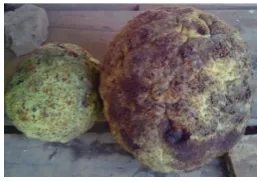
[image:1.595.368.497.249.340.2]Treculia Africana also known as African bread fruit is a specie of tree in the genus Treculia and belongs to the taxonomic family of Mureccae. In West Africa, individual breadfruit trees are found scattered throughout the southern rain forest zones. It is used as a food plant in Nigeria and some other countries of West Africa. It is popularly known as ukwa by the Igbo, afon in Yoruba, ize in Benin, izea in Ijaw and ediang in Efik (Abodenyi, et al 2015; Ego and Ozioma, 2012). The edible seeds are valuable food among the Igbos in particular (Okonkwo and Ubani, 2007). The seeds may be eaten after boiling or frying and in many delicacies; including porridges which are commonly produced from the seed. The seed also produces weaning foods, breakfast cereals and beverages (Etomaihe and Ndubueze, 2007).The crop is a rich source of high quality vegetable protein, oil and carbohydrates (Enibe et al 2011). It also contains essential vitamins and minerals (Nwigbo et al 2008).
Figure 1: Breadfruit head
Breadfruit is an excellent dietary staple and compares favorably with other starchy staple crops commonly eaten in the tropics with more than 120 species (Camille et al 2011); it is one of the highest-yielding food plants. It is a good source of dietary fiber, calcium, magnesium, and potassium (Ragone 2007). Breadfruit is an important food source and has some nutritional value and high starch content (Jeffrey et al 2006). Breadfruit seeds are potential sources of protein to help meet inadequate consumption of protein foods in Nigeria especially, at the rural settings where there is availability of the raw materials and the application in food processing (Ejidike and Ajileye 2007). The seeds are of particular interest because of their high nutritional value. Its potential for wide spread application in the production of weaning foods, beverages and animal feeds has also been acknowledged (Enibe et al, 2011).
© 2018, IRJET | Impact Factor value: 6.171 | ISO 9001:2008 Certified Journal | Page 3347 revealed that the oil from breadfruit seed could be
economically used for vegetable oil production. On a commercial scale, breadfruit yields 10.23% of oil (Nwigbo et al 2008). Also, the shell which is rich in potash is used in the production of feed cakes and meals for livestock (Nwabueze et al 2008). It can also be used as bedding for livestock and in the preservation and polishing of abrasives. The seed flour has been found to have bread making properties (Giami and Amasisi 2005).
Presently, the process of de-pulping African breadfruit traditionally is slow, tedious and dirty. It also consumes considerable amount of water and human energy. The aim is to study the effects of de-Pulping speed and fermentation period of breadfruit on the de-Pulping efficiency of a continuous process breadfruit de-pulping machine.
The specific objectives of this study are to design a mechanized system of de-pulping African breadfruit, fabricate the design and perform an efficiency evaluation using mathematical relations and also determine the effects of speed and fermentation period on de-pulping efficiency using Analysis of variance (ANOVA) with two factor randomized design (with replications)
In order to maximize the benefits of this fruit to mankind, the fruit has to be processed and this is mainly done in two stages
De-pulping stage: this is the stage at which the seeds are extracted from the fruit head, this is done usually after the fleshy pulp has been allowed to decompose and soften over a period of 3-9 days Presently, de-pulping of the breadfruit is done manually and the process is slow, dirty and tedious, requiring considerable quantity of water. The process involves slicing the fruit head into smaller pieces and it is allowed to decompose over 3 -9 days (Enibe 2001). The fermentation period can also be as long as 6 to21days as recorded by (Ugwu and Iwuchukwu 2013). The spongy fiber is separated from the hardcore or stone, and then the mixture of the seed and the fiber is placed in a basket and inserted in pool of water where the fiber is pulped without damaging the seeds.
Shelling stage: this stage involves all the processes of removal of the black and tough seed coat that covers the edible portions of the seed. The details of the shelling process are seen in (Nwigbo et al 2008).
1.1 Review of existing literature
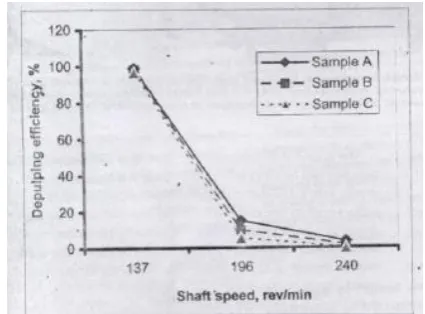
Bread fruit de-pulping machine is a mechanical device designed for cleaning of bread fruit seeds. (Enibe 2001) designed a machine for this purpose; the machine is similar to a batch agitator. The machine is being driven by 1.5KW electric motor and has a recommended shaft speed of 137rev/min as shown in figure 2.6. Performance test
[image:2.595.326.539.139.296.2]showed that the machine de-pulping efficiency improved at lower shafts speeds and short fermentation periods, the average de-pulping rate of the bread fruit is 23.2kg/h at the recommended shaft speed of 137rev/min.
Figure 2: Effect of shaft speed on de-pulping efficiency; samples A, B and C were processed after 3, 5 and 9 days of
fermentation respectively.
Source: (Enibe, 2001)
The machine is noisy and also has an average water consumption rate of about 28 l/kg which is considered to be high. The efficiency of the process increase’s with decrease in speed and shorter fermentation period. The proportion of broken seeds increased with increase in shaft speed, this is due to the impact due to increased collisions between the seeds and the paddles.
In order to overcome the problem of high water consumption and noise generated in the first machine, as well as increase the processing capacity, (Enibe et al 2011) developed a continuous flow bread fruit de-pulping machine. The performance result shows that effectiveness of the machine improved with intermittent feeding of the fruit into the machine as opposed to choke/ batch feeding. Also the effectiveness improved when processing partially fermented fruit. Though the effectiveness of the machine improved, but it is still noisy and also vibrates during operation due to intermittent motion of the slide crank mechanism used, hence the need for a rotary motion. It was also very bulky and the wire mesh fixed to the outlet of the de-pulping chamber for controlling the flow of the de-pulped fruit out of the chamber tended to prevent the flow of the slurry altogether.
2.
METHODOLOGY
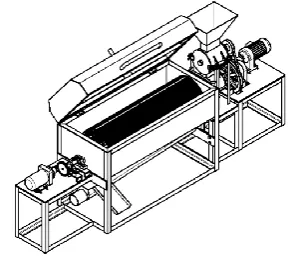
© 2018, IRJET | Impact Factor value: 6.171 | ISO 9001:2008 Certified Journal | Page 3348 the solid modeling of the continuous process breadfruit
[image:3.595.352.518.104.203.2]de-pulping machine. The factor levels used for this experiment were set using mock lab experiment and literature survey.
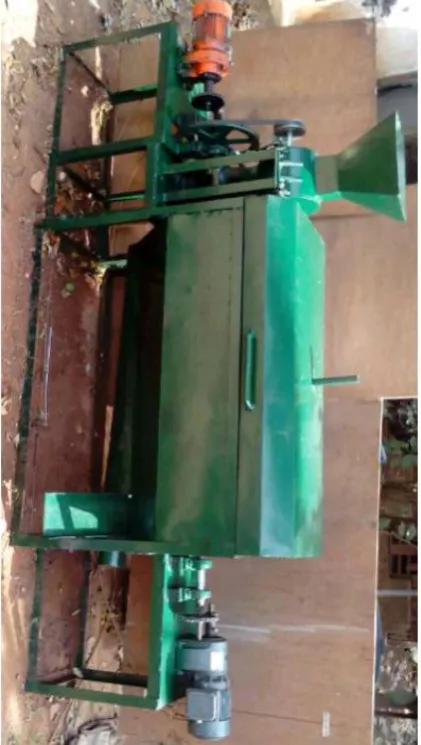
Figure 3: Breadfruit de-pulping machine.
2.1 Experiment Design and Performance Evaluation Methodology
The experiment to determine the effects of fermentation period of breadfruit and speed variation was performed. The following steps were followed in the experimentation process for the performance evaluation of a continuous flow breadfruit de-pulping machine
Experiment objective.
The objective of the experiment is to determine the effects of speed variation and fermentation period of breadfruit on de-pulping efficiency of the breadfruit de-pulping machine.
Hypothesis
Speed has no significant effect on breadfruit de-pulping efficiency of the machine.
Level of fermentation period has no significant effect on the breadfruit de-pulping efficiency of the machine.
There is no significant interaction effect of speed variation and fermentation period on the de-pulping efficiency.
Factor selection
Factor A: Fermentation periods of breadfruit Factor B: Variation of de-pulping speed
Table 1: Fermentation period for Factor A (days)
Factor A Treatments (days)
A1 2
A2 3
A3 4
A4 5
A5 6
Table 2: Speed combination for Factor B (rpm)
Factor B Treatments (BSSa / WMSa) (rpm)
B1 97.79 / 21.26
B2 11.13 / 21.26
2.2 Performance evaluation indices
The following equations were used in calculating the performance evaluation of the machine
( ) (1)
Where
is the efficiency
N1 is the number of seeds completely de-pulped
N2 is the number of seeds partially de-pulped
N3 is the number of seeds damaged
N0 is total number of seeds at the exit
Percentage of broken seeds = (2)
Percentage of partially de-pulped seeds = (3)
De-pulping rate = (4)
Through put (Kg/h) =
[image:3.595.88.236.145.273.2]
( )
[image:3.595.306.556.351.728.2]© 2018, IRJET | Impact Factor value: 6.171 | ISO 9001:2008 Certified Journal | Page 3349
2.3 Experiment Procedure
The following procedures were followed in conducting the experiment.
1. Slice the samples of the fruit head and allow it to ferment for 2, 3, 4, 5 and 6 days
2. Measure a sizeable quantity
3. Feed the measured unit to the hopper using intermittent feeding and start timing.
4. Turn on the water supply until all the fruit introduced has passed through the de-pulping process.
5. Turn off the water supply and the stop watch and measure the time taken and volume of water used.
6. Use equation (1) to calculate the de-pulping efficiency.
7. Repeat process (2-6) two times (2X) for each of the speed combinations in table 3.
8. Repeat process (2-7) for 3, 4, 5 and 6 days fermentation period as shown in table 2.
9. Compute the results.
10. Use Analysis of Variance (ANOVA) method to accept or reject the null hypothesis.
11. Plot charts were necessary and interpret the result.
[image:4.595.328.549.150.287.2]2.4 Selection of experimental design
Table 3: Two factor randomized design table (with replications)
Factor A Factor B
B1 B2
A1 A1B1, A1B1 A1B2, A1B2
A2 A2B1, A2B1 A2B2, A2B2
A3 A3B1, A3B1 A3B2, A3B2
A4 A4B1, A4B1 A4B2, A4B2
A5 A5B1, A5B1 A5B2, A5B2
[image:4.595.301.568.357.523.2]Factorial Completely Randomized Design (with replications) will be used in the experiment as shown in table 3.
3.
RESULTS, DISCUSSION AND OBSERVATIONS
3.1 Results
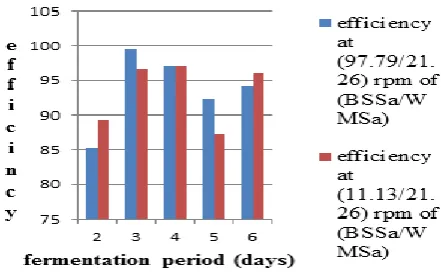
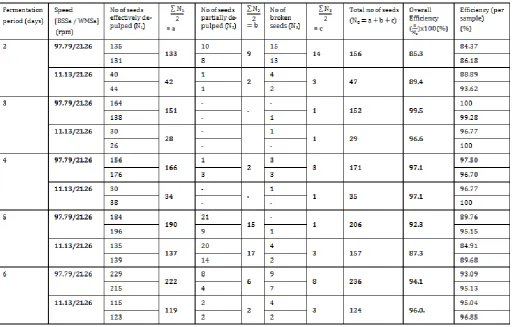
The de-pulping efficiency is plotted against the fermentation period in a bar chart as seen in figure 5,
while table 4 and 5 shows data (sample efficiencies) for two factor randomized design table (with replications) and result for Analysis of Variance (ANOVA) respectively. The average values of the replicated data in table 5 are used for the computation of the Analysis of variance.
Figure 5: Efficiency against fermentation period
Table 4: Data (sample efficiencies) for two factor randomized design table (with replications)
Fermentation
period Speed (97.79/21.26)
rpm average (11.13/21.26) rpm average
92.3 84.91% 87.3
95.15% 89.68%
6 days 93.09% 94.1 95.04% 96.0
[image:4.595.78.246.533.634.2]95.13% 96.85%
Table 5: Result for Analysis of Variance (ANOVA)
3.2 Result interpretation
From figure 4, the highest de-pulping efficiency of 99.5% is seen at the speed of (97.79 / 21.26) using a sample of breadfruit that has fermented for 3 days while the least efficiency of 85.3% is on the same shaft speed but on a sample of breadfruit that has fermented for 2 days.
2 days 84.37% 84.78 88.89% 89.4
86.18% 93.62%
3 days 100% 99.5 96.77% 96.6
99.28% 100%
4 days 97.5% 97.1 96.77% 97.1
96.7% 100%
[image:4.595.309.567.561.670.2]© 2018, IRJET | Impact Factor value: 6.171 | ISO 9001:2008 Certified Journal | Page 3350 From table 6, the result of the analysis of variance tested
at 95% confidence level shows that for fermentation period, F critical value is 3.478 and the F value is approximately 16.852. Since the F value is greater than the F critical value and P (significance level) is less than 0.05, the null hypothesis for fermentation period is rejected. Thus, fermentation period does have a significant effect on the de-pulping efficiency of the machine.
The F critical value, F value and P value for speed is approximately 4.964, 0.2697 and 0.6148 respectively. In this case, the F value is less than the F critical, and the P value is more than 0.05, the null hypothesis is accepted. Hence speed has no significant effect on the de-pulping efficiency of the machine.
The interaction of the fermentation period and the speed shows that the combined effect of both factors has no significant effect on the de-pulping efficiency of breadfruit seeds; hence the null hypothesis is accepted. The combined effect has F critical value, F value and P value to be approximately 3.478, 3.158 and 0.063 respectively.
The machine has the ability to de-pulp and clean 26 seeds/Sec. approximately with a throughput of 26kg/hr. at the BSSa/WMSa speed of (97.79 / 21.26) rpm.
3.3 Observations
The following observations were made while carrying out the experiment;
Within 2 to 4 days fermentation period the partially fermented core or stone in the samples were found to get trapped at the baffles while some core made their way through the channel designed for de-pulped seeds.
The de-pulped seeds at 2-4 fermentation periods weren’t too slimy when compared to de-pulped seeds samples at 5 and 6 days fermentation period.
[image:5.595.328.539.348.721.2] The high levels of seed breakage were caused not really by the de-pulping process but during slicing of the fruit head.
Figure 6: Core or stone of the fruit head
4.0 CONCLUSION
Development / mechanization of the process to de-pulp breadfruit have been attempted. Using Analysis of Variance (ANOVA), it is shown that fermentation period of breadfruit has a significant effect on de-pulping efficiency while speed and interaction between speed and fermentation period does not have a significant effect on the de-pulping efficiency of breadfruit.
ACKNOWLEDGEMENT
Our acknowledgement goes to the staff of Mechanical Engineering Department, Faculty of Engineering, Nnamdi Azikiwe University Awka, Anambra State Nigeria and National Engineering Design Development Institute (NEDDI) Nnewi, Anambra State for creating the enabling environment and constructive criticism during the duration of the project
Appendix
[image:5.595.110.214.614.744.2]© 2018, IRJET | Impact Factor value: 6.171 | ISO 9001:2008 Certified Journal | Page 3351
REFERENCES
[1.]Abodenyi V.A, S.E Obetta and Kaankuka T. P (2015). A comparative analysis 0f moisture content variation on flow and mechanical properties of breadfruit seed. International Journal of Scientific & Engineering Research, 6(5), 1802-1815.
[2.]Camille George, David Elton, Hank Garwick and George Ewing, (2011). How Understanding Local Challenges and Opportunities Influenced the Design of Post-Harvesting Technology in Haiti. Open Catalyzing Innovation Washington DC. 1-10.
[3.]Ego U. Okonkwo and Ozioma N. Ubani (2012). Application of HACCP to post-harvest processing of African breadfruit Treculia africana Decne in Nigeria. African Journal of Agricultural Research, 7(32),4536-4539.
[4.]Ejidike B N, Ajileye O (2007). Nutrient Composition of African Breadfruit (Treculia africana) Seed Hull and its use in Diets for the African Giant Land Snail (Archachatina marginata). Pak. J. Nutr. 6(2):201-203
[5.]Enibe S. O.,Asiegbu C.P. and Njoku H. O., (2011). Continuous-Flow Depulping Machine for Treculia
Africana. Global Journal of Engineering Research. 10(1-2), 77-103.
[6.]Enibe, S. O. (2001), Design, construction and testing of breadfruit de-pulping machine, Landwards, Summer 2001, 16-21.
[7.]Etoamaihe U. J. and Ndubueze K. C. (2010). Development and Performance Evaluation of a De-hulling Machine for African Breadfruit (Treculia africana). Journal of Engineering and Applied Sciences, 5(4), 312-315.
[8.]Giami S Y, Amasisi T (2005). Performance of African breadfruit (Treculia africana Decne) seed flour in bread making. Plant Foods Hum. Nutr. 58(3):1-8.
[9.]Jeffrey Weiss, Camille George and John Walker (2006). Redesigning an Appropriate Technology Shredder for Manufacture in a Developing Country. International Journal for Service Learning in Engineering Spring 2006, 1(1) 11-26.
[image:6.595.43.556.106.433.2][10.] Metu Chidiebere Sobechukwu, Enibe Samuel Ogbonna and Ulasi Tobechukwu Stanley (2016). Conceptual Design and Computer Aided Static Analysis of Frame and Plates of a Continuous Process
© 2018, IRJET | Impact Factor value: 6.171 | ISO 9001:2008 Certified Journal | Page 3352 Breadfruit De-Pulping Machine. American Journal of
Mechanical Engineering and Automation, 3(3), 22-28.
[11.] Nwabueze T. U., M. O. Iwe and E. N. T. Akobundu, (2008). Physical characteristics and acceptability of extruded African breadfruit based snacks. Journal of food quality, 31, 142-145.
[12.] Nwigbo S.C., Chinwuko E. C., Achebe C. H. and Tagbo D. A. (2008). Design of Breadfruit Shelling Machine. An International Multi-Disciplinary Journal, 2(4), 1-16.
[13.] Okonkwo E.U and Ubani O.N (2007). Indigenous technologies for the dehulling, storage and utilization of breadfruit seeds Artocarpus altilis (Park) Fosb. (Treculia africana Decne) Family: Moraceae in Anambra state. J. Res. Agric. 4(1): 27-30.
[14.] Onweluzo, L.J.C. and Odume, L. (2007). Method of extraction and demucilagination of Treculia africana: effect on composition. Nigerian Food Journal, 25(1), 90-99.
[15.] Palacio Zulima (2007). Breadfruit advocates say it could solve hunger in tropical regions. Retrieved from Voice of America, http://www.voanews.com/english/news/a-13-2007-06-28-voa39.html
[16.] Ragone, D. (2007). Breadfruit: Diversity, conservation and potential. Paper presented at the International Symposium on Breadfruit Research and Development, 19-29.