Munich Personal RePEc Archive
Monetary policy operating procedures:
the Peruvian case
Choy, Marylin
Bank of International Settlement
March 1999
Online at
https://mpra.ub.uni-muenchen.de/34966/
Monetary policy operating procedures:
the Peruvian case
Marylin Choy Chong
1. Background
(i) Reforms
At the end of 1990 Peru initiated a financial reform process as part of a broad set of structural reforms which enabled a series of markets to be liberalised, such as the financial and labour markets. Among other things, these reforms granted equal treatment to local and foreign investment. The objective of the reform programmes was to give the market a greater role as resource allocator.
In order that both interest rates and the distribution of financial resources would be determined by the market, the central bank started a process of financial deregulation,1 liberalising interest rates and the exchange rate as well as abandoning various administrative measures which restricted the functioning of the financial system.
A new banking law was enacted in 1991 (amended in 1996) which established universal banking as well as the Basle Committee guidelines concerning capital adequacy and consolidated supervision, among other aspects. Likewise, a deposit insurance system was introduced to replace the state guarantee which formerly covered customer deposits. At the same time, the functions and objectives of the Superintendency were redefined as the supervisory and controlling entity, while the preservation of monetary stability became the sole objective of the Banco Central de Reserva del Perú.
As part of the financial system reform, the state commercial banks were privatised and the state development banks were liquidated together with other insolvent financial entities.
1Such as lowering reserve requirements and eliminating selective credit controls, interest
(ii) The financial market
In 1990 the financial market was basically restricted to the banking sector. Practically the only financial option consisted of bank deposits, since there were almost no negotiable securities issued by private firms. Liquidity (currency + deposits with financial institutions) had declined from over 200/0 of GDP in the 1970s to just 40/0 in 1990. This was the result of the hyperinflation in the 1980s that culminated in an inflation rate of about 7,5000/0in 1990. Furthermore, more than 700/0of liquidity was held in dollars as a protection mechanism against hyperinflation. Liquidity is now almost 190/0of GDP although the degree of dollarisation is still high: more than 600/0 is held in dollar deposits, in spite of the reduction of the inflation rate to 70/0in 1997.
Real interest rates in new soles were at one time highly negative because of the administration of nominal interest rates. Financial libera-lisation corrected this distortion in interest rates (see Table 1).
At present, the capital market is gradually growing, leading in turn to the emergence of fixed income securities, encouraged by the appearance of institutional investors such as mutual funds2 and private pension fund managers.3
The banking system is made up of 25 private banks, representing 900/0 of the financial system. As of December 1997, foreign holdings amounted to more than 350/0of total banking equity while foreign loans to local banks totalled US$ 3,330 million. Total deposits in the banking system were US$ 11,800 million (just over 180/0 of GDP). The four largest banks held 710/0 of total deposits, while 15 banks held only 130/0 of total assets. Concentration and segmentation are therefore present in the Peruvian banking system. Other entities making up the financial sys-tem include seven financial firms, ten leasing companies, 13 municipal associations and 16 rural credit firms.
2Having grown more rapidly since 1996, mutual funds under management as of December
1997 totalled US$ 515 million, of which 230/0was invested in the banking system.
3The appearance of these funds was a consequence of the 1993 reform of the pension fund
system replacing the pay-as-you-go scheme by a system of individual capitalisation accounts managed by private firms. At the time of writing, private pension funds under management totalled US$ 1,400 million (450/0invested in the banking system, 190/0in corporate bonds and
The opening of the financial system and macroeconomic stability have allowed local companies direct access to the capital market to finance their operations, albeit still for limited amounts. Despite this progress, the capital market remains small and there is still no developed secondary market, particularly for Treasury bills.
2. Monetary policy design
Up to 1990 the central bank implemented its monetary policy in a setting of expansionary fiscal policies and strict controls on foreign exchange and capital flows. The central bank had three aims – monetary stability, strengthening and stability of the financial system and support to economic growth and employment – which usually implied opposing objectives and constrained its effectiveness.
As a result, monetary policy aimed at reducing financial pressures induced by fiscal policy, mainly using direct instruments: reserve require-ments, selective credit controls, and interest rate and foreign exchange controls. However, this policy generated financial repression, hyper-inflation of more than 7,000 in 1990 and a severe recession.
Table 1
Interest rates1
At an annual rate
Local currency US dollars Savings deposits Loans2 Savings deposits Loans2
Nominal Real3 Nominal Real3 Nominal Real3,4 Nominal Real3, 4
1980 30.5 –18.8 32.5 –17.6 .. .. .. .. 1985 50.0 –41.9 68.7 –34.7 .. .. .. .. 1990 888.7 –87.2 1,674.3 –77.1 8.3 –47.4 15.0 –44.2 1995 12.5 2.1 33.3 21.0 5.3 1.3 16.6 12.1 1996 11.0 – 0.8 26.1 12.8 4.9 5.7 16.0 16.8 1997 10.7 3.9 30.0 22.0 4.6 2.7 15.3 13.3
1Annual average. 2Short-term loans.3Calculated on the basis of cumulative annual inflation. 4Devaluation is calculated using the exchange rate set in the banking system.
(i) Purpose
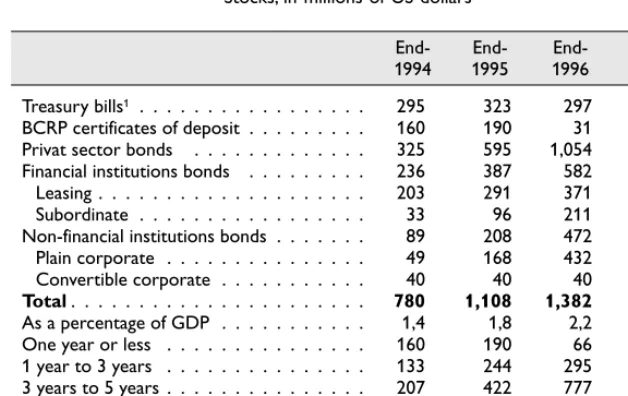
[image:5.459.51.365.86.284.2]As already mentioned, in 1992 financial reform modified the legal frame-work within which the central bank operated. Its sole purpose became the maintenance of monetary stability and its autonomy was clearly established. The central bank's monetary policy objective is therefore to control inflation, for which it establishes an annual inflation target range and uses the control of monetary aggregates as its intermediate variable. In order to achieve its prime objective, the monetary authority exerts strict control over the monetary base, employing for this purpose a monthly monetary base growth target. The reasons for using this target are that in Peru inflation expectations are closely related to the expansion of the monetary base, and that the central bank has control over this monetary variable. The central bank increases or reduces the monetary base by managing both its internal and external sources, that
Table 2
Fixed income securities
Stocks, in millions of US dollars
End- End- End- Sept. 1994 1995 1996 1997 Treasury bills1 . . . . 295 323 297 279
BCRP certificates of deposit . . . 160 190 31 2342
Privat sector bonds . . . 325 595 1,054 1,210 Financial institutions bonds . . . 236 387 582 696 Leasing . . . 203 291 371 440 Subordinate . . . 33 96 211 256 Non-financial institutions bonds . . . 89 208 472 514 Plain corporate . . . 49 168 432 514 Convertible corporate . . . 40 40 40 0
Total. . . 780 1,108 1,382 1,723
As a percentage of GDP . . . 1,4 1,8 2,2 2,4 One year or less . . . 160 190 66 272 1 year to 3 years . . . 133 244 295 229 3 years to 5 years . . . 207 422 777 874 Over 5 years . . . 280 252 245 344
1Includes US$ 232 million held by the central bank. These Treasury bills were issued to
capitalise the central bank. 2The stock as at 11th December 1997 was US$ 244 million.
is, credit from the central bank and factors related to foreign currency with local money creation implications.
The management of these variables permits the central bank to inject or withdraw liquidity from the economy, affecting the monetary aggregates. To do this, it relies mainly on market-oriented instruments.
(ii) Monetary Programming
At the beginning of each year, a monetary programme is constructed, that is based on the macroeconomic and fiscal forecasts and is consistent with the announced inflation target. Thus, liquidity flows are projected on the basis of the forecasts for production growth and inflation. The multiplier, together with the demand for currency and bank reserves is used to forecast monetary base growth. The source of growth in the monetary base and in credit to the private sector are determined and macroeconomic consistency is analysed. This programme, which includes monthly targets for the monetary aggregates, is periodically revised in order to ensure its consistency with the development of the fiscal and macroeconomic variables.
The central bank’s day-to-day monetary management is based on a daily estimate of banking system liquidity, calculated from a series of indicators such as banks’ cash balances, current account balances kept at the central bank, the system’s reserve position, the level of interbank interest rates, the net cheque clearing position and banks’ net foreign exchange position. Using this liquidity estimate, the central bank decides whether to inject or withdraw liquidity from the market.
3. Monetary policy instruments
management of the monetary base, the final objective being to reduce inflation. Preference is given to market mechanisms.
The central bank uses its instruments to eliminate excess liquidity in the banking system so as to reduce the volatility of interbank interest rates and avoid inflationary pressures. The major instruments are described below.
(i) Reserve requirements
Reserve requirements seek to control monetary growth, through a lower bank multiplier which counteracts the effects of a larger monetary base or the inflow of foreign capital into the financial system.
Since 1991, the importance of reserve requirements as a direct instrument of monetary policy has gradually diminished, since liquidity management depends increasingly on intervention in the foreign exchange market and open market operations. The rules presently in force are:
•
The central bank establishes which liabilities of the banks are subject to reserve requirements and what constitutes reserve funds.•
The reserve period established by the central bank is one month. Control is based on daily averages and deficits carry a penalty rate significantly higher than the market lending rate.•
The minimum legal reserve ratio cannot be set at a level higher than 90/0; nevertheless, for monetary policy reasons the central bank can establish additional or marginal reserve requirements.At present, the minimum reserve ratio is 70/0and there is a marginal reserve requirement of 450/0for foreign currency deposits (introduced in 1994). The central bank remunerates the additional reserves in foreign currency at a rate equivalent to LIBOR less 13/8 0/0. The minimum reserves do not bear interest.
requirement of 450/0for foreign currency deposits4also means that there is a substantial reserve with which to meet unexpected foreign currency outflows which could put the financial system at risk.
(ii) Open market operations
The central bank is increasingly using open market operations to regulate market liquidity, sterilising excesses or injecting new soles when needed by the market, so as to keep the monetary base and liquidity within the target range. The monetary base is reduced through the placement of central bank certificates of deposit and is expanded by repurchase agreements against these certificates or their redemption.
As there is no market for Treasury bills, the principal instrument employed to absorb excess liquidity is the sale of certificates issued by the central bank. The maturity of these instruments varies from four to 12 weeks and sales are organised through auctions where the central bank pre-announces the total amount of certificates on offer. The main intervening agents are banks and institutional investors, which notify to the central bank the amount of certificates they wish to acquire, together with the respective interest rate. The central bank ranks offers by interest rate and accepts them up to the maximum amount announced in the auction. Interest rates on central bank CDs constitute a market signal as to the direction of monetary policy.
In late 1997, the central bank started implementing repurchase agreements on its own securities. These operations are used as a mech-anism to inject very short-term (overnight) liquidity into the system. Repos take place through an auction procedure in which the central bank announces the amount while the price is determined by the market. This is also a multiple price auction; hence, the banks agree to pay different interest rates for the central bank's resources. The availability of these funds is immediate.
These repurchase operations enable both more precise monetary management and better treasury management by the banks, as they use their financial assets to obtain short-term liquidity. As a result of these operations, banks' excess reserve funds have decreased while demand for
4As a result of the marginal reserve policy, the average reserve ratio is approximately 430/0
central bank CDs has increased, given that banks can use them to cover periodic liquidity needs.
Interbank interest rates used to fluctuate widely in response to seasonal changes in liquidity. Large amounts of excess liquidity at the beginning of the month and large deficits in reserve positions during the tax collecting week made the interbank interest rate very volatile. However, since these fluctuations lasted only a few days, other interest rates did not show a similar degree of volatility, although in a sense they represented a cost that put a floor on other interest rates.
The introduction of repurchase operations has thus been also instru-mental in promoting the stability of interbank interest rates (see Graph 2), as they enable banks to reduce excess reserves; these previously represented the main source of funds available to banks to cover occasional liquidity needs.
(iii) Collateralised credit
The central bank may grant credit against collateral in order to provide temporary liquidity assistance to the financial system. It is very short-term, usually overnight, which means that the resulting monetary base
Graph 1
Bank’s average excess reserves
growth is temporary. It usually offsets the contraction in banking system liquidity generated by a variety of factors such as tax payments. The maximum term of these credits is 30 days and the maximum amount of credit that a bank may receive is the equivalent of its equity, with recourse to the facility limited to a maximum of 90 days within any 360-day period.
During the week of tax collection, banking system deposits are trans-ferred to the Treasury’s financial agent, Banco de la Nación, to pay tax liabilities. These fund flows result in temporary illiquidity in the banking system, which is offset by the combined use of repurchase operations and collateralised credits. Interest rates on these credits are generally higher than those on repurchase operations. The total of credits granted against collateral is decided at the end of the day, after the results of
Graph 2
Interbank and central bank’s credit rates
January–December 1997
0 2 4 6 8 10 12 14 16 18 20
0 2 4 6 8 10 12 14 16 18 20
Jan Feb Mar Apr May Jun Jul Aug Sep Oct Nov Dec
intervention in the foreign exchange market and of open market opera-tions. Likewise, as the use of repurchase operations increases, it is expected that collateralised credit will be used only in emergencies and as a last resort.
(iv) Public sector deposits
Monetary policy is implemented in close cooperation with fiscal policy, both being aimed at controlling inflation. During the last years, the government has generated a primary surplus that has enabled it to keep resources in the financial system. In order to facilitate monetary management, these government resources are kept at the central bank, their effect being similar to the issue of central bank CDs. These deposits make it possible to sterilise the liquidity generated by the central bank’s need to intervene in the foreign exchange market, without exerting additional pressure on interest rates. Public sector deposits within the central bank, provided they are term deposits, carry a similar interest rate to central bank CDs.
The Treasury is also obliged to deposit its daily cash surpluses with the central bank through Banco de la Nación. This is to prevent Treasury funds generating opposite liquidity flows to those of other monetary policy instruments, especially during the tax collection period.
(v) Foreign exchange swaps
Foreign exchange swaps are available for financial institutions. However, since Peru does not have a developed forward market, this instrument differs from traditional swaps so as to avoid the danger of sending wrong signals to the market about the central bank’s exchange rate view.
Foreign exchange swaps have an implicit interest rate. However, if the exchange rate change is higher than this implicit rate, the central bank charges the higher rate. This transfers the exchange rate risk to the commercial banks.
4. Intervention in the foreign exchange market
(i) Objective
Over the last few years, the central bank has had a major presence in the foreign exchange market. Given high capital inflows, extensive dollar-isation of the economy and the absence of Treasury bills which could be used to supply financial resources, the central bank has been using its dollar purchases to inject liquidity.
Foreign exchange intervention consists mainly of the purchase and very occasionally the sale of dollars by the central bank, which consequently affects the monetary aggregates through the injection and withdrawal of liquidity.
The central bank’s foreign exchange market intervention is carried out in accordance to the monetary targets. The monetary effect of every intervention generating excess liquidity therefore has to be sterilised so as to obtain the desired change in the monetary base; this is achieved through open market operations.
Foreign exchange intervention also seeks to counteract undesired and temporary exchange rate fluctuations, generated either by specula-tion or by the financial system's seasonal liquidity requirements. This, however, does not mean that the central bank bases its intervention on exchange rate bands. Rather, the strategy is to avoid abrupt short-term exchange rate movements which could have undesired repercussions on inflation or the competitiveness of tradable goods.
(ii) Factors determining intervention
The intensity of intervention in a given period is determined by the path of the monetary variables, forecast in the monetary programme. This forecast establishes the flow of base money consistent with the expected demand for money and with the inflation target.
Once the monetary framework and the volume of dollar purchases are determined, the central bank decides on the form and amount of the daily interventions. The daily management of the currency dealing room is based on decisions that chiefly take account of foreign exchange developments and financial system liquidity.
Financial system liquidity is characterised by marked seasonal fluctuations during the month, mainly due to tax payments. During tax collection periods, which usually last a week, a transfer of resources takes place from the private sector to the government, involving a transfer from the commercial banks to the Banco de la Nación and generating a liquidity shortage for commercial banks. To compensate for this shortage, banks usually seek credit from the central bank or sell dollars, thereby inducing an appreciation of the exchange rate, even in the run-up to the tax collection period.
In the last few years, Peru has seen large inflows of foreign currency into the financial system, which have been a major factor in increasing the dollar supply in the foreign exchange market and caused the exchange rate to appreciate. In order to counteract both liquidity shortages and pressure on the exchange rate, the central bank has intervened more heavily by buying dollars in the foreign exchange market. (Conversely, when the currency has tended to depreciate, the exchange rate is subject to a depreciation pressure, intervention has decreased (see Graph 3).
Another factor in the central bank’s decisions regarding dollar purchases is the Treasury’s need for dollars to service foreign debt. In doing so, the Treasury buys dollars from the central bank, thereby withdrawing new soles from the financial system. The central bank buys foreign currency in the market to meet the Treasury’s requirements, and replenishes the liquidity in local currency. Hence, the larger the Treasury’s needs for foreign currency, the larger the central bank’s inter-vention volume in the foreign exchange market.
The daily variables that determine the system’s liquidity, as well as the capital inflow, can show an unexpected behaviour during the programme period. For this reason, the central bank can intervene, if necessary, for volumes in excess of the programmed flows depending on the required increase in base money. Larger purchases of foreign exchange by the central bank are then sterilised through open market operations.
central bank’s purchases are subject to an upper limit. This limit is raised when the fiscal position supports the monetary policy stance. For instance, a fiscal surplus, with fiscal savings kept as deposits with the central bank, could enable the central bank to buy more dollars.
(iii) Intervention mechanism
The central bank buys and sells dollars at interbank exchange rates. The Monetary and Foreign Exchange Operations Committee meets daily to establish the intervention guidelines with regard to the amounts involved
Graph 3
Interbank exchange rate sale, tax period and central bank intervention 0 5 10 15 20 25 30
January February March April May June
0 5 10 15 20 25 30 0 5 10 15 20 25 30
July August September October November December
0 5 10 15 20 25 30 2.610 2.621 2.632 2.643 2.654 2.665 2.676 2.63 2.65 2.67 2.69 2.71 2.73 2.75
BCRP intervention (in millions of US$; l.h.s.) Interbank exchange rate sale (new sol/US$; r.h.s.)
and the reference prices. On this basis, the dealing room defines the strategy to be followed in terms of:
•
purchase amount per telephone call;•
number of quotes permitted per telephone call;•
quantity of calls or sessions per day;•
operation closing price.In line with the proposed strategy, the operators engage in daily transactions through the dealing system and by telephone. At present, 31 institutions are authorised to operate, 28 from the financial system and three belonging to exporters’ associations (National Mining and Petroleum Society, Exporters National Society and Exporters Associa-tion).
To make intervention as transparent as possible, communication between the central bank and participating dealers is via Reuters, to which the exchange rates at which the central bank buys or sells foreign currency are reported. Communication takes place in the order in which the institutions’ calls are received.
Intervention takes place in “firm” dealing sessions, based on the amount decided by the Monetary and Foreign Exchange Operations Committee: agents quote buy and sell rates for a given amount to three decimal places and the central bank can then accept either rate.
Dealing sessions work with multiples of US$ 100,000. They are con-ducted at variable time intervals, depending on the scale of intervention and on market activity. Dealing starts at 10:30 and closes at 12:30.
In general, the central bank only intervenes by buying in the market. The purpose is to smooth out occasional large exchange rate variations, but always in line with the financial system’s liquidity needs and the increase in base money projected in the monetary programme. In the event of speculative attacks on the local currency, the central bank prefers to increase interest rates rather than sell dollars.
(iv) Results
The growth in base money has also enabled the financial system’s local currency liquidity to grow. While still at relatively low levels, the monetisation coefficient, measured as the ratio of local currency liquidity to GDP has shown a marked recovery from less than 30/0 in 1990 to approximately 70/0in 1997.
Dollar purchases by the central bank have also led to a strong recovery of net international reserves. Thus, from the negative level of US$ 105 million in July 1990, reserves have grown substantially, reaching US$ 10,202 million in November 1997.
[image:16.459.59.370.92.317.2]The central bank’s net foreign exchange position (defined as net international reserves less its domestic liabilities in foreign currency), which was negative (US$ 1,071 million) in July 1990, turned positive in April 1992 (US$ 44 million) and reached US$ 2,272 million in November 1997.
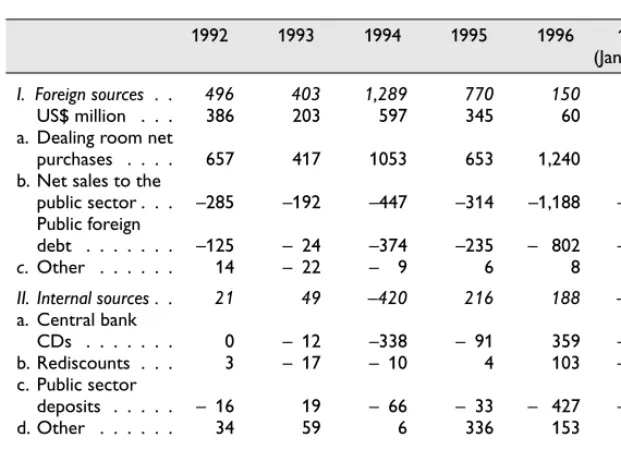
Table 3
Source of base money variations
Flows, in million of new soles
1992 1993 1994 1995 1996 1997 (Jan.–Nov.) I. Foreign sources . . 496 403 1,289 770 150 1,360
US$ million . . . 386 203 597 345 60 510 a. Dealing room net
purchases . . . . 657 417 1053 653 1,240 1,355 b. Net sales to the
public sector . . . –285 –192 –447 –314 –1,188 – 846 Public foreign
debt . . . –125 – 24 –374 –235 – 802 – 682 c. Other . . . 14 – 22 – 9 6 8 1 II. Internal sources . . 21 49 –420 216 188 –1,217 a. Central bank
CDs . . . 0 – 12 –338 – 91 359 – 844 b. Rediscounts . . . 3 – 17 – 10 4 103 – 40 c. Public sector
deposits . . . – 16 19 – 66 – 33 – 427 – 595 d. Other . . . 34 59 6 336 153 182 Total (I +II) . . . 517 452 869 986 338 143
Finally, the central bank’s strict monetary management combined with a policy of fiscal discipline, has enabled inflation to be reduced to single figures.
Both international reserves as well as the net foreign exchange position have reached sufficient levels to back not only one year of merchandise imports, but also the total monetary base. Thus, inter-national reserves amount to the equivalent of almost seven times the volume of base money, while the net foreign exchange position is almost one and a half times the same variable.
5. Concluding remarks
Both the objective and the powers of the central bank are clearly specified in its legal framework. In this respect, its aims and activities are transparent and explicit.
[image:17.459.36.387.104.249.2]Monetary policy influences the monetary aggregates through market instruments, sending clear signals to economic agents regarding the direction and objectives pursued.
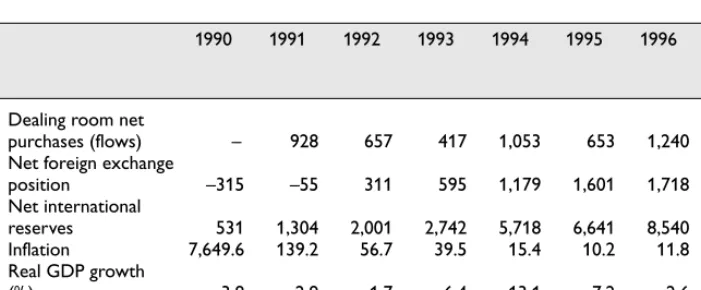
Table 4
Central bank intervention in the foreign exchange market, net foreign exchange position and net international reserves
In millions of US dollars and percentages
1990 1991 1992 1993 1994 1995 1996 1997 (Jan.– Nov.) Dealing room net
purchases (flows) 315– 928 657 417 1,053 653 1,240 1,355 Net foreign exchange
position –315 –55 311 595 1,179 1,601 1,718 2,272 Net international
reserves 531 1,304 2,001 2,742 5,718 6,641 8,540 10,202 Inflation 7,649.6 139.2 56.7 39.5 15.4 10.2 11.8 5.8 Real GDP growth
(0/0) – 3.8 2.9 –1.7 6.4 13.1 7.2 2.6 7.9*
Despite major changes in monetary policy management, policy implementation still encounters problems. The main problems are: