Received 26 June 2019 Accepted 21 October 2019
Edited by E. V. Boldyreva, Russian Academy of Sciences, Russia
Keywords:crystal structure; monoaquatri-fluoridoboron; boron trifluoride monohydrate; dioxane solvate; super acid; hydrogen bonding; chain structure.
CCDC reference:1960541
Supporting information:this article has supporting information at journals.iucr.org/e
The ‘super acid’ BF
3H
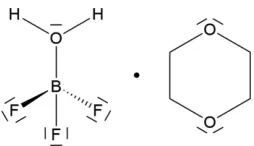
2O stabilized by 1,4-dioxane:
new preparative aspects and the crystal structure of
BF
3H
2O
C
4H
8O
2Peter Barthen* and Walter Frank*
Institut fu¨r Anorganische Chemie und Strukturchemie, Lehrstuhl II: Material- und Strukturforschung, Heinrich-Heine-Universita¨t Du¨sseldorf, Heinrich-Heine-Universita¨tsstrasse 1, D-40225 Du¨sseldorf, Germany. *Correspondence e-mail:
[email protected] , [email protected]
Highly Brønsted-acidic boron trifluoride monohydrate, a widely used ‘super acid-catalyst’, is a colourless fuming liquid that releases BF3 at room
temperature. Compared to the liquid components, i.e. boron trifluoride monohydrate and 1,4-dioxane, their 1:1 adduct, BF3H2OC4H8O2, is a solid
with pronounced thermal stability (m.p. 401–403 K). The crystal structure of the long-time-stable easy-to-handle and weighable compound is reported along with new preparative aspects and the results of 1H,11B, 13C and 19F spectroscopic
investigations, particularly documenting its high Brønsted acidity in acetonitrile solution. The remarkable stability of solid BF3H2OC4H8O2is attributed to the
chain structure established by O—H O hydrogen bonds of exceptional strength {O2 H1—O1 [O O = 2.534 (3) A˚ ] and O1—H1 O3i[2.539 (3) A˚ ] in the concatenating unit >O2 H1—O1—H2 O3i<}, taking into account the molecular (non-ionic) character of the structural moieties. Indirectly, this structural feature documents the outstanding acidification of the H2O molecule
bound to BF3and reflects the super acid nature of BF3H2O. In detail, theC2 2
(7) zigzag chain system of hydrogen bonding in the title structure is characterized by the double hydrogen-bond donor and double (O,O0) hydrogen-bond acceptor
functionality of the aqua ligand and dioxane molecule, respectively, the almost equal strength of both hydrogen bonds, the approximatety linear arrangement of the dioxane O atoms and the two neighbouring water O atoms. Furthermore, the approximately planar arrangement of B, F and O atoms in sheets perpendicular to the c axis of the orthorhombic unit cell is a characteristic structural feature.
1. Chemical context
Solutions of boron trifluoride in water have been under investigation for more than 200 years (Gay-Lussac & Thenard, 1809; Davy, 1812; Berzelius, 1824). Meerwein (1933) was able to isolate the BF3dihydrate and, after addition of one further
equivalent of BF3at low temperature, the BF3monohydrate
also. Both hydrates were examined in detail (Klinkenberg & Ketelaar, 1935; McGrath et al., 1944; Greenwood & Martin, 1951; Wamser, 1951; Pawlenko, 1959) and while the dihydrate was shown to be distillable without decomposition under reduced pressure, boron trifluoride monohydrate releases BF3
above its melting point of 279.2 K. At room temperature, it is a colourless fuming liquid with a density of 1.8 g ml1. To examine the acidity of the monohydrate, reactions with ethers, alcohols and carboxylic acids etc. were performed by Meer-wein & Pannwitz (1934). They obtained BF3H2OC4H8O2,
which they called thedioxane salt of boron trifluoride mono-hydrate, by adding BF3H2O to a solution of 1,4-dioxane in
petroleum naphta. BF3H2OC4H8O2 (1) precipitates as
needle-shaped crystals which melt at 401–403 K with decom-position (Meerwein & Pannwitz, 1934). Unexpectedly, the experiment described inx6 resulted in the same product. The primordial idea of this experiment was to prepare an anhy-drous solution of HBF4from HBF4/H2O (1:1w:w) by distilling
off water as the 1,4-dioxane/water azeotrope with coincident replacement of water by an excess of 1,4-dioxane. The dioxane adduct1starts to precipitate after a short period of time if a small amount of water remains in the resulting liquid. The formation of 1 in a ‘HBF4 solution’ impressively illustrates
how efficently BF3 is stabilized by water and dioxane. The
reactions and equilibria of HBF4-, BF3-, H2O- and
HF-containing systems have been examined in detail (Pawlenko, 1968; Gascard & Mascherpa, 1973; Christeet al., 1975; Mootz & Steffen, 1981a; Yeo & Ford, 2006; Dubeyet al., 2007) and it remains amazing that BF3H2O, unlike the other boron
triha-lide/water mixtures, releases the strong Lewis-acid (BF3)
unhydrolysed. Investigations by Greenwood & Martin (1951) showed that BF3H2O is highly ionized in the liquid state and
that the Hammett acidity of H[BF3OH] is H0 = 11.4. By NMR spectroscopic determination of the thermodynamic acidity function from13C chemical-shift changes of the signals of unsaturated ketones at infinite dilution in the acid under investigation, Farcasui & Ghenciu (1992) found boron trifluoride monohydrate to be super acidic, withH0<14. The
applications of this super acid are numerous, e.g. as a highly effective catalyst for several Friedel–Craft reac-tions (Yonedaet al., 1969; Oyamaet al., 1978; Liuet al., 2003; Prakashet al., 2016, and references therein). The long-time-stable and easy-to-handle solid1provides the ‘super acid BF3H2O’ in a safe and efficient way.
Although Meerwein & Pannwitz (1934) isolated compound 1 (m.p. 401–403 K) and a solid, in which BF3H2O is stabilized by 1,8-cineole (m.p. 344–346 K) more
than 80 years ago, the crystal structures of these compounds are still unknown and the reasons for the unexpected high thermal stability, especially of the dioxane adduct, are still unknown. Generally, there are very rare examples of crystal structures with BF3H2O moieties bound to O-donor
mol-ecules. The crystal structure of boron trifluoride monohydrate itself has been reported by Mootz & Steffen (1981b), after redetermination of the crystal structure of the dihydrate in the same year (Mootz & Steffen, 1981c; Bang & Carpenter, 1964). Stabilization of the mono- and dihydrate with 18-crown-6 (Bottet al., 1991; Feinberget al., 1993; Simonovet al., 1995) or of BF3H2O with dicyclohexane-18-crown-6 (Fonaret al., 1997)
led to three further crystal structures containing the BF3H2O
moiety and, as the most recent example, stabilization with triphenylphosphane oxide (Chekhlov, 2005) gave a crystalline 1:2 adduct of BF3H2O and (C6H5)3PO.
2. Structural commentary
Compound 1 was found to crystallize in the orthorhombic space groupPbcawith eight formula units in the unit cell and all components in general positions. Fig. 1 shows the asym-metric unit of the crystal structure, which contains aquatri-fluoridoboron and 1,4-dioxane molecular moieties. The dioxane moiety is free of any kind of conformational disorder often recognized in the case of saturated six-membered ring species. Bond lengths, angles and torsion angles defining the chair conformation are in excellent agreement with the expectations for a ‘fully ordered’ dioxane molecule,e.g.found in the structure of uncomplexed 1,4-dioxane at 153 K (Buschmannet al., 1986). Compared to the mean equivalent isotropic displacement parameter (Ueq) of the C and O atoms
in the 1,4-dioxane moiety [= 0.0427 (6) A˚2], the mean Ueq
value of B1, O1 and F1 to F3 in the aquatrifluoridoboron moiety [0.0867 (8) A˚2] is dramatically higher and correction for libration is needed prior to comparison with the geome-tries of BF3H2O moieties in related compounds. In Table 1, the
uncorrected and corrected (Schomaker & Trueblood, 1968; RG = 0.0241) B—O and B—F bond lengths of1are given in comparison to the bond lengths of BF3H2O (Mootz & Steffen,
[image:2.610.389.516.145.218.2]1981c) and BF3H2OH2O (Mootz & Steffen, 1981b). After
Table 1
Selected bond lengths (A˚ ).
Values for BF3H2OC4H8O2, BF3H2O (Mootz & Steffen, 1981b) and BF3H2OH2O (Mootz & Steffen, 1981c) in the left, middle and right columns, respectively; in square brackets are the corresponding bond valences and the valence sums calculated using the Brown formalism {r0[B—O(F)] = 1.371 (1.281), B = 0.37; Brown & Altermatt, 1985}; in braces are the values corrected for libration (Schomaker & Trueblood, 1968).
B1—O1 1.473 (4) [0.76] {1.528 (4) [0.65]} 1.532 (6) [0.64] 1.512 (2) [0.68] B1—F1 1.361 (4) [0.81] {1.409 (4) [0.71]} 1.383 (5) [0.76] 1.377 (2) [0.77] B1—F2 1.332 (4) [0.87] {1.396 (4) [0.73]} 1.399 (5) [0.73] 1.382 (2) [0.76] B1—F3 1.333 (4) [0.87] {1.410 (4) [0.71]} 1.382 (5) [0.76] 1.390 (2) [0.74]
[image:2.610.46.297.554.695.2]s(B–O,F) [3.31] {[2.80]} [2.89] [2.96]
Figure 1
correction, the values of 1 agree well with those of the hydrates and those in almost undistorted BF4
as found in Li[BF4] at 200 K [1.387 (3)–1.391 (3) A˚ ; Matsumoto et al.,
2006] or in H5O2[BF4] [1.381 (2)–1.399 (2) A˚ ; Mootz &
Steffen, 1981a]. The bond-valence sum of B1 is as expected taking into account the ‘uncorrected’ nature of ther0values
used (Brown & Altermatt, 1985). Interestingly, for all com-pounds mentioned in Table 1, the B—F bond perpendicular to the plane of the aqua ligand (1: B1—F3; BF3H2O: B1—F2;
BF3H2OH2O: B1—F3) is slightly but significantly longer than
the other two B—F bonds, probably attributable to a small destabilizing interaction with the oxygen lone pair. The F— B—O angles in all three compounds [1: 105.6 (3)–109.8 (3);
BF3H2O: 105.9 (4)–108.1 (4); BF3H2OH2O: 106.3 (1)–
109.8 (1)] are smaller than the F—B—F angles [1: 109.9 (3)–
112.1 (3); BF
3H2O: 111.2 (4)–113.0 (4); BF3H2OH2O:
109.8 (1)–114.0 (1)]. This fits to the observation (Table 1) that
the B—O bond in the BF3H2O moiety is relatively weaker
than the B—F bonds and the planar geometry of BF3 is
preserved in the aqua complex to some extent. Furthermore, for all three compounds, the O—B—F angle including the F atom that is approximately in plane with the aqua ligand [1: O1—B1—F1 = 105.6 (3); BF
3H2O: O—B—F3 = 105.9 (4);
BF3H2OH2O: O1—B—F2 = 106.3 (1)] is significantly smaller
than the other O—B—F angles. This observation may be attributed to an attractive F H interaction within the moiety. Although both BF3H2O and 1,4-dioxane are liquids at room
temperature, adduct 1 is a solid with a remarkably high
melting point (401–403 K), mainly resulting from the conca-tenation of the molecular components via O—H O hydrogen bonding, as shown in Fig. 2. The high stability might be correlated to the exceptional strength of both O2 H1—O1 [O O = 2.534 (3) A˚ ] and O1—H1 O3i [2.539 (3) A˚ ] in the concatenating >O2 H1—O1— H2 O3i< unit. Indirectly, this structural feature documents the outstanding acidification of the H2O molecule bound to
BF3 and reflects the super acid nature of BF3H2O. Further
details of the hydrogen bonding are given in Table 2. To the best of our knowledge, there is no example of a water ligand bonded to a nonmetal or a metal with the ligand engaged in a hydrogen bond of similar strength (O O < 2.60 A˚ ) to an O atom of a dioxane molecule. In the adduct 18-crown-6BF3H2O (m.p. 345 K), mentioned inx1, the aqua ligand is
hydrogen bonded to two O-donor atoms and the O O distances are 2.76 and 2.80 A˚ (Feinberg et al., 1993). In the structure of BF3H2OH2O, the nonligating water molecule
plays a similar role as bridging species as the dioxane molecule in 1. The O O distances in the characteristic H—O— H O(H2) H—O—H unit are 2.631 and 2.643 A˚ (Mootz
& Steffen, 1981c),i.e.as compared to the very strong Brønsted acids fluorosulfuric acid [O O = 2.643 (1) A˚ ] or trifluoro-methanesulfonic acid [O O = 2.640 (4) A˚ ] (Bartmann & Mootz, 1990), for example, the hydrogen bonding is of the same strength in the dihydrate and much stronger in the adduct1.
Figure 2
The zigzag chain of hydrogen-bonded moieties in the crystal of1[view direction [001]; 30% probability ellipsoids; symmetry codes: (A)x+3
2,
y1
2,z; (B)x,y+ 1,z]. Features indicative for the mode of concatenation
of the characteristic building blocks by hydrogen bonding are: (i) double hydrogen-bond donor and double (O,O0) hydrogen-bond acceptor
functionality of the aqua ligand and dioxane moiety, respectively; (ii) almost equal strength of both hydrogen bonds; (iii) an approximatety linear arrangement of the dioxane O atoms and the two neighbouring water O atoms (e.g.O1, O3A, O2A and O1A); (iv) an approximately planar arrangement of B1, F1, O1, O2 and O3.
Table 2
Hydrogen-bond geometry (A˚ ,).
D—H A D—H H A D A D—H A
O1—H1 O2 0.82 (5) 1.72 (5) 2.534 (3) 175 (5) O1—H2 O3i 0.82 (5) 1.72 (5) 2.539 (3) 170 (5)
Symmetry code: (i)xþ3 2;y
[image:3.610.317.560.407.703.2] [image:3.610.46.297.530.644.2]1 2;z.
Figure 3
3. Supramolecular features
As mentioned before, in the solid of1the aqua ligand of the BF3H2O moiety acts as a hydrogen-bond donor in two
direc-tions, establishing aC2
2(7) graph set (Etter, 1990) (Fig. 2). The
propagation vector of the zigzag chain is parallel to thebaxis of the unit cell. Note the almost equal strength of both hydrogen bonds. Fig. 3 shows the arrangement of the chains in the solid due to van der Waals interactions.
4. Database survey
A search of the Cambridge Structural Database (CSD; Version 5.40, November 2018 update; Groomet al., 2016) for the BF3H2O moiety yielded six structures: the crown ether
adducts 18-crown-6 monoaquatrifluoridoboron toluene semi-solvate (CSD refcode SIXFOU; Bottet al.1991), 18-crown-6 bis(monoaquatrifluoridoboron) dihydrate (LEKYIJ; Feinberg et al.1993, Simonovet al., 1995) and dicyclohexano-18-crown-6 bis(monoaquatrifluoridoboron) (NIYGAD; Fonar et al., 1997); the phosphane oxide adduct monoaquatrifluoridoboron bis(triphenylphosphane oxide) (XATWAR; Chekhlov, 2005); two transition-metal coordination compounds [CIGVUJ10 (Van Rijn et al., 1987) and UKAJIA (Orain et al., 2010)], containing cocrystallized monoaquatrifluoridoboron moieties. As mentioned above, in addition to these reports on com-pounds having organic components, there is the report of Mootz & Steffen (1981b) on the inorganic parent compound BF3H2O and there are two reports on the dihydrate
BF3H2OH2O (Mootz & Steffen, 1981c; Bang & Carpenter,
1964).
5. NMR spectroscopy
NMR studies of BF3H2OC4H8O2have not been published so
far. Ford & Richards (1956) have shown by low-temperature NMR investigations that, in the solid state, BF3H2O and
BF3H2OH2O are not ionized. Diehl (1958) reported the19F
NMR spectra of BF3H2O in aqueous solution. He observed
separate broad resonances which he attributed to HBF3OH,
HBF4, HBF2(OH)2and HBF(OH)3in concentrated solutions
at 243 K with coalescence of the peaks at higher temperatures. Gillespie & Hartman (1967) have shown by low-temperature (193 K)1H and19F NMR spetroscopy that BF3H2O is formed
in dilute solutions in acetone containing both water and BF3.
They found two major peaks in the 19F NMR spectrum and assigned the low-field peak (146.05 ppm) to the 1:1 complex of BF3with acetone and the high-field peak (146.59 ppm) to
BF3H2O in acetone. The corresponding 1
H NMR signals were detected by Gillespie & Hartmann at 12.42 ppm as multipletts. In our experiments, in the presence of CD3CN and
1,4-dioxane and at a significantly higher temperature (297 K), the protons were detected as a broad singlet at 9.41 ppm. Gottlieb et al.(1997) indicated that the influence of temperature on the NMR shift overcompensates the influence of the solvent if the basicity of the solvents is similar. Apart from this effect, the high acidity of the oxygen-bonded 1H nuclei in the title
compound is depicted by a shift of more than 7 ppm to higher frequencies (H2O in CD3CN:s, 2.13 ppm; Fulmeret al.2010).
The chemical shifts of the NMR signals belonging to 1,4-dioxane are close to those of the uncomplexed compound (C4H8O2in CD3CN:
1
H:s, 3.60 ppm;13C: 68.5 ppm; Fulmeret al., 2010). Due to the comparable donor numbers (Gutmann, 1976) of acetonitrile (NMR solvent) and 1,4-dioxane, it can be concluded that the acidity of BF3H2O is not critically reduced
by 1,4-dioxane with respect to its application as a super acid-catalyst.
The NMR sample was investigated in a 5 mm precision glass NMR tube (Wilmad 507) at 297 K in the deuterium-locked mode on a Bruker Avance III 400 MHz spectrometer oper-ating at 400.17, 376.54, 128.23 or 100.62 MHz for1H,19F,11B and13C nuclei, respectively. The1H NMR and13C chemical shifts were referenced with respect to tetramethylsilane yielding the chemical shift for CD3CN (contains CD2HCN) as
1.96 ppm and CD3CN as 118.7 ppm. The 19
F chemical shifts were referenced with respect to CFCl3 (0 ppm) as external
standard. The11B chemical shifts were referenced with respect to BF3(C2H5)2O (0 ppm) as external standard. 68 mg of
ground crystals were dissolved in 0.5 ml CD3CN to prepare
the NMR sample:1H NMR: 3.71 (s, 8H, C
4H8O2), 9.41 (s, 2H,
H2O). 19F NMR: 148.10 (s, 11BF3),148.04 (s, 10BF3).11B
NMR: 0.1 (s, 11BF3). 13
C NMR: 68.0 [t, 1J(C,H) = 189 Hz,
C4H8O2].
6. Synthesis and crystallization
All preparations and sample manipulations were carried out in tetrafluoroethylene hexafluoropropylene block copolymer (FEP) vessels. Tetrafluoroboric acid solution (50 wt% in water; Fluka Chemicals) was probed for its content of [BF3OH]
by19F NMR spectroscopy. Depending on the qu-antity of these anions, hydrofluoric acid (48 wt% in water, Sigma–Aldrich) was added. In a typical experiment, to 131.4 g (1.24 mol) of HBF4/H2O, 4.53 g (0.11 mol) HF/H2O was added
at 273 K. The mixture was stirred for 15 min, before 430 g of 1,4-dioxane was added at the same temperature. Subsequently, the reaction mixture was heated and the 1,4-dioxane–water azeotrope was distilled off under normal pressure until the boiling point (361 K) began to change. 368 g of azeotrope was removed by the distillation and the residue was a pale-brown solution. This solution was stored in a sealed FEP flask under an atmosphere of dry argon (Argon 5.0). After 1 h, the formation of colourless crystals of1started and was allowed to continue for 9 d. The crystals were isolated under an argon atmosphere and washed with hexane/1,4-dioxane (10:1 v/v) three times using Schlenk techniques. 40.7 g (0.23 mol) were collected after drying the almost hexagonal colourless crystals in an argon stream (40 min). Compound1 is stable at room temperature and shows a poor solubility in 1,4-dioxane, but a good solubility in acetonitrile.
Analysis calculated (%) for C4H10BF3O3: 27.62 C, 5.80 H;
found: 27.84 C, 5.87 H.
7. Refinement
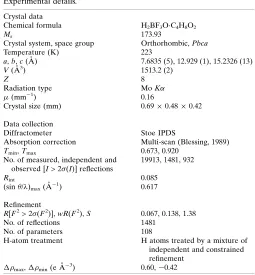
Crystal data, data collection and structure refinement details are summarized in Table 3. The positions of all H atoms were identifiedviasubsequentFsyntheses. In the refinement, a riding model was applied, using idealized C—H bond lengths, as well as H—C—H and C—C—H angles. The Uiso values
were set at 1.2Ueq(C) for methylene H atoms. For the H atoms
of the aqua ligand, positional parameters andUisovalues were
refined.
Acknowledgements
We thank E. Hammes and P. Roloff for technical support, and C. Siemes for the preparation of the structural formula scheme.
References
Bang, W. B. & Carpenter, G. B. (1964).Acta Cryst.17, 742–745. Bartmann, K. & Mootz, D. (1990).Acta Cryst.C46, 319–320. Berzelius, J. J. (1824).Liebigs Ann. Chem.46, 48–58. Blessing, R. H. (1989).J. Appl. Cryst.22, 396–397.
Bott, S. B., Alvanipour, A. & Atwood, J. L. (1991).J. Incl. Phenom.
Macrocycl. Chem.10, 153–158.
Brown, I. D. & Altermatt, D. (1985).Acta Cryst.B41, 244–247.
Buschmann, J., Mu¨ller, E. & Luger, P. (1986).Acta Cryst.C42, 873– 876.
Chekhlov, A. N. (2005).Russ. J. Coord. Chem.31, 9–13.
Christe, K. O., Schack, C. J. & Wilson, R. D. (1975).Inorg. Chem.14, 2224–2230.
Davy, J. (1812).Phil. Trans. R. Soc.102, 352–363. Diehl, P. (1958).Helv. Phys. Acta,31, 685–712.
Dubey, A., Saha, H. P., Pink, R. H., Badu, S. R., Mahato, D. N., Scheicher, R. H., Mahanti, K. M., Chow, L. & Das, T. P. (2007).
Hyperfine Interact.176, 45–50.
Etter, M. C. (1990).Acc. Chem. Res.23, 120–126. Farcasui, D. & Ghenciu, A. (1992).J. Catal.134, 126–133.
Feinberg, H., Columbus, I., Cohen, S., Rabinovitz, M., Selig, H. & Shoham, G. (1993).Polyhedron,12, 2913–2919.
Fonar, M. S., Simonov, Y. A., Mazus, M. D., Ganin, E. V. & Gelmboldt, V. O. (1997).Crystallogr. Rep.42, 790–794.
Ford, P. T. & Richards, R. E. (1956).J. Chem. Soc.pp. 3870–3874. Fulmer, G. R., Miller, A. J. M., Sherden, N. H., Gottlieb, H. E.,
Nudelman, A., Stoltz, B. M., Bercaw, J. E. & Goldberg, K. I. (2010).
Organometallics,29, 2176–2179.
Gascard, C. & Mascherpa, G. (1973).J. Chim. Phys.70, 1040–1047. Gay-Lussac, J. L. & Thenard, L. J. (1809).Ann. Phys.32, 1–15. Gillespie, R. J. & Hartman, J. S. (1967).Can. J. Chem.45, 859–863. Gottlieb, H. E., Kotlyar, V. & Nudelman, A. (1997).J. Org. Chem.62,
7512–7515.
Greenwood, N. N. & Martin, R. L. (1951).J. Chem. Soc.pp. 1915– 1921.
Groom, C. R., Bruno, I. J., Lightfoot, M. P. & Ward, S. C. (2016).Acta
Cryst.B72, 171–179.
Gutmann, V. (1976).Coord. Chem. Rev.18, 225–255.
Klinkenberg, L. J. & Ketelaar, J. A. A. (1935).Recl Trav. Chim. Pays Bas,54, 959–961.
Liu, L., Wang, X. & Li, C. (2003).Org. Lett.5, 361–363.
Matsumoto, K., Hagiwara, R., Mazej, Z., Goreshnik, E. & Zˇ emva, B. (2006).J. Phys. Chem. B,110, 2138–2141.
McGrath, J. S., Stack, G. G. & McCusker, P. A. (1944).J. Am. Chem. Soc.66, 1263–1264.
Meerwein, H. (1933).Ber. Dtsch Chem. Ges. A/B,66, 411–414. Meerwein, H. & Pannwitz, W. (1934).J. Prakt. Chem.141, 123–148. Mootz, D. & Steffen, M. (1981a).Z. Anorg. Allg. Chem.482, 193–200. Mootz, D. & Steffen, M. (1981b).Z. Anorg. Allg. Chem.483, 171–180. Mootz, D. & Steffen, M. (1981c).Acta Cryst.B37, 1110–1112. Orain, P.-Y., Capon, J.-F., Gloaguen, F., Pe´tillon, F. Y., Schollhammer,
P., Talarmin, J., Zampella, G., De Gioia, L. & Roisnel, T. (2010).
Inorg. Chem.49, 5003–5008.
Oyama, T., Hamano, T., Nagumo, K. & Nakane, R. (1978). Bull.
Chem. Soc. Jpn,51, 1441–1443.
Pawlenko, S. (1959).Z. Anorg. Allg. Chem.300, 152–158. Pawlenko, S. (1968).Chem. Ing. Tech.40, 52–55.
Prakash, G. K. S., Gurung, L., Marinez, E. R., Mathew, T. & Olah, G. A. (2016).Tetrahedron Lett.57, 288–291.
Schomaker, V. & Trueblood, K. N. (1968).Acta Cryst.B24, 63–76. Sheldrick, G. M. (2008).Acta Cryst.A64, 112–122.
Sheldrick, G. M. (2015).Acta Cryst.C71, 3–8.
Simonov, Y. A., Gelmboldt, V. O., Ganin, E. V., Dvorkin, A. A., Fonar, M. S., Ostapchuk, L. V. & Lipkovsky, Y. (1995).Russ. J.
Coord. Chem.21, 724–729.
Stoe & Cie (2009). X-AREA. Stoe & Cie GmbH, Darmstadt, Germany.
Van Rijn, J., Reedijk, J., Dartmann, M. & Krebs, B. (1987).J. Chem.
Soc. Dalton Trans.pp. 2579–2593.
Wamser, C. A. (1951).J. Am. Chem. Soc.73, 409–416. Westrip, S. P. (2010).J. Appl. Cryst.43, 920–925.
Yeo, G. A. & Ford, T. A. (2006).S. Afr. J. Chem.59, 129–134. Yoneda, N., Hasegawa, E., Aomura, K. & Ohtsuka, H. (1969).Bull.
[image:5.610.42.297.84.359.2]Jpn Petrol. Inst.11, 54–58.
Table 3
Experimental details.
Crystal data
Chemical formula H2BF3OC4H8O2
Mr 173.93
Crystal system, space group Orthorhombic,Pbca
Temperature (K) 223
a,b,c(A˚ ) 7.6835 (5), 12.929 (1), 15.2326 (13)
V(A˚3) 1513.2 (2)
Z 8
Radiation type MoK
(mm1) 0.16
Crystal size (mm) 0.690.480.42
Data collection
Diffractometer Stoe IPDS
Absorption correction Multi-scan (Blessing, 1989)
Tmin,Tmax 0.673, 0.920
No. of measured, independent and observed [I> 2(I)] reflections
19913, 1481, 932
Rint 0.085
(sin/)max(A˚
1) 0.617
Refinement
R[F2> 2(F2)],wR(F2),S 0.067, 0.138, 1.38
No. of reflections 1481
No. of parameters 108
H-atom treatment H atoms treated by a mixture of independent and constrained refinement
max,min(e A˚3) 0.60,0.42
Computer programs: X-AREA (Stoe & Cie, 2009), SHELXS (Sheldrick, 2008),
sup-1
Acta Cryst. (2019). E75, 1787-1791
supporting information
Acta Cryst. (2019). E75, 1787-1791 [https://doi.org/10.1107/S2056989019014312]
The `super acid
′
BF
3H
2O stabilized by 1,4-dioxane: new preparative aspects and
the crystal structure of BF
3H
2O
·
C
4H
8O
2Peter Barthen and Walter Frank
Computing details
Data collection: X-AREA (Stoe & Cie, 2009); cell refinement: X-AREA (Stoe & Cie, 2009); data reduction: X-AREA (Stoe
& Cie, 2009); program(s) used to solve structure: SHELXS (Sheldrick, 2008); program(s) used to refine structure:
SHELXL2014 (Sheldrick, 2015); molecular graphics: SHELXTL (Sheldrick, 2008); software used to prepare material for
publication: publCIF (Westrip, 2010).
Aquatrifluoridoboron–1,4-dioxane (1/1)
Crystal data
H2BF3O·C4H8O2 Mr = 173.93
Orthorhombic, Pbca a = 7.6835 (5) Å b = 12.929 (1) Å c = 15.2326 (13) Å V = 1513.2 (2) Å3 Z = 8
F(000) = 720
Dx = 1.527 Mg m−3
Mo Kα radiation, λ = 0.71073 Å Cell parameters from 7579 reflections θ = 2.7–25.9°
µ = 0.16 mm−1 T = 223 K Prisms, colourless 0.69 × 0.48 × 0.42 mm
Data collection
Stoe IPDS diffractometer
Radiation source: sealed tube φ–scan
Absorption correction: multi-scan (Blessing, 1989)
Tmin = 0.673, Tmax = 0.920
19913 measured reflections
1481 independent reflections 932 reflections with I > 2σ(I) Rint = 0.085
θmax = 26.0°, θmin = 2.7° h = −9→9
k = −15→15 l = −18→18
Refinement
Refinement on F2
Least-squares matrix: full R[F2 > 2σ(F2)] = 0.067 wR(F2) = 0.138 S = 1.38 1481 reflections 108 parameters 0 restraints
Primary atom site location: structure-invariant direct methods
Secondary atom site location: difference Fourier map
Hydrogen site location: difference Fourier map H atoms treated by a mixture of independent
and constrained refinement w = 1/[σ2(F
o2) + 1.3744P]
where P = (Fo2 + 2Fc2)/3
(Δ/σ)max < 0.001
Δρmax = 0.60 e Å−3
sup-2
Acta Cryst. (2019). E75, 1787-1791
Special details
Geometry. All esds (except the esd in the dihedral angle between two l.s. planes) are estimated using the full covariance matrix. The cell esds are taken into account individually in the estimation of esds in distances, angles and torsion angles; correlations between esds in cell parameters are only used when they are defined by crystal symmetry. An approximate (isotropic) treatment of cell esds is used for estimating esds involving l.s. planes.
Fractional atomic coordinates and isotropic or equivalent isotropic displacement parameters (Å2)
x y z Uiso*/Ueq
F1 0.2228 (2) 0.10315 (15) 0.11881 (16) 0.0760 (7)
F2 0.2173 (4) −0.0515 (2) 0.05362 (17) 0.1020 (9)
F3 0.2125 (4) −0.0419 (2) 0.19661 (18) 0.1177 (11)
O1 0.4628 (3) 0.0027 (2) 0.1262 (3) 0.0968 (14)
H1 0.516 (6) 0.057 (4) 0.133 (3) 0.108 (17)*
H2 0.515 (6) −0.053 (4) 0.128 (3) 0.109 (17)*
O2 0.6367 (2) 0.16850 (14) 0.13995 (14) 0.0435 (5)
O3 0.8588 (2) 0.33805 (14) 0.11459 (14) 0.0425 (5)
C1 0.8229 (3) 0.1569 (2) 0.1462 (2) 0.0409 (7)
H11 0.8705 0.1372 0.0889 0.049*
H12 0.8511 0.1021 0.1883 0.049*
C2 0.9021 (4) 0.2567 (2) 0.1756 (2) 0.0435 (8)
H21 0.8585 0.2745 0.2341 0.052*
H22 1.0288 0.2493 0.1792 0.052*
C3 0.6730 (3) 0.3498 (2) 0.1084 (2) 0.0410 (7)
H31 0.6449 0.4046 0.0663 0.049*
H32 0.6256 0.3696 0.1657 0.049*
C4 0.5934 (4) 0.2498 (2) 0.0791 (2) 0.0448 (8)
H41 0.4666 0.2573 0.0756 0.054*
H42 0.6366 0.2319 0.0205 0.054*
B1 0.2712 (4) 0.0021 (3) 0.1232 (3) 0.0412 (8)
Atomic displacement parameters (Å2)
U11 U22 U33 U12 U13 U23
F1 0.0439 (11) 0.0559 (12) 0.128 (2) 0.0169 (9) 0.0004 (13) 0.0007 (12)
F2 0.0930 (18) 0.113 (2) 0.1005 (19) −0.0035 (16) −0.0243 (16) −0.0500 (16)
F3 0.118 (2) 0.141 (2) 0.0942 (19) −0.035 (2) 0.0120 (17) 0.0528 (18)
O1 0.0264 (12) 0.0294 (13) 0.234 (4) 0.0014 (11) −0.008 (2) −0.0130 (18)
O2 0.0295 (10) 0.0357 (10) 0.0652 (14) −0.0044 (8) −0.0025 (9) 0.0052 (10)
O3 0.0292 (10) 0.0355 (10) 0.0629 (14) −0.0033 (8) 0.0010 (10) 0.0012 (10)
C1 0.0308 (16) 0.0374 (15) 0.0544 (18) 0.0027 (12) −0.0045 (13) 0.0001 (14)
C2 0.0314 (14) 0.0430 (17) 0.056 (2) 0.0027 (13) −0.0078 (14) −0.0035 (14)
C3 0.0318 (15) 0.0367 (15) 0.0544 (19) 0.0014 (12) −0.0022 (13) 0.0054 (14)
C4 0.0348 (15) 0.0442 (17) 0.055 (2) −0.0003 (13) −0.0100 (15) 0.0025 (14)
sup-3
Acta Cryst. (2019). E75, 1787-1791
Geometric parameters (Å, º)
F1—B1 1.361 (4) C1—C2 1.495 (4)
F2—B1 1.332 (4) C1—H11 0.9800
F3—B1 1.333 (4) C1—H12 0.9800
O1—B1 1.473 (4) C2—H21 0.9800
O1—H1 0.82 (5) C2—H22 0.9800
O1—H2 0.82 (5) C3—C4 1.499 (4)
O2—C4 1.440 (3) C3—H31 0.9800
O2—C1 1.442 (3) C3—H32 0.9800
O3—C3 1.439 (3) C4—H41 0.9800
O3—C2 1.442 (3) C4—H42 0.9800
B1—O1—H1 121 (3) O3—C3—H31 109.8
B1—O1—H2 119 (3) C4—C3—H31 109.8
H1—O1—H2 120 (4) O3—C3—H32 109.8
C4—O2—C1 110.4 (2) C4—C3—H32 109.8
C3—O3—C2 110.4 (2) H31—C3—H32 108.2
O2—C1—C2 109.5 (2) O2—C4—C3 110.1 (2)
O2—C1—H11 109.8 O2—C4—H41 109.6
C2—C1—H11 109.8 C3—C4—H41 109.6
O2—C1—H12 109.8 O2—C4—H42 109.6
C2—C1—H12 109.8 C3—C4—H42 109.6
H11—C1—H12 108.2 H41—C4—H42 108.2
O3—C2—C1 110.1 (2) F3—B1—F2 109.9 (3)
O3—C2—H21 109.6 F3—B1—F1 111.0 (3)
C1—C2—H21 109.6 F2—B1—F1 112.1 (3)
O3—C2—H22 109.6 F3—B1—O1 108.3 (3)
C1—C2—H22 109.6 F2—B1—O1 109.8 (3)
H21—C2—H22 108.2 F1—B1—O1 105.6 (3)
O3—C3—C4 109.5 (2)
C4—O2—C1—C2 58.7 (3) C2—O3—C3—C4 −58.7 (3)
C3—O3—C2—C1 59.2 (3) C1—O2—C4—C3 −58.9 (3)
O2—C1—C2—O3 −58.6 (3) O3—C3—C4—O2 58.5 (3)
Hydrogen-bond geometry (Å, º)
D—H···A D—H H···A D···A D—H···A
O1—H1···O2 0.82 (5) 1.72 (5) 2.534 (3) 175 (5)
O1—H2···O3i 0.82 (5) 1.72 (5) 2.539 (3) 170 (5)
![Figure 3Packing diagram ofInspection of the intermolecular distances gives no evidence forment of the zigzag chains to flat sheets perpendicular to the 1 (view direction [010]) documenting the arrange- c axis.interactions stronger than van der Waals forces between the chains.](https://thumb-us.123doks.com/thumbv2/123dok_us/379198.535353/3.610.317.560.407.703/ofinspection-intermolecular-distances-perpendicular-direction-documenting-interactions-stronger.webp)