INTRODUCTION
In the last decade, industrialisation and consoli-dation became characteristic features in the agri-cultural and food sector. Technological progress in production, development of information systems, new ways of trade and distributional system have caused changes in the various stages of agro-food chains, from input supplies through agricultural products, their processing and distribution to retail outlets (Bečvářová(2001).
Food and agribusiness firms are confronted with great competition on agro-food markets. The trend
will be towards greater interdependence, when the main aspect of competitiveness will not be the only ability to be responsive to changing customer needs and business environmental challenges, but also cost decreasing, product efficiency and delivery reliability. Thus, the costs of producing the diverse products demanded by consumers will be likely lower in a more closely coordinated system. It implies that market position and financial performance will depend in-creasingly upon the successful negotiation and link-ages between suppliers and distributors and also upon the proper external partners. These developments will bring about the need for durable partnerships.
The process of vertical coordination and its
consequences within the beer commodity chain
Vertikální koordinace a její projevy v komoditní vertikále piva
E. VESELSKÁ
Mendel University of Agriculture and Forestry, Brno, Czech Republic
Abstract: The paper aims to identify the potential benefits from vertical coordination within the selected commodity chain. The problem is applied to the beer commodity chain because of its high importance in the Czech agribusiness and foreign trade. On the basis of the vertical analysis of the chosen commodity chain, a mathematic model of consumer price simula-tion is created and the existence of vertical coordinasimula-tion is verified in the analysed commodity chain. This model assumes that input price increases are transmitted to consumers. The retail prices of beer are simulated by holding technology and input-output relationships constant, while production as well as marketing costs change according to the changes in input prices. The simulated retail price is then compared with the actual retail price to indicate productivity gains resulting from vertical coordination passed on to consumers. The results of the Model of Retail Price Simulation show that Czech brewery industry was in the observed period (1994–2002) vertically coordinated.
Key words: retail price simulation, vertical coordination, agri-food chain and beer
Abstrakt: Cílem příspěvku je identifikovat potenciální přínosy plynoucí z vertikální koordinace v rámci vybraného potra-vinového řetězce. Problém je aplikován na komoditní vertikálu piva, jelikož pivo patří k významným položkám českého agrárního exportu a také světově uznávanou komoditou. Na základě vertikální analýzy vybraného potravinového řetězce byl vytvořen model simulace maloobchodní ceny a prověřena přítomnost vertikální koordinace v odvětví. Tento model předpokládá, že zvýšení cen vstupů ponese v plné míře spotřebitel. Maloobchodní cena piva je simulována za předpokladu, že technologie a vztahy mezi vstupy a výstupy jsou konstantní a mění se pouze objem produkce a marketingové náklady. Simulovaná maloobchodní cena je pak porovnávána s aktuální tržní cenou, a tak jsou vyjádřeny potenciální přínosy ply-noucí spotřebiteli z vertikální koordinace. Výsledky modelu simulace maloobchodní potvrdily, že české pivovarské odvětví bylo v průběhu sledovaného období (1994–2002) vertikálně koordinováno.
Klíčová slova: simulace maloobchodní ceny, vertikální koordinace, komoditní vertikála, pivo
Vertical coordination could be one of the solutions (Martinez, Reed 1996; Sporleder 1992).
MATERIAL AND METHODS
Vertical coordination as a consequence of the agro-food market changes
A food supply system is comprised of a set of eco-nomic stages of production (Figure 1). The vertical arrangement of economic stages reaches from the upstream farm production stage to downstream retail stage1. Each stage represents an activity that adds value to the final product. A stage is referred to here as an economic stage in the sense that it is a process capable of producing a saleable prod-uct or service under appropriate circumstances (Mighel, Jones 1963). Vertical coordination refers to all possible economic arrangements involved in transferring resources between economic stages. For the most part, firms in different stages of food production coordinate the transfer of inputs and outputs through open production, contract pro-duction, quasi-vertical coordination, or vertical integration. Each method of vertical coordination has an impact on consumer.
Ways of achieving vertical coordination
Methods of vertical coordination can be classified according to the degree of control over vertical stages (Martinez, Reed 1996) (Figure 2).
Historically, open production has been the promi-nent way in which the food industry has allocated resources between stages. In open production, a producing firm does not commit itself to selling its output before completing production. Cash (spot) prices coordinate resource transfer across the stages of production. For example, farmers selling their wheat to the local elevator at the posted price, or supermarkets selling their goods to customers, are examples of open production. If food industries are perfectly competitive, consumer values are clearly reflected in the resources allocated to food produc-tion, in the variety and quality of food produced, and in food prices2. Economists refer to this concept as market efficiency. However, perfectly competitive firms can vertically coordinate resources in ways other than open production and the market can re-main efficient.
Contract production is production for a forward market3. When a buyer and seller negotiate a pro-duction contract, their relationship is closer than open production. Before completing production, a
Agricultural 1.processing 2.processing Wholesale Retail Consumer production stage stage
Figure 1. Vertical stages of the agro-food chain
Degree of control
minimum maximum
Open Vertical
integration Quasi-vertical
integration Contracting
Degree of control
minimum maximum
production
Vertical integration Quasi-vertical
[image:2.595.66.535.70.126.2]integration Contracting
Figure 2. Methods of vertical coordination according to the degree of control over indi-vidual market stages
Source: Martinez, Reed 1996
1This differs from horizontal arrangements, which refer to arrangements between firms at the same stage of
produc-tion.
producer commits to deliver a particular product to a particular buyer.
Quasi-vertical coordination occurs when a firm owns a specific asset that is used by one of its suppliers.
Vertical integration refers to combining two or more stages within a single firm. When stages are vertically integrated, the firm administers resources between stages.
Other forms of coordination also exist in the food industry. Strategic alliances are informal collabora-tions between firms based on trust and involve a transfer, or sharing, of assets (Sporleder 1992). The food service distributor has developed a strategic alliance with McDonalds by establishing an “un-derstanding” that he/she will be the sole supplier of certain products for McDonalds restaurants in the given geographical area. Evidently, sufficient incentives exist, without a formal contract, for the food service distributor to maximize its effort and provide quality service to one of the world’s largest restaurant chains. Food ingredient suppliers may also forge strategic alliances with processing firms to jointly carry out firm’s research and development of new food products.
However, even modest changes can affect the prices and quantity of food products and new vertical ar-rangements can lead to market efficiency and in-creased responsiveness to consumer.
Any trend toward contract production and vertical integration, as opposed to open production, implies that firms at one stage of production exert more control over the quality of output at other stages of produc-tion. Decisions made by a firm at an early stage of production might be transferred to a downstream firm. This represents transfer of control. For example, pasta processors may gain control over planting decisions or seed selections that were made by farmers who previously sold wheat on the spot market. Farmers are compensated for relinquishing control through bonuses for quality and through reduced uncertainty. Frank and Henderson (1992) incorporate this concept of control into a vertical coordination index that at-tempts to measure the closeness of stages within a single food industry. The index increases as control is transferred across stages of production. Specifically, Frank and Henderson treat open production, contract production, and vertical integration as a continuum from the least control transferred (open production) to the greatest control transferred (vertical integration). For example, as an industry moves from open produc-tion to contract producproduc-tion, its index increases.
Evidently, firms choose a level of control by selecting a method of vertical coordination. Pasta processors, for example, may choose to vertically integrate back
to the wheat production stage to procure a specific type of wheat for a specific type of pasta. The pasta firm might expect that higher quality pasta, achieved with the additional control over wheat quality, would result in the positive marginal revenue. By verti-cally integrating to the farm stage to achieve this control, the processing firm would also incur the costs of wheat production. Alternatively, the firm might achieve almost the same degree of control by negotiating production contracts with independent wheat farmers. Contract production might involve the costs of negotiating and enforcing contracts, but would not involve the costs of wheat production. By matching the additional revenues from higher quality pasta with the additional marginal costs of achieving control over wheat quality, the pasta firm maximizes profits. Economists refer to this as produc-tion efficiency. By choosing the appropriate method of vertical coordination, firms maximize profits and produce efficiently.
But does a changed vertical coordination translate into increases in market power? If changes in vertical coordination impart market power to a few firms, market efficiency is lost-the quality and variety of food produced and the prices paid for food do not reflect consumer values. On the other hand, if changes in vertical coordination occur within an efficient mar-ket (i.e., marginal costs of attracting resources into food production match the value consumers place on food), food supply and prices reflect consumer values. It is important, therefore, to view changes in vertical coordination within a context of chang-ing food consumption patterns and the changchang-ing structure of food industries.
Main incentives for vertical coordination
Before deciding about vertical coordination, it is necessary to thing about its important general con-tributions and costs, depending on the given sector. As motives in favour of vertical integration, there can be considered (Bečvářová 2001; Blažková 2002; Porter 1994; Ziggers, Trienekens 1999):
– Reduction of transaction costs. Transaction costs are the costs associated with the process of exchange itself. Thanks to vertical integration, a firm may potentially save part of sales costs, price negotia-tions, or marketing costs.
timely access to market information allowing a more rapid or specified adjustment of product characteristics.
– Reduction of risk. Vertical coordination can reduce supply or demand uncertainty and price fluctua-tion risks.
– Improved market position. Vertical coordination creates entry barriers in case of significant econo-mies of scale or requirements of capital. The more important net contributions of integration there are (e.g. high prices, low costs or risks), the greater pressure on other firms there is to integrate.
– More efficient exchange of information and organi-sational structures. Vertical coordination may cause the firm to require less information and so reduc-ing costs. Of course, the potential cost advantage must be balanced against the disadvantage of the possibility if missing advantageous external oppor-tunities. An integrated firm can use the prediction of consumer demand for final product at all stages of its vertical chain. Besides, vertical integration facilitates the introduction of more efficient and specialised procedures and organisational structures to improve production.
Vertical coordination may have several disadvan-tages, such as dulled incentives and reduced flexibil-ity. The big scale of differences between the various stages in agro-food chains is also one of the arguments against vertical integration. The potential costs and risks of vertical integration as compared to market exchange are (Bečvářová 2001; Blažková 2002; Porter 1994; Ziggers, Trienekens 1999):
– Dissipation of resources. Due to the dependence of all vertical chain performance on each its stage, the firm can be obliged to invest in marginal stages to keep operating of the whole subject. Either the firm must accept cost disadvantages due to inef-ficient operating scales or it has to sell/purchase outputs/inputs at the market. Moreover, the firm may foreclose itself from access to independent suppliers or buyers.
– Reduced flexibility. High investment may reduce flexibility. Changes in technology, product design and market developments may cause the production or technologies to become more costly, inferior in quality or inappropriate compared to those of independent suppliers or buyers. The integrated firm is then confronted with higher switching costs than in the case of contracting independent partners.
– High demand for capital. To make vertical integra-tion profitable, high investments need to be offset by substantial cost savings or returns greater than or at least equal to the firm’s opportunity cost of capital4.
– Rigidity of organisational structures. Managing various vertical stages may require distinctly dif-ferent managerial approaches. However, vertically united firms operate together and that is why there is a tendency to think of them as similar from the management viewpoint. Moreover, tightly linked and assured linkages between the stages within an integrated firm may cause dulled incentives. In ge-neral, markets promote high-powered incentives and restrain bureaucratic distortions more effectively than compared to internal organisation.
With respect on the specific market and produc-tion characteristics of agro-food chains, addiproduc-tional motives for vertical integration on the agro-food markets may be deduced. They include:
– Perishability of production
– Variability of quality and quantity of supplies of farm-based inputs due to biological variation, sea-sonality, random factors connected with weather, diseases or other biological hazards
– Differences in time between successive stages
– Availability of capital
– Increased consumer attention concerning both product and method of production.
Determination of vertical coordination
To analyse the situation within the chosen com-modity chain, the Martinez model of retail price simulation (see Appendix)can be used. This model is based on the presumption, that:
– Between the degree of vertical coordination and retail price is interdependence. Production is more effective due to vertical coordination, which results in lower retail product price.
– Input price increases are passed on to consum-ers,
– Technology and input-output relationships are constant and only production volume and market-ing costs vary.
The simulated price is then compared with the actual retail price to identify productivity gains resulting from vertical coordination passed on to consumers.
4Vertical integration consumes capital that has the value of opportunity costs inside the firm, whereas in transactions
RESULTS AND DISCUSSION
Characterisation of beer commodity chain
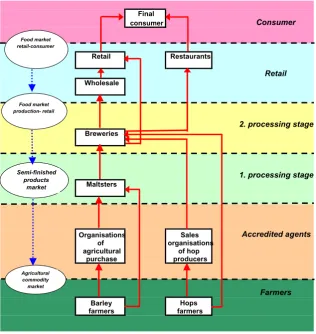
Beer belongs to the most significant and world-known Czech export products with a long tradition and high value added. Figure 3 depicts the beer com-modity chain including all its partial markets and economic subjects that represent individual links of the beer commodity chain.
At the first stage of processing of essential raw material, there operate maltsters that process malt barley – semi-finished product determined for fur-ther processing.
Malt is processed by breweries at the second stage of the beer commodity chain accompanied by the purchase of other raw materials (hops, water, etc.)
The final product – beer – is consecutively passed to the last link of the chain – retailers or restaurants, which sell it to the final consumer.
Vertical interconnections within beer commodity chain
Maltsters represent the first processing stage of this commodity chain. Taking into consideration
that the total malt production in the Czech Republic is about 300 thousand tons per year and breweries need annually about 260–275 thousand tons for beer production (almost constant volume since 1994), maltsters’s position is more and more dependent on this successive link of the commodity chain and on the export. Input supplies into maltsters are provided mainly by purchasing organisations and partly directly by individual large farmers.
Due to the actual excessive malting capacity and slow decrease in beer consumption per person (as a consequence of healthy life style), leading producers in the malting industry have become giant maltsters with explicit and direct linkages to commodity suppli-ers as well as the mutual connection to the successive processing stage. Due to the above- mentioned reason, the consequence of low malt price is eliminated by taking advantage of this lower price to minimize the costs of further processing in the given firm. A rela-tively low malt price becomes a comparative advan-tage, because financial capital should be redistributed within the firm and the business may be financed partly from the means gained through commodity processing at the successive and final stages.
On the other hand, firms at the second processing stage, e.g. breweries, have to gain direct contacts
Final
consumer Consumer
Retail Restaurants
Retail
Wholesale
2. processing stage
Breweries
1. processing stage
Maltsters
Organisations Sales Accredited agents
of organisations agricultural
purchase producersof hop
Farmers
Barley Hops farmers farmers
Food market retail-consumer
Food market production- retail
Semi-finished products
market
[image:5.595.64.381.433.768.2]Agricultural commodity market
to such suppliers, who will guarantee commodity deliveries in the required quality, quantity and at the right time to be able to satisfy retail requests as regards the standard quality of supply and constant delivery.
Results of retail price simulation
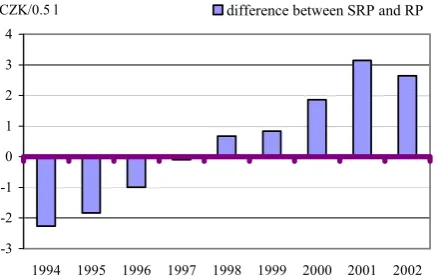
The results of the mathematic model of retail price simulation have proved an existence of ver-tical coordination within the analysed commod-ity chain during the observed period. As we can see from the graph (Figure 4), between the years 1999 and 2000, the vertical coordination in the industry started. From 2000 to 2003, the simulated retail price was higher than actual retail price, therefore there was a vertical coordination in the industry and it brought benefits to consumers in
this extent. The deepening gap between consumer (retail) price and simulation price (Figure 5) is due to productivity gains and benefits resulting from vertical coordination.
CONCLUSIONS
Over the last decade, vertical coordination of se-veral Czech food industries might be described less as a series of stages that are coordinated by atomistic producers selling output on spot markets, and more as large scale, capital-intensive manufacturing firms more directly controlling the decisions of producers. This change has been accompanied by an increase in concentration. It is the increase in concentration accompanying changes in vertical coordination that has raised two primary concerns.
The first concern is market power. Currently, the concern is whether manufacturing firms exert monopsonic power over firms in the farm sector. If market power is created, market efficiency is lost, and consumer welfare suffers from the reduced va-riety of products, or higher or more variable prices increases.
The second concern regarding an increase in con-centration is environmental protection, especially in areas near massive livestock operations. It seems likely that if large, industrialized livestock opera-tions are to continue to grow, firms will be forced to adopt technologies to effectively manage waste. Failure to do so may result in costly litigation and in reductions in consumer welfare. It seems likely that the choice between efficient production and environmental quality will be made in the policy arena.
On the basis of the gained results, the existence of vertical coordination within analysed industry was proved, its displays started to appear between the years 1997 and 1998 and it brought benefits to consumers. The main arguments for vertical coor-dination in the chosen commodity chain (between maltsters and breweries) in the Czech Republic can be derived.
(a) A commodity chain is increasingly influenced by external factors – extensive and fast expansion of retailing channels and foreign retail chains that look for suppliers which are able to provide their shops with products of the required structure, volume and quality and which operate on the whole domestic market.
(b) As consequence of increased competition, each stage has to seek possibilities of minimizing costs in order to be competitive.
-3 -2 -1 0 1 2 3 4
1994 1995 1996 1997 1998 1999 2000 2001 2002
CZK/0.5 l difference between SRP and RP
SRP = simulated retail price of beer (0.5 l bottle)
[image:6.595.71.290.347.477.2]RP = actual retail price of beer converted to real prices (1995)
Figure 5. Difference between the actual retail price and the simulated price of beer
0 2 4 6 8 10 12
1994 1995 1996 1997 1998 1999 2000 2001 2002
[image:6.595.67.285.558.698.2]CZK/0.5 l SRP RP
(c) Vertical coordination enables increase in labour productivity through specialization, concentration and investment in modern technologies. (d) The competitiveness of producers requires quality
assurance and stability, which will ensure better quality by product processing.
Theoretical issues discussed at the beginning of the paper were confirmed by the practical example of the specific agro-food chain – the beer commodity chain in the Czech Republic. These developments have been enforced by the situation on the agro-food markets and so vertical coordination is believed to become a necessity to survive on the market as well as to be competitive.
There is no doubt that subjects within the agro-food chains are becoming more and more interdependent and this development will continue and will be ne-cessary for the future with respect to the increasing competition on the world market.
APPENDIX
Martinez Model of Retail Price Simulation
Simulated retail price was calculated by summing the simulated farm value in year j, marketing costs in year j and gross profit in year j.
Farm value in each year was simulated by using price indices for production inputs to convert costs for all inputs and returns to basic year (1960) and summing across inputs,
(1)
where:
input x – the amount of costsfor agricultural input per unit of final product in 1960
FPIj – farmer price index in year j
input y – the amount of costsfor input(semi-finished product), per unit of final product in 1960 PPIj – the industrial producer price index in year j returns – the returns to producers above production costs
in 1960
CPIj – the consumer price index in year j
Similarly, marketing costs are simulated by multiplying marketing costs in 1960 by the appropriate price indices, and summing:
(2)
where:
labour – the labour cost per unit of final product in 1960
EARNj – the index of average monthly earnings of workers in the food industry in year j energy – the energy cost per unit of final product
in 1960
FUELj – the index for fuels, power and related pro- ducts in year j
pack – the packaging and materials costs per unit of final product in 1960
CONTAINj – the index of prices for containers in year j Overhd – overhead and other costs per unit of final
product in 1960
PPIj – the industrial producer price index in year j The simulated producer price in year j is calculated by summing farm value and marketing costs
SPPj = FVj + MCj
Then simulated retail price is calculated by summing simulated producer price and gross margin.
SRPj = SPPj + gross profitj
where:
RPj – the retail price of final product in year j, converted in real price (1960), without VAT,
PPj – the industrial producer price of final product in year j, converted in real price (1960), without consumption tax,
PPCTj – the industrial producer price of final product in year j, converted in real price (1960), with con- sumption tax,
SPPj – the simulated industrial producer price in year j.
REFERENCES
Bečvářová V. (2001): Vliv vertikální integrace na konkurenceschopnost zemědělství. In: Produkčná a obchodná výkonnosť agropotravinárského kom-plexu. SPU Nitra; ISBN 80-7137-973-5.
Blažková I. (2002): Vertikální integrace jako projev globalizace v agrobusinesu. In: Mezinárodné ve-decké dni 2002. Ekonomika a manažment pod-nikov v procese globalizácie. SPU Nitra; ISBN 80-8069-030-8. � � � � � � � � � � � � � � � � � � � � � � � � � � � 1960 1960 1960 CPI CPI returns PPI PPI y input FPI FPI x input
FVj j j j
� � � � � � � � � � � � � � � � � � � � � � � � � � � 1960 1960 1960 CPI CPI returns PPI PPI y input FPI FPI x input
FVj j j j
� � � � � � � � � � � � � � � � � � � � � � � � � � � � � � � � � � � � 1960 1960 1960 1960 PPI PPI overhd CONTAIN CONTAIN pack FUEL FUEL energy EARN EARN labour
MCj j j j j
� � � � � � � � � � � � � � � � � � � � � � � � � � � � � � � � � � � � 1960 1960 1960 1960 PPI PPI overhd CONTAIN CONTAIN pack FUEL FUEL energy EARN EARN labour
Frank S.D., Henderson D.R. (1992): Managerial Eco-nomics of Vertically Coordinated Agricultural Firms. American Journal of Agricultural Econom-ics, 74 (4).
Martinez S.W., Reed A. (1996): From Farmers to Con-sumers. Vertical Coordination in the Food Indus-try. Economic Research Service Report, No. 720, USDA, Washington.
Mighell R.L., Jones L.A. (1963): Vertical Coordination in Agriculture. AER-19, USDA, Washington. Lipsey R.G., Steiner P.O. (1978): Economics. Harper
& Row Publishers, New York.
Porter M. E. (1994): Konkurenční strategie. Victoria Publishing, Praha; ISBN 80-85605-11-2.
Sporleder T.L. (1992): Managerial Economics of Ver-tically Coordinated Agricultural Firms. American Journal of Agricultural Economics, 74 (5). Veselská E. (2004): Vliv vertikální koordinace na
spo-třebitelskou cenu v podmínkách českého pivovar-ského odvětví. In: Firma a konkurenční prostředí 2004, PEF MZLU, Brno.
Ziggers G.W., Trienekens J. (1999): Quality assurance in food and agribusiness supply chains: Developing successful partnerships. International Journal of Production Economics, 60–61, (4): 271–279. ERS USDA. Agricultural Outlook 2000, 2001. Statistical Yearbook of Czech Republic 1995–2003.
ČSÚ, Praha.
Arrived on 29th April 2005
Contact address: