ISSN Online: 2157-9458 ISSN Print: 2157-944X
Verification of Macro- and Micronutrient
Intake in the First Year of Roux-En-Y
Gastric Bypass Using MSM Method
Caroline Frehner
1*, Marilia R. Zaparolli
2, Magda R. R. da Cruz
3, Antônio C. L. Campos
2,
Maria Eliana M. Schieferdecker
2, Alcides J. B. Filho
41Clinical Hospital of Federal University of Parana (UFPR), Curitiba, Brazil 2Federal University of Parana (UFPR), Curitiba, Brazil
3Pontifical Catholic University of Parana (PUCPR), Curitiba, Brazil 4Cevip-Paraná Laparoscopy Center, Curitiba, Brazil
Abstract
Background:Bariatric surgery is an alternative treatment for obesity. Howev-er, physicians need to be aware of the possible consequences of nutritional de-ficiencies with this type of surgery. This study aimed to determine the preva-lence of inadequacy of macro- and micronutrients from the diet in patients undergoing Roux-en-Y gastric bypass after 3, 6, and 12 months postopera-tively. Methods: We performed a longitudinal, observational, clinical study during preoperatively and 3-, 6-, and 12-month postoperatively (n = 95 pa-tients). We collected information from medical records of patients in a Refer-ence Clinic of Bariatric Surgery. Quantitative food intake was analyzed by ADS Nutri® and Multiple Source Method® software. The obtained data were
compared with the daily-recommended intake in accordance with specific guidelines for bariatric surgery. Data were analyzed using t-tests, Mann- Whitney test, one-way analysis of variance (ANOVA), and Tukey’s test. Re-sults: There was a high prevalence of inadequacy of macronutrients and mi-cronutrients from food in the postoperatively period. However, only vitamin B12 intake was adequate based on the daily recommended intake. Conclu-sions: Our study suggests that the intake of nutrients by feeding is below cur-rent recommendations. Individual nutritional counseling with a therapeutic plan for adequate nutrition and prescription supplements are important to ensure that nutritional recommendations are adhered to.
Keywords
Macronutrients, Micronutrients, Bariatric Surgery, Gastric Bypass, Food Intake
How to cite this paper: Frehner, C., Za-parolli, M.R., da Cruz, M.R.R., Campos, A.C.L., Schieferdecker, M.E.M. and Filho, A.J.B. (2017) Verification of Macro- and Micronutrient Intake in the First Year of Roux-En-Y Gastric Bypass Using MSM Me- thod. Food and Nutrition Sciences, 8, 392- 401.
https://doi.org/10.4236/fns.2017.84027
Received: December 22, 2016 Accepted: April 21, 2017 Published: April 24, 2017
Copyright © 2017 by authors and Scientific Research Publishing Inc. This work is licensed under the Creative Commons Attribution International License (CC BY 4.0).
1. Introduction
Obesity is a metabolic and multifactorial disease associated with genetic, beha-vioral, environmental, and endocrine disorders. Therefore, obesity is considered the epidemic of the century, as well as a major problem of global public health
[1]. Obesity is the second leading cause of preventable and premature death in the United States [2]. In Brazil, 50.8% of the population is overweight and 17.5% is obese [3].
Conventional treatments for obesity include nutritional counseling, physical activity, drug treatment, and psychological treatment [4]. Surgical intervention is an alternative treatment if conventional treatments fail. [5]. The Roux-en-Y gastric bypass corresponds to 49% of all bariatric surgeries performed worldwide
[6].
Patients undergoing this surgical technique are at high risk of developing nu-tritional deficiencies, because of reduced absorption, after intestinal bypass [7]. The combination of restrictive and disabsorptive components increases the nu-tritional risk, requiring intensive and continuous nunu-tritional monitoring [8]. More- over, the prevalence of symptoms, such as nausea, vomiting, diarrhea, dumping syndrome, and food intolerance, is high in Roux-en-Y gastric bypass, contribut-ing to development of micro- and macronutrient deficiency [9].
The main deficiency of macronutrients after Roux-en-Y gastric bypass occurs because of a lack of protein [10]. Deficiencies in micronutrients postoperatively involve iron, folate, B vitamins (mainly B12), calcium, vitamin D, selenium and zinc [11].
Anatomical and physiological changes can affect food intake in patients who undergo Roux-en-Y gastric bypass. Correcting deficiencies in micro- and ma-cronutrients to maintain adequate nutritional status is important. However, there is a lack of studies on Roux-en-Y gastric bypass that quantitatively assess nutrients from food postoperatively. Therefore, this study aimed to determine the prevalence of inadequacy of macro- and micronutrients at 3, 6, and 12 months postoperatively in patients who underwent Roux-en-Y gastric bypass.
2. Materials and Methods
2.1. Study Design
We performed a longitudinal, observational, retrospective, clinical study during preoperatively and 3-, 6-, and 12-month postoperatively. We studied patients in a reference bariatric surgery clinic. Approval for the study was obtained by the Ethics Committee of the Pontifical Catholic University of Paraná (PUCPR) un-der the following registration number: 13491913.8.0000.0020.
2.2. Sample
months postoperatively.
2.3. Nutritional Record Information
Data were collected from the electronic nutritional records. The following in-formation was collected: name, sex, age, initial weight and weight at each period, height, and 24-h food recall recorded at 3-, 6-, and 12-month visits. We calcu-lated body mass index (BMI) and the percentage of excess weight loss (% EWL)
[12]. The nutritionist and the surgical team collected nutritional data and medi-cal data, respectively. The same surgeon performed all surgeries.
2.4. Analysis of Food Intake
The food intake data were assessed from quantitative analysis of 24-h food recall recorded at three time points. Estimation of food intake can be performed from two repeated measures that include different days of the week and periods dur-ing 1 year [13]. For this analysis, we used ADS Nutri® diet software
(http://www.adsnutri.com.br/). Energy, carbohydrates, proteins, lipids, fiber,
vi-tamin B12, iron, calcium, zinc, and selenium were evaluated. The usual intake of micronutrients was calculated using the Multiple Source Method® software
(https://msm.dife.de/), which controls individual variability using statistics.
2.5. Analysis of the Prevalence of Inadequate Macronutrients and
Micronutrients
For determining the inadequacy of macronutrients and micronutrients, we used quantitative analysis of food intake and compared it with specific recommenda-tions. Micronutrients were compared with the estimated average requirement according to sex and age, and macronutrients were compared with the guide-lines for bariatric surgery [10].
2.6. Statistical Analysis
We used SPSS version 2.0 (SPSS Inc., Chicago, IL, USA) to perform normal tests, categorize variables as parametric and non-parametric, for descriptive analysis, and to compare means. Parametric variables analyzed by descriptive statistics are shown as the mean and standard deviation, while nonparametric variables are shown as median, minimum, and maximum values. The t-test was used for in-dependent samples and the Mann-Whitney test was used to compare the means and medians of the three periods. ANOVA and Tukey’s test were used for com-parison of means between different periods. The level of significance was p < 0.05.
3. Results
weight was 104 kg, with a minimum of 75 kg and maximum of 178 kg (Table 1).
There was an important reduction in weight and BMI at 3, 6, and 12 months compared with that before surgery. The mean BMI of patients preoperatively was 39.3 kg/m2 and 31.22 kg/m2 at 3 months after surgery, with a decline to
26.63 kg/m2 at 12 months postoperatively. EWL at 3 months postoperatively was
56.39% ± 17.32%. At 6 months, EWL reached 74.5% (33% - 139%), and at 12 months, it was 88.57% ± 23.7% (Table 1).
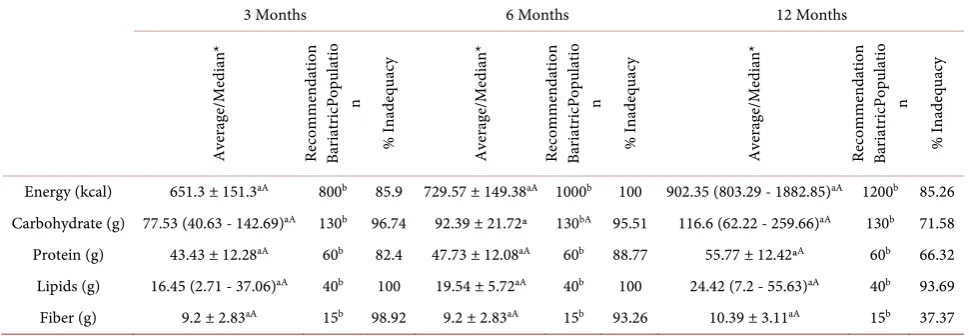
[image:4.595.56.541.542.710.2]Medium energy intake increased over the postoperative period, with a signifi-cant increase compared with energy recommendations at each time point (p < 0.05). However, there was no significant difference in medium energy intake of the three periods after surgery compared with that before surgery (p > 0.05). The highest percentage of inadequacy was protein intake at 12 months postopera-tively (66.32%). The percentage of inadequate energy and lipids was higher at 6 months postoperatively, during which no patients had adequate intake of these variables, compared with 3 and 12 months postoperatively. The prevalence of inadequate zinc intake gradually declined over the three periods (Table 2). There was a gradual increase in the intake of micronutrients, with the exception
Table 1. Characteristics of the study population pre- and post-surgery.
Variables Average/Median* Pre-surgery Average/Median* 3 months Average/Median* 6 months Average/Median* 12 months
Number of patients 95 92 88 95
Age (years) 46 (20 - 64) - - -
Height (m) 1.63 ± 0.07 - - -
Weight (kg) 104 (75 - 178) 83 (65- 140) 75.45 (56 - 131) 71 ( 47 - 127.5)
BMI (kg/m²) 39.3 (29 - 67.83) 31.22 (23.92 - 53.35) 28.79 (22.39 - 49.92) 26,63 (19.07 - 48.58)
% weight loss - 56.39 ± 17.32 74.5 (33 - 139) 88.57 ± 23.7
*Mean ± SD/median (minimum-maximum); Note: BMI, body mass index.
Table 2. Energy and macronutrient consumption at 3, 6, and 12 months postoperatively.
3 Months 6 Months 12 Months
A ver age/ M edi an * Rec om m en da tio n Ba ria tric Po pu la tio n % In adeq uac y A ver age/ M edi an * Rec om m en da tio n Ba ria tric Po pu la tio n % In adeq uac y A ver age/ M edi an * Rec om m en da tio n Ba ria tric Po pu la tio n % In adeq uac y
Energy (kcal) 651.3 ± 151.3aA 800b 85.9 729.57 ± 149.38aA 1000b 100 902.35 (803.29 - 1882.85)aA 1200b 85.26
Carbohydrate (g) 77.53 (40.63 - 142.69)aA 130b 96.74 92.39 ± 21.72ª 130bA 95.51 116.6 (62.22 - 259.66)aA 130b 71.58
Protein (g) 43.43 ± 12.28aA 60b 82.4 47.73 ± 12.08aA 60b 88.77 55.77 ± 12.42ªA 60b 66.32
Lipids (g) 16.45 (2.71 - 37.06)aA 40b 100 19.54 ± 5.72aA 40b 100 24.42 (7.2 - 55.63)aA 40b 93.69
Fiber (g) 9.2 ± 2.83aA 15b 98.92 9.2 ± 2.83aA 15b 93.26 10.39 ± 3.11aA 15b 37.37
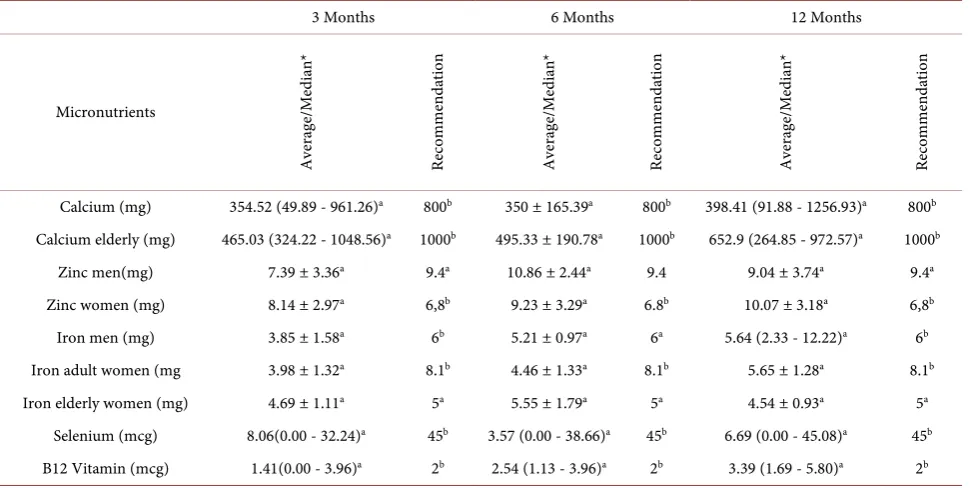
of zinc for men. Despite this increase, all of these nutrients were below the daily recommended intake (Table 3).
Unlike the other nutrients, Vitamin B12 was adequate in accordance with the recommendations. The usual intake of zinc in women, iron in older women, cal-cium in elderly men and women, and calcal-cium and selenium, reached values close to or above 100% inadequacy (Table 4).
4. Discussion
[image:5.595.57.547.268.512.2]In our study, over a 12-month postoperative period, there was a significant in-crease in %EWL, which indicated surgical success. However, there was a high prevalence of inadequate macro- and micronutrients from food intake. Among
Table 3. Comparison of consumption of micronutrients at 3, 6, and 12 months postoperatively.
3 Months 6 Months 12 Months
Micronutrients
A
ver
age/
M
edi
an
*
Rec
om
m
en
da
tio
n
A
ver
age/
M
edi
an
*
Rec
om
m
en
da
tio
n
A
ver
age/
M
edi
an
*
Rec
om
m
en
da
tio
n
Calcium (mg) 354.52 (49.89 - 961.26)a 800b 350 ± 165.39a 800b 398.41 (91.88 - 1256.93)a 800b
Calcium elderly (mg) 465.03 (324.22 - 1048.56)a 1000b 495.33 ± 190.78a 1000b 652.9 (264.85 - 972.57)a 1000b
Zinc men(mg) 7.39 ± 3.36a 9.4a 10.86 ± 2.44a 9.4 9.04 ± 3.74a 9.4a
Zinc women (mg) 8.14 ± 2.97a 6,8b 9.23 ± 3.29a 6.8b 10.07 ± 3.18a 6,8b
Iron men (mg) 3.85 ± 1.58a 6b 5.21 ± 0.97a 6a 5.64 (2.33 - 12.22)a 6b
Iron adult women (mg 3.98 ± 1.32a 8.1b 4.46 ± 1.33a 8.1b 5.65 ± 1.28a 8.1b
Iron elderly women (mg) 4.69 ± 1.11a 5a 5.55 ± 1.79a 5a 4.54 ± 0.93a 5a
Selenium (mcg) 8.06(0.00 - 32.24)a 45b 3.57 (0.00 - 38.66)a 45b 6.69 (0.00 - 45.08)a 45b
B12 Vitamin (mcg) 1.41(0.00 - 3.96)a 2b 2.54 (1.13 - 3.96)a 2b 3.39 (1.69 - 5.80)a 2b
*Mean ± SD/median (minimum−maximum); a,b: Significant difference by Tukey’s test (p < 0.05). The same letter does not indicate a significant difference.
Table 4. Recommendation and prevalence of inadequacy of micronutrients at 1 year postoperatively.
Nutrients Usual consumption Recommendation % Inadequacy
Calcium (mg) 346.65 ± 144.44 800 99.95
Calcium elderly (mg) 469.65 ± 166.14 1000 99.92
Zinc men (mg) 10.17 ± 0.72 9.4 60.26
Zinc women (mg) 9.14 ± 0.98 6.8 100
Iron men (mg) 5.47 ± 0.52 6 83.39
Iron adult women (mg) 4.76 ± 0.37 8.1 100
Iron elderly women (mg) 4.84 ± 0.28 5 67
Selenium (mcg) 8.30 ± 3.85 45 100
B12 Vitamin (mcg) 2.48 ± 0.004 2 0
[image:5.595.62.539.554.720.2]the micronutrients, vitamins had the lowest index of inadequacy.
The number of women in our study who had surgery was higher than that in men. This finding is consistent with a study that investigated the effect of baria-tric surgery on weight loss, and showed that 72.6% of patients who underwent bariatric surgery were women [14].
A deficit in energy intake was found in our population. A previous study (n = 36 patients) showed an intake of 322 kcal preoperatively and 1060 kcal at 6 months after bariatric surgery, using recall 24h and Nutwin® software for
nu-trient calculation [22]. Similarly, another study on bariatric surgery in 93 pa-tients showed a higher energy intake than that found in our study (849 ± 329 kcal at 3 months and 1101 ± 400 kcal at 12 months postoperatively) [23]. How-ever, despite the fact that the 24-h dietary recall method is valid for postopera-tive follow-up and has a minimal risk of underestimating reduction in weight, these previous reports may have underestimated energy intake.
In our study, patients had inadequate protein intake. This finding is similar to results from another study (n = 137 patients) that investigated progression of weight loss and anemia in patients undergoing Roux-en-Y gastric bypass [16]. This previous study showed 14.2 ± 45.6 g of protein intake at 3 months and 58.5 ± 17.1 g at 12 months. Another study showed that 6 months after the bariatric surgery, protein intake was 47.11 ± 17.70 g [15]. This inadequacy can lead to a reduction in body mass, decrease in metabolic rate, and physiological damage. A protein diet with the recommended amount increases satiety, increases weight loss, and improves body composition [17]. Therefore, maintenance of protein supplementation might achieve the recommended requirements. This supple-mentation requirement can also be explained by the fact that there is a deliberate reduction in calorie intake of 78% on average because of restrictions for surgery, which contributes to reducing protein intake. There is an association between in-tolerance to protein and a decrease in secretion of proteolytic enzymes. To avoid the risk of malnutrition, protein supplementation up to 6 months after surgery is recommended and may continue until supply is obtained through food [18].
The recommended 15 g/day fiber intake was not reached until 12 months after surgery in our study. Bariatric surgery leads to a decrease in the volume of eaten food, especially during the first months after surgery. However, changes in the nutritional quality of food intake that occur in the preoperative period must not occur during the postoperative period, as this will lead to health problems. We also analyzed fiber intake in post-surgical patients and found that fiber intake up to 12 months after surgery was less than the recommended intake [19]. This finding reflects the need for continuous nutritional education on an outpatient basis, encouraging the consumption of fruits, vegetables, whole grains, and high-fiber foods.
and the intestinal absorptive area [20]. There is a high risk of developing nutri-tional deficiencies after bariatric surgery because of the difficulty of maintaining proper nutrition [21]. In addition to all of the risk factors, there was an inade-quate intake of micronutrients of patients in our study because of the difficulty of maintaining adequate food.
In the current study, there was a high percentage of inadequate iron intake. This finding is consistent with previous studies, which showed that 36% of pa-tients have iron deficiency after 12 months of surgery. Another study showed that 86.11% of the population studied was below 85% of the recommended in-take of iron [15]. This deficiency occurs not only due to low iron intake, but also in gastric hypochlorhydria and intolerance to red meat [20]. Guidelines mend using elemental iron supplementation after surgery, and the daily recom-mendation is 45 - 60 mg [21]. There may be a need for additional vitamin C concurrently to increase the absorption of iron [22].
Our study showed that the intake of vitamin B12 had the lowest prevalence of inadequate intake. This result may be due to nutritional counseling that is fo-cused on encouraging consumption of food sources (eggs, milk, and dairy prod-ucts) of this vitamin. However, a previous study showed a high prevalence of vi-tamin B12 deficiency in patients undergoing gastroplasty with intestinal bypass in Roux-en-Y gastric bypass (42.1%) [21]. Despite many reports of vitamin B12 deficiency, it can vary from 12% - 75% of the population after bariatric surgery. This variation is caused by the individual time taken to exhaust the stock of vi-tamin B12 in the liver (2 - 5 years). This is exacerbated because of reduced gas-tric production of hydrochloric acid and decreased production of intrinsic fac-tors in the stomach [20]. Recommended supplementation of vitamin B12 may be orally at 1000 mcg/day, intravascularly at 1000 mcg/month, or 3000 mcg every 6 - 12 months [21]. The adequacy of vitamin B12 intake in our study population may have been achieved as a result of preoperative and postoperative encou-ragement to consume food sources rich in this nutrient, the fact that no patients were vegetarians, or underestimation of the food composition table values.
There was a high inadequate zinc intake in patients in this study. This inade-quacy of zinc may be related to food intolerance [22]. More than 18 months after surgery, 20% - 24% of the population is estimated to develop zinc deficiency
[23]. Absorption of zinc requires an acidic environment in the stomach, and this absorption occurs in the proximal portion of the intestine [23]. This absorption is compromised by anatomical changes because of bariatric surgery. The recom-mendation for zinc supplementation is 50 - 60 mg of elemental zinc per day [11].
The high percentage of inadequate calcium intake observed in our population is a concern. Low intake of calcium was also investigated in a study that eva-luated patients (n = 36) undergoing gastroplasty with intestinal bypass in Roux- en-Y gastric bypass during the preoperatively and 6 months postoperatively and showed an average calcium intake of 597.03 ± 289.55 mg among participants
disease [20]. Dairy products are also good sources of vitamin D. Therefore, re-ducing dairy product intake has consequences for ingestion and absorption of calcium and vitamin D. This increases the risk of developing osteopenia, osteo-porosis, and osteomalacia [24].
This study showed no adequancy of selenium with food intake. The main die-tary sources of selenium include nuts, salmon, wheat bran, and raw oysters. By analyzing data from food consumption of our population, we found a low intake of these foods as micronutrient sources. Educating patients and informing them of the main food sources are important for continuous, adequate nutrition.
Patients who undergo bariatric surgery may already show changes in plasma levels of micronutrients in the preoperative period because obesity with a poor quality of diet is a cause of nutrient deficiency. As mentioned above, bariatric surgery causes anatomical and physiological changes that affect the quantity and quality of food intake and absorption. Therefore, nutritional deficiency is di-rectly related to preoperative status and the surgical method, and is also exacer-bated by inadequate food intake post-surgically. Therefore, prevention and cor-rection of deficiencies in vitamins and minerals should be initiated preopera-tively, minimizing the risk of postoperative deficiency.
5. Conclusion
Food intake deficits of macro- and micronutrients result from eating habits in the first year of Roux-en-Y gastric bypass, indicating an insufficient intake of food sources. Because of the high risk of developing serious nutritional deficien-cies, continuous nutritional monitoring, and encouraging adherence to a nutri-tional plan in accordance with the recommendations proposed for post-bariatric surgery are necessary. Furthermore, a therapeutic plan with supplements should be established, noting the individual nutritional needs.
Acknowledgements
Clínica de Videolaparoscopia do Paraná—Cevip.
Ethical Approval
All procedures performed in studies involving human participants were in ac-cordance with the ethical standards of the institutional and/or national research committee and with the 1964 Helsinki declaration and its later amendments or comparable ethical standards. For this type of study, formal consent is not re-quired.
Conflict of Interest
The authors declare that they have no conflicts of interest.
References
http://www.diabetes.org.br/ebook/component/k2/item/83-conduta-terapeutica-no-diabetes-tipo-2-algoritmo-sbd-2014
[2] Centers for Disease Control And Prevention—CDC. Overweight and Obesity. Adult Obesity Facts, 2014. http://www.cdc.gov/obesity/data/adult.html
[3] Vigilância de fatores de risco e proteção para doenças crônicas por inquérito tele- fônico—VIGITEL. Excess Weight and Obesity, 2013.
http://www.abeso.org.br/uploads/downloads/73/553a2458a9fae.pdf
[4] Bult, M.J., Van Dalen, T. and Muller, A.F. (2008) Surgical Treatment of Obesity.
European Journal of Endocrinology, 158, 135-145. https://doi.org/10.1530/EJE-07-0145
[5] Zeze, J.L.M., Tomaz, C.A.B., Nassif, P.A.N., Lima, J.H., Sansano, L.R.Z. and Zeve, C.H. (2013) Obese Patients with dIabetes Mellitus Type 2 Undergoing Gastric Bypass in Roux-en-Y: Analysis of Results and Its Influence in Complications. ABCD. Arquivos Brasileiros de Cirurgia Digestiva (São Paulo), 26, 47-52.
https://doi.org/10.1590/S0102-67202013000600011
[6] Buchwald, H. and Oien, D.M. (2008) Metabolic/Bariatric Surgery Worldwide. Ob-esity Surgery, 19, 1605-1611. https://doi.org/10.1007/s11695-009-0014-5
[7] Kim, M.K., Kim, W., Kown, H.S., Baek, K.H. and Kim, E.K. (2014) Effects of Baria-tric Surgery on Metabolic and Nutritional Parameters in Severely Obese Korean Pa-tients with Type 2 Diabetes: A Prospective 2-Year Follow Up. Journal of Diabetes Investigation, 5, 221-227. https://doi.org/10.1111/jdi.12137
[8] Isom, K.A., Andromalos, L., Ariagno, M., Hartman, K., Mogensen, K.M., Stepha-nides, K. and Shikora, S. (2014) Nutrition and Metabolic Support Recommenda-tions for the Bariatric Patient. Nutrition in Clinical Practice. Nutrition in Clinical Practice, 29, 718-739. https://doi.org/10.1177/0884533614552850
[9] Elrazek, A.E.M.A.A., Elbanna, A.E.M. and Bilasy, S.E. (2014) Medical Management of Patients after Bariatric Surgery: Principles and Guidelines. World Journal of Ga-strointestinal Surgery, 6, 220-228.
[10] Mechanick, J.I., Kushner, R.F., Sugerman, H.J., Gonzalez-Campoy, J.M., et al.
(2009) American Association of Clinical Endocrinologists, the Obesity Society, and American Society for Metabolic & Bariatric Surgery Medical Guidelines for Clinical Practice for the Perioperative Nutritional, Metabolic, and Nonsurgical Support of the Bariatric Surgery Patient. Obesity, 17, S3-S72.
https://doi.org/10.1038/oby.2009.28
[11] Ramos, N.M., Magno, F.C., Cohen, L., Rosado, E.L. and Carneiro, J.R. (2015) Weight Loss and Nutritional Anemia in Patients Submitted to Roux-en-Y Gastric Bypass on Use of Vitamin and Mineral Supplementation. ABCD. Arquivos Brasi- leiros de Cirurgia Digestiva (São Paulo), 28, 44-47.
https://doi.org/10.1590/S0102-67202015000100012
[12] World Health Organization (WHO) Obesity: Preventing and Managing the Global Epidemic. Report of a WHO Consultation.
http://www.who.int/nutrition/publications/obesity/WHO_TRS_894/en/
[13] Hoffmann, K. (2002) Estimating the Distribution of Usual Dietary Intake by Short- Term Measurements. European Journal of Clinical Nutrition, 56, 53-62.
[14] Buchwald, H., Avidor, Y., Braunwlad, E., Jensen, M.D., Pories, W., Fahrbach, K. and Schoelles, K. (2004) Bariatric Surgery: A Systematic Review and Meta-Analysis.
JAMA, 292, 1724-1737. https://doi.org/10.1001/jama.292.14.1724
Obesity Surgery, 13, 23-28. https://doi.org/10.1381/096089203321136548
[16] Gobato, R.C., Chaves, D.F.S. and Chaim, E.A. (2014) Micronutrient and Physiologic Parameters before and 6 Months after RYGB.Surgery for Obesity and Related Dis-eases, 10, 944-951. https://doi.org/10.1016/j.soard.2014.05.011
[17] Faria, S.L., Faria, O.P., Buffington, C., Cardeal, M.A. and Ito, M.K. (2011) Dietary Protein Intake and Bariatric Surgery Patients: A Review. Obesity Surgery, 21, 1798- 1805. https://doi.org/10.1007/s11695-011-0441-y
[18] Coppini, L.Z. (2015) Nutrition and Metabolism in Metabolic and Bariatric Surgery: Nutritional Guidelines for Post-Operative Vertical Gastrectomy. Rubio, Rio de Ja-neiro.
[19] Bavaresco, M., Paganini, S., Lima, T.P., Salgado Jr., W., Ceneviva, R., Dos Santos J.E. and Nonino-Borges, C.B. (2010) Nutritional Course of Patients Submitted to Bariatric Surgery. Obesity Surgery, 20, 716-721.
https://doi.org/10.1007/s11695-008-9721-6
[20] Bordalo, L.A., Mourão, D.N. and Bressan, J. (2010) Nutritional Deficiencies after Bariatric Surgery: Why They Happen? Acta Médica Portuguesa, 24, 1021-1028. [21] Alexandrou, A., Tsoka, E., Armeni, E., Rizos, D., Diamantis, T., Augolea, A.,
Pa-noulis, C., Liakakos, T. and Lambrinoudaki, I. (2015) Determinants of Secondary Hyperparathyroidism in Bariatric Patients after Roux-en-Y Gastric Bypass or Sleeve Gastrectomy: A Pilot Study. International Journal of Endocrinology, 2015, Article ID: 984935. https://doi.org/10.1155/2015/984935
[22] Lima, K.V.G., Costa, M.J.C., Gonçalves, M.C.R. and Sousa, B.S. (2013) Micronu- trient Deficiencies in the Pre-Bariatric Surgery. ABCD. Arquivos Brasileiros de Cir- urgia Digestiva (São Paulo), 26, 63-66.
https://doi.org/10.1590/S0102-67202013000600014
[23] Gletsu-Miller, N. and Wright, B.N. (2013) Mineral Malnutrition Following Bariatric Surgery. Advances in Nutrition: An International Review Journal, 4, 506-517. https://doi.org/10.3945/an.113.004341
[24] Sarmento, R., Casagrande, D. and Schaan, B. (2014) Bariatric Surgery in the Treat- ment of Obesity: Impact on Bone Metabolism. Revista Hospital Universitário Pedro Ernesto, Rio de Janeiro, 13, 87-93. https://doi.org/10.12957/rhupe.2014.9811
Submit or recommend next manuscript to SCIRP and we will provide best service for you:
Accepting pre-submission inquiries through Email, Facebook, LinkedIn, Twitter, etc. A wide selection of journals (inclusive of 9 subjects, more than 200 journals)
Providing 24-hour high-quality service User-friendly online submission system Fair and swift peer-review system
Efficient typesetting and proofreading procedure
Display of the result of downloads and visits, as well as the number of cited articles Maximum dissemination of your research work
Submit your manuscript at: http://papersubmission.scirp.org/