Computational Methods in the Theory of Synthesis of
Radio and Acoustic Radiating Systems
Petro Sаvenko
Department of Numerical Methods of the Pidstryhach Institute for Applied Problems of Mechanics and Mathematics, National Academy of Sciences of Ukraine, Lviv, Ukraine
Email: [email protected]
Received November 27, 2012; revised January 12, 2013; accepted January 19, 2013
ABSTRACT
A brief review of the works of the author and his co-authors on the application of nonlinear analysis, numerical and analytical methods for solving the nonlinear inverse problems (synthesis problems) for optimizing the different types of radiating systems, is presented in the paper. The synthesis problems are formulated in variational statements and further they are reduced to research and numerical solution of nonlinear integral equations of Hammerstein type. The existence theorems are proof, the investigation methods of nonuniqueness problem of solutions and numerical algorithms of find- ing the optimal solutions are proved.
Keywords: Nonlinear Inverse Problems; Synthesis of Radiating Systems; Nonlinear Equations of Hammerstein Type; Branching of Solutions; Nonlinear Two-Parameter Spectral Problem; Localization of Solutions; Numerical Methods and Algorithms; Convergence of Iterative Processes
1. Introduction
In many practical applications at the optimal design of various types of radio and acoustic radiating systems the requirements are only to the energy characteristics of the directivity of the radiated field (amplitude directivity pat- tern (DP) or DP by the power). Therefore there is a need to approximate real finite functions by modules of one- dimensional or two-dimensional and discrete Fourier transform dependent on the real physical parameters. At the same time the absence of requirements to phase cha- racteristics of field is used to improve the quality of ap- proximation of synthesized DP to given.
Later on the variational formulations of different types of inverse problems in mean-square approach, which in further are reduced to investigation and numerical solu- tion of one-dimensional or two-dimensional nonlinear integral equations of the Hammerstein type with separate module and argument of desired complex-valued func- tion, are considered. Nonuniqueness and branching (or bifurcation) of solutions dependent on the change of the physical parameters characterizing the radiating system are characteristic features of such equations. Problems on finding the set of branching points (bifurcation) are not investigated nonlinear one-parameter or two-parameter spectral problems.
The existence of connected components of the spec- trum, which in the case of real parameters are of spectral lines, is essential difference between the two-dimensional
and one-dimensional spectral problems. The problem on finding the spectral lines is reduced to numerical solution of the Cauchy problem for an ordinary differential equa- tion of the first order.
The degenerate of kernels in linear operators of the Hammerstein type equations is feature of the synthesis problems of antenna arrays. It allows to reduce nonlinear two-parameter spectral problems on finding the set of branching points of solutions to the corresponding sys- tems of linear algebraic equations with nonlinear occur- rence of the spectral parameters in the coefficients of sys- tem.
In the basis of construction of numerical algorithms for finding the optimal solutions are taken such prince- ples: localization of existing solutions dependent on the value of the physical parameters of the problem by means the use of numerical methods of solving the non-linear one-parameter and two-parametric spectral problems, and methods of the branching theory of solutions—con- struction and justification of the convergence of iterative processes for numerical finding the various types of ex- isting solutions of basic equations (equations of Ham- merstein type)—analysis of the effectiveness of found solutions.
2. Formulation of Problems. Basic Equations
of Synthesis
of radio (or acoustic) radiating systems are reduced to so- lution the corresponding boundary problems of electro- dynamics (acoustic) at a given excitation sources of fields [1-4] on the basis of Maxwell’s equations (wave equa- tion). The directivity pattern f is one of the basic cha- racteristics of the emitted field on large distances from the radiating system. It describes the properties of the field in space dependent on the angular coordinates of a spherical coordinate system. In general case, the DP f is a vector of complex-valued function which has the form [5,6]
f f A A
f i i Ui Ui . (1)
Here A
A A,
is linear operator acting fromsome functional Hilbert space HU (the space of square integrable functions in the domain V , describing the distribution of extraneous fields (currents) U in vol- ume V ) into the space of complex-valued continuous functions C
defined in some domain 2 (or1
) [7]. The form and properties of operators A,
A are defined by type and geometry of the radiating system. The set (domain) of values of the operator
A A,
A is called [8,9] set or class of realized di- rectivity patterns. This means that for any DP f from this class there exists such function of distribution of the currents (fields) UHU that realizes this DP, i.e.
.
AU f
In the simplest form the inverse problem (the synthesis problem) according to the prescribed amplitude DP can be formulated as the problem on finding the solutions of nonlinear operator equation of the first kind
F
AU , (2)
where F is a given amplitude DP. In staged thus the synthesis problem all three correct conditions of prob- lems by Hadamard [10-12]: existence of the solution, uniqueness of the solution, continuous dependence of the solution of the input data, can be violated simultaneously. Violation of condition (1) in the first place is connected with the fact that the given DP F can not belong to the class realized, that is to the domain of values of the op- erator A. In other words, such DP can not be obtained at any distribution of field in the aperture of the radiating system belonging to the space HU . Trying to recreate the DP F just leads to effect of superdirectivity [5]. The system becomes resonance and critical to change of parameters.
Condition (2) is violated due to the nonlinearity of the problem.
Therefore, the variational formulations of problems, which in addition to the requirements of the basic char- acteristics of DP also contain requirements to the distri- bution function of the currents (fields) in the aperture of the radiating system, are considered. At that is required
not complete coincidence obtained DP f with given
F, but only the best (in the sense of the selected crite- rion) approximation to it.
An important feature of the variational formulation of synthesis problems is the fact that in the optimization cri- terion can introduce functionals describing certain other requirements to amplitude-phase distribution (APD) of outside excitation sources. Their mean-square deviation, as a rule, will be used as the criterion of proximity of amplitudes of the given and synthesized DP.
2.1. The Case of Linear Polarization of Extraneous Field
First we consider the scalar case of problems when ex- traneous fields (currents) in the radiating system is line- arly polarized [7,13], and created by their DP (1) has only one component. Let the operator A acts from some Hilbert functional space HU L V2
into the complexspace of continuous and square integrable functions in domain 2 (or 1)
2
C .
In space HU we introduce the scalar product and norm
U U1, 2
HU
VU P U P V1
2
d ,
2
1 2d U
H V
U
U P V , (3)where P
x y z, ,
is a point of integration. Along with the Chebyshev norm sup
C Q
f f Q
, (4)
in the space we introduce scalar product and the gen- erated by it norm and metric C 2
as follows:
2
, C d
f g f Q g Q Q
, 2
21 2
,
C C
f f f
,
22 1, 2 1 2 C
C f f f f
. (5)
Note, space 2
C is a Banach space relatively uni-
form norm (4) and it is incomplete space concerning norm defined according to (5) [14].
We consider also that the operator A has the izomet- ric property or it is completely continuous. Let the given amplitude DP F is real positive (nonnegative) con- tinuous function which different from nonzero in some limited closed domain G and identically equal zero on complement G. Let A is isometric opera- tor, that is for any UHU and f AU H f equality is satisfied
2
22 2
, ,
U U
C H
C H
f AU AU U U U
. (6)
DP F is formulated (is investigated) as a minimization problem in the Hilbert space HU L V2
of the func-tional
2
2
F U F AU C
(7)
characterizing the value of mean-square deviation of mo- dules of given and synthesized DP in domain . For the formulated problem occurs [18,19]
Theorem 2.1. Let the linear operator
2 2:
A L V C is isometric relatively mean-square metric and it is continuous operator from L V2
into G2
C concerning uniform metric of the space C 2 , and
the given amplitude DP F s
is a real positive (non- negative) continuous function in the domain G.Then at least one point of absolute minimum of the functional (7) exists in the space UA F
ei argAU
and a subsequence which converges weakly to one of points of absolute minimum can be selected from any minimizing sequence.On the base of the necessary condition for an extre- mum of the functional (zero equality of its Hato differen- tial [20]) DF
U w,
F
U w 0, we obtain the equation with respect to the optimal distribution of exci- tation sources
eiargAU
UA F , (8) where A is the conjugate with A operator.
Let the set of zeros N A
of the operator A consists of only one zero element 0 . Then acting on both parts of (8) by operator A, we obtain the equivalent to (8) equation in space C G
:
ei argf
f AA F . (9) By solutions f of this equation the optimal distribu-
tion of excitation sources in radiating system are defined by the formula
eiargf
U A F
. (10)
From Theorem 2.1 and the properties of functional
F U
follows
Corollary 2.1. Since functional F
U is differen- tiable in HU by Hato, it is growing [21] and according to Theorem 2.1 has at least one point of absolute mini-mum, then (8) in the space HU and (9) in the space
C G have at least one solution.
Lemma 2.1.Between solutions of (8) and (9) there ex- ists bijection, that is if U is the solution of (8), then
fAU is the solution of (9). On the contrary, if f
is the solution of (9), then the corresponding solution of (8) is defined by (10).
The possibility of investigation of solutions of synthe- sis problems, using (8) or (9) follows from Lemma. Note,
Equation (9) is simpler as (8), since the latter contains the operator exponent.
Note, solutions of synthesis problems according to the prescribed amplitude DP are determined with precision to value ei ( is arbitrary constant), since
i
e
U U . So if there exists the solution of Equations (8) (or (9)), then there is also generated by its family of solutions in which one solution different from another by phase constant. For the uniqueness of desired solutions additional conditions impose on the functions argU or
argf .
In the case completely continuous operator describing DP of radiating system the smoothing Tikhonov type functional [11]
2
2
2 2
2 2
U G
U G
F C H
H C
I F f U
F AU U
(11)
which includes requirements as to the mean-square de- viation of DP, so to norm of current, is used [18,22] for the synthesis of various types of antennas. The parameter α can be viewed as regularization parameter [11,23] or as a weighing coefficient, by means of which can control ratio between the first and second summand of func- tional.
Theorem 2.2. Let the linear operator A acts from the complex Hilbert space HU L V2
into the com-plex space of continuous functions 2
G
C and it is com- pletely continuous, and given DP is real positive (non- negative) and continuous function in G1 (or in
2
G ).
Then at least one point of absolute minimum of func- tional F
U exists in HU L V2
and a subse-quence which converges weakly to one of the points of absolute minimum can be selected from any minimizing sequence.
Differentiating functional F
U by Hato and per- forming appropriate transformations, we obtain the equa- tion [22,24]
exp i arg
U A AU A F AU
(12)
in the space HU.
Equation with respect to synthesized DP based on equality f AU and (12) has the form
exp i arg
f AA f AA F f
. (13)
Lemma similar to Lemma 2.1 is valid for (12) and (13).
From Theorem 2.2 and properties of functional
F U
Corollary 2.2. Since differentiable in HU by Hato functional F
U is growing and according to Theo- rem 2.2 has at least one point of absolute minimum, then (12) in space HU and (13) in the space C G
have at least one by one solution.2.2. The Case of Arbitrary Polarization of Excitation Fields
Consider the more general case when the excitation fields (or currents) in the radiating system and generated by it DP have vector character [5,6]. In this case, we set that the operator A is completely continuous and it acts from HU L V2
L V2
L V2
complex space ofsquare integrable in the domain V vector-valued func- tions, into the complex space of continuous functions on the compact G2 vector-valued functions
G2 C G2 C G2
C equipped by scalar product. We in-
troduce the scalar product and generated by it norm in U
H :
1 2 1 2 1 2
1 2
1 2 1 2
1 2
, , , ,
, , , , , , , ,
, , , , d d d ,
x x y y z z
x x y y
V
z z
U U U U U U
U x y z U x y z U x y z U x y z
U x y z U x y z x y z
U U (14)
1 2 1 2 , , , , U Hx x y y z z
U U U U U U
U U U
. (15)
We define module of vector U as following:
1 2x x y y z z
U U U U U U
U .
In the space 2 2 2
G CG CG
C along with the Che-
byshev norm
G max, G
,
Cf f , (16)
where
1 2, f , f , f , f ,
f ,
we introduce the scalar product and generated by it the mean-square norm and metric
2 1 2 2 1 2 2
1 2
1 2 1 2
, , ,
, , , ,
sin d d ,
G CG CG
G
f f f f
f f f f
C f f (17) 2
21 2
,
G G
C C
f f f . (18)
If DP of radiating system has two components f,
f, i.e. it is described by (1), then as the optimization
criterions are used the following functionals [7]:
2 2 2 2 2 2 , U G U GF C H
H C F F A
U f U
U U (19)
2 2 2 2 2 2 2 2 2 2 U G G U G GF C C H
H
C C
F f F f
F A F A
U U
U U U
.
(20) In the functional (20), F, F are the given ampli-
tude of components of required DP. At that
2 2
1 2F F F , F C G 1 and functions F, F
can be given with account of existing requirements to polarization characteristics of emitted field.
If in the synthesis problem functional (19) is used as the optimization criterion, the problem on finding the minimum points is reduced to finding the solutions of the equation
1 1 F
*
U A AU A AU AU (21)
in the space HI. Equivalent to (21) equation with re- spect to vector DP f in space 2
G
C has the form
1 1 F
f AA f AA f f . (22)
In this case the following theorem is valid [7].
Theorem 2.3. Let linear completely continuous op- erator A acts from the complex Hilbert space
2 2 2
U
H L V L V L V into the complex space
of continuous functions 2 2 2
G CG CG
C equipped by
the scalar product, and given DP is a real positive con-tinuous function on the compact G.
Then in HU there exists at least one point of absolute minimum of functional F
U and a subsequencewhich converges weakly to one of the points of absolute minimum can select from any minimizing sequence.
For the functional (20) is true
Theorem 2.4.At conditions of Theorem 2.3 functional
F U in the space HU has at least one point of ab- solute minimum and subsequence which converges weakly to one of points of absolute minimum can be se- lected from any minimizing sequence.
For minimizing of the functional F
U in thespace HU we obtain equation [7]
i arg i arg
1 F A e A , F A e A
U U
U A U U .
Equivalent to (23) equation with respect to synthesized DP f in the space 2
G
C has the form
i arg i arg
1
e f , e f
F f F f
f AA . (24)
The existence of solutions of (23) in space HU and (24) in the space 2
G
C , respectively, follows from nec- essary condition of functional minimum F
U .If necessary the weight function [15,17] can introduce in the functionals F and F by means entering ap-
propriate scalar products and affect on quality of the ap- proximation of synthesized and given DP in a certain range of angles.
2.3. Simultaneous Optimization of the Geometry of Aperture and Excitation Fields
The synthesis problems with optimization of geometry of radiating system are more complicated class of problems. These problems need to find a configuration of the radi- ating system and amplitude-phase distribution of excita- tion fields (currents) in it [25,26]. Moreover, the operator A depends on two functions: function describing the geometry of the system, and amplitude-phase distri- bution function of excitation sources U, i.e.
f A U. (25)
In addition, the function U has, as rule, vector char- acter, and the operator A is a nonlinear concerning the function . Later on we shall consider the synthesis problem of a flat aperture, in which in addition to ampli- tude-phase distribution (APD) desired is too the function that describes the boundary of aperture. The basis of the formulation of such problems can be put the functionals (7), (11) and (20), expanding their by corresponding re- quirements to geometry of radiating system.
2.4. Synthesis Problem of Discrete Radiating Systems―Antenna Arrays
In many radio engineering systems antenna arrays (AR) have gained widespread use. Antenna array is [4,6,27] antenna, which consists of N identical (or different- type) radiators placing corresponding way in space and they collate by common system of power and control. In [28-37] investigations of nonlinear synthesis problems and planar antenna arrays according to the prescribed amplitude DP are presented.
To describe the electromagnetic characteristics of an- tenna arrays are used different by precision mathematical models [38-42]. In the base of construction of mathe- matical models is imposed [40,42] that the excitation of each radiator is characterized by a unique complex num- ber In-complex amplitude of excitation. It’s the physical meaning depends on the type of radiating system. On the
base on the linearity of the Maxwell’s equations the complex excitation amplitudes enter linearly in the ex- pression for DP of array, that is
i sin cos sin sin cos 1
, , e n n n
N
k x y z
n n n
I
f f , (26)
where
,
n
,
n
,
n f f
f i i is vector
DP n-th radiator. Vector I
I I1, , ,2 IN
is calledvector excitation of array or vector of amplitude-phase distribution of currents in the array.
In general, the construction of high-accuracy mathe- matical models of array is reduced to solving the corre- sponding exterior boundary problem of high-frequency electrodynamics for system of the Maxwell’s equations in multiply-connected domain [1,39-41]. In the particular case, where the elements of the array are ideally leading talamy accounting of the mutual influence is based on the method of induced electromotive forces (IEF) and it is reduced to solution the corresponding system of linear integral equations [42]
I U
B , (27)
where B is matrix-integral linear operator; I is complex-
valued vector distribution function of surface currents on radiators; UHU is vector-valued function describing the outside fields (voltage) which is necessary to create in the system of power of array. Allocating in the space
I
H compact class of solutions (where (27) is correct), solution of (27) is written as
1
I B U . (28) Here it is assumed that the corresponding regularized system1 BI U exists for the system of (27). Then on
the basis of (28) formula for DP of array takes the form
1
A
f B U. (29) This relation allows to formulate the synthesis problem of antenna array according to the prescribed amplitude DP with account of the mutual influence of elements as the problem on finding the vector U minimizing the functional
2
2 2
1
U G
F F A C H
U BU U (30)
in space HU.
At need to take into account the component-wise ap- proximation of modules of given and synthesized DP’s,
1Note: regularization methods [11,12] are the basic methods of
the functional [43-45]
2 2
2 2
2
2 2
2 2
1 1
2
U
G G
G G
U
F C C H
C C
H
F f F f
F A F A
B
U U
U U
U
B (31)
analogously to (20) can be used as optimizing criterion. By the desired solutions of this problem the optimal vector of extraneous voltages on inputs of radiators is de- termined on the basis of (27).
Thus, the basic requirements for synthesis problems of different types of radiating systems according to the pre- scribed amplitude DP are formulated. Note that recorded functionals is not convex [21], and therefore may have nonunique extreme point. In further the above statements of problems allow to obtain relatively simple nonlinear integral or matrix equations for the study and solution of which can be applied numerical methods of nonlinear analysis methods.
Integral equations method [40,42] is used widely in such classes of problems. The method of synthesis of an- tenna arrays from cylindrical dipoles with account of mu- tual influence is proposed in [43-45]. Analysis of prob- lem of nonuniqueness solutions is studied there by means computational experiments.
2.5. Nonlinear Synthesis Problem of Radiating Systems with Use of Energy Criterion
In spite of the fact that from the amplitude DP f is easy to obtain the DP by power N f 2 and vice versa, in the mathematical aspect the synthesis problems of given amplitude DP F0 and given energy DP 2
0 0
N F
are different tasks. For example, if f is the optimal solution of some variational synthesis problem of ampli- tude DP, then f2 will not be the optimal solution of a similar problem for the given DP 2
0
F . On this basis, in [46-49] on the operator level are considered statements of synthesis problems with use of two types of stabilizing functionals, in which the vector character of the electro- magnetic fields takes into account.
Consider the synthesis problem of given energy DP
0 ,
N . Taking into account the expression for DP
2 2
2 2
2
N f f f AU AU , in the simplest form this problem can be formulated as a problem on finding the solutions of nonlinear operator equation of the first kind
2 2
2
0
A A N
AU U U , (32)
where N0 is a real positive continuous function in
2
G (at that
max, GN0
,
1) which can not be-long to the domain of values of the operator AU2. It is known [11] that (32) is severely ill-posed problem. In this connection, we consider the problem on best mean- square approximation of the real positive continuous (in the domain G) function N0
,
by function
2,
f
( f
,
AIR A
,U
U U Ux, y, z
HU). Formulate it as minimizing problem of functional [49]
2
2
2
2 2
0 2
2 2
0
U G
U G
N H
H
N A
N
C
C
U U U
f U
(33)
in the space HU. In this functional the first summand characterizes mean-square deviation of given and syn- thesized DP by power. Second summand imposes restric- tions on norm of currents in the radiating system. Real parameter 0 we shall consider as a weighing multi- plier. The existence of at least one point of minimum functional N
U in the space HU states [7,49]Theorem 2.5. Let the linear operator A acts from the spaceHU into
2
G
C and it is completely continuous,
0 ,
N is given nonnegative continuous the function in G, at that
0
,max , 1
GN
.
Then in the space HU there exists at least one point of absolute minimum of the functional N
U and sub- sequence that converges weakly to one of the points of absolute minimum can be selected from any minimizing sequence.On the base of necessary condition of minimum func- tional is obtained the equation [7]
2
0
2 N 2
U A AU A AU AU (34)
with respect to optimal currents in the space HU. This equation is a nonlinear operator equation having in the right part linear operator along with the Hammerstein type operator. If the set of zeros N A
consists of only the zero element 0, then acting on both parts of (34) by operator A, we obtain equation an equivalent to (34) with respect to synthesized DP in the space 2G C
2
0
2 N 2 .
f B f AA f AA f f (35)
In [49] is shown that the functional N
U has m-property [50], that is the minimum point of the func- tional is interior point of some convex weakly closed set of the space HU. On this basis from Theorem 2.5 fol- lows [7]ferentiable in HU by Hato, has at least one minimum point and m property- , then (34) in the space HU and (35) in the space 2
G
C have at least by one solution.
Lemma 2.2. At conditions of Theorem 2.5 and limited values of parameter operator
2
0
2 2
N
B f AA f AA f f (36)
is compact in the space 2
G C .
Since for elements relatively compact set of normal- ized space the strong and weak convergence coincide [51] then with Theorem 2.5 and Lemma 2.2 follows
Corollary 2.4.If
Un is minimizing sequence of the functional N
U converging weakly to the minimum point U, then the sequence
fnAUn
C G2 con- verges uniformly in 2G
C to fAU.
3. About Branching of Solutions of the Basic
Equations of Synthesis. Partial Cases
Here on the example of scalar synthesis problems of lin- ear radiator and radiating system with a flat aperture are presented the results of investigation of nonuniqueness problem of solutions corresponding to these tasks non- linear integral equations of Hammerstein type depending on the change of the physical parameters.
3.1. The Case of a Linear Radiator
We put that the linear antenna is linear electric conductor of length 2a, sizes of cross-section of which are much less than the wavelength. Due to these limitations the excitation currents in the antenna shall have only direct- axis current [5]. Introduce the Cartesian and connected with spherical coordinate systems such that the origin of coordinates coincides with the middle of the antenna. We direct the axis OZ along the antenna. Then the current vector in a Cartesian coordinate system will have only z-component U z
. We shall introduce the dimension- less coordinates ssin sin0 , z z a, and para-meter
0
sin
c ka , (37) connecting the electric size of antenna with angle 20, outside of which given amplitude DP F s
identically zero. Then the formula for DP of linear antenna takes the form [7]
1
i1 e d
cz s
f s AU
U z z. (38) For DP of antenna the Parseval equality [8]
2
1
21
d 2π d
f s s c U z z
(39)is valid, that is the operator A is isometric.
Taking into account that F is finite function with compact carrier G
1,1
and expressions for the op- erators A and A, we obtain the expanded form of (8):
1
i arg
11 ei d
12π exp d
cz s
U z z czs
U z c F s s
. (40)On the basis of (9), (38) we obtain the Hammerstein type equation concerning optimal DP
1
i arg 1 , ; e d
f s
f s Bf
F s K s s c s (41) in the space C 21,1, where
, ;
sin
π
K s s c c s s s s . (42) The existence of at least one solution of (40) in the space HU L2
1,1
and (41) in the space C
1,1
follows from Corollary 2.1.We shall present three important properties of (41). 1) If f s
is the solution of (41), then complex- conjugate function f s
is the solution of (41) too.2) If f s
is the solution of (41), then eif s
isthe solution of (41) too, where β is an arbitrary real con- stant.
3) For even functions F s
nonlinear operator B, which is in the right part of (41), transfers even phase DP
argf s
in even, and odd—in an odd. That is the op- erator B is invariant with respect to the type of parity of function argf s
. Due to this property the existence of fixed points of the operator B-solutions of (41) is possible in the classes of even and odd phase DP’s.In [16,52] is shown that (41) has two solutions in the class of real functions:
1
1 , 1 , ; d
f s c
F s K s s c s , (43) which is called the primary solution of the first type and
1
2 , 1 , ; sgn 0 d
f s c
F s K s s c ss s (44) is the primary solution of the second type. Point
0
s s c is determined from the condition f s c2
, 0.For the even F s
s00, that is the solution (44) is areal odd function (the corresponding to it amplitude DP is even function).
These solutions are effective only at small values of parameter c. With the growth of this parameter there exist branching points ci at which more effective (in the sense value of functional F) complex solutions branch-off from real solutions.
1 1 1 1 2 2 1, , , , d
, ; d ,
u s Q s s c u s v s s
u s
F s K s s c s
u s v s
1 2 1 1 2 2 1, , , , d
, ; d .
v s Q s s c u s v s s
v s
F s K s s c s
u s v s
(45)On the base of the branching theory of solutions [53] the problem on finding such values of parameter c c l (branching points) and all different from f s c1
, l
solu-tions of system of (45) satisfying the conditions
1 1,1
1,1
max , , 0,
at
max , 0,
l l
s
l l
s
u s c f s c
c c v s c
, (46)
are considered. Condition (46) means that it is necessary to find small continuous solutions
, 1
, l
,w s u s c f s c
s v s c, , converging uniformly to zero at ccl. Putting in (45)
, 1
, l
, 0
u s c f s c w s v s s (47) and expanding the integrand Q1, Q2 in the vicinity of
the point
c f s cl, 1
, l
,0
in the power series by w, and , and taking into account that the function
1 ,
f s c is its solution, we obtain system of integral equations of Lyapunov-Schmidt type [53] with respect to small solutions w s
,
s :
1 2 1
,
, d ,
l
p m n
mnp m n p
w s a s c
A s s w s s s
(48)
1 1 1 1 2 1, ; d
,
, d ,
p m n
mnp m n p
s
s F s K s s c s
f s c
B s s w s s s
(49)where
1
1 001
1
, , d
a s c
A s s s. On the base of the left part of (49) we obtain linear homogeneous integral equa- tion
1
1 1
, ; d
,
s
s T c F s K s s c s
f s c
(50)for finding the points of possible branching of solutions. Equation (50) is a nonlinear one-parameter spectral problem concerning parameter c. It is shown in [7,16] that for a given even amplitude DP F s
there exist branching points of two types: eigenvalues of multiplic-ity two correspond to the first type, eigenvalues the mul- tiplicity of three—to the second type. It is found in [54] analytical expressions for eigenfunctions of (50) and are obtained systems of transcendental equations for finding the possible branching points.
Using for finding the solutions of branching equation the Newton diagram method, it is shown [53] that two complex-conjugate between themselves solutions, which in the first approximation, have the form
1 1,2 1 1 21 1 1 020 1 1
1 2 3 2 2 1 1
,
, , ,
i ,
l
l l l
l
f s c
f s c a s c s c h
s c h O
, (51)
branch-off from the real solution f s1
in the branch-ing points of the first type 1
l
c . Here
, 1 l
a s c ,
1
020 , 1l
s c
are even by s functions which are obtained by means corresponding transformations,
2 , 1 1 , 1l l
s c s f s c
is the second eigenfunction of
(50) at the points 1
l
c .
In [7] it is shown also that the branching-off solutions branch-off too. Analogous investigations are performed in branching points of the second type 2
l
c .
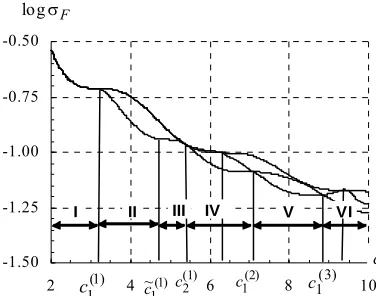
To estimate the effectiveness of different types of so- lutions we consider value of the functional F depend- ing on the parameter c, which it takes on these solutions. For example, in Figure 1 are shown the values of the functional for F s
1. The most effective solution images envelope which: on the segments I corresponds to the primary solution f1, on II-branching-off solutions1 1,2
f at the point c1 1 with odd phase DP, on III-solu-
tions f1,2 1 and branching-off solutions 1 1,2
f from these, on IV-solutions f1,2 1 and branching-off solutions
2 1,2
f
at the point 1 2
c with even phase, на V-branching-off at the point 2
1
c solutions of the type f1,2 1 , on VI-solu-
tions 2 1,2
f .
Thus, the analytical investigations [7,16,52,54] and the results of numerical experiments enable to describe the general structure of the solutions of the problem de- pendeing on change of the value of the parameter c.
Because the values of the functional on some types of solutions in a given interval of change of the parameter c may be equal, the curves shown in Figure1, does not map the full structure of the existing solutions. For greater clarity this structure can be represented sche- matically as a “tree” of solutions. In Figure 2 it is shown for the case of even DP. The primary solution f s c1
,is central. The solution f 1
s c, with odd phase DP
argf 1 s c,
branches first. At the point 1 1 [image:8.595.77.292.88.220.2]-1.50 -1.25 -1.00 -0.75 -0.50
2 4 6 8 10
I II III IV V
c
VI
) 1 ( 1
c (1) 1
~
c c(21) c1(2) c1(3)
F
[image:9.595.76.264.85.233.2]log
Figure 1. The value of the functional σFon the first primary and branching-off solutions for F(s) = 1.
c f1 1 (1)
f1
f1(s,c)
f1,2 (1)
c
c1(1)
~
1,2 (1)
f
1,2 (2)
f
c(1) 2
c(2)1
c(3)1
c1 (1)
~~
1,2(1)
f
~
0
(s,c) (s,c)
(s,c)
(s,c) (s,c)
[image:9.595.86.257.277.455.2](s,c)
Figure 2. “Tree” of solutions.
1
,f s c branches from branching solution f 1
s c, ,and solution f 1
s c, enter in a real solution in aneighborhood of the point 1 2
c at c, tending to 1 2
c . At the same point 1
2
c solution with even phase DP
2
,f s c branches from primary solution. The solution of the type f 1
s c, with an odd phase DP branches atthe point 2 1
c , which is located directly behind 1 2
c . The solutions of the type f 1
s c, and the type f 2
s c,form basic branches of “tree”. The possible branching points of branching-off solutions are shown on these branches.
3.2. Radiating System with a Flat Aperture
3.2.1. Basic Equations and Relations
Consider according with [55-58] the synthesis problems of a flat aperture assuming that form of aperture S is known and a field has elliptical polarization. Let the plane in which aperture is located, coincides with the plane XOY of the Cartesian coordinate system. Then the radiated field in the far zone can be represented by
the formula [6]:
, ,
ei
,
4π
kR k R
R
E D ,
where
,
r
r
D i n i f ,
,
, eik x sin cos ysin sin d d Sx y x y
f U , (52)
r
i is radial ort of spherical coordinate system, n iz,
,
f is a vector DP of flat aperture S . Since
z
n i , function U
x y, describes the tangential component of the electric vector E or vector of current flowing through the aperture S:
x y, U x yx
, xU x yy
, yU i i . (53)
Introducing in a far zone special coordinate system [6]
1
g , g2, g3 connected with orts of spherical coordinate
system by formulas
1cossin
g i i , g2sinicosi, 3 r
g i (54) enables the vector synthesis problem to reduce to two independent scalar synthesis problems.
Obviously, the system g1, g2, g3 is orthonormal,
and transformation (54) is rotation of spherical coordi- nate system on an angle around the vector ir. At that vector D
,
in the coordinate system (54) has the form [6]
1 cos
fx 1 fy 2
D g g , (55)
where
, , ,
i sin cos sin sin ,
,
, e d d
x y x y x y
k x y
x y S
f A U
U x y x y
. (56)For mappings (56) the Parseval equality [59]:
2 2
, , ,
f U
x y x y H x y H
A U U (57)
are valid, that is operators Ax, Ay are isometric. Consider the synthesis problem of a flat aperture, in which component-wise deviation of modules given and synthesized diagrams is taken into account. As optimiza- tion criterion we choose the functional type
2
1 1
2
2 2
1 2
2
1 2 1 2
1 2 1 2 1 2
2 2
1 2 1 2 1 2
, ,
, , d d
, , d d
F
g g
G
g g
g g
G
F s s f s s
F s s f s s s s
f s s f s s s s
U
where Fg1, Fg2 are modulus of components of the
given amplitude DP
21 22
1 2g g
F F F in closed domain
2
G . This criterion provides not only proximity of modules of given F and synthesized f DP’s, but it allows certain to influence on the polarization character- istics of the radiated field [5]. On the base of the neces- sary minimum condition of the functional (58) and the corresponding transformation we obtain system equa- tions (these equations is not connected between them- selves) concerning components of synthesized DP:
1 22 2
1 2
i arg ,
1 2 1 2 1 2 1 2
,
2π
, , , , ; e d d
1, 2
j j
g j j
g j g
f s s g
G
k
f s s B f
F s s K s s s s k s s
j
(59)where
1 2 2
1 1 1 2 2 2
, ,
2π
exp i d d
G c c K Q Q
c x s s c y s s x y
c
(60) is a kernel. In the case of rectangular aperture the kernel
1, , , ; ,2 1 2 1 2
K s s s s c c takes the form
1
1
1
2
2
2
1 2 1 2 1 2
1 1 1 2 2 2
sin sin
, , , ; , c s s c s s
K s s s s c c
c s s c s s
,
(61) where
1 1sin ,1 2 2sin ,2
c ka c ka (62)
are real numeric parameters characterizing the sizes of aperture a1, a2 in wavelengths, k2π is wave
number, 1, 2 are angles that characterize the domain
G (solid angle), in which different from the identity components of amplitude DP Fgj
s s1 , 2
are given.Later on we omit index in (59) and shall investigate the solutions of one equation
, , e
i argf Q d Gf Q Bf
F Q K Q Q c Q, (63)where for reduction of records we introduce the follow- ing notations
1, 2
Q s s , dQd ds s1 2, c
c c1, 2
.Thus, the synthesis problem of flat radiating system with arbitrary polarization of irradiation according to the prescribed amplitude DP is reduced to two independent and simpler synthesis problems with linearly polarized fields in the aperture.
Equation (63) is a nonlinear two-dimensional integral
equation of the Hammerstein type and it has nonunique solutions. Their quality and properties depend on the form of aperture S, the values of parameters c c1, 2 and
properties of given amplitude DP F.
On the base of decomplexification [14] we shall con- sider the complex space C
G as a direct sum of two real spaces of continuous functions
G C G C GC in the domain G. The elements
of this space are written as: f
u v, C
G ,
Re
u f C G , vIm
f C G
. Norms in these spaces have the form:
max , max ,
max , .
C G Q G C G Q G
C G C G C G
u u Q v v Q
f u v
(64)
Equation (63) in the decomplexified space C
G is reduced to equivalent to it system of equations
1 , , , 2 2 d
G
u Q
u Q B u v F Q K Q Q Q
u Q v Q
c ,
2 , , , 2 2 d
G
v Q
v Q B u v F Q K Q Q Q
u Q v Q
c .(65) Denote the closed convex set of continuous functions as SMC
G setting that
, :
u v u u
M M M M M C G
S S S S u S u M ,
:
v v
M M C G
S v S v M ,
max , , d
Q G G
M F Q K Q Q Q
c .Consider one of the properties of the function
exp i argf Q that included in (62) at f Q
0. Obviously,
2 2
1 2exp i arg
i f Q f Q
f Q
u Q v Q
u Q v Q
(66)
is a continuous function if u Q
Ref Q
and
Im
v Q f Q are continuous functions, at that