ISSN Online: 2153-120X ISSN Print: 2153-1196
An Application of Generalized Entropy
Optimization Methods in Survival Data Analysis
Aladdin Shamilov
1, Cigdem Kalathilparmbil
1*, Sevda Ozdemir
21Faculty of Science, Department of Statistics, Anadolu University, Eskişehir, Turkey
2Ozalp Vocational School, Accountancy and Tax Department, Yuzuncu Yil University, Van, Turkey
Abstract
In this paper, survival data analysis is realized by applying Generalized En-tropy Optimization Methods (GEOM). It is known that all statistical distribu-tions can be obtained as MaxEnt distribution by choosing corresponding moment functions. However, Generalized Entropy Optimization Distribu-tions (GEOD) in the form of
MinMaxEnt,MaxMaxEnt
distributions which are obtained on basis of Shannon measure and supplementary optimization with respect to characterizing moment functions, more exactly represent the given statistical data. For this reason, survival data analysis by GEOD acquires a new significance. In this research, the data of the life table for engine failure data (1980) is examined. The performances of GEOD are established by Chi-Square criteria, Root Mean Square Error (RMSE) criteria and Shannon entropy measure, Kullback-Leibler measure. Comparison of GEOD with each other in the different senses shows that along of these distributions(
MinMaxEnt
)
4 is better in the senses of Shannon measure and of Kullback- Leibler measure. It is showed that,(
MinMaxEnt) (
3(
MaxMaxEnt)
4)
is moresuitable for statistical data among
(
MinMaxEnt ,)
m m=1,2,3,4 MaxMaxEnt ,(
(
)
m m=1,2,3,4)
. Moreover,(
MinMaxEnt
)
3 is better for statistical data than(
MaxMaxEnt
)
4 in the sense of RMSE criteria. According to obtained distribution(
MinMaxEnt
)
3(
)
(
MaxMaxEnt 4)
estimator of Probability Density Function f tˆ( )
,Cumula-tive Distribution Function F tˆ
( )
, Survival Function S tˆ( )
and Hazard Rate( )
ˆ
h t are evaluated and graphically illustrated. The results are acquired by us-ing statistical software MATLAB.
Keywords
Survival Function, Censored Observation, Generalized Entropy Optimization Methods,
MaxEnt,MinMaxEnt,MaxMaxEnt
DistributionsHow to cite this paper: Shamilov, A., Kalathilparmbil, C. and Ozdemir, S. (2017) An Application of Generalized Entropy Optimization Methods in Survival Data Analysis. Journal of Modern Physics, 8, 349-364.
https://doi.org/10.4236/jmp.2017.83024 Received: August 5, 2016
Accepted: February 25, 2017 Published: February 28, 2017
Copyright © 2017 by authors and Scientific Research Publishing Inc. This work is licensed under the Creative Commons Attribution International License (CC BY 4.0).
http://creativecommons.org/licenses/by/4.0/
1. Introduction
Entropy Optimization Methods (EOM) have important applications, especially in statistics, economy, engineering and so on. There are several examples in the litera-ture that known statistical distributions do not conform to statistical data; however, the entropy optimization distributions conform well. Generalized Entropy Optimi-zation Methods (GEOM) have suggested distributions in the form of MinMaxEnt which is the closest to statistical data, and MaxMaxEnt which is the furthest from mentioned data in the sense of information theory [1][2], respectively. For this reason, GEOM can be more successfully applied in Survival Data Analysis.
Different aspects and methods of investigations of survival data analysis are considered in [3]-[8].
In particular in the paper [6], it is investigated several problems of hazard rate function estimation based on the maximum entropy principle. The potential ap-plications include developing several classes of the maximum entropy distribu-tions which can be used to model different data-generating distribudistribu-tions that sa-tisfy certain information constraints on the hazard rate function.
In order to represent the results of our investigations, we give some auxiliary concepts and facts first.
2. Survival Analysis
Survival time can be defined broadly as the time to the occurrence of a given
event. This event can be the development of a disease, response to a treatment, relapse or death [9].
Censoring: The techniques for reducing experimental time are known as
cen-soring. In survival analysis, the observations are lifetimes, which can be indefi-nitely long. So quite often the experiment is so designed that the time required for collecting the data is reduced to manageable levels.
Let T be a continuous, non-negative valued random variable representing the lifetime of a unit. This is the time for which an individual (or unit) carries out its appointed task satisfactorily and then passes into “failed’’ or “dead’’ state thereafter [10].
The probabilistic properties of the random variable are studied through its cumulative distribution function F or other equivalent functions defined be-low [9]:
Cumulative Distribution Function:
( )
{
}
0t( )
d , 0F t =P T t< =
∫
f u u < < ∞tSurvival Function: This function is denoted by
S t
( )
, is defined as theproba-bility that an individual survives longer than t:
( )
1
( )
S t
= −
F t
( )
{
}
t( )
d , 0S t =P T t> =
∫
∞f u u < < ∞tProbability Density Function: Like any other continuous random variable, the
probability that an individual fails in the short interval t+ ∆t per unit width
t
∆ , or simply the probability of failure in a small interval per unit time. It can be expressed as
( )
d( )
d( )
d d
F t S t f t
t t
= = −
Hazard Rate: This function is defined as the probability of failure during a
very small time interval, assuming that the individual has survived to the begin-ning of the interval, or as the limit of the probability that an individual fails in a very short interval, t+ ∆t, given that the individual has survived to time t:
( )
f t( )
( )
.h t S t =
3. Generalized Entropy Optimization Methods (GEOM)
Entropy Optimization Problem (EOP) [11] and Generalized Entropy Optimiza-tion problem (GEOP) [10] can be formulated in the following form.EOP: Let f( )0
( )
x be given probability density function (p.d.f.) of randomvariable X, L be an entropy optimization measure and g be a given mo-ment vector function generating m moment constraints. It is required to ob-tain the distribution corresponding to g, which gives extreme value to L.
GEOP: Let f( )0
( )
x be given probability density function of random variableX, L be an entropy optimization measure and K be a set of given moment vector functions. It is required to choose moment vector functions g( )1 ,
( )2
g ∈K such that g( )1 defines entropy optimization distribution f( )1
( )
xclosest to f( )0
( )
x , g( )2 defines entropy optimization distribution f( )2( )
xfurthest from f( )0
( )
x with respect to entropy optimization measure L. If L istaken as Shannon entropy measure, then f( )1
( )
x is called the MinMaxEnt distri-bution, and f( )2
( )
x is called the MaxMaxEnt distribution [1][2][12][13][14].The method of solving GEOP is called as GEOM.
3.1.
MaxEnt
Functional
The problem of maximizing entropy function
( )
1 ln ,(
1, ,)
n
i i n
i
H p = −
∑
= p p p= p p (1)subject to constraints
( )
1 1 1 , 0,1, 2, ,
n n
i i j i j
i= p = i= p g x =µ j= m
∑
∑
(2)where
µ =
01,
g x
0( )
=
1, 0, 1,2, , ; 1
p
i≥
i
=
n m
+ <
n
,
has solution
( )
0 , 1, 2, ,
m j j i j g x
i
p =e−∑ =λ i= n (3)
where
λ
j(
j
=
0,1,2, ,
m
)
are Lagrange multipliers. Finding the distribution(
p p
1,
2
,
p
n)
which maximizes function (1) subject to constraints generatedthe MATLAB program to calculate Lagrange multipliers.
If (3) is substituted into (1), the maximum entropy value is obtained:
( )
0 ( )(
( )
)
max 0
1 0
.
m j j i j
n g x m
m
j j i j j j
i j
H p e− =λ λ g x λ µ
=
= =
∑
= −
∑
−∑
=∑
(4)If distribution ( )0
(
( )0 ( )0)
1 , , np = p p is calculated from the data, the moment
vector value
µ
=
(
1, ,
µ
1
µ
m)
can be obtained for each moment vector function( )
(
1, 1( )
, , m( )
)
g x = g x g x . Thus, Hmax is considered as a functional of
g x
( )
and called the MaxEnt functional. Therefore, we use the notation
U g
( )
to denote the maximum value of H corresponding to( )
(
1, 1( )
, , m( )
)
g x = g x g x .
3.2.
MinMaxEnt
and
MaxMaxEnt
Distributions
Let K be the compact set of moment vector functions
g x U g
( ) ( )
.
reaches its least and greatest values in this compact set, because of its continuity proper-ty. For this reason,( )
( )
( )1( )
( )
( )2min ; max .
g K∈ U g =U g g K∈ U g =U g Consequently,
( )
( )
1( )
( )2 .U g ≤U g
Distributions ( )1
(
( )1 ( )1)
1 , , np = p p and ( )2
(
( )2 ( )2)
1 , , np = p p corresponding
to the g( )1
( )
x and g( )2( )
x , respectively, are called MinMaxEnt andMaxMaxEnt distributions [1].
(
)
MinMaxEnt MaxMaxEnt
method for a finite set of characterizing moment functions can be defined in following form.Let
K
0=
{
g
1, ,
g
r}
be the set of characterizing moment vector functionsand all combinations of r elements of K0 taken m elements at a time be 0,m
K . We note that, each element of K0,m is vector g with m components.
Solving the MinMaxEnt and the MaxMaxEnt problems require to find vector functions
(
( )1( )
)
0,
g g x ,
(
( )2( )
)
0,g g x , where
( )
( )1 ( )20 1, , 0,m 0,m
g x = g ∈K g ∈K minimizing and maximizing
U g
( )
accor-dingly with respect to Shannon entropy measure. It should be noted thatU g
( )
reaches its minimum value subject to constraints generated by functiong x
0( )
and all m-dimensional vector functions
g x g K
( )
,
∈
0,m. In other words,min-imum value of
U g
( )
is least value of values Hmax corresponding to( )
,
0,mg x g K
∈
. If(
( )1)
0,g g gives the minimum value to
U g
( )
then distribu-tion ( )1(
( )1 ( )1)
1 , , n
p = p p corresponding to
(
( )1)
0,g g is called the
MinMaxEnt distribution. MinMaxEnt method represents probability distri-bution in the form of MinMaxEnt distribution. In a similar way,
U g
( )
reaches its maximum value subject to constraints generated by functiong x
0( )
and all m-dimensional vector functions
g x g K
( )
,
∈
0,m. In other words,max-imum value of
U g
( )
is greatest value of values Hmax corresponding to( )
,
0,mg x g K
∈
. If(
( )2)
0,g g gives the maximum value to
U g
( )
then distribu-tion ( )2(
( )2 ( )2)
1 , , n
p = p p corresponding to
(
( )2)
0,MaxMaxEnt distribution. MaxMaxEnt method represents probability dis-tribution in the form of MaxMaxEnt distribution. It should be noted that both distributions can be applied in solving proper problems in survival data analysis.
4. Application of
MinMaxEnt
and
MaxMaxEnt
Methods
to Survival Data
4.1.
MinMaxEnt
and
MaxMaxEnt
Distributions for Finite Set of
Characterizing Moment Functions
In the present research, the data of the life table for engine failure data (1980) given in Table 1 is considered [10].
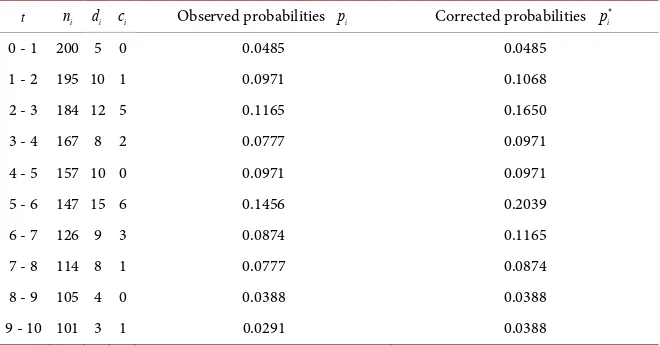
In our investigation, the experiment is planned for 200 numbers of patients surviving at beginning of interval but the presence of censoring from the plan-ning patients 97 individuals stay out the experiment. This situation is taken into account in Table 2.
[image:5.595.206.538.345.528.2]It should be noted that, the presence of censoring in the survival times leads to a situation where the sum of observation probabilities stands less than 1 for the
Table 1. The data of the life table for engine failure data (1980).
Survival Time (year) t
Working at the beginning of interval ni
Failed during the interval di
Censored during the interval ci
0 - 1 200 5 0
1 - 2 195 10 1
2 - 3 184 12 5
3 - 4 167 8 2
4 - 5 157 10 0
5 - 6 147 15 6
6 - 7 126 9 3
7 - 8 114 8 1
8 - 9 105 4 0
9 - 10 101 3 1
Table 2. Observed and corrected probabilities.
t ni di ci Observed probabilities pi Corrected probabilities pi ∗
[image:5.595.209.539.562.735.2]survival data. For this reason, in solving many problems, it is required to sup-plement the sum of observation probabilities up to 1. Since the sum of observed probabilities pi in Table 2 is 0.8155, according to the number of censoring,
supplementary probability 1 0.8155 0.1845− = is uniformly distributed to each censoring data and corrected probabilities
p
i∗ are obtained.As we noted that above, MinMaxEnt and MaxMaxEnt distributions can be applied in solving proper problems in survival data analysis. In our investiga-tion as components of K0 characterizing moment vector function
( )
( )
2( )
( ) ( )
21 , , ln , ln2 3 4
g x =x g x =x g x = x g x = x ,
( )
(
2)
5 ln 1
g x = +x are chosen. The set of moment functions is chosen from the characteristic moments which are mostly used in Statistics.
Consequently,
K
0=
{
g
1, ,
g
5}
. For example, if m=3 then( )
(
1)
(
2(
)
2)
( )1 0, 1, , , ln , 0,3g g = x x x g ∈K
gives the least value to
U g
( )
and( )
(
2)
(
2(
2)
)
( )20, 1, , ln , ln 1 , 0,3
g g = x x +x g ∈K
gives the greatest value to
U g
( )
.The MaxEnt distributions corresponding to
(
g g g x
0, ,
)
0( )
=
1,
g K
∈
0,m, 1,2, ,4
m
=
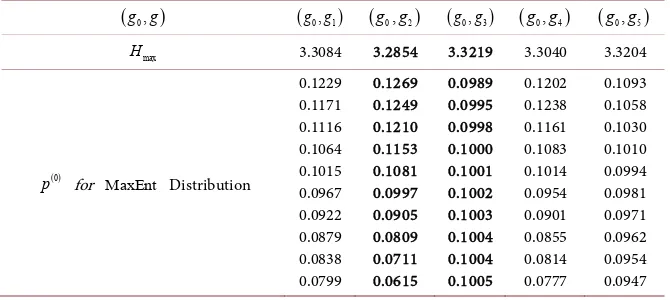
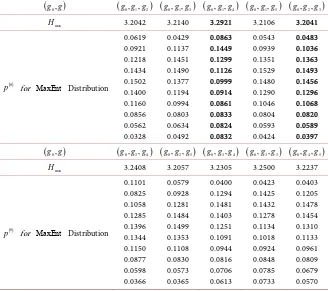
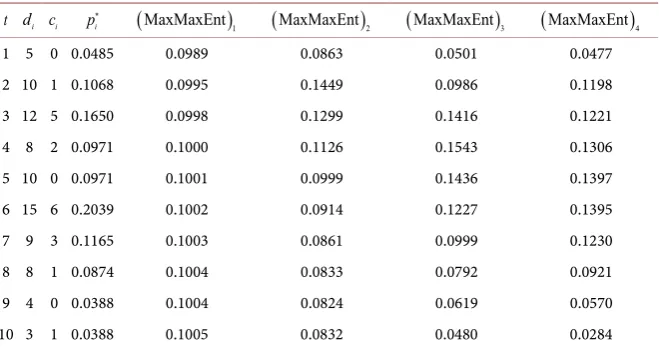
and Hmax values are shown inTables 3-6. In these tables, MinMaxEnt and MaxMaxEnt distributions cor-responding to HMinMax and HMaxMax are represented with bold font. By virtue
of these tables are also obtained
(
MinMaxEnt
)
m,(
MaxMaxEnt
)
m,1,2,3,4
m= distributions which are shown in Table 7 and Table 8.
In order to obtain the performance of the mentioned distributions, we use various criteria as Root Mean Square Error (RMSE), Chi-Square, entropy values of distributions. The acquired results are demonstrated inTable 9 and Table 10.
All
(
MinMaxEnt , MaxMaxEnt ,
) (
m)
mm
=
1,2,3,4
distributions are accepta-ble to survival data in the sense of Chi – Square criteria. [image:6.595.206.541.585.735.2]In the sense of RMSE criteria each
(
MinMaxEnt
) (
mm
=
1,2,3,4
)
distribution is better than corresponding(
MaxMaxEnt
) (
mm
=
1,2,3,4
)
distribution. More-over,(
MinMaxEnt
)
1 is nearer to statistical data than(
MaxMaxEnt
)
1 andTable 3. The predicted probabilities for the MaxEnt distribution corresponding to
(
g g g x0, ,) ( )
0 =1,g K∈ 0,1 and Hmax values.(
g g0,)
(
g g0, 1)
(
g g0, 2)
(
g g0, 3)
(
g g0, 4)
(
g g0, 5)
max
H 3.3084 3.2854 3.3219 3.3040 3.3204
( )0
p for MaxEnt Distribution
Table 4. The predicted probabilities for the MaxEnt distribution corresponding to
(
g g g x0, ,) ( )
0 =1,g K∈ 0,2 and Hmax values.(
g g0,)
(
g g g0, ,1 2)
(
g g g0, ,1 3)
(
g g g0, ,1 4)
(
g g g0, ,1 5)
(
g g g0, ,2 3)
maxH 3.2042 3.2140 3.2921 3.2106 3.2041
( )0
p for MaxEnt Distribution
0.0619 0.0921 0.1218 0.1434 0.1502 0.1400 0.1160 0.0856 0.0562 0.0328 0.0429 0.1137 0.1451 0.1490 0.1377 0.1194 0.0994 0.0803 0.0634 0.0492 0.0863 0.1449 0.1299 0.1126 0.0999 0.0914 0.0861 0.0833 0.0824 0.0832 0.0543 0.0939 0.1351 0.1529 0.1480 0.1290 0.1046 0.0804 0.0593 0.0424 0.0483 0.1036 0.1363 0.1493 0.1456 0.1296 0.1068 0.0820 0.0589 0.0397
(
g g0,)
(
g g g0, ,2 4)
(
g g g0, ,2 5)
(
g g g0, ,3 4)
(
g g g0, ,3 5)
(
g g g0, ,4 5)
max
H 3.2408 3.2057 3.2305 3.2500 3.2237
( )0
p for MaxEnt Distribution
[image:7.595.207.540.444.737.2]0.1101 0.0825 0.1058 0.1285 0.1396 0.1344 0.1150 0.0877 0.0598 0.0366 0.0579 0.0928 0.1281 0.1484 0.1499 0.1353 0.1108 0.0830 0.0573 0.0365 0.0400 0.1294 0.1481 0.1403 0.1251 0.1091 0.0944 0.0816 0.0706 0.0613 0.0423 0.1425 0.1432 0.1278 0.1134 0.1018 0.0924 0.0848 0.0785 0.0733 0.0403 0.1205 0.1478 0.1454 0.1310 0.1133 0.0961 0.0809 0.0679 0.0570
Table 5. The predicted probabilities for the MaxEnt distribution corresponding to
(
g g g x0, ,) ( )
0 =1,g K∈ 0,3 and Hmax values.(
g g0,)
(
g g g g0, , ,1 2 3)
(
g g g g0, , ,1 2 4)
(
g g g g0, , ,1 2 5)
(
g g g g0, , ,1 3 4)
(
g g g g0, , ,1 3 5)
maxH 3.2024 3.2000 3.2042 3.2083 3.2100
( )0
p for MaxEnt Distribution 0.0537 0.0972 0.1291 0.1471 0.1488 0.1355 0.1118 0.0838 0.0573 0.0357 0.0489 0.1034 0.1314 0.1458 0.1466 0.1342 0.1117 0.0844 0.0578 0.0358 0.0625 0.0920 0.1211 0.1427 0.1501 0.1405 0.1167 0.0859 0.0561 0.0324 0.0515 0.0974 0.1359 0.1519 0.1472 0.1290 0.1051 0.0808 0.0593 0.0420 0.0503 0.0988 0.1382 0.1526 0.1458 0.1268 0.1033 0.0802 0.0601 0.0438
(
g g0,)
(
g g g g0, , ,2 3 5)
(
g g g g0, , ,2 3 5)
(
g g g g0, , ,2 3 5)
(
g g g g0, , ,2 3 5)
(
g g g g0, , ,2 3 5)
max
H 3.2104 3.2035 3.2039 3.2050 3.2155
( )0
Table 6. The predicted probabilities for the MaxEnt distribution corresponding to
(
g g g x0, ,) ( )
0 =1,g K∈ 0,4 and Hmax values.(
g g0,)
(
g g g g g0, ,1 2, 3, 4)
(
g g g g g0, ,1 2, 3, 5)
(
g g g g g0, ,1 2, 4, 5)
(
g g g g g0, ,1 3, 4, 5)
(
g g g g g0, ,2 3, 4, 5)
max
H 3.1937 3.1935 3.1936 3.1932 3.1934
( )0
p for MaxEnt Distribution
0.0477 0.1198 0.1221 0.1306 0.1397 0.1395 0.1230 0.0921 0.0570 0.0284
0.0476 0.1203 0.1216 0.1302 0.1402 0.1400 0.1230 0.0917 0.0568 0.0287
0.0477 0.1201 0.1218 0.1303 0.1400 0.1398 0.1230 0.0919 0.0568 0.0286
0.0475 0.1217 0.1192 0.1292 0.1422 0.1421 0.1225 0.0898 0.0560 0.0298
[image:8.595.208.540.290.465.2]0.0476 0.1209 0.1207 0.1298 0.1408 0.1407 0.1229 0.0911 0.0565 0.0290
Table 7. Distributions of
(
MinMaxEnt ,)
m m=1,2,3,4.t di ci pi
∗
(
)
1
MinMaxEnt
(
MinMaxEnt)
2(
MinMaxEnt)
3(
MinMaxEnt)
4 [image:8.595.209.539.499.674.2]1 5 0 0.0485 0.1269 0.0483 0.0489 0.0475 2 10 1 0.1068 0.1249 0.1036 0.1034 0.1217 3 12 5 0.1650 0.1210 0.1363 0.1314 0.1192 4 8 2 0.0971 0.1153 0.1493 0.1458 0.1292 5 10 0 0.0971 0.1081 0.1456 0.1466 0.1422 6 15 6 0.2039 0.0997 0.1296 0.1342 0.1421 7 9 3 0.1165 0.0905 0.1068 0.1117 0.1225 8 8 1 0.0874 0.0809 0.0820 0.0844 0.0898 9 4 0 0.0388 0.0711 0.0589 0.0578 0.0560 10 3 1 0.0388 0.0615 0.0397 0.0358 0.0298
Table 8. Distributions of
(
MaxMaxEnt ,)
m m=1,2,3,4.t di ci pi
∗
(
)
1
MaxMaxEnt
(
MaxMaxEnt)
2(
MaxMaxEnt)
3(
MaxMaxEnt)
41 5 0 0.0485 0.0989 0.0863 0.0501 0.0477 2 10 1 0.1068 0.0995 0.1449 0.0986 0.1198 3 12 5 0.1650 0.0998 0.1299 0.1416 0.1221 4 8 2 0.0971 0.1000 0.1126 0.1543 0.1306 5 10 0 0.0971 0.1001 0.0999 0.1436 0.1397 6 15 6 0.2039 0.1002 0.0914 0.1227 0.1395 7 9 3 0.1165 0.1003 0.0861 0.0999 0.1230 8 8 1 0.0874 0.1004 0.0833 0.0792 0.0921 9 4 0 0.0388 0.1004 0.0824 0.0619 0.0570 10 3 1 0.0388 0.1005 0.0832 0.0480 0.0284
(
MinMaxEnt
)
3 is more suitable and among of distributions(
MaxMaxEnt
)
m,(
m
=
1,2,3,4
)
the distribution(
MaxMaxEnt
)
4 is more convenient for statis-tical data. These results are also corroborated by graphical representation (seeFigures 1-4). Consequently, we shall consider Probability Density Function
( )
ˆ
f t , Cumulative Distribution Function F tˆ
( )
, Survival Function S tˆ( )
and Hazard Rate h tˆ( )
for only(
MinMaxEnt
)
3 and(
MaxMaxEnt
)
4 distributions. Although the distribution with the largest number of moment functions tends to fit better, it should be noted that in some cases, the set of moment functions with fewer elements is more informative then a different set of moment func-tions with more number of elements.Table 9. The obtained results for
(
MinMaxEnt)
m, m=1,2,3,4.Distribution of MinMaxEnt H Calculated value of Chi-Square Chi-Square value Probability of Table value of Chi-Square RMSE
(
MinMaxEnt)
1 3.2854 4.4310 0.81632 8,α 15.51
χ = 0.3158
(
MinMaxEnt)
2 3.2041 0.6512 0.99872 7,α 14.07
χ = 0.1873
(
MinMaxEnt)
3 3.2000 1.7787 0.93892 6,α 12.59
χ = 0.1799
(
MinMaxEnt)
4 3.1932 1.6161 0.89932 5,α 11.07
χ = 0.1830
Table 10. The obtained results for
(
MaxMaxEnt)
m, m=1,2,3,4.Distribution of MinMaxEnt H Calculated value of Chi-Square Chi-Square value Probability of Table value of Chi-Square RMSE
(
MaxMaxEnt)
1 3.3219 5.3820 0.71612 8,α 15.51
χ = 0.3492
(
MaxMaxEnt)
2 3.2921 4.9233 0.66932 7,α 14.07
χ = 0.3492
(
MaxMaxEnt)
3 3.2155 2.2804 0.89222 6,α 12.59
χ = 0.2104
(
MaxMaxEnt)
4 3.1937 1.6383 0.89662 5,α 11.07
χ = 0.1888
(a) (b)
[image:9.595.206.540.260.358.2] [image:9.595.140.538.400.708.2](a) (b)
Figure 2. Graphic of
(
MinMaxEnt)
2 and(
MaxMaxEnt)
2 distributions. [image:10.595.138.537.292.485.2](a) (b)
Figure 3. Graphic of
(
MinMaxEnt)
3 and(
MaxMaxEnt)
3 distributions.(a) (b)
[image:10.595.140.538.520.708.2]4.2. Availability of GEOD to Survival Data in the Sense of Shannon
Measure
In order to establish availability of GEOD to survival data in the sense of Shan-non measure it is required to consider entropy values of GEOD.
From Table 3 it is seen that the MinMaxEnt (the MaxMaxEnt) distribu-tion is realized by vector funcdistribu-tion
(
)
( )
2(
(
) (
)
)
0, 2 1, 0, 3 1,ln
g g = x g g = x and
(
)
(
MinMaxEnt 1)
3.2854(
(
(
MaxMaxEnt)
1)
3.3219)
H = H = .
From Table 4 it is seen that the MinMaxEnt (the MaxMaxEnt) distribu-tion is realized by vector funcdistribu-tion
(
)
(
2)
(
(
)
(
( )
2)
)
0, ,2 3 1, ,ln 0, ,1 4 1, , ln
g g g = x x g g g = x x and
(
)
(
MinMaxEnt 2)
3.2041(
(
(
MaxMaxEnt)
2)
3.2921)
H = H = .
From Table 5 it is seen that the MinMaxEnt (the MaxMaxEnt) distribu-tion is realized by vector funcdistribu-tion
(
)
(
2(
)
2)
(
(
)
(
2(
2)
)
)
0, , ,1 2 4 1, , , ln 0, , ,2 3 5 1, ,ln ,ln 1
g g g g = x x x g g g g = x x +x and
(
)
(
MinMaxEnt 3)
3.2000(
(
(
MaxMaxEnt)
3)
3.2155)
H = H = .
From Table 6 it is seen that the MinMaxEnt (the MaxMaxEnt) distribu-tion is realized by vector funcdistribu-tion
(
)
(
( )
2(
2)
)
(
(
)
(
2( )
2)
)
0, ,1 3, 4, 5 1, ,ln , ln ,ln 1 0, ,1 2, 3, 4 1, , ,ln , ln
g g g g g = x x x +x g g g g g = x x x x
and H
(
(
MinMaxEnt)
4)
=3.1932(
H(
(
MaxMaxEnt)
4)
=3.1937)
.Comparison of GEOD with each other in the sense of Shannon measure shows that along of these distributions
(
MinMaxEnt
)
4 is better.The results of our investigation according to using known characterizing moment vector functions from K0,m are summarised in the form of following
Corollary.
Corollary 1. If by
(
MaxMaxEnt) (
m(
MinMaxEnt)
m)
denote theMaxMaxEnt (the MinMaxEnt) distribution corresponding to m moment conditions generated by moment functions
g x g K
( )
,
∈
0,m, then inequality(
)
(
)
(
(
)
)
(
)
(
)
(
(
)
)
(
11 22)
MaxMaxEnt MaxMaxEnt
MinMaxEnt MinMaxEnt
m m
m m
H H
H H
>
>
is fulfilled, when m m1< 2. In other words, entropy value of the MaxMaxEnt
(the MinMaxEnt) distribution depending on the number m of moment con-ditions decreases.
Moreover for any m the inequality
(
)
(
MaxMaxEnt m)
(
(
MinMaxEnt)
m)
H >H
takes place.
4.3. Availability of GEOD to Survival Data in the Sense of
Kullback-Leibler Measure
Now, we calculate the distance between observed distribution
(
1, , ,
2 10)
ip
=
p p
p
given in Table 2 and distributions( )
(
)
( )(
)
mini MinMaxEnt ,i maxi MaxMaxEnt ,i 1, 2,3, 4
p = p = i= given in Table 7 and
It is known that the Kullback – Leibler distance between distributions
(
1, , ,
2 n)
p
=
p p
p
andq
=
(
q q
1, , ,
2
q
n)
is obtained by formula(
;)
n1 ln i i ii p D p q p
q
=
=
∑
.By starting these formula Kullback-Leibler measures for the distance between observed distribution
p
i=
(
p p
1, , ,
2
p
10)
and distributions( )
(
)
( )(
)
mini MinMaxEnt ,i maxi MaxMaxEnt ,i 1, 2,3, 4
p = p = i= are given in Table 11
and Table 12 respectively.
From Table 11 and Table 12 follows that along of GEOD
(
MinMaxEnt
)
4 is better in the sense of Kullback-Leibler measure.The results of our investigation according to using known characterizing moment vector functions from K0,m are summarised in the form of following
Corollary.
Corollary 2. If
p
i=
(
p p
1, , ,
2
p
10)
observed distribution and( )
(
)
(
( )(
)
)
mini MinMaxEnt ,i 1, 2,3, 4 maxi MaxMaxEnt ,i 1, 2,3, 4
p = i= p = i= denote the
MinMaxEnt (the MaxMaxEnt ) distribution corresponding to i moment conditions generated by moment functions
g x g K
( )
,
∈
0,m, then inequality( )
(
)
(
( ))
( )
(
)
(
( ))
(
)
1 2
1 2
min min
max max
; ;
; ;
m m
i i
m m
i i
D p p D p p
D p p D p p >
>
is fulfilled, when m m1< 2. In other words, Kullback-Leibler value of the
MinMaxEnt (the MaxMaxEnt) distribution depending on the number
m
ofmoment conditions decreases.
Moreover for any i the inequality
( )
(
)
(
( ))
maxi ; i mini ; i
D p p >D p p
[image:12.595.207.539.525.611.2]takes place.
Table 11. Kullback-Leibler measure of
(
MinMaxEnt , 1,2,3,4)
m i= distributions.(
MinMaxEnt , 1,2,3,4)
m i= distributions(
( ))
min; , 1,2,3,4 i
i
D p p i=
(
MinMaxEnt)
1 0.3938(
MinMaxEnt)
2 0.3348(
MinMaxEnt)
3 0.3300(
MinMaxEnt)
4 0.3193Table 12. Kullback-Leibler measure of
(
MaxMaxEnt , 1,2,3,4)
m i= distributions.(
MaxMaxEnt , 1,2,3,4)
m i= distributions(
( ))
max; , 1,2,3,4 i
i
D p p i=
(
MaxMaxEnt)
1 0.4441(
MaxMaxEnt)
2 0.4009(
MaxMaxEnt)
3 0.3457 [image:12.595.205.539.648.734.2]4.4. Survival Expression of Distributions
(
MinMaxEnt
)
3,
(
MaxMaxEnt
)
4In this section survival data analysis is conducted by
(
MinMaxEnt) (
3(
MaxMaxEnt)
4)
distribution since the above acquired investi-gations(
MinMaxEnt) (
3(
MaxMaxEnt)
4)
is more presentable for survival data among(
MinMaxEnt) (
m(
MaxMaxEnt)
m)
, m=1, 2, , 4 distributions.(
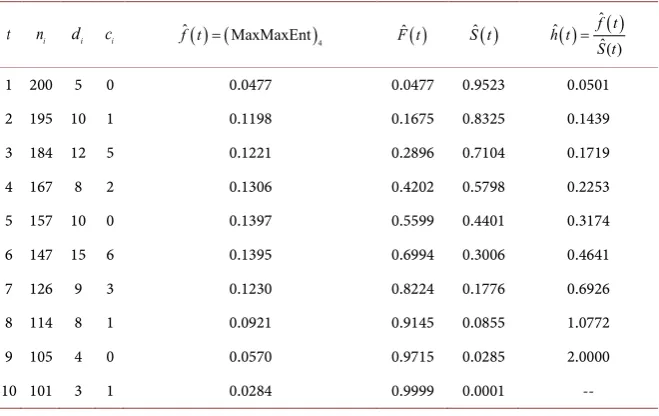
MinMaxEnt
)
3 and(
MaxMaxEnt
)
4 estimations of Probability Density Function f tˆ( )
, Cumulative Distribution Function F tˆ( )
, Survival Function( )
ˆ
S t and Hazard Rate h tˆ
( )
are given in Table 13 & Table 14, respectively. On basis of the results given in Table 13 & Table 14, graphs of f t F tˆ( )
, ˆ( )
,( )
ˆ
[image:13.595.208.541.290.495.2]S t and h tˆ
( )
are demonstrated in Figures 5(a)-(c) & Figures 6(a)-(c).Table 13. Survival analysis by
(
MinMaxEnt)
3.t ni di ci f tˆ( ) (= MinMaxEnt)3 F tˆ( ) S tˆ( ) ( )
( ) ( )
ˆ ˆ
ˆ
f t h t
S t
=
1 200 5 0 0.0489 0.0489 0.9511 0.0514 2 195 10 1 0.1034 0.1523 0.8477 0.1220 3 184 12 5 0.1314 0.2837 0.7163 0.1834 4 167 8 2 0.1458 0.4295 0.5705 0.2556 5 157 10 0 0.1466 0.5761 0.4239 0.3458 6 147 15 6 0.1342 0.7103 0.2897 0.4632 7 126 9 3 0.1117 0.8220 0.1780 0.6275 8 114 8 1 0.0844 0.9064 0.0936 0.9017 9 105 4 0 0.0578 0.9642 0.0358 1.6145 10 101 3 1 0.0358 1.0000 0.0000 --
Table 14. Survival analysis by
(
MaxMaxEnt)
4.t ni di ci f tˆ( ) (= MaxMaxEnt)4 F tˆ( ) S tˆ( ) ( )
( )
ˆ ˆ
ˆ( )
f t h t
S t
=
[image:13.595.209.539.528.736.2](a) (b)
[image:14.595.168.535.61.522.2](c)
Figure 5. Survival expression of distribution
(
MinMaxEnt)
3.5. Conclusion
(a) (b)
[image:15.595.168.539.61.556.2](c)
Figure 6. Survival expression of distribution
(
MaxMaxEnt)
4.is showed that,
(
MinMaxEnt) (
3(
MaxMaxEnt)
4)
is more suitable for statisticaldata among
(
MinMaxEnt ,)
m m=1, 2,3, 4 MaxMaxEnt ,(
(
)
m m=1, 2,3, 4)
. More-over,(
MinMaxEnt
)
3 is better for statistical data than(
MaxMaxEnt
)
4 in the sense of RMSE criteria. According to obtained distribution(
MinMaxEnt
)
3(
)
(
MaxMaxEnt 4)
estimator of Probability Density Function f tˆ( )
, CumulativeReferences
[1] Shamilov, A. (2006) A Development of Entropy Optimization Methods. Wseas Transactions on Mathematics, 5, 568-575.
[2] Shamilov, A. (2007) Generalized Entropy Optimization Problems and the Existence of Their Solutions. Physica A: Statistical Mechanics and Its Applications, 382, 465- 472. https://doi.org/10.1016/j.physa.2007.04.014
[3] Kaminski, D. and Geisler, C. (2012) Survival Analysis of Faculty Retention in Science and Engineering by Gender. Science, 335, 864-866.
https://doi.org/10.1126/science.1214844
[4] Reingold, E.M., Reichle, E.D. and Glaholt, M.G. (2012) Heather Sheridan, Direct Lexical Control of Eye Movements in Reading: Evidence from a Survival Analysis of Fixation Durations. Cognitive Psychology, 65, 177-206.
[5] Wang, H. and Dai, H.S. (2012) Accelerated Failure Time Models for Censored Sur-vival Data under Referral Bias. Biostatistics, 14, 313-326.
[6] Ebrahimi, N. (2000) The Maximum Entropy Method for Lifetime Distributions. Sankhyā: The Indian Journal of Statistics, Series A, 62, 236-243.
[7] Guyot, P., Ades, A., Ouwens, M.J. and Welton, N.J. (2012) Enhanced Secondary Analysis of Survival Data: Reconstructing the Data from Published Kaplan-Meier Survival Curves. BMC Medical Research Methodology, 12, 9.
https://doi.org/10.1186/1471-2288-12-9
[8] Joly, P., Gerds, T.A., Qvist, V., Commenges, D. and Keiding, N. (2012) Estimating Survival of Dental Fillings on the Basis of Interval-Censored Data and Multi-State Models. Statistics in Medicine, 31, 11-12.
[9] Lee, E.T. and Wang, J.W. (2003) Statistical Methods for Survival Data Analysis. Wi-ley-Interscience, Oklahoma.
[10] Deshpande, J.V. and Purohit, S.G. (2005) Life Time Data: Statistical Models and Methods, Series on Quality. Vol. 11, Reliability and Engineering Statistics, India. [11] Kapur, J.N. (1992) Kesavan, Entropy Optimization Principles with Applications. [12] Shamilov, A. (2009) Entropy, Information and Entropy Optimization. T.C. Anadolu
University Publication, Eskisehir.
[13] Shamilov, A. (2010) Generalized Entropy Optimization Problems with Finite Mo-ment Functions Sets. Journal of Statistics and Management Systems, 13, 595-603. https://doi.org/10.1080/09720510.2010.10701489
Submit or recommend next manuscript to SCIRP and we will provide best service for you:
Accepting pre-submission inquiries through Email, Facebook, LinkedIn, Twitter, etc. A wide selection of journals (inclusive of 9 subjects, more than 200 journals)
Providing 24-hour high-quality service User-friendly online submission system Fair and swift peer-review system
Efficient typesetting and proofreading procedure
Display of the result of downloads and visits, as well as the number of cited articles Maximum dissemination of your research work
Submit your manuscript at: http://papersubmission.scirp.org/