R E V I E W
Open Access
Optimizing methods and dodging pitfalls in
microbiome research
Dorothy Kim
1†, Casey E. Hofstaedter
1†, Chunyu Zhao
1, Lisa Mattei
1, Ceylan Tanes
1, Erik Clarke
2, Abigail Lauder
2,
Scott Sherrill-Mix
2, Christel Chehoud
2, Judith Kelsen
1, Máire Conrad
1, Ronald G. Collman
3, Robert Baldassano
1,
Frederic D. Bushman
2and Kyle Bittinger
1*Abstract
Research on the human microbiome has yielded numerous insights into health and disease, but also has resulted in a
wealth of experimental artifacts. Here, we present suggestions for optimizing experimental design and avoiding known
pitfalls, organized in the typical order in which studies are carried out. We first review best practices in experimental
design and introduce common confounders such as age, diet, antibiotic use, pet ownership, longitudinal instability, and
microbial sharing during cohousing in animal studies. Typically, samples will need to be stored, so we provide data on
best practices for several sample types. We then discuss design and analysis of positive and negative controls, which
should always be run with experimental samples. We introduce a convenient set of non-biological DNA sequences that
can be useful as positive controls for high-volume analysis. Careful analysis of negative and positive controls is particularly
important in studies of samples with low microbial biomass, where contamination can comprise most or all of a sample.
Lastly, we summarize approaches to enhancing experimental robustness by careful control of multiple comparisons and
to comparing discovery and validation cohorts. We hope the experimental tactics summarized here will help researchers
in this exciting field advance their studies efficiently while avoiding errors.
Keywords:
Metagenomics, 16S rRNA gene, Shotgun metagenomics, Environmental contamination, Methods,
Study design, Best practices
Background
Studies of microbial communities
—
the microbiome
—
have
become quite popular in recent years. These studies are
powered by the new DNA sequencing technologies which
allow acquisition of over one trillion bases of sequence
in-formation in a single instrument run. Using these
methods, sequence profiles of microbial communities
from different sources can be obtained and compared to
elucidate the associated patterns in the microbiota. For
ex-ample, human samples from a disease state can be
com-pared to samples from healthy controls, allowing for
quantification of differences [1
–
8]. In these studies, DNA
is first purified from the samples. DNA sequencing is then
used to characterize the associated taxa, querying either a
marker gene (16S for bacteria, 18S for eukaryotes, and
ITS for fungi) or all DNAs in a mixture (shotgun
metage-nomics sequencing). In at least some situations, the nature
of these microbial communities matters a lot
—
fecal
mi-crobial transplantation radically resets gut community
structure and cures relapsing
Clostridium difficile
infec-tion in up to 90% of cases [9, 10].
Carrying out definitive experiments on the microbiota
requires great care, as in any field of research. All
analyt-ical methods have biases that must be taken into account
in experimental execution and interpretation. For
ex-ample, for analysis of 16S rRNA gene segments, the choice
of gene region studied influences the types of bacteria
queried [11
–
16]. Another example, emphasized here,
in-volves low microbial biomass samples. If there is very little
microbial DNA in a specimen, the library preparation and
sequencing methods will often return sequences that are
derived primarily from contamination [17
–
24].
Contamin-ating sequences can originate in reagents, dust, crossover
between samples, or other sources. Without appropriate
precautions and controls, these false calls can be difficult
* Correspondence:[email protected] †Equal contributors
1Division of Gastroenterology, Hepatology, and Nutrition, The Children’s
Hospital of Philadelphia, Philadelphia, Pennsylvania 19104, USA Full list of author information is available at the end of the article
to distinguish from authentic microbiota. Other challenges
mentioned below include changes associated with sample
storage, microbial sharing among animals during
cohous-ing, and authentic longitudinal microbial instability in the
body site of a host animal.
The goal of this article is to catalog major challenges in
microbiome research and to outline approaches to address
them. Many of these points have come up in the projects of
the PennCHOP Microbiome Program, with which the
au-thors of this article are associated. This review is intended
to help our collaborators and other microbiome researchers
wrestling with these issues. We will focus primarily on
la-boratory work important for microbiome analysis and
touch on computational and statistical methods only
briefly. Most examples will be from 16S rRNA marker gene
sequencing, but examples from ITS marker gene
sequen-cing for fungi and shotgun metagenomics are also
dis-cussed. Several good articles have also addressed these
issues and are recommended as additional reading [25
–
29].
Reviews of methods for bioinformatics analysis of
micro-biome specimens include [28, 30
–
33]. We focus here on
studies of the vertebrate microbiome and break out points
that are specific to studies of humans and model organisms.
We present sections in an order that matches the
progres-sion of performing an experiment
—
the paper begins with
study design, continues with sample collection and
process-ing, and concludes with analysis.
Planning a microbiome experiment
It is essential to plan carefully to ensure that the
experi-ment carried out will answer the question posed. Plan the
statistical analysis for your study at the start. If possible,
carry out a power analysis. Several approaches tailored to
microbiome research have been reported [34, 35].
Consider the influence of factors such as antibiotic use,
age, sex, diet, geography, and pet ownership
The human microbiome is sensitive to its environment,
which can considerably confound associating any
par-ticular condition or intervention with a change in
micro-biota composition. Drug use, diet, age, geography, pet
ownership, and sex have all been reported to influence
function and composition [36
–
39]. In 2008, Relman and
colleagues documented effects of antibiotic treatment on
the gut microbiome, and many subsequent studies have
also reported effects [5, 40
–
42]. It has further been
sug-gested that additional prescription drugs can affect
microbiome analyses [43, 44]. For example, Imhann
et al. have suggested that decreasing the acidity of the
stomach with proton pump inhibitors allows upper
gastrointestinal microbes to move down into the gut
more readily [45], altering the composition of the lower
gastrointestinal microbiota and increasing the risk of
C.
difficile
infections.
Diet also influences the microbiota [5, 46
–
56]. Microbial
community structure and gene expression are reported to
change on time scales in response to extreme
short-term alterations in diet [57]. Long-short-term dietary patterns
have been linked to gut microbiomes dominated by
cer-tain genera
—
diets high in protein and animal fat are
asso-ciated with high
Bacteroides
, whereas diets high in
carbohydrates are associated with high
Prevotella
[55].
The human microbiome evolves from birth until death.
Typically, the gut microbiota adopts a stable anaerobic
pattern around age 3 years but varies in early life [58
–
60].
The microbiome also changes in old age, with
institution-alized elderly commonly developing high levels of
Proteo-bacteria
[61]. Thus, it is critical to use age-matched
controls for microbiota comparisons.
Sex can also affect microbiome studies. The gut
micro-biome serves as a virtual endocrine organ due to the
me-tabolites and neurotransmitters it produces [62]. For
example, early microbial exposure has increased
testoster-one levels in male mice, leading to a protective effect
against type 1 diabetes [63]. When the microbiota from
these protected male mice was transplanted into younger
female mice, the same protection against type 1 diabetes
was seen [63]. A study of an anti-psychotic drug on weight
and gut microbiota in male and female rats reported that
drug treatment induced significant weight gain in female
rats only [64]. Microbial circadian rhythms in mice were
re-ported to differ between sexes [65]. Sex differences in
microbiota have also been reported in macaques [39, 66].
Remarkably, even sexual preference among men has
been linked to gut microbiome differences [67], which
may be a confounding factor in studies of gut
micro-biome and HIV infection where controls were not
matched by sexual preference.
Other studies have investigated whether pets influence
the human microbiome and vice versa [68]. One group
showed that cohabiting adults shared more similar skin
microbiota if they owned a dog [69].
How each of these factors will influence any given
microbiome study is dependent on the question asked
and the strengths of differences between study groups.
In general, it is important to enumerate possible
con-founders during experimental design, quantify each, and
then treat them each as independent variables in
down-stream statistical analyses.
Longitudinal instability
the human vagina, can vary on short-time scales without
necessarily indicating dysbiosis [74
–
78]. Even the gut
microbiome has been reported to display circadian
be-havior on a 24-h cycle [65, 79, 80]. Thus, for studies of a
new sample type, it is essential to understand
longitu-dinal variation in order to acquire samples that address
the question posed.
Different batches of DNA extraction kit reagents can be
a significant source of variation for longitudinal studies
[23, 81]. It is wise to purchase all the extraction kits needed
at the start of the study, or store samples and extract all at
the same time, to minimize the effects of this variable.
Cage effects in animal experiments
Cage effects can derail microbiome studies in mice and
may be important for other laboratory animals as well.
Mice housed in the same cage come to share similar gut
microbiota due to mixing by coprophagia [82]. For
per-spective, in a recent study, mouse strain was found to
ac-count for 19% of the variation in gut microbiota, whereas
cage effects contributed to 31% [83].
To account for cage effects, an investigator must set
up multiple cages for each study group and treat the
cage as a variable in the final statistical analyses. One
can then determine whether microbial communities
dif-fer between groups given the measured effect of the cage
variable. To keep costs down, it is fine to house two to
three mice per cage [84
–
86].
As an example, consider the longitudinal study of
fun-gal populations during an antibiotic intervention in mice
in Dollive et al. [87]. In this work, antibiotic treatment
was associated with increased fungal colonization in the
treated groups (Fig. 1). The fungi detected were mostly
consistent within each cage, but varied from cage to cage
within each treatment group and also in the untreated
controls. The types of fungi detected changed
longitu-dinally, but nevertheless were consistent within cages.
This highlights how potent cage effects can be, and
em-phasizes the importance of analyzing multiple cages per
study group.
Considerations during sample collection and
processing
Sample storage conditions
The most important considerations for storing
micro-biome samples are to reduce changes in the original
microbiota from sample collection to processing and to
keep storage conditions consistent for all samples in a
study. Sample storage conditions are not always consistent
between labs due to downstream applications and
re-source limitations. In 2010, Wu et al. compared human
fecal samples that were immediately frozen at
−
80 °C,
stored on ice for 24 h, or stored on ice for 48 h before
DNA extraction and analysis. Differences due to storage
method were not significant compared to differences
be-tween human individuals [88].
Due to an increased number of studies collecting
sam-ples from remote locations, several groups have assessed
the efficacy of preservation methods that may be used
when laboratory freezers are not readily available. In
2016, Song et al. tested the effects of different
preserva-tives and temperature fluctuations on feces to mimic
microbiome sampling in the field. If fecal samples
can-not be frozen, store the samples in 95% ethanol, on FTA
cards, or use the OMNIgene Gut kit [89]. These
condi-tions are optimized for sample collection in the field;
however, they may not be applicable to all studies
depending on study goals and available resources. Other
groups have also published similar sample storage
studies [90
–
97].
Candida
Cyberlindnera Debaryomyces
Sporopachydermia
Cage
1 2
1 2
1 2
Mouse 0
0.2 0.4 0.6 0.8 1 Condition 2
Condition 1 Condition 3
A11 A12 A14 A15 A16 A17 A18 A19 A20 A1 A2 A3 A4 A5 A6 A7 A8 A9 N1 N2 N3 N4 N5 N6 N7 N8 N9 N10
Fig. 1Example of cage effects dominating a mouse study of fungal communities. Fungal lineages in the murine gut were inferred from ITS rRNA
gene sequencing of pellets [87]. The heat maps summarize taxonomic assignments derived from the sequence data. The color scale to theright
We recently performed a study on the storage of oral
swab samples and found conditions to be relatively
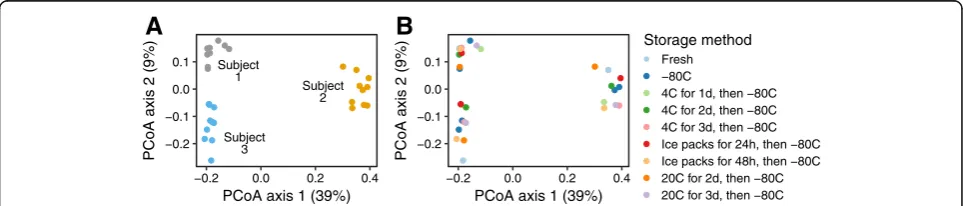
forgiv-ing (Fig. 2). In this study, we collected cheek swab samples
from three healthy subjects and stored them in a variety
of conditions (frozen at
−
20 °C, refrigerated at 4 °C, or
stored at an ambient temperature of 20 °C for 0, 24, 48,
72, or 96 h) before freezing at
−
80 °C (details and
add-itional analysis are presented in Addadd-itional file 1). Figure 2
shows a principal coordinates analysis of unweighted
Uni-Frac distance between the samples. The subject identifier
(Fig. 2a) accounted for almost half the total variation in
UniFrac distances (
R
2= 0.47,
P
< 0.001). The storage
con-ditions did not represent a significant effect (Fig. 2b)
—
we
estimated the relative effect size at less than half the effect
of inter-subject variability (
R
2= 0.17,
P
= 0.2). The UniFrac
results were recapitulated in our analysis of taxon
abun-dances, where the effect of subject far exceeded any
po-tential storage effects. This analysis provided evidence that
over a period of 3 days, storage conditions of cheek swabs
did not substantially influence the measured oral
micro-biome composition for these subjects. Another group
re-cently investigated the effect of collection method, storage
condition, and storage medium on taxonomic relative
abundance in saliva and dental plaque, and found saliva
samples stored in OMNIgene medium to be relatively
consistent after a week at room temperature [98].
Optimal storage conditions have also been investigated
for other sample types. Lauber et al. tested the effect of
both temperature and length of storage on relative taxon
abundance of bacterial communities in soil, human skin,
and human fecal samples. The overall composition of
bacterial communities and the relative abundance of
most major bacterial taxa did not change with different
storage conditions studied (
P
> 0.1 for all sample types)
[99]. Replicate samples for both skin and feces clustered
by host rather than by temperature or length of storage.
However, Lauber et al. mentioned that one fecal sample
replicate kept at room temperature was excluded from
analysis due to visible fungal growth before DNA was
extracted. Though convenience can be prioritized when
handling samples over a short period of time (e.g.,
ship-ping samples on cold-packs for a 48 hour period before
putting them in the freezer), we do recommend freezing
samples promptly after collection or using alternative
preservative methods if freezers are unavailable [89].
Low microbial biomass samples
—
managing
environmental contamination
Handling and analyzing samples with low microbial
bio-mass can be challenging. Reagent and laboratory
contam-ination comprise a larger proportion of the total microbial
load in these samples compared to samples with rich
mi-crobial communities (e.g., healthy human feces). The low
absolute amount of starting material can be overpowered
by trace amounts of DNA from reagents or laboratory
in-struments used for sample processing, so that some or all
of the microbial reads can be derived from environmental
sources. Accounting for potential contaminants is
espe-cially important when studying the microbiome of body
sites with low levels of bacteria, such as the human lung
and skin, or sites that may not normally harbor any
mi-crobes at all, such as various healthy tissues [17, 19, 22].
Problems with contamination were well recognized
even before the era of deep sequencing [100
–
102]. More
recently, several groups have reported on the presence
of bacteria in DNA extraction kits
—
the
“
kitome
”—
as
well as other reagents used during sample processing
[20, 23, 24, 103]. Salter et al. demonstrated that serial
di-lutions of a bacterial culture produced more
contaminat-ing 16S sequence reads and fewer
“
real
”
reads with each
subsequent dilution, until contamination accounted for
the majority of total sequences [23]. This pattern
oc-curred at three different institutes that participated in
this study, indicating a widespread issue [23]. Salter and
colleagues also investigated effects of the number of
PCR cycles for amplification. For low biomass samples,
20 cycles was too low, but 40 cycles recovered both
con-taminating and authentic low level sequences [23]. Later,
−0.2 −0.1 0.0 0.1
−0.2 0.0 0.2 0.4
PCoA axis 1 (39%)
PCoA axis 2 (9%)
Storage method
Fresh −80C
4C for 1d, then −80C 4C for 2d, then −80C 4C for 3d, then −80C Ice packs for 24h, then −80C Ice packs for 48h, then −80C 20C for 2d, then −80C 20C for 3d, then −80C −0.2
−0.1 0.0 0.1
−0.2 0.0 0.2 0.4
PCoA axis 1 (39%)
PCoA axis 2 (9%)
Subject 3
Subject 2 Subject
1
A
B
Fig. 2Effects of sample storage methods on community structure inferred for oral swabs. Oral swab samples were acquired from three human
Kennedy and colleagues reported that starting template
concentration was the major factor behind variability in
sequencing results [104]. Even in metagenomic samples
prepared without a targeted PCR amplification step,
similar contamination patterns were observed for
sam-ples containing low amounts of microbial DNA [23].
The kitome varies between kits, and can even vary
be-tween different lots of the same kit [20, 23]. Thus, it is
best to process all samples in a project side by side using
the same batches of reagents. It is crucial to record the
kit used to process each sample, and which batch of
each kit was used. If multiple kits were used, treat kit
batch as a factor in the statistical analysis.
In our lab, we have investigated different DNA
extrac-tion methods in order to minimize the presence of the
kitome. While the MO BIO PowerSoil DNA Isolation Kit
(MO BIO Laboratories, Carlsbad, CA, USA) provides high
yields and has been used widely in microbiome work,
in-cluding the Human Microbiome Project [105], the kit was
designed to isolate DNA from soil, stool, and
environmen-tal samples which are high in microbial DNA. The MO
BIO kit was not manufactured with the intention of
min-imizing background contamination.
C. difficile
and
Strep-tophyta
, for example, have both been identified as possible
reagent contaminants in this kit [22]. For low microbial
biomass samples, we instead recommend using DNA
iso-lation kits designed to minimize kit contamination (e.g.,
the QIAamp UCP (UltraClean production) Pathogen Mini
Kit (QIAGEN)). Remember: it is important to choose one
kit type for all of the samples in a microbiome study.
Thus, if a project contains both low and high microbial
biomass samples, please commit to one kit type for all
samples in order to avoid kitome variation.
On the analytical side, several methods have been
de-veloped for filtering suspected contaminating taxa. In a
study of the human oral and lung microbiome, Bittinger
et al
.
introduced a method to determine the probability
that fungal taxa arose from contamination sources [18],
making use of the total fungal DNA concentration, as
ap-proximated by post-PCR assays of DNA concentration
using PicoGreen. The PicoGreen assay is usually included
in the sequencing protocol as a standard step, so the data
is available with no extra effort. Similarly, Lazarevic et al.
presented a method that incorporates measurements of
total DNA concentration by qPCR, a more accurate but
more resource-intensive approach [106]. Jervis-Bardy and
colleagues showed that contaminating taxa tend to show
a strong decrease in relative abundance as total DNA
concentration increases and used this as the basis of
another method to remove contaminant taxa [21].
Indi-vidual contamination sources can be modeled using
SourceTracker, which employs a Bayesian approach to
es-timate the relative fraction of sequence reads arising from
each source [107].
Studies investigating a potential placenta microbiome
provide a case study of the difficulties of working with low
biomass samples (Fig. 3). Several groups have reported
that there may be a unique, low-abundance microbiome
in healthy human placenta [46, 108
–
110], but reporting of
negative controls in these studies has been incomplete.
However, a series of independent control studies showed
no significant difference in taxonomic abundance between
placenta samples and contamination controls [22]. Lauder
and colleagues extracted DNA from placenta from six
hu-man subjects and worked them up alongside several types
of blank swabs and empty extraction wells containing
re-agents only. DNA was extracted from samples using two
different purification kits in order to characterize the
con-tribution of the kitome. Real-time qPCR was performed to
quantify total 16S rRNA gene copies in placental samples,
controls, and saliva samples (from the same subjects)
which were also purified using both DNA extraction kits.
Placental samples and controls showed copy numbers that
were low and indistinguishable from negative controls
re-gardless of the kit used, whereas oral samples showed high
signals several logs above background. Characterization of
bacterial lineages by 16S rRNA gene sequencing showed
that oral samples harbored distinct 16S profiles
character-istic of the well-studied oral microbiota, and results were
consistent between kits. However, placental and control
samples looked similar to each other, but the pattern seen
tracked with the DNA extraction kit used rather than with
the sample type (Fig. 3). Several of the shared lineages
found in placental and control samples were known
con-taminants of DNA extraction kits. The inference was that
the kitome provided the predominant microbial signature
in placental samples [22]. It remains to be seen whether
future studies can show a clear distinction between
pla-cental samples and negative controls.
Negative control samples
It is essential to collect negative control samples to allow
empirical assessment of the contamination background. We
commonly include three types of negative control samples
on each 16S rRNA marker gene sequencing run (Fig. 4). In
“
blank swab
”
samples, a sterile swab was opened from its
package in the sequencing lab, and the full sequencing
protocol was applied to the swab. In
“
blank extraction
”
sam-ples, DNA extraction and all subsequent steps were carried
out with no additional input material. In
“
blank library
”
samples, the extraction protocol was not applied; DNA-free
water (UltraClean PCR Water, MO BIO Laboratories,
Carlsbad, CA, USA) was used as input to the
post-extraction steps of the protocol, starting with library
gener-ation, to characterize contamination in downstream steps.
MO BIO Powersoil Kit PSP Spin Stool DNA Plus Kit
Extr
action Blank Ster
ile Sw
ab
OR Air Sw
ab
Placenta (FS) Placenta (MS)
Sali
v
a
Ext
raction Blank Ster
ile Sw
ab
OR Air Sw
ab
Placenta (FS) Placenta (MS)
Sali
v
a
0% 25% 50% 75% 100%
Clostridiales
Sediminibacterium
Bradyrhizobiaceae
Lactobacillus
Streptococcus
Prevotella
Veillonella
Enterococcus
Phyllobacteriaceae
Enterobacteriaceae
Methylobacterium
Ruminococcaceae
Other
Fig. 3Wrestling with kit contamination—similar bacterial composition in placental samples and negative controls. Relative abundances of bacterial
lineages were inferred from 16S V1-V2 rRNA marker gene sequence information [22]. Samples studied included negative controls, fetal side (FS) placental swabs, maternal side (MS) placental swabs, saliva, and vaginal swabs. Replicates of each sample were extracted using two different kits—the kit type is indicated above each panel. Operating room (OR) air swabs are swabs that were waved in the air at the time of sample collection to be used as negative controls. Saliva samples, which are high in microbial biomass, showed similar compositions for each of the two extractions; placental samples resemble the kit-specific negative controls
0e+00 5e+04 1e+05
experimental blank swab blank extraction blank library
Sample Types
A
v
er
age read counts
Actinobacteria Actinomycetaceae Actinobacteria Corynebacterium Actinobacteria Friedmanniella Actinobacteria Propionibacterium Bacteroidetes Bacteroides Bacteroidetes Prevotella Bacteroidetes Rikenellaceae Bacteroidetes S24−7 Cyanobacteria MLE1−12 Firmicutes Alicyclobacillus Firmicutes Catenibacterium Firmicutes Clostridiales Firmicutes Lachnospiraceae Firmicutes Lactobacillus Firmicutes Ruminococcaceae Firmicutes Staphylococcus Firmicutes Streptococcus Fusobacteria Fusobacterium Proteobacteria Bradyrhizobiaceae Proteobacteria Caulobacteraceae Proteobacteria Comamonadaceae Proteobacteria Delftia
Proteobacteria Pseudoalteromonadaceae Proteobacteria Ralstonia Proteobacteria Rhodocyclaceae
blank swab blank extraction blank library
0 0.2 0.4 0.6 0.8 1
B
A
Fig. 4Analysis of three negative control sample types reveals contaminating taxa. Data for negative controls was acquired using 16S V1-V2 rRNA
marker gene sequencing analyzed on the Illumina MiSeq platform. Data from 11 experiments were pooled.aComparison of average read counts. Experimental samples had an average read count of 137,243 and negative control samples had an average read count of 6613.bHeat map summary of bacterial lineages present in negative control samples. Different OTUs are present in DNA-extraction controls (“blank extraction”and
studies of the lung microbiome using bronchoalveolar
lav-age, an excellent negative control can be generated by
washing the bronchoscope with a sample of the lavage
sa-line prior to carrying out the bronchoscopy [19].
In our recent work, the average number of DNA
se-quence reads for negative control samples was typically
five logs lower than the average for experimental samples
derived from high biomass sites such as feces (Fig. 4a).
The bacterial taxa appearing in negative control samples
were among those previously reported as contamination
in the literature, including
Comamonadaceae
,
Ralstonia
,
and
Propionibacterium
(Fig. 4b).
Positive control samples
Side by side sequencing of new samples with well-vetted
positive controls is strongly recommended. Positive control
samples allow verification that sample preparation and
se-quencing procedures are running smoothly. When samples
are purified on multi-well plates, the consistent placement
of samples in defined locations on plates allows any sample
tracking mix-ups to be detected in the sequence output.
Positive and negative controls will ideally be positioned
asymmetrically on extraction plates, uniquely defining the
plate orientation.
Many studies have used positive controls comprised of
mixtures of cultured organisms (
“
mock communities
”
)
[23, 96, 111] or known mixtures of free DNA (
“
mock
DNA
”
samples) [88, 112, 113], both of which make useful
controls. Analysis usually shows that sequencing results
are reproducible within a method and lab environment,
but biases can differ between methods and labs [23].
For a simple positive control, we designed and
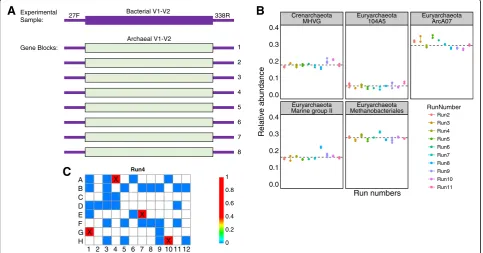
synthe-sized mock DNA samples as gene blocks (Fig. 5a, see
Additional file 2 for DNA sequences). We selected DNA to
synthesize using regions of the 16S rRNA gene in eight
ar-chaeal species which would not normally be detected in
ex-perimental data because the sequences at the amplification
primer binding sites in the archaeal V1-V2 region do not
match the bacterial V1-V2 primers used. In the engineered
sequences, bacterial 16S V1-V2 primer binding sites were
added synthetically to archaeal controls, allowing
amplifica-tion. This has the advantage that the control sequences can
be easily distinguished from experimental samples while
still being processed through the same pipeline. A
disad-vantage of this strategy is that such controls are specific to
a particular primer set and must be remade for each
amplicon used. However, given the low cost of synthetic
DNA, cost for a set of positive controls is modest (about
$450). After sequencing archaeal gene block samples in 11
C
Experimental Sample:Gene Blocks:
Bacterial V1-V2
Archaeal V1-V2
27F 338R
1
2
3
4
5
6
7
8
A
B
CrenarchaeotaMHVG Euryarchaeota104A5 EuryarchaeotaArcA07
Euryarchaeota
Marine group II MethanobacterialesEuryarchaeota
0.0 0.1 0.2 0.3 0.4
0.0 0.1 0.2 0.3 0.4
Run numbers
Relativ
e a
b
undance
RunNumber Run2 Run3 Run4 Run5 Run6
Run7 Run8 Run9 Run10 Run11
Run4
1 2 3 4 5 6 7 8 9 10 11 12 X X
X
X A B C D E F G
H 0
0.2 0.4 0.6 0.8 1
Fig. 5Synthetic non-biological 16S DNA as a positive control for 16S rRNA marker gene sequencing.aA diagram of the gene block design. At the
separate sequencing runs, we found that the relative
abun-dances of the sequences were relatively consistent (Fig. 5b).
The gene block design provided an opportunity to test
the level of cross-contamination between experimental
samples during wet-lab library preparation (in 96-well
plates) and sequence acquisition. Figure 5c shows
repre-sentative results from one sequencing run. The abundance
of control archaeal taxa did not increase with proximity to
positive control samples on the 96-well plates (
P
= 0.6,
lin-ear regression analysis), suggesting that spill-over during
preparation was not a prominent source of admixture
be-tween samples. However, low levels of these sequences
could be detected in multiple dispersed samples (Fig. 5c,
blue squares), potentially due to misreading of bar codes
or hybridization of DNA molecules in adjacent clusters
during Illumina sequencing [114]. A possible means of
suppressing this would be to use bar codes on both ends
of the amplicons and to require precise matches to both
in the quality filtering [115].
The gene block scheme is a simple method for ensuring
proper amplification of experimental samples, tracking
sam-ple mix-ups, and measuring samsam-ple cross-contamination
during library preparation and sequencing. However,
syn-thetic positive controls are not useful for benchmarking
analytical and statistical methods. Analysis methods
developed for real communities often do not perform as
well on mock communities, and vice versa, due to the
pres-ence of naturally occurring sequpres-ence variation and low
abundance taxa.
Many investigators use primers that simultaneously
tar-get the 16S region of both bacteria and archaea, for
ex-ample, the 515fB/806rB primer set used by the Earth
Microbiome Project [116, 117]. Here, there is no
advan-tage to using archaeal sequences in the gene blocks
be-cause archaea might be observed in experimental samples.
Nonetheless, investigators can build gene blocks using
ar-tificially altered DNA sequences that are different enough
to be reliably distinguished from genomic sequence but
similar enough to be compatible with the analysis pipeline.
In Additional file 2, we present example gene block sets
for the 515fB/806rB primer pair.
When artificial positive control samples are not suitable
or cost effective, many of the benefits may be achieved by
sequencing a small number of positive control samples
collected from the field. We have used samples of pond
water and saliva as indicators of consistency in sample
preparation and sequencing, though ultimately found the
mock DNA samples to be more convenient.
Contamination in shotgun metagenomic data
Microbial DNA introduced by reagents can also be
de-tected in shotgun metagenomic sequencing. As for
ampli-con sequencing, ampli-contamination is particularly apparent in
samples with low microbial biomass. This is seen both for
samples with generally low biomass (e.g., skin swab) and
for samples dominated by non-microbial DNA (e.g.,
tissue biopsy).
For example, in our work to characterize the microbiota
in sarcoidosis, we performed shotgun metagenomic
se-quencing on tissue DNA extracted using both standard
(DNeasy PowerSoil, Qiagen, Valencia, CA, USA) and
low-contaminant (QiaAmp UCP Pathogen, Qiagen, Valencia,
CA, USA) kits (unpublished data). When sequencing
negative control samples, we observed that the kit
back-ground differed between the two (Fig. 6a). Lineages found
in both kits were also present in our low biomass tissue
samples, likely derived from reagents. Lineages found in
both samples and controls included
Propionibacterium
spp
.
and
Corynebacterium
spp., commonly associated with
human skin, and
Bradyrhyzobium
, a common soil bacteria
also identified as a contaminant by other groups [23, 118].
Of concern, this lineage has been proposed to be
respon-sible for a colitis syndrome in patients undergoing
umbilical-cord hematopoietic stem-cell transplantation
[118, 119]
—
it will be key to strengthen the link to colitis
with additional forms of data to rule out contamination as
an explanation.
This indicates that while some reagent contamination
is unavoidable, usage of low-contaminant kits reduces
the total sequencing effort spent on contaminants.
Fur-thermore, it highlights the importance of sequencing
and analyzing extraction controls, because without them
it is impossible to distinguish reagent contamination
from true microbial signals.
An extreme example of contamination detection
comes from virome analysis, where multiple
displace-ment amplification is used to amplify specimens. The
multiple displacement amplification method uses the
phage phi29 DNA polymerase, a highly processive phage
polymerase, to copy target DNA prior to library
prepar-ation. Shotgun metagenomic sequencing of a blank
vir-ome prep sample (unpublished data) returned hits on
phage phi29, but upon inspection, these turned out to
align exclusively to the polymerase gene (Fig. 6b).
Evi-dently the amplification method was so sensitive that we
recovered the gene used to produce a protein that we
had purchased from a commercial supplier and used in
our library preparation procedure.
Considerations during analysis
This article is mostly concerned with optimal procedures
for laboratory methods, but we do want to comment on
three issues in analyzing and interpreting microbiome data.
Handling of negative controls
control samples even if library yield is low or
undetect-able. Show the lineages present in stacked bar graphs or
heat maps. Check negative control data into sequence
archives when experimental samples are deposited. Do
not just subtract lineages in negative controls and
con-sider the problem solved. There is no reason to think
that contaminating lineages are fully sampled without
specific evidence, and there can be cases where
environ-mental lineages are authentically present in samples and
functionally important.
Controlling multiple comparisons
High-throughput sequencing experiments commonly
gen-erate sequence reads attributed to hundreds of taxa.
Re-searchers wishing to know which taxa are potentially
associated with a difference in phenotype must make many
comparisons, each time testing a null hypothesis of no
dif-ference in taxon abundance. In addition, studies will often
involve multiple types of clinical data, allowing myriad
comparisons over the microbiome data set. If the
acceptable false positive rate for the test is set at a certain
level (e.g., 5%), these repeated comparisons will raise the
chances of getting a false positive higher than that level. To
re-adjust the false positive rate back to the desired level, a
multiple testing correction must be used.
This type of problem
—
controlling for multiple
compari-sons
—
is well covered by the statistical literature. A
conser-vative approach is to ensure that none of the hypotheses
are falsely rejected, within a specified probability, using the
Bonferroni correction [120]. However, this method has
been shown to be unacceptably conservative, leading to
too many false negatives. A more popular approach is to
control for a pre-specified rate of false discovery (i.e., false
rejections of the null hypothesis). Benjamini and Hochberg
presented a method to control for the false discovery rate
in a series of independent tests [121], and this is the
formu-lation used in microbiome analysis software such as QIIME
[122] and Mothur [123]. Use of a multiple testing
correc-tion is strongly recommended whenever multiple
compari-sons are made.
19,282 bp
Bacillus phage phi29 genome
B
A
0 bp 4,000 bp 8,000 bp 12,000 bp 16,000 bp
DNA Polymerase Gene
PowerSoil UCP
0.00 0.25 0.50 0.75 1.00
Blank Blank
Streptococcus Pseudomonas Staphylococcus Unclassified Bacteria Unclassified Proteobacteria Corynebacterium
Propionibacterium Bradyrhizobium Other
Fig. 6Contamination in shotgun metagenomic data.aLineages observed in shotgun metagenomic sequencing of negative control samples
Discovery and validation cohorts
Moving beyond single experiments, researchers can provide
better and more reliable evidence for a discovery by
re-producing the results in an independent cohort of samples.
The use of separate discovery and validation cohorts is
standard in genome-wide association studies, which are
also massively multivariate (e.g., [124].). Using this strategy
in the microbiome context, the experiment is first
con-ducted in the discovery cohort and taxa or gene types are
selected using a particular testing procedure. The validation
cohort is then analyzed to test only those results found to
be significant in the discovery cohort. The total number of
tests is thus drastically reduced in the validation cohort.
Several microbiome studies have used independent
dis-covery and validation cohorts to select taxa of interest for a
disease state. Sabino et al
.
identified three bacterial genera
associated with primary sclerosing cholangitis in a discovery
cohort and used their results to correctly classify 75% of
subjects in an independent validation cohort [125].
For-slund et al. used separate cohorts to replicate their findings
of taxa altered in metformin-treated subjects with type 2
diabetes mellitus [126]. In a series of papers, a composite
index of bacterial taxon abundance in stool associated with
inflammatory bowel disease (IBD) was developed in one
group of subjects [73], and then found to distinguish IBD
from healthy controls in an independent follow-up study
[127]. Kelsen et al. applied the discovery-validation cohort
design to determine differences in the subgingival
micro-biota between children with Crohn
’
s disease and healthy
controls [128], and successfully demonstrated reproducible
taxa. Additionally, they were able to distinguish taxa that
were associated with antibiotic use from those associated
only with the disease.
Conclusions
Summarizing the considerations above, we can make
several recommendations for the design and execution
of microbiome studies.
For analysis, multiple confounding factors need to
be taken into account, including antibiotic use, age,
sex, diet, geography, and pet ownership.
In animal studies, cage effects can dominate over
what may seem to be extreme interventions. Thus, it
is critical to set up each condition to be studied in
multiple cages, so that the caging variable can be
isolated and accounted for.
Although we recommend storing samples, especially
fecal samples, at
−
80 °C immediately after collection
for most accurate results, alternative storage
methods for field studies also lead to results with
relatively small deviations. For new sample types, it
will be wise to test for changes during storage under
study-specific storage conditions.
In a cross-sectional study, it is essential to know
whether the time point sampled will be
representa-tive. For example, the healthy adult gut microbiota
does not change radically over short time scales, but
that of the vagina sometimes does. Therefore, it is
important to assess the relationship of possible
lon-gitudinal dynamics to the question posed.
Be energetic in creating and analyzing negative
controls
—
DNA extraction kits usually come with
contaminants, and contamination may vary between
suppliers and even between batches of the same kit.
Use positive controls for each batch of samples.
Mock communities are valuable for this, and the
simple synthetic DNA controls presented here
(Additional file
2
) are also quite useful. Place
controls asymmetrically in purification plates to
verify proper sample tracking through the DNA
purification and library preparation procedures.
Low microbial biomass samples present many
challenges. When starting a study that might involve
low microbial biomass samples, it is essential to
quantify the microbial load in the samples to
understand the extent of the challenge. QPCR of
total 16S rRNA gene copies can be used for this
purpose, as can conventional plating assays if
applicable. In an experiment that may involve low
biomass samples, start with the null hypothesis that
all sequence data reflects contamination only, and
ask whether this idea can be rejected in a statistical
analysis of the data.
Be realistic about
“
data dredging,
”
that is, imposing a
rigorous statistical method to control multiple
comparisons.
Lastly, if affordable, it greatly strengthens a study to
assess effects in separate discovery and validation
cohorts.
There is no question that the human microbiota are
critical for health and disease
—
by attending to the above
challenges, one can generate high quality data to drive
new discoveries in this exciting field.
Additional files
Additional file 1:Supplementary methods. (PDF 1926 kb)
Additional file 2:DNA sequences for gene block control samples.
(XLSX 11 kb)
Abbreviation
ITS:Internal transcribed spacer
Acknowledgements
Funding
This work was supported by the National Institute of Allergy and Infectious Diseases P30 AI 045008 (EC, AL, and FDB); the National Heart, Lung, and Blood Institute R01 HL113252 (RGC); National Institute of Allergy and Infectious Diseases T32 AI007632 (SSM, and CC); Pennsylvania Department of Health SAP 4100068710 (DK, CEH, CZ, LM, CT, RB, and KB); Crohn’s and Colitis Foundation of America Career Development Award 3276 (JK); National Institutes of Health 1T32DK101371-01 (MC).
Availability of data and materials
The raw sequence files generated for comparisons of swab storage methods, positive gene block controls, and negative control samples are available from the NCBI Sequence Read Archive (BioProject accessions PRJNA356343, PRJNA356422, PRJNA356404, and PRJNA380255, respectively).
Authors’contributions
DK, CEH, LM, AL, EC, SSM, RGC, RB, FDB, and KB wrote the manuscript. DK, CEH, LM, AL, JK, and MC carried out experiments for the comparison of storage methods and positive/negative control samples. JK, MC, FDB, and KB designed the comparison of storage methods. DK, CEH, LM, FDB, and KB designed the comparison of positive/negative controls. CZ, CT, SSM, CC, and KB performed the data analysis. All authors read and approved of the final manuscript.
Competing interests
The authors declare that they have no competing interests.
Consent for publication Not applicable.
Ethics approval and consent to participate Not applicable.
Publisher
’
s Note
Springer Nature remains neutral with regard to jurisdictional claims in published maps and institutional affiliations.
Author details
1Division of Gastroenterology, Hepatology, and Nutrition, The Children’s
Hospital of Philadelphia, Philadelphia, Pennsylvania 19104, USA.2Department of Microbiology, University of Pennsylvania, Philadelphia, Pennsylvania 19104, USA.3Department of Medicine, Perelman School of Medicine, University of Pennsylvania, Philadelphia, Pennsylvania 19104, USA.
Received: 24 December 2016 Accepted: 21 April 2017
References
1. Chehoud C, Albenberg LG, Judge C, Hoffmann C, Grunberg S, Bittinger K, Wu GD. Fungal signature in the gut microbiota of pediatric patients with inflammatory bowel disease. Inflamm Bowel Dis. 2015;21(8):1948–56. doi:10. 1097/MIB.0000000000000454.
2. Debelius JW, Vazquez-Baeza Y, McDonald D, Xu Z, Wolfe E, Knight R. Turning participatory microbiome research into usable data: lessons from the american gut project. J Microbiol Biol Educ. 2016;17(1):46–50. doi:10. 1128/jmbe.v17i1.1034.
3. Faust K, Sathirapongsasuti JF, Izard J, Segata N, Gevers D, Raes J, Huttenhower C. Microbial co-occurrence relationships in the human microbiome. PLoS Comput Biol. 2012;8(7):e1002606. doi:10.1371/journal.pcbi.1002606. 4. Human Microbiome Project, C. A framework for human microbiome
research. Nature. 2012;486(7402):215–21. doi:10.1038/nature11209. 5. Lewis JD, Chen EZ, Baldassano RN, Otley AR, Griffiths AM, Lee D, Bushman
FD. Inflammation, antibiotics, and diet as environmental stressors of the gut microbiome in pediatric crohn’s disease. Cell Host Microbe. 2015;18(4):489– 500. doi:10.1016/j.chom.2015.09.008.
6. Ley RE, Turnbaugh PJ, Klein S, Gordon JI. Microbial ecology: human gut microbes associated with obesity. Nature. 2006;444(7122):1022–3. doi:10.1038/4441022a.
7. Qin J, Li R, Raes J, Arumugam M, Burgdorf KS, Manichanh C, Wang J. A human gut microbial gene catalogue established by metagenomic sequencing. Nature. 2010;464(7285):59–65. doi:10.1038/nature08821.
8. Turnbaugh PJ, Ley RE, Hamady M, Fraser-Liggett CM, Knight R, Gordon JI. The human microbiome project. Nature. 2007;449(7164):804–10. doi:10. 1038/nature06244.
9. Kassam Z, Lee CH, Yuan Y, Hunt RH. Fecal microbiota transplantation for Clostridium difficile infection: systematic review and meta-analysis. Am J Gastroenterol. 2013;108(4):500–8. doi:10.1038/ajg.2013.59.
10. van Nood E, Vrieze A, Nieuwdorp M, Fuentes S, Zoetendal EG, de Vos WM, Keller JJ. Duodenal infusion of donor feces for recurrent Clostridium difficile. N Engl J Med. 2013;368(5):407–15. doi:10.1056/NEJMoa1205037.
11. Baker GC, Smith JJ, Cowan DA. Review and re-analysis of domain-specific 16S primers. J Microbiol Methods. 2003;55(3):541–55.
12. D’Amore R, Ijaz UZ, Schirmer M, Kenny JG, Gregory R, Darby AC, Hall N. A comprehensive benchmarking study of protocols and sequencing platforms for 16S rRNA community profiling. BMC Genomics. 2016;17:55. doi:10.1186/ s12864-015-2194-9.
13. Liu Z, Lozupone C, Hamady M, Bushman FD, Knight R. Short pyrosequencing reads suffice for accurate microbial community analysis. Nucleic Acids Res. 2007;35(18):e120. doi:10.1093/nar/gkm541.
14. Mizrahi-Man O, Davenport ER, Gilad Y. Taxonomic classification of bacterial 16S rRNA genes using short sequencing reads: evaluation of effective study designs. PLoS One. 2013;8(1):e53608. doi:10.1371/journal.pone.0053608. 15. Schloss PD, Jenior ML, Koumpouras CC, Westcott SL, Highlander SK. Sequencing
16S rRNA gene fragments using the PacBio SMRT DNA sequencing system. PeerJ. 2016;4:e1869. doi:10.7717/peerj.1869.
16. Tremblay J, Singh K, Fern A, Kirton ES, He S, Woyke T, Tringe SG. Primer and platform effects on 16S rRNA tag sequencing. Front Microbiol. 2015;6:771. doi:10.3389/fmicb.2015.00771.
17. Aho VT, Pereira PA, Haahtela T, Pawankar R, Auvinen P, Koskinen K. The microbiome of the human lower airways: a next generation sequencing perspective. World Allergy Organ J. 2015;8(1):23. doi:10.1186/s40413-015-0074-z. 18. Bittinger K, Charlson ES, Loy E, Shirley DJ, Haas AR, Laughlin A, Bushman FD.
Improved characterization of medically relevant fungi in the human respiratory tract using next-generation sequencing. Genome Biol. 2014; 15(10):487. doi:10.1186/s13059-014-0487-y.
19. Charlson ES, Bittinger K, Haas AR, Fitzgerald AS, Frank I, Yadav A, Collman RG. Topographical continuity of bacterial populations in the healthy human respiratory tract. Am J Respir Crit Care Med. 2011;184(8):957–63. doi:10.1164/ rccm.201104-0655OC.
20. Glassing A, Dowd SE, Galandiuk S, Davis B, Chiodini RJ. Inherent bacterial DNA contamination of extraction and sequencing reagents may affect interpretation of microbiota in low bacterial biomass samples. Gut Pathog. 2016;8:24. doi:10.1186/s13099-016-0103-7.
21. Jervis-Bardy J, Leong LE, Marri S, Smith RJ, Choo JM, Smith-Vaughan HC, Marsh RL. Deriving accurate microbiota profiles from human samples with low bacterial content through post-sequencing processing of Illumina MiSeq data. Microbiome. 2015;3:19. doi:10.1186/s40168-015-0083-8. 22. Lauder AP, Roche AM, Sherrill-Mix S, Bailey A, Laughlin AL, Bittinger K,
Bushman FD. Comparison of placenta samples with contamination controls does not provide evidence for a distinct placenta microbiota. Microbiome. 2016;4(1):29. doi:10.1186/s40168-016-0172-3.
23. Salter SJ, Cox MJ, Turek EM, Calus ST, Cookson WO, Moffatt MF, Walker AW. Reagent and laboratory contamination can critically impact sequence-based microbiome analyses. BMC Biol. 2014;12:87. doi:10.1186/s12915-014-0087-z. 24. Weiss S, Amir A, Hyde ER, Metcalf JL, Song SJ, Knight R. Tracking down the sources of experimental contamination in microbiome studies. Genome Biol. 2014;15(12):564. doi:10.1186/s13059-014-0564-2.
25. Di Bella JM, Bao Y, Gloor GB, Burton JP, Reid G. High throughput sequencing methods and analysis for microbiome research. J Microbiol Methods. 2013;95(3):401–14. doi:10.1016/j.mimet.2013.08.011. 26. Foster JA, Bunge J, Gilbert JA, Moore JH. Measuring the microbiome:
perspectives on advances in DNA-based techniques for exploring microbial life. Brief Bioinform. 2012;13(4):420–9. doi:10.1093/bib/bbr080.
27. Goodrich JK, Di Rienzi SC, Poole AC, Koren O, Walters WA, Caporaso JG, Ley RE. Conducting a microbiome study. Cell. 2014;158(2):250–62. doi:10.1016/j.cell.2014.06.037.
28. Kuczynski J, Lauber CL, Walters WA, Parfrey LW, Clemente JC, Gevers D, Knight R. Experimental and analytical tools for studying the human microbiome. Nat Rev Genet. 2012;13(1):47–58. doi:10.1038/nrg3129. 29. Robinson CK, Brotman RM, Ravel J. Intricacies of assessing the human
30. Bikel S, Valdez-Lara A, Cornejo-Granados F, Rico K, Canizales-Quinteros S, Soberon X, Ochoa-Leyva A. Combining metagenomics, metatranscriptomics and viromics to explore novel microbial interactions: towards a systems-level understanding of human microbiome. Comput Struct Biotechnol J. 2015;13:390–401. doi:10.1016/j.csbj.2015.06.001.
31. Kim Y, Koh I, Rho M. Deciphering the human microbiome using next-generation sequencing data and bioinformatics approaches. Methods. 2015; 79–80:52–9. doi:10.1016/j.ymeth.2014.10.022.
32. Laukens D, Brinkman BM, Raes J, De Vos M, Vandenabeele P. Heterogeneity of the gut microbiome in mice: guidelines for optimizing experimental design. FEMS Microbiol Rev. 2016;40(1):117–32. doi:10.1093/femsre/fuv036. 33. Tsilimigras MC, Fodor AA. Compositional data analysis of the microbiome: fundamentals, tools, and challenges. Ann Epidemiol. 2016;26(5):330–5. doi: 10.1016/j.annepidem.2016.03.002.
34. Kelly BJ, Gross R, Bittinger K, Sherrill-Mix S, Lewis JD, Collman RG, Li H. Power and sample-size estimation for microbiome studies using pairwise distances and PERMANOVA. Bioinformatics. 2015;31(15):2461–8. doi:10.1093/bioinformatics/btv183.
35. La Rosa PS, Brooks JP, Deych E, Boone EL, Edwards DJ, Wang Q, Shannon WD. Hypothesis testing and power calculations for taxonomic-based human microbiome data. PLoS One. 2012;7(12): e52078. doi:10.1371/journal.pone.0052078.
36. Blaser M, Bork P, Fraser C, Knight R, Wang J. The microbiome explored: recent insights and future challenges. Nat Rev Microbiol. 2013;11(3):213–7. doi:10.1038/nrmicro2973.
37. Dave M, Higgins PD, Middha S, Rioux KP. The human gut microbiome: current knowledge, challenges, and future directions. Transl Res. 2012;160(4): 246–57. doi:10.1016/j.trsl.2012.05.003.
38. Lozupone CA, Stombaugh JI, Gordon JI, Jansson JK, Knight R. Diversity, stability and resilience of the human gut microbiota. Nature. 2012;489(7415): 220–30. doi:10.1038/nature11550.
39. McKenna P, Hoffmann C, Minkah N, Aye PP, Lackner A, Liu Z, Bushman FD. The macaque gut microbiome in health, lentiviral infection, and chronic enterocolitis. PLoS Pathog. 2008;4(2):e20. doi:10.1371/journal.ppat.0040020. 40. Abeles SR, Ly M, Santiago-Rodriguez TM, Pride DT. Effects of long term
antibiotic therapy on human oral and fecal viromes. PLoS One. 2015;10(8): e0134941. doi:10.1371/journal.pone.0134941.
41. Dethlefsen L, Huse S, Sogin ML, Relman DA. The pervasive effects of an antibiotic on the human gut microbiota, as revealed by deep 16S rRNA sequencing. PLoS Biol. 2008;6(11):e280. doi:10.1371/journal.pbio.0060280. 42. Jakobsson HE, Jernberg C, Andersson AF, Sjolund-Karlsson M, Jansson JK,
Engstrand L. Short-term antibiotic treatment has differing long-term impacts on the human throat and gut microbiome. PLoS One. 2010;5(3): e9836. doi:10.1371/journal.pone.0009836.
43. Devkota S. MICROBIOME. Prescription drugs obscure microbiome analyses. Science. 2016;351(6272):452–3. doi:10.1126/science.aaf1353.
44. Mardinoglu A, Boren J, Smith U. Confounding effects of metformin on the human gut microbiome in type 2 diabetes. Cell Metab. 2016;23(1):10–2. doi: 10.1016/j.cmet.2015.12.012.
45. Imhann F, Bonder MJ, Vich Vila A, Fu J, Mujagic Z, Vork L, Zhernakova A. Proton pump inhibitors affect the gut microbiome. Gut. 2016;65(5):740–8. doi:10.1136/gutjnl-2015-310376.
46. Amarasekara R, Jayasekara RW, Senanayake H, Dissanayake VH. Microbiome of the placenta in pre-eclampsia supports the role of bacteria in the multifactorial cause of pre-eclampsia. J Obstet Gynaecol Res. 2015;41(5):662– 9. doi:10.1111/jog.12619.
47. Dore J, Blottiere H. The influence of diet on the gut microbiota and its consequences for health. Curr Opin Biotechnol. 2015;32:195–9. doi:10. 1016/j.copbio.2015.01.002.
48. Fallucca F, Porrata C, Fallucca S, Pianesi M. Influence of diet on gut microbiota, inflammation and type 2 diabetes mellitus. First experience with macrobiotic Ma-Pi 2 diet. Diabetes Metab Res Rev. 2014;30 Suppl 1:48–54. doi:10.1002/dmrr.2518.
49. Hrncir T, Stepankova R, Kozakova H, Hudcovic T, Tlaskalova-Hogenova H. Gut microbiota and lipopolysaccharide content of the diet influence development of regulatory T cells: studies in germ-free mice. BMC Immunol. 2008;9:65. doi:10.1186/1471-2172-9-65.
50. Moreira AP, Texeira TF, Ferreira AB, Peluzio Mdo C, Alfenas Rde C. Influence of a high-fat diet on gut microbiota, intestinal permeability and metabolic endotoxaemia. Br J Nutr. 2012;108(5):801–9. doi:10. 1017/S0007114512001213.
51. Murphy EA, Velazquez KT, Herbert KM. Influence of high-fat diet on gut microbiota: a driving force for chronic disease risk. Curr Opin Clin Nutr Metab Care. 2015;18(5):515–20. doi:10.1097/MCO.0000000000000209. 52. Rothe M, Blaut M. Evolution of the gut microbiota and the influence of diet.
Benef Microbes. 2013;4(1):31–7. doi:10.3920/BM2012.0029.
53. Scott KP, Gratz SW, Sheridan PO, Flint HJ, Duncan SH. The influence of diet on the gut microbiota. Pharmacol Res. 2013;69(1):52–60. doi:10.1016/j.phrs.2012.10.020. 54. Sherman MP, Zaghouani H, Niklas V. Gut microbiota, the immune system,
and diet influence the neonatal gut-brain axis. Pediatr Res. 2015;77(1-2):127– 35. doi:10.1038/pr.2014.161.
55. Wu GD, Chen J, Hoffmann C, Bittinger K, Chen YY, Keilbaugh SA, Lewis JD. Linking long-term dietary patterns with gut microbial enterotypes. Science. 2011;334(6052):105–8. doi:10.1126/science.1208344.
56. Wu GD, Compher C, Chen EZ, Smith SA, Shah RD, Bittinger K, Lewis JD. Comparative metabolomics in vegans and omnivores reveal constraints on diet-dependent gut microbiota metabolite production. Gut. 2016;65(1):63– 72. doi:10.1136/gutjnl-2014-308209.
57. David LA, Maurice CF, Carmody RN, Gootenberg DB, Button JE, Wolfe BE, Turnbaugh PJ. Diet rapidly and reproducibly alters the human gut microbiome. Nature. 2014;505(7484):559–63. doi:10.1038/nature12820. 58. Koenig JE, Spor A, Scalfone N, Fricker AD, Stombaugh J, Knight R, Ley RE.
Succession of microbial consortia in the developing infant gut microbiome. Proc Natl Acad Sci U S A. 2011;108 Suppl 1:4578–85. doi:10.1073/pnas.1000081107. 59. Lee D, Albenberg L, Compher C, Baldassano R, Piccoli D, Lewis JD, Wu GD.
Diet in the pathogenesis and treatment of inflammatory bowel diseases. Gastroenterology. 2015;148(6):1087–106. doi:10.1053/j.gastro.2015.01.007. 60. Yatsunenko T, Rey FE, Manary MJ, Trehan I, Dominguez-Bello MG, Contreras
M, Gordon JI. Human gut microbiome viewed across age and geography. Nature. 2012;486(7402):222–7. doi:10.1038/nature11053.
61. Claesson MJ, Cusack S, O’Sullivan O, Greene-Diniz R, de Weerd H, Flannery E, O’Toole PW. Composition, variability, and temporal stability of the intestinal microbiota of the elderly. Proc Natl Acad Sci U S A. 2011;108 Suppl 1:4586– 91. doi:10.1073/pnas.1000097107.
62. Clarke G, Stilling RM, Kennedy PJ, Stanton C, Cryan JF, Dinan TG. Minireview: gut microbiota: the neglected endocrine organ. Mol Endocrinol. 2014;28(8): 1221–38. doi:10.1210/me.2014-1108.
63. Markle JG, Frank DN, Mortin-Toth S, Robertson CE, Feazel LM, Rolle-Kampczyk U, Danska JS. Sex differences in the gut microbiome drive hormone-dependent regulation of autoimmunity. Science. 2013;339(6123): 1084–8. doi:10.1126/science.1233521.
64. Davey KJ, O’Mahony SM, Schellekens H, O’Sullivan O, Bienenstock J, Cotter PD, Cryan JF. Gender-dependent consequences of chronic olanzapine in the rat: effects on body weight, inflammatory, metabolic and microbiota parameters. Psychopharmacol (Berl). 2012;221(1):155–69. doi:10.1007/s00213-011-2555-2. 65. Liang X, Bushman FD, FitzGerald GA. Rhythmicity of the intestinal
microbiota is regulated by gender and the host circadian clock. Proc Natl Acad Sci U S A. 2015;112(33):10479–84. doi:10.1073/pnas.1501305112. 66. Ren W, Ma Y, Yang L, Gettie A, Salas J, Russell K, Cheng-Mayer C. Fast
disease progression in simian HIV-infected female macaque is accompanied by a robust local inflammatory innate immune and microbial response. AIDS. 2015;29(10):F1–8. doi:10.1097/QAD.0000000000000711.
67. Noguera-Julian M, Rocafort M, Guillen Y, Rivera J, Casadella M, Nowak P, Paredes R. Gut microbiota linked to sexual preference and HIV infection. EBioMed. 2016;5:135–46. doi:10.1016/j.ebiom.2016.01.032.
68. Oh C, Lee K, Cheong Y, Lee SW, Park SY, Song CS, Lee JB. Comparison of the oral microbiomes of canines and their owners using next-generation sequencing. PLoS One. 2015;10(7):e0131468. doi:10.1371/journal.pone.0131468. 69. Song SJ, Lauber C, Costello EK, Lozupone CA, Humphrey G, Berg-Lyons D,
Knight R. Cohabiting family members share microbiota with one another and with their dogs. Elife. 2013;2:e00458. doi:10.7554/eLife.00458. 70. Jalanka-Tuovinen J, Salonen A, Nikkila J, Immonen O, Kekkonen R, Lahti L,
de Vos WM. Intestinal microbiota in healthy adults: temporal analysis reveals individual and common core and relation to intestinal symptoms. PLoS One. 2011;6(7):e23035. doi:10.1371/journal.pone.0023035.
71. Rajilic-Stojanovic M, Heilig HG, Tims S, Zoetendal EG, & de Vos WM. Long-term monitoring of the human intestinal microbiota composition. Environ Microbiol. 2012. doi:10.1111/1462-2920.12023
![Fig. 1 Example of cage effects dominating a mouse study of fungal communities. Fungal lineages in the murine gut were inferred from ITS rRNAgene sequencing of pellets [87]](https://thumb-us.123doks.com/thumbv2/123dok_us/9083736.1901042/3.595.59.540.525.671/example-dominating-communities-fungal-lineages-inferred-rrnagene-sequencing.webp)