www.wjpr.net Vol 3, Issue 9, 2014. 1207
DEVELOPMENT AND EVALUATION OF NOVEL FORMULATION
OF TRIGONELLA FOENUM – GRAECUM
Radha Sharma*1,Leena Vaidya2, Suman Jain3
1
SriRam College of Pharmacy, Banmore, Morena M.P. (India).
2
Dr. H. S. Gaur University, Sagar, M.P. (India).
3
SOS in Pharmaceutical Sciences, Jiwaji University, Gwalior M.P. (India). ABSTRACT
In India from the ancient times Trigonella foenum graecum seeds as spice are used to flavor and improve the taste of food recipes. They are also used in cosmetics and medicinal preparations. After almost two decades of scientific eclipse, vaginal spermicidal contraceptive methods are gaining interest and importance due to safety and acceptability reasons. At the same time, increasing concern about the side effects of oral contraceptives, IUDs and other methods. This has resulted a shift in attention of investigators and users from these methods to traditional methods of fertility regulation. For this reason a study was carried out on seeds of Trigonella foenum-graecum
(Fenugreek), to explore its contraceptive efficacy regarding to its spermicidal action. The Fenugreek extract showed immense potential as a spermicidal drug. An ideal contraceptive formulation can be developed for controlling the population explosion to some extent. Irritation studies showed that upto 2% concentration range the extracts are safe while earlier studies showed that the minimum concentration of fenugreek extract for spermicidal action is 0.3%. Further the irritation potential of fenugreek extract can be minimized by developing a formulation with suitable inert base so that a safe and effective vaginal contraceptive of herbal origin may be developed.
KEYWORDS: Spermicidal, Vaginal contraceptive, Trigonella foenum-graecum,
Intra-uterine devices, Fenugreek. 1. INTRODUCTION
Trigonella foenum (Fenugreek) is an annual plant belongs to Fabaceae family. The plant has
Volume 3, Issue 9, 1207-1214. Research Article ISSN 2277– 7105
Article Received on 16 September 2014,
Revised on 10 Oct 2014, Accepted on 03 Nov 2014
*Correspondence for
Author
Dr. Radha Sharma
SriRam College of
Pharmacy, Banmore,
www.wjpr.net Vol 3, Issue 9, 2014. 1208 Small round leaves, is cultivated worldwide as a semi-arid crop. [1,2] Some other properties of trigonella are carminative, anticarcinogenic, hypoglycemic, hypocholestrolemic, antibac terial, laxative, diuretic, antiulcerative, antihypertensive, antithrombotic, antioxidant. [3-5] The daily use of fenugreek seeds as dietary supplement is safe. It has good beneficial effects to raise blood hemoglobin by easy means. This is helpful in preventing as well as cure anemia.
[6]
Trigonella foenum-graecum (Fenugreek /methi) have great medicinal value in Indian homes and ancient medical system. Fenugreek seeds are thought to be a galactagogue that is often used to increase milk supply in lactating women. [7] Various herbal spermicidal agents such as Neem oil, Sapindus saponins, etc. have been reported yet, there is need to develop a safe, vaginal contraceptive having local actions so that to minimize systemic toxicities. Fenugreek seeds were shown to protect against breast and colon cancer. [8-9] The fenugreek seeds also have hepatoprotective propertiy. [10] Fenugreek seeds provide polysaccharide galactomannan and gitogenin with tigogenin and neotigogens. Some other bioactive constituents of fenugreek include mucilage, volatile oils and alkaloids such as choline and trigonelline, sotolone and pyrazines. The bitter taste of fenugreek seeds is mainly due to steroidal saponins and alkaloids. All the active constituents are nontoxic on consumption. [11] There is no ideal spermicidal agent investigated till date. Available spermicidal contraceptives also possess some serious physical and physiological side effects. At the same time, increasing concern about the side effects of oral contraceptives, intra uterine devices (IUDs) and other methods have shifted attention of investigators and users from these methods to traditional methods of fertility regulation. For this reason a study was carried out on seeds of Trigonella foenum-graecum (Fenugreek), to explore its contraceptive efficacy regarding to its spermicidal action.
2. MATERIAL AND METHOD
Fenugreek extracts are rich source of saponins, which may be the main reason of its spermicidal activity and saponins shows hemolysis, in vitro hemolytic potency of the extracts was determined. In vitro assessment of local irritation by spermicidal agents is based on their hemolytic potency. [12-13] Vaginal irritation potential was accessed by in vivo vaginal irritation studies on female rats as animal models. All the experiments were performed as per CPCSEA guidelines.
2.1 Preparation of the Extract
www.wjpr.net Vol 3, Issue 9, 2014. 1209 solvents. Extracts were concentrated and dried. Each extract was dissolved in physiological saline to produce various concentrations.
2.2 Hemolytic Study (RBC Hemolytic Assay)
Blood samples in heparinized tubes were obtained from local pathology lab. Erythrocytes were separated by centrifugation at 1,000 rpm for 15 min. Washed and resuspended in phosphate buffered saline (PBS). Test samples were prepared by combining 0.5 ml of RBC suspension with 3 ml of PBS containing various concentrations of alcohol extract (0.01% - 2%). min. The samples were than centrifuged at 1500 rpm for 3 min. Supernatant of each sample was collected and absorbance (A) was measured at 450 nm. Zero and 100% hemolysis were determined with isotonic PBS and 0.1 % Triton X100 respectively. [13]
2.3 Vaginal Irritation Test in Rats
Eighteen female rats used were divided into 6 groups of three animals in each group. Group 1 was kept as control and 1 ml of saline (0.9%) was applied vaginally to the animals. Group 2 to group 5 animals were treated intra vaginally with 1 ml of different concentrations of Fenugreek extract once per day for 10 consecutive days. Group 6, animals were treated with 1 ml of 5% of N-9 was applied for 10 consecutive days. All the animals were sacrificed on day 11 and the reproductive tract was examined grossly and microscopically. Vaginal tissues were rapidly removed and fixed in 10% neutral-buffered formalin. Vaginas were examined for epithelial ulceration, edema, leukocyte infiltration, and vascular congestion. Irritation scores were assigned based on the scoring system. [14] Total scoring of 0 to 8 is acceptable, scores of 9 to 11 indicate borderline irritation potential, and scores greater than 12 are potentially irritating.
3. RESULTS AND DISCUSSIONS
www.wjpr.net Vol 3, Issue 9, 2014. 1210 3.1 Hemolytic Study (RBC Hemolytic Assay)
Hemolytic potency was determined to access the local irritation of the Fenugreek extracts as compared to N-9. The % hemolysis was calculated as-
(A450 in the extract samples–A450 in PBS)
% Hemolysis =--- (A450 in 0.1% Triton X 100–-A450 in PBS) X 100
[image:4.595.146.416.303.425.2]The results are summarized in Table 1. Study showed that ethanol extract of Fenugreek showed 50% and 100% hemolysis at above 0.6% and 2.5% concentrations respectively, while N-9 showed 50% and 100% hemolysis at 0.1% and above 2% levels, respectively.
Table 1. Results of hemolytic study.
Concentration % Hemolysis
Alcohol Extract N-9
2% 86.0% 98.0%
1% 63.0% 92.0%
0.5% 42.0% 60.0%
0.1% 39.0% 40.0%
0.05% 17.0% 35.0%
0.01% 9.0% 17.0%
*Values are mean of three readings *Control PBS = 0% *Standard 0.1% Triton X100 = 100% Hemolysis
3.2 Vaginal Irritation Test in Rats
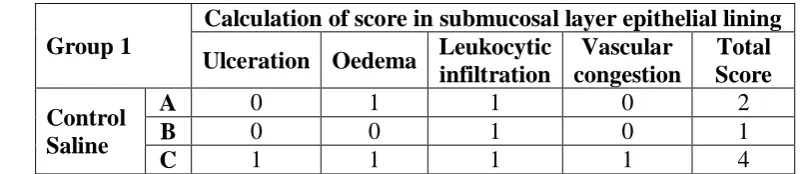
Group 1: No irritation reaction observed in vaginal epithelium of control group animals as
the inflammatory score of the animals was in acceptable range i.e. 0–4 (Table 2). Table 2. Results of group 1 of vaginal irritation test.
Group 1
Calculation of score in submucosal layer epithelial lining
Ulceration Oedema Leukocytic
infiltration
Vascular congestion
Total Score
Control Saline
A 0 1 1 0 2
B 0 0 1 0 1
C 1 1 1 1 4
[image:4.595.90.494.572.659.2]www.wjpr.net Vol 3, Issue 9, 2014. 1211 Table 3. Results of group 2 of vaginal irritation test.
Group 2
Calculation of score in submucosal layer epithelial lining
Ulceration Oedema Leukocytic
infiltration Vascular congestion Total Score 0.3% Fenugreek extract
A 0 1 1 1 3
B 0 2 0 1 3
C 0 0 1 1 2
Group 3: No irritation reaction observed in vaginal epithelium of 1.0% Fenugreek extract treated group animals as the inflammatory score of the animals was in acceptable range i.e. 0-4 (Table 0-4).
Table 4. Results Of Group 3 of Vaginal Irritation Test.
Group 3
Calculation of score in submucosal layer epithelial lining
Ulceration Oedema Leukocytic
infiltration
Vascular
congestion Total Score
1% Fenugreek extract
A 0 1 2 1 4
B 0 0 1 0 1
C 1 0 1 1 3
Group 4: Mild irritation reactions observed in vaginal epithelium of 2.0% Fenugreek extract
treated group animals as the inflammatory score of the animals was in range 4–8 (Table 5). Table 5. Results of group 4 of vaginal irritation test.
Group 4
Calculation of score in submucosal layer epithelial lining
Ulceration Oedema Leukocytic
infiltration Vascular congestion Total Score 2% Fenugreek extract
A 0 2 1 2 1
B 0 1 1 0 2
C 1 1 2 1 5
[image:5.595.77.516.462.552.2]Group 5: Irritation reactions observed in vaginal epithelium of 5.0% Fenugreek extract treated group animals as the inflammatory score of the animals was in range 4–8 (Table 6). Table 6. Results of group 5 of vaginal irritation test.
Group 5
Calculation of score in submucosal layer epithelial lining
Ulceration Oedema Leukocytic
infiltration Vascular congestion Total Score 5% Fenugreek extract
A 3 2 1 0 6
B 2 2 2 3 9
C 1 2 3 2 8
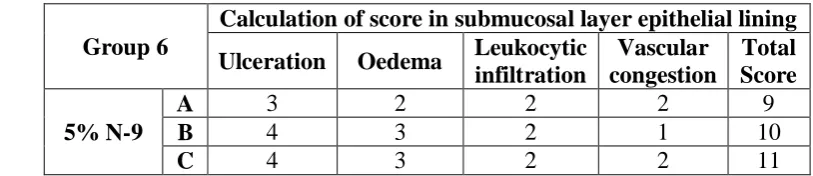
Group 6: Irritation reaction observed in vaginal epithelium of N-9 treated group animals as
www.wjpr.net Vol 3, Issue 9, 2014. 1212 Table 7. Results of group 6 of vaginal irritation test.
Group 6
Calculation of score in submucosal layer epithelial lining
Ulceration Oedema Leukocytic
infiltration
Vascular congestion
Total Score
5% N-9
A 3 2 2 2 9
B 4 3 2 1 10
C 4 3 2 2 11
Previous animal experiments and human intervention research demonstrated that the antidiabetic effect of fenugreek seeds ameliorate most metabolic symptoms associated with diabetes. [16-18] It can be concluded from the earlier research work that Trigonella foenum graecum extract can lower kidney or body weight ratio, blood glucose, blood lipids and improve hematological properties. Fenugreek Supplements decreases serum cholesterol, triacylglycerol low density lipoprotein in human patients. This is also been tested in experimental models of hypercholesterolemia and hypertriglyceridemia. [20]
Hemolytic study of extracts was performed to access local irritation potential as compared to the N-9 samples. The extract showed 50% and 100% hemolysis at 0.6% and 2.5% concentrations respectively. While N-9 showed 50% and 100% hemolysis at 0.1% and 2% concentrations. Alcoholic extract does not induce any pathological changes in the rat vagina. Results showed no significant difference between the treated and control groups of animals. Inflammatory score caused by Fenugreek extract at concentration 0.1-1% was in acceptable range. At 2 % concentration the extract showed mild irritation reactions while, at 5% concentration the score is in 8-10 range i.e. showing irritation reactions. Results were compared to the irritation scores in control (0.9% saline treated animals) and N-9 treated animals group. The Fenugreek extract showed immense potential as a spermicidal drug and an ideal contraceptive formulation can be developed for controlling the population explosion to some extent. As irritation studies showed that upto 2% concentration range the extracts are safe while our earlier studies showed that the minimum concentration of fenugreek extract for spermicidal action is 0.3%. Further the irritation potential of fenugreek extract can be minimized by developing a formulation with suitable inert base so that a safe and effective vaginal contraceptive of herbal origin may be developed so far.
4. CONCLUSION
www.wjpr.net Vol 3, Issue 9, 2014. 1213 basis of various ethnopharmacological literatures it can be concluded that fenugreek seeds can be used in simple remedies for treating a variety of ailments. Till date there is no ideal spermicidal agent investigated. The existing spermicidal contraceptives also possess some serious physical and physiological side effects. At the same time, increasing concern about the side effects of oral contraceptives, IUDs and other methods have shifted attention of investigators and users from these methods to traditional methods of fertility regulation. For this reason a study was carried out on seeds of Trigonella foenum-graecum (Fenugreek), to explore its contraceptive efficacy regarding to its spermicidal action. Thus the present study concludes that fenugreek have contraceptives property along with restorative and nutritive properties. From the literature the daily use of fenugreek seeds as dietary supplement is safe. It has good beneficial effects to raise blood hemoglobin.
5. ACKNOWLEDGEMENT
One of author wish to express their gratitude and thankfulness to Union Grant Commission for providing grants for the complision of the above research work.
REFERENCES
1. Hamden K, Jaouadi B, et al “Inhibitory effect of Fenugreek Galactomannan on digestive enzymes related to Diabetes, Hyperlipidemia, and liver-Kidney dysfunctions” Biotech Biopro Engineering. 2010; 15: 407-413.
2. Srinivasan K “Fenugreek (Trigonella foenum–graecum) A review of health beneficial physiological effects” Food reviews International, 2006; 22:203-224.
3. Balaraman R, Dangwal SM et al “Antihypertensive effect of Trigonella foenum –graecum seeds in experimeninduced ypertension in rats” Pharm Biology, 2006; 44: 568-575. 4. Pandian RS, Anuradha CV et al “ Gastro protective effect of fenugreek seeds (Trigonella
foenum–graecum) on experimental gastric ulcer in rats” J Ethnopharmacology, 2002; 81:393-397.
5. Kaviarasan S, Vijayalakshmi K et al “Polyphenol-Rich extract of fenugreek seeds protect erythrocytes from oxidative damage” Plant Foods for Human Nutrition. 2004; 59:143-147.
6. Kaviarasan S, Naik GH et al “In vitro studies on antiradical and antioxidant activities of Fenugreek (Trigonella foenum–graecum) seeds” Food Chemistry. 2007; 103:31-37. 7. Petit P, Sauvaire Y et al “Effects of Fenugreek seed extract on feeding behavior in the rat:
www.wjpr.net Vol 3, Issue 9, 2014. 1214 8. Amin A, Ayasha A, et al “Hemopreventive activities of Trigonella foenum graecum
(Fenugreek) against breast cancer” Cell Biol International, 2005; 29: 687-94.
9. Raju J, Patlolla JM et al “Diosgenin, a steroid saponin of Trigonella foenum graecum (Fenugreek), inhibits azoxymethane-induced aberrant crypt foci formation in F344 rats and induces apoptosis in HT-29 human colon cancer cells". Cancer Epidemio l Biomarkers Prev. 2004; 13: 1392-1398.
10.Kaviarasan S, Nalini Ramamurty et al “Fenugreek (Trigonella foenum-graecum) seed extract prevents ethanol-induced toxicity and apoptosis in Chang liver cells” Alcohol Alcoholism, 2006; 41:267-273.
11.Udayasekhra PR, Sesikiran B et al “Short term nutritional and safety evaluation of fenugreek” Nutrition Research, 1996; 16:1495-15.
12.Pape W, Hoppe U. Skin Pharmacol. 1991; 4(3):205-212.
13.Pape W, Pfannanbecka U et al. Mol. Toxicol. 1987; 1(4): 525-536. 14.Eckstein P, Jackson MC et al .J. Reprod. Fertil. 1969; 20: 85-93.
15.Basch E, Catherne U et al “Therapeutic applications of fenugreek” Altern Med Review, 2003; 8: 20-27.
16.Sharma RD “Effect of fenugreek seeds and leaves on blood glucose and serum insulin responses in human subjects” Nutrition Research, 1986; 6:1353-1364.
17.Sharma RD, Sarkar A et al “Use of fenugreek seed powder in the management of non-insulin dependent diabetes mellitus” Nutrition Research, 1996; 16:1331-1339.