www.wjpr.net Vol 7, Issue 07, 2018. 133
LOCAL SURVEY FOR AWARENESS OF HYPERACIDITY AND/OR
OTHER ASSOCIATED PROBLEMS
Dr. Geeta D. Parulkar*1, Dr. Manjushri Kharat2, Dr. Abhishek Taksale3,
Dr. Ajitkumar Sahu4, Dr. Vaishali Kokani5, Dr. Ganesh Patare6 and Dr. Minal
Bhusewar7
1
M.D. (Chikitsa) (Mum), PhD(Chikitsa) (Mum), Professor, Dept. of Kayachikitsa.
2
M.D (Chikitsa) (Scholar) Final Year.
3
M.D (Chikitsa) (Scholar) Second Year.
4,5
M.D (Chikitsa) (Scholar) First Year.
6,7
M.D (Scholar) Under Kayachikitsa Dept. at the time of Camp.
ABSTRACT
Awareness for Hyperacidity and associated problems was judged in a
population of Worli area of Mumbai during a medical camp held on
March 15, 2017 at the campus of M.A. Podar (Govt.) Hospital, Worli,
Mumbai-18. As preparatory work, a questionnaire was designed on
associated problems. Following which, a survey conducted during the
medical camp was organized by the main author with the help of six
post-graduate Ayurvedic scholars. The information about the camp
was advertised through the distribution of banners and pamphlets in the
above said area. Total 283 patients suffering from Hyperacidity and
associated problems. Patients with poor digestion, IBS, Colitis etc
visited this camp. They were screened by physical examination and
advised related management of Ayurvedic medicines. 34.98% of the
patients were suffering from poor digestion. It is essential to pass on
basic knowledge about Hyperacidity and associated problems in public for prevention and
cure on a larger scale. Awareness of this will definitely get success to conquer the disease up
to some extent.
KEYWORDS: Medical Camp-Hyperacidity and associated problems-Awareness-Local
survey- Worli area-Mumbai.
Volume 7, Issue 7, 133-139 Research Article ISSN 2277 – 7105
Article Received on 21 Feb. 2018,
Revised on 13 March 2018, Accepted on 03 April 2018,
DOI: 10.20959/wjpr20187-11505
*Corresponding Author
Dr. Parulkar Geeta D.
M. D. (Chikitsa) (Mum),
PhD (Chikitsa) (Mum),
Professor (Chikitsa), R. A.
Podar (Govt.) Medical
College, attached to M. A.
Podar Hospital, Worli,
www.wjpr.net Vol 7, Issue 07, 2018. 134 INTRODUCTION
Following are the definitions of terms used in this survey article:
Survey
A series of questions administered to a sample of individuals in a population.
Hyperacidity
Hyperacidity is a broad term characterized by retro-sternal burning discomfort, often rising
up into chest and sometimes accompanied by regurgitation of acidic or bitter fluids into the
throat.
Poor Digestion
Poor Digestion is a broad term comes under Dyspepsia, which includes symptoms such as
Discomfort, Bloating and Nausea; which mainly originates from Upper GI tract.
IBS
Irritable Bowel Syndrome is characterized by recurrent abdominal pain, in association with
www.wjpr.net Vol 7, Issue 07, 2018. 135
Colitis
Inflammation of inner lining of Colon. There are numerous causes of Colitis which includes
infection, Inflammatory Bowel Disease (Crohn’s disease and Ulcerative Colitis), Ischemic
Colitis etc.
MATERIAL AND METHODS
In the present study, Worli area around M.A. Podar (Govt.) Hospital was surveyed. Podar
Hospital is a government institution under the state of Maharashtra and is well-known in the
field of Ayurvedic medicinal therapies. Area came under Worli with Slum, Slum-like and
Non-slum population.
Main author (Dr. Geeta Parulkar) is a permanent full time employee at this centre. The
benefits of this area for conducting this study were (a) The best community medicine
infrastructure (Podar Hospital Campus) and (b) Communication with the population through
Outdoor Patients Department and Indoor Patients Department directly.
www.wjpr.net Vol 7, Issue 07, 2018. 136 PREPARATORY WORK
Before the actual study, main author and the co-authors with graduate degree in Ayurvedic
medicine and now under the guidance of the main author as Scholars for Post-graduation in
Ayurvedic medicine planned the whole project. They were already trained in collecting
information using a specially designed questionnaire. It was ensured that the information
collected should be relevant to Hyperacidity (Poor digestion, IBS, Colitis etc).
Data was collected by following the interview technique. The clinical and USG findings were
obtained from individual case records prepared by the main author and co-authors.
PRACTICAL WORK
283 patients were screened by physical examinations and advised medicinal therapies free of
cost. Podar institution management was instrumental in arranging the required infrastructure
for the camp. Many reputed pharmaceutical companies participated for distribution of
medicines with no cost.
INCLUSION CRITERIA
A) Patients suffering from Hyperacidity and associated problems.
B) Both Genders.
C) From age group 11 years to 89 years.
D) With/without Mild Hypertension, Mild Diabetes Mellitus, Mild Ischemic Heart Disease,
Mild Anaemia etc.
EXCLUSION CRITERIA
A) From age group below 11 yrs and above 89 years.
B) Pregnant and Lactating mothers.
C) Patients suffering from complications like moderate to severe Hypertension, moderate to
severe Diabetes Mellitus, moderate to severe Ischemic Heart Disease, moderate to severe
Hepatitis, Moderate to severe Renal Disease, moderate to severe Anaemia, Carcinomas
anywhere in the body etc.
OBSERVATIONS
Table 1: Age wise distribution of patients.
Age group 11-19
years 20-29 years 30-39 years 40-49 years 50-59 years 60-69 years 70-79 years 80-89 years
www.wjpr.net Vol 7, Issue 07, 2018. 137 Table 2: Gender wise distribution of patients.
Gender No. of patients Percentage
Male 145 51.23%
Female 138 48.76%
Table 3: Education status wise distribution of patients.
Education Male Percentage Female Percentage
Below SSC 8 2.82% 27 9.54%
SSC 12 4.24% 54 19.08%
HSC 61 21.55% 38 13.42%
Graduation 54 19.08% 13 4.59%
Post-Graduation 10 3.53% 6 2.12%
Table 4: Socio-economic status wise distribution of the patients.
Class No. of patients Percentage
Lower middle class 178 62.89%
Middle class 77 27.20%
Upper middle class 28 9.89%
Table 5: Disease wise distribution of patients.
Disease/Complaint No. of patients Percentage
Poor digestion 99 34.98%
IBS 48 16.96%
Colitis 35 12.36%
With H/o Food poisoning 14 4.94%
No specific disease 87 30.74%
Table 6: Period wise distribution of disease.
Suffering period No. of patients Percentage
Upto 1 year 90 31.80%
Above 1 year 193 68.19%
Table 7: Related region wise distribution of disease.
Region No. of Patients Percentage
Oesophagus 81 28.62%
Gastric 123 43.46%
Duodenum 79 27.91%
Table 8: Medication wise distribution of patients.
Therapy No. of patients Percentage
Allopathic 83 29.32%
Ayurvedic 60 21.20%
Homeopathic 44 15.54%
Mixed 86 30.38%
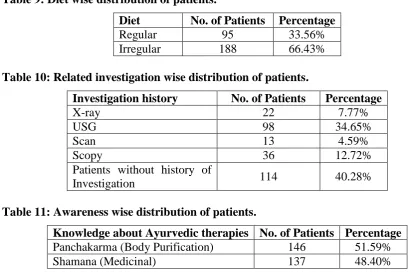
www.wjpr.net Vol 7, Issue 07, 2018. 138 Table 9: Diet wise distribution of patients.
Diet No. of Patients Percentage
Regular 95 33.56%
Irregular 188 66.43%
Table 10: Related investigation wise distribution of patients.
Investigation history No. of Patients Percentage
X-ray 22 7.77%
USG 98 34.65%
Scan 13 4.59%
Scopy 36 12.72%
Patients without history of
Investigation 114 40.28%
[image:6.595.70.480.80.354.2]
Table 11: Awareness wise distribution of patients.
Knowledge about Ayurvedic therapies No. of Patients Percentage Panchakarma (Body Purification) 146 51.59%
Shamana (Medicinal) 137 48.40%
RESULTS
Our study was conducted among 283 patients as mentioned above. Majority of them
belonged to the age group 50-59 years. 34.98% patients were suffering from Poor digestion.
62.89% patients belonged to lower middle class. 34.65% patients had carried their related
USG (Abdomen and Pelvis) reports with them, while 40.28% patients had not undergone any
investigation related to their disease. 51.59% patients were aware regarding Shodhan Chikitsa
(Ayurvedic Panchakarma therapy).
CONCLUSION
Ayurvedic body purification management i.e. Panchakarma such as Vamana (Emesis),
Virechana (Purgation), Basti (Enema), Nasya (Nasal insufflation) and Raktamokshana
(Blood-letting), as well as others like Shamana (Medicinal) therapies show remarkable results
in patients with Hyperacidity and assciated problems. Hence, it is a great necessity to spread
awareness regarding these therapies.
ACKNOWLEDGMENT
We are thankful to the management of Podar institution, as well as companies which
www.wjpr.net Vol 7, Issue 07, 2018. 139 REFERENCES
1. Y.P. Munjal, API Textbook of Medicine. Ninth Edition, New Delhi; Jaypee Brothers,
2012.
2. Harsh mohan, Textbook of Pathology. Sixth edition, New Delhi; Jaypee Brothers Medical
Publishers, 2010.
3. Harrison’s Principles of Internal Medicine, 19th edition, by McGraw-Hill Education,
2015.
4. Manual of Practical Medicine by R. Algappan, Fifth edition, Jaypee Brothers Medical