Private Stateful Information Retrieval
Sarvar Patel
∗1, Giuseppe Persiano
†1,2, and Kevin Yeo
‡11
Google LLC
2Universit`
a di Salerno
Abstract
Private information retrieval (PIR) is a fundamental tool for preserving query privacy when accessing outsourced data. All previous PIR constructions have significant costs preventing widespread use. In this work, we present privatestatefulinformation retrieval (PSIR), an extension of PIR, allowing clients to be stateful and maintain information between multiple queries. Our design of the PSIR primitive maintains three important properties of PIR: multiple clients may simultaneously query without complex concurrency primitives, query privacy should be maintained if the server colludes with other clients, and new clients should be able to enroll into the system by exclusively interacting with the server.
We present a PSIR framework that reduces an online query to performing one single-server PIR on a sub-linear number of database records. All other operations beyond the single-server PIR consist of cryptographic hashes or plaintext operations. In practice, the dominating costs of resources occur due to the public-key operations involved with PIR. By reducing the input database to PIR, we are able to limit expensive computation and avoid transmitting large ciphertexts. We show that various instantiations of PSIR reduce server CPU by up to 10x and online network costs by up to 10x over the previous best PIR construction.
Contents
1 Introduction 3
1.1 Our Contributions . . . 3 1.2 Relation to Other Privacy-Preserving Storage Primitives . . . 4
2 Technical Overview 6
3 Definitions 9
3.1 Private Stateful Information Retrieval . . . 9 3.2 Oblivious Constrained Partitions . . . 11 3.3 Private Batched Sum Retrieval . . . 12
4 Oblivious Constrained Partitions 12
5 Private Batched Sum Retrieval 15
6 Private Stateful Information Retrieval 16
6.1 Discussion . . . 19
7 Experimental Evaluation 19
7.1 The Experimental Setup . . . 19 7.2 Cost of Ring-LWE basedPSIR . . . 21 7.3 Cost ofPaillierPSIR . . . 22
8 Conclusions 23
A Cost of OCP 26
B Chernoff Bounds 27
C PSIR Amortization 27
C.1 Online Work to Offline Processing . . . 27 C.2 Worse Case to Average Case Cost . . . 27
D Oblivious Constrained Partition 28
D.1 Online Partial Sums Data Structure . . . 28 D.2 Space-Efficient OCPScheme . . . 28
E Private Batched Sum Retrieval 30
1
Introduction
Private Information Retrieval (PIR) [18, 35] is a very important privacy-preserving primitive for accessing data held by untrusted servers. PIR enables clients to retrieve a record stored in a database hosted by an untrusted server without revealing the record’s identity to the server and it has been used as a critical component in several systems such as friend discovery [11], publish-subscribe [17], advertisement [25] and media consumption [27]. In this work, we are interested in single-server PIR with computational security as first considered by Kushilevitz and Ostrovsky [35].
Previous works on single-server PIRs considered stateless clients as well as a stateless server that do not maintain information between queries and this implies the following three important properties.
• Parallel Access: The same PIR server can be simultaneously used by several independent clients.
• Dynamic User Sets: The set of clients does not need to be chosen ahead of time. New clients can be added to the system without the intervention of existing clients and clients that crash can easily recover and continue to use the system.
• Privacy Against Other Clients: Privacy for record retrieval is guaranteed when the adversarial honest but curious server is colluding with (possibly all) other clients.
Despite its wide applicability, PIR has not been used in applications because of its high costs. In a PIR protocol, the server is required to perform at least one operation for each database record. If a record is not involved in the computation of the reply, then it is certainly not the one sought by the client. In practice, things are even worse as, in most implementations of single-server PIR, the server performs a linear number of expensive public-key operations.
In this paper, we introduce the concept of aPrivate Stateful Information Retrieval(PSIR), that extends the concept of a PIR without losing any of the three desirable properties of PIR described above. We give implementations of PSIR that drastically reduce communication and the server’s computational overhead compared to PIR. Our main modification of PIR andPSIRlies in the fact that clients are stateful. That is, a client may store information between queries. The server ofPSIRis stateless except for the database like in PIR. Despite having a state, clients of PSIR execute retrieval operations independently. Each retrieval only affects the state of the client performing the retrieval and does not impact other clients in any way. Together with the fact that the server is stateless,PSIRsupports parallel access for multiple client without the need to deal with concurrency issues. Furthermore, the initial state of a client is obtained by the client by interacting solely with the server. Therefore, new clients (as well as crashed clients that lose their state) can enter aPSIRscheme at any time without affecting existing clients. For security, we wish to provide privacy for the client against both the server as well as other possibly adversarial clients. Formally, PSIRensures that the identity of any records retrieved by any honest client remains private from the adversary even if the server is colluding with all other clients. Overall,PSIRmaintains the three desirable properties of PIR while the availability of a client state inPSIRwill significantly improve the efficiency of private retrievals as our constructions will show.
1.1
Our Contributions
We show that PSIRis more efficient than PIR constructions by giving a general construction for compu-tationally secure PSIRwith practical instantiations. More precisely, let n be the number of records in the database, letkbe an adjustable parameter, 0< k < n, and suppose the client has memory to storecrecords. Our main technical contribution consists in a reduction of a query in PSIRto an online phase consisting of one blackbox PIR query on a database of n/k records and the transfer of k seeds and k integers from client to server. Both the client and server perform an additionalO(n) hash evaluations and other simple operations. The reduction assumes that the client has already performed an offline initialization phase with
constructions all required the server to execute at leastnpublic-key operations per query. OurPSIRscheme replaces most of these expensive public-key operations with simple, efficient operations. We stress that our reduction does not add any other public-key operation on top of the ones needed to execute PIR on a sub-linear sized database. We note that our server still performs O(n) computation as otherwise our construction would not guarantee security. As an example, we can concretely instantiate our construction by setting k=√n which means only O(√n) public-key operations are required. We construct PSIRusing XPIR [5] as well as a PIR construction built from the Paillier cryptosystem [42]. In addition, we estimate costs forPSIRwith SealPIR [7] using their reported results.
Our concrete results are two-fold. We present a construction of PSIR that outperforms the previous, best PIR construction in important resource costs for databases with 100K to 1M 288 byte records (a standard database size experiment used in previous works [7]). Specifically, we show thatPSIRwith Paillier outperforms SealPIR by giving up to 4x speedup in server CPU, a 5-10x reduction in online bandwidth and a 1.3-4x decrease in amortized total bandwidth. Furthermore, more than 50% of the total bandwidth can be performed offline during cheaper, non-busy hours. We remark though that PSIRwith Paillier increases client CPU usage compared to SealPIR. In our opinion, these trade-offs are beneficial in concrete terms. For 1M items, total client CPU increases to only 660 milliseconds while server CPU decreases by more than 4.5 seconds. To achieve these benefits, the client uses up to 525 KB of state. We note that 525 KB is less than 1/12 the network costs of generic XPIR and is less than twice the network costs of generic SealPIR. On the other hand, SealPIR requires the server to store 2.9 MB of auxiliary cryptographic material for each client whereasPSIRwith Paillier does not require any extra storage beyond database.
In addition, we show that PSIR variants using XPIR and SealPIR reduce resource costs compared to generic XPIR and SealPIR. In terms of concrete savings, PSIRwith XPIR results in a 12-28x speedup in server CPU, up to 20x less online network costs and 17x less amortized network costs compared to generic XPIR. Our estimates for PSIR with SealPIR result in an up to 10x speedup in server CPU, but a slight increase in online network costs and an up to 50% increase in amortized network costs compared to generic SealPIR. Additionally,PSIRintroduces an increase in client CPU of at most 660 milliseconds in both cases. We still view the trade-offs as excellent since, in concrete numbers, server CPU is decreased by at least 4 seconds in both cases for 1M items. For network costs, the benefits are clear for PSIR with XPIR. While network costs for PSIR with SealPIR increase, the majority of the extra network costs can be performed offline during off-peak periods. PSIRrequires up to 525 KB of state in all cases.
1.2
Relation to Other Privacy-Preserving Storage Primitives
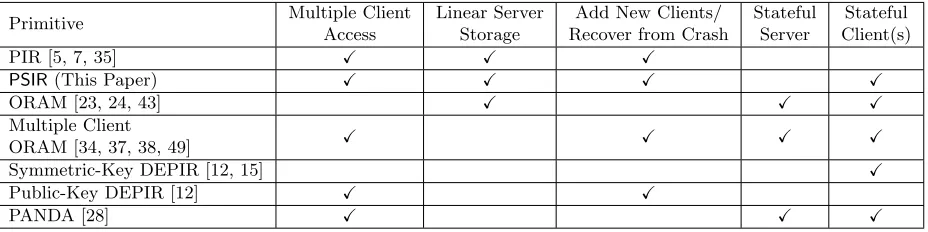
In the previous section, we presentedPSIR as an extension of PIR. Many other privacy-preserving storage and retrieval primitives have been considered in previous works, We compare PSIRwith ORAM as well as extensions of PIR and ORAM and present a summary in Table 1.
ORAM Oblivious RAM (ORAM) [23, 24] guarantees also privacy of the blocks in addition to privacy of the access pattern. This implies that the client state contains the secret key used to decrypt the block and, if any client were corrupted by the server then full privacy would be lost. The secret key enables ORAM to use sublinear computation and bandwidth (the current, best ORAM construction usesO(logn·log logn) bandwidth and computation [43]). However, since the server does not have the secret key, enrollment of new clients would involve existing clients. In addition, in most ORAM construction the client also has alocation mapmapping logical block identity to physical server locations which dynamically changes as physical blocks are accessed by the client. The presence of a location map would make parallel access very inefficient as performing queries in parallel requires complex algorithms using expensive concurrency primitives to enable access to shared resources.
Primitive Multiple Client Access
Linear Server Storage
Add New Clients/ Recover from Crash
Stateful Server
Stateful Client(s)
PIR [5, 7, 35] X X X
PSIR(This Paper) X X X X
ORAM [23, 24, 43] X X X
Multiple Client
ORAM [34, 37, 38, 49] X X X X
Symmetric-Key DEPIR [12, 15] X
Public-Key DEPIR [12] X X
PANDA [28] X X X
Table 1: This table compares single-server privacy-preserving storage systems. Multiple client access refers to systems that enable accessibility to large groups of clients while providing privacy against subsets of colluding clients. Add new clients/recover from crash refers to servers with the capability to enroll stateless clients into the system.
compromise privacy for honest clients. New clients may also be added by constructing new ORAM schemes. However, this scheme requires large storage since the database is replicated once for each client unlikePSIR
that stores the database exactly once.
Another way to enable access to multiple clients is splitting the ORAM (as well as the secret key) into shares and distributing the shares to several non-colluding servers. To retrieve/overwrite a record, the client performs a protocol with all non-colluding servers to generate an access to the shared ORAM scheme. While these schemes are efficient, they require the strong assumption of multiple, non-colluding servers whereas
PSIRfocuses on the single-server setting. ORAM and its multiple client extensions do not provide practical solutions for enabling access to large groups of clients efficiently and privately compared toPSIR.
Doubly Efficient PIR Doubly Efficient PIR(DEPIR) refers to an extension of PIR that allows a setup phase which preprocesses the database before any retrieval requests. Beyond the preprocessed database, the server will be stateless. DEPIR schemes are categorized into symmetric-key and public-key variants. In the symmetric-key variant, each client must use a secret key to access the encoded database. On the other hand, the public-key variant is accessible by all clients. The first public-key DEPIR construction was presented by Beimelet al.[9] in the multiple, non-colluding server setting that is information-theoretically secure. More recently, Boyleet al.[12] and Canettiet al. [15] present symmetric-key DEPIR schemes in the single-server setting using locally decodable codes built from Reed-Muller codes [41, 45]. In addition, Boyle et al. [12] present a public-key DEPIR scheme using a variant of obfuscation. All above DEPIR schemes ensure that both the client and server perform a sub-linear number of operations compared to the database per retrieval. Both symmetric-key DEPIR and ORAM share the same problems involving the secret key that must be shared by all clients that require access to the database. Any extensions to multiple clients will suffer the same problems as multiple client ORAM. On the other hand, public-key DEPIR provides many useful properties that are offered byPSIR. However, all public-key constructions are built using very strong assumptions. The scheme of Beimelet al.[9] requires multiple non-colluding servers while the scheme of Boyleet al.[12] relies on non-standard assumptions involving obfuscation while, also, requiring server storage super-linear in the database size. Therefore, DEPIR schemes are not a practical solution for privacy-preserving data access due to their reliance on strong assumptions.
et al.[28] present both a read-only and public-write PANDA scheme. Public-writes are an operation that are beyond the scope of PSIR, so we focus on the read-only variant. Their PANDA scheme must be built using a collusion parameter that determines the maximum size of the subset of colluding clients before privacy becomes compromised. Both client and server operations as well as server storage grow linearly in the collusion parameter. On the other hand, the client and server operations for a private retrieval scale poly-logarithmically in the database size.
In relation to PSIR that simply stores the database in plaintext, their PANDA scheme requires server storage super-linear in the size of the database even when providing no protection against colluding clients. If we wish the PANDA scheme to be secure in the setting that the server colludes with all clients except one, the server would require storage larger than simply replicating the database for each client. In comparison, our construction of PSIR outlined in Section 1 guarantees privacy even when the server colludes with all clients except one without sacrificing computational or storage efficiency. Also, PANDA does not allow enrolling stateless clients into the system by only interacting with the server unlikePSIR. As a consequence, PANDA does not provide a practical solution.
2
Technical Overview
Our construction is inspired by the construction of PIR with side information of Kadheet al.[33] that con-siders the following hypothetical scenario. Suppose the client has obliviously obtained someside information
consisting ofk−1 records (thus the server is unaware of which records are known to the client). Can the client leverage on this side information to privately access other records more efficiently? Kadheet al.[33] show that the client can randomly partition the database ofnrecords inton/k parts of sizeksuch that the desired query record and allk−1 records of side information are in the same parts. The server will add all records (that are represented as elements in a field) within the same parts and return the n/k record sums to the client. The client discards all sums except the sum of the desired record and the side information. By subtracting the side information, the client successfully retrieves the desired record. However, Kadhe et al.
do not provide concrete algorithms to privately obtain side information. Furthermore, the network costs of communicating the partition and downloading alln/ksums are significant.
In this paper, we present a construction of PSIR which addresses these issues. Our PSIRrelies on two main building blocks that are of independent interest outside ofPSIR: oblivious constrained partitionsand
private batched sum retrieval. In addition,PSIRalso uses a single-server PIR scheme.
• Oblivious Constrained Partitions (OCP). AOCPconsists of two algorithms: theconstructionalgorithm and the expansion algorithm. Given aconstraint subsetS ⊆[n] of sizek, theconstruction algorithm
OCP.GenerateSeedof anOCPreturns a succinct representation of a partition of [n], (P1, . . . , Pm), into m = n/k parts, each of size k, such that one of the m parts is equal to the constraint subset S. The obliviousness property guarantees that an adversary cannot correctly guess whether the input constraint subsetS contains a givenq∈[n] better than guessing at random. Theexpansionalgorithm
OCP.ExtractPartition, given a succinct description of a partition, produces the actual partition. We give a construction algorithm that outputs a description of a partition consisting of kseeds of length equal to the security parameter λ and k integers in [n]. Both the constructing and expanding the description requireO(n) PRF evaluations.
• Private Batched Sum Retrieval (PBSR). GivencsubsetsS1, . . . , Sc⊆[n], the client wishes to privately retrieve c sums corresponding to the sum of all records in each subset. That is, for a database D = (B1, . . . ,Bn), the client wishes to retrieve thec sums: O1=Pi∈S1Bi, . . . , Oc =Pi∈ScBi. This is an extension of private batched retrieval [30] where only records, instead of sums of records, are retrieved. For privacy, the adversary should not learn thec input subsets.
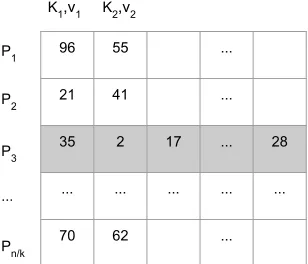
96 55 ...
21 41 ...
35 2 17 ... 28
... ... ... ... ...
70 62 ...
P1
P2
P3
...
Pn/k
K1,v1 K2,v2
Figure 1: The constraint subset is embedded into the third row. The pairs (K1, v1) and (K2, v2) succinctly represent the first two ordered column subsets. The remaining columns have not been generated yet.
s1, . . . , sc, where sumsiis over the setSiofk−1 randomly chosen records from the database. Now, suppose the client wishes to retrieve recordq and letSi be the next unused set that does not contain q. Using the construction algorithm of an OCP with S = Si∪ {q} as constraint set, the client constructs an ordered partitionP = (P1, . . . , Pm) and letj be such thatPj=S. The client sends the succinct description ofP to the server. Upon receiving the description of the partition, the server expands it and constructs a database where, forl= 1, . . . , m, the l-th record is the sum pl of all the records with index in partPl. The client in addition constructs a query, using the underlying single-server PIR, to retrieve pj and sends the query to
the server. Then, the server executes the PIR query using (p1, . . . , pm) as the database and returns the PIR
response to the client. Finally, the client decrypts the PIR response to retrieve pj and obtains the sought
record by computingpj−si. Once the client runs out ofSi, the client will execute the private batched sum
retrieval protocol to gain new side information. Additionally, a client without state (such as a new client or a crashed client that lost state) may execute a private batched sum retrieval protocol with the server to start performing retrievals.
Let us now give informal descriptions of our constructions forOCPandPBSR.
Oblivious Constrained Partitions. Sampling a random partition of [n] into m parts each of size k is equivalent to creating a random assignment of the integers of [n] to the n cells of an m×k matrix M, with each row corresponding to a part. The partition can be succinctly described by the random seed to a PRF that is to be used to generate the randomness of an agreed upon procedure for sampling a random permutation, like, for example, Fisher-Yates [21]. The randomly sampled permutation is then used to assign integers to the cells of the m×k matrix. However, we have two additional goals. The first is of having a particular row be constrained to givenkvalues from the constraint setS. This could be easily achieved by using Fisher-Yates to generate a permutation ofn−kvalues and then explicitly add thekconstrains values to the seed of the PRF used for Fisher-Yates. However, this method does not satisfy our privacy requirement that the description of the partition be oblivious to the constraints.
σ1. The expansion algorithm reconstructs the column by evaluatingP(k1, x) for x=σ1, . . . , σ1+ (m−1). For the second column, the construction algorithm randomly selects key k2 and does the same: that is, it sets ρ2 := P−1(k2, s2) and then evaluates the PRP from ρ2 going back until the value M[1,2] in row 1 is computed and forward until the value M[m,2] is computed. As before, the algorithm makes sure none of the remaining constrained row values are used. If a value from the constrained row appears, then a new key
k2 is randomly selected and the selection of column 2 starts again. Furthermore, it may be the case that a generated value for column 2 appears in column 1. In this case, another keyk2 is generated randomly and the algorithm repeats. The expansion algorithm, once column 1 has been reconstructed, obtains column 2 by repeatedly applyingF(k2,·) starting fromσ2; if during the reconstruction a value from column 1 appears, it is ignored and the process continues untilmvalues distinct from those appearing in column 1 are obtained. The process continues until allkcolumns have been specified.
There are two problems with this scheme: firstly, in the later columns, we will have several collisions with values from previous columns and this will require extra invocations of the PRP. We can avoid this by using an indirection. Rather than treating the outputs of the PRP as permuted values themselves, we will treat them as pointers in a tableT of unused values. Initially,T has allnunused values and is ordered from 1 to
n. For column 1, all PRP evaluations are pointers to values inT. For example, if the evaluation at row 5 results in 11 then the actual value for row 5 is read from table asT[11] which, for column 1, happens to be 11 also since all values are unused. For the second column, we first remove all the values fromT that were used for column 1 and now have a modifiedT with n−mordered values. The domain of the PRP for the second column will be 1, . . . , n−m. This way we can avoid generating new permutation keys by colliding with values from previous columns and we only need to check that values from the constrained row values are not used. The client continues this process for allkcolumns.
The second problem with PRP is that instantiating them securely is quite expensive: in practice one would use PRP based on block ciphers on small domains that can be constructed from secure block ciphers at the cost of multiple evaluations (see, for example, [40, 46]). Hence, we provide our main construction below that only uses PRFs and is very efficient. Briefly, for each column, the PRF F will generate m different values that are treated as a pointer to get unused values from table T. This can be done by repeatedly evaluating the F in increasing index until m different values appear. For convenience, we will assume the firstminvocations ofFare unique. As a result,F(K, i) will actually be thei-th unique value appearing when evaluatingFin increasing index. As the table size or domain size changes column to column, the PRF output can be simply mod-ed by the new domain size to get appropriate values, as long as the original output of the PRF was large enough to keep the biases negligible. However, we still have to guarantee that the element in the constrained row of each column is an element from the constrained setS. Unlike a PRP, we cannot invert the PRF and find the correct index to start evaluating. Instead, the algorithm will use an augmented description for the columns that consists of the keyk along with adisplacement v. The displacement v is computed to ensure that ther-th unique value produced by each column PRF results in a specified index of
T corresponding to a value from the constrained setS. Thus, the expansion algorithm will set the element in row 1 of a column described by (K, v) as the one in positionF(K,1) +v of tableT (with wrap-around if necessary). The algorithm choosesvso thatF(K, r) +vis the current index inT of the constraint setS that is destined for row r of the column being computed. The reconstruction algorithm is straightforward: the partition is created column by column, using the key to instantiate the PRP and encrypt forward to create pointers to which the displacementv is added to get index for the tableT. After each column, the server removes the used values from the table and the PRF works on a smaller domain for the next column.
The algorithm described above requires maintaining an ordered table of theunusedelements, that is the elements that have not been assigned to a part yet, and this would require linear storage. However, we observe that only the ranks of the unused elements of the constraint set need to be maintained. For each elementsi from the constraint set, the algorithm maintains the number of unused elements that are smaller
thansi. Indeed, after generating a column, the algorithm only needs to check that the column contains the
and an additionalO(m) storage to explicitly store the generated column.
Private Batched Sum Retrieval We present several different private batched sum retrieval protocols with both practical and theoretical interest. Recall as input, the protocol receivescsubsetsS1, . . . , Sc⊆[n].
The protocol with the best performance on practical database sizes is also the simplest scheme, which simply downloads the entire database usingnrecords of communication.
A more complex algorithm makes use of a private batched retrieval (PBR) scheme [7, 22, 26, 30]. The client constructs the set of records used in thecsums,S =S1∪. . .∪Sc. Additional records are added toS untilShas|S1|+. . .+|Sc|records. Afterwards, the client simply executes a PBR scheme to retrieve all records in S and adds the records locally. This scheme requires only O(|S| ·polylog(n)) records of communication and O(n) CPU computation. This scheme makes sense for scenarios where network costs are significantly higher than computation costs. In Appendix E, we present more protocols of theoretical interest that use onlyO(c·polylog(n)) records of communication.
Paper Organization In Section 3, we present the definitions of oblivious partitioning, private batched sum retrieval and private stateful information retrieval. We present ourOCP,PBSR andPSIRconstructions in Sections 4, 5 and 6 respectively. The results of our experiments are shown in Section 7.
3
Definitions
We suppose the databaseD containsnrecords denoted B1, . . . ,Bn. We will interchangeably use the terms records and blocks. We use [n] to denote the set {1, . . . , n}. For a two-party protocol Prot, the writing (y1, y2)←Prot(x1, x2) denotes that when the protocol is played by party 1 with inputx1 and party 2 with inputx2 then party 1 receivesy1as output whereas party 2 receives y2.
For an algorithmAthat interacts with the server, we denote the transcript byTrans[y←A(x)] as all the information revealed to the server by executingAto compute outputy on inputx. The transcript includes all data uploaded to the server as well as the sequence of data accesses performed when executingA.
3.1
Private Stateful Information Retrieval
In this section, we define the notion of Private Stateful Information Retrieval (PSIR). Roughly speaking,
PSIRis an extension of the classical notion of a single-server PIR [35] in which the client keeps a state between queries. Before any query can be issued, the client initializes its state by executing the Init protocol with the server. As in PIR, the query process of aPSIRconsists of a single client-to-server message followed by a single server-to-client message. The client will use the server’s response and their current state to recover the record desired. For the sake of clarity, we split this last step into two distinct parts: anExtractalgorithm executed by the client to extract the record queried from the server’s reply, and anUpdateState algorithm jointly executed by the client and server to update the client’s state. In our construction, the UpdateState
protocol consumes part of the client’s state and, if needed, re-executes the Initprotocol. We stress that the server of aPSIRdoes not have a state just like in the original notion of a single-serverPIR.
Definition 1(PSIR). AStateful Information RetrievalPSIR= (PSIR.Init,PSIR.Query,PSIR.Reply,PSIR.Extract, PSIR.UpdateState) consists of the following components
• (st0,Query)←PSIR.Query(q,st): an algorithm executed by the client that takes as input indexq∈[n] and its current state st and outputsQuery to be sent to the server. In addition, the client’s state is updated tost0.
• Reply←PSIR.Reply(Query, D= (B1, . . . ,Bn)): an algorithm executed by the server that takes as input Query computed by a client and the database and returnsReply.
• B←PSIR.Extract(Reply,st): an algorithm executed by the client to extract a record from the server’s
Reply to the query. Note that the client’s state is not updated.
• (st,⊥)←PSIR.UpdateState((st),(D)): a protocol executed by a client and the server that updates the client’s state.
such that the followingCorrectnesscondition is satisfied.
Correctness For all λ, for alln ≤ poly(λ), for all c ≤ poly(λ), for any setH of honest players, for any database D = (B1, . . . , Bn) of size n and for any sequenceQ= ((q1, u1), . . . ,(ql, ul)) of lengthl =poly(λ) we have
PrhExptPSIRCorrectness(λ, c,H, D,Q)6= 1i≤negl(λ)
where the experimentExptPSIRCorrectness is defined as follows
ExptPSIR
Correctness(λ, c,H, D,Q); For allu∈H
(stu,⊥)←PSIR.Init((1λ,1c),(1λ, D)); Fori←1, . . . , l:
(stui,Queryi)←PSIR.Query(qi,stui); Replyi←PSIR.Reply(Queryi, D);
Ri←PSIR.Extract(Replyi,stui);
(stui,⊥)←PSIR.UpdateState((stui),(D)];
Output 1 iff for alli∈[l]Ri=Bqi;
To properly define the notion of security for a a stateful information retrieval we need the concept of sequencescompatiblewith respect to a set of corrupted players.
Definition 2. Two sequences Q0 = ((q10, u 0
1), . . . ,(q 0 l, u
0
l)) andQ
1 = ((q0 1, u
1
1), . . . ,(q 0 l, u
1
l)) are compatible
with respect to setCof users if
1. u0i =u1i, for alli= 1, . . . , l;
2. qi0=q1i, for allisuch thatu0i =u1i ∈C.
We are now ready to present our static notion of security.
Definition 3. A Stateful Information Retrieval is aPrivate Stateful Information Retrieval(PSIR) if for all
λ, for all n≤poly(λ), for allc ≤poly(λ), for any setsHof honest players and Cof corrupted players, for any databaseD= (B1, . . . , Bn) of sizen, and for any two compatible sequences,Q0 andQ1 with respect to
Cof lengthl=poly(λ) and for all PPT adversaryA, we have that
Pr[ExptPSIRA (λ,C,H, D,Q0) = 1]−Pr[ExptPSIRA (λ,C,H, D,Q1) = 1]
<negl(λ),
ExptPSIR
A (λ, c,H,C, D,Q);
View←S
u∈H∪CTrans[(stu,⊥)←PSIR.Init((1λ,1c),(1λ, D))];
View←View∪ S
u∈Cstu
;
ParseQasQ= ((q1, u1), . . . ,(ql, ul)); Fori←1, . . . , l:
(stui,Queryi)←PSIR.Query(qi,stui); View←View∪ {Queryi};
Replyi←PSIR.Reply(Queryi, D);
Bqi←PSIR.Extract(Replyi,stui);
View←View∪Trans[(stui,⊥)←PSIR.UpdateState((stui),(D)];
Ifui∈CthenView←View∪ {stui};
OutputA(View);
If we enforce the restriction that each user’s state is empty and that bothInitandUpdateStateare empty functions, we attain a security definition for PIR where the server may non-adaptively corrupt a set of users.
Adaptive corruption. In the security definition above, the set of corrupted usersCis fixed at the begin-ning. We can also present a security definition against adaptive corruption by means of the following game between an A and a challenger CH. The games starts with CH executing PSIR.Initfor all users uand by picking a random bit η. Then at each step i, A can decide to corrupt a new player u. The initial state of stu of uis then given to Aalong with all the random coin tosses ofu, and all the replies received byu
from CH. In addition,A may issue a query on behalf of user ui, in which case Aoutputs (qi0, q1i, ui) and
CH executes query qηi for userui and gives Athe view of the server and, if ui ∈C, the updated statestui of ui. At the end of the game, Aoutputs its guess η0 for η. We say thatA wins ifη =η0 and sequences
Q0= ((q01, u1), . . . ,(ql0, ul)) andQ1= ((q11, u1), . . . ,(ql1, ul)) are compatible with respect the set of corrupted
playersCat the end of the game. APSIRscheme is anadaptively privatestateful information retrieval if for any PPT adversaryAthe probability thatAwins is negligibly inλclose to 1/2.
It can be shown that our main construction presented in Section 6 is also adaptively private.
3.2
Oblivious Constrained Partitions
In this section, we define the concept of a Oblivious Constrained Partition OCP. An OCP consists of two algorithms (OCP.GenerateSeed,OCP.ExtractPartition). AlgorithmOCP.GenerateSeedtakes integersn, k and the constraint subset S ⊆ [n] of size k and returns the pair (K, r) such that K is the description of a partition (P1, . . . , Pm) of [n] into m:=n/k ordered parts of size k andr is such that Sr =S. Algorithm OCP.ExtractPartitiontakesKand expands it into the partition (P1, . . . , Pm). We require that the construction hides the constraint subset S used to sample (P1, . . . , Pm), in the sense that an adversary that sees the description of a partition has no information on which of the parts of the partition was used as constraint subset in the generation of the partition. In particular, an adversary given the seed K cannot determine whether an elementqbelongs to the constraint subset or not.
Definition 4(Constrained Partition). AConstrained PartitionOCP= (OCP.GenerateSeed,OCP.ExtractPartition) consists of the following two PPT algorithms:
• (K, r)←OCP.GenerateSeed(1λ,1n, S): an algorithm that takes as input security parameterλ, integers nandconstraintsubsetS⊆[n] of sizek, such thatkdividesn, and outputs a seedKand an integerr.
• (P1, . . . , Pm) ← OCP.ExtractPartition(K): an algorithm that takes as input a seed K and outputs subsets (P1, . . . , Pm), withm=n/k.
that satisfy the following two properties:
• Correctness. For everyn, k, λand for everyS⊆[n] of sizek, if (K, r)←OCP.GenerateSeed(1λ,1n, k, S)
• Obliviousness. For allλ, alln=poly(λ) andksuch thatkdividesn, for any two elementsq0, q1∈[n] and for any PPT adversaryA,
Pr[Expt OCP
A (λ, n, k, q 0) = 1]
−Pr[ExptOCPA (λ, n, k, q1) = 1]
<negl(λ),
where ExptOCPA is defined as follows
ExptOCPA (λ, n, k, q);
Randomly chooseS0⊆[n] of sizek−1; SetS=S0∪ {q};
(K, r)←OCP.GenerateSeed(1λ,1n, S); OutputA(K);
3.3
Private Batched Sum Retrieval
Aprivate batched sum retrievalis an algorithm that computes the sums ofcsubsetsS1, . . . , Sc ofnelements from a fieldF stored by a potentially adversarial server. In such a scheme, the server should not learn the subsets for which the algorithm is computing the partial sums. In Section 5, we present several different batched sum retrieval schemes with various bandwidth and computational overheads. To analyze commu-nication, we count the number of field elements that are transferred by the algorithm. For computational costs, we count the number of field operations performed.
Definition 5. (Batched Sum Retrieval) Abatched sum retrievalschemePBSRis an algorithm that takes as inputcsubsets,S1, . . . , Sc⊆[n] and accessesnfield elementsD= (B1. . . ,Bn)∈Fn stored on a server and outputscsums,O1, . . . , Oc, whereOi=Pj∈SiBj for alli= 1, . . . , c.
A batched sum retrieval scheme isprivateif for allλ, for alln=poly(λ), for anyc=poly(λ) and for any pair of sequences of subsets (S1, . . . , Sc) and (S10, . . . , Sc0) such that|Si|=|Si0|for alli∈[c] and for any PPT
adversaryA,
Pr[ExptPBSRA (λ, n, S1, . . . , Sc) = 1]−Pr[ExptPBSRA (λ, n, S10, . . . , Sc0) = 1]
<negl(λ),
whereExptPBSRA is defined as follows
ExptPBSR
A (λ, n, S1, . . . , Sc);
χ←Trans[(O1, . . . , Oc)←PBSR(S1, . . . , Sc, D)]; OutputA(χ);
4
Oblivious Constrained Partitions
In this section, we give a construction forOCP. We refer the reader to Section 2, for an informal description of the algorithm. Our construction uses a family of pseudorandom functions,F={F(K,·)}K∈{0,1}?. For a
λ-bit keyK,F(K,·) is a function from {0,1}λ to{0,1}λ. We assume Fis a random oracle for security.
We start by describing two subroutines that will be useful in our construction. SubroutineExtractSubset
takes as input integers u and m and seed K and outputs a sequenceT consisting of m distinct values in [u]. The subsetsT is obtained by evaluating F(K,·) starting from 0 untilmdistinct elements are obtained. SubroutineExtractSubsetis also used in our construction ofPSIRof Section 6. SubroutineExtractCondSubset
instead outputs a succinct description of a sequenceT ofmdistinct elements of [u] subject to the constrain that the r-th element is equal to a given element x. ExtractSubset and ExtractCondSubset are described in Figure 2. We also use procedure FisherYates(1m,K
k) that samples a random permutation of [m] using
the Fisher-Yates algorithm and using F(Kk,·) as the source of randomness. We omit a description of this standard algorithm.
We are now ready for a formal description of our constructionOCP.
T ←ExtractSubset(K, u,1m)
1. InitializeT to be an array of sizem. 2. Initializeseento be an empty set. 3. Initializenext←0.
4. Whileseen.size< m:
`←F(K,next) modu. If` /∈seen:
Insert`into seen. Append `toT. Incrementnextby one. 5. returnT.
(T,K, v)←ExtractCondSubset(1λ, u,1m, r, x)
1. Generate random seedK ← {0,1}λ.
2. ExecuteT ←ExtractSubset(K, u,1m). 3. Computev←T[r]−xmodu. 4. SetT[l]←T[l]−vmodu. 4. Return (T,(K, v)).
Figure 2: Description ofExtractSubsetandExtractCondSubset.
OCP.GenerateSeed. This algorithm outputs a compact description of a partitionP = (P1, . . . , Pm) of [n] into m:=n/k parts of size k such that one of the parts is the constraint subsetS received in input. The algorithm sees the partition as a matrix with mrows, one for each of the m parts of the partition, and k
columns . ColumnsT1, . . . , Tk are constructed one at a time and thej-th partitionPjwill consist of thej-th element of each column. At the start of the algorithm, all elements of [n] are unused and elements become
usedas they are assigned to a part by the algorithm when columns are constructed. As we have explained in the informal description of the algorithm in Section 2, a column is not directly specified by its element but only by an index to a table of sorted unused elements.
((K1, v1). . . ,(Kk, vk))←OCP.GenerateSeed(1λ,1n, S)
1. Setk=|S| and writeS asS= (s1, . . . , sk) withs1< s2<· · ·< sk.
Pick random r∈[m] and a random permutationτ of [k].
The algorithm will guarantee that ther-th element of each column will be an element ofS. Specifically, sτ(`) ofS will appear as the r-th element of column T`, for`= 1, . . . , k.
2. Allocate arrayunusedofk Boolean values and initializeunused[i] =True, fori= 1, . . . , k.
The algorithm maintains the invariant thatunused[i] =Trueif and only ifsi, thei-th smallest element of S, is unused. Clearly, when the algorithm starts no element ofS, actually no element of [n], has been assigned to a part yet. Note that the algorithm only needs to keep track of which elements of S are unused.
3. Allocate arrayrank ofkintegers and initializerank[`] =s`, for`= 1, . . . , k.
The algorithm maintains the invariant that rank[`] is equal to the number of unused elements of [n]
that are smaller than or equal to s`. Since at the beginning all elements of[n] are unused, rank[`] is initialized to be s`.
4. For each`←1, . . . , k−1:
The algorithm constructs the first k−1 columns. For efficiency reasons, the last column, Tk, is constructed using an ad-hoc procedure.
(a) Set (T`,(K, v))←ExtractCondSubset(1λ, u:=n−m·(`−1),1m, r, x:=rank[τ(`)]).
that the r-th element of the column is equal tosτ(`) by enforcing T`[r] to be equal to the current rank xofsτ(`).
Next the algorithm updates the ranks of the unused elements of S and checks ifT` as returned by ExtractCondSubsetcontains unused elements ofS other than sτ(`).
(b) InitializenewRank to store the updated ranks as ifT` were to be the`-th column.
(c) For all elements si∈S such thatunused[i] =True:
i. Letj be the largest integer such thatrank[i]≥T`[j]. ii. Ifrank[i] =T`[j] and i6=`then go to Step 4a.
In this case,T`[j] is equal to the current rank,rank[i], ofsi and which means that the column contains an unused element ofS other than`. The algorithm thus restart by selecting another candidate column forT`.
iii. SetnewRank[i]←rank[i]−(j−1).
Note that j−1 elements ofT` that are smaller than rank[i]will be used and thus the rank of si is adjusted accordingly.
(d) SetK`← K andv`←v, setunused[τ(`)] =Falseand updaterank←newRank. T` can be used as the`-th column subset.
5. Randomly selectKk← {0,1}λ, Tk ←FisherYates(1m,Kk) and setvk ←Tk[r]−rank[τ(k)].
6. Output ((K1, v1). . . ,(Kk, vk)).
OCP.ExtractPartition. This algorithm takes the succinct representation, ((K1, v1), . . . ,(Kk, vk)) of a parti-tion of [n] intomparts of sizekand outputs the explicit partition.
(P1, . . . , Pm)←OCP.ExtractPartition(n,(K1, v1), . . . ,(Kk, vk))
1. InitializeP1, . . . , Pm to be empty arrays.
2. InitializeT ←[n] as an ordered set.
3. Fori←1, . . . , k−1:
(a) ExecuteTi←ExtractSubset(|T|, m,Ki).
(b) For eachj←1, . . . , m:
Append the (Ti[j]−vi)-th smallest item inT toPj.
(c) For each j←1, . . . , m:
Remove (Ti[j]−vi)-th smallest item fromT.
4. ExecuteTk ←FisherYates(n/k,Kk).
5. For eachj←1, . . . , m:
Retrieve the (Tk[j]−vk)-th smallest item inT and append it toPj.
6. Output (P1, . . . , Pm).
We now prove the efficiency and security of our OCP construction. Our proofs will use the Chernoff Bounds that are reviewed in Appendix B.
Proof. At each iteration of the loop for ` that starts at Step 4, there are exactly u = n−m·(`−1) unused elements and this value is passed toExtractCondSubsetat Step 4a and, eventually, to ExtractSubset
to generate a subset of sizem.
Note that u ≥ 2m in all invocations and therefore each F evaluations has probability at least 1/2 of being distinct from all previous evaluations. We considerp:= 2(1 + 2)·m independent evaluations ofF,
X1, . . . , Xp such thatXi= 1 if and only if thei-th evaluation is distinct from all previous evaluations. We
setX =X1+. . .+Xpas the total number of successes and observe thatµ=E[X]≥p/2 = (1 + 2)·m. Note ExtractSubset only requiresmsuccesses to terminate and thus the probability that ExtractSubset performs more thanpevaluations is at most Pr[X≤m]≤Pr [X ≤(1−)µ]. Assuming thatis small enough so that (1 + 2)(1−)≥1 and by using Chernoff bounds, we obtain that this probability isnegl(n).
Lemma 8. A subset output byExtractCondSubsetintersects the constraint subset at exactly one element witg probability at least 1/e.
Proof. Fix any ` ∈ [k−1] for which we are focusing our analysis. After fixing the r-th element of T` in Step 4a, we can view the remainingm−1 elements as being randomly drawn from the set of the remaining
u−1 unused elements. The sampling is considered successful if we avoid the remaining k−` elements of the constraint subsetS. As a result, the probability thatT` intersects only at ther-th element is
1− k−`
u−1
·
1−k−`
u−2
·. . .·
1− k−`
u−(m−1)
≥
1− k−`
u−m
m ≥
1− k−`
m(k−`) m
≈1
e.
Theorem 9. OCP.GenerateSeedrequiresO(n) PRF evaluations except with negligible probability innwhen
m, k=ω(logn) as well as storage of O(m+k) integers.
Proof. OCP.GenerateSeedrequires storage of the ranks of thekelements of the constraint subset as well as themelements ofT`at each loop iteration.
By Lemma 8, a subset output by ExtractCondSubsethas probability 1/e of passing the test of the loop starting at Step 4.c. We considerp:=e(1 + 3)·kindependent invocations of ExtractCondSubsetwe would expect µ = (1 + 3)k invocations to be successful. Therefore, by Chernoff bounds, the probability that
OCP.GenerateSeedperforms more than (1−)µ≥(1 +)kinvocations is negligible, provided thatis small enough so that (1 + 3)(1−) ≥ (1 +). The Theorem follows since, by Lemma 7, each invocation of
ExtractCondSubsetrequires O(m) PRF evaluations except with negligible probability,
Theorem 10. Construction 6 is an oblivious constrained partition according to Definition 4 when function
F is modeled as a random oracle.
Proof. The theorem follows from the fact that the constraint set, as all the other subsets of the partition, is randomly selected and thus cannot be distinguished from the others.
In Appendix D, a more complex OCP scheme requiring O(k) client storage for OCP.GenerateSeed is presented.
5
Private Batched Sum Retrieval
Construction 11. (O1, . . . , Oc)←StreamPBSR(S1, . . . , Sc)
1. InitializeO1←0, . . . , Oc←0.
2. Fori= 1, . . . , n:
(a) For allj∈[c] such thati∈Sj:
i. Oj←Oj+Bi
3. Output (O1, . . . , Oc).
Theorem 12. StreamPBSRis a private batched sum retrieval scheme according to Definition 5. In addition, the algorithm usesO(n) bandwidth,O(P
i|Si|) additions, andO(c) memory.
Proof. The algorithm accesses all the field elements in order independent of the input subsets.
In Appendix D, we present several more communication efficient algorithms of more theoretical interest.
6
Private Stateful Information Retrieval
In this section, we present our construction of PSIR that uses as subprotocols an oblivious constrained partition schemeOCP, a private batched sum schemePBSR, and a single-server PIRPIR. Our construction is parametrized by two integers (c, k). For a choice (c, k) of the parameters,PSIRhas the following performance in terms of client memory required and bandwidth:
• Client memory: the client memory must be large enough to containc records;
• Bandwidth per query amortized over c queries: k integers in the range [n], k seeds of λ bits, and
n/c+PIR(n/k) blocks, wherePIR(N) is the bandwidth of the underlying single-server PIR PIRfor a database of N records.
Except for thePIR operations, the server and client only need to perform plaintext operations or pseudo-random function evaluations.
A client initializes their state by executingPBSR to downloadc sums where each sum is over a random subset of k−1 records, which will be the client’s side information. To retrieve a record, the client iterates through its stored record sums or side information until finding a sum that does not include the desired query record as an addend. If all unused side information contains the desired query record, then ourPSIR
scheme will fail. However, we show that at least (1−)c queries will succeed for all constant 0 < < 1 andk≤n/2. After exactly (1−)c queries, all clients will re-initialize the state (and side information) by running anotherPBSRprotocol.
After finding side information that does not include the query record, the client executes OCPwith the side information and the query record as the constraint subset. In addition, the client executes PIR to construct a PIR request corresponding to retrieving the constraint subset. The request fromPIR and seed fromOCPare sent to the server. The server reconstructs the partition and adds all records with each of the
m:=n/k parts. The server executes PIR on them record sums and returns the result to the client. The client simply decrypts the sum of side information and the query record and subtracts the side information to retrieve the query record. The formal description ofPSIRis below.
PSIR.Init This protocol is jointly executed by the client and server to compute the client’s initial statest. The databaseD is provided as input to the server. AlgorithmExtractSubsetis described in Section 4.
(st,⊥)←PSIR.Init((1λ,1c),(1λ, D= (B1, . . . ,Bn)))
1. Client randomly selectsK1, . . . ,Kc← {0,1}λ and sets
• S1←ExtractSubset(K1, n,1k−1) • . . .
• Sc ←ExtractSubset(Kc, n,1k−1).
2. Client and Server jointly set (O1, . . . , Oc)←PBSR(S1, . . . , Sc).
3. Client setscount←1 andnext←1.
4. Outputst= (count,next, O1, . . . , Oc,K1, . . . ,Kc).
PSIR.Query This algorithm is executed by the client to retrieve theq-th record of the database. It takes as input the statestand the indexq and returns an updated statestand aQuerythat is sent to the server.
(st,Query)←PSIR.Query(q,st)
1. Writestasst= (count,next, O1, . . . , Oc,K1, . . . ,Kc).
2. Letpbe the smallest integerp≥nextsuch thatq /∈Spand set next=p+ 1 andcount=count+ 1. If no such integerpexists, then abort.
3. SetS←Sp∪ {q}.
4. Execute (K, r)←OCP.GenerateSeed(1λ,1n, S).
5. Execute (PIRQuery,PIRKey)←PIR.Query(r).
6. Updatest= (count,next, O1, . . . , Oc,K1, . . . ,Kc, ((K, r), PIRKey)).
7. OutputQuery= (K,PIRQuery).
PSIR.Reply This algorithm is executed by the server to computeResponseto the client’sQuery.
Reply←PSIR.Reply(Query, D= (B1, . . . ,Bn))
1. WriteQueryas Query= (K,PIRQuery) and setm=n/k.
2. Set (P1, . . . , Pm)←OCP.ExtractPartition(n,K).
3. ComputeTi←P
j∈PiBj fori= 1, . . . , m.
4. OutputResponse=PIR.Reply(PIRQuery, T1, . . . , Tm).
PSIR.Extract This algorithm is executed by the client to recover the q-th block from Response obtained from server and theQueryKey associated with theQuerysent to the server.
Bq ←PSIR.Extract(Response,st)
1. Parsestas
(count,next, O1, . . . , Oc,K1, . . . ,Kc,((K, r),PIRKey)).
2. ExecuteBq ←PIR.Extract(Response,PIRKey)−Or.
PSIR.UpdateState This protocol is executed by the client, possibly interacting with the server, to update the client’s state. This can be executed offline by the client by itself unless it requires the server’s help to re-instate an initial state.
(st,⊥)←PSIR.UpdateState((st),(D))
1. Parsestas
(count,next, O1, . . . , Oc,K1, . . . ,Kc,((K, r),PIRKey)).
2. Setstas st= (count,next, O1, . . . , Oc,K1, . . . ,Kc).
3. Ifcount>(1−)c/2 then
Execute protocol (st,⊥)←PSIR.Init((1λ,1c),(1λ, D)).
4. Outputst.
We next prove that if a client has local storage large enough to holdcblocks then, except with negligible probability, the initial state can be used for Ω(c) queries. We use the following lemma on the tail of the sum of geometric distributions (for a proof, see Theorem 2.1 of [32]).
Lemma 14. Let X1, . . . , Xn be n geometrically distributed random variables with success probability p1, . . . , pn and defineX to beX :=P
n
i=1Xi. Then, for every >0,
Pr[X≥(1 +)µ]≤e−p?µ(−ln(1+)),
whereµ=E[X] =P
i1/pi andp?= minipi.
Lemma 15. AlgorithmPSIR.Queryfails with probability negligible innwheneverc=ω(logn) andk≤n/2.
Proof. PSIR.Queryfails only if allcsubsets are consumed by fewer than (1−)c/2 queries. ByPSIR.Init, each
Sp is a randomly chosen subset of [n] of cardinalityk−1 and thus, for any fixedq∈[n], the probability that q6∈Sp is (n−(k−1))/n, which is at least 1/2 sincek ≤n/2. Therefore the number of subsets consumed
by each invocation ofPSIR.Query is geometrically distributed with probability of success at least 1/2. The lemma follows by applying the bound given by Lemma 14.
Theorem 16. Construction 13 reduces private record retrieval to a single PIR execution on a database of
n/krecords while all other operations are strictly plaintext or cryptographic hashes as well as communicating
k seeds andkintegers. In addition, the client must download (offline)O(n/c) records amortized over Ω(c) queries.
Proof. The cost of communicatingkseeds andkintegers derive from the seeds derived fromOCP.GenerateSeed. Besides the operations ofPIR, all other client or server operations are cryptographic hash evaluations and adding or moving blocks around (plaintext). For amortized communication costs, the client streamsnrecords to construct side information which is used overO(c) queries. Therefore, a total ofO(n/c) amortized offline communication is required.
Theorem 17. Construction 13 is a private stateful information retrieval scheme according to Definition 1.
Proof. We note that PSIR.Initand PSIR.UpdateState are independent of the input subsets by the security of the underlying PBSR scheme. As a result, the adversary’s view is independent of each honest client’s state. PSIR.QueryoutputsQuerywhich is viewed by the adversary. PSIR.Queryuses only the inputqand the client’s state. Queryconsists ofPIRQueryand the seed generated byOCP. By the security of the underlying
PIR, PIRQueryis generated independently from the input q. Similarly, K generated by OCP.GenerateSeed
is independent from the input q. As a result, Query is independent from q. As a result, the execution of
PSIR.Reply as well its transcript is independent from q as it only takes Query and the database as input. Therefore, the adversary’s view is independent of the query sequence for all honest clients.
6.1
Discussion
In this section, we will discuss various parts of ourPSIRconstruction.
Online to Offline. A major contribution of ourPSIRscheme is moving online costs to an offline phase. Not all computation and network costs are identical. A charging phone downloading at night connected to WiFi is almost free in comparison to a phone downloading during the day over cellular networks. PIR expenses all bandwidth at query time whereas our PSIR scheme moves costs to cheaper offline costs overcoming a significant practical obstacle.
Use of StreamPBSR. At first look, StreamPBSR might seem really inefficient to download the entire database to construct the client’s state. However, it turns out thatStreamPBSRis very efficient in terms of private retrieval storage schemes that must handle many queries. For existing single-server PIR constructions, a couple hundreds of PIR queries requires communication more than streaming an entire database.
In practice,StreamPBSRis competitive when compared to asymptotically more efficient methods that use homomorphic encryption and batch codes in an attempt to decrease communication costs (see Appendix D). These techniques require significant computation so that the amortized computations costs become similar or worse than existing single-server PIR constructions even though they have better asymptotic performance. On the other hand,StreamPBSRuses linear communication costs with very smaller hidden constants giving much better practical efficiency.
Initializing State. Another issue that arises is that initializing a client’s state before performing query requires streaming the entire database. Many clients may wish to perform queries immediately after joining the protocol. In this case, there are several options that the client may use. First, the client may just perform standard PIR queries while waiting for client state to finish initializing. On the other hand, the client may use another private batched sum retrieval schemes described in Appendix E.1 to initialize state for a small number of queries. The client may use this smaller state for immediate queries while waiting for the large client state to be initialized. The first small number of queries for each client will be slow as the client waits for its state initialization to complete (analogous to a cache warming up).
7
Experimental Evaluation
In this section we report on the experimental evaluation of PSIR that we have conducted. We start by describing our experimental setup and our choice of parameters for the experiments. We then consider two types of implementations of PSIR: the first is on top of the C++ APIs provided by the open sourced XPIR [2] implementation and relies on Ring-LWE and the second considers PIR based on Paillier’s encryption scheme [42].
Using the experiments, we attempt to answer three important questions. First, can we construct anPSIR
scheme with less concrete costs than the current best PIR construction, SealPIR [7]? Second, what are the benefits of anPSIRwith XPIR and SealPIR compared to generic XPIR and SealPIR? Finally, what is the latency of ourPSIRschemes in several different settings?
7.1
The Experimental Setup
Our experiments are conducted using two identical machines, one for the client and one for the server. The machines are Ubuntu PCs with 12 cores, 3.5 GHz Intel Xeon E5-1650 and 32 GB of RAM. All reported results (except the estimate costs for SealPIR) have standard deviations less than 10% of the means. The cost of network resources are determined at the application layer. The client and server implementations of
SealPIR SealPSIR PaillierPSIR
Database Size (n) 216 218 220 216 218 220 216 218 220
Client State (KB) N/A N/A N/A 129 258 524 129 258 524 Client CPU (sec)
Query <0.01 <0.01 <0.01 <0.01* <0.01* <0.01* 0.01 0.02 0.04 Extract <0.01 <0.01 <0.01 <0.01* <0.01* <0.01* 0.11 0.11 0.11
OCP.GenerateSeed N/A N/A N/A 0.04 0.12 0.51 0.04 0.12 0.51
total < 0.01 <0.01 <0.01 <0.05* <0.13* < 0.52* 0.16 0.25 0.66 Server CPU (sec)
Reply 0.41 1.20 6.50 0.05* 0.10* 0.20* 0.74 0.91 1.24
OCP.ExtractPartition N/A N/A N/A 0.02 0.11 0.51 0.02 0.11 0.51
total 0.41 1.20 6.50 0.07* 0.21* 0.71* 0.76 1.02 1.75 Network (KB)
Query 64 64 64 64 64 64 2 4 8
Answer 256 256 256 256 256 256 18 18 18
OCPseed N/A N/A N/A 10 20 40 10 20 40
online total 320 320 320 330 340 360 30 42 66
StreamPBSR N/A N/A N/A 47 92 178 47 92 178
amortized total 320 320 320 377 432 538 77 134 244
Table 2: Microbenchmarks for network and CPU costs. The left column results are reported from [7]. The middle column is extrapolated estimates from [7] with asterisks indicating estimates. The right column are our experimental results.
Database. Our experimental database contains n = 216,218, 220 records of 288 bytes to match the ex-periments of previous works [7, 8]. Each database record will be chosen uniformly at random. This is a pessimistic choice for our StreamPBSR scheme since the database cannot be compressed. For real-world databases, compression could save up to 75% of network costs especially for large databases. As we shall see, even with this very pessimistic choice, ourPSIRscheme is more efficient than previousPIRschemes.
Primitives. OurPSIRconstruction relies on three primitives: PBSR,OCPand PIR. In all our experiments we have usedStreamPBSRas ourPBSRscheme. As far as Oblivious Constrained Partition is concerned, we implemented our construction from Section 4 using the OpenSSL implementation of SHA256 as the basis of our function F. All seeds are 16 bytes long. OCP.ExtractPartition requires an ordered set implementation that requires efficient querying for thei-th smallest element. We implement a red-black tree that maintains the number of elements in each node’s left and right subtree to efficiently query for thei-th smallest element in logarithmic time.
Parameters. PSIR inherits parameter k from OCP and k determines the number of seeds that must be transferred during the online phase ofPSIRand the size of the PIR database that must be constructed by the server to answer the client’s query. In our experiments, we fixk= 2√nwherenis the number of records. We choose the client to store approximately 125, 250 and 500 KB of state for database with 216, 218 and 220 records respectively. In our experiments, the client will store slightly less than the above chosen values. With records of 288 bytes, we choose the client to hold c∈ {425,850,1725} records of side information for each respective record size.
We note our client state size assumptions are reasonable since they are significantly smaller than the network costs of XPIR and similar to the network costs of SealPIR. The cost of adding plaintext records within parts for ourPSIRschemes is reported with the underlying PIR protocol.
client memory. We prove that, except with negligible probability, c records of side information suffice to serve (1−)c/2 queries, for any >0 and sufficiently largec. We have performed experimental evaluation to determine the correct number of queries our PSIR schemes will service before running PSIR.Init to re-initialize client state. We consider database sizes ofn∈ {216,218,220}with the parametersk= 2√n. In our experiments, we pickcrandom subsets ofk−1 records as the client’s side information. We consider random query sequences and determine the maximum number of queries that may be serviced by thecblocks of side information. We run the above experiment 1,000,000 times and report on the average and minimum queries serviced.
Database Size (n) 216 218 220
Parameter(c) 425 850 1725
Average Number of Queries Serviced 421.97 846.57 1722.52 Minimum Number of Queries Serviced 420 844 1719
We see that, on average, less than 5 blocks of side information are wasted. Furthermore, the minimum en-countered over all 1,000,000 experiments is greater thanc−6 in all three scenarios. Therefore, we empirically choose thatc−25 queries will be serviced by ourPSIRscheme before runningPSIR.Initto re-initialize client state.
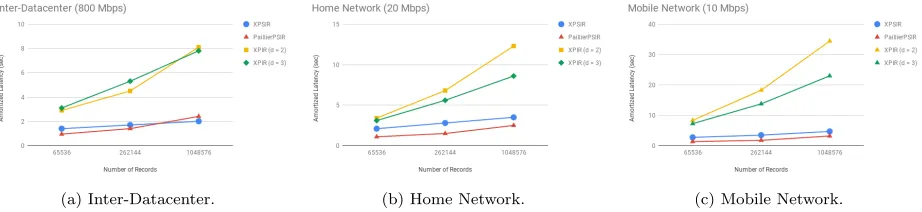
Latency. To understand the total time required to perform a private retrieval, we measure the latency of retrieving one 288 byte element from databases ofn∈ {216,218,220}records. We set up our client and server machines on the same LAN network and utilize the Linux Traffic Control [1] to configure the bandwidth on both machines. We consider the following three scenarios also used in [7]: querying between two datacenters, using a home network and using a mobile network. We configure our machines to maintain 800 Mbps for queries between data centers. For the home and mobile network, we choose 18.7 Mbps and 10 Mbps for each setting based on Akamai’s latest reports [3]. The results are reported in Figure 3. Amortized latency refers to online latency and the latency of PSIR.Initand PSIR.UpdateState spread over queries. PaillierPSIR and
XPSIRhave smaller latency than XPIR.
7.2
Cost of Ring-LWE based
PSIR
Our first implementation of PSIR is in C++ on top of the APIs provided by the open sourced XPIR [2] implementation.
We choose the parameters for Ring-LWE based FHE schemes used by XPIR based on the analysis by Albrechtet al.[6]. Similar parameters are used in previous instantiations of XPIR [5] and SealPIR [7]. For XPIR, we use 2048 degree polynomials and 60 bit coefficient modulus. In particular, we use the recommended modulus of the form 261−i·214+ 1 for differenti. We will packα= 14 records to be downloaded and fitα records into a single ciphertext. Therefore, XPIR will view the database asn/αrecords of 288·αbytes.
We construct PSIRusing the XPIR scheme with d= 2 levels of recursion, which we denoteXPSIR. In addition, we estimate costs ofPSIRwith SealPIR (SealPSIR) using previously reported results [7]. We note our experimental setup is worse than the one chosen in [7] in terms of number of cores, RAM size and CPU version. The means of 10 experiment runs are reported for XPSIR in Table 3. Our estimated costs for
SealPSIRare shown in Table 2. The costs ofOCPare shown in Appendix A.
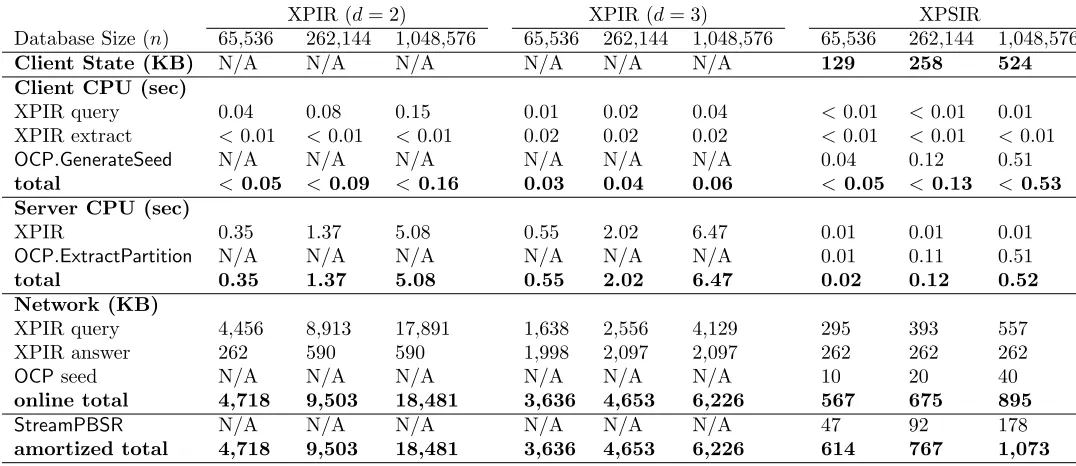
XPSIR. The results for XPSIRshow up to 12x reductions in server CPU, 7x reductions in online network costs and 6x reductions in total amortized network costs compared to XPIR. For the 1M items case,XPSIR
introduces up a half second increase in client CPU, but offsets the gain by decreasing server by at least 4.5 seconds.
SealPSIR. Our estimates for SealPSIR indicate up to 10x reduction in server CPU costs since the PSIR
XPIR (d= 2) XPIR (d= 3) XPSIR
Database Size (n) 65,536 262,144 1,048,576 65,536 262,144 1,048,576 65,536 262,144 1,048,576
Client State (KB) N/A N/A N/A N/A N/A N/A 129 258 524 Client CPU (sec)
XPIR query 0.04 0.08 0.15 0.01 0.02 0.04 <0.01 <0.01 0.01
XPIR extract <0.01 <0.01 <0.01 0.02 0.02 0.02 <0.01 <0.01 <0.01
OCP.GenerateSeed N/A N/A N/A N/A N/A N/A 0.04 0.12 0.51
total < 0.05 <0.09 <0.16 0.03 0.04 0.06 < 0.05 <0.13 <0.53 Server CPU (sec)
XPIR 0.35 1.37 5.08 0.55 2.02 6.47 0.01 0.01 0.01
OCP.ExtractPartition N/A N/A N/A N/A N/A N/A 0.01 0.11 0.51
total 0.35 1.37 5.08 0.55 2.02 6.47 0.02 0.12 0.52 Network (KB)
XPIR query 4,456 8,913 17,891 1,638 2,556 4,129 295 393 557
XPIR answer 262 590 590 1,998 2,097 2,097 262 262 262
OCPseed N/A N/A N/A N/A N/A N/A 10 20 40
online total 4,718 9,503 18,481 3,636 4,653 6,226 567 675 895
StreamPBSR N/A N/A N/A N/A N/A N/A 47 92 178
amortized total 4,718 9,503 18,481 3,636 4,653 6,226 614 767 1,073
Table 3: Microbenchmarks for network and CPU costs for XPIR withd∈ {2,3}levels of recursion andPSIR
using XPIR (d= 2).
However, the client CPU increase is half a second while 6 seconds are saved in server CPU. Furthermore, 80% of the extra network costs can be performed offline at cheaper, non-busy times.
7.3
Cost of
PaillierPSIR
In the previous section, we show that our estimates forSealPSIRindicate decreases in server CPU and online network costs but increases in total amortized network costs. Is it possible to construct aPSIRscheme that can decrease the total amortized network while reducing server CPU and online network costs significantly? We answer in the affirmative.
We construct a library that constructs PIR based on the Paillier cryptosystem [42] and build a PSIR
scheme on top of the Paillier PIR library. We denote this PSIRscheme as PaillierPSIR. Traditionally, PIR schemes built from Paillier enjoy the advantages of small network costs but suffer from extremely large server CPU costs. However,PaillierPSIRreduces the online PIR request to a small database where the Paillier-built PIR is feasible. We study the time needed by the client to generate queries and extract responses as well as the time needed by the server to generates responses from queries. In addition, we examine network costs. The results can be seen in the right column of Table 2 and compared to SealPIR (the best, previous construction) seen in the left column of Table 2.
Optimizations to Paillier. The Paillier cryptosystem [42] is a partially homomorphic encryption sys-tem. Paillier has two important properties which enable its use for PIR: homomorphic plaintext absorption and homomorphic addition. Homomorphic plaintext absorption is the property that given an encryption,
Enc(K, m), and a plaintext,p, then Enc(K, m)p=Enc(K, mp). Homomorphic addition is the property that
for any two ciphertexts,Enc(K, m1) andEnc(K, m2), thenEnc(K, m1)Enc(K, m2) =Enc(K, m1+m2). Pail-lier can be used to perform PIR requests. For a database,p1, . . . , pn, ofnitems ofbbits, the client uploads Enc(K, m1), . . . ,Enc(K, mn) where only one mi = 1 corresponding to retrieving the i-th item. The server needs to compute the value Q
j∈[n]Enc(K, mj)
pj. The trivial way to compute a product of powers is to
(a) Inter-Datacenter. (b) Home Network. (c) Mobile Network.
Figure 3: The amortized latency for queries under different settings.
computational efficiency of this problem. We implement Straus’s algorithm [48] as a faster way to compute the product of powers. For parameterρ, we only require (n/ρ)·(2ρ+b) multiplications and (n/ρ)·bsquarings.
For a description of Straus’s algorithm, see Algorithm 14.88 in [39].
Network costs. PaillierPSIRbenefits from significant reductions in online network costs as well as a modest reduction in total amortized network costs. PaillierPSIRuses 4.8-10.5x less online network costs and 1.3-4.5x less total amortized network costs compared to SealPIR. The main gains derive from replacing RLWE-based PIR schemes with the Paillier PIR scheme. Furthermore, the majority of amortized network costs may be performed offline.
CPU costs. For 1M items,PaillierPSIRreduces server CPU costs by more than 3.7x compared to SealPIR. However, PaillierPSIRintroduces an increase in client CPU costs which we believe is a worthwhile tradeoff. In concrete terms, client CPU increases by 660 milliseconds while server CPU decreases by more than 4 seconds.
8
Conclusions
In this paper, we present PSIR, an extension of PIR, that is able to utilize the large amounts of storage available to applications on client devices. Unlike other stateful primitives, we designPSIRsuch that several important practical properties of PIR are maintained. In particular,PSIRensures that simultaneous querying capability to large groups of independent clients, query privacy for a server colluding with clients and the ability for stateless clients to enroll in the system using only interaction with the server. By using client state, PSIRreduces the number of public-key operations that dominate practical costs to be sub-linear in the database size.
For concrete gains, we show that PaillierPSIR scheme (PSIR using PaillierPIR) is able to significantly reduce server CPU, online and amortized total network costs compared to SealPIR (the current best PIR construction). In addition, we show that instantiating PSIRwith XPIR and SealPIR can also significantly reduce server CPU. ForPSIRwith XPIR, significant network cost are also enjoyed whilePSIRwith SealPIR increases network costs. Due to ourPSIR scheme, the majority of network costs may be moved to offline processing.
References
[1] Introduction to Linux traffic control. http://tldp.org/HOWTO/Traffic-Control-HOWTO/intro.html, 2006.
![Table 2: Microbenchmarks for network and CPU costs. The left column results are reported from [7]](https://thumb-us.123doks.com/thumbv2/123dok_us/7968359.1321508/20.612.74.575.75.305/table-microbenchmarks-network-cpu-costs-column-results-reported.webp)