A Virtual Reality-based Context
Simulator for Evaluating the Effect of
Uncertainty on Smart Building
Applications
A thesis submitted to the
University of Dublin, Trinity College
in fulfilment of the requirements for the degree of
Doctor of Philosophy
Kris McGlinn
Knowledge and Data Engineering Group, School of Computer Science & Statistics,
Trinity College Dublin, Ireland, [email protected]
Supervised by Dr. Dave Lewis Co-supervised by Dr. Lucy Hederman
Declaration
I declare that this thesis has not been submitted as an exercise for a degree at this or any other university and it is entirely my own work.
Signed: __________________________
Kris McGlinn
Permission to lend or copy
I agree to deposit this thesis in the University’s open access institutional repository or allow the library to do so on my behalf, subject to Irish Copyright Legislation and Trinity College Library conditions of use and acknowledgement.
Signed: __________________________
Kris McGlinn
v
Abstract
Smart Building Applications (SBAs) adapt their behaviour in response to context information generated by sensors present in the smart building. SBA developers must however account for uncertainty in the accuracy of context information resulting from imperfection in the sensing technology and potentially complex interactions between the sensed phenomenon, the sensor and the physical environment. To address this challenge, Context Simulators are increasingly employed. These generate simulated context information based on an internal model of the building, it sensors and its occupants and their activities. Some simulators employ Virtual Reality (VR) environments, to more accurately capture the likely behaviour of users in a simulated smart building, and thereby model and simulate their interaction with sensors and, via the resulting context information, with SBAs. This type of evaluation can result in better designed SBAs by prototyping them in simulated conditions before being deployed into a real physical environment. A number of key challenges remain to be addressed however, before such a simulation-based SBA prototyping approach can become widely used. Firstly, any context simulator must be flexible in its approach to simulating context, so that it supports simulating different mixes of SBAs, context sources and smart buildings, using a selection of methods most suitable to the evaluation task at hand. Secondly, the context simulator must support simulating uncertainty in context. Lastly, the process of setting up a simulation should be efficient in use, satisfying to the developer and also, be effective in correctly evaluating the SBA behaviour.
vi
Contents
Acknowledgments ... iv
Abstract ... v
ABBREVIATIONS ... xviii
Glossary ... xxi
Related Publications by the Author ... xxiii
1 Introduction ... 1
1.1 Motivation ... 1
1.2 Research Hypothesis ... 7
1.3 Research Objectives ... 7
1.3.1 Objective 1: ... 7
1.3.2 Objective 2: ... 7
1.3.3 Objective 3: ... 8
1.4 Technical Approach ... 8
1.5 Research Contributions ... 10
1.6 Thesis Overview ... 12
2 Background ... 15
2.1 Introduction ... 15
2.2 Context, Context-Aware Computing and Context-Aware Applications ... 15
2.3 Context Modelling ... 17
2.4 Uncertainty in Context ... 20
2.5 Modelling Uncertainty ... 22
2.6 Smart Building Modelling ... 25
2.6.1 Sensor Modelling ... 27
2.7 What is meant by usability? ... 29
2.7.1 Usability Evaluation Structure ... 29
3 State of the Art ... 32
3.1 Introduction ... 32
3.2 Smart Building Applications ... 32
3.2.1 Indoor Location Systems and Context ... 33
3.2.2 Smart Building Application Development ... 35
3.3 Evaluating Smart Building Applications ... 37
3.3.1 Criteria for Context Simulation ... 37
3.4 Context Simulators ... 40
3.4.1 Non-interactive Context Simulators ... 41
3.4.2 Interactive Context Simulators ... 57
3.5 Categorising Properties of Existing Simulation Approaches ... 63
3.5.1 Simulating Context and Uncertainty ... 64
3.5.1.7 Modelling and Configuration Tools ... 74
3.5.2 Comparison Framework ... 78
3.6 Summary of Key Findings of Context Simulator ... 82
3.6.1 Strengths of Existing Context Simulators ... 82
3.6.2 Weaknesses of Existing Context Simulators ... 84
3.7 Chapter Summary and Conclusion ... 86
4 Design ... 88
4.1 Introduction ... 88
4.2 Influence from State of the Art ... 89
4.3 The Information Delivery Manual ... 92
4.4 Smart Building Application Life Cycle... 93
4.4.1 Smart Building Application Evaluation Using Context Simulation ... 94
4.4.2 SimCon Context Simulator Overview ... 96
4.4.3 SimCon Context Simulation Model and Contum Definition ... 98
4.5 Summary and Conclusion... 113
5 Implementation ... 115
5.1 Introduction ... 115
5.2 Overview of the SimCon System ... 115
5.3 Pre-SimCon Modelling ... 116
5.3.1 Pre-Modelling: The Tatus Platform ... 117
5.3.2 Pre-Modelling: SimConfig and SimConViz ... 118
5.3.3 Pre-Modelling: Summary ... 120
5.4 The SimConfig Tool ... 120
5.4.1 SimConfig: Graphical Modelling Interface ... 121
5.4.2 SimConfig: SimCon Source Configuration Interface... 123
5.4.3 SimConfig: Summary ... 129
5.5 SimConGen: Simulated Context Generation ... 129
5.5.1 Connection to Tatus ... 130
5.5.2 SimConGen and the SimCon Model ... 131
5.5.3 Non-User Driven Contum Generation ... 132
5.5.4 User Driven Location Contum Generation ... 132
5.5.5 Uncertainty Generation ... 134
5.5.6 External Simulator Models ... 134
5.5.7 Hybrid Simulation ... 135
5.5.8 Smart Building Application Integration ... 136
5.5.9 SimConGen Summary ... 136
5.6 SimConViz Tool ... 137
5.6.1 Location Visualisation ... 138
5.6.2 CFD and Temperature Context Visualisation ... 140
5.6.3 Radio Propagation Visualisation ... 141
5.6.5 Summary SimConViz Tool ... 143
5.7 Chapter Summary and Conclusion ... 143
6 SimCon Evaluation ... 145
6.1 Introduction ... 145
6.2 Usability Evaluation: SimCon Model ... 146
6.2.1 Methodology and Metrics... 146
6.2.2 Goals... 147
6.2.3 Metrics ... 148
6.2.4 Overview of Usability Evaluations ... 152
6.3 Usability Evaluation 1 ... 156
6.3.1 Evaluation 1A: Comparative Usability Evaluation SimConfig Prototype ... 156
6.3.2 Evaluation 1B: Formative Usability Evaluation of SimCon Version 1 ... 162
6.3.3 Summary and Conclusion Usability Test 1 ... 168
6.4 Usability Evaluation 2 ... 169
6.4.1 Evaluation 2A: Formative Usability Evaluation of SimCon Version 2 ... 169
6.4.2 Evaluation 2B: Formative Evaluation of SimConfig Tool Usability ... 175
6.4.3 Evaluation 2C: Formative Evaluation of SimCon Usability with Non-technical Users 181 6.4.4 Summary of Findings of Usability Evaluation 2 A, B and C and Implications for Final Summative Evaluation ... 189
6.4.5 Usability Evaluation 2 Conclusion and Implications for Future Evaluations ... 191
6.5 Usability Evaluation 3: ... 191
6.5.1 Usability Evaluation 3: Final Summative Evaluation ... 192
6.5.2 Goal ... 193
6.5.3 Findings ... 200
6.5.4 Findings All Participants ... 201
6.5.5 Findings for Non-Expert Participants ... 205
6.5.7 Interpretation ... 211
6.5.8 Conclusion ... 217
6.6 Comparison of Evaluation Results against Objectives ... 218
6.7 Summary and Conclusion... 219
7 Conclusion ... 221
7.1 Objectives and Achievements ... 221
7.1.1 Objective 1: ... 221
7.1.2 Objective 2: ... 221
7.1.3 Objective 3: ... 221
7.1.4 Comparison to State of the Art ... 224
7.2 Contribution to the State of the Art ... 231
7.2.1 Peer Reviewed Publications ... 234
7.3 Further Work ... 235
7.3.1 Context Simulation ... 235
7.3.2 Extending SimCon to Support Building Energy Analysis ... 239
8 Bibliography ... 242
9 Appendix A: BLIS Model View Definition ... 260
10 Appendix B (Data Models) ... 261
10.1 SimConXML Description Ubisense Cell ... 261
10.2 SensorML Descriptions ... 263
10.2.1 Ubisense Cell ... 263
10.2.2 Tyndall ZigBee Transceiver ... 266
10.3 Contums ... 270
10.3.1 Coordinate (Ubisense) ... 270
10.3.2 Presence (Generic Passive Infrared Sensor) ... 270
10.3.3 Proximity (ZigBee Tyndall Mote) ... 270
11 Appendix C: Usability Evaluations Figures ... 271
11.1 Figures Usability Evaluation 1 ... 271
11.1.1 Figures Usability Evaluation 1 SimCon V1 ... 273
11.1.2 Figures Usability Two: SimCon Version 2 Evaluation 1 ... 273
11.1.3 Usability Two: SimCon Version 2 Evaluation 2... 274
12 Appendix D: Pre-questionnaires and Backgrounds ... 275
12.1 Evaluation 1A ... 275
12.1.1 1A Pre-Questionnaire Findings ... 275
12.2 Evaluation 1B ... 276
12.2.1 Pre-Questionnaire ... 276
12.3 Evaluation 2A ... 276
12.3.1 2A Pre-Questionnaire ... 276
12.4 Evaluation 2B ... 277
12.4.1 2B Pre-Questionnaire ... 277
12.5 Evaluation 2C ... 278
12.5.1 Pre-Questionnaire ... 278
12.5.2 Evaluation 3 ... 279
13 Appendix E: Significant Errors and Times ... 281
13.1 Errors ... 281
13.1.1 Evaluation 1A ... 281
13.1.2 Evaluation 1B ... 281
13.1.3 Evaluation 2A ... 281
13.1.4 Evaluation 2B ... 282
13.1.5 Evaluation 2C ... 282
13.2 Times ... 283
13.2.1 Evaluation 1B ... 283
14 Appendix F: Post-Questionnaires ... 285
14.1 Evaluation 1A ... 285
14.2 Evaluation 2C ... 285
14.3 Evaluation 1B ... 287
14.4 Evaluation 2B: SUS Questions ... 287
14.5 Evaluation 3 ... 288
14.5.1 SimCon Tool Specific Questions ... 288
14.5.2 Evaluation 3: Post Questionnaire Comments ... 291
14.5.3 Standard Usability Scale ... 294
15 Appendix G: Evaluation 3 Position of PIRs ... 295
15.1 All Participants ... 295
15.2 Non-Experts ... 295
15.3 Experts ... 296
16 Appendix H: Experimental Instructions ... 297
16.1 Evaluation 2C ... 297
16.1.1 Part 1 ... 297
16.1.2 Introduction ... 297
16.1.3 Tasks ... 297
16.1.4 Part 2 (Group B) ... 305
16.1.5 Introduction ... 305
16.1.6 Tasks ... 305
16.2 Evaluation 3 ... 312
16.2.1 Introduction ... 312
16.2.2 Tasks ... 316
17 Appendix I: Detailed Description of Experiment Tasks ... 324
Table of Tables
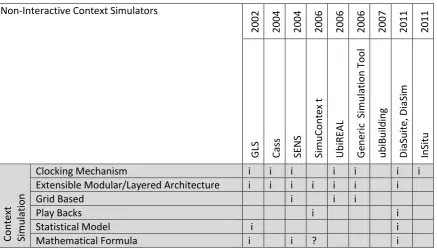
Table 3-1 Comparison Framework – Non-Interactive Simulators ... 78
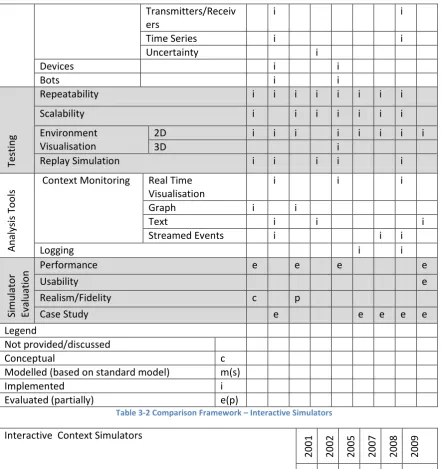
Table 3-2 Comparison Framework – Interactive Simulators ... 80
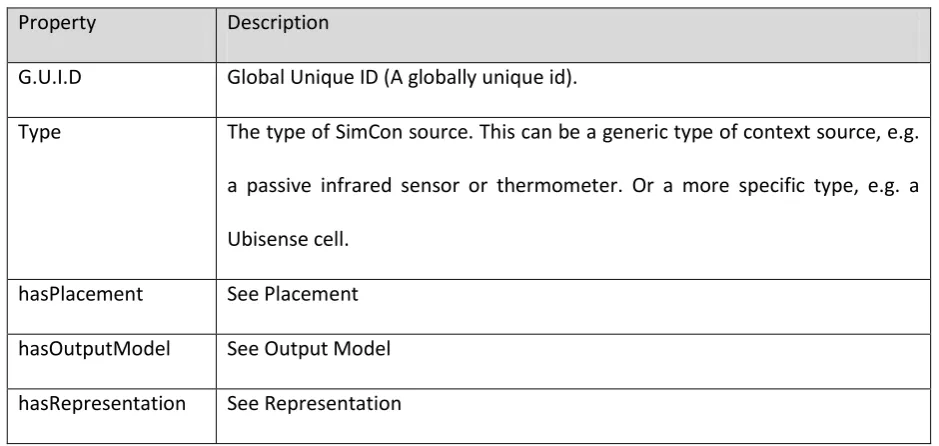
Table 4-1 SimCon Source Properties ... 100
Table 4-2 SimCon Placement Model ... 100
Table 4-3 SimCon Output Model ... 101
Table 4-4 SimCon Bot Model ... 104
Table 4-5 SimCon Transmitter Model ... 106
Table 4-6 SimCon Uncertainty Model ... 107
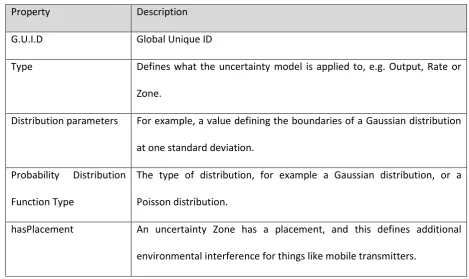
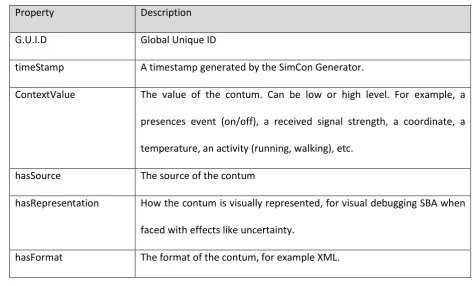
Table 4-7 SimCon Contum Model ... 109
Table 4-8 SimCon Model Conceptual Mappings with two Existing Sensor Models ... 111
Table 5-1: Contum (Ubisense) ... 131
Table 6-1 Overview of Usability Evaluations ... 155
Table 6-2 1A Time to Complete Tasks (in minutes) ... 160
Table 6-3 Control and Test Group along with Experience Levels ... 195
Table 6-4 Number of Participants who correctly placed the PIR Sensors: All participants ... 201
Table 6-5 Number of Participants who correctly placed the PIR Sensors: Non-Expert Participants .. 205
Table 6-6 Number of Participants who correctly placed the PIR Sensors: Expert Participants ... 208
Table 7-1 Comparison Framework – SimCon v Interactive Simulators... 224
Table 12-1 1B Pre-questionnaire ... 276
Table 12-2 Background - No Experience ... 279
Table 12-3 Background - Novice ... 279
Table 12-4 Background - Intermediate ... 279
Table 12-5 Background - Expert ... 279
Table 13-1 Average time per task and standard deviation. ... 283
Table 13-2 Time to Complete Tasks: All Participants ... 283
Table 13-3 Time to Complete Tasks: Non-Expert participants ... 284
Table 13-4 Time to Complete Tasks: Expert participants ... 284
Table 14-1 Specific Usability Questions for Part 2 Participants ... 285
Table 14-2 SimCon Specific Questions Control Group: All Participants ... 289
Table 14-3 SimCon Specific Questions Control Group: Non-Expert ... 289
Table 14-4 SimCon Specific Questions Control Group: Expert ... 289
Table 14-5 SimCon Specific Questions Test Group: All Participants ... 290
Table 14-6 SimCon Specific Questions Test Group: Non-Expert ... 290
Table 14-7 SimCon Specific Questions Test Group: Expert ... 290
Table 14-8 SUS All Control Group ... 294
Table 14-9 SUS All Test Group ... 294
Table 15-1 Position of PIR Sensors Control Group: All participants ... 295
Table 15-2 Position of PIR Sensors Test Group: All participants ... 295
Table 15-3 Position of PIR Sensors Control Group: Non-Expert participants ... 295
Table 15-4 Position of PIR Sensors Test Group: Non-Expert participants ... 295
Table 15-5 Position of PIR Sensors Control Group: Expert Users ... 296
Table 15-6 Position of PIR Sensors Test Group: Expert Users ... 296
Table of Figures
Figure 2-1 Context Acquisition and Processing, resulting in low and high level context and ending in a
situation ... 17
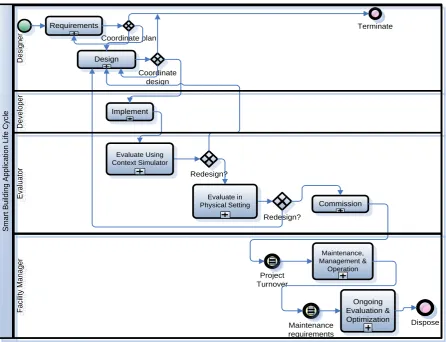
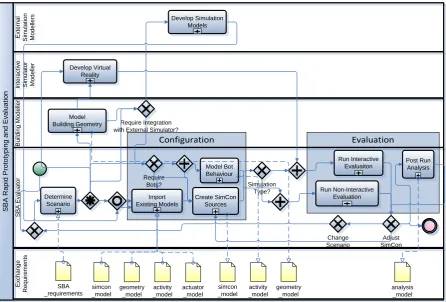
Figure 4-1 BPMN Overview SBA Life Cycle... 94
Figure 4-2 SBA Evaluation using Context Simulation ... 95
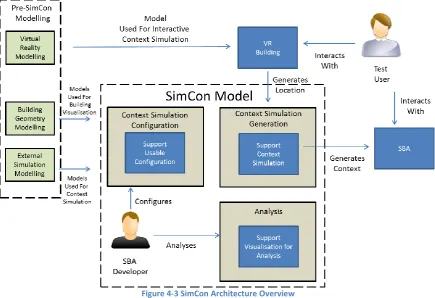
Figure 4-3 SimCon Architecture Overview ... 97
Figure 4-4 UML Class Diagram: SimCon Model... 99
Figure 4-5 User Driven Context Simulation ... 103
Figure 5-1 Overview SimCon Implementation: SimCon model components (Simconfig and SimConViz tools and SimConGen contum Generator), External Modelling requirements, Half Life 2 Games Engine and Smart Building Application. ... 116
Figure 5-2 Virtual Reality Buildings in Half Life 2 for supporting user driven context generation (Left: Environmental Research Institute Cork, Right: Lloyd Building TCD) ... 118
Figure 5-3 Visualisation of Building Model (2D and 2.5D): Supports placement of SimCon sources and also visualisation of contums ... 119
Figure 5-4 SimConfig Components: Graphical Modelling Interface and Configuration Interface ... 121
Figure 5-5 SimCon Configuration: The Graphical Modelling Tool for modelling of multiple SimCon sources as processes and which generate both low and high level context ... 122
Figure 5-6 SimConfig: Configuring Source Info ... 124
Figure 5-7 SimConfig: Configuring a Ubisense SimCon source ... 124
Figure 5-8: SimConfig Placement and Visualisation of SimCon sources (Type, Zone and Origin) ... 125
Figure 5-9 Output Model: Temperature SimCon Source Modelled as Time Series ... 126
Figure 5-10 Assigning a Ubisense Transmitter to an Avatar named “player” with a transmission rate of 0.1 seconds. ... 127
Figure 5-11 An Uncertainty Zone (green box) Model for a Ubisense cell ... 128
Figure 5-13 Winplanner Radio Propagation Model ... 134
Figure 5-14 SimConViz using sensorML context source description to visualise a proximity contum ... 138
Figure 5-15 SimConViz: Visualisation of tagged and non-tagged avatars, and location and presence contums. ... 139
Figure 5-16 External Models for Temperature Simulation, and temperature at point for a room in the NIMBUS centre in Cork. Left centre a heat source has been defined, and an exit right centre an open door. ... 140
Figure 5-17 Displaying Hybrid simulation, simulated coordinate and real temperature using SimConGen and SimConViz. ... 141
Figure 5-18 External Models for user driven RSS Simulation ... 142
Figure 5-19 Visualising Performance Metrics for determining whether temperature is falling bove or below acceptable levels. ... 142
Figure 6-1. The ISO definition of Usability Converted into Quantifiable Metrics ... 148
Figure 6-2 A comparison of the adjective ratings, acceptability scores, and school grading scales, in relation to the average SUS score (Bangor, Kortum et al. 2009) ... 149
Figure 6-3 Overview Evaluations and Objectives ... 152
Figure 6-4 Post Questionnaire (Q3 and Q4) ... 161
Figure 6-5 Virtual Reality Building Floor plan with Context Source Info. ... 164
Figure 6-6 Time taken per task and average time per task. ... 165
Figure 6-7 Average Time Per Task and Standard Deviation ... 166
Figure 6-8 1B Post Question Answers (Appendix F section 14.3) ... 166
Figure 6-9 Time taken per task (minutes) ... 173
Figure 6-10 Average Time Per Task and Standard Deviation (minutes) ... 173
Figure 6-12 Time taken per task (mins) ... 178
Figure 6-13 Average Time and Standard Deviation (mins) ... 178
Figure 6-14 Post- Questionnaire Answers ... 180
Figure 6-15 Times Part 1 ... 185
Figure 6-16 Times Part 2 ... 185
Figure 6-17 Standard Usability Scale ... 186
Figure 6-18 Q1: How helpful was sensor data (context) visualisation for understanding how the security application views user location? Q2: How helpful was user location visualisation for understanding how uncertainty impacts on the application for detecting intruders? ... 186
Figure 6-19 Q3: How easy was it to create a SimCon source type? Q4: How easy did you find configuring SimCon uncertainty? Q5: How easy did you find visualising sensor data (context)? ... 187
Figure 6-20 The corridor with a Ubisense cell (purple), zoneA (white) in front of the open door (yellow) and user? (red) and userA (blue). ... 196
Figure 6-21 Automatic Door Finite State Machine ... 197
Figure 6-22 Experiment Situations ... 198
Figure 6-23 Average Time (and Standard Deviation) to Successfully Place PIR and Complete Task: All Participants (Control Group) ... 201
Figure 6-24 Average Time (and Standard Deviation) to Successfully Place PIR and Complete Task: All Participants (Test Group) ... 201
Figure 6-25 Average Time (and Standard Deviation) to Complete Tasks: All Participants (Control Group) ... 202
Figure 6-26 Average Time (and Standard Deviation) to Complete Tasks: All Participants (Test Group) ... 202
Figure 6-27 Q3 “Creating a SimCon source was challenging” All participants (control and test) ... 203
Figure 11-1 Overview of SimCon Prototype, Upper right Sequence approach, bottom right Activity
approach. ... 271
Figure 11-2 Prototype SimCon Tool (Activity Diagram) ... 272
Figure 11-3 SimCon Configuration Tool Interface, Iteration 1 ... 273
Figure 11-4 Maze Game and 3rd Person Environment and SimConViz Tool ... 273
Figure 11-5 SimConfig tool bottom. SimConViz Tool. ... 274
Figure 11-6 SimConfig SimCon source Visualisation and SimConViz Contum Visualisation ... 274
Figure 12-1 1A Pre-Questionnaire Answers ... 275
Figure 12-2 2A Pre-Questionnaire Answers ... 276
Figure 12-3 2B Pre-Questionnaire Answers ... 277
Figure 12-4 Have you ever used a Computer Aided Design (CAD) tool? ... 278
Figure 12-5 Can you name the tool(s)? ... 278
Figure 12-6 How would you rate your level of knowledge of sensor systems for detecting location? ... 278
Figure 12-7 How would you rate your level of knowledge of SBAs? ... 278
Figure 14-1 Post Questionnaire ... 285
Figure 16-1 The corridor with a Ubisense cell (purple), zoneA (white) in front of the open door (yellow) and user? (red) and userA (blue). ... 312
Figure 16-2 Experiment Situations ... 313
Figure 16-3 Automatic Door Finite State Machine ... 314
Figure 16-4 A Normal PDF ... 315
Figure 16-5 SimCon Model: (Type, GUID and Context) ... 316
Figure 16-6 SimCon Model: (Position ID, Coordinate) ... 317
Figure 16-7 SimCon Model: (Source ID and Type, Target, Uncertainty ID, Distribution, Standard Deviation))... 318
Abbreviations
AI Artificial Intelligence
AEC Architecture, Engineering and Construction API Application Programming Interface
BIM Building Information Model BLC Building Life Cycle
BLIS Building Lifecycle Interoperable Software BPMN Business Process Modelling Notation CAD Computer Aided Design
CAVE Cave Automatic Virtual Environment CFD Computational Fluid Dynamics CIT Cork Institute of Technology CIF Common Industry Format
CSUQ Computer System Usability Questionnaire CVE Collaborative Virtual Environment
ECG Electrocardiography
ERI Environmental Research Institute GLS Generic Location Event Simulator GMF Graphical Modelling Framework GML Geographical Mark-up Language GPS Global Position Satellites GSN Global Sensor Network GUID Global Unique Identifier GUI Graphical User Interface HL2 Half Life 2
HVAC Heating Ventilation and Air Conditioning
ID Identifier
IFC Industry Foundation Classes
ISO International Organization for Standardization ITS Intelligent Transport System
JRE Java Runtime Environment
KDEG Knowledge and Data Engineering Group LAN Local Area Network
LCD Liquid Crystal Display MVD Model View Definition
NASA National Aeronautics and Space Administration NIST National Institute of Standards and Technology OMG Object Management Group
PAS Publicly Available Specification PDF Probability Distribution Function PIR Passive Infrared Sensor
QUIS Questionnaire for User Interaction Satisfaction RCEU Replaceable Code Emulation Unit
RF Radio Frequency
RFID Radio Frequency Identification RSS Received Signal Strength
SB Smart Building
SBA Smart Building Application
SENS Sensor, Environment and Network Simulator SensorML Sensor Modelling Language
SDK Software Development Kit
SL Second Life
SQL Structured Query Language p131
SWEET Semantic Web for Earth and Environmental Terminology SUMI Software Usability Measurement Inventory
TCD Trinity College Dublin
TEDS Transducer Electronic Data Sheet
TCP/IP Transmission Control Protocol/ Internet Protocol UCD University College Dublin
UCC-CE University College Cork Civil Engineering UML Unified Modelling Notation
USE Ease of Use Questionnaire UWB Ultra Wide Band
WLAN Wireless Local Area Network WoZ Wizard of Oz
WSN Wireless Sensor Network VR Virtual Reality
Glossary
Accuracy: The closeness of agreement between a measured quantity value and a true quantity value
Avatar: A graphical representation of user in a simulated smart environment, which is controlled interactively by a human.
Bot: A simulated user of a smart environment.
Bot-driven context simulation: Context simulation which is affected by the behaviour of bots in the simulation environment.
Building Life Cycle (BLC): Defines the entire life of a building from inception and design, to construction, through operation and maintenance and on to eventual demolition/recycling (O’Sullivan, Keane et al. 2004).
Building Information Model (BIM): An integrated data model for storing all the information relevant to the BLC.
Context: Any information that can be used to characterise the situation of an entity. An entity is a person, place, or object that is considered relevant to the interaction between a user and an application, including the user and applications themselves (Addlesee, Jones et al. 1997).
Context Acquisition: A process of generating context information.
Context-Aware Application: Any application which makes use of context information.
Context Processing: A process of transforming low-level context into high-level context and situations.
Context Simulator: A piece of software which can generate simulated context.
Context Source: Any entity which generates context information relevant to a context-aware application (Broens and Halteren 2006).
Contum: A piece of discrete context information that is associated with a value of uncertainty.
Interactive Context Simulation: A context simulator which supports user-driven context simulation i.e. simulated context which is affected by the interactions of a user with the simulation environment.
Low Level Context: Context generated by sensors.
Non-Interactive Context Simulation: A context simulator which does not support user-driven context simulation.
Precision: The closeness of agreement between indications or measured quantity values obtained by replicate measurements on the same or similar objects under specified conditions
Smart Building: A subset of smart environments.
Smart Building Application: A context-aware application used in an indoor setting and affected by low-level context gathering in that setting.
Smart Environment: Environments which are richly and invisibly interwoven with sensors, actuators, displays, and computational elements.
Situation: The highest level of abstraction of context and the level at which users define a particular context. An application acts upon a situation which is derived from either low or high level context.
Related Publications by the Author
AnzaldiI, G. Corchero, A. Gutu, D., Marinov, M. Dibley, M.J. McGlinn, K. “Intelligent Building Energy Management through holistic knowledge based approach" Accepted to the 15th International Conference of the Catalan Association of Artificial Intelligence CCIA 2012, pages 223 – 232, University of Alacant, October 24-26, 2012.
McGlinn, K., R. Brennan, O’Sullivan, D. Lewis, D. (2011). “The SimCon Generator: An Interactive Context Simulator for Rapid Evaluation of Smart Building Applications using Virtual Reality.” 8th International Workshop on Managing Ubiquitous Communications and Services, pages 50-55, Seattle, USA, IEEE, 2011.
McGlinn, K., O'Neill, E., Gibney, A., O’Sullivan, D. Lewis, D.(2010). "SimCon: A Tool to Support Rapid Evaluation of Smart Building Application Design using Context Simulation and Virtual Reality." Journal of Universal Computer Science. V 16(15): pages 1992-2018, 2010.
McGlinn, K., E. Corry, O'Neill, E. Keane, M. Lewis, D. O'Sullivan D. (2010). “Monitoring Smart Building Performance Using Simulation and Visualisation”. In Proceedings of Ubiquitous Computing for Sustainable Energy (UCSE2010), Ubicomp 2010 Workshop, Copenhagen, Sept 25th, ACM, 2010.
O'Neill, E., McGlinn, K., Lewis, D., Bailey, E., Dobson, S., and McCartney, K., ”Application Development using Modelling and Dynamical Systems Analysis”, In Proceedings of 1st International Workshop on Context-Aware Middleware and Services (CAMS '09), Dublin, Ireland, 16th June 2009, ACM, 2009.
McGlinn, K., E. O'Neill, Lewis, D. (2008). “SimCon: A Tool for Modelling Context Sources for Rapid Evaluation of Pervasive Applications using Virtual Reality”. Proceedings of the 5th Annual International Conference on Mobile and Ubiquitous Systems: Computing, Networking, and Services (Mobiquitous '08), pages 1-2, ICST, Trinity College Dublin, Ireland, July 21-25, 2008.
Kevin Feeney, D. L., Kris McGlinn, Declan O’Sullivan, Anne Holohan. “Avoiding ‘Big Brother’ Anxiety with Progressive Self-Management of Ubiquitous Computing Services”, Proceedings of the 5th Annual International Conference on Mobile and Ubiquitous Systems: Computing, Networking, and Services (Mobiquitous '08), ACM, Trinity College Dublin, Ireland, July 21-25, 2008.
O'Neill, E., McGlinn, K., and Lewis, D., “A Platform to Evaluate Usability in Adaptive Context-Aware Services through Adaptive Questioning”. In Adjunct Ubicomp '07 Proceedings, USE '07, 1st International Workshop on Ubiquitous Systems Evaluation, Innsbruck, Austria, 16th Sept 2007.
McGlinn, K., O'Neill, E., Lewis, D., “Modelling of Context and Context-Aware Services for Simulator Based Evaluation”, In Proceedings of 4th International Workshop on Managing Ubiquitous Communications and Services (MUCS ’07), Multicon Lecture Notes, Munich, Germany, May 25, 2007.
1
1
Introduction
1.1
Motivation
The term “smart environment”, as defined by Cook and Das, denotes an environment which is “richly and invisibly interwoven with sensors, actuators, displays, and computational elements" (Cook and Das 2004). Smart environments are an enabler for context-aware applications, which are applications that can react to changing context. In Dey’s Ph.D. thesis “Towards a better understanding of context and context-awareness” he defined context as “any information that can be used to characterize the situation of an entity. An entity is a person, place, or object that is considered relevant to the interaction between a user and an application, including the user and applications themselves”(Dey 2000). When the smart environment in question is a building which enables context-aware applications, we call this a “smart building” (SB). Smart building applications (SBAs) are therefore a subset of context-aware applications and are applications which can react to changing context in buildings. SBAs can support building functions such as security (Song, Choi et al. 2008), energy management systems (Agarwal, Balaji et al. 2010), assisted living for elderly (Wood, Stankovic et al. 2008), and museum tour guides (Tsai, Chou et al. 2010).
2
building for the purposes of conducting evaluations of an SBA therefore represents a significant cost (Reilly, Dearman et al. 2005).
Sensor deployments may also exhibit varying levels of uncertainty in the context information they generate (Bettini, Brdiczka et al. 2010). Uncertainty is a measure of lack of knowledge about a system. This can be the result of having incomplete information about the current state of an environment as a result of not having the right type or number of sensors to detect a phenomenon, or it can be the result of measurement uncertainty. Measurement uncertainty in sensors is the result of a number of factors. (Ye, McKeever et al. 2008) identified these as: the technical limitations of the sensor (for example, variation in sample rates, delays and the accuracy of the sensors); environmental noise (for example factors which affect the accuracy of the measurement, such as temperature, humidity or the properties of materials which may cause multi-path issues for wireless); and user behaviour (e.g. the user configuration of the sensors may affect accuracy or a user may neglect to carry a tag required for location detection).
3
There are a number of methods for mitigating against uncertainty at the application level. These involve the use of different models to reason about uncertainty, for example, Bayesian networks (Gu, Pung et al. 2004; Truong, Lee et al. 2005; Ye, Coyle et al. 2007), hidden markov models (Liao, Patterson et al. 2007; Sanchez, Tentori et al. 2008), fuzzy logic (Cao, Xing et al. 2005; Cheung 2005; Delir Haghighi, Krishnaswamy et al. 2008), probabilistic logic (Ranganathan, Al-Muhtadi et al. 2004), and Dempster-Shafer theory (Wu, Siegel et al. 2002; Padovitz, Loke et al. 2005; Liao, Bi et al. 2011). These methods rely on programmed or learned knowledge about the behaviour of the sensors in order to assign values to support decision making. Whether the developer is using one of these techniques or developing their own specific heuristics for dealing with context uncertainty in their application, a clear understanding of the context uncertainty being dealt with and its impact on SBA development is required (Bettini, Brdiczka et al. 2010). Another method for mitigating against uncertainty in an application is to improve the intelligibility of the effects of context uncertainty for the users. This can be performed by visualising context uncertainty levels for users (Antifakos, Kern et al. 2005; Rukzio, Hamard et al. 2006; Dearman, Varshavsky et al. 2007; Lemelson, King et al. 2008; Lim and Dey 2011), so that they gain an improved understanding of why an application is behaving in a certain, perhaps unexpected, way, and thereby, it is theorized, trust in applications exhibiting imperfect context aware behaviour is improved (Lim and Dey 2011). Evaluations of this approach have seen various levels of success and some studies have found that while trust may be improved, giving the user additional information on uncertainty can have a negative impact on user performance (Rukzio, Hamard et al. 2006; Lim and Dey 2011).
4
(Kidd, Orr et al. 1999; Consolvo, Arnstein et al. 2002; Yamazaki 2005). Such evaluations involved coordination of a number of users moving around the SB to interact with sensor and SBAs while performing a range of activities. This type of user-centric field-based evaluation is valuable in gathering direct user reactions to SBA behaviour over a very wide range of possible user, SB and SBA interaction scenarios. However, it is both time-consuming to organise and, when not conducted in dedicated test laboratories, disruptive to the buildings’ on-going use. This makes the ideal of user centric rapid prototyping through iterative design and evaluation cycles expensive and problematic while the complexity of context-aware applications makes one short evaluation in a traditional waterfall design process highly risky (Reilly, Dearman et al. 2005). Ideally, SBA designers should be able to rapidly prototype their designs early and repeatedly evaluate them during their development (Davies, Landay et al. 2005; Weis, Knoll et al. 2007).
Numerous methods have been suggested to reduce the costs of conducting field-based evaluations, ranging from experience evaluation (Reilly, Dearman et al. 2005), paper prototyping (Carter and Mankoff 2005) and Wizard of Oz (WoZ) techniques (Reilly, Dearman et al. 2005), (Li, Hong et al. 2007). These require an investment of time from a third party, which must also have the necessary skills to conduct the test. Furthermore, for mobile applications, monitoring or following participants can be difficult to manage and can limit the realism (Reilly, Dearman et al. 2005).
5
generates context information, such as user location (Barton and Vijayaraghavan 2002; Shirehjini and Klar 2005; Prendinger, Brandherm et al. 2009). Virtual Reality (VR) is often used to support the interactive, user-driven generation of context information. A popular candidate for supporting the interactive VR element, is the use of first-person view VR games engine like Quake (Bylund and Espinoza 2002) or Half Life 2 (O’Neill, Klepal et al. 2005), or third person 3D virtual worlds like Second Life (Prendinger, Brandherm et al. 2009). These are preferred over more immersive VR alternatives like CAVE (DeFanti, Acevedo et al. 2011), which may present users more realistic visual environments, but offer few advantages in terms of improved user interaction with sensors and the SBA while being an expensive resource typically beyond the reach of most SBA developers.
To enable SBA evaluation using an interactive context simulator a number of tasks must first be undertaken. These tasks range from identifying an appropriate set of test scenarios, placing and configuring of sensors, the integration of simulated context with the SBA prototype, the capture and use in SBA evaluation of user behaviour and the configuration, and visualisation and understanding of the impact of context uncertainty on the behaviour of an SBA design. The integration of these tasks and the ease with which they can be conducted and repeated by SBA evaluators is therefore key to the success of any context simulator. However, while usability has been identified as a key objective of context simulators to support developers in these complex tasks (Broens and Halteren 2006; Reynolds, Cahill et al. 2006), few focus on ease of use in their design and no existing context simulators have yet been evaluated to determine the usability of their models. A context simulator should therefore, using a standard definition of usability (ISO 1998), be evaluated to determine if it is effective, efficient and satisfying for SBA developers to use when conducting evaluation of SBA prototypes.
re-6
use and sharing of visual models between application design and evaluation projects, facilitated by the use of standards like the Virtual Reality Modelling Language (VRML) (Nishikawa, Yamamoto et al. 2006). In the building industry Computer Aided Design (CAD) and simulation tools are common in evaluating architectural design, construction and energy and security management decisions (Papamichael, Chauvet et al. 1999). The need to share data across the Building Life Cycle (BLC) has led to the development of the Building Information Model (BIM) (Himanen 2003; O’Sullivan and Keane 2005; Eastman, Teicholz et al. 2011). The BLC is the process of conception, design, construction, operation, modernisation and finally recycling (or demolition) of a building (Himanen 2003). A BIM describes an integrated data model for storing all the information relevant to the building life cycle. The advantage of using BIM is that not only can the visual representation of the building be modelled (to support interaction), but also properties of the building can be modelled, which can then be used as parameters for context simulation, for example, to simulate context sensing uncertainty caused by building material.
This thesis therefore addresses the design, implementation and evaluation of a context simulation model that uses VR-based interactive context simulation, leverages existing building information models and support simulation and intelligibility of context uncertainty in the evaluation of SBA prototypes by SBA developers. The approach must assess the usability of tools that implement this model with the assumption that SBA developers will have to repeatedly evaluate different SBA prototypes with different user behaviours, in different buildings equipped with different sensor systems deployed in a wide variety of configurations.
7
1.2
Research Hypothesis
This thesis sets out to evaluate the research question: “What level of usability is achievable in a VR- based context simulator that supports creation and configuration of simulated context sources, their
associated uncertainty, and which supports the evaluation of SBAs in a manner that is flexible,
extensible, and leverages other models in the building life cycle.”
Usability here refers to how well SBA developers can effectively and efficiently evaluate aspects of a SBA’s behaviour over a variety of context sources and associated uncertainty characteristics and their satisfaction with the experience. Flexibility refers to the context simulation model’s capacity to model a range of heterogeneous contexts sources and uncertainty characteristics in the resulting simulated context. Extensibility refers to the context simulation model’s capacity to be extended to handle new context types. The leveraging of other models in the building lifecycle is assessed by the level of interoperability achieved between the context simulation model and the building information model standards.
1.3
Research Objectives
To address the presented research question, the following objectives were defined:
1.3.1 Objective 1:
Conduct a state of the art review of current approaches to supporting SBA developers to evaluate SBAs through the use of simulation, in particular when faced with varying levels of uncertainty in context information. From this review, identify the key requirements for such a platform through analysis of the strengths and weaknesses of current approaches.
1.3.2 Objective 2:
8
understood and manipulated for this task by SBA developers. The model must also be interoperable with existing standards to support integration with other tools involved in the building life cycle and thereby to leverage the models produced with these tools.
1.3.3 Objective 3:
Implement and evaluate the resulting model to determine if it has met the key requirement of being usable by SBA developers during configuration of user driven simulated context sources and during the evaluation of SBA’s when faced with varying levels of uncertainty. The usability evaluation is further broken down into four task-based sub-objectives. These are that the context simulation model supports:
SO1 Configuration of a variety of heterogeneous user driven simulated context sources.
SO2 Evaluation of SBA using the simulation and visualisation of heterogeneous context sources.
SO3 Configuration of uncertainty in user driven simulated context sources.
SO4 Evaluation of SBA using simulation and visualisation of context sources with various uncertainty configurations.
1.4
Technical Approach
9
modelling of both the buildings and sensors is required to a level sufficient for early rapid evaluation of the SBA using VR. A standard called the Industry Foundation Classes (IFC) and Sensor Modelling Language (SensorML (Botts 2002)) were identified as existing standards to address the modelling of the buildings and the sensors. Also identified was the need for any solution to be usable by SBA developers, and so some background of usability was examined. The background survey was followed by a state of the art review of smart building applications and the requirements of smart building application developers. From this a set of criteria were identified by which to analyse context simulators. This analysis identified key features, including strengths and weaknesses, of current context simulators. From this state of the art analysis the key requirements for the proposed context simulation model were identified.
To meet objective two and address the requirements identified in objective one, a context simulation model called the SimCon model was designed which supports the creation and configuration of uncertainty in simulated context sources, by SBA developers, and that generates simulated context from user interactions with a virtual reality building environment. The model also supports the evaluation of SBA’s, by SBA developers, when faced with varying levels of uncertainty in context. The model shares concepts with the existing standard IFC, supporting the use of IFC building models were available. This model was then implemented to enable its evaluation. To determine the usability of the SimCon model when creating, placing and configuring simulated context sources with uncertainty, a tool called “SimConfig” has been developed.
10
placing and configuring simulated context sources within a VR building which generate context from user (and also bot) driven behaviour to support SBA developers evaluate an SBA when faced with varying levels of uncertainty in context.
1.5
Research Contributions
This section provides the major and minor contributions of this thesis.
The major contribution of this thesis is the SimCon model which addresses the complexity of developing and evaluating SBAs when faced with varying levels of uncertainty in context generated by sensors. The SimCon model addressed this complexity through the development of models which abstract from the underlying complexity of the causes of uncertainty, so that SBA developers may configure the properties of the simulated context sources and then evaluate their SBA in a manner which is satisfying and most importantly effective. Only InSitu (section 3.4.1.9) has been examined to determine its level of usability, but its focus is on specifying situations to determine unwanted behaviour and does not address the range of SBA developer tasks assembled here from the literature. Conducting usability evaluation of the subsets of tasks that the SimCon model addresses is an important contribution since improving the level of usability of context simulators, in particularly when dealing with practical problems around context uncertainty, is key to integrating SBA development as a mature part of the future smart building lifecycle. In particular, the SimCon model has contributed to this in two key respects.
11
simulated sensor during an interactive evaluation. It also supports configurable zones of differing imprecision for location context sources and a toolset for creating, configuring and placing of these zones, so that they can be related to the building geometry and the position of avatars when generating user driven location context. While a number of non-interactive context simulators have discussed modelling uncertainty, for example, the Generic Simulation Tool (section 3.4.1.6), and for configuring uncertainty, for example, SimuContext (section 3.4.1.4) neither of these have been evaluated in use by SBA developers to determine their level of usability. The only interactive context simulator to discuss uncertainty is the Simulation Framework in Second Life (section 3.4.2.6), but does not provide any models and only discusses the requirement for usable tools to support the SBA developer with configuring the simulator. It also presents no discussion of additional tools to support the evaluation process.
The second part of the contribution is the task of evaluating the SBA. Through the combination of the SimConGen simulated context generator, and the SimConViz context visualisation tool, the SimCon model has been shown to support SBA developers during the process of SBA evaluation by generating simulated context with varying, configured levels of precision and visualising the resulting uncertainty in context. A key finding of the research, through the summative evaluation, is that SBA developers ranging from novice to expert who were presented with the visualisation of varying levels of precision in location context, when placing simulated context sources to meet the requirements of an SBA under evaluation, exhibit a threefold improvement of placement over users who did not have this visualisation. This provides evidence on the importance of visual feedback in SBA development, whereas evaluation in providing such feedback during SBA usage indicates that in that role it is more of a distraction (Rukzio, Hamard et al. 2006; Lim and Dey 2011).
12
simulator is DiaSim (section 3.4.1.8), which supports a number of the reviewed approaches to context simulation. It does not address interactive context simulation though and no existing interactive context simulator presents methods for simulating context other than location context. Also, only the Context Simulation Tool discusses at a high level the use of external models to support simulation, and SimCon is unique in its support for this as shown in its implementation.
The minor contribution of this thesis is the integration of the context simulation model into a standard model for describing buildings called Industry Foundation Classes. This is important because the user driven simulation of context in buildings is a complex task which can require visual representations of the building, properties of building elements and models of sensors which support context simulation. The main advantage of this is that the potential exists for importing existing building models directly into SimCon, reducing the time to develop interactive VR environments and improving consistency with other modelling activities in the BLC. IFC also supports modelling aspects of the building which may affect the value of simulated contexts. This type of parametric simulation can result in context simulation which is a closer match to how the physical system being simulated behaves in a particular environment. Therefore, integrating IFC into the context simulation approach has the potential of improving the realism of the simulations, i.e. how true the simulation is to how the physical systems behave.
1.6
Thesis Overview
Chapter 2 presents background literature relevant to this thesis. It begins by giving an introduction and definition to some of the key concepts, relating to context, context modelling and uncertainty in context. The current practices in building and sensor modelling are also presented. Finally, the topic of usability is discussed due to its relevance to the research question.
13
method to support the evaluation of SBAs. Next, a review of context simulators is given with respect to a set of identified criteria which must be met to support SBA developers. This review results in a table which captures the different features of the context simulators along with explanations of these features. Lastly, the chapter gives a summary of the strengths and weaknesses of existing context simulators, followed by a summary and conclusion to the chapter.
Chapter 4 presents the design of the context simulation model. It begins by identifying the requirements, resulting from the state of the art review. A high level view of where the context simulator fits into the process of SBA design and development is presented next, focussing on the specific tasks required for the developers of SBAs when evaluating their application when faced with varying levels of uncertainty in context using a context simulator. The result of this is an overview of the context simulation framework emphasising the role that the SimCon model plays in that framework. This leads to the presentation of the SimCon model and a detailed description of the different components that make up that model, as well as conceptual similarities with existing standards. Finally a conclusion and summary are given of the proposed design.
Chapter 5 presents the implementation of the SimCon model. It begins by introducing the different implemented components which make up the SimCon system beginning with a description of the prerequisite modelling which must be done to enable SimCon. Next the SimConfig tool for creating, placing and configuring SimCon sources in a simulated building is presented. This leads to the description of the SimConGen simulated context generator which includes an explanation of how the different context simulation approaches are implemented. Finally, the SimConViz tool is described, which enables visualisation of simulated context to further support evaluation of the SBA.
14
and conclusion for all evaluations at the end of the chapter and a comparison of the SimCon model with existing context simulators.
15
2
Background
2.1
Introduction
This chapter will describe the background to this thesis. It begins by giving an introduction and definition to some of the key concepts used in the thesis and in particular those related to context simulation. Next it explores the need for considering factors that vary the levels of uncertainty in context sensing when evaluating smart building applications (SBAs). The causes of uncertainty in context generated by context sources, like sensors, are then explored. From this the need for both building and sensor models to support simulation of context to evaluate SBAs will be argued. The current practice in building and sensor modelling are then presented.
Finally, the complexity of evaluating SBAs with varying levels of uncertainty in sensed context means the usability of the model is a key success factor. However, the analysis of the state of the art in the next chapter reveals that the assessment of the usability of tools in this area is poorly researched, so in advance of addressing such evaluation, the topic of usability is discussed.
2.2
Context, Context-Aware Computing and Context-Aware Applications
As this thesis sets out to address the simulation of context in buildings for the purpose of evaluating SBAs, this section will explore key concepts related to SBA development.
16
interesting to the user” (Chen and Kotz 2000). Within the scientific community, in differing fields, the exact definition of context is still open for discussion due to its subjective nature (Bazire and Brézillon 2005). In 2000 Dey presented what is perhaps the most widely referenced definition of context, and the definition this thesis will use (Dey 2000):
“Context is any information that can be used to characterize the situation of an entity. An entity is a person, place, or object that is considered relevant to the interaction between a user and an application, including the user and applications themselves.”
Within the ubiquitous computing domain applications which use context are called “context-aware applications”. Ubiquitous computing is a term which is widely attributed to Mark Weiser who described it as technologies that “weave themselves into the fabric of everyday life until they are indistinguishable from it” (Weiser 1999). Other terms often used interchangeably with ubiquitous computing are pervasive computing and ambient intelligence, and each share many similarities, although a study by Ronzani has found that, in the literature, pervasive computing tends to be used in relation to technologies deployed at home and for leisure (Ronzani 2009). Ronzani has found that ambient intelligence, on the other hand, is a more recent term and is more difficult to associate with any particular technology or domain. Cook and Das refer to environments which are “richly and invisibly interwoven with sensors, actuators, displays, and computational elements" as “smart environments” (Cook and Das 2004). This thesis shall use the term smart environment to refer to environments which enable context-aware applications, as defined by Cook and Das.
17
both indoor and outdoor context-aware applications. Also, the approach taken in this thesis to context simulation, while applied to buildings, will be based on a flexible model which may be applied at a future date to evaluating outdoor context-aware applications. Before smart buildings and smart building modelling are discussed in more detail, some background in the area of context modelling and also issues of uncertainty will be discussed.
2.3
Context Modelling
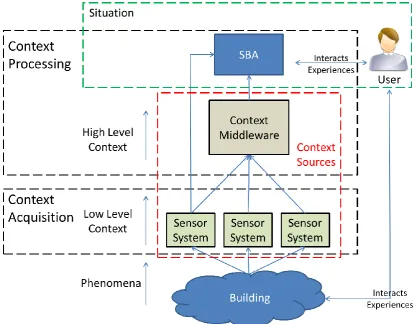
[image:44.595.88.505.420.744.2]At the sensor level, context is often referred to as “low level context” and is the result of the sensor measuring a phenomena in the environment (Bettini, Brdiczka et al. 2010). High level context and situations are seen as higher abstractions of low level context and which are the result of “context processing” (Damián-Reyes, Favela et al. 2011). A situation could be, for example, “in_meeting_now” (Loke 2006). Figure 2-1 gives and overview of these different stages of context and where they lie in relation to the SBA.
18
The SBA must process low and/or high level contexts to determine if such a situation applies. The user experiences the building as they interact with it and other occupants and they may also be affected by the SBA in some way. For example, when an SBA determines a situation to have occurred and acts upon it, either through actuating a device in the building (for example, turning on the air conditioning in the meeting room) or it adjusts its own behaviour in some way (for example, a mobile phone turns itself to silent). The objective for the SBA developer is to ensure that the SBA’s interpretation of the current situation matches with that of the users, and the SBA therefore behaves in an appropriate manner. This requires context acquisition and context processing to take place.
Context processing is done either by middleware or by the application and can result in the aggregation and/or filtering of low level context, and/or the creation of new more semantically rich high level context through context fusion (Wu, Siegel et al. 2002; Padovitz, Loke et al. 2005; Anagnostopoulos, Sekkas et al. 2007; Roy, Gu et al. 2010). Ultimately it is the application which acts upon context and all context processing relies on low level context which is gathered through a process called “context acquisition” (Damián-Reyes, Favela et al. 2011). Context acquisition is handled by context sources (Baldauf, Dustdar et al. 2007). This thesis makes use of Broens and Halterens definition of a context source as anything which generates context relevant to a context-aware application (Broens and Halteren 2006). A context source can therefore be a sensor which measures some phenomena (temperature, radio frequency) or it could also be a device that reports on the state of hardware (a device is on/off, a window is open/closed). Finally, it should be noted, that a context source may also include context processing which processes low level context to infer a higher level context. Context sources may therefore be an aspect of context processing.
19
(Scholtz and Consolvo 2004), the focus of this thesis will be on simulating low level context sources which form part of context acquisition by measuring phenomena in the environment. This context will be used to evaluate SBAs which process low level context and use it to react to changing situations. The method employed to simulating low level context sources will aim to be flexible enough to model context sources which generate higher level context, though these will not be evaluated in this thesis.
Strang et al. have identified context models as a “key accessor to the context in any context-aware system”(Strang and Linnhoff-Popien 2004). For applications, context models are necessary in order to reason over changing situations and over the years a large number have been developed to address the needs of different application domains (Bettini, Brdiczka et al. 2010). Strang, Baldauf and Bettini (Strang and Linnhoff-Popien 2004; Baldauf, Dustdar et al. 2007; Bettini, Brdiczka et al. 2010) have identified the following types: ranging from: key-value models (Schilit, Adams et al. 1994), mark-up scheme models (Sheng and Benatallah 2005), graphical models (Henricksen, Indulska et al. 2003) (Sheng and Benatallah 2005), object oriented based models (Northover and Wilson 2004), ontology based models (Chen, Finin et al. 2005; Zhang, Gu et al. 2005), spatial context models (i.e. models of context which take space into consideration) (Schilit, Adams et al. 1994; Addlesee, Jones et al. 1997) and hybrid models (Henricksen, Livingstone et al. 2004).
20
type”, “value”, “confidence”, “timestamp” and “source”. Context type indicates a category of context, for example, location. Context is the symbolic value, for example a coordinate, and value
indicates its numerical value. In their model, Korpipää and Mäntyjärvi model uncertainty from the application perspective, giving the context a confidence property which they describe as either a probability or fuzzy membership which can be reasoned over. As highlighted in the introduction chapter, uncertainty can have a significant impact on the behaviour of SBAs which must react to changing context. The next section will therefore explore uncertainty in context and different concepts, like confidence, in greater detail.
2.4
Uncertainty in Context
Uncertainty can be introduced into context both during the context acquisition and context processing stages identified in the previous section (Damián-Reyes, Favela et al. 2011). Processing uncertainty requires that context models capture aspects of uncertainty. In the context modelling community, concepts like up-to dateness (Buchholz, Küpper et al. 2003), frequency and timeliness (Lee, Ha et al. 2006), freshness (Lei, Sow et al. 2002; Ranganathan, Al-Muhtadi et al. 2004) and decay (Clear, Dobson et al. 2007), are all used in relation to the rate which context is generated and any additional delays. This information is important as the time between the actual event and the processing of the context will have a direct correlation to its accuracy. For example, a coordinate location of a mobile tag carried by a person moving at a meter per second and which takes a tenth of a second to be processed will be more accurate that a coordinate which takes a full second to process, as the person will have moved a greater distance in that time.
21
literature. In this thesis when discussing accuracy and precision, the definition given by the Joint Committee for Guides in Metrology in the international vocabulary of metrology is used, and they define accuracy as the closeness of agreement between a measured quantity value and a true quantity value, and precision as the closeness of agreement between indications or measured quantity values obtained by replicate measurements on the same or similar objects under specified conditions (Zlatanova and Verbree 2005). Other values related to uncertainty are confidence (Lei, Sow et al. 2002; Ranganathan, Al-Muhtadi et al. 2004; Clear, Dobson et al. 2007) and trustworthiness (Buchholz, Küpper et al. 2003). Both concepts attempt to assign a probability to the source of the context information that captures the likelihood that it is providing “correct” information, although once again, definitions may vary according to author and domain.
Numerous solutions have been suggested to deal with uncertainty at the processing stage, which involve modelling and reasoning about using low level context, for example, Bayesian networks (Gu, Pung et al. 2004; Truong, Lee et al. 2005; Ye, Coyle et al. 2007), hidden markov models (Liao, Patterson et al. 2007; Sanchez, Tentori et al. 2008), fuzzy logic (Cao, Xing et al. 2005; Cheung 2005; Delir Haghighi, Krishnaswamy et al. 2008), probabilistic logic (Ranganathan, Al-Muhtadi et al. 2004), and Dempster-Shafer theory (Wu, Siegel et al. 2002; Padovitz, Loke et al. 2005; Liao, Bi et al. 2011). These methods often rely on learned knowledge by the model developers about the behaviour of the sensors themselves in order to assign values to support decision making. They also rely on expert knowledge of the modelling process itself. This presents a considerable effort in terms of time and resources for the developers (Damián-Reyes, Favela et al. 2011).
22
respect to a location based service (Dearman, Varshavsky et al. 2007). Conversely, Antifakos et al. found that displaying system confidence improved user trust in the application but also impacted negatively on their performance when uncertainty was high (Antifakos, Kern et al. 2005). Rukzio et al. also found that performance was affected negatively by displaying uncertainty (Rukzio, Hamard et al. 2006). Similarly to Ruzkio and Antifakos, Lim et al. found that displaying uncertainty when the application was behaving correctly resulted in a negative impression for the user, although, the user was more likely to forgive the application for behaving inappropriately when uncertainty was displayed. They suggest that by giving the user an active role, improving intelligibility may be useful when interactively debugging an application.
Therefore, this thesis does not focus on solutions which aim to develop models to reason about uncertainty or methods for improving intelligibility for end users, but rather on providing tools for SBA developers to test against uncertainty at the level of context acquisition, as it is uncertainty that is introduced at this level which propagates through each subsequent level up until the point at which context is consumed by the application (Ye, McKeever et al. 2008). By providing SBA developers a method to test and evaluate their applications early in development, they can develop more robust applications which can handle varying levels of uncertainty introduced during context acquisition. Chapter 3 will look at the use of simulation to meet this requirement. First, some background in uncertainty modelling is explored which can then be used to assess the approaches taken by existing context simulators and inform the approach taken in this thesis.
2.5
Modelling Uncertainty
23
result from a range of factors from the imperfect calibration of measurement instruments, aging or damage to components, lack of resolution in sensors technology, changes in the environment which interfere with the measurement process or when the sensor influences the phenomena being observed, defined as invasiveness (for example using a large room temperature thermometer to measure a small cold object). The effect which error has on the output of a sensor can result in an offset to the measured value which is stable, or which is dependent on a changing variable in the system (like temperature, or battery life of the sensor). If the sensor is mobile, these types of error may be difficult to identify, but where the cause is known, the offset can be modelled as a single value, or a curve which maps the offset to some parameter (e.g. temperature). For the purpose of simulation, this approach can be applied to simulate many types of error which result in offsets which are predictable given sufficient understanding of the properties of the system. Chalmers gives a more complete list of these types of errors (Chapter 9) (Chalmers 2011).
One type of systematic error which requires a different approach to simulation is a fault. A fault which arises in the sensor may result in either an intermittent or temporary end of the output signal, or random behaviour (Chalmers 2011). The cause of such a fault can be due to the manufacturing or as a result of the environment and not related to the measured phenomena (e.g. impact, moisture, temperature or vibration). A fault may also be simply the result of loss of power. These same faults may also occur in the communication network. Saturation can also cause a fault when the sensor stimulus approaches or goes beyond the sensor design. The reliability (i.e. chance of a fault occurring which result in complete cessation of output) can be modelled as a Poisson distribution (Staroswiecki 2003).
24
2004). Therefore methods are needed for introducing pseudo-uncertainty in simulated context. While uncertainty is a measure of lack of knowledge about the system, there are known causes of uncertainty. To give an example, in real time location system like Ubisense (Steggles and Gschwind 2005) uncertainty can be the result of other electronic devices which may interfere with wireless signals, random hardware noise, interference from various building materials, temperature, humidity, background radiation, line of sight issues, its position relative to other objects and occupancy which collectively contribute to reflection, attenuation and multi-path issues (Zyren and Petrick 1998; Schmidt 2003). A method is needed therefore by which the effect of this uncertainty on the simulated context from a context source like Ubisense is modelled for simulation.
25
Gaussian distribution based on the specification of each sensors (precision) and on testing calibrated sensors under normal conditions (Elnahrawy and Nath 2003).
Calculating the variance of the Gaussian distribution for a particular sensor can therefore be performed by either the manufacturer or by the user after installation. Environmental factors can then be examined and used as parameters to derive an uncertainty model for specific contexts. It is this a priori knowledge which results in higher fidelity simulation when dealing with specific contexts. A trade-off is therefore required between the effort to create highly accurate simulations of uncertainty and the requirements for an SBA developer, who may wish to conduct rapid evaluation. Chapter 3 will show that currently, there is a lack of models to support simulation of context with uncertainty to support rapid prototyping. Another important aspect of uncertainty which has been discussed in this section is the need for models of both the context sources and the building to accurately model uncertainty, as the placement of the context source can result in different levels of uncertainty due to the properties of the surrounding environment. The next section shall look at some background on modelling for both buildings and also sensors (i.e. low level context sources).