Decomposing Bilexical Dependencies into Semantic and Syntactic Vectors
Jeff Mitchell
Abstract
Bilexical dependencies have been com-monly used to help identify the most likely parses of a sentence. The probability of a word occurring as the dependent of a given head within a particular structure provides a measure of semantic plausibil-ity that complements the purely syntactic part of the parsing model.
Here, we attempt to use the distribu-tional information within these bilexical dependencies to construct representations that decompose into semantic and syntac-tic components. In parsyntac-ticular, we com-pare two different approaches to compos-ing vectors to explore how syntactic and semantic representations should interact within such a model.
Our results suggest a tensor product ap-proach has advantages, which we believe could be exploited in making more ef-fective use of the information captured in these bilexical dependencies.
1 Introduction
Using points within the geometry of a vector space to represent the way words are distributed across contexts has proven to be a fruitful tactic for many language processing tasks. For example, Landauer and Dumais (1997) projected raw tf-idf scores of occurrence across a set of documents down into lower dimensional vectors using a technique called singular value decomposition. The result-ing semantic representations were then applied to semantic dismbiguation and to predict synonyms in a TOEFL test. Working instead with the linear structure of raw text, Collobert et al. (2011) trained a neural language model to induce word vectors in
the hidden layer of their network. These versatile representations were then applied to a wide range of tasks including part-of-speech tagging, chunk-ing, named entity recognition, and semantic role labeling.
Two key elements within any such approach to constructing representations are the contexts across which the distribution of a word is tracked and how vectors are constructed from these oc-currences. Here, we investigate the construction of distributional representations from bilexical de-pendencies found in a parser and explore how such vectors can be decomposed into semantic and syn-tactic components.
Although, distributional approaches have com-monly become most strongly associated with se-mantic representations and tasks, they have also seen applications to syntax. In fact, distributional analysis was first applied by linguists to syntactic categories rather than the representation of mean-ing and Ross (1972) presented a continuous, or at least graded, conception of syntax long before the recent surge of interest in vectorial approaches to semantics.
Practical applications of these distributional techniques to syntactic problems have included work on the induction (Brown et al., 1992) or learning (Mintz, 2003) of categories and the com-putational problems of tagging (Tsuboi, 2014) and parsing (Socher et al., 2013). The latter problem of parsing brings to the foreground the question of how syntactic and semantic representations re-late to and interact with each other, as the optimal parse must maximise both syntactic and semantic plausibility, in an integrated structure.
An unmodified PCFG, modelling just the de-pendencies between syntactic categories, is gen-erally inadequate to derive robust parses, and lexi-calisation is commonly used to enhance such mod-els. In particular, bilexical dependencies introduce
a measure of the plausibility of combining specific heads and dependents within the possible syntactic structures.
These dependencies contain much the same in-formation used by Lin (1998) and Pad´o and Lapata (2007) to construct semantic representations, and we can easily see that the plausibility ofcakeas an object of bake, eat and regret tells us something about the semantic properties ofcake. Nonethe-less, these dependencies contain substantial quan-tities of syntactic information, too. The depen-dencies observed for cake and eat, for example, are substantially different because the former is a noun while the latter is a verb.
However, the sparsity of the resulting counts can mean these dependencies may contribute lit-tle to parser performance, particulaly on out of domain data. One solution, proposed by Rei and Briscoe (2013), is to smooth the bilexical depen-dencies using a similarity measure. For example, if counts forpublicationas an object ofread are lacking we might instead leverage the similarity ofpublicationtobook to use the counts forbook
as an object of read to make a reasonable infer-ence about the unseen dependency. Alternatively, we might try to use some form of dimensionality reduction to smooth out the sparsity.
Levy and Goldberg (2014) use a modified ver-sion of word2vec (Mikolov et al., 2013) to in-duce 300 dimensional representations from word distributions across 900,000 dependency contexts. They find that these word vectors capture a form of functional similarity, with the closest words in the space typically being cohyponyms within the same syntactic class. This syntactic specificity is not particularly surprising, as we would expect the strongest effects within these dependencies to re-late to the syntactic class of a word - e.g. only a noun can be the subject of a verb - with semantic factors having a weaker influence merely on word choice within the correct syntactic class.
In this paper, we will consider a couple of ap-proaches that attempt to separate out semantic and syntactic components of the dependencies, boost-ing performance on both types of task. One popu-lar method of boosting semantic performance has been to ignore or average over syntactic structure. By treating the context a target occurs in as a bag-of-words (Landauer and Dumais, 1997; Blei et al., 2003; Mikolov et al., 2013), syntactic infor-mation is washed out and semantic inforinfor-mation
is retained. Conversely, distributional approaches to syntactic tasks typically make use of the se-quential structure contained in bigrams (Brown et al., 1992; Clark, 2003) or longer n-grams (Mintz, 2003; Redington et al., 1998).
Recent work, (Mitchell, 2013; Mitchell and Steedman, 2015), has attempted to use both types of information in a single model that decomposes representations into syntactic and semantic com-ponents. An open question, however, is the most effective way of forming these combined represen-tations. Mitchell and Steedman (2015) explicitly employ a direct sum - i.e. concatenation - of se-mantic and syntactic vectors. On the other hand, the multiplicative combination used by Mitchell (2013) is much closer to a tensor product formula-tion.
Griffiths et al. (2005) also pursue the represen-tation of semantics and syntax in a single distri-butional model. They integrate a topic model and HMM to produce a model of the sequential struc-ture of raw text in which each word is either se-mantic - chosen by the topic model to fit the long range semantic context - or syntactic - chosen to fit the short range dependencies of the HMM. This ei-ther/or assumption is rejected by Boyd-graber and Blei (2009) who moreover work with parsed sen-tences, rather than raw text. In this model, each word is chosen based on a product of a document topic distribution and a set of syntactic transi-tion probabilities, determined top-down within the parse tree. Socher et al. (2010) are also concerned with inducing distributional representations within the stucture of parse trees. Their neural network model composes vectors recursively from the bot-tom up to represent possible phrases and from those representations computes how likely each is to be a valid constituent.
Although, parsing may seem, initially, to be the ideal task in which to explore the relationship be-tween semantic and syntactic representations, the complexity of a working system - which Bikel (2004a) describes as an intractable behemoth -makes it difficult to isolate and investigate just this question on its own. Parser performance de-pends on a multitiude of interacting components, and could only obliquely produce insights into the merit of the approaches to representation we want to consider here.
eval-uations of distributional representations induced from the parameters of a wide coverage model. We focus in on just the bilexical dependencies within the BLLIP parser (Charniak and Johnson, 2005; McClosky et al., 2006) and explore models of these parameters in which the representation for each word decomposes into a semantic and a syn-tactic vector. We evaluate both a direct sum and a tensor product approach to this decomposition of the representation space and find that the latter has advantages.
In the next section, we describe the BLLIP parser and the data we extract from the wide cov-erage model of McClosky et al. (2006). Then in Sections 3 and 4 we describe the models applied to this data and their evaluation. Finally, we present our results and conclusions in Sections 5 and 6.
2 BLLIP Parser
The BLLIP parser (Charniak and Johnson, 2005) uses a two stage approach, based on discriminative reranking applied to candidate parses produced by a generative lexicalised PCFG. That first stage of the model takes inspiration from loglinear models to express the overall parse probability in terms of a product of multiplicative factors.
Here we are specifically interested in the bilex-ical dependencies, which are stored in the model as a probability,p(d|h, t), of a dependent,d, given a head,hwithin some tree structure,t, along with a count for the occurence of that head-tree com-bination. The tree structure, t, is only specified in terms of the tags on the head and dependent leaves, the node from which they branch, and the category of the dependent branch below that point. Thus, many distinct trees are collapsed into a sin-gle class. For example, the model fails to distin-guish between subjects and objects of a verb.
McClosky et al. (2006) expanded the domain of the standard Penn Treebank (Marcus et al., 1993) trained BLLIP model, applying self-training to 2.5M sentences from the NANC corpus (Graff, 1995). The resulting model has a large vocab-ulary, with reliable estimates of probabilities for many words, which provides a useful basis for our investigations.
We extract the bilexical dependencies and head-tree counts from the model file, replacing words that occur less than 5 times with an hUNKitag, and also excluding any word that does not occur in both the head and dependent positions. The
head-tree contexts are similarly filtered, with items that occur less then 5 times replaced with a dummy catch-all context.
3 Models
The models we discuss here derive a probability of a dependent word,d, within the context of a tree, t, with a head,h, in terms of latent variables, e.g. i, j, k. So, the simplest model we will consider has the form:
p(d|h, t) =X
i
p(d|i)p(i|h, t) (1)
It will be useful, notationally and conceptually, to think of these models in terms of vectors. The equation above already has a superficial similar-ity to a dot product, being a sum over a series of products.
We can rewrite this:
p(d|h, t) =p(d)X
i
p(i)p(i|d) p(i)
p(i|h, t) p(i) (2)
We will think of pp(i|x(i))as being the components, vx
i, of a vector,vx, representingxand define an
in-ner product in terms of a weighted1 sum of com-ponent products as follows:
u·v=X
i
λiuivi (3)
Takingλi =p(i), we can rewrite Eq. 2 as
fol-lows:
p(d|h, t) =p(d)vd·vht (4)
More generally, this model form will need to include normalisation:
p(d|h, t) = p(d)vd·vht
N(h, t) (5) One of the benefits of this model form is that the normalising constant for each head-tree can be calculated fairly efficiently in terms of a single in-ner product.
N(h, t) =n·vht (6)
Here,nis a sum over all dependent probabilities and vectors.
1The use of such a weighting implies we are working with
n=X
d
p(d)vd (7)
Given this model form, we must then specify how the vectors v are constructed. In particular, if our representations are based on semantic vec-tors,a, and syntactic vectors,b, then we must de-cide how these are to be combined. One obvious choice is between a direct sum (Eq. 8) and a tensor product (Eq. 9).
¯
v= ¯a⊕¯b (8)
˜
v= ˜a⊗˜b (9)
Although both these constructions consist of a combination of vectors, aand b, the actual vec-tors induced during EM training will inevitably turn out to be substantially different for each ap-proach. In fact, our purpose is precisely to in-vestigate how this choice of combination affects the representations induced in our trained models. We therefore notationally distinguish the two ap-proaches: using a bar, v¯, to indicate direct sum vectors and a tilde, ˜v, for tensor product vectors. However, we will also employ bare symbols with-out bar or tilde when discussing general properties across both types of structure.
So, if aand b are m and n dimensional vec-tors respectively, then Eq. 8 corresponds to form-ing then+mdimensional concatenation of those vectors, while Eq. 9 results in then×m dimen-sional vector of all products of their components. From a probabilistic perspective, a reasonable in-terpretation would be that our models using the di-rect sum representations in Eq. 8 assume that the dependencies between head and dependent are ei-ther syntactic or semantic, whereas tensor product models, Eq. 9, assume that each word has both semantic and syntactic characteristics.
Given some method for combining vectors a
andb, we also need to specify the form of their components. In particular, we are interested here in separating semantic and syntactic dependen-cies.
Mitchell (2013) and Mitchell and Steedman (2015) both exploit word order to decompose rep-resentations into semantic and syntactic compo-nents, with semantic dependencies being modelled in terms of a similarity measure that is indepen-dent of word order, while the syntactic part of the model captures sequential information. However,
the bilexical dependencies we are working with here do not explicitly relate to surface word or-der. Nonetheless, the relationship is still directed, distinguishing a head and a dependent, and we can exploit this directedness to define a symmetric semantic component and an asymmetric syntactic component.
In each of the models below, any word has a sin-gle semantic vector,a, whether it occurs in head or dependent position, with componentsaj given by:
aj = p(pj(|jw)) (10)
Ignoring the syntactic component of the model for a moment, we can define a semantics only model (leaving out the normalising constant for brevity):
p(d|h, t)∝p(d)X
j
p(j)p(pj(|jw)d)p(pj(|wj)h)
=p(d)ad·ah (11)
This employs an inner product defined by
ad·ah =P
jλjadjajh withλj = p(j). However,
this semantic only model ignores the tree t the words occur in and gives words the same repre-sentations whether they occur in head or depen-dent position. It is therefore symmetric in relation to these roles, and we can think of this model as capturing what head and dependent have in com-mon.
In contrast, there are two forms of syntactic vec-tors, bd and bht, distinguishing between depen-dents and the head-tree contexts they occur in, with components given by:
bhtk = p(pk(|h, tk) ) (12)
bdk= pp(k(k|d)) (13)
Again we can ignore the other part of the model and consider this part on its own:
p(d|h, t)∝p(d)X
k
p(k)pp(k(k|d))p(pk(|h, tk) )
=p(d)bd·bht (14)
Taking the direct sum approach first (Eq. 8), we concatenate the semantic vectors, ¯a, and syntac-tic vectors,b¯, to form a combined vector,¯v, with indices ranging over bothjandk.
¯ vi =
¯
aj ifi=j;
¯bk ifi=k. (15) Inner products of such vectors will consist of a sum over the j component products followed by a sum over thekcomponent products, with some appropriate weighting. The simplest model having this structure is an interpolation of the two models above (Eq. 11 and Eq. 14) with proportionsqaand
qb.
p(d|ht)∝qap(d)¯ad·¯ah+qbp(d)¯bd·¯dht (16)
In terms of the model form of Eq. 5, this is equivalent to defining an inner product on the di-rect sum vectors, ¯vd·¯vht, with weightings λ of
qap(j)andqbp(k)for the two sets of components
respectively.
¯
vd·¯vht =
qa
X
j
p(j)p(pj(|jw)d)p(pj(|wj)h)
+ qb
X
k
p(k)p(k|d) p(k)
p(k|h, t) p(k)
(17)
For the tensor product model (Eq. 9), the in-dices of the combined vector, ˜v, range over all combinations ofjandk.
˜
vjk = ˜aj˜bk (18)
The components of˜vhtare then given by
prod-ucts of terms, which suggests conditional indepen-dence ofjandkonht.
˜
vjk = p(pk(|h, tk) )pp(j(j|h)) = pp(j, k(j)p|h, t(k)) (19)
Making a similar assumption of conditional in-dependence in relation to˜vdis enough to derive a
model forp(d|h, t).
p(d|h, t) =X
jk
p(d|j, k)p(j, k|h, t)
∝p(d)X
jk
p(j|d)p(k|d)
p(j, k) p(j|h)p(k|h, t) (20)
This can be put into the form of Eq. 5 by defin-ing the inner product˜vd·˜vhtas follows:
˜
vd·v˜ht=X
j,k
λjk˜adj˜bdk×a˜hj˜bhtk =
X
j,k
p(j)2p(k)2
p(j, k)
p(j|wd)
p(j)
p(k|d) p(k) × p(j|wh)
p(j)
p(k|h, t) p(k)
(21)
Here, the weightingλjk = p(jp)(2j,kp(k))2 is based on
the assumption thatjandkare both conditionally independent ofdandht.
As described above, the tensor product of a pair of vectors (Eq. 9) of dimensionmandnproduces a vector of dimensionn×m. However, these vec-tors only form a subset of the fulln×m dimen-sional space. Moreover, the form of the model in both the direct sum and tensor product cases as-sumes that the semantic relation of head and de-pendent is indede-pendent of the syntactic relation. That is, we employ the same semantic vectors to represent head and dependent irrespective of the tree they occur in. We could begin to address both these issues by considering representations that lie in the fulln×mdimensional tensor product space. This would essentially allow us to represent the dependence of semantic content on syntactic con-text. However, for now we restrict ourselves to the models described above.
We calculate the cross-entropy between the model and the BLLIP bilexical dependencies for each head-tree context and our objective function is then an average of these values, weighted by the occurence of that context. Training maximises this measure over 200 iterations of the EM algorithm. 4 Evaluation
Our semantic similarity tasks are based on the ratings in two datasets, on both of which we eval-uate our models using Spearman correlation. The first is the WordSim353 dataset (Finkelstein et al., 2002) containing ratings from 16 participants be-tween pairs of nouns. The second dataset contains similarity ratings for noun-verb pairs (Mitchell, 2013). The former measures the ability of the model to capture semantic similarity within a POS class, while the latter tells about its representa-tion of similarity across classes. This cross-class measure is useful in determining how effective the model has been in separating semantic from syn-tactic information. A model that bundles both into a single representation may identify the similarity indisappear-vanishbut will typically fail to make the same judgement aboutdisappearance-vanish. Making that judgement requires ignoring the syn-tactic difference between nouns and verbs, which we achieve in our models by representing that in-formation separately.
Our syntactic task is POS induction. We clus-ter the vocabulary into 45 classes using k-means, and evaluate in terms of the many-to-one measure using the PTB POS classes as a gold standard. Al-though POS class information is already present in the bilexical dependency data, we use this task as a means of determining the quality of syntactic in-formation contained in the vectors, rather than as an example of a practical application.
We then examine how our models differentiate semantic and syntactic plausibility. Our seman-tic plausibility dataset is constructed by combin-ing a set of food nouns (e.g. milk, meat, bread, etc.) with either food appropriate adjectives (e.g.
hot, bitter, sweet, etc.) or implausible political adjectives (e.g. bipartisan, legislative, constitu-ional, etc.). To create an equivalent syntactic plausibility dataset we combine common singu-lar and plural nouns (e.g. year - years, player
- players, etc.) with the modifier several. In each case, we calculate a semantic plausibility (ad·ah = Pp(j)ad
jahj) and a syntactic
plausi-bility (bd·bht = Pp(k)bd
kbhtk ) for the resulting
adjective-noun phrase. Comparing the distribution of these measures in the high and low plausibility cases allows us to investigate further the extent to which the model separates semantic and syntactic dependencies.
Finally, we evaluate the best performing model - based on a tensor product of vectors -
qualita-tively by examining the closest neighbours of set of nouns, adjectives and verbs.
5 Results
Table 1 gives the correlations and many-to-one measures for the raw data, the simple posed model (Eq. 2), the symmetric undecom-posed model (Eq. 11), the direct sum model (Eq. 8) and the tensor product model (Eq. 9). Look-ing at the first two rows of the table, to compare the raw data to the simple model, we can see that the latter outpeforms the fomer on the POS clus-tering task, but is worse on the semantic similar-ity tasks. The improvement in performance on the clustering task can probably be put down to the excessive dimensionality (= number of head-tree contexts) of the input space in the case of the raw data. Reduction of this space using a la-tent variable model appears to make the cluster-ing more effective. On the other hand, achiev-ing this dimensionality reduction requires preserv-ing the strongest, typically syntactic, dependen-cies and discarding weaker, frequently semantic, dependencies with the result that performance on semantic similarity tasks degrades. The predicted noun-verb similarities for both approaches is only weakly correlated with the human ratings, which we ascribe to the fact that neither model has a mechanism for finding the commonalities between words found in distinct sets of syntactic contexts.
The undecomposed symmetric model, a, pro-duces a better performance on the semantic tasks, but is worse on the syntactic task. This is not sur-prising, as the form of this model ignores the dif-ference between heads and dependents, essentially treating the dependencies as a bag-of-words.
Both the direct sum and tensor product models also contain a similarity based component. How-ever, only the tensor product model achieves an improvement in performance over the undecom-posed models. In fact, this model outperforms the other models on all three measures, includ-ing achievinclud-ing a reasonable level of correlation on the noun-verb dataset. This difference between the two decomposed models can be related to the fact that the form of the tensor product assumes that a dependent should be semanticallyand syntacti-cally appropriate to its head-tree context, while the direct sum model uses anorcondition between the two parts of the model.
exper-Model NV WS353 MTO
raw 0.15 0.37 0.39
v -0.06 0.22 0.73
a 0.24 0.42 0.42
¯
a⊕¯b 0.03 0.17 0.61
˜
[image:7.595.105.261.62.144.2]a⊗˜b 0.38 0.49 0.74
Table 1: Correlations of model cosines with hu-man similarity ratings on the noun-verb (NV) and WordSim353 (WS353) datasets, alongside many-to-one (MTO) measures of cluster quality on the POS clustering task, for the raw data (raw), the simple undecomposed model (v), the symmetric undecomposed model (a), the direct sum model (¯a⊕b¯) and the tensor product model (˜a⊗˜b).
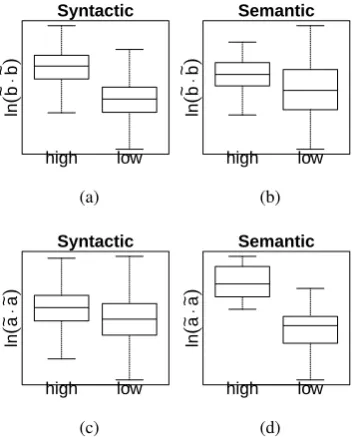
iments on how these representations predict the plausibility of various adjective-noun phrases. In particular, these boxplots give an insight into the ability of these models to differentiate semanti-cally from syntactisemanti-cally implausible constructions. Each plot contrasts the distribution of a logarithm of a dot product for high and low plausibility items. This dot product is either taken of seman-tic vectors, a, or syntactic vectors, b, providing a measure of, respectively, semantic and syntactic plausibility as predicted by the model. The results for each model are organised into a 2 ×2 array of plots, with the left hand column relating to the syntactic task and the right hand column to the se-mantic task.
Examining the results for the tensor product model in Figure 1 first, we find that of the syntactic plots, 1a and 1c, the contrast between high and low plausibility items is greatest for theln(˜b·b˜) mea-sure. This indicates that these vectors have cap-tured more of the syntactic information necessary to identify phrases such asseveral yearas implau-sible. In contrast, the semantic plots, 1b and 1d, show the reverse pattern. There, it is theln(˜a·a˜) measure which shows the largest contrast between high and low plausibility items. Thus, the differ-ence in plausibility betweenhot breadand bipar-tisan bread is more effectively captured in the ˜a
vectors.
Turning to the results for the direct sum model in Figure 2, this differentiation between semantic and syntactic plausibility is no longer as clear, and the largest contrast between high and low plausi-bility items is always found in theln(¯b·b¯) mea-sure. Specifically, in the plots for the semantic
Word ˜a⊗˜b ˜a b˜
black
khaki hispanic female
baggy latino decrepit
cashmere midterm handmade
plaid D.C. antique
lace Merle year-old
political
tribal cultural biomedical tax-and-spend favoritism mechanical
populist sect sole
cultural dissidents mystical staunch enlightenment forensic
found
discovered evidence unveiled
examined takers snared
pleaded fossils rejected revealed researchers knocked flagged conclusive backfired
help
blame strain permit
reprimand psychological resolve inflict blisters nudge relieve suffering laugh prevent suffers jump-start
company
firm manufacturer think-tank
insurer maker nobody
unit pharmacuetical everybody corporation conglomerate everyone consortium subsidiary foreman
game
opener missed speech
finale preseason rotation
rout opener shootout
rematch games balloting
tournament NFC opener
Table 2: Nearest neighbours within the full tensor product space (˜a⊗b˜) and its semantic (˜a) and syn-tactic (b˜) components for a sample of adjectives, verbs and nouns.
task, 2b and 2d, theln(¯a·a¯)measure does not pro-duce a convincingly smaller prediction for the low plausibility items. In other words, the ¯avectors do not contain the semantic information needed to identify the implausibility of phrases such as bi-partisan breadorconstitutional milk.
Thus, the tensor product space appears to be most effective in separating semantic and syntac-tic information and its structure can be understood more concretely in terms of the sample of nearest neighbours shown in Table 2. Taking the adjective
[image:7.595.308.536.67.489.2]prod-high low
ln
(
b
~ ⋅
b
~ )
Syntactic
(a)
high low
ln
(
b
~ ⋅
b
~ )
Semantic
(b)
high low
ln
(
a~
⋅
a~
)
Syntactic
(c)
high low
ln
(
a~
⋅
a~
)
Semantic
[image:8.595.91.269.73.292.2](d)
Figure 1: Boxplots of plausibility factors for ten-sor product representations on syntactic and se-mantic tasks.
uct space, which appear to be other descriptors of material appearance or structure. In contrast, the neighbours within the semantic space,˜a, listed in the second column, seem to be words with cultural or political associations to black, while the syn-tactic neighbours in the third column,˜b, are other adjectives drawn from a much wider domain.
6 Conclusions
We have shown that the bilexical dependencies within a parser capture useful semantic informa-tion, and also that it is possible to, at least par-tially, begin to separate out this semantic informa-tion from the syntactic informainforma-tion. Our experi-ments with vectors based on ratios of probabilities suggest that a tensor product approach to decom-posing the space of representations has advantages over a direct sum approach. While the latter is conceptually simpler, being just a concatenation of the two vectors, the resulting model corresponds to an assumption that semantic and syntactic de-pendencies are disjoint, i.e. that the relationship between head and dependent iseithersemanticor
syntactic. In contrast, the tensor product approach leads to a model in which a dependent must be syntactically and semantically appropriate to the context of tree and head word, and this seems to be more effective in practice.
These conclusions apply only to the ratio of
high low
ln
(
b
⋅
b
)
Syntactic
(a)
high low
ln
(
b
⋅
b
)
Semantic
(b)
high low
ln
(
a
⋅
a
)
Syntactic
(c)
high low
ln
(
a
⋅
a
)
Semantic
(d)
Figure 2: Boxplots of plausibility factors for di-rect sum representations on syntactic and semantic tasks.
probabilities type vectors that were investigated here. Log-linear vectors, as produced by neural network models, are likely to show substantially different behaviours. In fact, Mitchell and Steed-man (2015) have shown that a direct sum approach can be effective for this type of model. Future work should investigate tensor product models in this setting.
Furthermore, there are theoretical reasons to pursue the tensor product approach further. While the models considered here are based on combin-ing separate, independent semantic and syntactic vectors, the tensor product approach also allows us to consider the interaction of the two components. The direct sum approach, on the other hand, is less expressive.
[image:8.595.327.503.73.293.2]References
Daniel Bikel. 2004a. A distributional analysis of a lex-icalized statistical parsing mode. InProceedings of the 2004 Conference on Empirical Methods in Nat-ural Language Processing, pages 182–189.
Daniel M. Bikel. 2004b. On the parameter space
of generative lexicalized statistical parsing models. Ph.D. thesis, University of Pennsylvania, Philadel-phia, PA, USA.
David M. Blei, Andrew Y. Ng, and Michael I. Jordan.
2003. Latent dirichlet allocation. Journal of
Ma-chine Learning Research, 3:993–1022, March. Jordan L. Boyd-graber and David M. Blei. 2009.
Syn-tactic topic models. In D. Koller, D. Schuurmans, Y. Bengio, and L. Bottou, editors,Advances in Neu-ral Information Processing Systems 21, pages 185– 192. Curran Associates, Inc.
Peter F. Brown, Peter V. deSouza, Robert L. Mer-cer, Vincent J. Della Pietra, and Jenifer C. Lai. 1992. Class-based n-gram models of natural
lan-guage. Comput. Linguist., 18(4):467–479,
Decem-ber.
Eugene Charniak and Mark Johnson. 2005. Coarse-to-fine n-best parsing and maxent discriminative
reranking. InProceedings of the 43rd Annual
Meet-ing on Association for Computational LMeet-inguistics, ACL ’05, pages 173–180, Ann Arbor, Michigan. As-sociation for Computational Linguistics.
Alexander Clark. 2003. Combining distributional and morphological information for part of speech
induc-tion. In Proceedings of the tenth Annual Meeting
of the European Association for Computational Lin-guistics (EACL), pages 59–66.
Ronan Collobert, Jason Weston, L´eon Bottou, Michael Karlen, Koray Kavukcuoglu, and Pavel Kuksa. 2011. Natural language processing (almost) from
scratch. J. Mach. Learn. Res., 12:2493–2537,
November.
Lev Finkelstein, Evgeniy Gabrilovich, Yossi Matias, Ehud Rivlin, Zach Solan, Gadi Wolfman, and Ey-tan Ruppin. 2002. Placing search in context: The concept revisited. ACM Trans. Inf. Syst., 20(1):116– 131, January.
David Graff. 1995. North american news text corpus. LDC95T21.
Thomas L. Griffiths, Mark Steyvers, David M. Blei, and Joshua B. Tenenbaum. 2005. Integrating topics
and syntax. InIn Advances in Neural Information
Processing Systems 17, pages 537–544. MIT Press. Thomas K Landauer and Susan T. Dumais. 1997.
A solution to platos problem: The latent semantic analysis theory of acquisition, induction, and
rep-resentation of knowledge. Psychological Review,
104(2):211–240.
Omer Levy and Yoav Goldberg. 2014.
Dependency-based word embeddings. InProceedings of the 52nd
Annual Meeting of the Association for Computa-tional Linguistics, ACL, Volume 2: Short Papers, pages 302–308, Baltimore, MD, USA.
Dekang Lin. 1998. An information-theoretic
def-inition of similarity. In Proceedings of the
Fif-teenth International Conference on Machine
Learn-ing, ICML ’98, pages 296–304, San Francisco, CA,
USA. Morgan Kaufmann Publishers Inc.
Mitchell P. Marcus, Mary Ann Marcinkiewicz, and Beatrice Santorini. 1993. Building a large
anno-tated corpus of english: The penn treebank.
Com-put. Linguist., 19(2):313–330, June.
David McClosky, Eugene Charniak, and Mark John-son. 2006. Effective self-training for parsing. In
Proceedings of the Main Conference on Human Lan-guage Technology Conference of the North Amer-ican Chapter of the Association of Computational Linguistics, HLT-NAACL ’06, pages 152–159, New York, New York. Association for Computational Linguistics.
Tomas Mikolov, Wen-tau Yih, and Geoffrey Zweig. 2013. Linguistic regularities in continuous space
word representations. InProceedings of the 2013
Conference of the North American Chapter of the Association for Computational Linguistics: Human Language Technologies, pages 746–751, Atlanta, Georgia, June. Association for Computational Lin-guistics.
Toben H. Mintz. 2003. Frequent frames as a cue for grammatical categories in child directed speech.
Cognition., 90(1):91–117.
Jeff Mitchell and Mark Steedman. 2015. Orthogo-nality of syntax and semantics within distributional
spaces. In Proceedings of the 53rd Annual
Meet-ing of the Association for Computational LMeet-inguistics and the 7th International Joint Conference on Natu-ral Language Processing (Volume 1: Long Papers), pages 1301–1310, Beijing, China, July. Association for Computational Linguistics.
Jeff Mitchell. 2013. Learning semantic
representa-tions in a bigram language model. InProceedings
of the 10th International Conference on Computa-tional Semantics (IWCS 2013) – Short Papers, pages 362–368, Potsdam, Germany, March. Association for Computational Linguistics.
Sebastian Pad´o and Mirella Lapata. 2007.
Dependency-based construction of semantic
space models. Comput. Linguist., 33(2):161–199,
June.
Martin Redington, Nick Chater, and Steven Finch. 1998. Distributional information: A powerful cue
for acquiring syntactic categories. Cognitive
Marek Rei and Ted Briscoe. 2013. Parser lexicali-sation through self-learning. InProceedings of the 2013 Conference of the North American Chapter of the Association for Computational Linguistics: Hu-man Language Technologies, pages 391–400, At-lanta, Georgia, June. Association for Computational Linguistics.
John R. Ross. 1972. The category squish:
End-station Hauptwort. In Papers from the Eighth
Re-gional Meeting, pages 316–328, Chicago. Chicago Linguistic Society.
Richard Socher, Christopher D. Manning, and An-drew Y. Ng. 2010. Learning Continuous Phrase Representations and Syntactic Parsing with
Recur-sive Neural Networks. InProceedings of the Deep
Learning and Unsupervised Feature Learning Work-shop of NIPS 2010, pages 1–9.
Richard Socher, John Bauer, Christopher D. Manning, and Ng Andrew Y. 2013. Parsing with
composi-tional vector grammars. InProceedings of the 51st
Annual Meeting of the Association for Computa-tional Linguistics (Volume 1: Long Papers), pages 455–465, Sofia, Bulgaria, August. Association for Computational Linguistics.