in QR '94: 8th. International Workshop on Qualitative Reasoning about Physical Systems, pp90-97, Nara, Japan, June 1994.
Physical Model Generation in PDE Analysis
using Model-based Case-based Reasoning
Donal P. Finn
1and Padraig Cunningham
2A b s t r a c t Model generation has emerged as a key task in
engineering design and analysis. AI research in this area has focused on model based reasoning emphasising qualitative models in attempting to automate this process. In this paper, we propose that this work on the use of model based reasoning in model generation would benefit from the inclusion of case-based reasoning (CBR) techniques. We argue that the use of cases constrains the reasoning process as cases reflect known good routes in the solution space. Cases also have the advantage of facilitating the integration of heat transfer exemplars, approximations, formulae and correlations. In addition, much of human competence in this area is based on reusing solutions to previously solved problems and CBR emulates this. In the paper, we advance these arguments based on our experience with CoBRA, a CBR system for physical model generation for the domain of heat transfer described by partial differential equations.
1 INTRODUCTION
Model generation has been recognised to be one of the significant research challenges of the qualitative reasoning community [22, 23, 24] In recent years, research work has focused on different aspects of model generation including; modelling of engineering systems using compositional modelling [7,12], behavioural modelling of engineering phenomena using model abstraction switching [1], modelling across multiple ontologies using meta -modelling techniques [13], simplification of design analysis models using first principles reasoning [14], differential equation modelling using order of magnitude reasoning [25]. Although these projects have been motivated by different goals and adopt different artificial intelligence approaches, a number of general points can be made. Firstly, most work has interpreted model generation as a ‘model switching’ task between an initial complex model and some simpler but unspecified model. Consequently, this perspective has lead to the development of model generation systems that have been based on traversing a vast solution space of engineering knowledge using model-based reasoning techniques. Secondly, few of the research efforts appear to have been explicitly grounded on a cognitive understanding of how engineers in practise actually carry out modelling. This, we believe, has resulted in the overlooking of a large body of experiential engineering know-how and techniques. Thirdly, most of the research efforts have aspired towards automated modelling environments which aim to replicate the skills and expertise of engineers. This, we argue has resulted in the focusing on modelling tasks that are often simplistic and therefore unrelated to modelling of real world engineering problems. Finally, it is noted that for some work, there appears to have been little effort in understanding the real needs of engineers from model generation tools and to apply these findings to the research efforts; this has resulted in the development of applications that are often of little practical use to the engineering profession. It is worth noting that these comments are not unique to this paper, in so far that they have been noted by other researchers commenting on the direction of research in the qualitative reasoning community [22,23,24].
In this work, we focus on the task of physical model generation associated with the analysis of engineering problems described by partial differential equations (PDEs). PDEs are nowadays analysed using numerical simulation techniques such as the finite element method. Prior to simulation engineers must create simplified spatial, phenomenological and temporal models of real world engineering problems to facilitate efficient computation. Thus, in this context, physical model generation can be regarded as one of the preliminary stages of numerical PDE analysis [9]. It has been acknowledged by both engineering [2, 8] and numerical analysis researchers [3, 18] that these preliminary modelling tasks form a crucial part of the overall simulation process and they call for increased research efforts in the development of knowledge based model generation tools. Although, there has been considerable work from the qualitative reasoning community in model generation, there has been little effort explicitly directed towards physical model generation in numerical simulation of PDEs.
In this paper, we present a novel approach to physical modelling in heat transfer analysis which aims to address many of the issues raised in the first paragraph including: What is the nature of modelling in PDE analysis? How do engineers carry out modelling and how does this influence our approach? What do engineers require from modelling systems? What type of tools assist engineers best with the model generation task? Our examination of these questions has led us to view model generation as an iterative design task that uses both experiential and model-based knowledge. Consequently we have developed a physical modelling system called CoBRA which exploits both model-based and case-based reasoning techniques within a derivational analogy framework. We argue that this approach has a number of advantages over other work including; cognitive plausibility, computational tractability, ease of knowledge acquisition and a more pragmatic engineering approach to model generation. Finally, we believe that it addresses some of concerns raised by researchers from the qualitative reasoning community about the need to firstly, focus more clearly on significant engineering problems, and secondly, to tackle these problems in a manner that is beneficial to the engineering community [22].
The paper is laid out as follows: Section 2 discusses, firstly the issues associated with the physical modelling of heat transfer problems described by PDEs, and secondly our understanding of how engineers carry out physical model generation. Section 3 describes our approach and introduces CoBRA, a system for carrying out physical modelling in heat transfer analysis. Section 4 examines other related work and deals with some of the wider implications of our approach. Section 5 concludes the paper.
2 MODEL
GENERATION
2.1 Physical modelling in PDE analysis
Convection heat transfer problems can be defined as physical systems where heat transfer occurs between a solid body and a surrounding fluid medium, each at a different temperature. Numerical analysis of convection problems is usually carried out in a number of stages (see Figure 1) which have been identified as follows [3, 18]:
• Behavioural Analysis This is the first task in most numerical
engineering problems and it involves reasoning about the physical system with the objective of obtaining a behavioural understanding of the underlying phenomena. In this work, we assume that the engineer has already obtained a behavioural understanding of the physical system.
• Physical Modelling This phase involves applying
idealisations and simplifications to spatial, phenomenological and temporal aspects of the physical system with the objective of abstracting a mathematical model. This is the focus of the current work.
• Numerical Simulation This phase involves creating a
numerical model and simulating using numerical techniques such as the finite element method.
• Visualisation This stage involves post processing and
visualising of the numerical data produced by the simulation process.
Real World Problem
Behavioural
Model Physical Model
Behavioural
Modelling ModellingPhysical
Numerical Modelling
Numerical Model
Figure 1 Physical Model Generation
Except for simple problems, it is neither feasible nor desirable to analyse all aspects of a physical system. This is because most real world problems contain complexities that render numerical simulation difficult and redundancies that are unnecessary to analyse. In practise, engineers simplify complexities thereby facilitating more efficient computation and ignore redundancies without loss to the integrity of the physical system. In physical model generation the major challenges to the engineer are: identifying the various complexities and redundancies in a physical system, applying appropriate modelling strategies to simplify or reduce these features and assessing the suitability of the resulting model. We consider physical modelling to consist of a number of subtasks including, spatial, phenomenological and temporal modelling.
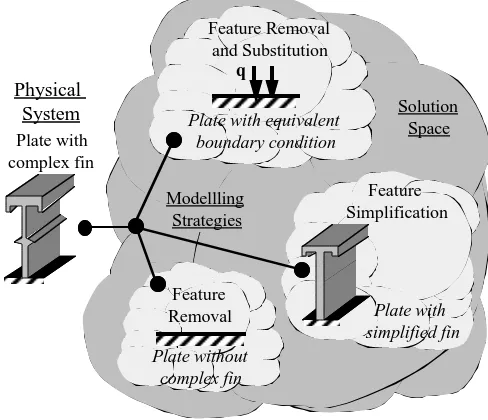
Spatial modelling focuses on geometric features of the problem domain and involves applying modelling strategies such as: taking a two dimensional idealisation of a three dimensional physical system, finding geometric symmetries or carrying out feature modelling. Figure 2 illustrates feature modelling, and strategies can involve either replacing an existing complex feature with a simpler feature, removing the feature and substituting it with an equivalent boundary condition or removing the feature completely without any compensatory measures.
Phenomenological modelling deals with the construction of a PDE model that describes the thermal heat transfer process. Considering the full thermal PDE, it consists of three equations based on the physical laws of conservation of mass, momentum and energy. Each equation is in turn composed of terms, where each term describes a particular sub-phenomenon. In many heat transfer problems it is not necessary to model all these sub -phenomenon and therefore terms can be either simplified or even be ignored completely.
Temporal modelling involves choosing an appropriate transient or steady state model.
Plate with complex fin
Physical
System
SolutionSpace
Plate with simplified fin
Feature Simplification
Plate without complex fin
Plate with equivalent boundary condition
Feature Removal and Substitution
q
Feature Removal Modellling
[image:2.595.299.543.218.428.2]Strategies
Figure 2 Feature modelling strategies
2.2 Our approach to physical modelling in PDE
analysis
The central argument presented in this paper is that for physical modelling in finite element analysis the existing approach of using model-based reasoning should be augmented with case-based reasoning techniques. This argument is based on two assertions:
• This modelling task is based on a weak domain theory. • When modelling engineers refer to exemplars and previously
solved problems
themselves are based on a strong domain theory but the process of producing and simplifying these models is not.
Our second assertion is less contentious; our experience with engineering modelling is that human experts refer extensively to heat transfer exemplars and previously modelled problems. Exemplars occur extensively in the form of fundamental scenarios that include heat transfer to plates, cylinders, fins, etc. Associated with these exemplars are a rich body of approximations and correlations which facilitate analysis and evaluation. Exemplars in the form of modelling episodes provide the basis for model generation as practised by engineers. These modelling episodes are used as building blocks for designing models for use in simulation. Engineers reason by remembering these scenarios and then modifying them to fit the current context. These modifications usually involve 'first-principles' reasoning based around approximations and correlations associated with the exemplar. This anecdotal evidence is backed up by research in the related area of engineering design. While there has little work on the integration of CBR in engineering modelling there has been much work on using CBR in design. Arguments that human designers refer to past problem solving episodes are presented in [11, 20, 21].
Summarising then, we argue that the QR research on modelling would benefit from the integration of CBR techniques because that is the way engineers do it. In addition, we argue that the fact that modelling is based on a weak domain theory signals that a CBR approach will be fruitful.
3.0 PHYSICAL MODEL GENERATION IN
Co BRA
CBR is an AI methodology that serves the basic intuition that humans reuse solutions to previously solved problems during problem solving. The most obvious advantage of this approach is that competent systems can be developed based on shallow domain models, thus requiring little knowledge engineering. However, it is generally accepted that CBR systems for design require reasonably deep domain models and much work has been done in this area [4, 11, 15, 16]. CBR systems incorporating deep domain models still have advantages over systems based on first-principles reasoning. The case organisation helps focus the knowledge acquisition process and the cases encode known good routes through the solution space and thus constrain the solution search process [6].
One of the key issues in CBR is the manner in which the cases are adapted. The standard approach is to transform the solution of the old case to meet the specification for the new case. In some circumstances the interdependencies in the solution components are too complex for this to be practicable. In this case generative adaptation (derivational analogy) can be used. This involves reworking the steps in the solution generation process in the context of the new problem specification. This is the strategy adopted in CoBRA.
Considering now how this approach is incorporated with the CoBRA modelling system, we summarise our conceptual approach by the following points:
• Modelling is carried out in distinct stages which include phenomenological, spatial and temporal modelling.
• Within any modelling stage, modelling decisions are taken in a piecewise fashion by examining each modelling issue in
turn. In this way a physical model is designed in a step by step manner.
• Case based reasoning with model-based generative adaptation forms the core AI approach.
• A case consists of a description of the modelling problem, a modelling solution and a derivational trace.
• Derivational traces consist of a model based reasoning trace by which a modelling solution was reached. They also act as a validation mechanism and explanation facility of the case solution.
3.1 Case Descriptions in CoBRA
In CoBRA, a target case consists of a frame based representation of the physical system. Frames are generated by means of a graphical input using AutoCAD. Within a target frame, representation is organised according to the different modelling stages, spatial, phenomenological and temporal. A physical entity is classified by the user in terms of qualitative indices. Problem parameters such as geometric data are also included in the target case but are not used as indices, however this information is used in the derivational traces.
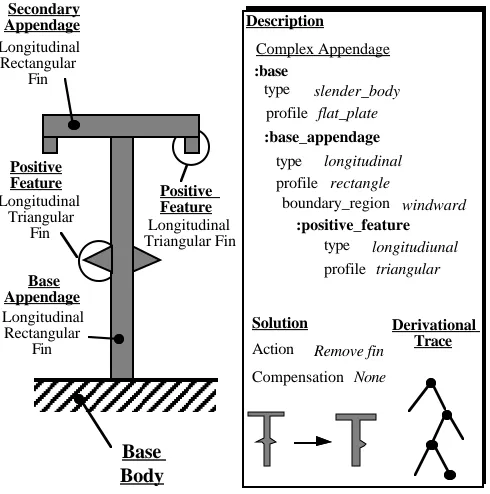
A base case consists of a representation of the real world physical system, the solution in the form of a simplified model and a reasoning trace of the justifications for the transformations in going from the real world problem to the simplified model. Figure 3 illustrates a portion of such a case. The diagram on the left shows a cross section of a finned heat exchanger cooler, and the task addressed by CoBRA is to produce a simplified model of this physical system. The frame definition on the right illustrates the problem description, the problem solution and the derivational trace that provided this solution. A target case contains only the problem description; this is the specification of the physical system. Cases are retrieved using an activation network based on feature similarities and a case solution is created by using generative adaptation involving a re-run of the reasoning trace using the derivational trace (see [10] for more details).
3.2 Generative Adaptation using Model based
Reasoning
In CoBRA, the derivational trace links the start and goal state of a case. Each reasoning trace has two main components; a decision part and a resulting action part (after [5]). The decision part contains:
• Alternative modelling strategies considered and rejected • Assumptions and justifications for the decisions taken. • Heat transfer approximations and correlations to allow
evaluation of a particular modelling strategy.
• Heat transfer domain knowledge describing dependencies of later decisions on earlier ones.
the feature under consideration. By estimating this heat loss parameter a suitable strategy can be chosen and the appropriate modelling actions can be applied to the target case.
Base
Body
Longitudinal Rectangular
Fin Base Appendage
Positive
Feature Positive
Feature Longitudinal Triangular Fin Longitudinal
Triangular Fin Longitudinal Rectangular
Fin Secondary Appendage
Complex Appendage Description
:base
:base_appendage type
profile
slender_body flat_plate
type profile
longitudinal rectangle
boundary_region windward :positive_feature
longitudiunal
type
triangular
profile
Solution
Action Remove fin
Compensation None
[image:4.595.299.526.73.334.2]Derivational Trace
Figure 3 A case in the Cobra system
4.0 Comparison with Related Work
In this section we briefly review related work and in this context, compare our approach to model generation.
Addanki [1] describes an automated modelling approach using a methodology called the “graph of models”. The basic idea is that system behaviour can be represented by a series of interlinked models which exist at different levels of abstraction. Modelling progresses by automatic selection and changing of analysis models on the basis of assumption satisfaction and model accuracy.
Iwasaki [12] describes a system called Device Modelling Environment that formulates a behavioural model of a device, simulates its behaviour and interprets the results. An input description of the device topological structure is given and a compositional modelling approach formulates the appropriate mathematical model.
Yip [25] describes a system for simplifying the Navier Stokes fluid equations using order of magnitude reasoning within a qualitative reasoning framework. The conceptual approach adopted is rather similar to the way an engineering academic would engage in deriving simplified models. PDE models produced by the system are mathematically complete, but may in some cases have no physical meaning. This modelling task in similar to the phenomenological modelling stage described in Section 2.1
Ling [14] discusses a system for generating sets of PDEs for designing thermal systems described by either algebraic equations, ordinary differential equations and PDEs. Order of magnitude and dimensional analysis techniques are used to heuristically derive a mathematical model. Currently they have implemented their approach for conduction heat transfer problems.
Turbulent Laminar
Feature on Appendage
Enclosed Non-enclosed
REMOVE
REMOVE COMPENSATE Heat transfer
less than 5% Heat transfer greater than 5%
less than 8%
Heat transfer greater than 8%
RETAIN RESIZE
Flat Plate
Flat Plate & Boundary Condition
Laminar or turbulent ??
Boundary layer enclosure ??
Heat Transfer ??
Goal_2
Goal_3
[image:4.595.38.283.132.379.2]Feature on Appendage Goal_ 1
Figure 4 A model-based derivational trace
Shephard et al. [17] discuss the various modelling decisions that must be considered when specifying a mathematical model for numerical analysis. They describe an approach based on a rule based expert system for the domain of stress analysis in aircraft structures. Attention is focused on the use of different idealised behavioural models at different levels of abstraction.
Falkenhainer and Forbus [7] describe an approach based on compositional modelling. By using explicit modelling assumptions, domain knowledge can be to be decomposed into semi-independent fragments, each describing various components of the physical system.
In our work, we deal with physical model generation associated with engineering problems described by PDEs; to date only the work of Yip [25] and Ling [14] have dealt with this class of problem. Our approach however has some significant differences.
Firstly, rather than deriving models from first principles, we use cases which are based on tried and tested episodes. One advantage is that, in practise for finite element analysis, engineers do not normally derive physical models from first principles (as described by Yip [25]). Instead, our obervations have been, that they choose between known good models and then ‘tweak’ these models to satisfy the problem at hand [9]. Cases with model-based generative adaptation support this approach to modelling more readily. Another advantage is that, cases encode known good routes through weak domain solution spaces thereby avoiding extensive backtracking often associated with model-based approaches [6].
Thirdly, from a knowledge engineering perspective, the use of derivational traces means that the knowledge acquisition process is carried out in the context of episodes. This we found provided no special difficulties for our domain expert, which is in contrast to experiences for elicitation of generalised knowledge associated with model based approaches [26].
Fourthly, we argue that this approach meets more closely the needs of engineering practitioners in a number of ways. For instance, compared to the work of Iwasaki [12] which aims to develop a complete modelling and simulation environment, we believe that the emergence of modelling tools that can be integrated between existing CAD and numerical packages will serve engineering needs most usefully [2,3,8,18]. In addition, we believe that such tools should aim to empower engineering analysts, and therefore, it is likely that interactive modelling support systems as advocated in this paper will achieve this aim more readily [9].
5.0 Conclusions
In this paper we presented an approach to physical model generation that adopts both case based and model based reasoning. This approach has been based on the assertion that physical modelling generation is a poorly understood process and is often carried out using a combination of episodic and first principles reasoning. This argument is backed up by our belief, not only that physical modelling is based on a weak domain theory but also that engineers make extensive use of previous modelling episodes and experiential knowledge when modelling. Furthermore we argue that for physical modelling in PDE analysis, interactive modelling tools that operate between CAD and numerical analysis systems are most likely to most useFul for engineers in physical modelling tasks.
References
[1] Addanki, S. Cremonini, R and Penberthy, J.S. ‘Graph of Models’, Artificial Intelligence, 51(1-3) , 145-177, (1991). [2] Amaral S. ‘Report on DAPRA-sponsored Workshop on
Design. Technical Report LCST-TR-160, LCSR, Rutgers University New Brunswick, 08903, (1991).
[3] Bathe, K.J., Lee, N.S. and Bucalem M.L. 1990, ‘On the Use of Hierachical Models in Engineering Analysis’ Computer Methods in Applied Mech. and Engineering, 82(1-3) , 5-26. (1990)
[4] Bhansali S., Harandi M., ‘Synthesis of UNIX programs using Derivational Analogy’, Machine Learning, 10, 7-55, (1993). [5] Carbonell J.G., ‘Derivational Analogy: A theory of
reconstructive problem solving and expertise acquisition’, in Machine Learning Vol. II, R.S. Michalski, J.G. Carbonell, T.M. Mitchell eds., 371-392, (1986).
[6] Cunningham, P., Finn, D., Slattery, S. ‘Knowledge Engineering Requirements in Derivational Analogy’ in Proc. of the First European Workshop on Case-Based Reasoning, Kaiserslautern, Germany, November, 108-113, (1993). [7] Falkenhainer, B. and Forbus, K.D., ‘Compositional
Modelling: finding the right model for the job’, Artificial Intelligence, 51(1-3), 95-143. (1991).
[8] Finger, S. and Dixon J.R., ‘A Review of Research in Mechanical Engineering Design. Part II’ Research in Engineering Design., 1, 121-137, (1989).
[9] Finn, D.P., ‘Preliminary Stages of Engineering Analysis and Modelling: Workshop Summary, 2nd International Conf. on Artificial Intelligence in Design (AID ‘92).’ Artificial
Intelligence in Engineering Design Manufacturing and Analysis, (AI EDAM Special Issue: Guest-Editor: D. Finn),
7(4) , 231-237, (1993).
[10] Finn, D., Slattery, S., Cunningham, P. ‘Modelling of Engineering Thermal Problems - An Implementation using CBR with Derivational Analogy’ in Proceedings of the First European Workshop on Case-Based Reasoning, Kaiserslautern, Germany, November, 114-119, (1993). [11] Goel A. K., Kolodner J. L., Pearce M., Billington R., Zimring
C., ‘Towards a Case-Based Tool for Aiding Conceptual Design Problem Solving’ , In Proceedings of DARPA Case -Based Reasoning Workshop 1991, Washington, D.C., San Mateo, California: Morgan Kaufmann. , (1991).
[12] Iwasaki, Y., Low C.M. ‘Model Generation and Simulation of Device Behaviour with Continuous and Discrete Changes.’ Intelligent Systems Engineering. 1(2), (1993)
[13] Kirayama, T. , Tomiyama, T. ‘Reasoning about Models across Multiple Ontologies’ Procedings of the Seventh Int. Workshop on Qualitative Reasoning about Physical Systems. University of Washington, pp. 124-131, (1993).
[14] Ling, S. , Steinberg, L. ‘Approximation Operators in Distributed Modellling.’ Procedings of the Seventh International Workshop on Qualitative Reasoning about Physical Systems. Dept. of Computer Science, University of Washington, pp. 138-144, (1993)
[15] Mostow J., ‘Design by Derivational Analogy: Issues in the automated replay of design plans’, Artificial Intelligence, 40, pp119-184, (1989).
[16] Smyth B., Cunningham P., ‘Déjà Vu: A Hierarchical Case-Based Reasoning System for Software Design’, in Proceedings of 10th. European Conference on Artificial Intelligence, Vienna, Austria, 587-589, (1992).
[17] Shephard, M., Baehmann, P., Georges, M. and Korngold, E,. ‘Framework for Reliable Generation and Control of Analysis Idealisations’ Computer Methods in Applied Mechanics and Engineering, 82(1-3) , 257-280. (1990).
[18] Tworzydlo, W. and Oden, J.. 1990. ‘Towards an Automated Environment in Computational Mechanics’ Comp. Methods in App. Mechanics & Engineering, 104(1-3), 87-143, (1993). [19] Veloso M., Carbonell J.G., ‘Learning by analogical replay in
PRODIGY: first results’ European Working Session on Learning, Y. Kodratoff, ed., pp375-389, Porto, Portugal, Springer Verlag, (1991).
[20] Visser W., ‘Planning in routine design: some counterintuitive data from empirical studies’ In J.S. Gero & F. Sudweeks (Eds.) Workshop on Artificial Intelligence in Design at Twelfth International Joint Conference on Artificial Intelligence. University of Sydney, Australia, (1991). [21] Visser W., ‘Reuse of designs: Desperately seeking an
interdisciplinary cognitive approach’ In W. Visser (Ed.) Workshop on Reuse of Designs at Thirteenth International Joint Conference on Artificial Intelligence. Chambéry, France (1993).
[22] Weld, D.S. and DeKleer, J., ‘Multiple Ontologies and Automated Modelling’ Readings in Qualitative Reasoning about Physical Systems, 481-483, Morgan Kaufmann, (1990) [23] Weld, D.S ‘Introduction to Forum. Taking Issue/forum: Prolegomena to any Future Qualitative Physics’ Computational Intelligence, (8)2 , pp.175-186.
[24] Williams and deKleer ‘Qualitative Reasoning about Physical Systems: a Return to Roots’, Artificial Intelligence, 51(1-3), 1-9., (1991).
[25] Yip., K. ‘Model simplification by asymptotic order of magnitude reasoning’ In: D. Weld (ed): Working Papers Qualitative Reasoning '93 (QR '93). Seattle: University of Washington, 266-272. (1994)