OhioState at SemEval-2018 Task 7: Exploiting Data Augmentation for
Relation Classification in Scientific Papers Using Piecewise Convolutional
Neural Networks
Dushyanta Dhyani
The Ohio State University OH, USA [email protected]
Abstract
We describe our system for SemEval-2018 Shared Task on Semantic Relation Extraction and Classification in Scientific Papers where we focus on the Classification task. Our simple piecewise convolution neural network (PCNN) performs decently in an end to end manner. A simple inter-task data augmenta-tion significantly boosts the performance of the model. Our best-performing systems stood 8th out of 20 teams on the classification task on noisy data and 12th out of 28 teams on the classification task on clean data.
1 Introduction
Relation extraction (RE) and Classification (RC) is an integral component of information extraction systems which aim to extract all the entity pairs and their relationhe1, r, e2ifrom a given text
cor-pora. An alternate formulation of relation extrac-tion task focuses on identifying if a relaextrac-tion exists between a predefined pair of entities, and if yes classify from a given set of class relations. RE finds applications in a variety of domains, rang-ing from knowledge base construction to semantic parsing and question answering. However, the ap-plicability of existing efforts in relation extraction to scientific text calls for a quantitative and quali-tative analysis which is the aim of this shared task.
2 Related Work
Existing efforts for RE range from traditional strategies (Qian et al., 2008; Bunescu and Mooney, 2006, 2005;Mintz et al., 2009; Riedel et al.,2010) to more recent end to end deep learn-ing based methods (Zeng et al., 2014, 2015; Lin et al.,2016; Wu et al., 2017) that are more suit-able in situations where a lot of training data is available. While a majority of efforts in the RE community are specifically focused towards using
distantly supervised data and reduce the associ-ated noise, their discussion is not relevant to the current scenario. The most relevant work is that of (Zeng et al.,2014) who demonstrated the effi-cacy of convolution neural networks for relation classification and (Zeng et al.,2015) who further enhanced the architecture by proposing the piece-wise max-pooling strategy.
3 Task Description
The semantic relation extraction and classification in scientific papers task (G´abor et al.,2018) aims at identifying semantic relations expressed by en-tity pairs in scientific literature. The contest is fur-ther divided into three subtasks, where the first two focus on classification of varying nature of data and the third focuses on extraction task. Since our submitted systems focused only on the classifica-tion task, we would from here on discuss mostly about the classification sub-tasks.
3.1 Dataset
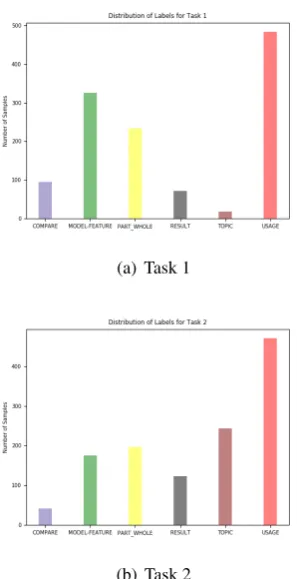
The data contains titles and abstracts of papers from ACL Anthology Corpus where entity men-tions are either manually annotated (Subtask 1.1 and Subtask 2) or heuristically (Subtask 1.2) de-termined. However, the relations are manu-ally annotated across all subtasks. For the clas-sification scenario, we are provided with rele-vant entities and the directionality of their rela-tion. There are 6 class labels: USAGE, RE-SULT, MODEL, PART WHOLE, TOPIC, COM-PARISON. The classes are highly imbalanced in nature as shown in Fig.2
3.2 Evaluation
For both Task 1.1 and 1.2, given that the classes are imbalanced, macro-f1 score is used as the of-ficial evaluation metric and thus the metric we use for hyperparameter tuning. For more details, we
Figure 1: PCNN Encoder with Word, Position and Directionality embeddings.
(a) Task 1
(b) Task 2
Figure 2: Class Sizes for Task 1 & Task 2.
would refer the reader to the task description pa-per (G´abor et al.,2018)
4 Methodology
As shown in Fig. 1, we use the piecewise convolutional encoder proposed by (Zeng et al., 2015) which encodes the sentence into an embed-ding space taking into account the context of text around the entities in an end to end manner. The various components of the encoder are described below
4.1 Preprocessing
[image:2.595.104.253.421.711.2]special character (e.g. word sense disambiguation becomes word sense disambiguation) or to sim-ply use entity head words to represent the starting position of the entity as proposed by (Nguyen and
Grishman, 2015). We chose the latter approach
for two reasons: 1) The amount of data is rela-tively small to learn word embeddings on the data itself 2) The conjoined entity representation as in the former approach would probably not exist in the pre-trained word embeddings and thus would have to be replaced by an unknown token. Finally, we used common text cleaning techniques like removing non-alphanumeric characters, replacing all numbers by a unique token, etc.
4.2 Word Representation
Each word in the input is transformed to a static, dense feature representation by looking up a pre-trained word embedding dictionary. We use dependency based word embeddings (Levy and Goldberg,2014) which incorporate long-range de-pendencies between words and thus generate em-beddings that are more functional in nature (than the traditional bag of words based embeddings) which is presumably more suitable to the cur-rent task as dependency based features have been shown to be useful for relation extraction (Xu
et al., 2015; Bunescu and Mooney, 2005). All
words that do not exist in the dictionary are re-placed byUNKtoken and initialized randomly.
4.3 Position Embedding
Since convolved representations are position in-variant, incorporating positional information us-ing embeddus-ings has been shown to be useful for a variety of task (Zeng et al.,2014;Gehring et al., 2017) when using a convolutional encoder. We evaluate the distance of each word in the sen-tence with respect to bothentity 1andentity 2(we limit the values to a maximum distance of posi-tion window size). These posiposi-tion values are then projected into a relatively small embedding space using a trainable embedding layer.
4.4 Directionality Embedding
Since the relations are directional in nature, it is important to incorporate the available direction-ality information in the sentence representation. While this can be implicitly done when using de-pendency tree base input representation, to incor-porate the directionality of the relation exhibited by the two entities (< e1, r, e2>or< e2, r, e1>)
we also project the direction information into the embedding space by another embedding layer that is trained along with the entire network.
4.5 Convolution and Piecewise Max-Pooling CNN’s have been shown to be good at encoding sentences into vector representations for text clas-sification tasks (Kim,2014;Zhang et al.,2015;Hu et al.,2014;Kim et al.,2016) and at the same time also speed up the training and inference time. The word representations and position embeddings are concatenated and fed into a convolution encoder which generates features using varying width of filters. To take into account the context of text around and between the entities in consideration, we then perform a piecewise max-pooling oper-ation as shown in Fig. 1. The input represen-tations (word-embedding⊕ position-embedding) are appropriately padded before the convolution operation to ensure that the convolved features have the same length as the input sentence in or-der to correctly use entity positions for piecewise max-pooling. These features generated by the PCNN are finally concatenated with the direction-ality embeddings discussed above to generate the sentence level representation.
4.6 Regularization, Output and Training We use dropout (Srivastava et al., 2014) on the sentence representations with a keep probability of 0.5 as a simple regularization strategy. This is fol-lowed by a fully connected layer and a softmax op-eration for the classification task. We use the stan-dard multi-class cross-entropy loss as our training objective and Adam (Kingma and Ba, 2014) for optimization.
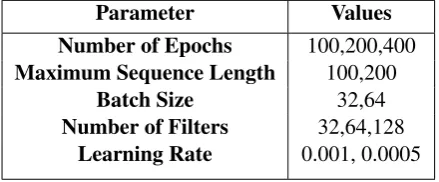
Parameter Values
Number of Epochs 100,200,400 Maximum Sequence Length 100,200
Batch Size 32,64
[image:3.595.307.527.565.656.2]Number of Filters 32,64,128 Learning Rate 0.001, 0.0005
Table 1: Hyperparameter Values.
5 Experiments
5.1 Data Augmentation
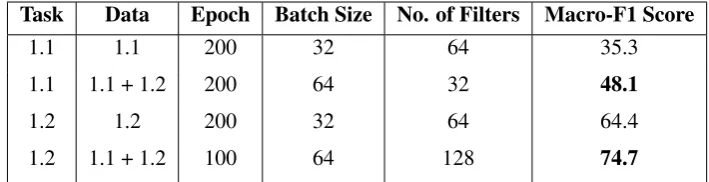
Task Data Epoch Batch Size No. of Filters Macro-F1 Score
1.1 1.1 200 32 64 35.3
1.1 1.1 + 1.2 200 64 32 48.1
1.2 1.2 200 32 64 64.4
[image:4.595.120.475.62.153.2]1.2 1.1 + 1.2 100 64 128 74.7
Table 2: Results of our best performing systems on the official test set with/without data augmentation.
our neural model is relatively shallow, the data size for each of the subtask is also small. As a workaround, we simply mix the data from subtask 1.1 with data from subtask 1.2 which hopefully helps in improving the model’s generalizability.
5.2 Experimental Settings
While the final training and prediction was per-formed on the entire training dataset, we use the official validation split provided by contest orga-nizers to perform hyper-parameter tuning. For the data augmentation scenario, however, we also make use of the validation data from the other task. Given that CNN’s are fast to train, we eas-ily use grid search to find the optimal combina-tion of a subset of parameters for each task and each data configuration (with or without augmen-tation) which are listed in Table1. For the remain-ing parameters, we used standard values as recom-mended by prior literature as follows: convolution filters of width 3,4 and 5; position and directional-ity embeddings of size 5; windows size for relative positions from entities was set to 30.
6 Results
We report our performance on the classification tasks (Subtask 1.1 and 1.2) according to the of-ficial evaluation. While all task settings perform best for a maximum sequence length of 200 and learning rate of 0.001, the rest of the parameters and their corresponding results are listed in Table 2. Even a simple mixing of the two datasets which differ significantly in the nature of tagged entities lead to a significant improvement. Surprisingly though, adding the noisy data to the clean dataset also leads to a 36% increase in performance. This could be attributed to the fact that while heuris-tically annotated entities are high-level concepts thus sharing a lot of context with similar concepts, most of the manually annotated entities are full noun phrases, thus adding to the complexity of the
task. These results also falsify our initial assump-tion/expectation of Task 1.1 to be easier.
7 Conclusion
We presented a simple end to end model that is fast to train and though does not perform competitively well, makes effective use of addi-tional data for a significant improvement in per-formance. These results show the effectiveness of mixing/transferring supervision from data com-ing from a different distribution and thus invites further exploration in semi-supervised/supervised domain adaptation scenarios.
References
Razvan Bunescu and Raymond Mooney. 2005. A shortest path dependency kernel for relation extrac-tion. InProceedings of Human Language Technol-ogy Conference and Conference on Empirical Meth-ods in Natural Language Processing, pages 724– 731, Vancouver, British Columbia, Canada. Associ-ation for ComputAssoci-ational Linguistics.
Razvan Bunescu and Raymond J. Mooney. 2006.
Subsequence kernels for relation extraction. In
Advances in Neural Information Processing Sys-tems, Vol. 18: Proceedings of the 2005 Conference (NIPS).
Kata G´abor, Davide Buscaldi, Anne-Kathrin Schu-mann, Behrang QasemiZadeh, Ha¨ıfa Zargayouna, and Thierry Charnois. 2018. Semeval-2018 Task 7: Semantic relation extraction and classification in scientific papers. In Proceedings of International Workshop on Semantic Evaluation (SemEval-2018), New Orleans, LA, USA.
Jonas Gehring, Michael Auli, David Grangier, and Yann Dauphin. 2017. A convolutional encoder model for neural machine translation. In Proceed-ings of the 55th Annual Meeting of the Associa-tion for ComputaAssocia-tional Linguistics (Volume 1: Long Papers), pages 123–135. Association for Computa-tional Linguistics.
In Z. Ghahramani, M. Welling, C. Cortes, N. D. Lawrence, and K. Q. Weinberger, editors,Advances in Neural Information Processing Systems 27, pages 2042–2050. Curran Associates, Inc.
Yoon Kim. 2014. Convolutional neural networks for sentence classification. In Proceedings of the 2014 Conference on Empirical Methods in Natural Language Processing (EMNLP), pages 1746–1751, Doha, Qatar. Association for Computational Lin-guistics.
Yoon Kim, Yacine Jernite, David Sontag, and Alexan-der M Rush. 2016. Character-aware neural language models. InAAAI, pages 2741–2749.
Diederik P Kingma and Jimmy Ba. 2014. Adam: A method for stochastic optimization. arXiv preprint arXiv:1412.6980.
Omer Levy and Yoav Goldberg. 2014. Dependency-based word embeddings. In Proceedings of the 52nd Annual Meeting of the Association for Com-putational Linguistics (Volume 2: Short Papers), pages 302–308, Baltimore, Maryland. Association for Computational Linguistics.
Yankai Lin, Shiqi Shen, Zhiyuan Liu, Huanbo Luan, and Maosong Sun. 2016. Neural relation extraction with selective attention over instances. In Proceed-ings of the 54th Annual Meeting of the Association for Computational Linguistics (Volume 1: Long Pa-pers), pages 2124–2133, Berlin, Germany. Associa-tion for ComputaAssocia-tional Linguistics.
Mike Mintz, Steven Bills, Rion Snow, and Daniel Ju-rafsky. 2009. Distant supervision for relation ex-traction without labeled data. In Proceedings of the Joint Conference of the 47th Annual Meeting of the ACL and the 4th International Joint Conference on Natural Language Processing of the AFNLP, pages 1003–1011, Suntec, Singapore. Association for Computational Linguistics.
Thien Huu Nguyen and Ralph Grishman. 2015. Rela-tion extracRela-tion: Perspective from convoluRela-tional neu-ral networks. InProceedings of the 1st Workshop on Vector Space Modeling for Natural Language Pro-cessing, pages 39–48.
Longhua Qian, Guodong Zhou, Fang Kong, Qiaom-ing Zhu, and Peide Qian. 2008. Exploiting con-stituent dependencies for tree kernel-based semantic relation extraction. In Proceedings of the 22nd In-ternational Conference on Computational Linguis-tics (Coling 2008), pages 697–704, Manchester, UK. Coling 2008 Organizing Committee.
Sebastian Riedel, Limin Yao, and Andrew McCallum. 2010. Modeling relations and their mentions with-out labeled text. In Proceedings of the European Conference on Machine Learning and Knowledge Discovery in Databases (ECML PKDD).
Nitish Srivastava, Geoffrey Hinton, Alex Krizhevsky, Ilya Sutskever, and Ruslan Salakhutdinov. 2014.
Dropout: A simple way to prevent neural networks from overfitting. Journal of Machine Learning Re-search, 15:1929–1958.
Yi Wu, David Bamman, and Stuart Russell. 2017. Ad-versarial training for relation extraction. In Proceed-ings of the 2017 Conference on Empirical Methods in Natural Language Processing, pages 1778–1783, Copenhagen, Denmark. Association for Computa-tional Linguistics.
Yan Xu, Lili Mou, Ge Li, Yunchuan Chen, Hao Peng, and Zhi Jin. 2015. Classifying relations via long short term memory networks along shortest depen-dency paths. In Proceedings of the 2015 Confer-ence on Empirical Methods in Natural Language Processing, pages 1785–1794. Association for Com-putational Linguistics.
Daojian Zeng, Kang Liu, Yubo Chen, and Jun Zhao. 2015.Distant supervision for relation extraction via piecewise convolutional neural networks. In Pro-ceedings of the 2015 Conference on Empirical Meth-ods in Natural Language Processing, pages 1753– 1762, Lisbon, Portugal. Association for Computa-tional Linguistics.
Daojian Zeng, Kang Liu, Siwei Lai, Guangyou Zhou, and Jun Zhao. 2014. Relation classification via con-volutional deep neural network. InProceedings of COLING 2014, the 25th International Conference on Computational Linguistics: Technical Papers, pages 2335–2344, Dublin, Ireland. Dublin City Uni-versity and Association for Computational Linguis-tics.
Xiang Zhang, Junbo Zhao, and Yann LeCun. 2015.