Proceedings of the Workshop on Figurative Language Processing, pages 133–138
Using Language Learner Data for Metaphor Detection
Egon W. Stemle Eurac Research Bolzano-Bozen, Italy [email protected]
Alexander Onysko Alpen-Adria-Universit¨at Klagenfurt a.W., Austria [email protected]
Abstract
This article describes the system that partici-pated in the shared task (ST) on metaphor de-tection (Leong et al.,2018) on the Vrije Uni-versity Amsterdam Metaphor Corpus (VUA). The ST was part of the workshop on pro-cessing figurative language at the 16th annual conference of theNorth American Chapter of the Association for Computational Linguistics
(NAACL2018).
The system combines a small assertion of trending techniques, which implement ma-tured methods from NLP and ML; in partic-ular, the system uses word embeddings from standard corpora and from corpora represent-ing different proficiency levels of language learners in a LSTM BiRNN architecture. The system is available under the APLv2 open-source license.
1 Introduction
Ever since conceptual metaphor theory was laid out in Lakoff and Johnson(1980), the most vex-ing question has remained a methodological one: how can conceptual metaphors be reliably identi-fied in language use? Although manual identifica-tion was put on a stronger methodological foot-ing with the Metaphor Identification Procedure (MIP) (”Pragglejaz Group”,2007) and its elabora-tion into MIPVU (Steen et al.,2010), fuzzy areas remain due to the fact that conceptual metaphors can vary between primary metaphors and com-plex metaphors (cf. Grady, 1997). Furthermore, highly conventionalized metaphorical expressions might not be processed in the same way as novel metaphors. The core process of manual metaphor identification is not completely unproblematic ei-ther since it can be difficult to establish wheei-ther the meaning of a lexical unit in its context devi-ates from its basic meaning or not. In the face of
that slippery terrain, automatic metaphor identifi-cation emerges as an extremely challenging task. An increasing volume of research since the start of annual workshops at NAACL in 2013 has shown first promising results using different methods of automated metaphor identification (see for exam-ple Shutova et al. (2015) and Klebanov et al. (2016) for previous events). The current shared task of metaphor identification provided a further opportunity to put the computational spotting of metaphors to the test.
Our bid for this task combines (cf. Section 2) fastText word embeddings (WEs) with a single-layer long short-term memory bidirectional recurrent neural network (BiRNN) architecture. The input, sequences of WE representations of words, is fed into the BiRNN which predicts metaphorical usage for each word.
The WEs were trained (cf. Section 4.2) on different large corpora (BNC, Wikipedia, enTen-Ten13, ukWaC) and on the Vienna-Oxford Inter-national Corpus of English (VOICE) as well as on the TOEFL11 Corpus of Non-Native English. The latter corpus was used, among others, in the First Native Language Identification Shared Task (Tetreault et al.,2013) held at the8th Workshop on Innovative Use of NLP for Building Educational Applicationsas part of NAACL-HLT 2013.
We were led by the idea (cf. Section 2.3) that metaphorical language use changes while gaining proficiency in a language, and so we hoped to be able to utilise the information contained in corpora of different proficiency levels.
The paper is organised as follows: We present our system design with related work in Section2, the implementation in Section 3, and the experi-mental setup with an evaluation in Section4. Sec-tion5concludes with an outlook on possible next steps.
2 Design
Generally, our design builds upon the foundation laid out by Collobert et al. (2011) for a neural network (NN) architecture and learning algorithm that can be applied to various natural language processing tasks. The most related task specific design is given inDo Dinh and Gurevych(2016) who used a NN in combination with WEs to detect metaphors. In contrast to our study, they used a dense multi-layer NN while we adapted the design of Stemle (2016a,b), who combined WEs with a recurrent NN (RNN) to predict part-of-speech (PoS) tags of computer-mediated communication (CMC) and Web corpora for German and Italian. RNNs are usually considered to be more suitable for labelling sequential data such as text.
2.1 Word Embeddings
Recently, state-of-the-art results on various lin-guistic tasks were accomplished by architectures using neural-network based WEs. Baroni et al. (2014) conducted a set of experiments comparing the popular word2vec (Mikolov et al., 2013a,b) implementation for creating WEs with other well-known distributional methods across various (se-mantic) tasks. These results suggest that the WEs substantially outperform the other architectures on semantic similarity and analogy detection tasks. Subsequently,Levy et al.(2015) conducted a com-prehensive set of experiments that suggest that much of the improved results are due to the system design and parameter optimizations, rather than the selected method. They conclude that ”there does not seem to be a consistent significant advan-tage to one approach over the other”.
WEs provide high-quality low dimensional vec-tor representations of words from large corpora of unlabelled data. The representations, typically computed using NNs, encode many linguistic reg-ularities and patterns (Mikolov et al.,2013b).
2.2 Bidirectional Recurrent Neural Network
NNs consist of a large number of simple, highly interconnected processing nodes in an architec-ture loosely inspired by the strucarchitec-ture of the cere-bral cortex of the brain (O’Reilly and Munakata, 2000). The nodes receive weighted inputs through their connections on one side andfireaccording to their individual thresholds of their shared activa-tion funcactiva-tion. A firing node passes on an activaactiva-tion to all connected nodes on the other side. During
learning the input is propagated through the net-work and the actual output is compared to the de-sired output. Then, the weights of the connections (and the thresholds) are adjusted step-wise so as to more closely resemble a configuration that would produce the desired output. After all training data have been presented, the process typically starts over, and the learned output values will usually be closer to the desired values.
Recurrent NNs (RNNs), introduced by Elman (1990), are NNs where the connections between the elements are directed cycles, i.e. the networks have loops, and this enables the NN to model sequential dependencies of the input. However, regular RNNs have fundamental difficulties learn-ing long-term dependencies, and special kinds of RNNs need to be used (Hochreiter,1991); a very popular one is the so called long short-term mem-ory (LSTM) network proposed byHochreiter and Schmidhuber(1997).
Bidirectional RNNs (BiRNN), introduced by Schuster and Paliwal(1997), extend unidirectional RNNs by introducing a layer, where the directed cycles enable the input to flow in opposite sequen-tial order. While processing text, this means that for any given word the network not only consid-ers the text leading up to the word but also the text thereafter.
Overall, we benefit from available labelled data with this design but also from large amounts of available unlabelled data.
2.3 Language Learner Data
de-tection via WEs as learner language provides dif-ferent usage patterns compared to WEs derived from standard language corpora.
3 Implementation
We maintain the implementation in a source code repository1. Our system uses sequences of word features as input to a BiRNN with a LSTM archi-tecture.
3.1 Word Embeddings
We use gensim2, a Python tool for unsupervised semantic modelling from plain text, to load pre-computed WE models and to compute embedding-vector representations of words. Words missing in a WE model, i.e. out-of-vocabulary words (OOV), are first estimated by looking at a fixed context of their non-OOV words. If this fails, OOVs are mapped to their individual, randomly generated, vector representations.
3.2 Neural Network
Our implementation uses Keras (Chollet,2015), a high-level NNs’ library written in Python, on top of TensorFlow (Abadi et al.,2016), an open source software library for numerical computation.
The number of input layers corresponds to the number of employed feature sets. For multiple feature sets, e.g. multiple WE models or additional PoS tags, sequences are concatenated on the word level such that the number of features for an indi-vidual word grows.
Input sequences have a pre-defined length and represent original textual sentence segments. In case a sentence is longer than the sequence length, the input is split into multiple segments. And if a segment is shorter than the sequence length, the remaining slots are padded, i.e. they are filled with identical dummy information.
Each input layer feeds into a masking layer such that the padded values from the input sequence will be skipped in all downstream layers.3 The masked input is fed into a bidirectional LSTM layer that, in turn, projects to a fully connected output layer that is activated by a softmax func-tion.
1https://github.com/bot-zen/ 2https://radimrehurek.com/gensim/ 3This is considered good practice and speeds up
process-ing with long sequences and many padded values – with our rather short sequences it did not help much.
The output is a single sequence of matching length with labels indicating whether the corre-sponding word is used metaphorically or not.
During training, we use dropout for the linear transformation of the recurrent state, i.e. the net-work drops a fraction of recurrent connections, which helps prevent overfitting (Srivastava et al., 2014); and we use a weighted categorical cross-entropy loss function to counteract the fact that far fewer words in our sequences are labelled as metaphorical than non-metaphorical, which usu-ally hampers classification performance (cf. Kot-siantis et al.,2006).
4 Experiments and Results
Participants of the ST could either participate in the metaphor prediction tracks for verbs only, all content part-of-speech only, or both. For a given text in VUA, and for each sentence, the task was to predict metaphoricity for each verb or content word respectively, and submit the result to Co-daLab4for evaluation. Results were calculated as the harmonic average of the precision and recall (F1-score) of the metaphoricity label. We partici-pated with our system in both tasks.
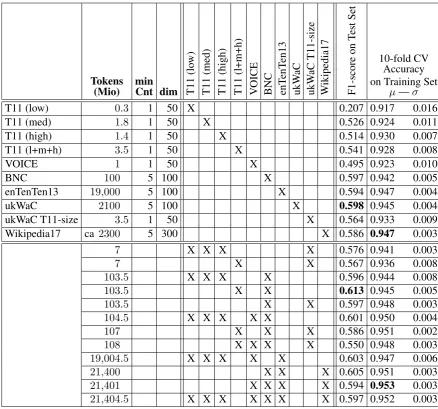
The remainder of this section introduces the of-ficial data set, our WE models and describes our fixed hyper-parameters. The results of different combinations of WE models are shown in Table 1. Also note thatall resultsin this paper refer only to the all content part-of-speech task.
4.1 Shared Task Data
The VUA, the corpus that was used in the shared task, originates from the British National Corpus (BNC). Altogether, it is comprised of 117 texts covering four genres (academic, conversation, fic-tion, news). For the ST, VUA was pre-divided by the organisers into a training and a test set. The training set was labelled and could be used to train classifiers, while the participants were sup-posed to label the test set and submit it. The dis-tribution of metaphorical vs. non-metaphorical la-bels was imbalanced with a ratio of roughly 1:6 (11044 : 61567).
4.2 Word Embedding Models
We use pre-built WE models of the follow-ing corpora: BNC and enTenTen13 web
Tokens
(Mio) minCnt dim T11
(lo
w)
T11
(med)
T11
(high)
T11
(l+m+h)
V
OICE
BNC enT
enT
en13
ukW
aC
ukW
aC
T11-size
W
ikipedia17
F1-score
on
Test
Set
10-fold CV Accuracy on Training Set
µ—σ
T11 (low) 0.3 1 50 X 0.207 0.917 0.016
T11 (med) 1.8 1 50 X 0.526 0.924 0.011
T11 (high) 1.4 1 50 X 0.514 0.930 0.007
T11 (l+m+h) 3.5 1 50 X 0.541 0.928 0.008
VOICE 1 1 50 X 0.495 0.923 0.010
BNC 100 5 100 X 0.597 0.942 0.005
enTenTen13 19,000 5 100 X 0.594 0.947 0.004
ukWaC 2100 5 100 X 0.598 0.945 0.004
ukWaC T11-size 3.5 1 50 X 0.564 0.933 0.009
Wikipedia17 ca 2300 5 300 X 0.586 0.947 0.003
7 X X X X 0.576 0.941 0.003
7 X X 0.567 0.936 0.008
103.5 X X X X 0.596 0.944 0.008
103.5 X X 0.613 0.945 0.005
103.5 X X 0.597 0.948 0.003
104.5 X X X X X 0.601 0.950 0.004
107 X X X 0.586 0.951 0.002
108 X X X X 0.550 0.948 0.003
19,004.5 X X X X X 0.603 0.947 0.006
21,400 X X X 0.605 0.951 0.003
21,401 X X X X 0.594 0.953 0.003
[image:4.595.77.516.60.469.2]21,404.5 X X X X X X X 0.597 0.952 0.003
Table 1: Overview of the word embedding models we used, and evaluation results for individual models and some combinations on the metaphor prediction track forall content part-of-speech.
Number of tokens in the original corpus, parametersminCountanddimforfastTextduring training of the models. Our calculated F1-scores on the official labelled test set (they should coincide with the organisers’ results). The mean accuracy as well as the standard deviation in the accuracy for 10-fold cross validation runs on the training set.
pus (Jakub´ıˇcek et al.,2013) from SketchEngine5, as well as Wikipedia176 from fastText ( Bo-janowski et al.,2016).
We trained WE models using fastText’s SkipGram model with the default parameters7 ex-cept for the two parameters -minCount (the minimal number of word occurrences) and-dim (size of word vectors). The two parameters were altered to take the smaller sizes of our corpora into
5https://embeddings.sketchengine.co.
uk/static/index.html
6https://fasttext.cc/docs/en/
pretrained-vectors.html
7https://github.com/facebookresearch/
fastText/archive/v0.1.0.zip
account. See Table1for details.
Three individual models were trained for the different proficiency levels low, medium and high of the training subset of theTOEFL11(Blanchard et al.,2013); another model was trained for the full training set comprising all three proficiency levels. One model was trained for theVOICE(Seidlhofer et al.,2013), a corpus of English as it is spoken by a non-native speaking majority of users in differ-ent contexts.
the second model for a random sample of docu-ments approximating the token count of the full TOEFL11 training set.
4.3 Hyper-Parameter Tuning
Hyparameter tuning is important for good per-formance. The parameters of our system were op-timised via an ad-hoc grid search in 3-fold cross validation (CV) runs.
Parameters were: NN optimizer (rmsprop, adadelta, adam), recurrent dropout rate for the LSTM layer (0.1, 0.25, 0.5), dropout for the in-put layer (0, 0.1, 0.2), sequence length (5, 10,15, 50), learning epochs (3, 5,20, 32) and batch size (16,32, 64), and the network architecture, e.g. in-troducing a second LSTM abstraction layer or us-ing a Gated Recurrent (GRU) layer instead of the LSTM layer. Furthermore, we trained WE mod-els with different values for thedim(25,50, 100, 150, 200, 250) andminCount (1, 2, 5, 10) pa-rameters.
The weight for the categorical cross-entropy loss function is calculated as the logarithm of the ratio of number of words vs. metaphorical labels. The context for estimating OOV words was set to 10.
Once set, we used the same configuration for all experiments.
5 Conclusion & Outlook
The combination of WEs with a BiRNN is capa-ble of recognizing metaphorical usage of words better than many other already tested approaches. More importantly, our design does not rely on WordNet or VerbNet information, and does not need concreteness or abstractness information like many successful architectures from previous an-nual workshops at NAACL. Besides VUA, our system only needs running text.
The best result on the test set was achieved with a combination of TOEFL11 learner data and data from the BNC. So far, the results are encouraging—but also mixed—regarding our ini-tial idea that metaphorical language use at differ-ent proficiency levels could be utilised to recog-nizing metaphorical usage of words. To this end, we are looking forward to output from the Euro-pean Network for Combining Language Learning with Crowdsourcing Techniques8, where
poten-8http://www.cost.eu/COST_Actions/ca/
CA16105
tially more and more fine-grained language learner data will be collected and made available.
Acknowledgements
The computational results presented have been achieved in part using theVienna Scientific Clus-ter (VSC).
References
Martin Abadi, Paul Barham, Jianmin Chen, Zhifeng Chen, Andy Davis, Jeffrey Dean, Matthieu Devin, Sanjay Ghemawat, Geoffrey Irving, Michael Isard, Manjunath Kudlur, Josh Levenberg, Rajat Monga, Sherry Moore, Derek G Murray, Benoit Steiner, Paul Tucker, Vijay Vasudevan, Pete Warden, Martin Wicke, Yuan Yu, and Xiaoqiang Zheng. 2016. Ten-sorFlow: A System for Large-Scale Machine Learn-ing. In12th USENIX Symposium on Operating Sys-tems Design and Implementation (OSDI 16), pages 265–283, Savannah, GA. USENIX Association. Marco Baroni, Silvia Bernardini, Adriano Ferraresi,
and Eros Zanchetta. 2009. The WaCky wide web: a collection of very large linguistically processed web-crawled corpora. Language Resources and Evaluation, 43(3):209–226.
Marco Baroni, Georgiana Dinu, and German Kruszewski. 2014. Don’t count, predict! A systematic comparison of context-counting vs. context-predicting semantic vectors. InProceedings of the 52nd Annual Meeting of the Association for Computational Linguistics (Volume 1: Long Papers), pages 238–247. Association for Computa-tional Linguistics. http://www.aclweb.org/ anthology/P14-1023.
Beata Beigman Klebanov and Michael Flor. 2013.
Argumentation-Relevant Metaphors in Test-Taker Essays. InProceedings of the First Workshop on Metaphor in NLP, pages 11–20. Association for Computational Linguistics.
Daniel Blanchard, Joel Tetreault, Derrick Higgins, Aoife Cahill, and Martin Chodorow. 2013. Toefl11: A corpus of non-native english. ETS Research Re-port Series, 2013(2):i–15.
Piotr Bojanowski, Edouard Grave, Armand Joulin, and Tomas Mikolov. 2016. Enriching word vectors with subword information.CoRR, abs/1607.04606. Franc¸ois Chollet. 2015. Keras: Deep Learning library
for Theano and TensorFlow. https://github. com/fchollet/keras.
Erik-Lˆan Do Dinh and Iryna Gurevych. 2016. Token-Level Metaphor Detection using Neural Networks. InProceedings of the Fourth Workshop on Metaphor in NLP, pages 28–33, San Diego, California. Asso-ciation for Computational Linguistics.
Jeffrey L. Elman. 1990. Finding structure in time.
Cognitive Science, 14(2):179–211.
Joseph Grady. 1997. Foundations of Meaning: Pri-mary Metaphors and PriPri-mary Scenes. Ph.D. thesis, University of California, Berkeley.
Sepp Hochreiter. 1991. Untersuchungen zu dynamis-chen neuronalen Netzen. diploma thesis, TU M¨unchen.
Sepp Hochreiter and J¨urgen Schmidhuber. 1997.
Long short-term memory. Neural Computation, 9(8):1735–1780. http://dx.doi.org/10. 1162/neco.1997.9.8.1735.
Miloˇs Jakub´ıˇcek, Adam Kilgarriff, Vojtˇech Kov´aˇr, Pavel Rychl`y, and V´ıt Suchomel. 2013. The Ten-Ten corpus family. In 7th International Cor-pus Linguistics Conference (CL 2013), pages 125– 127, Lancaster. http://ucrel.lancs.ac. uk/cl2013/.
Beata Beigman Klebanov, Ekaterina Shutova, and Pa-tricia Lichtenstein. 2016. Proceedings of the Fourth Workshop on Metaphor in NLP. InProceedings of the Fourth Workshop on Metaphor in NLP. Associa-tion for ComputaAssocia-tional Linguistics.
Sotiris Kotsiantis, Dimitris Kanellopoulos, and Panayi-otis Pintelas. 2006. Handling imbalanced datasets: A review. GESTS International Transactions on Computer Science and Engineering, 30.
George Lakoff and Mark Johnson. 1980. Metaphors we Live by. University of Chicago Press.
Chee Wee Leong, Beata Beigman Klebanov, and Eka-terina Shutova. 2018. A report on the 2018 VUA metaphor detection shared task. In Proceedings of the Workshop on Figurative Language Processing, New Orleans, LA.
Omer Levy, Yoav Goldberg, and Ido Dagan. 2015. Improving distributional similarity with lessons learned from word embeddings.
Transactions of the Association for Compu-tational Linguistics, 3:211–225. https: //tacl2013.cs.columbia.edu/ojs/ index.php/tacl/article/view/570. Tomas Mikolov, Kai Chen, Greg Corrado, and Jeffrey
Dean. 2013a. Efficient Estimation of Word Repre-sentations in Vector Space. CoRR, abs/1301.3781. http://arxiv.org/abs/1301.3781. Tomas Mikolov, Ilya Sutskever, Kai Chen, Greg
Cor-rado, and Jeffrey Dean. 2013b. Distributed Rep-resentations of Words and Phrases and their Com-positionality. CoRR, abs/1310.4546. http:// arxiv.org/abs/1310.4546.
Randall C. O’Reilly and Yuko Munakata. 2000. Com-putational Explorations in Cognitive Neuroscience Understanding the Mind by Simulating the Brain.
MIT Press. http://books.google.com/
books?id=BLf34BFTaIUC{&}pgis=1. ”Pragglejaz Group”. 2007. MIP: A Method for
Iden-tifying Metaphorically Used Words in Discourse.
Metaphor and Symbol, 22(1):1–39.
M. Schuster and K.K. Paliwal. 1997. Bidirectional re-current neural networks. IEEE Transactions on Sig-nal Processing, 45(11):2673–2681.
Barbara Seidlhofer, Angelika Breiteneder, Theresa Klimpfinger, Stefan Majewski, Ruth Osimk-Teasdale, Marie-Luise Pitzl, and Michael Radeka. 2013. The Vienna-Oxford International Corpus of English (VOICE).
Ekaterina Shutova, Beata Beigman Klebanov, and Pa-tricia Lichtenstein. 2015. Proceedings of the Third Workshop on Metaphor in NLP. InProceedings of the Third Workshop on Metaphor in NLP. Associa-tion for ComputaAssocia-tional Linguistics.
Nitish Srivastava, Geoffrey E. Hinton, Alex Krizhevsky, Ilya Sutskever, and Ruslan Salakhut-dinov. 2014. Dropout : A Simple Way to Prevent Neural Networks from Overfitting. Journal of Ma-chine Learning Research (JMLR), 15:1929–1958.
Gerard J. Steen, Aletta G. Dorst, J. Berenike Herrmann, Anna A. Kaal, Tina Krennmayr, and Trijntje Pasma. 2010.A Method for Linguistic Metaphor Identifica-tion: From MIP to MIPVU. 00:238.
Egon W. Stemle. 2016a. bot.zen @ EmpiriST 2015 -A minimally-deep learning PoS-tagger (trained for German CMC and Web data). InProceedings of the 10th Web as Corpus Workshop (WAC-X) and the Em-piriST Shared Task, pages 115–119. Association for Computational Linguistics.
Egon W. Stemle. 2016b. bot.zen @ EVALITA 2016 -A minimally-deep learning PoS-tagger (trained for Italian Tweets). In Proceedings of Third Italian Conference on Computational Linguistics (CLiC-it 2016) & Fifth Evaluation Campaign of Natural Lan-guage Processing and Speech Tools for Italian. Final Workshop (EVALITA 2016), Napoli, Italy.