Deep Multilingual Correlation for Improved Word Embeddings
Ang Lu1, Weiran Wang2, Mohit Bansal2, Kevin Gimpel2, and Karen Livescu2
1Department of Automation, Tsinghua University, Beijing, 100084, China
2Toyota Technological Institute at Chicago, Chicago, IL, 60637, USA
{weiranwang, mbansal, kgimpel, klivescu}@ttic.edu
Abstract
Word embeddings have been found useful for many NLP tasks, including part-of-speech tagging, named entity recognition, and pars-ing. Adding multilingual context when learn-ing embeddlearn-ings can improve their quality, for example via canonical correlation analysis (CCA) on embeddings from two languages. In this paper, we extend this idea to learndeep non-linear transformations of word embed-dings of the two languages, using the recently proposed deep canonical correlation analy-sis. The resulting embeddings, when eval-uated on multiple word and bigram similar-ity tasks, consistently improve over monolin-gual embeddings and over embeddings trans-formed with linear CCA.
1 Introduction
Learned word representations are widely used in NLP tasks such as tagging, named entity recogni-tion, and parsing (Miller et al., 2004; Koo et al., 2008; Turian et al., 2010; T¨ackstr¨om et al., 2012; Huang et al., 2014; Bansal et al., 2014). The idea in such representations is that words with similar context have similar meaning, and hence should be nearby in a clustering or vector space. Con-tinuous representations are learned with neural lan-guage models (Bengio et al., 2003; Mnih and Hin-ton, 2007; Mikolov et al., 2013) or spectral meth-ods (Deerwester et al., 1990; Dhillon et al., 2011).
The context used to learn these representations is typically the set of nearby words of each word oc-currence. Prior work has found that adding transla-tional contextresults in better representations (Diab and Resnik, 2002; T¨ackstr¨om et al., 2012; Bansal et al., 2012; Zou et al., 2013). Recently, Faruqui and Dyer (2014) applied canonical correlation analysis (CCA) to word embeddings of two languages, and found that the resulting embeddings represent word
similarities better than the original monolingual em-beddings.
In this paper, we follow the same intuition as Faruqui and Dyer (2014) but rather than learning lin-ear transformations with CCA, we permit the cor-related information to lie in nonlinear subspaces of the original embeddings. We use the recently pro-posed deep canonical correlation analysis (DCCA) technique of Andrew et al. (2013) to learn non-linear transformations of two languages’ embed-dings that are highly correlated. We evaluate our DCCA-transformed embeddings on word similarity tasks like WordSim-353 (Finkelstein et al., 2001) and SimLex-999 (Hill et al., 2014), and also on the bigram similarity task of Mitchell and Lapata (2010) (using additive composition), obtaining con-sistent improvements over the original embeddings and over linear CCA. We also compare tuning crite-ria and ensemble methods for these architectures. 2 Method
We assume that we have initial word embeddings for two languages, denoted by random vectorsx∈RDx
andy∈RDy, and a set of bilingual word pairs. Our
goal is to obtain a representation for each language that incorporates useful information from bothxand y. We consider the two input monolingual word em-beddings as different views of the same latent se-mantic signal. There are multiple ways to incor-porate multilingual information into word embed-dings. Here we follow Faruqui and Dyer (2014) in taking a CCA-based approach, in which we project the original embeddings onto their maximally corre-lated subspaces. However, instead of relying on lin-ear correlation, we llin-earn more powerful non-linlin-ear transformations of each view via deep networks. Canonical Correlation Analysis A popular method for multi-view representation learning is canonical correlation analysis (CCA; Hotelling, 1936). Its objective is to find two vectorsu ∈RDx
andv∈RDysuch that projections of the two views
onto these vectors are maximally (linearly) corre-lated:
max
u∈RDx,v∈RDy
E(u⊤x)(v⊤y)
p
E[(u⊤x)2]pE[(v⊤y)2]
= p u⊤Σxyv
u⊤Σxxupv⊤Σyyv (1)
whereΣxy andΣxx are the cross-view and within-view covariance matrices. (1) is extended to learn multi-dimensional projections by optimizing the sum of correlations in all dimensions, subject to different projected dimensions being uncorrelated. Given sample pairs{(xi,yi)}Ni=1, the empirical
es-timates of the covariance matrices are Σˆxx =
1
N
PN
i=1xix⊤i +rxI,Σˆyy = N1 PNi=1yiy⊤i +ryI and Σˆxy = N1 PNi=1xiy⊤i where (rx, ry) > 0are regularization parameters (Hardoon et al., 2004; De Bie and De Moor, 2003). Then the optimal k -dimensional projection mappings are given in closed form via the rank-k singular value decomposition (SVD) of theDx×DymatrixΣˆxx−1/2ΣˆxyΣˆ−yy1/2.
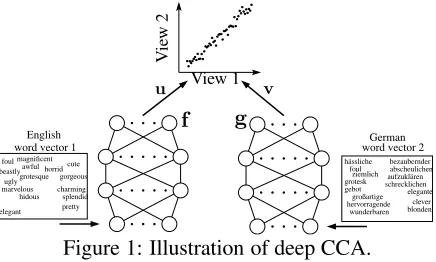
2.1 Deep Canonical Correlation Analysis A linear feature mapping is often not sufficiently powerful to faithfully capture the hidden, non-linear relationships within the data. Recently, Andrew et al. (2013) proposed a nonlinear extension of CCA using deep neural networks, dubbed deep canonical correlation analysis (DCCA) and illustrated in Fig-ure 1. In this model, two (possibly deep) neural networks f and g are used to extract features from each view, and trained to maximize the correlations between outputs in the two views, measured by a linear CCA step with projection mappings (u,v). The neural network weights and the linear projec-tions are optimized together using the objective
max
Wf,Wg,u,v
u⊤Σfgv p
u⊤Σffupv⊤Σggv, (2)
whereWf andWg are the weights of the two
net-works and Σfg, Σff and Σgg are covariance ma-trices computed for {f(xi),g(yi)}Ni=1 in the same
way as CCA. The final transformation is the com-position of the neural network and CCA projection, e.g.,u⊤f(x)for the first view. Unlike CCA, DCCA
word vector 2
English German
word vector 1
View 1
V
ie
w
2
u v
f g
foul foul awful
ugly
pretty charming
cute gorgeous marvelous
magnificent
elegant
splendid hidous beastlygrotesquehorrid
schrecklichen h¨assliche
ziemlich bezaubernder
clever blonden wunderbaren
großartige elegante hervorragende
abscheulichen
[image:2.612.318.536.60.191.2]gebot grotesk aufzukl¨aren
Figure 1: Illustration of deep CCA.
does not have a closed-form solution, but the param-eters can be learned via gradient-based optimization, with either batch algorithms like L-BFGS as in (An-drew et al., 2013) or a mini-batch stochastic gradient descent-like approach as in (Wang et al., 2015). We choose the latter in this paper.
An alternative nonlinear extension of CCA is ker-nel CCA (KCCA) (Lai and Fyfe, 2000; Vinokourov et al., 2003), which introduces nonlinearity through kernels. DCCA scales better with data size, as KCCA involves the SVD of anN ×N matrix. An-drew et al. (2013) showed that DCCA achieves bet-ter correlation on held-out data than CCA/KCCA, and Wang et al. (2015) found that DCCA outper-forms CCA and KCCA on a speech recognition task. 3 Experiments
We use English and German as our two languages. Our original monolingual word vectors are the same as those used by Faruqui and Dyer (2014). They are 640-dimensional and are estimated via latent semantic analysis on the WMT 2011 monolingual news corpora.1 We use German-English translation pairs as the input to CCA and DCCA, using the same set of 36K pairs as used by Faruqui and Dyer. These pairs contain, for each of 36K English word types, the single most frequently aligned German word. They were obtained using the word aligner in cdec (Dyer et al., 2010) run on the WMT06-10 news commentary corpora and Europarl. After training, we apply the learned CCA/DCCA projec-tion mappings to the original English word embed-dings (180K words) and use these transformed em-beddings for our evaluation tasks.
3.1 Evaluation Tasks
We compare our DCCA-based embeddings to the original word vectors and to CCA-based
beddings on several tasks. We use WordSim-353 (Finkelstein et al., 2001), which contains WordSim-353 English word pairs with human similarity ratings. It is divided into WS-SIM and WS-REL by Agirre et al. (2009) to measure similarity and relatedness. We also use SimLex-999 (Hill et al., 2014), a new similarity-focused dataset consisting of 666 noun pairs, 222 verb pairs, and 111 adjective pairs. Fi-nally, we use the bigram similarity dataset from Mitchell and Lapata (2010) which has 3 subsets, adjective-noun (AN), noun-noun (NN), and verb-object (VN), and dev and test sets for each. For the bigram task, we simply add the word vectors output by CCA or DCCA to get bigram vectors.2
All task datasets contain pairs with human sim-ilarity ratings. To evaluate embeddings, we com-pute cosine similarity between the two vectors in each pair, order the pairs by similarity, and com-pute Spearman’s correlation (ρ) between the model’s ranking and human ranking.
3.2 Training
We normalize the 36K training pair vectors to unit norm (as also done by Faruqui and Dyer). We then remove the per-dimension mean and standard deviation of this set of training pairs, as is typi-cally done in neural network training (LeCun et al., 1998). We do the same to the original 180K Eng-lish word vectors (normalize to unit norm, remove the mean/standard deviation of the size-36K train-ing set), then apply our CCA/DCCA mapptrain-ings to these 180K vectors. The resulting 180K vectors are further normalized to zero mean before cosine simi-larities between test pairs are computed, as also done by Faruqui and Dyer.
For both CCA and DCCA, we tune the output dimensionality among factors in
{0.2,0.4,0.6,0.8,1.0} of the original embed-ding dimension (640), and regularization (rx, ry) from {10−6,10−5,10−4,10−3}, based on the 7
tuning tasks discussed below.
For DCCA, we use standard deep neural net-works with rectified linear units and tune the depth (1 to 4 hidden layers) and layer widths (in
{128,256,512,1024,2048,4096}) separately for each language. For optimization, we use stochastic
2We also tried multiplication but it performed worse. In
fu-ture work, we will directly train on bigram translation pairs.
gradient descent (SGD) as described by Wang et al. (2015). We tune SGD hyperparameters on a small grid, choosing a mini-batch size of 3000, learning rate of0.0001, and momentum of0.99.
3.3 Tuning
Our main results are based on tuning hyperparame-ters (of CCA/DCCA) on 7 word similarity tasks.3 We perform additional experiments in which we tune on the development sets for the bigram tasks. We set aside WS-353, SimLex-999, and the test sets of the bigram tasks as held-out test sets. We consider two tuning criteria:
BestAvg: Choose the hyperparameters with the best average performance across the 7 tuning tasks. This is the only tuning criterion used for CCA.
MostBeat: For DCCA, choose the hyperparameters that beat the best CCA embeddings on a maximum number of the 7 tasks; to break ties here, choose the hyperparameters with the best average performance. The idea is that we want to find a setting that gener-alizes to many tasks.
We also consider simple ensembles by averaging the cosine similarities from the three best settings under each of these two criteria.
3.4 Results
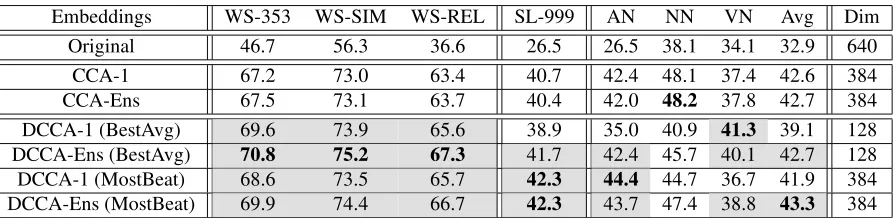
Table 1 shows our main results on the word and bi-gram similarity tasks. All values are Spearman’s correlation (ρ). We show the original word vector results, the best-tuned CCA setting (CCA-1), the en-semble of the top-3 CCA settings (CCA-Ens), and the same for DCCA (with both tuning criteria). The DCCA results show an overall improvement on most tasks over linear CCA (all of the shaded DCCA re-sults are better than all corresponding CCA rere-sults). Each of our tuning criteria for DCCA performs well, and almost always better than CCA. BestAvg is better on some tasks while MostBeat is better on others; we report both here to bring attention to and promote discussion about the effects of tuning meth-ods when learning representations in the absence of supervision or in-domain tuning data.
In Table 2, we report additional bigram similarity results obtained by tuning on the dev sets of the
bi-3RG-65 (Rubenstein and Goodenough, 1965), MC-30
Embeddings WS-353 WS-SIM WS-REL SL-999 AN NN VN Avg Dim Original 46.7 56.3 36.6 26.5 26.5 38.1 34.1 32.9 640
CCA-1 67.2 73.0 63.4 40.7 42.4 48.1 37.4 42.6 384
[image:4.612.83.531.58.167.2]CCA-Ens 67.5 73.1 63.7 40.4 42.0 48.2 37.8 42.7 384 DCCA-1 (BestAvg) 69.6 73.9 65.6 38.9 35.0 40.9 41.3 39.1 128 DCCA-Ens (BestAvg) 70.8 75.2 67.3 41.7 42.4 45.7 40.1 42.7 128 DCCA-1 (MostBeat) 68.6 73.5 65.7 42.3 44.4 44.7 36.7 41.9 384 DCCA-Ens (MostBeat) 69.9 74.4 66.7 42.3 43.7 47.4 38.8 43.3 384 Table 1: Main results on word and bigram similarity tasks, tuned on 7 development tasks (see text for details). Shading indicates a result that matches or improves the best linear CCA result; boldface indicates the best result in a given column. See Section 3.4 for discussion on NN results.
Embeddings AN NN VN Avg
CCA 42.4 48.1 37.4 42.6 Deep CCA 45.5 47.1 45.1 45.9 Table 2: Bigram results, tuned on bigram dev sets. gram tasks themselves (as provided by Mitchell and Lapata), since the 7 tuning tasks are not particularly related to the bigram test sets. We see that DCCA can achieve even stronger improvements over CCA and overall using these related dev sets.
We note that the performance on the NN task does not improve. The typical variance of annota-tor scores for each bigram pair was larger for the NN dataset than for the other bigram datasets, sug-gesting noisier annotations. Also, we found that the NN annotations often reflected topical relatedness rather than functional similarity, e.g., television set andtelevision programmeare among the most simi-lar noun-noun bigrams. We expect that multilingual information would help embeddings to more closely reflect functional similarity.
For DCCA, we found that the best-performing networks were typically asymmetric, with 1 to 2 lay-ers on the English side and 2 to 4 on the German side. The best network structure on the bigram VN development set is 640-128-128 for the English view and 640-128-512-128 for the German view, with a final CCA projection layer with dimensionality 128 for each language.
4 Discussion
Normalization and Evaluation We note that the cosine similarity (and thus Spearman’sρ) between a pair of words is not invariant to the series of simple (affine) transformations done by the normalizations in our procedure. For their baseline, Faruqui and Dyer (2014) did not remove the standard deviation
better with DCCA worse with DCCA arrive come author creator locate find leader manager
way manner buddy companion recent new crowd bunch
take obtain achieve succeed boundary border attention interest
win accomplish join add contemplate think mood emotion Table 3: Highly-similar pairs in SimLex-999 that improved/degraded the most under DCCA. Pairs are sorted in decreasing order according to the amount of improvement/degradation.
of the 36K training set for the 180K English vocabu-lary during testing. We have accidentally found that this normalization step alone greatly improves the performance of the original vectors.
For example, the WS-353 correlation improves from 46.7 to 67.1, essentially matching the linear CCA correlations, though DCCA still outperforms them both. This indicates that the cosine similarity is not stable, and it is likely better to learn a dis-tance/similarity function (using labeled tuning data) atop the learned features such that similarities be-tween selected pairs will match the human similari-ties, or such that the rankings will match.
Error Analysis We analyze high-similarity word pairs that change the most with DCCA, as compared to both linear CCA and the original vectors.
For a word pair w, we use r(w) to refer to its similarity rank, subscripting it whether it is com-puted according to human ratings (rh) or if based on cosine similarity via the original vectors (ro), CCA-1 (rc), or DCCA-1 MostBeat (rd). We define
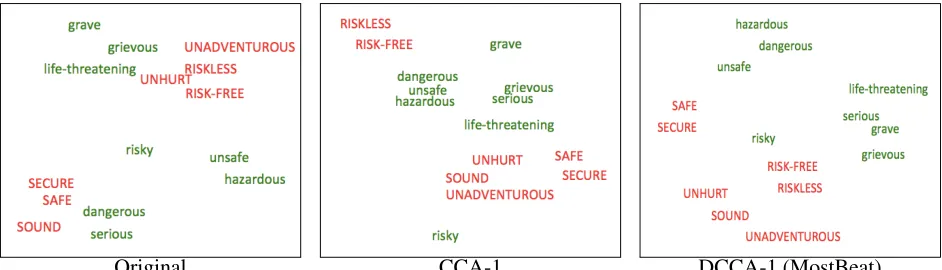
Original CCA-1 DCCA-1 (MostBeat) Figure 2: t-SNE visualization of synonyms (green) and antonyms (red, capitalized) ofdangerous.
δd(w) − (δc(w) + δo(w)). If ∆(w) < 0, then word pairwwas closer to the human ranking using DCCA. Table 3 shows word pairs from SimLex-999 with high human similarity ratings (≥7out of 10); column 1 shows pairs with smallest ∆values, and column 2 shows pairs with largest∆values.
Among pairs in column 1, many contain words with several senses. Using bilingual information is likely to focus on the most frequent sense in the bi-text, due to our use of the most frequently-aligned German word in each training pair. By contrast, using only monolingual context is expected to find an embedding that blends the contextual information across all word senses.
Several pairs from column 2 show hypernym rather than paraphrase relationships, e.g., author-creatorandleader-manager. Though these pairs are rated as highly similar by annotators, linear CCA made them less similar than the original vectors, and DCCA made them less similar still. This matches our intuition that bilingual information should en-courage paraphrase-like similarity and thereby dis-courage the similarity of hypernym-hyponym pairs. Visualizations We visualized several synonym-antonym word lists and often found that DCCA more cleanly separated synonyms from antonyms than CCA or the original vectors. An example of the clearest improvement is shown in Fig. 2.
5 Related work
Previous work has successfully used translational context for word representations (Diab and Resnik, 2002; Zhao et al., 2005; T¨ackstr¨om et al., 2012; Bansal et al., 2012; Faruqui and Dyer, 2014), includ-ing via hand-designed vector space models (Peirs-man and Pad´o, 2010; Sumita, 2000) or via
unsuper-vised LDA and LSA (Boyd-Graber and Blei, 2009; Zhao and Xing, 2006).
There have been other recent deep learning ap-proaches to bilingual representations, e.g., based on a joint monolingual and bilingual objective (Zou et al., 2013). There has also been recent interest in learning bilingual representations without using word alignments (Chandar et al., 2014; Gouws et al., 2014; Koˇcisk`y et al., 2014; Vulic and Moens, 2013). This research is also related to early examples of learning bilingual lexicons using monolingual cor-pora (Koehn and Knight, 2002; Haghighi et al., 2008); the latter used CCA to find matched word pairs. Irvine and Callison-Burch (2013) used a su-pervised learning method with multiple monolingual signals. Finally, other work on CCA and spectral methods has been used in the context of other types of views (Collobert and Weston, 2008; Dhillon et al., 2011; Klementiev et al., 2012; Chang et al., 2013). 6 Conclusion
We have demonstrated how bilingual information can be incorporated into word embeddings via deep canonical correlation analysis (DCCA). The DCCA embeddings consistently outperform linear CCA embeddings on word and bigram similarity tasks. Future work could compare DCCA to other non-linear approaches discussed in§5, compare differ-ent languages as multiview context, and extend to aligned phrase pairs, and to unaligned data.
Acknowledgments
References
Eneko Agirre, Enrique Alfonseca, Keith Hall, Jana Kravalova, Marius Pacsca, and Aitor Soroa. 2009. A study on similarity and relatedness using distribu-tional and wordnet-based approaches. InProceedings of HLT-NAACL.
Galen Andrew, Raman Arora, Jeff Bilmes, and Karen Livescu. 2013. Deep canonical correlation analysis. InProceedings of ICML.
Mohit Bansal, John DeNero, and Dekang Lin. 2012. Un-supervised translation sense clustering. In Proceed-ings of NAACL-HLT.
M. Bansal, K. Gimpel, and K. Livescu. 2014. Tailoring continuous word representations for dependency pars-ing. InProceedings of ACL.
Yoshua Bengio, R´ejean Ducharme, Pascal Vincent, and Christian Janvin. 2003. A neural probabilistic lan-guage model.JMLR, 3:1137–1155, March.
Jordan Boyd-Graber and David M Blei. 2009. Multilin-gual topic models for unaligned text. InProceedings of UAI.
Elia Bruni, Nam-Khanh Tran, and Marco Baroni. 2014. Multimodal distributional semantics. J. Artif. Intell. Res.(JAIR), 49:1–47.
Sarath Chandar, Stanislas Lauly, Hugo Larochelle, Mitesh Khapra, Balaraman Ravindran, Vikas Raykar, and Amrita Saha. 2014. An autoencoder approach to learning bilingual word representations. In Proceed-dings of NIPS.
Kai-Wei Chang, Wen-tau Yih, and Christopher Meek. 2013. Multi-relational latent semantic analysis. In Proceedings of EMNLP.
Ronan Collobert and Jason Weston. 2008. A unified ar-chitecture for natural language processing: Deep neu-ral networks with multitask learning. InProceedings of ICML.
Tijl De Bie and Bart De Moor. 2003. On the regular-ization of canonical correlation analysis. Int. Sympos. ICA and BSS, pages 785–790.
Scott C. Deerwester, Susan T. Dumais, Thomas K. Lan-dauer, George W. Furnas, and Richard A. Harshman. 1990. Indexing by latent semantic analysis. JASIS, 41(6):391–407.
Paramveer Dhillon, Dean P. Foster, and Lyle H. Ungar. 2011. Multi-view learning of word embeddings via CCA. InProceedings of NIPS.
Mona Diab and Philip Resnik. 2002. An unsupervised method for word sense tagging using parallel corpora. InProceedings of ACL.
C. Dyer, A. Lopez, J. Ganitkevitch, J. Weese, F. Ture, P. Blunsom, H. Setiawan, V. Eidelman, and P. Resnik. 2010. cdec: A decoder, alignment, and learning
framework for finite-state and context-free translation models. InProceedings of ACL.
Manaal Faruqui and Chris Dyer. 2014. Improving vector space word representations using multilingual correla-tion. InProceedings of EACL.
Lev Finkelstein, Evgeniy Gabrilovich, Yossi Matias, Ehud Rivlin, Zach Solan, Gadi Wolfman, and Eytan Ruppin. 2001. Placing search in context: The concept revisited. InProceedings of WWW.
Stephan Gouws, Yoshua Bengio, and Greg Corrado. 2014. Bilbowa: Fast bilingual distributed repre-sentations without word alignments. arXiv preprint arXiv:1410.2455.
Aria Haghighi, Percy Liang, Taylor Berg-Kirkpatrick, and Dan Klein. 2008. Learning bilingual lexicons from monolingual corpora. InProceedings of ACL. David R. Hardoon, Sandor Szedmak, and John
Shawe-Taylor. 2004. Canonical correlation analysis: An overview with application to learning methods. Neu-ral Computation, 16(12):2639–2664, December. Felix Hill, Roi Reichart, and Anna Korhonen. 2014.
Simlex-999: Evaluating semantic models with (genuine) similarity estimation. arXiv preprint arXiv:1408.3456.
Harold Hotelling. 1936. Relations between two sets of variates.Biometrika, 28(3/4):321–377, December. Fei Huang, Arun Ahuja, Doug Downey, Yi Yang, Yuhong
Guo, and Alexander Yates. 2014. Learning repre-sentations for weakly supervised natural language pro-cessing tasks. Computational Linguistics, 40(1). Ann Irvine and Chris Callison-Burch. 2013. Supervised
bilingual lexicon induction with multiple monolingual signals. InProceedings of HLT-NAACL, pages 518– 523.
Alexandre Klementiev, Ivan Titov, and Binod Bhattarai. 2012. Inducing crosslingual distributed representa-tions of words.
Tom´aˇs Koˇcisk`y, Karl Moritz Hermann, and Phil Blun-som. 2014. Learning bilingual word representa-tions by marginalizing alignments. arXiv preprint arXiv:1405.0947.
Philipp Koehn and Kevin Knight. 2002. Learning a translation lexicon from monolingual corpora. In Pro-ceedings of the ACL Workshop on Unsupervised Lexi-cal Acquisition.
Terry Koo, Xavier Carreras, and Michael Collins. 2008. Simple semi-supervised dependency parsing. In Pro-ceedings of ACL.
P. L. Lai and C. Fyfe. 2000. Kernel and nonlinear canonical correlation analysis. Int. J. Neural Syst., 10(5):365–377, October.
1524 ofLecture Notes in Computer Science, pages 9– 50, Berlin. Springer-Verlag.
Minh-Thang Luong, Richard Socher, and Christopher D. Manning. 2013. Better word representations with re-cursive neural networks for morphology. In Proceed-ings of CoNLL.
Tomas Mikolov, Ilya Sutskever, Kai Chen, Greg Corrado, and Jeffrey Dean. 2013. Distributed representations of words and phrases and their compositionality. In Proceedings of NIPS.
George A Miller and Walter G Charles. 1991. Contex-tual correlates of semantic similarity. Language and cognitive processes, 6(1):1–28.
Scott Miller, Jethran Guinness, and Alex Zamanian. 2004. Name tagging with word clusters and discrimi-native training. InProceedings of HLT-NAACL. Jeff Mitchell and Mirella Lapata. 2010. Composition in
distributional models of semantics. Cognitive Science, 34(8):1388–1439.
Andriy Mnih and Geoffrey Hinton. 2007. Three new graphical models for statistical language modelling. In Proceedings of ICML.
Yves Peirsman and Sebastian Pad´o. 2010. Cross-lingual induction of selectional preferences with bilin-gual vector spaces. InProceedings of HLT-NAACL. Kira Radinsky, Eugene Agichtein, Evgeniy Gabrilovich,
and Shaul Markovitch. 2011. A word at a time: com-puting word relatedness using temporal semantic anal-ysis. InProceedings of WWW.
Herbert Rubenstein and John B Goodenough. 1965. Contextual correlates of synonymy. Communications of the ACM, 8(10):627–633.
Eiichiro Sumita. 2000. Lexical transfer using a vector-space model. InProceedings of ACL.
Oscar T¨ackstr¨om, Ryan McDonald, and Jakob Uszkoreit. 2012. Cross-lingual word clusters for direct transfer of linguistic structure. InProceedings of HLT-NAACL. Joseph Turian, Lev-Arie Ratinov, and Yoshua Bengio.
2010. Word representations: A simple and general method for semi-supervised learning. InProceedings of ACL.
Alexei Vinokourov, Nello Cristianini, and John Shawe-Taylor. 2003. Inferring a semantic representation of text via cross-language correlation analysis. In Pro-ceedings of NIPS.
Ivan Vulic and Marie-Francine Moens. 2013. A study on bootstrapping bilingual vector spaces from non-parallel data (and nothing else). In Proceedings of EMNLP.
Weiran Wang, Raman Arora, Karen Livescu, and Jeff Bilmes. 2015. Unsupervised learning of acoustic fea-tures via deep canonical correlation analysis. In Pro-ceedings of ICASSP.
Dongqiang Yang and David MW Powers. 2006. Verb similarity on the taxonomy of wordnet. Proceedings of GWC-06, pages 121–128.
Bing Zhao and Eric P Xing. 2006. Bitam: Bilin-gual topic admixture models for word alignment. In Proceedings of the COLING/ACL on Main conference poster sessions, pages 969–976. ACL.
Bing Zhao, Eric P Xing, and Alex Waibel. 2005. Bilin-gual word spectral clustering for statistical machine translation. InProceedings of the ACL Workshop on Building and Using Parallel Texts.