Review Article
Investigation and analysis on occurrence of
incontinence-associated dermatitis of ICU
patients with fecal incontinence
Zhen-Zhi Ma*, Jun-Ying Song*, Min Wang
Department of ICU, Zaozhuang Municipal Hospital, Zaozhuang 277100, Shandong, China. *Equal contributors.
Received September 28, 2015; Accepted April 5, 2016; Epub May 15, 2017; Published May 30, 2017
Abstract: Objective: To describe the occurrence of incontinence-associated dermatitis of ICU patients with fecal in-continence, and analyze the risk factors of its occurrence. Methods: ICU Patients with fecal incontinence of a
three-level first grade hospital in Suzhou were taken as study objects. Data of every patient were collected with self-made “Data list of patients with fecal incontinence” until these patients left ICU, were dead, or healed in dermatitis. All the results were analyzed. Results: Among 104 patients with fecal incontinence, 30 patients had IAD with occurrence rate of 28.85%. The median time to form IAD is 3 days, and the score on the 3rd day is the highest. The average
healing time is 8 day. Logistic regression analysis shows that vasoactive agent, sensory ability, friction force, and
shear force are the risk factors of IAD occurrence. Conclusion: IAD formation of patients with fecal incontinence in
ICU is featured with short time and rapid development. Vasoactive agent, sensory ability, friction force, and shear
force are the risk factors of IAD occurrence.
Keywords: ICU, incontinence-associated dermatitis, risk factor
Introduction
Incontinence-associated dermatitis (IAD) refers
to the irritant dermatitis caused by the expo-sure to defecation, which may be accompanied or unaccompanied by erosion or secondary
infection on superficial skin. This is one the
most common skin injuries for the patients with incontinence [1, 2]. Foreign reports show that
the morbidity of IAD of ICU patients can be up
to 50% [3]. The latent period ranges from 1 to 6 days, with an average time of 4 days; while the healing time ranges from 1 to 19 days, with an average of 7 days [4]. The domestic research by Wang Xin [5] et al. shows that the morbidity of
IAD by the patients received and cured in com
-prehensive hospital is 34.2%. IAD can not only
cause pain and itching and lead to the reduc-tion of the patients’ living quality, but also add the risks of urinary tract infection, pressure sores, secondary skin infection and etc. [6-8]. ICU patients are the highest-risk population
suffering from IAD. Some research shows [1] that it is beneficial to diagnose IAD at an early
stage by understanding its occurrence and development. Therefore, this study describes
the occurrence of IAD in ICU patients with
incontinence in third-grade class-A hospitals in Suzhou, and analyzes the relevant risk factors for providing evidence of early prevention and
intervention of IAD.
Objects and methods
Objects
ICU patients with incontinence treated in ICU, neurosurgery ICU, and neurology ICU of a third-grade class-A hospital in Zaozhuang from September 2014 to February 2015 were select-ed as the research objects. Admission
stan-dards are described below: (1) age ≥18; and (2)
the patients with indwelling catheter for fecal incontinence and defecation incontinence caused by various reasons. Exclusion criteria
include (1) there have been skin injuries (IAD,
ostomy bag or fecal drainage system; (3) the patients who have serious illness state and instable hemodynamics, or who cannot turn over according to a doctor’s advice for skin observation. There were 104 patients (72 males and 32 females) admitted in this study between the age of 27~100, with an average age of (63.09±15.63). Among these patients, 36 cases had cerebrovascular disease, 19 cases had cerebral trauma, 15 cases had brain lesion disease, 15 cases had respiratory dis-ease, 8 cases had cardiovascular disdis-ease, 8 cases had multiple injury, 2 cases had lumbar vertebrae injuries, and 1 case had epilepsy. All the patients used disposable absorbable urinal pads. The patients in these three kinds of ICUs
had no unified standard for IAD care, and nurs -es could choose different care methods and products.
Methods
Research tool: a. Data list of ICU patients with
fecal incontinence. This list includes two parts.
The first part is the list of basic conditions of
the ICU patients with fecal incontinence, includ-ing age, sex, diagnosis, incontinence time, stool characters, times, Lagoras score, Barthel in- dex, APACHEII score, Braden score, oxygen use, nutrition support method, antibiotics, depres-sant, use condition of vasoactive agent and hormone, use condition of restraint strap, albu-min, and body temperature. The second part is
the list of basic conditions of IAD patients,
including formation time, part, severity, healing time, and clinical performance. b.
Incontinence-associated dermatitis (IADS) and its severity
instrument. This is used to judge if the patient
has IAD and its severity degree. This instrument
was proposed by Borchert and Bliss [9] in 2010. It can divide the skin around the patient’s private parts and anus into 13 areas, and eval-uate the color, skin defects, and rash of skin in every area. The degree of severity can be
clas-sified into 3 classes: erythema (pink and red),
rash, and skin defect. In addition, the corre-sponding scores will be given. For example, 0
refers to no occurrence, and ≥1 refers to occur -rence. The higher the score, the more severe
the IAD. The Cronbach coefficient α of this
instrument is 0.72, the reliability among evalua-tors is 0.82, and CVR is 0.91 [10]. c. Braden rating scale. This is used to evaluate the occur-rence risk of pressure sores. According to
inter-national standards, Braden score ≤9 refers to
extremely dangerous, 10~12 scores refer to highly dangerous, 13~14 scores refer to medi-um dangerous, and 15~16 scores refer to a low
level of danger [11]. d. Britos stool classifica -tion. This is used to evaluate the stool
charac-ters of patients. Stool can be classified into
seven classes. Type I and II refer to constipa-tion, type III and IV refer to ideal stool, espe-cially type IV is the shape which can be defecat-ed most easily, and type V to VII may possibly have diarrhea [12]. According to research demands, stool characters can be divided into three types: formed stool, loose and formless stool, and watery stool.
Data collecting method: The baseline informa-tion of the selected patients was collected with
self-made “Data list of ICU patients with fecal incontinence” by the researchers once every
day until the patients left ICU, are dead, or are healed in dermatitis.
Data processing: Statistical analysis on data was conducted using SPSS18.0 statistical package. Mean, standard deviation, and con-stituent ratio were used for descriptive statis-tics. Single factor analysis was conducted on
the influential factors of IAD at first, and enu
-meration data was verified with x2 and
mea-surement data was verified with two indepen -dent samples. Then, variables with statistical
significance obtained by single factor analysis
were substituted into a logistic regression model for analysis. P<0.05 means that the
[image:2.612.92.306.85.294.2]dif-ference has statistical significance.
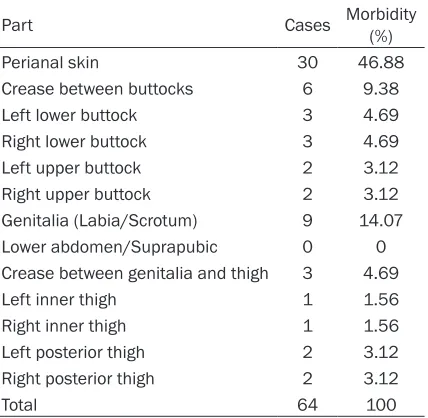
Table 1. Comparison of IAD morbidity in all parts Part Cases Morbidity (%) Perianal skin 30 46.88 Crease between buttocks 6 9.38 Left lower buttock 3 4.69 Right lower buttock 3 4.69 Left upper buttock 2 3.12 Right upper buttock 2 3.12 Genitalia (Labia/Scrotum) 9 14.07 Lower abdomen/Suprapubic 0 0 Crease between genitalia and thigh 3 4.69 Left inner thigh 1 1.56 Right inner thigh 1 1.56 Left posterior thigh 2 3.12 Right posterior thigh 2 3.12
Results
IAD occurrence conditions for the ICU patient with fecal incontinence
There were 104 patients with fecal inconti-nence in this study, including 28 patients in comprehensive ICU, 55 patients in neurosur-gery ICU, and 21 patients in neurology ICU. There were totally 30 patients suffering from
IAD with a morbidity of 28.85%, including 19 patients with light IAD, 2 patients with medium
IAD, and 9 patients with serious IAD. 5 patients
suffer from rash and 9 patients suffer from skin injury. All of these patients had the perianal
region involved, and the specific involved parts
and cases are shown in Table 1. The formative
period of IAD is 1~13 days, with an average time of 3 days. On the 3rd day, IAD score is the
[image:3.612.92.521.84.573.2]highest. The average time from light to serious is 2 days, and the average time for healing is 8 days. 7 patients were not healed when they left ICU (7/30, 23.33%) (see Table 1).
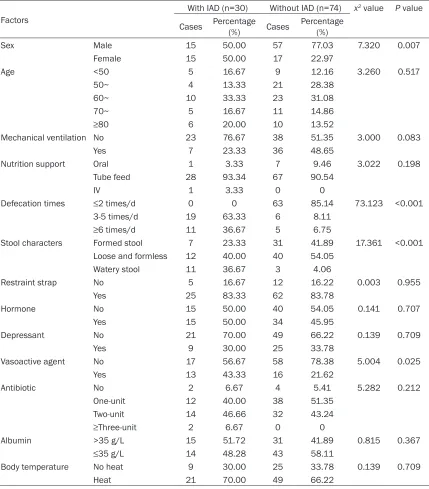
Table 2. Data comparison between 30 patients with IAD and without IAD
Factors
With IAD (n=30) Without IAD (n=74) x2 value P value
Cases Percentage(%) Cases Percentage(%)
Sex Male 15 50.00 57 77.03 7.320 0.007 Female 15 50.00 17 22.97
Age <50 5 16.67 9 12.16 3.260 0.517
50~ 4 13.33 21 28.38
60~ 10 33.33 23 31.08
70~ 5 16.67 11 14.86
≥80 6 20.00 10 13.52
Mechanical ventilation No 23 76.67 38 51.35 3.000 0.083
Yes 7 23.33 36 48.65
Nutrition support Oral 1 3.33 7 9.46 3.022 0.198 Tube feed 28 93.34 67 90.54
IV 1 3.33 0 0
Defecation times ≤2 times/d 0 0 63 85.14 73.123 <0.001
3-5 times/d 19 63.33 6 8.11
≥6 times/d 11 36.67 5 6.75
Stool characters Formed stool 7 23.33 31 41.89 17.361 <0.001 Loose and formless 12 40.00 40 54.05
Watery stool 11 36.67 3 4.06
Restraint strap No 5 16.67 12 16.22 0.003 0.955 Yes 25 83.33 62 83.78
Hormone No 15 50.00 40 54.05 0.141 0.707 Yes 15 50.00 34 45.95
Depressant No 21 70.00 49 66.22 0.139 0.709
Yes 9 30.00 25 33.78
Vasoactive agent No 17 56.67 58 78.38 5.004 0.025 Yes 13 43.33 16 21.62
Antibiotic No 2 6.67 4 5.41 5.282 0.212 One-unit 12 40.00 38 51.35
Two-unit 14 46.66 32 43.24
≥Three-unit 2 6.67 0 0
Albumin >35 g/L 15 51.72 31 41.89 0.815 0.367
≤35 g/L 14 48.28 43 58.11
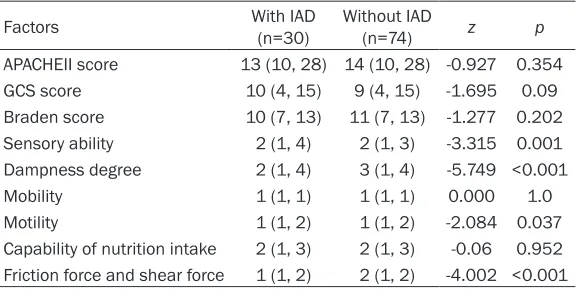
Data comparison between 30 patients with IAD and without IAD (see Tables 2 and 3).
Influential factors of IAD occurrence for the ICU
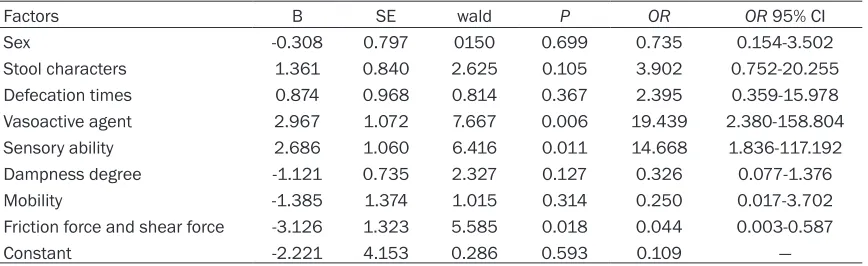
patients with fecal incontinence. A logistic regression analysis was conducted by taking
IAD occurrence condition as the dependent variable (with IAD=1, without IAD=0), and
parameter items with P<0.05 in Table 2 as the self-variable, with the aim of screening out the
influential factors of IAD occurrence for the ICU
patients with fecal incontinence (see Table 4). Discussions
Analysis on IAD occurrence conditions
This study used 104 ICU patients with fecal incontinence as the study objects, in which 30
patients suffered from IAD, with a morbidity of 28.85%. The median formative time of IAD is 3
days, which is close to the research results as reported in foreign literatures [4]. In addition,
one can conclude that the IAD score on the 3rd
day is the highest, and the average time from
light to severe IAD is 2 days. Therefore, IAD for -mation of ICU patients is characterized by short time and rapid development. Such characteris-tics require that ICU nurses should rapidly iden-tify the risk factors and clinical performance of
IAD occurrence and take prevention and treat -ment measures as early as possible. However,
there is no unified care standard in three kinds
of ICU, so the nurses may take different care methods and products. A cross-section investi-gation on pressure sores [13] found that some practical measures for prevention taken by nurses are harmful and negative, and different preventive measures are also an indirect factor
ries occurred in perianal region and buttocks. The responsible nurse paid great attention to it, and contacted with the doctor immediately to take appropriate intestinal tract management and asked the hospital’s wound care team to do a consultation. This patient was healed on the 6th day, which is lower than the average
healing time. Therefore, IAD management
should be enhanced, relevant knowledge and attention level of nurses should be enhanced,
and moreover, a unified care plan should be
taken.
This study applied incontinence-associated
dermatitis and its severity instrument (IADS)
proposed by Borchert and Bliss [9] to judge
whether the patient had IAD and to determine
its severity. This instrument makes careful divi-sion of the skin in the perianal region and perineum to avoid the measurement of erythe-ma, rash, and skin defect area of patients with dermatitis. It is convenient and suitable for the nurses in clinic applications. The result showed that all the patients had perianal region fol-lowed by the region of genitals (labium/scro-tum) involved, while little inner thigh and rear parts, found relatively far away from perianal region, were involved. The patients with these parts involved always had watery stool with def-ecation more than 6 times per day. Some research results [14] proved that frequent
watery excretion is the main risk factor of IAD
[image:4.612.91.382.96.241.2]occurrence. Watery stool had much cholate and pancrepipase, and various enzymes in it have high activity; moreover, it had large con-tact area with skin, resulting great harms to the skin. Therefore, the patients with frequent wa- tery excretion should have their skin cleaned in Table 3. Data comparison between patients with IAD and without
IAD
Factors With IAD (n=30) Without IAD (n=74) z p
APACHEII score 13 (10, 28) 14 (10, 28) -0.927 0.354 GCS score 10 (4, 15) 9 (4, 15) -1.695 0.09 Braden score 10 (7, 13) 11 (7, 13) -1.277 0.202 Sensory ability 2 (1, 4) 2 (1, 3) -3.315 0.001
Dampness degree 2 (1, 4) 3 (1, 4) -5.749 <0.001 Mobility 1 (1, 1) 1 (1, 1) 0.000 1.0 Motility 1 (1, 2) 1 (1, 2) -2.084 0.037 Capability of nutrition intake 2 (1, 3) 2 (1, 3) -0.06 0.952 Friction force and shear force 1 (1, 2) 2 (1, 2) -4.002 <0.001
for the occurrence of pres-sure sores. There is no rele-vant cross-section
investiga-tion on IAD, and similar condi
-tions also exist in IAD care
during the case tracking. The average healing time for ICU patients is 8 days, and the intervention measures and attitude taken by nurses are
crucial to the healing of IAD.
In one case, a patient with
inju-time to be vigilant to damaged skin in far regions.
Analysis on risk factors of IAD occurrence
This study taken the frame model proposed by Brown et al. [15] as its reference and reviewed
the previous literatures to confirm IAD risk fac -tors of ICU patients, including tissue tolerance, perineum environment, and defecation ability.
Specifically, tissue tolerance includes age, sex,
APACHEII score, the application of hormone, depressant, antibiotic, and vasoactive agent, mechanical ventilation, nutrition support meth-od, albumin level, and body temperature; perineum environment includes fecal inconti-nence times, stool characters, friction force and shear force, and dampness degree; defe-cation ability includes mobility, activity, sensory ability, application of restraint strip, and GCS score; logistic regression analysis concluded that vasoactive agent, sensory ability, and fric-tion force and shear force are the risk factors of
IAD occurrence.
Relationship between Braden score and IAD occurrence: This study shows that the influence of Braden score on IAD occurrence is not great.
This does not conform to previous research results. The previous research [16] shows that the lower the Braden score, the higher the risk
of IAD occurrence. The reason may be that the
patients involved in this study were all bedrid-den patients, in which 67.31% (70/104) had cerebral disease and consciousness distur-bance with low GCS scores. Therefore, the scores of sensory ability, mobility, and activity are quite low. Under this condition, among 104 patients, there were 102 patients in extreme and high danger, while only 2 patients were in
medium danger. Braden score fluctuates in
7-13 scores with small scope, so it cannot
reflect the influence of Braden score on IAD
occurrence at all. This study does not conclude the relationship between Braden score and
IAD, but logistic regression analysis shows that
sensory ability, friction force, and shear force
are all the risk factors of IAD occurrence. The
study by Arnold et al. [17] shows that patients with 1 score or 2 scores in sensory ability are
more likely to form IAD than those with 4 scores;
when the score of friction force and shear force
reduces 1, the risk of IAD occurrence will
increase by 1.87 times. Therefore, Braden
score still has good warning effect on IAD occur -rence. Nurses should carefully evaluate six aspects in Braden scale, maintain the bed unit
dry and flat, and reduce the friction between
disposable absorbable urinal pad and patient skin as much as possible.
Relationship between medicine and IAD occur-rence: ICU patients with critical condition always require anesthesia and sedation medi-cine which may reduce their sensory ability, so they cannot change their position, or the use of vasoactive agent may affect the perfusion of soft tissue. Shannon et al. [18] thought that some medical treatment used by ICU patients may threaten the completeness of their skin. This study discussed the relationships of antibi-otic, hormone, depressant, and vasoactive
agent with IAD occurrence, and concluded that
vasoactive agent has a close relationship with
IAD occurrence. Vasoactive agent may affect
the perfusion of soft tissue, and make skin hypoxia more severe. Therefore, nurses should pay close attention and vigilance to patients’ skin when applying vasoactive agent.
[image:5.612.91.525.84.217.2]Relationships of stool characters and times with IAD occurrence: ICU patients always have Table 4. Logistic regression analysis on IAD influential factors
Factors B SE wald P OR OR 95% CI
Sex -0.308 0.797 0150 0.699 0.735 0.154-3.502 Stool characters 1.361 0.840 2.625 0.105 3.902 0.752-20.255
Defecation times 0.874 0.968 0.814 0.367 2.395 0.359-15.978
Vasoactive agent 2.967 1.072 7.667 0.006 19.439 2.380-158.804 Sensory ability 2.686 1.060 6.416 0.011 14.668 1.836-117.192
Dampness degree -1.121 0.735 2.327 0.127 0.326 0.077-1.376
fecal incontinence for inappropriate enteral nutrition, mechanical ventilation treatment, fre-quent cough, machine suction, application of various broad-spectrum antibiotics, and intesti-nal bacterial translocation [19]. The study con-ducted by Thibault et al. [20] shows that when enteral nutrition reaches 60% more than target volume, the risk of diarrhea will increase great-ly, and the stool times and characters will change. In this study, the patients with loose and formless stool, watery stool, and more
stool times may be more likely to have IAD than
those with formed stool and less stool times. However, the result shows that stool characters
and times are not the risk factors of IAD occur -rence. This is may be related to the small sam-pling volume.
Conclusions
This study shows that IAD formation of ICU
patients is characterized by short time and rapid development by longitudinally studying and analyzing 104 ICU patients with fecal incontinence, so nurses should take effective intervention measures as soon as possible. According to logistic regression analysis, one can conclude that vasoactive agent, sensory ability, and friction force and shear force are
the risk factors of IAD occurrence. However, there are still many factors related to IAD occur -rence, including age, antibiotics, and albumin level according to literatures and reports [15, 18]. It is suggested that a larger sampling vol-ume in subsequent studies during the
investi-gations of the risk factors of IAD occurrence so as to provide more scientific evidence for reduc
-ing IAD occurrence.
Disclosure of conflicts of interest
None.
Address correspondence to: Min Wang,
Depart-ment of Intensive Care Unit, Zaozhuang Municipal
Hospital, No.41 of Longtou Street, Shizhong District,
Zaozhuang 277100, Shandong, China. Tel: +86 13606322986; Fax: +86 010 3288018; E-mail: [email protected]
References
[1] Gray M, Bliss DZ, Doughty DB, Ermer-Sulten J,
Kennedy-Evans KL, Palmer MH. Incontinence-Associated dermatitis: a consensus. J Wound Ostomy Continence Nurs 2007; 34: 45-54. [2] Junkin J, Selekof JL, Lerner J. Prevalence of
in-continence and associated skin injury in the
acute care patient. J Wound Ostomy Conti-nence Nurs 2007; 34: 260-269.
[3] Driver DS. Perineal dermatitis in criticl care pa -tients. J Crit Care Nurs 2007; 27: 42-46. [4] Bliss DZ, Savik K, Thorson MA, Ehman SJ, Leb
-ak K, Beilman G. Incontinence-Associated der-matitis in critically ill adults: time to develop-ment, severity, and risk factors. J Wound Ostomy Continence Nurs 2011; 38: 433-445. [5] Wang X, Ruan QH, Chen YJ. Analysis Status
quo of incontinence associated dermatitis in a three grade A hospital. Chinese Nursing Re-search 2014; 28: 4025-4027.
[6] Bliss DZ, Zehrer C, Savik K, Smith G, Hedblom
E. An economic evaluation of four skin damage prevention regimens in nursing home resi-dents with incontinence: Economics of skin damage prevention. J Wound Ostomy Conti-nence Nurs 2007; 34: 143-152.
[7] Wishin J, Gallagher TJ, McCann E. Emerging options for the management of fecal inconti-nence in hospitalized patients. J Wound Osto-my Continence Nurs 2008; 35: 104-110. [8] Campbell JL, Coyer FM, Osborne SR.
Inconti-nence-associated dermatitis: a cross-sectional prevalence study in the Australian acute care hospital setting. J Int Wound J 2014; [Epub ahead of print].
[9] Borchert K, Bliss DZ, Savik K, Radosevich DM.
The incontinence-associated dermatitis and its severity instrument: development and vali-dation. J Wound Ostomy Continence Nurs 2010; 37: 527-535.
[10] Zhang N. The construction and implementa-tion of the nursing process for the prevenimplementa-tion of the incontinence associated dermatitis in
patients with critical illness [D]. Nantong: Nan -tong University; 2013. Need too check. [11] Guan X, Wang L, Shao X. The incidence and
risk factors of pressure ulcer in the intersive care unit patients. China Journal of Nursing 2014; 7: 840-843.
[12] Lewis SJ, Heaton KW. Stool form scale as a useful guide to intestinal transit time. J Scand J Gastroenterol 1997; 32: 920-924.
[13] Moore Z, Price P. Nurses, attitudes, behaviors and perceived barriers towards pressure ulcer prevention. J Clin Nurs 2004; 13: 942-951. [14] Gray M, Beeckman D, Bliss DZ, Fader M, Logan
S, Junkin J, Selekof J, Doughty D, Kurz P. Incon -tinence-Associated dermatitis: a comprehen-sive Review and Update. J Wound Ostomy Con-tinence Nurs 2012; 39: 61-74.
[15] Brown DS, Sears M. Perineal dermatitis: a con -ceptual framework. Ostomy Wound Manage 1993; 39: 20-2, 24-5.
[17] Long MA, Reed LA. Incontinence-associated dermatitis in a long-term acute care facility. J Wound Ostomy Continence Nurs 2012; 39: 318-327.
[18] Shannon ML, Lehman CA. Protecting the skin of the elderly patient in the intensive care unit. J Crit Care Nurs Clin North Am 1996; 8: 17-28. [19] Vanessa C, Foxx-Orenstein AE, Mayer AP,
Crow-ell MD. Office-based management of fecal in -continence. Gastroenterol Hepatol (N Y) 2013; 9: 423-433.
[20] Thibault R, Graf S, Clerc A, Delieuvin N, Hei