68
Learning Multilingual Word Embeddings Using Image-Text Data
Karan Singhal
Stanford University
Karthik Raman
Google AI
Balder ten Cate
Google AI
Abstract
There has been significant interest recently in learning multilingual word embeddings – in which semantically similar words across lan-guages have similar embeddings. State-of-the-art approaches have relied on expensive labeled data, which is unavailable for low-resource languages, or have involved post-hoc unification of monolingual embeddings. In the present paper, we investigate the effi-cacy of multilingual embeddings learned from weakly-supervised image-text data. In particu-lar, we propose methods for learning multilin-gual embeddings using image-text data, by en-forcing similarity between the representations of the image and that of the text. Our ex-periments reveal that even without using any expensive labeled data, a bag-of-words-based embedding model trained on image-text data achieves performance comparable to the state-of-the-art on crosslingual semantic similarity tasks.
1 Introduction
Recent advances in learning distributed represen-tations for words (i.e., word embeddings) have resulted in improvements across numerous natu-ral language understanding tasks (Mikolov et al., 2013c;Pennington et al., 2014). These methods use unlabeled text corpora to model the seman-tic content of words using their co-occurring con-text words. Key to this is the observation that semantically similar words have similar contexts (Sahlgren, 2008), thus leading to similar word embeddings. A limitation of these word embed-ding approaches is that they only produce mono-lingual embeddings. This is because word co-occurrences are very likely to be limited to being within language rather than across language in text corpora. Hence semantically similar words across languages are unlikely to have similar word em-beddings.
To remedy this, there has been recent work on learningmultilingual word embeddings, in which semantically similar words withinandacross lan-guages have similar word embeddings (Ruder, 2017). Multilingual embeddings are not just in-teresting as an interlingua between multiple lan-guages; they are useful in many downstream ap-plications. For example, one application of mul-tilingual embeddings is to find semantically simi-lar words and phrases across languages (Ammar et al., 2016). Another use of multilingual em-beddings is in enabling zero-shot learning on un-seen languages, just as monolingual word embed-dings enable predictions on unseen words (Artetxe and Schwenk,2018). In other words, a classifier using pretrained multilingual word embeddings can generalize to other languages even if train-ing data is only in English. Interesttrain-ingly, multilin-gual embeddings have also been shown to improve monolingual task performance (Faruqui and Dyer, 2014b;Kiela et al.,2014).
Consequently, multilingual embeddings can be very useful for low-resource languages – they al-low us to overcome the scarcity of data in these languages. However, as detailed in Section2, most work on learning multilingual word embeddings so far has heavily relied on the availability of ex-pensive resources such as word-aligned / sentence-aligned parallel corpora or bilingual lexicons. Un-fortunately, this data can be prohibitively expen-sive to collect for many languages. Furthermore even for languages with such data available, the coverage of the data is a limiting factor that re-stricts how much of the semantic space can be aligned across languages. Overcoming this data bottleneck is a key contribution of our work.
bridge across languages. For example, the En-glish word “cat” might be found on webpages con-taining images of cats. Similarly, the German word “katze” (meaning cat) is likely to be found on other webpages containing similar (or perhaps identical) images of cats. Thus, images can be used to learn that these words have similar seman-tic content. Importantly, image-text data is gener-ally available on the internet even for low-resource languages.
As image data has proliferated on the inter-net, tools for understanding images have ad-vanced considerably. Convolutional neural net-works (CNNs) have achieved roughly human-level or better performance on vision tasks, particularly classification (Russakovsky et al., 2014;Szegedy et al., 2015;He et al., 2016). During classifica-tion of an image, CNNs compute intermediate out-puts that have been used as generic image features that perform well across a variety of vision tasks (Sharif Razavian et al.,2014). We use these image features to enforce that words associated with sim-ilar images have simsim-ilar embeddings. Since words associated with similar images are likely to have similar semantic content, even across languages, our learned embeddings capture crosslingual sim-ilarity.
There has been other recent work on reducing the amount of supervision required to learn multi-lingual embeddings (cf. Section 2). These meth-ods take monolingual embeddings learned using existing methods and align them post-hoc in a shared embedding space. A limitation with post-hoc alignment of monolingual embeddings, first noticed byDuong et al.(2017), is that doing train-ing of monoltrain-ingual embeddtrain-ings and alignment separately may lead to worse results than joint training of embeddings in one step. Since the monolingual embedding objective is distinct from the multilingual embedding objective, monolgual embeddings are not required to capture all in-formation helpful for post-hoc multilingual align-ment. Post-hoc alignment loses out on some in-formation, whereas joint training does not.Duong et al.(2017) observe improved results using a joint training method compared to a similar post-hoc method. Thus, a joint training approach is de-sirable. To our knowledge, no previous method jointly learns multilingual word embeddings using weakly-supervised data available for low-resource languages.
To summarize: In this paper we propose an ap-proach for learning multilingual word embeddings using image-text data jointly across all languages. We demonstrate that even a bag-of-words based embedding approach achieves performance com-petitive with the state-of-the-art on crosslingual semantic similarity tasks. We present experiments for understanding the effect of using pixel data as compared to co-occurrences alone. We also pro-vide a method for training and making predictions on multilingual word embeddings even when the language of the text is unknown.
2 Related Work
Most work on producing multilingual embeddings has relied on crosslingual human-labeled data, such as bilingual lexicons (Mikolov et al.,2013b; Ammar et al., 2016; Faruqui and Dyer, 2014b; Xing et al.,2015) or parallel/aligned corpora (Kle-mentiev et al., 2012;Ammar et al., 2016;Luong et al.,2015;Vuli´c and Moens,2015). These works are also largely bilingual due to either limitations of methods or the requirement for data that exists only for a few language pairs. Bilingual embed-dings are less desirable because they do not lever-age the relevant resources of other langulever-ages. For example, in learning bilingual embeddings for En-glish and French, it may be useful to leverage re-sources in Spanish, since French and Spanish are closely related. Bilingual embeddings are also limited in their applications to just one language pair.
For instance, Luong et al. (2015) propose BiSkip, a model that extends the skip-gram ap-proach ofMikolov et al.(2013a) to a bilingual par-allel corpus. The embedding for a word is trained to predict not only its own context, but also the contexts for corresponding words in a second cor-pus in a different language. Ammar et al.(2016) extend this approach further to multiple languages. This method, called MultiSkip, is compared to our methods in Section5.
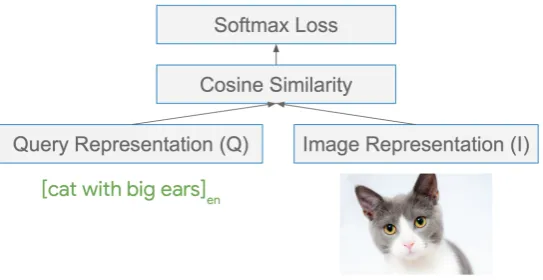
Figure 1: Our high-level approach for constraining query and image representations to be similar. The English query “cat with big ears” is mapped toQ, while the corresponding image example is mapped toI. We use the cosine similarity of these representations as input to a softmax loss function. The model task can be understood as predicting if an image is relevant to a given query.
spaces first noticed by Mikolov et al. (2013b). As discussed in Section 1, post-hoc alignment of monolingual embeddings is inherently subopti-mal. For example,Smith et al.(2017) andArtetxe et al. (2017) use human-labeled data, along with shared surface forms across languages, to learn an alignment in the bilingual setting. Conneau et al. (2017) build on this for the multilingual setting, using no human-labeled data and instead using an adversarial approach to maximize alignment between monolingual embedding spaces given their structural similarities. This method (MUSE) outperforms previous approaches and represents the state-of-the-art. We compare it to our methods in Section5.
There has been other work using image-text data to improve image and caption representa-tions for image tasks and to learn word transla-tions (Karpathy and Fei-Fei, 2015; Frome et al., 2013;Gella et al.,2017;Calixto et al.,2017; He-witt et al., 2018), but no work using images to learn competitive multilingual word-level embed-dings.
3 Data
We experiment using a dataset derived from Google Images search results1. The dataset con-sists of queries and the corresponding image search results. For example, one (query, image) pair might be “cat with big ears” and an image of a cat. Each (query, image) pair also has a weight corresponding to a relevance score of the image for the query. The dataset includes 3 billion (query, image, weight) triples, with 900 million
1https://images.google.com
unique images and 220 million unique queries. The data was prepared by first taking the query-image set, filtering to remove any personally iden-tifiable information and adult content, and tok-enizing the remaining queries by replacing special characters with spaces and trimming extraneous whitespace. Rare tokens (those that do not appear in queries at least six times) are filtered out. Each token in each query is given a language tag based on the user-set home language of the user making the search on Google Images. For example, if the query “back pain” is made by a user with English as her home language, then the query is stored as “en:back en:pain”. The dataset includes queries in about 130 languages.
Though the specific dataset we use is propri-etary,Hewitt et al.(2018) have obtained a similar dataset, using the Google Images search interface, that comprises queries in 100 languages.
4 Methods
We present a series of experiments to investigate the usefulness of multimodal image-text data in learning multilingual embeddings. The crux of our method involves enforcing that for each query-image pair, the query representation (Q) is similar to the image representation (I). The query rep-resentation is a function of the word embeddings for each word in a (language-tagged) query, so en-forcing this constraint on the query representation also has the effect of constraining the correspond-ing multilcorrespond-ingual word embeddcorrespond-ings.
co-sine similarity and softmax objective to produce our loss. This high-level approach is illustrated in Figure1. In particular, we calculate unweighted loss as follows for a queryq and a corresponding imagei:
loss(Queryq,Imagei) =−log e
QTq Ii |Qq||Ii|
P
je
QTq Ij |Qq||Ij|
whereQqis the query representation for queryq;
Iiis the image representation corresponding to im-agei;jranges over all images in the corpus; and
QTqIi is the dot product of the vectors QqandIi. Note that this requires thatQq andIj have identi-cal dimensionality. If a weight wis provided for the (query, image) pair, the loss is multiplied by the weight. Observe thatQandI remain unspec-ified for now: we detail different experiments in-volving different representations below.
In practice, given the size of our dataset, calcu-lating the full denominator of the loss for a query, image pair would involve iterating through each image for each query, which isO(n2)in the
num-ber of training examples. To remedy this, we cal-culated the loss within each batch separately. That is, the denominator of the loss only involved sum-ming over images in the same batch as the query. We used a batch size of 1000 for all experiments. In principle, the negative sampling approach used byMikolov et al.(2013c) could be used instead to prevent quadratic time complexity.
We can interpret this loss function as producing a softmax classification task for queries and im-ages: given a query, the model needs to predict the image relevant to that query. The cosine simi-larity between the image representationIi and the query representationQqis normalized under soft-max to produce a “belief” that the imageiis the image relevant to the queryq. This is analogous to the skip-gram model proposed byMikolov et al. (2013a), although we use cosine similarity instead of dot product. Just as the skip-gram model en-sures the embeddings of words are predictive of their contexts, our model ensures the embeddings of queries (and their constituent words) are predic-tive of images relevant to them.
4.1 Leveraging Image Understanding
Given the natural co-occurrence of images and text on the internet and the availability of powerful generic features, a first approach is to use generic
image features as the foundation for the image rep-resentationI. We apply two fully-connected lay-ers to learn a transformation from image features to the final representation. We can compute the image representationIifor imageias:
Ii =ReLU(U∗ReLU(V fi+b1) +b2)
wherefi is ad-dimensional column vector repre-senting generic image features for imagei,V is a
m×dmatrix,b1is anm-dimensional column
vec-tor,Uis an×mmatrix, andb2is ann-dimensional
column vector. We use a rectified linear unit acti-vation function after each fully-connected layer.
We use 64-dimensional image features derived from image-text data using an approach similar to that used byJuan et al. (2019), who train image features to discriminate between fine-grained se-mantic image labels. We run two experiments with
mandn: in the first,m= 200andn= 100 (pro-ducing 100-dimensional embeddings), and in the second,m = 300andn = 300(producing 300-dimensional embeddings).
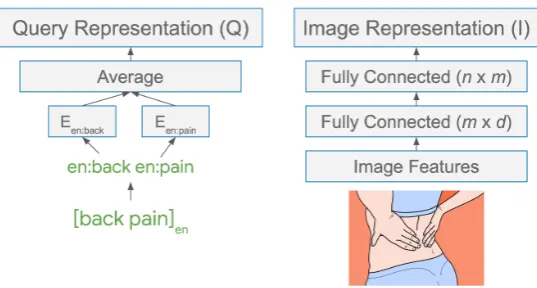
For the query representation, we use a simple approach. The query representation is just the av-erage of its constituent multilingual embeddings. Then, as the query representation is constrained to be similar to corresponding image representa-tions, the multilingual embeddings (randomly ini-tialized) are also constrained.
Note that each word in each query is prefixed with the language of the query. For example, the English query “back pain” is treated as “en:back en:pain”, and the multilingual embeddings that are averaged are those for “en:back” and “en:pain”. This means that words in different languages with shared surface forms are given separate embed-dings. We experiment with shared embeddings for words with shared surface forms in Section4.3.
In practice, we use a fixed multilingual vocab-ulary for the word embeddings, given the size of the dataset. Out-of-vocabulary words are handled by hashing them to a fixed number of embedding buckets (we use 1,000,000). That is, there are 1,000,000 embeddings for all out-of-vocabulary words, and the assignment of embedding for each word is determined by a hash function.
Our approach for leveraging image understand-ing is shown in Figure2.
4.2 Co-Occurrence Only
Figure 2: Our first method for calculating query and image representations, as presented in Section4.1. To calculate the query representation, the multilingual embeddings for each language-prefixed token are averaged. To calculate the image representation,d-dimensional generic image features are passed through two fully-connected layers with mandnneurons.
Without using pixel data, how well can we do? Given the statistics of our dataset (3B query, image pairs with 220M unique queries and 900M unique images), we know that different queries co-occur with the same images. Intuitively, if a queryq1
co-occurs with many of the same images as queryq2,
thenq1 andq2 are likely to be semantically
simi-lar, regardless of the visual content of the shared images. Thus, we can use a method that uses only co-occurrence statistics to better understand how well we can capture relationships between queries. This method serves as a baseline to our initial ap-proach leveraging image understanding.
In this setting, we keep query representations the same, and we modify image representations as follows: the image representation for an image is a randomly initialized, trainable vector (of the same dimensionality as the query representation, to en-sure the cosine similarity can be calculated). The intuition for this approach is that if two queries are both associated with an image, their query repre-sentations will both be constrained to be similar to the same vector, and so the query representations themselves are constrained to be similar. This ap-proach is a simple way to adapt our method to make use of only co-occurrence statistics.
One concern with this approach is that many queries may not have significant image co-occurrences with other queries. In particular, there are likely many images associated with only a sin-gle query. These isolated images pull query rep-resentations toward their respective random im-age representations (adding noise), but do not pro-vide any information about the relationships be-tween queries. Additionally, even for images
as-sociated with multiple queries, if these queries are all within language, then they may not be very helpful for learning multilingual embeddings. Consequently, we run two experiments: one with the original dataset and one with a subset of the dataset that contains only images associated with queries in at least two different languages. This subset of the dataset has 540 million query, image pairs (down from 3 billion). For both experiments, we usem = 200andn = 100and produce 100-dimensional embeddings.
4.3 Language Unaware Query Representation
In Section 4.1, our method for computing query representations involved prepending language pre-fixes to each token, ensuring that the multilingual embedding for the English word “pain” is distinct from that for the French word “pain” (meaning bread). These query representations arelanguage aware, meaning that a language tag is required for each query during both training and prediction. In the weakly-supervised setting, we may want to re-lax this requirement, as language-tagged data is not always readily available.
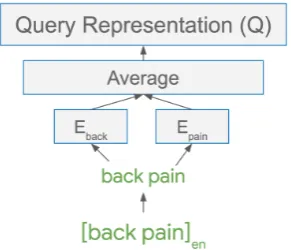
Figure 3: In our language unaware approach, language tags are not prepended to each token, so the word “pain” in English and French share an embedding.
image features, exactly as in Section4.1. In our language-unaware experiment, we use m = 200
andn = 100 and produce 100-dimensional em-beddings.
4.4 Evaluation
We evaluate our learned multilingual embeddings using six crosslingual semantic similarity tasks, two multilingual document classification tasks, and 13 monolingual semantic similarity tasks. We adapt code fromAmmar et al.(2016) andFaruqui and Dyer(2014a) for evaluation.
Crosslingual Semantic Similarity This task measures how well multilingual embeddings cap-ture semantic similarity of words, as judged by human raters. The task consists of a series of crosslingual word pairs. For each word pair in the task, human raters judge how semantically simi-lar the words are. The model also predicts how similar the words are, using the cosine similarity between the embeddings. The score on the task is the Spearman correlation between the human rat-ings and the model predictions.
The specific six subtasks we use are part of the Rubenstein-Goodenough dataset (Rubenstein and Goodenough,1965) and detailed byAmmar et al. (2016). We also include an additional task aggre-gating the six subtasks.
Multilingual Document Classification In this task, a classifier built on top of learned multilin-gual embeddings is trained on the RCV corpus of newswire text as in Klementiev et al.(2012) and Ammar et al.(2016). The corpus consists of doc-uments in seven languages on four topics, and the classifier predicts the topic. The score on the task is test accuracy. Note that each document is mono-lingual, so this task measures performance within
languages for multiple languages (as opposed to crosslingual performance).
Monolingual Semantic Similarity This task is the same as the crosslingual semantic similarity task described above, but all word pairs are in En-glish. We use this to understand how monolingual performance differs across methods. We present an average score across the 13 subtasks provided byFaruqui and Dyer(2014a).
Coverage Evaluation tasks also report a cover-age, which is the fraction of the test data that a set of multilingual embeddings is able to make predic-tions on. This is needed because not every word in the evaluation task has a corresponding learned multilingual embedding. Thus, if coverage is low, scores are less likely to be reliable.
5 Results and Conclusions
We first present results on the crosslingual se-mantic similarity and multilingual document clas-sification for our previously described experi-ments. We compare against the multiSkip ap-proach by Ammar et al. (2016) and the state-of-the-art MUSE approach byConneau et al.(2017). Results for crosslingual semantic similarity are presented in Table 1, and results for multilingual document classification are presented in Table2.
en+es en+de en+fr de+es de+fr fr+es all
ImageVec 100-Dim .75[.87] .77[.87] .84[.74] .80[.83] .76[.77] .77[.73] .79[.81]
ImageVec 300-Dim .79[.87] .81[.87] .86[.74] .81[.83] .77[.77] .80[.73] .82[.81]
ImageVec Baseline .10[.87] .03[.87] .14[.74] -.25[.83] .07[.77] .15[.73] .08[.81]
ImageVec Baseline 2 Lang. .27[.87] .38[.79] .23[.74] .26[.75] .16[.75] .27[.73] .28[.78]
ImageVec Lang. Unaware .59[.87] .62[.87] .79[.74] .63[.83] .73[.77] .73[.73] .67[.81]
multiSkip 40-Dim .51[.83] .67[.75] .44[.70] .39[.63] .29[.56] .43[.60] .49[.68]
multiSkip 512-Dim .43[.83] .73[.76] .62[.70] .43[.63] .24[.56] .48[.60] .50[.69]
MUSE 300-Dim .76[.87] .85[.86] .79[.74] .83[.81] .73[.77] .74[.73] .79[.80]
Table 1: Crosslingual semantic similarity scores (Spearman’sρ) across six subtasks for ImageVec (our method) and previous work. Coverage is in brackets. The last column indicates the combined score across all subtasks. Best scores on each subtask are bolded.
en+da+it 7 Lang.
ImageVec 100-Dim .74[.60] .79[.52]
ImageVec 300-Dim .80[.60] .84[.52]
ImageVec Baseline .60[.60] .59[.52]
ImageVec Baseline 2 Lang. .65[.45] .65[.36]
ImageVec Lang. Unaware .73[.60] .78[.52]
multiSkip 40-Dim .77[.45] .82[.44]
multiSkip 512-Dim .87[.48] .91[.46]
MUSE 300-Dim .87[.54] .91[.51]
Table 2: Multilingual document classification accuracy scores across two subtasks for ImageVec (our method) and previous work. Coverage is in brackets. Best scores are bolded (ties broken by coverage).
Is Image Understanding Necessary? Compar-ing the experiments leveragCompar-ing image understand-ing to our co-occurrence-only baseline experi-ments ImageVec Baseline and ImageVec Base-line 2 Lang described in Section 4.2, we see that performance is significantly degraded without pixel data (note that both experiments use 100-dimensional embeddings). Still, the results for multilingual document classification, in particular, show that we are able to learn multilingual word embeddings using co-occurrence between queries and images alone.
Interestingly, we can see that performance in the experiment in which images are filtered to be as-sociated with at least two languages appears better than the baseline experiment on the full dataset (al-though coverage is low for multilingual document classification). As mentioned in Section 4.2, this may be because images without multiple queries degrade performance by introducing noise to the
optimization problem. We also experimented with the same filtering on the experiments using im-age understanding to see if this could further boost performance (results not shown), but this reduced performance to a similar extent as random data fil-tering. This is likely because even isolated images (with just one query associated with an image) are still helpful for the task in this case, since the use of generic image features still constrains queries associated with similar images to have similar rep-resentations.
Even in the filtered baseline, results for both tasks are significantly lower than the methods leveraging image understanding, indicating that while co-occurrence data alone is useful, pixel data may be needed to learn competitive multilin-gual embeddings using our method.
Language Unaware Learning The language unaware setting only differs from the language aware one when words share a common surface form. In some cases, words sharing a common sur-face form have the same meaning across languages (i.e.,cognates). An example is “actor” in English and Spanish. In these cases, the language unaware setting may boost performance, as the embedding for “actor” effectively has more training data be-hind it. In other cases, words sharing a common surface form have different meanings across lan-guages (i.e.,false cognates). An example is “pain” in English and French. In these cases, we expect language unawareness to reduce performance, es-pecially if the meanings of false cognates are very different.
avg. score
ImageVec 100-Dim .48[.98]
ImageVec 300-Dim .48[.98]
ImageVec Baseline .24[.98]
ImageVec Baseline 2 Lang. .33[.95]
ImageVec Lang. Unaware .42[.98]
multiSkip 40-Dim .44[.94]
multiSkip 512-Dim .44[.96]
[image:8.595.91.274.65.201.2]MUSE 300-Dim .62[.97]
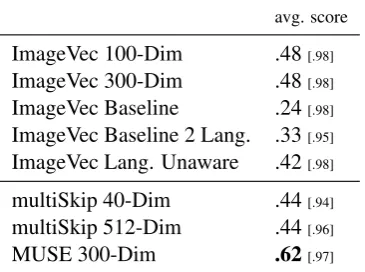
Table 3: Average monolingual semantic similarity score (Spearman’sρ) across 13 subtasks for ImageVec (our method) and previous work. Average coverage is in brackets. Best score is bolded.
that this experiment performs worse on crosslin-gual semantic similarity but about the same on multilingual document classification as the 100-dimensional language aware experiment ( Im-ageVec 100-Dim). Still, on crosslingual semantic similarity, it significantly outperforms both mul-tiSkip experiments. Thus, in applications where language unaware training or prediction is impor-tant, our method produces multilingual embed-dings competitive with other language aware ap-proaches.
Effect of Embedding Size In these experi-ments, embeddings with higher dimensionalities generally perform better in both evaluation tasks. 300-dimensional embeddings produced using our method slightly outperform 100-dimensional ones in every subtask for both tasks.
Monolingual Embedding Quality As men-tioned earlier in Section5, we suspect that the dif-ference in performance (as compared to MUSE) on crosslingual semantic similarity and multilin-gual document classification for our experiments might be due to reduced monolingual perfor-mance. After all, other methods train by leverag-ing word contexts (and subword information, in the case of MUSE) in a large monolingual cor-pus, whereas we use only images as a bridge be-tween words within and across languages. Es-pecially for words representing abstract concepts without obvious image associations (consider the word “democracy”), it is likely that our method would produce lower quality within-language em-beddings than text-only methods. This is not un-expected: Hewitt et al. (2018) found that word
translations learned via images are worse for more abstract words and Kiela et al.(2014) found that using image data is unhelpful for improving the quality of representations for some concepts.
It stands to reason then that our method would produce weaker monolingual performance. To test this, we ran 13 English monolingual semantic similarity tasks on each experiment. We present average scores in Table 3. We can see that 300-dimensional embeddings produced using our method fare significantly worse than MUSE em-beddings, although they perform similarly to the multiSkip embeddings. For comparison, competi-tive English word embeddings achieve results sim-ilar to MUSE. This suggests that there is signif-icant room for improvement within language (at least for English) in the quality of our learned multilingual embeddings. Improving monolingual performance would also likely boost scores across other tasks, motivating future work in this direc-tion.
6 Discussion
We demonstrated how to learn competitive mul-tilingual word embeddings using image-text data – which is available for low-resource languages. We have presented experiments for understand-ing the effect of usunderstand-ing pixel data as compared to co-occurrences alone. We have also proposed a method for training and making predictions on multilingual word embeddings even when lan-guage tags for words are unavailable. Using a simple bag-of-words approach, we achieve per-formance competitive with the state-of-the-art on crosslingual semantic similarity tasks.
improve results. Multilingual embeddings learned in a multi-task setting would reap both the bene-fits of our methods and existing methods for pro-ducing word embeddings. For example, while our method is likely to perform worse for more ab-stract words, when combined with existing ap-proaches it is likely to achieve more consistent per-formance.
An interesting effect of our approach is that queries and images are embedded into a shared space through the query and image representa-tions. This setup enables a range of future re-search directions and applications, including bet-ter image features, betbet-ter monolingual text rep-resentations (especially for visual tasks), nearest-neighbor search for text or images given one modality (or both), and joint prediction using text and images.
Acknowledgments We thank Tom Duerig, Ev-geniy Gabrilovich, Dan Gillick, Raphael Hoff-mann, Zhen Li, Alessandro Presta, Aleksei Tim-ofeev, Radu Soricut, and our reviewers for their insightful feedback and comments.
References
Waleed Ammar, George Mulcaire, Yulia Tsvetkov, Guillaume Lample, Chris Dyer, and Noah A. Smith. 2016. Massively multilingual word embeddings.
CoRR, abs/1602.01925.
Mikel Artetxe, Gorka Labaka, and Eneko Agirre. 2017. Learning bilingual word embeddings with (almost) no bilingual data. InProceedings of the 55th Annual Meeting of the Association for Computational Lin-guistics (Volume 1: Long Papers), volume 1, pages 451–462.
Mikel Artetxe and Holger Schwenk. 2018. Mas-sively multilingual sentence embeddings for zero-shot cross-lingual transfer and beyond. CoRR, abs/1812.10464.
Iacer Calixto, Qun Liu, and Nick Campbell. 2017.
Multilingual multi-modal embeddings for natural language processing.CoRR, abs/1702.01101.
Alexis Conneau, Guillaume Lample, Marc’Aurelio Ranzato, Ludovic Denoyer, and Herv´e J´egou. 2017.
Word translation without parallel data. CoRR, abs/1710.04087.
Long Duong, Hiroshi Kanayama, Tengfei Ma, Steven Bird, and Trevor Cohn. 2017. Multilingual training of crosslingual word embeddings. InProceedings of the 15th Conference of the European Chapter of the Association for Computational Linguistics: Volume 1, Long Papers, volume 1, pages 894–904.
Manaal Faruqui and Chris Dyer. 2014a. Community evaluation and exchange of word vectors at word-vectors.org. InProceedings of ACL: System Demon-strations.
Manaal Faruqui and Chris Dyer. 2014b. Improving vector space word representations using multilingual correlation. InProceedings of the 14th Conference of the European Chapter of the Association for Com-putational Linguistics, pages 462–471.
Andrea Frome, Greg S Corrado, Jon Shlens, Samy Bengio, Jeff Dean, Tomas Mikolov, et al. 2013. De-vise: A deep visual-semantic embedding model. In
Advances in neural information processing systems, pages 2121–2129.
Spandana Gella, Rico Sennrich, Frank Keller, and Mirella Lapata. 2017. Image pivoting for learn-ing multillearn-ingual multimodal representations.CoRR, abs/1707.07601.
Kaiming He, Xiangyu Zhang, Shaoqing Ren, and Jian Sun. 2016. Deep residual learning for image recog-nition. In Proceedings of the IEEE conference on computer vision and pattern recognition, pages 770– 778.
John Hewitt, Daphne Ippolito, Brendan Callahan, Reno Kriz, Derry Tanti Wijaya, and Chris Callison-Burch. 2018. Learning translations via images with a mas-sively multilingual image dataset. InProceedings of the 56th Annual Meeting of the Association for Com-putational Linguistics (Volume 1: Long Papers), volume 1, pages 2566–2576.
Da-Cheng Juan, Chun-Ta Lu, Zhen Li, Futang Peng, Aleksei Timofeev, Yi-Ting Chen, Yaxi Gao, Tom Duerig, Andrew Tomkins, and Sujith Ravi. 2019. Graph-rise: Graph-regularized image semantic em-bedding. arXiv preprint arXiv:1902.10814.
Andrej Karpathy and Li Fei-Fei. 2015. Deep visual-semantic alignments for generating image descrip-tions. In Proceedings of the IEEE conference on computer vision and pattern recognition, pages 3128–3137.
Douwe Kiela, Felix Hill, Anna Korhonen, and Stephen Clark. 2014. Improving multi-modal representa-tions using image dispersion: Why less is sometimes more. InProceedings of the 52nd Annual Meeting of the Association for Computational Linguistics (Vol-ume 2: Short Papers), volume 2, pages 835–841.
Alexandre Klementiev, Ivan Titov, and Binod Bhat-tarai. 2012. Inducing crosslingual distributed repre-sentations of words. Proceedings of COLING 2012, pages 1459–1474.
Tomas Mikolov, Kai Chen, Greg Corrado, and Jef-frey Dean. 2013a. Efficient estimation of word representations in vector space. arXiv preprint arXiv:1301.3781.
Tomas Mikolov, Quoc V. Le, and Ilya Sutskever. 2013b. Exploiting similarities among languages for machine translation.CoRR, abs/1309.4168.
Tomas Mikolov, Ilya Sutskever, Kai Chen, Greg S Cor-rado, and Jeff Dean. 2013c. Distributed representa-tions of words and phrases and their compositional-ity. InAdvances in neural information processing systems, pages 3111–3119.
Jeffrey Pennington, Richard Socher, and Christopher Manning. 2014. Glove: Global vectors for word representation. InProceedings of the 2014 confer-ence on empirical methods in natural language pro-cessing (EMNLP), pages 1532–1543.
Herbert Rubenstein and John B Goodenough. 1965. Contextual correlates of synonymy. Communica-tions of the ACM, 8(10):627–633.
Sebastian Ruder. 2017. A survey of cross-lingual em-bedding models. CoRR, abs/1706.04902.
Olga Russakovsky, Jia Deng, Hao Su, Jonathan Krause, Sanjeev Satheesh, Sean Ma, Zhiheng Huang, An-drej Karpathy, Aditya Khosla, Michael S. Bernstein, Alexander C. Berg, and Fei-Fei Li. 2014. Imagenet large scale visual recognition challenge. CoRR, abs/1409.0575.
Magnus Sahlgren. 2008. The distributional hypothesis.
Italian Journal of Disability Studies, 20:33–53.
Ali Sharif Razavian, Hossein Azizpour, Josephine Sul-livan, and Stefan Carlsson. 2014. Cnn features off-the-shelf: an astounding baseline for recognition. In
Proceedings of the IEEE conference on computer vi-sion and pattern recognition workshops, pages 806– 813.
Samuel L Smith, David HP Turban, Steven Hamblin, and Nils Y Hammerla. 2017. Offline bilingual word vectors, orthogonal transformations and the inverted softmax. arXiv preprint arXiv:1702.03859.
Christian Szegedy, Wei Liu, Yangqing Jia, Pierre Sermanet, Scott Reed, Dragomir Anguelov, Du-mitru Erhan, Vincent Vanhoucke, and Andrew Ra-binovich. 2015. Going deeper with convolutions. In
Proceedings of the IEEE conference on computer vi-sion and pattern recognition, pages 1–9.
Ivan Vuli´c and Marie-Francine Moens. 2015. Bilin-gual word embeddings from non-parallel document-aligned data applied to bilingual lexicon induction. In Proceedings of the 53rd Annual Meeting of the Association for Computational Linguistics and the 7th International Joint Conference on Natural Lan-guage Processing (Volume 2: Short Papers), vol-ume 2, pages 719–725.