238
Representation Learning and Dynamic Programming for Arc-Hybrid
Parsing
Joseph Le Roux Antoine Rozenknop Mathieu Lacroix Laboratoire d’Informatique de Paris Nord,
Universit´e Paris 13 – SPC, CNRS UMR 7030, F-93430, Villetaneuse, France
{leroux,rozenknop,lacroix}@lipn.fr
Abstract
We present a new method for transition-based parsing where a solution is a pair made of a dependency tree and a derivation graph de-scribing the construction of the former. From this representation we are able to derive an ef-ficient parsing algorithm and design a neural network that learns vertex representations and arc scores. Experimentally, although we only train via local classifiers, our approach im-proves over previous arc-hybrid systems and reach state-of-the-art parsing accuracy.
1 Introduction
While transition-based dependency parsing is usu-ally implemented as a beam-search procedure, e.g. (Kiperwasser and Goldberg,2016), some re-cent work such as (Shi et al., 2017) showed that global inference can be performed efficiently with dynamic programming. To this end, the stack rep-resenting pending subparses and the buffer repre-senting the unconsumed input must both be ab-stracted into equivalence classes, while remaining rich enough to help with accurate predictions.
In this paper we first explicitly consider that a solution in transition-based parsing is represented as a pair made of a derivation graph and a derived dependency tree allowing the scoring function to be expressed naturally as a sum over these 2 struc-tures. While we restrict our presentation to arc-hybrid systems, our method can be applied quite directly to other transition rule systems.
Secondly we show that this representation leads to an exact O(n4) parsing algorithm using dy-namic programming. This algorithm can be seen as an extension of the minimal feature set arc-hybrid parsing algorithm presented in (Shi et al., 2017) where the contribution of the dependency arcs can be explicitly added to the scoring function as in the Eisner parsing algorithm (Eisner,1996).
We then propose an alternative approach to global inference where derivation steps are repre-sented as dense vectors based on the number and type of steps in a derivation. With this abstrac-tion we design a neural architecture based on non-local networks (Wang et al.,2017) related to self-attention mechanism (Vaswani et al., 2017; Gu et al., 2018) to learn these representations while maintaining the possibility for exact decoding.
Our contribution can be summarized as follows: (i)a representation of arc-hybrid parsing as max-imum subgraphs selection where a solution con-tains dependencies and derivation information;(ii) a polynomial dynamic programming algorithm to solve this problem exactly;(iii)a neural architec-ture able to learn representations for the subgraph vertices and compute arc scores without explicit stack and buffer representations.
These contributions are validated empirically by experimental results on the Penn Treebank where our system reaches state-of-the-art accu-racy (94.8%UAS) for arc-hybrid parsing with net-works of comparable size.
We first review arc-hybrid dependency parsing (§2) then present a deductive scheme to solve it (§3). The neural architecture is presented in §4 and experiments reported in§5. Finally we discuss some related work in§6.
2 Arc-Hybrid Dependency Parsing
2.1 Arc-Hybrid Derivations
initially contains a dummy root word. The words which have not been read yet are stored in order in the buffer. The first word in the buffer is called the frontier word.
The algorithm proceeds by reducing the most recent pending word (the top of the stack) which means assigning it a governor. This governor is either the current frontier word, creating a left arc, or the previously most recent pending word (be-low in the stack), creating a right arc. Once given a governor, the most recent pending word is popped out. When the frontier word has been given all his left dependents, it is shifted which means it is pushed in the stack, becomes the most recent pending word and the next word in the sentence becomes the frontier word.
More formally, the arc-hybrid parsing algorithm is defined using configurations. Following stan-dard definition, a configuration is a triplet[σ, β, A]
whereσis a stack of indexes of words which have not been given a governor yet,β a list (buffer) of indexes of words still to be read1, andAthe set of dependency arcs that have been constructed so far. Given sentencew=w1,..., wnand dummy root
tokenw0, there are one initial configurationc1 =
[0,1...,∅]and many goal configurations of the form
[0,∅, A]. There exist 3 transition rules to pass from one configuration to another2:
shift [σ, b|β, A]→S [σ|b, β, A]
left [σ|d, h|β, A]→L[σ, h|β, A∪ {(h, d)}]
right [σ|h|d, β, A]→R[σ|h, β, A∪ {(h, d)}]
A derivation for w is a sequence γ =
c1, t1, c2, t2, . . . , t2n, c2n+1of2ntransitions from c1leading to a goal configurationc2n+1.
The set of derivations for a sentencewis noted Dw. It can be shown that derivations all
gener-ate projective dependency trees and that, for a sen-tence withnwords, they each containnshift op-erations andnleft or right reductions3.
Shifts and reductions can be seen as forming a well-parenthesized expression. Each word is as-sociated with a kind of parenthesis and shifting and reducing this word correspond to opening and closing parentheses of this kind.
1
A buffer containing(i,..., n)will be denoted by “i...”.
2
Shift and left transitions require a non-empty buffer and the stack has to be of length at least 2 for left and right tran-sitions sincew0cannot be the governor of a left arc.
3Note that derivation is not unique for a dependency tree.
For instance, in She wants to eat an apple, the derivation (She)L(wants(to)L(eat(an)L(apple)R)R)R,
where shifting a word is represented by a sub-scripted opening parenthesis and reductions are closing parentheses typed eitherLorR, will gen-erate the following dependency tree:
w0 She wants to eat an apple
Arc-hybrid parsing amounts to finding the highest-scoring derivation for a sentence:
ˆ
γ = arg max γ∈Dw
s(γ)
If we assumesdecomposes over transition scores s`(c`, t`), we retrieve the well-studied cumulative
sum of its transition scores.
s(γ) = X
1≤`≤2n
s`(c`, t`) (1)
2.2 General Formulation for Dynamic Programming
We present a dynamic programming (DP) algo-rithm for arc-hybrid parsing with cumulative tran-sition scores as in Eq.1. This algorithm cannot be used as such since states references complete stack contents, of which there is an exponential number, leading to an intractable complexity. To use this algorithm in practice we would need to resort to beam search in order to approximate solutions, see for instance (Dyer et al.,2015).
However, this constitutes a general framework from which efficient algorithms can be derived by considering various equivalence classes over states and independence assumptions in the scor-ing function. For instance we can retrieve the Min-imal Feature Setalgorithm ofShi et al.(2017), or the new algorithm presented in Section3.
In our algorithm, an itemσ,Ahi, jiBrepresents
the following set of subsequences of a derivation:
σ,Ahi, jiB: [σ, i..., A]→−∗ [σ|i, j..., B]
i.e.subsequences which start withshiftingwi and
end withwion top of the stack andwjon top of the
buffer4. As a special case, we will note∅,∅h0, jiB
the set of subderivations starting from the initial configuration[0,1...,∅]and leading to[0, j..., B].
4such a subderivation is only possible ifi < j ≤ n+1
Goal: Goal items have the form: ∅,∅h0, n+1iA: [∅,0...,∅]−→∗ [0,∅, A].
Axioms: The algorithm starts with the set of items corresponding to possible shifts5:
σ,Ahi, i+1iA : [σ, i..., A] → [σ|i, i+1..., A]. The
first axiom6 ∅,∅h0,1i∅ pictures a dummy sub-derivation that would put w0 on top of the stack and lead to the initial configuration[0,1...,∅].
DP Steps: A DP step consists in building an item σ,Ahi, jiB by composing σ,Ahi, kiC, σ|i,Chk, jiD, and areduceoperation on wordw
k:
σ,Ahi, kiC : [σ, i..., A] −→∗ [σ|i, k..., C]
σ|i,Chk, jiD : [σ|i, k..., C] −→∗ [σ|i|k, j..., D]
reduce: [σ|i|k, j..., D] → [σ|i, j..., B]
We thus have aright reductionrule:
σ,Ahi, kiC σ|i,Chk, jiD
σ,Ahi, jiD∪{(i,k)} [(i→k)]
and aleft reductionrule:
σ,Ahi, kiC σ|i,Chk, jiD
σ,Ahi, jiD∪{(k,j)} [(k←j)]
Scoring Items: We trivially score an axiom
σ,Ahi, i+1iA with the score of a shift transition
occurring in configuration[σ, i..., A].
We compute the score of a DP step as the sum of the scores of the combined items and the score ofreducingwkfrom configuration[σ|i|k, j..., D].
When several DP steps produce the same item, it is assigned the highest score.
2.3 Minimal Feature Set Algorithm
For this algorithm (Shi et al., 2017), the score of a transitiont`does not depend on the whole
con-figuration but only on the index on top of the stack and the first index of the buffer. In other words, lo-cal scoress`only depend on word indexes (i,j,k).
This assumption is crude but it allows for quite large items equivalence classes. We can retrieve this algorithm from the one above by removing unnecessary information in the items. Items of the formσ,Ahi, jiBwill simply reduce tohi, ji, there
will beO(n2)such items, and the DP complexity will beO(n3). More concretely, we have the fol-lowing schemata:
5There is one axiom for each possible configuration
[σ, i..., A]with0 ≤ i < n, σa valid stack andAthe set of corresponding arcs.
6Other axioms can be generated lazily from stack and arcs
set pairs of items created by DP steps.
Goal: h0, n+1i.
Axioms: hi, i+1i.
DP Steps:
hi, ki hk, ji
hi, ji [(i→k)]
and
hi, ki hk, ji
hi, ji [(k←j)]
One of the issues with this parsing scheme is the difficulty to interpret item scores consistently. In the case of a left reduction (producing k ← j above) the score ofhk, jican be interpreted as the score of wordjbeing the governor of wordkand the score ofhi, kias the score of shifting wordk in the context ofibeing the most recent pending word.
On the contrary, in the case of a right reduction (producing i → k above) if the score of hi, ki
may well be interpreted analogously as the score of havingias a governor ofk, we cannot interpret
hk, ji as the score of shifting k, and it may be difficult to interpret this item score in terms of a transition operation.
3 Parsing with Derivations and Dependencies
3.1 A New Score for Derivations
We depart form previous work and make the de-pendency arc contribution explicit in the score function:
ˆ
γ,τˆ= arg max γ,τ∈Sw
s(γ) +s(τ) (2)
whereSw is the set of pairs(γ, τ)with γ ∈ Dw
andτ the dependency tree corresponding toγ. We use an arc-factored model forτ from now on and discuss scores forγ.
We define an equivalence class (i, q) contain-ing all configurationsc`such that the first indexi`
ofβ` equalsiand the size of stack|σ`|equalsq.
Thus, we rewrite cumulative transition scores as:
s(u)(γ) = X
1≤`≤2n
su(i`,|σ`|, t`). (3)
words, we exploit the perfect matching induced by a derivation between shift and reduce transi-tions: ift`is a shift transition andt`0 its matching
reduction, we consider a score depending on the equivalence classes ofc` andc`0+1. Note that the
nestedness property implies that the stacksσ`and
σ`0+1 are equal. Moreover, i`0+1 = i`0 as t`0 is
a reduction, an operation which does not modify the buffer. Denoting by M the set of matching shift/reduce pairs(t`, t`0)inγ, this gives:
s(m)(γ) = X
(t`,t`0)∈M
sm(i`,|σ`|, i`0). (4)
Note that sm(i`,|σ`|, i`0) can be seen as the
score of performing a reduction wheni` is on the
top of the stack of size|σ`|andi`0 is the first word
position of the buffer. Hence, this gives a score similar to the reduction score used in the minimal feature set algorithm. The difference is that the score takes into account the size of the stack but not the type (left or right) of reduction that is per-formed. The direction information will be given by the dependency arc score.
Finally, the derivation score is:
s(γ) =s(u)(γ) +s(m)(γ) (5)
3.2 Graph Representation of a Derivation
In this section we represent the derivation of the arc-hybrid parsing using graphs.
A derivation is a sequence ofnshifts andn re-ductions such that no more rere-ductions than shifts are performed at each step. Such a sequence is a Dyck word and can then be represented as a path in an(n+ 1)×(n+ 1)grid starting at the lower left corner, ending at the lower right corner, using only up-right diagonal arcs and downward arcs (Roman, 2015). Such representation is the starting point of our derivation graph.
Define thederivation graphG= (V, A)as fol-lows. V = {vqi|1 ≤ q ≤ i ≤ n+ 1}represents the set of equivalence classes. A vertexviq corre-sponds to the class(i, q)of configurations, where wi is the first word in the buffer7 and the stack is
of sizeq. The arc set Ais given by A = T ∪E whereT represents transitions between states and Ematches between shifts and reductions. We note T =TS∪TL∪TR:
• TS={(viq, viq+1+1)|1≤q ≤i≤n},
7The valuen+ 1foriindicates that the buffer is empty.
• TL={(viq, viq−1)L|2≤q≤i≤n},
• TR={(viq, viq−1)R|2≤q≤i≤n+ 1}.
TS,TLandTRrepresent shifts and tagged reduc-tions respectively. We setE ={(vqi, vjq)|1≤q ≤
i < j ≤n+ 1}because a shift can be matched to a reduction only if the size of the stack is the same before the shift and after the reduce. Note that for a sentence withnwords,Gwill haveO(n2) ver-tices andO(n3)arcs.
A derivationγ obtained by the arc-hybrid pars-ing will be represented by a pair (P, M) where P ⊆T is a path representing the derivationγ and M ⊆E is the set of arcs matching the shifts with their associated reductions in the derivation.
More formally,(P, M)is a solution if and only if we have the following. P is a path from v11 to v1n+1inGusing only arcs ofT. By construction, it containsnarcs ofTS andn arcs ofTL∪TR. It then corresponds to the sequence of transitions t1, . . . , t2n. Note that any arc(vqi, v
q+1
i+1)inP con-sists in pushing wordwion the top of the stack and
any arc(vqi, viq−1)inP consists in popping the top of the stack. One can retrieve the sequence of con-figurationsc1, . . . , c2n+1thanks to the transitions. Remark that each vertexviq covered byP cor-responds to configurationc2i−q sincei−1shifts
andi−q reduces have been performed. An arc
(viq, vqj)ofEbelongs toMif the transitiont2i−qis
a shift, transitiont2j−q−1 is a reduction and these shift and reduce operations are matched together. Hence,(viq, vjq) ∈ M implies that(vqi, vqi+1+1) and
(vjq+1, vjq)belong toP.
One can associate a scoresu from Eq. (3) with
each arc of T and a score sm from Eq. (4) with
each arc ofE. In this case,s(γ)corresponds to
s(γ) =X a∈P
su(a) +
X
a∈M
sm(a) (6)
As an illustration, the derivation presented in the introduction can be represented by the set of black arcsP and red arcsM in Figure1.
3.3 Dynamic Programming Algorithm
L
L
L R
R
R
[image:5.595.81.276.78.225.2]w0 She wants to eat an apple
Figure 1: A Derivation forShe wants to eat an apple. Shifts (resp. reductions) are represented in black diag-onal (resp. vertical) arcs. Red curved edges represent matchings. Vertices are configuration classesvqi.
Since score functionssuandsmtake the size of
the stack into account, items with different (initial) stack sizes cannot be equivalent. Hence, items of the form qhi, jiare needed, where q = |σ| rep-resents the size of the stack before shifting wi.
Leaving out the resulting dependency arcs, both reduction rules can be written with these equiva-lent items:
qhi, ki q+1hk, ji
qhi, ji
There areO(n3)equivalent items and the DP com-plexity will beO(n4). Such items will be scored in the following way :
• the score of an axiom qhi, i+1i is su(i, q,shift). Axioms appear as black
diagonal arcs(vqi, vqi+1+1)in Figure1.
• In a DP step, the score of thereducetransition issu(j, q+2,reduce). The transition is
repre-sented as a black vertical arc(vjq+2, vjq+1)in Figure1.
• Finally the matching score in a DP step is sm(k, q+1, j). This score corresponds to red
curved arcs(vqk+1, vqj+1)in Figure1.
Figure2depicts both reduction rules. An item is represented as an arrow for the initial shift, and a triangle for the well-nested part of the subderiva-tion. A reduction builds a new item by extend-ing the well-nested part of the left antecedent with a new matching arc obtained from the right an-tecedent and the new reduction arc.
A dependency arc is added to assign a head to k, the midpoint of the reduction rule, depending on the direction of the reduction.
viq vqi+1+1
qhi, ki vqk+1
vqk+1 vqk+2+1
q+1hk, ji
vqj+2
qhi, ji
vqi viq+1+1
vkq+1 vkq+2+1
vjq+2
vjq+1 L/R
[image:5.595.361.471.115.285.2]wi wk wj L R
Figure 2:Illustration of reduction rules.Items are rep-resented by a diagonal arc (first shift) and an horizontal edge (well-nested part). When combining two items in a reduction rule, a (curved) matching edge and a (verti-cal) reduction arc are added. The type of the reduction leads to a new dependency arc for the modifierwk.
4 Learning Derivation Scores
We first present our network architecture inspired by recent work on self attention (Vaswani et al., 2017;Wang et al.,2017) which is able to learn rep-resentations of arc-hybrid configuration classes, that we call step representations. These represen-tations are then used to compute derivation scores. Our network is an encoder/decoder. The en-coder computes word and step representations in the specific context of the sentence to be parsed, while the decoder computes arc scores.
We borrow from the transformer layer (Vaswani et al.,2017) the idea of global attention but extend it to the case where the size of the output is dif-ferent from the size of the input. This has already been explored in (Gu et al., 2018) in the context of Machine Translation. However our problem is simpler because the size of the output is always twice the size of the input, in other words we do not have to estimate the size of the output.
4.1 Notation
We call interpolation layers functions like I(x,y) =C(x)·x+(1−C(x))·ywhereCis a lin-ear transformation followed by a sigmoid squash-ing, and·denotes the component-wise product.
Combining the previous two, we define high-way layers (Greff et al., 2017) as functions H(x) = I(x, F F(x)), i.e. an interpolation of in-putxand a feed-forward transformation ofx.
We also make use of biaffine functions follow-ing (Dozat and Manning,2017) that we define as functions of the formB(e,f) =e>Mf+Ve, with matrixM and vectorV learnable parameters.
4.2 Layer Structure
Each layer Li is the composition of two
sublay-ersAi, computing a generalized attention, andBi,
performing a feed-forward transformation. As is the case in previous approaches, each sublayer is followed by a layer normalization (Ba et al.,2016) and a residual connection to prevent underflows.
In more details, each layer takes as input a se-quence of sizenof dense vectors of sizedpacked as a matrixXinRn×dand a query vector sequence
of sizeo, either equal tonor2ndepending on the layer (see infra) packed as a matrix Y in Ro×d.
WhenXandYare the same, we recover the self-attention mechanism of the transformer layer. The layer forward value is given by the following equa-tions, whereLN is a layer normalization:
ai(X,Y) = X+Ai(X,Y)
bi(X) = X+Bi(X)
Li(X,Y) = LN(bi(LN(ai(X,Y)))).
The first sublayerAi computes for each output
position inY a multi-head scaled dot-product at-tention over input queryY and key/valueX, with mattention heads.
Ai(X,Y) = m
X
h=1
(A(QhiY, KihX, VihX))
Each attention head A takes a query as input queries, keys and values, and computes for each query vector a convex combination of value vec-tors, the coefficients of which are given by an op-eration between the query and the key vectors:
A(Q,V,K) = softmax(µQK>)V
where softmax is applied row-wise and µ is a smoothing factor between 0 and 1, which is set to d−0.5, where dis the size of a query vector, fol-lowing previous implementations of dot-product attention (Luong et al.,2015).
The second sublayerBi applies the same
feed-forward transformation to each element of the se-quence of vectors returned byAi.
4.3 Word and Position Embeddings
Each word in the train set is associated with a real vector stored in a lookup tableE. In order to cope with unseen words, we follow (Kiperwasser and Goldberg, 2016) and at training time words are randomlyUNK-ed with a probability inversely pro-portional to their frequency in the train set.
Contrarily to recurrent networks such as LSTMs, attention networks do not have a built-in notion of position so it must be provided exter-nally. In our systems, we have two types of po-sitions, namely word positions and step positions. We use position embeddings stored in lookup ta-bles called respectivelyT andS.
4.4 Word Encoder and Dependency Scores
Our encoder is the composition ofeself-attention layers starting from word and position vectors.
X0 = [E(w1) +T(1);. . .;E(wn) +T(n)]
Xi = Li(Xi−1, Xi−1),1≤i≤e
After encoding, we getXethat we interpret as a
sequence of contextualized word vectors. We can use these vectors to predict arc scores. In the fol-lowing, we use a biaffine function Bdep to define
the raw score between head at positioniand mod-ifier at positionj:swi→wj =Bdep(Xe[i], Xe[j]).
These raw scores are used in two ways.First and most obviously they score dependency arcs of the derived tree in this model. Second, for each modi-fier we use incoming arc scores to weigh potential heads and compute an expected head vector. We use normalized scores via softmax to interpolate head vectors. As a result for each vector word Xe[i] we obtain an expected head vector Ye[i],
which will be used hereafter.
4.5 Step Encoder
For steps, we distinguish the first layer from the others. For the first layer, input is the sequence re-turned by the last word encoder notedXe and
the increasing sequence of valid step position em-beddings calledP = [S(1);. . .;S(2n)].
D0 =Xe+Ye, P1 =P, D1=Le+1(D0, P1)
Fork >1, we setDk=Le+k(Dk−1, Dk−1). Given sentence w, we noteh(w) the sequence of vectors returned by the last decoder layer.
4.6 Decoders as Local Classifiers
In this section we present how the score function can be decomposed as local probabilities. Given a sentencew, we assume the probability of a deriva-tion γ is conditioned upon its corresponding de-rived treeτ. This condition prevents inconsisten-cies betweenτandγbut plays no other role in the scoring function. The probability of a derived tree decomposes as independent head predictions com-puted by a logistic regression over head scores.
p(γ, τ|w) =p(γ|w, τ)×p(τ|w)
=p(γ|w, τ)× Y h→m∈τ
p(h|m, w)
The probability of a derivation in Dw is the
probability at each independent step`of 2 events: the transitiont`and the step positionr`of the
cor-responding reduction for a shift, or a dummy posi-tion for a reducposi-tion. We consider these two events to be independent but requiring the knowledge of the differenceq`between the number of shifts and
reductions already performed before the current step. This difference can also be interpreted in the context of the arc-hybrid algorithm as the depth of the stack. The difference is then used as a param-eter for the potentials. This gives:
p(γ|w) =
2|w|
Y
`=1
p(t`, r`, q`|w, `)
=
2|w|
Y
`=1
pd(q`|w, `)×p(t`, r`|w, `, q`)
=
2|w|
Y
`=1
pd(q`|w, `)
×pu(t`|w, `, q`)×pm(r`|w, `, q`)
The condition on sentence and step index w, ` is implemented via functions taking the `th step representation ofw computed as described in the
previous section, denoted h(w)` or simply h` if
the sentence is clear from the context.
In practice we restrict the set of values forq`as
the set of natural numbers between one and nine, and a special value for differences greater or equal to ten8. We use a lookup tableF to convert dis-crete difference values to dense representations.
Note that although the 3 distributions are con-ditioned on the same step representations intro-duced in the previous section, these represen-tations are first passed through highway layers,
{Hi}i=d,u,m, parameterized for each distribution.
This helps with the specialization of step repre-sentations while keeping the possibility to share information between tasks.
The first two distributions are categorical dis-tributions of the exponential family. They are computed as normalized potentials given by feed-forward transformations of steps and differences.
pd(q|h`) ∝expFFd(F(q) +Hd(h`)),
pu(t|q, h`) ∝expFFt(F(q) +Hu(h`)).
The third distribution is computed with a bi-affine function Bm followed by a softmax, as
in (Dozat and Manning,2017). We reserve an ex-tra value for the result random variable which en-codes the absence of corresponding reduction.This is used whensis not a shift step. Note the differ-ence embedding is only used on the left side ofM.
pm(r|h`, q)∝expBm(F(q) +Hm(h`), h`+r)
Learning is performed by simply maximizing the conditional log-likelihood of the 4 distribu-tions over the correct derivadistribu-tions given a set of sentences. Once parameterized, it is straightfor-ward to see how these distributions can fit the score model of Equation5.
Conditional log-likelihood minimization re-quires to compute values for each distribution along gold solutions, which means it is a O(n2)
procedure, because of distributions on dependency arcs and matching transitions, which both require 2 position parameters in order to be computed.
5 Experiments
Data We ran experiments on the Wall Street sections of the English Penn Treebank (Marcus
8We found almost all train sentences could be parsed with
POS embedding size 28 Other embedding size 100 Encoder input/output size 256 Decoder input/output size 256 Hidden layer size in B subnetworks 512 attention heads 8 Maximum step numbers 200 Maximum difference D (stack height) 10 Number of word encoder layers 4 Number of step encode layers 4
Table 1: Network hyperparameters
et al., 1994) converted to Stanford Dependencies (de Marneffe and Manning,2008). Transition se-quences were obtained from dependencies and in case of ambiguity right reductions were always performed before shift if possible. We followed the standard split (02-21 for training, 23 for test-ing and 22 for development purposes) and used POS tags predicted by the Stanford MaxEnt tagger trained using 10-way jackknifing (Toutanova et al., 2003). We evaluate on unlabeled attachment with-out punctuation, with CoNLL evaluation script.
Implementation Hyperparameters are given in Table1. In addition to word embeddings parame-terized on the PTB, we use pretrained Glove vec-tors (Pennington et al., 2014). Our prototype is written in c++ with DYNET9 for neural compu-tations (Adam optimizer and default values) and UDPIPE10for reading and writing data files. Mini-batches contain around 1,000 tokens. We train each model for 100 epochs and select our best model according to its development UAS. We fol-low previous works with transformers to set the learning rate (Vaswani et al., 2017). For the first
8,000updates the learning increases linearly with the number of steps, then it decreases proportion-ally to the squared root of the number of steps. We use the formula ofStrubell et al.(2018).
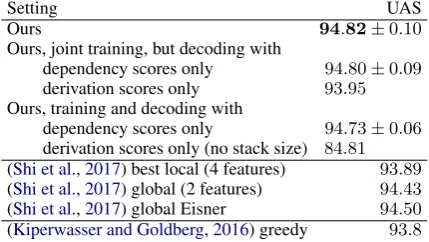
Results Results on the PTB test set are presented in Table 2 and comparisons with previous work on arc-hybrid parsing with comparable network sizes. Parsing results are obtained by averaging 5 models initialized with different random seeds and standard deviation is also provided. Our sys-tem reaches94.8%UAS and parses the whole sec-tion 23 in 1.13 seconds (DP only) on an Intel Xeon 2.10 GHz. Although our system is trained via local classifiers, we can see that it improves over global
9
https://github.com/clab/dynet
10http://ufal.mff.cuni.cz/udpipe
Setting UAS
Ours 94.82±0.10
Ours, joint training, but decoding with
dependency scores only 94.80±0.09
derivation scores only 93.95
Ours, training and decoding with
dependency scores only 94.73±0.06
derivation scores only (no stack size) 84.81
(Shi et al.,2017) best local (4 features) 93.89
(Shi et al.,2017) global (2 features) 94.43
(Shi et al.,2017) global Eisner 94.50
(Kiperwasser and Goldberg,2016) greedy 93.8
Table 2: Comparisons on PTB test set
systems trained without step encodings.
Ablations indicate that the major part of scoring comes from dependencies. We may also conclude that (i) derivation information is useful per se but most importantly as an auxiliary task to improve dependencies and (ii) the stack size is paramount in this model since otherwise the network has no indication of the stack content. If not considered, accuracy drop considerably: step indexes alone are too vague as they can correspond to many dif-ferent stack and buffer contents.
6 Discussion and Related Work
Derivation Parsing Maximum subgraph selec-tion has played a central role in dependency pars-ing since the MST reduction by McDonald et al. (2005) and can also be traced back to the parsing-as-intersection tradition in phrase-based parsing – see for instance (Billot and Lang,1989) – where the goal is to find, starting from a generic gram-mar, a graph-structure (a shared forest) that recog-nizes the input presented as a string or an automa-ton. In dependency parsing, this approach has since been extended to more complex dependen-cies such as non-crossing and 1-endpoint-crossing dependencies (Kuhlmann and Jonsson,2015;Cao et al.,2017).
There is a long line of research which solve the different variants of transition-based dependency parsing algorithms with dynamic programming. Recent work showed that this can be performed ef-ficiently, inO(n3), for arc-hybrid parsers ( G´omez-Rodr´ıguez et al., 2008) and have since been ex-tended with non-linear classifiers (Kiperwasser and Goldberg, 2016; Shi et al., 2017) to reach state-of-the-art parsing accuracy.
[image:8.595.309.524.63.184.2]properties on dependencies. Here we represent derivationsinstead of derived structures. In that respect, we are closer to approaches developed for mildly-context sensitive formalisms such as Tree Adjoining Grammars which work primarily on the derivation tree (Corro et al., 2017) and consider the derived tree, i.e. the parse structure, as a by-product. Compared to other dynamic program-ming approaches to arc-hybrid parsing, we there-fore work on a richer model, and have more ex-pressive power to take a representation of states into account in the scoring scheme. This comes at a cost since the time complexity of our pars-ing algorithm is O(n4), an order of magnitude higher. The stack information (size) is minimal and is used to parameterize access to information available from step embeddings.
Compared to joint parsing systems working on both constituents and dependencies, our approach doesn’t require external linguistic knowledge such as head percolation rules. On the other hand, since derivations don’t add new information, but merely offer a new vision of the problem, the potential accuracy gain is lower.
Machine Learning Aspects Self-attention net-works have been used in parsing, see for instance (Kitaev and Klein, 2018), whether based on de-pendencies or syntagms. Curiously we found few models of transition-based parsing based on these networks, and bidirectional recurrent network are still preferred in most architectures, where they are believed to capture some information about the sequential nature of transition-based algorithms. Instead we present a non-sequential model of transition-based parsing where representation vec-tors are obtained via unrolled iterative estimation (Greff et al.,2017).
Our encoder-decoder architecture together with independence assumptions made in the probabilis-tic model which decomposes a derivation score in several subtasks can be seen as auxiliary tasks as in (Coavoux et al.,2018).
The use of expected head vectors as input of the step encoder is related to the syntactic head at-tention of the SRL neural architecture in (Strubell et al.,2018).
7 Conclusion
We presented the arc-hybrid parsing transition rule system as a subgraph selection problem and showed how this can be solved exactly by a
dy-namic programming algorithm. This theoretical result is backed up by state-of-the-art results on the PTB.
This new representation of the problem is the basis of a novel neural architecture which learns vertex representations (for derivation steps) and edge scores (for derivation features).
From a parsing perspective, understanding why derivation prediction is a good auxiliary task to learn syntactic dependencies could prove insight-ful to explain how transitions and dependencies are related.
The derivation/derived pair is a very powerful concept that remains to be fully exploited. In par-ticular, there are two promising avenues for fu-ture improvements. First, the learning framework could be enriched in a setting where the derivation graph is modeled as a latent variable and marginal-ized over. It remains to be seen if this can be done exactly or if sampling is required for efficiency. Second, since the score of a solution is the sum of the scores of elements in a pair, it should be pos-sible to design an approximate solver based on la-grangian decomposition more efficient in practice.
Acknowledgments
This work is partially supported by a public grant overseen by the French National Research Agency (ANR) as part of the program Investissements d’Avenir (ANR-10-LABX-0083). It contributes to the IdEx Universit´e de Paris (ANR-18-IDEX-0001). This work is partially supported by a pub-lic grant overseen by the French ANR (ANR-16-CE33-0021).
References
Lei Jimmy Ba, Ryan Kiros, and Geoffrey E. Hinton. 2016.Layer normalization.CoRR, abs/1607.06450.
Sylvie Billot and Bernard Lang. 1989. The structure of shared forests in ambiguous parsing. InProceedings of the 27th annual meeting on Association for
Com-putational Linguistics, pages 143–151. Association
for Computational Linguistics.
Junjie Cao, Sheng Huang, Weiwei Sun, and Xiao-jun Wan. 2017. Quasi-second-order parsing for 1-endpoint-crossing, pagenumber-2 graphs. In Pro-ceedings of the 2017 Conference on Empirical
Meth-ods in Natural Language Processing, pages 24–34.
Association for Computational Linguistics.
representa-tions of text. In Proceedings of the 2018 Confer-ence on Empirical Methods in Natural Language
Processing, pages 1–10. Association for
Computa-tional Linguistics.
Caio Corro, Joseph Le Roux, and Mathieu Lacroix. 2017. Efficient discontinuous phrase-structure pars-ing via the generalized maximum spannpars-ing arbores-cence. In Proceedings of the 2017 Conference on Empirical Methods in Natural Language Process-ing, pages 1644–1654. Association for Computa-tional Linguistics.
Timothy Dozat and Christopher D. Manning. 2017. Deep biaffine attention for neural dependency
pars-ing. InInternational Conference on Learning
Rep-resentations.
Chris Dyer, Miguel Ballesteros, Wang Ling, Austin Matthews, and Noah A. Smith. 2015. Transition-based dependency parsing with stack long short-term memory. InProceedings of the 53rd Annual Meeting of the Association for Computational Lin-guistics and the 7th International Joint Conference on Natural Language Processing (Volume 1: Long
Papers), pages 334–343, Beijing, China.
Associa-tion for ComputaAssocia-tional Linguistics.
Jason M. Eisner. 1996.Three new probabilistic models for dependency parsing: An exploration. In COL-ING 1996 Volume 1: The 16th International
Confer-ence on Computational Linguistics.
Carlos G´omez-Rodr´ıguez, John Carroll, and David Weir. 2008. A deductive approach to dependency parsing. In Proceedings of ACL-08: HLT, pages 968–976, Columbus, Ohio. Association for Compu-tational Linguistics.
Klaus Greff, Rupesh Kumar Srivastava, and J¨urgen Schmidhuber. 2017. Highway and residual net-works learn unrolled iterative estimation. In
Inter-national Conference on Learning Representations.
Jiatao Gu, James Bradbury, Caiming Xiong, Victor OK Li, and Richard Socher. 2018. Non-autoregressive neural machine translation. InInternational
Confer-ence on Learning Representations.
Eliyahu Kiperwasser and Yoav Goldberg. 2016. Sim-ple and accurate dependency parsing using bidirec-tional lstm feature representations. Transactions
of the Association for Computational Linguistics,
4:313–327.
Nikita Kitaev and Dan Klein. 2018. Constituency parsing with a self-attentive encoder. In Proceed-ings of the 56th Annual Meeting of the Association for Computational Linguistics (Volume 1: Long
Pa-pers), pages 2676–2686. Association for
Computa-tional Linguistics.
Marco Kuhlmann, Carlos G´omez-Rodr´ıguez, and Gior-gio Satta. 2011. Dynamic programming algorithms
for transition-based dependency parsers. In Pro-ceedings of the 49th Annual Meeting of the Asso-ciation for Computational Linguistics: Human
Lan-guage Technologies, pages 673–682, Portland,
Ore-gon, USA. Association for Computational Linguis-tics.
Marco Kuhlmann and Peter Jonsson. 2015. Parsing to noncrossing dependency graphs. Transactions of the
Association for Computational Linguistics, 3:559–
570.
Thang Luong, Hieu Pham, and Christopher D. Man-ning. 2015. Effective approaches to attention-based neural machine translation. InProceedings of the 2015 Conference on Empirical Methods in Natural
Language Processing, pages 1412–1421.
Associa-tion for ComputaAssocia-tional Linguistics.
Mitchell Marcus, Grace Kim, Mary Ann Marcinkiewicz, Robert MacIntyre, Ann Bies, Mark Ferguson, Karen Katz, and Britta Schas-berger. 1994. The penn treebank: annotating predicate argument structure. In HLT’94: Pro-ceedings of the workshop on Human Language
Technology, pages 114–119, Morristown, NJ, USA.
Association for Computational Linguistics.
Marie-Catherine de Marneffe and Christopher D. Man-ning. 2008. Stanford typed dependencies manual. Technical report, Stanford University.
Ryan McDonald, Fernando Pereira, Kiril Ribarov, and Jan Hajic. 2005. Non-projective dependency pars-ing uspars-ing spannpars-ing tree algorithms. In Proceed-ings of Human Language Technology Conference and Conference on Empirical Methods in Natural
Language Processing, pages 523–530, Vancouver,
British Columbia, Canada. Association for Compu-tational Linguistics.
Jeffrey Pennington, Richard Socher, and Christopher Manning. 2014. Glove: Global vectors for word representation. In Proceedings of the 2014 Con-ference on Empirical Methods in Natural Language
Processing (EMNLP), pages 1532–1543.
Associa-tion for ComputaAssocia-tional Linguistics.
Steven Roman. 2015. An Introduction to Catalan Num-bers, 1st edition. Birkh¨auser Basel.
Tianze Shi, Liang Huang, and Lillian Lee. 2017. Fast(er) exact decoding and global training for transition-based dependency parsing via a minimal feature set. In Proceedings of the 2017 Confer-ence on Empirical Methods in Natural Language
Processing, pages 12–23. Association for
Compu-tational Linguistics.
Emma Strubell, Patrick Verga, Daniel Andor, David Weiss, and Andrew McCallum. 2018. Linguistically-informed self-attention for semantic role labeling. In Proceedings of the 2018 Confer-ence on Empirical Methods in Natural Language
Processing, pages 5027–5038. Association for
Kristina Toutanova, Dan Klein, Christopher D. Man-ning, and Yoram Singer. 2003. Feature-rich part-of-speech tagging with a cyclic dependency network.
InProceedings of the 2003 Human Language
Tech-nology Conference of the North American Chapter
of the Association for Computational Linguistics.
Ashish Vaswani, Noam Shazeer, Niki Parmar, Jakob Uszkoreit, Llion Jones, Aidan N Gomez, Łukasz Kaiser, and Illia Polosukhin. 2017. Attention is all you need. InAdvances in Neural Information
Pro-cessing Systems, pages 5998–6008.
Xiaolong Wang, Ross Girshick, Abhinav Gupta, and Kaiming He. 2017. Non-local neural networks.