82
Probing Biomedical Embeddings from Language Models
Qiao Jin
University of Pittsburgh [email protected]
Bhuwan Dhingra
Carnegie Mellon University [email protected]
William W. Cohen
Google, Inc. [email protected]
Xinghua Lu
University of Pittsburgh [email protected]
Abstract
Contextualized word embeddings derived from pre-trained language models (LMs) show significant improvements on downstream NLP tasks. Pre-training on domain-specific cor-pora, such as biomedical articles, further im-proves their performance. In this paper, we conduct probing experiments to determine what additional information is carried intrinsi-callyby the in-domain trained contextualized embeddings. For this we use the pre-trained LMs as fixed feature extractors and restrict the downstream task models to not have ad-ditional sequence modeling layers. We com-pare BERT (Devlin et al.,2018), ELMo ( Pe-ters et al.,2018a), BioBERT (Lee et al.,2019) and BioELMo, a biomedical version of ELMo trained on10M PubMed abstracts. Surpris-ingly, while fine-tuned BioBERT is better than BioELMo in biomedical NER and NLI tasks, as a fixed feature extractor BioELMo outper-forms BioBERT in our probing tasks. We use visualization and nearest neighbor analysis to show that better encoding of entity-type and relational information leads to this superiority.
1 Introduction
NLP has seen an upheaval in the last year, with contextual word embeddings, such as ELMo ( Pe-ters et al., 2018a) and BERT (Devlin et al., 2018), setting state-of-the-art performance on many tasks. These empirical successes suggest that unsupervised pre-training from large corpora could be a vital part of NLP models. In spe-cific domains like biomedicine, NLP datasets are much smaller than their general-domain coun-terparts1, which leads to a lot of ad-hoc mod-els: some infer through knowledge bases (Chandu
1For example, MedNLI (Romanov and Shivade, 2018)
only has about11k training instances while the general do-main NLI dataset SNLI (Bowman et al.,2015) has550k.
et al.,2017), while others leverage large-scale gen-eral domain datasets for domain adaptation (Wiese et al.,2017). However, unlabeled biomedical texts are abundant, and their full potential has perhaps not yet been fully realized.
We train a domain-specific version of ELMo on
10M PubMed abstracts, called BioELMo2. Ex-periments on biomedical named entity recogni-tion (NER) dataset BC2GM (Smith et al., 2008) and biomedical natural language inference (NLI) dataset MedNLI (Romanov and Shivade, 2018) clearly show the utility in training in-domain con-textual word representations, but we would also like to know exactly what extra information is car-riedintrinsicallyin these embeddings.
To answer this question, we design twoprobing tasks, one for NER and one for NLI, where contex-tualized embeddings are used solely as fixed fea-ture extractors and no sequence modeling layers are allowed above the embeddings. This setting prohibits the model from capturing task-specific contextual patterns, and instead only utilizes the information already present in the representations. In parallel to our work of BioELMo, Lee et al. (2019) introduce BioBERT, which is a biomedical version of in-domain trained BERT. We also probe BioBERT in our experiments.
Expectedly, BioELMo and BioBERT perform significantly better than their general-domain counterparts. When fine-tuned, BioBERT out-performs BioELMo, however, when used as fixed feature extractors, BioELMo is better than BioBERT in our probing tasks. Visualizations and nearest neighbor analyses suggest that it’s be-cause BioELMo more effectively encodes entity-types and information about biomedical relations, such as disease and symptom interactions, than BioBERT.
2 Related Work
Embeddings from Language Models: ELMo (Peters et al.,2018a) is a pre-trained deep bidirec-tional LSTM (biLSTM) language model. ELMo word embeddings are computed by taking a weighted sum of the hidden states from each layer of the LSTM. The weights are learned along with the parameters of a task-specific downstream model, but the LSTM layers are kept fixed. Re-cently, Devlin et al. (2018) introduced BERT, and they showed that pre-training transformer net-works on a masked language modeling objective leads to even better performance by fine-tuning the transformer weights on a broad range of NLP tasks. We study biomedical in-domain versions of these contextualized word embeddings in compar-ison to the general ones.
Biomedical Word Embeddings: Context-independent word embeddings, such as word2vec (w2v) (Mikolov et al.,2013) trained on biomedi-cal corpora, are widely used in biomedibiomedi-cal NLP models. Some recent works reported better NER performance with in-domain trained ELMo than general ELMo (Zhu et al.,2018;Sheikhshab et al.,2018).Lee et al.(2019) introduce BioBERT, which is BERT pre-trained on biomedical texts and set new state-of-the-art performance on several biomedical NLP tasks. We reaffirm these results on biomedical NER and NLI datasets with in-domain trained contextualized embeddings, and further explorewhythey are superior.
Probing Tasks: Designing tasks to probe sen-tence or token representations for linguistic prop-erties has been a widespread practice in NLP. In-ferSent (Conneau et al.,2017) uses transfer tasks to probe for sentence embeddings pre-trained on supervised data. Many studies (Dasgupta et al., 2018; Poliak et al., 2018) design new test sets to probe for specific linguistic signals in sen-tence rerpesentations. Tasks to probe for token-level properties are explored by Blevins et al. (2018); Peters et al. (2018b), where they test whether token embeddings from different pre-training schemes encode part-of-speech and con-stituent structure.
Tenney et al. (2018) extend token-level prob-ing to span-level probprob-ing and consider a broader range of tasks. Our work is different from them in the following ways – (1) We probe for biomedical domain-specific contextualized embeddings and
compare them to the general-domain embeddings; (2) For NER, instead of classifying the tag for a given span, we adopt an end-to-end setting where the spans must also be identified. This allows us to compare the probing results to state-of-the-art numbers; (3) We also probe for relational infor-mation using the NLI task in an end-to-end style.
3 Methods
3.1 Biomedical Contextual Embeddings
BioELMo: We train BioELMo on thePubMed
corpus. PubMed provides access to MEDLINE, a database containing more than24M biomedical citations3. We used10M recent abstracts (2.46B tokens) from PubMed to train BioELMo. The statistics of this corpus are very different from more general domains. For example, the token pa-tientsranks 22 by frequency in the PubMed cor-pus while it ranks 824 in the 1B Word Bench-mark dataset (Chelba et al., 2013). We use the Tensorflow implementation4 of ELMo to train BioELMo. We keep the default hyperparameters and it takes about 1.7K GPU hours to train 8 epochs. BioELMo achieves an averaged forward and backward perplexity of 31.37 on test set.
BioBERT: In parallel to our work, Lee et al. (2019) developed BioBERT, which is pre-trained on English Wikipedia, BooksCorpus and fine-tuned on PubMed (7.8B tokens in total). BioBERT was initialized with BERT and further trained on PubMed for200K steps.5
To get fixed features of tokens, we use the learnt downstream task-specific layer weights to calcu-late the average of 3 layers (1 token embedding layer and 2 biLSTM layers) for BioELMo and 13 layers (1 token embedding layer and 12 trans-former layers) for BioBERT. As fixed feature ex-tractors, BioELMo and BioBERT are not fine-tuned by downstream tasks.
3.2 Downstream Tasks
We first use BioELMo with state-of-the-art mod-els and fine-tune BioBERT on the downstream tasks, to test their full capacity. In§3.3 we intro-duce our probing setup which tests BioBERT and
3
https://www.ncbi.nlm.nih.gov/pubmed/ 4https://github.com/allenai/bilm-tf 5We note there is a difference in the size of training
Premise: He returned to the clinic three weeks later and was prescribed with antibiotics.
Hypothesis: The patient has an infection. Label: Entailment
to treat
Figure 1: Relation information in a MedNLI instance.
BioELMo as fixed feature extractors.
NER: For BioELMo, following Lample et al. (2016), we use the contextualized embeddings and a character-based CNN for word representations, which are fed to a biLSTM, followed by a condi-tional random field (CRF) (Lafferty et al., 2001) layer for tagging. For BioBERT, we use the single sentence tagging setting described inDevlin et al. (2018), where the final hidden states of each token are trained to classify its NER label.
NLI: For BioELMo, We use the ESIM model (Chen et al.,2016), which encodes the premise and hypothesis using biLSTM. The encodings are fed to a local inference layer with attention, another biLSTM layer and a pooling layer followed by softmax for classification. For BioBERT, we use the sentence pair classification setting described in Devlin et al.(2018), where the final hidden states of the first token (special ‘[CLS]’) are trained to classify the NLI label for the sentence pair.
3.3 Probing Tasks
We design two probing tasks where the contextu-alized embeddings are only used as fixed feature extractors and restrict the down-stream models to be non-contextual, to investigate the information intrinsically carried by them. One task is on NER to probe for entity-type information, and the other is on NLI to probe for relational information.
NER Probing Task: As shown in Figure 2 (left), we embed the input tokens to R = [E1;E2;...;EL] ∈ RL×De, where L is the
se-quence length andDeis embedding size. The
em-beddings are fed to several feed-forward layers:
f
Ei=FFN(Ei)∈RT
where T is the number of tags. [Ef1;Ef2;...;EfL] is then fed to a CRF output layer. CRF doesn’t model the context but ensures the global consis-tency across the assigned labels, so it’s compatible with our probing task setting.
NLI Probing Task: Relational information be-tween tokens of premises and hypotheses is vital to solve MedNLI task: as shown in Figure1, the hy-pothesis is an entailment because antibioticsare used to treat aninfection, which is a drug-disease
relation. We design the task shown in Figure 2 (right) to probe such relational information: We embed the premise and hypothesis seperately to
P∈RL1×De andH∈
RL2×De, whereL1,L2are
sequence lengths. Then we use bilinear layers6 to getS= [S1;S2;...;SR]∈RR×L1×L2 where
Sr=PWrHT ∈RL1×L2,
andWr ∈ RDe×De is the weight matrix of a
bi-linear layer. Note that each element ofSrencodes
the interaction between a token from the premise and a token from the hypothesis. We denote
hij=
S1[i, j] ... SR[i, j]
T
∈RR, (1)
as the distributed relation representation be-tween tokeni in premise and token j in hypoth-esis, andRis the tunable dimension of it. We then apply an element-wise maximum pooling layer:
e
h= max
i,j hij∈R R.
We use a linear layer to compute the softmax logits of the NLI labels, e.g. p(entailment) ∝
exp(ehT went), where went is the learnt weight vector corresponding to the entailment label.
For BERT, we probe two variants. The first, denoted as BERT / BioBERT, feeds the premise and hypothesis to the model separately. The sec-ond, denoted as BERT-tog / BioBERT-tog, con-catenates the two sentences by the ‘[SEP]’ token and feeds to the modeltogetherto get the embed-dings. This is how BERT is supposed to be used for sentence pair classification tasks, but it’s not comparable to ELMo in our setting since ELMo doesn’t take two sentences together as input.
4 Experiments
4.1 Experimental Setup
Data: For the NER task, we use the BC2GM dataset. BC2GM stands for BioCreative II gene mention dataset (Smith et al.,2008). The task is to detect gene names in sentences. It contains15k training and5k test sentences. We also test on the general-domain CoNLL 2003 NER dataset (Tjong Kim Sang and De Meulder,2003), where the task is to detect entities such as person and location.
For the NLI task, we use the MedNLI dataset (Romanov and Shivade,2018), where the task is, given a pair of sentences (premise and hypothesis), to predict whether the relation of entailment, con-tradiction, or neutral (no relation) holds between
6We also tried models without bilinear layers, which turn
Contextualized Embeddings FFN
CRF NER Probing Model
E1
FFN
E2
FFN
EL
. . . . . .
Ctx. Embeddings
‘EKG’ E1
Bilinear
EL E2 1
Ctx. Embeddings
Hypothesis
E1 E2 EL2 Max Pooling
Linear Softmax
NLI Probing Model
]
R. . . . . .
‘Serum’ ‘C3’ . . . ‘.’ ‘shows’ . . . ‘.’ ‘The’ ‘patient’ . . . ‘.’
Premise
p p p h h h
O B-GENE . . . O
[image:4.595.134.466.67.223.2]Entailment
Figure 2:Left:NER probing task. The contextual word representations are directly used to predict the NER labels, followed by a CRF layer to ensure label consistency. Right: NLI probing task. Bilinear operators map pairs of word representations to relation representations which are used to predict the entailment label.
them. The premises are sampled from doctors’ notes in the clinical dataset MIMIC-III (Johnson et al.,2016). The hypotheses and annotations are generated by clinicians. It contains 11,232 train-ing, 1,395 development and 1,422 test instances. We also test on the general-domain SNLI dataset (Bowman et al.,2015), where the premises and hy-potheses are drawn from image captions.
Compared Settings:For each dataset, theWhole
setting refers to the state-of-the-art model we used (described in§3.2), including contextual modeling layers or fine-tuning of the embedding encoder.
Probing andControl settings describe the prob-ing task model introduced in§3.3. The control set-ting tests the representations on a general-domain dataset/task, to check whether we lose any infor-mation in domain-specific embeddings. Probing and control results are averaged over three seeds.
Compared Embeddings: We compare: (1) non-contextual biomedical w2v trained on a biomedi-cal corpus of5.5B tokens (Moen and Ananiadou, 2013), (2) ELMo trained on a general-domain cor-pus of 5.5B tokens7, (3) BioELMo8, (4) Cased base version of BERT trained on a general-domain corpus of3.3B tokens9and (5) BioBERT10.
4.2 Main Results
4.2.1 NER Results
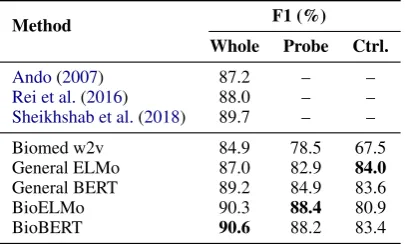
In Domain v.s. General Domain: Results in Table 1 show that BioBERT and BioELMo in
7https://allennlp.org/elmo 8
Though BioELMo uses the smallest corpus to train, it performs better than BioBERT in probing setting, and general ELMo in whole and probing setting.
9
https://github.com/google-research/ bert
10https://github.com/dmis-lab/biobert
Method F1 (%)
Whole Probe Ctrl.
Ando(2007) 87.2 – –
Rei et al.(2016) 88.0 – –
Sheikhshab et al.(2018) 89.7 – –
Biomed w2v 84.9 78.5 67.5
General ELMo 87.0 82.9 84.0
General BERT 89.2 84.9 83.6
BioELMo 90.3 88.4 80.9
BioBERT 90.6 88.2 83.4
Table 1: NER test results. Whole: whole model per-formance on BC2GM; Probe: Probing task perfor-mance on BC2GM;Ctrl.: Probing task performance on CoNLL 2003 NER. We use the official evaluation codes to calculate the F1 scores where there are multi-ple ground-truth tags, so the F1 scores are much higher than what were reported inLee et al.(2019).
the Whole setting perform better than the general BERT and ELMo and biomed w2v, setting new state-of-the-art performance for this dataset.
BioBERT and BioELMo remains competitive in the Probing setting, doing much better than their general domain counterparts and even gen-eral ELMo in the Whole setting. This shows that with the right pre-training, the downstream model can be considerably simplified.
[image:4.595.316.519.276.398.2]general-domain entities whereas the reverse is not true. Because BioBERT is initialzied with BERT and also uses general-domain corpora like Enligsh WikiPedia for pre-training, it’s not surprising that BioBERT is just0.2worse than BERT on CoNLL 2003 NER in control setting.
BioELMo v.s. BioBERT: Fine-tuned BioBERT outperforms BioELMo with biLSTM and CRF on BC2GM. As a feature extractor, BioBERT is slightly worse than BioELMo in probing task of BC2GM, but outperforms BioELMo in probing task of CoNLL 2003, which can be explained by the fact that BioBERT is also pre-trained on general-domain corpora.
Method Accuracy (%) Whole Probe Ctrl.
Romanov and Shivade(2018) 76.6 – –
Biomed w2v 74.2 71.1 59.2
General ELMo 75.8 69.6 60.8
General BERT – 67.6 62.1
General BERT-tog 77.8 71.0 74.1
BioELMo 78.2 75.5 58.3
BioBERT – 70.1 58.8
[image:5.595.74.293.266.389.2]BioBERT-tog 81.7 73.8 69.9
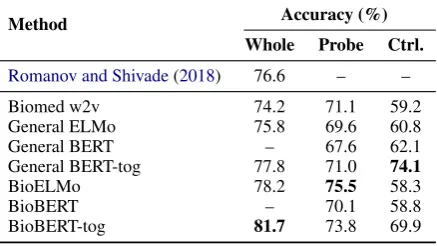
Table 2: NLI test results.Whole: whole model perfor-mance on MedNLI;Probe: Probing task performance on MedNLI;Ctrl.: Probing task performance on SNLI. To make the results comparable, we only use the same number of SNLI training instances as that of MedNLI.
4.2.2 NLI Results
In Domain v.s. General Domain:Table2shows that BioBERT and BioELMo in the Whole setting perform better than their general domain counter-parts and biomedical w2v for NLI, setting state-of-the-art performance for this dataset as well.
Once again, we observe that BioBERT and BioELMo outperform their general domain coun-terparts in the Probing settings, which comes at the cost of losing general domain information as indicated in the Control setting results.
Note that the Probing taskonlymodels relation-ships between tokens, but we still see competitive accuracy in that setting (75.5% vs 76.6% previ-ous best). This suggests that, (i) many instances in MedNLI can be solved by identifying token-level relationships between the premise and the hypoth-esis, and (ii) BioELMo already captures this kind of information in its embeddings.
BioELMo v.s. BioBERT: Fine-tuned BioBERT does much better than BioELMo with ESIM model. However, BioELMo performs better than
BioBERT by a large margin in the probing task of MedNLI. We explore this in more detail in the next section. Again, BioBERT is better than BioELMo in probing task of SNLI because it’s also pre-trained on general corpora.
We notice that the -tog setting improves the BERT performance. Encoding two sentences sep-arately, BioELMo still outperforms BioBERT-tog. It suggests that BioELMo is a better feature extrac-tor than BioBERT, even though the latter has su-perior performance when fine-tuned on MedNLI.
4.3 Analysis
4.3.1 Entity-type Information
In biomedical literature, the acronymERhas mul-tiple meanings: out of the124mentions we found in 20K recent PubMed abstracts, 47 refer to the gene “estrogen receptor”,70refer to the organelle “endoplasmic reticulum” and4refer to the “emer-gency room” in hospital. We use t-SNE (Maaten and Hinton,2008) to visualize different contextu-alized embeddings of these mentions in Figure3.
In Domain v.s. General Domain: For general ELMo, by far the strongest signal separating the mentions is whether they appear inside or outside parentheses. This is not surprising given the re-current nature of LSTM and language modeling training objective for learning these embeddings. BioELMo does a better job of grouping mentions of the same entity (ER as estrogen receptor) to-gether, which is clearly helpful for the NER task.
ER mentions of the same entities cluster bet-ter by BioBERT than general BERT: there are two major clusters corresponding to estrogen receptor and endoplasmic reticulum by BioBERT as indi-cated by the dashed circles, while entities of dif-ferent types are scattered almost evenly by BERT.
Figure 3: t-SNE visualizations of the tokenERembeddings in different contexts by BioELMo, general ELMo, BioBERT and general BERT. andKrepresent ERmentions within and outside of parentheses, respectively. Colors refer to different actual meanings of theERmention.
Relation Type NN w/ Representation of Same Type (%)
BioELMo ELMo BioBERT-tog BioBERT BERT-tog BERT Biomed w2v
disease-symptom 54.2 52.1 44.5 38.8 34.2 37.0 40.9 disease-drug 32.8 34.4 26.1 17.9 27.7 22.6 23.6 number-indication 70.5 63.9 47.0 45.3 48.1 49.5 74.4 synonyms 63.6 56.4 60.8 55.8 56.4 52.8 51.7
All 57.5 53.3 47.1 42.1 43.3 42.5 49.5
Subset Accuracy (%) 73.9 62.8 71.4 65.0 65.8 64.5 69.7
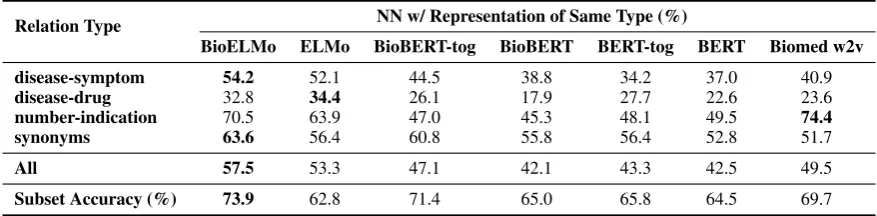
Table 3: Average proportion of nearest neighbor (NN) representations that belong to the same type for different embeddings, averaged over three random seeds. Biomed w2v performs best for number-indication relations, prob-ably because it uses a vocabulary of over5M tokens, in which about100k are numbers. Subset accuracy denotes the probing task performance in the subset of MedNLI test set used for this analysis.
4.3.2 Relational Information
We manually examine all test instances with the “entailment” label in MedNLI, and found 78 token pairs across the premises and hypotheses which strongly suggest entailment. Among them, 22 are disease-symptom pairs, 13 are disease-drug pairs, 19 are numbers and their indications (e.g.: 150/93 and hypertension) and 24 are synonyms or closely related concepts (e.g.: LasixR and diuretic).
Fig-ure1shows an example of disease-drug relation-ship. We hypothesize that a model is required to encode relation information to perform well in MedNLI task. We evaluate relation representa-tions from different embeddings by nearest neigh-bor (NN) analysis: For each distributed relation representation (Eq.1) of these token pairs, we cal-culated the proportions of its five nearest neigh-bors that belong to the same relation type. We re-port the average prore-portions in table 3and use it as a metric to measure the effectiveness of repre-senting relations by different embedding schemes. We also show model performance for this sub-set (78 instances for relation analysis) in table3. The trends of subset accuracy moderately corre-late with the NN proportions (Pearson correlation coefficientr= 0.52).
In Domain v.s. General Domain: For all re-lations, BioELMo is significantly11 better than ELMo in representing same relations closer to each other, while there is no significant differ-ence between BioBERT and BERT. This indicates that even pre-trained by in-domain corpus, as fixed feature extractor, BioBERT still cannot effectively encode biomedical relations compared to BERT.
BioELMo v.s. BioBERT: BioELMo signifi-cantly outperforms BioBERT and even BioBERT-tog for all relations. This explains why BioELMo does better than BioBERT in the probing task: BioELMo better represents vital biomedical rela-tions between tokens in premises and hypotheses.
5 Conclusion
We have shown that BioELMo and BioBERT rep-resentations are highly effective on biomedical NER and NLI, and BioELMo works even without complicated downstream models and outperforms untuned BioBERT in our probing tasks. This ef-fectiveness comes from its ability as a fixed fea-ture extractor to encode entity types and especially their relations, and hence we believe they should
11Significance is defined asp <0.05in two-proportion z
[image:6.595.79.518.230.338.2]benefit any task which requires such information. A long-term goal of NLP is to learn univer-sal text representations. Our probing tasks can be used to test whether learnt representations ef-fectively encode entity-type or relational informa-tion. Moreover, comprehensive characterizations of BioELMo and BioBERT as fixed feature extrac-tors would also be an interesting further direction to explore.
6 Acknowledgement
We are grateful for the anonymous reviewers who gave us very insightful suggestions. Bhuwan Dhingra is supported by a grant from Google.
References
Rie Kubota Ando. 2007. Biocreative ii gene men-tion tagging system at ibm watson. In Proceed-ings of the Second BioCreative Challenge Evalua-tion Workshop, volume 23, pages 101–103. Centro Nacional de Investigaciones Oncologicas (CNIO) Madrid, Spain.
Terra Blevins, Omer Levy, and Luke Zettlemoyer. 2018. Deep rnns encode soft hierarchical syntax.
arXiv preprint arXiv:1805.04218.
Samuel R Bowman, Gabor Angeli, Christopher Potts, and Christopher D Manning. 2015. A large anno-tated corpus for learning natural language inference.
arXiv preprint arXiv:1508.05326.
Khyathi Chandu, Aakanksha Naik, Aditya Chan-drasekar, Zi Yang, Niloy Gupta, and Eric Nyberg. 2017. Tackling biomedical text summarization: Oaqa at bioasq 5b.BioNLP 2017, pages 58–66.
Ciprian Chelba, Tomas Mikolov, Mike Schuster, Qi Ge, Thorsten Brants, Phillipp Koehn, and Tony Robin-son. 2013. One billion word benchmark for measur-ing progress in statistical language modelmeasur-ing. arXiv preprint arXiv:1312.3005.
Qian Chen, Xiaodan Zhu, Zhenhua Ling, Si Wei, Hui Jiang, and Diana Inkpen. 2016. Enhanced lstm for natural language inference. arXiv preprint arXiv:1609.06038.
Alexis Conneau, Douwe Kiela, Holger Schwenk, Loic Barrault, and Antoine Bordes. 2017. Supervised learning of universal sentence representations from natural language inference data. arXiv preprint arXiv:1705.02364.
Ishita Dasgupta, Demi Guo, Andreas Stuhlm¨uller, Samuel J Gershman, and Noah D Goodman. 2018. Evaluating compositionality in sentence embed-dings. arXiv preprint arXiv:1802.04302.
Jacob Devlin, Ming-Wei Chang, Kenton Lee, and Kristina Toutanova. 2018. Bert: Pre-training of deep bidirectional transformers for language understand-ing.arXiv preprint arXiv:1810.04805.
Alistair EW Johnson, Tom J Pollard, Lu Shen, H Lehman Li-wei, Mengling Feng, Moham-mad Ghassemi, Benjamin Moody, Peter Szolovits, Leo Anthony Celi, and Roger G Mark. 2016. Mimic-iii, a freely accessible critical care database.
Scientific data, 3:160035.
John Lafferty, Andrew McCallum, and Fernando CN Pereira. 2001. Conditional random fields: Prob-abilistic models for segmenting and labeling se-quence data.
Guillaume Lample, Miguel Ballesteros, Sandeep Sub-ramanian, Kazuya Kawakami, and Chris Dyer. 2016. Neural architectures for named entity recognition.
arXiv preprint arXiv:1603.01360.
Jinhyuk Lee, Wonjin Yoon, Sungdong Kim, Donghyeon Kim, Sunkyu Kim, Chan Ho So, and Jaewoo Kang. 2019. Biobert: pre-trained biomed-ical language representation model for biomedbiomed-ical text mining. arXiv preprint arXiv:1901.08746.
Laurens van der Maaten and Geoffrey Hinton. 2008. Visualizing data using t-sne. Journal of machine learning research, 9(Nov):2579–2605.
Tomas Mikolov, Ilya Sutskever, Kai Chen, Greg S Cor-rado, and Jeff Dean. 2013. Distributed representa-tions of words and phrases and their compositional-ity. InAdvances in neural information processing systems, pages 3111–3119.
SPFGH Moen and Tapio Salakoski2 Sophia Anani-adou. 2013. Distributional semantics resources for biomedical text processing. InProceedings of the 5th International Symposium on Languages in Biol-ogy and Medicine, Tokyo, Japan, pages 39–43.
Matthew E Peters, Mark Neumann, Mohit Iyyer, Matt Gardner, Christopher Clark, Kenton Lee, and Luke Zettlemoyer. 2018a. Deep contextualized word rep-resentations. arXiv preprint arXiv:1802.05365.
Matthew E Peters, Mark Neumann, Luke Zettlemoyer, and Wen-tau Yih. 2018b. Dissecting contextual word embeddings: Architecture and representation.
arXiv preprint arXiv:1808.08949.
Adam Poliak, Aparajita Haldar, Rachel Rudinger, J Ed-ward Hu, Ellie Pavlick, Aaron Steven White, and Benjamin Van Durme. 2018. Collecting diverse nat-ural language inference problems for sentence rep-resentation evaluation. In Proceedings of the 2018 Conference on Empirical Methods in Natural Lan-guage Processing, pages 67–81.
Alexey Romanov and Chaitanya Shivade. 2018. Lessons from natural language inference in the clin-ical domain. arXiv preprint arXiv:1808.06752.
Golnar Sheikhshab, Inanc Birol, and Anoop Sarkar. 2018. In-domain context-aware token embeddings improve biomedical named entity recognition. In
Proceedings of the Ninth International Workshop on Health Text Mining and Information Analysis, pages 160–164.
Larry Smith, Lorraine K Tanabe, Rie Johnson nee Ando, Cheng-Ju Kuo, I-Fang Chung, Chun-Nan Hsu, Yu-Shi Lin, Roman Klinger, Christoph M Friedrich, Kuzman Ganchev, et al. 2008. Overview of biocreative ii gene mention recognition. Genome biology, 9(2):S2.
Ian Tenney, Patrick Xia, Berlin Chen, Alex Wang, Adam Poliak, R Thomas McCoy, Najoung Kim, Benjamin Van Durme, Samuel R Bowman, Dipan-jan Das, et al. 2018. What do you learn from con-text? probing for sentence structure in contextual-ized word representations.
Erik F Tjong Kim Sang and Fien De Meulder. 2003. Introduction to the conll-2003 shared task: Language-independent named entity recognition. In
Proceedings of the seventh conference on Natural language learning at HLT-NAACL 2003-Volume 4, pages 142–147. Association for Computational Lin-guistics.
Georg Wiese, Dirk Weissenborn, and Mariana Neves. 2017. Neural domain adaptation for biomedical question answering. arXiv preprint arXiv:1706.03610.