Proceedings of NAACL-HLT 2019: Demonstrations, pages 12–17 12
Enabling Search and Collaborative Assembly of Causal Interactions
Extracted from Multilingual and Multi-domain Free Text
†George C. G. Barbosa,‡Zechy Wong,
Gus Hahn-Powell,Dane Bell, ‡Rebecca Sharp,‡
Marco A. Valenzuela-Esc´arcega,‡Mihai Surdeanu †
Centre for Data and Knowledge Integration for Health (CIDACS), Salvador, Brazil
‡
University of Arizona, Tucson, Arizona, USA
LUM.AI, Tucson, Arizona, USA
{gcgbarbosa,zechy,bsharp,marcov,msurdeanu}@email.arizona.edu
{ghp,dane}@lum.ai
Abstract
Many of the most pressing current research problems (e.g., public health, food security, or climate change) require multi-disciplinary col-laborations. In order to facilitate this process, we propose a system that incorporates multi-domain extractions of causal interactions into a single searchable knowledge graph. Our sys-tem enables users to search iteratively over di-rect and indidi-rect connections in this knowl-edge graph, and collaboratively build causal models in real time. To enable the aggrega-tion of causal informaaggrega-tion from multiple lan-guages, we extend an open-domain machine reader to Portuguese. The new Portuguese reader extracts over 600 thousand causal state-ments from 120 thousand Portuguese publica-tions with a precision of 62%, which demon-strates the value of mining multilingual scien-tific information.
1 Introduction
The number of scientific publications has in-creased dramatically in the past few years. For example, PubMed1, a repository of biomedical pa-pers, now indexes more than one million publica-tions per year, for a total of over 29 million publi-cations processed to date2.
Given this vast amount of information, it is clear that search must be a key part of the sci-entific research process. However, we argue that search tools today do not support this process properly. We see at least three limitations. First, most search tools tend to be relatively shallow (i.e., relying on keywords or topics), while in-formation needs in science often require seman-tics. For example, scientific hypotheses in many sciences can be represented as causal statements,
1
https://www.ncbi.nlm.nih.gov/PubMed
2As of February 4, 2019. See the Advanced search tab on
the PubMed website.
e.g., “what causes malnutrition?”, or “what are the effects of pollution?”. Such queries are not easily supported by current tools. Second, many sciences are becoming increasingly multilingual, as key scientific analyses are published in non-English venues. For example, Brazil has reduced the under-5 mortality rate resulting from poverty-related causes through itsBolsa Familiaprogram (BFP), a widespread conditional money transfer to poor households (Rasella et al., 2013). However, most of the data collected in the BFP and the re-sulting analyses are only made available through scientific reports in Portuguese. For example, SciELO3, an electronic repository of papers pub-lished in South America, now indexes 234,596 publications in Brazilian Portuguese4. Lastly, re-search isiterativeandcollaborative, whereas most search is stateless and private. For example, under-standing children’s health requires collaborations across multiple disciplines, e.g., biology, econ-omy, education.
We propose a system for the search of scientific literature that addresses these three limitations. In particular, the contributions of our work are:
(1) An approach for the search of causal state-ments that can be both direct and indirect. Our approach relies on a novel approach for open-domain information extraction (OpenIE) that is unsupervised and domain agnostic. The proposed OpenIE method relies on syntax, and performs ex-tractions using a top-down grammar, which first extracts relevant events, followed by event argu-ments, whose boundaries are determined by the syntactic constraints of the event predicate. The extractions are assembled into a graph knowledge base (KB), which supports both direct and indirect searches across causal pathways.
3
http://www.SciELO.br
4As of February 4, 2019. See SciELO analytics:https:
Domain Experts (e.g., biologist, economist) a)
b)
c)
Readers
… aleitamento materno
exclusivo … possibilitaria uma
redução marcante nos índices
de mortalidade infantil … PT
EN
Graph Assembler
Knowledge Graph DB
Web UI
Collaborative Interest Maps
DB
… minimizing the use of a pacifier may promote the establishment of
exclusive breastfeeding …
breastfeeding pacifier
mortalidade infantil aleitamento
materno exclusivo
pacifier mortalidade
infantil breastfeeding
pacifier mortalidade
infantil
[image:2.595.109.253.61.394.2]overweight breastfeeding
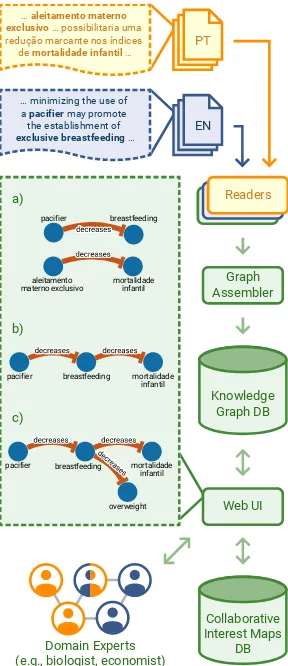
Figure 1: System architecture and example. Causal rela-tions from sentences about breastfeeding in English ( Maas-trup et al.,2014) and Portuguese (Cavalcanti et al.,2015) are extracted and used by domain experts to collaboratively build a shared causal model of the task of interest, called an inter-est map, through a web UI. (a) A user searches for causes of
breastfeedingand effects ofaleitamento materno exclusivo
(exclusive breastfeeding), and adds two interesting links to a shared interest map. (b) A second user mergesaleitamento
materno exclusivoandbreastfeeding. (c) A third user adds
an additional link (tooverweight) from a new search to the shared interest map. The constructed interest maps are stored in a separate database, where they can be edited in real-time by collaborators.
(2) A multilingual search platform. We provide OpenIE grammars for English and Portuguese, and demonstrate their utility in searching PubMed and SciELO.
(3) A framework for collaborative model build-ing. The proposed system allows end users to save the results of their semantic searches into an editable graph knowledge base, which can be shared and edited in real time by multiple collab-orators. The underlying functionality for this col-laborative component relies on Operational Trans-formations (OT), which is a conflict-free and non-blocking change propagation algorithm that al-lows individual users to edit a shared knowledge base in real time (Sun and Ellis,1998).
2 Architecture
Our approach for information aggregation com-bines the output of machine readers into a knowl-edge graph which can be efficiently queried, stored, filtered, and edited by multiple users in real-time.
Specifically, given a collection of documents, we first extract relevant relations using a set of rule-based machine readers. This approach can use the output of any reader (e.g., the biomedi-cal relation extraction framework of
Valenzuela-Esc´arcega et al.(2018) or the open-domain
frame-work ofHahn-Powell et al. (2017)), but here we focus on the Eidos reader (Section 3) which we extend to Portuguese (Section3.2) in order to crease the coverage of the knowledge graph by in-cluding scientific publications in Portuguese.
The extracted concepts are unified using the deduplication approach of Hahn-Powell et al.
(2017), which uses anO(n)hash-based approach to fingerprint relation and concept attributes paired with a set of normalized terms filtered against a series of linguistic constraints. A graph database is then populated with the unified concepts and the relations linking them. During this process, we preserve all evidence for the extractions, along with information about whether relations were hedged or negated. We employ two Lucene5 in-dexes, one for indexing the content of the papers (for use in filtering the knowledge graph based on a specified context), and another for the concepts in the knowledge base (to allow for faster query-ing).
An important component of this system is a web-based user interface (UI) which allows users to query the graph easily and incrementally se-lect results in order to construct a qualitative influ-ence model, which we refer to as aninterest map
(Section4). This UI features a real-time collab-orative graph editor that is conflict-free and non-blocking, allowing multiple users to work together on a shared interest map.
3 Reader
In the context of OpenIE (Banko et al., 2007), determining the fixed set of relevant entities and events, and aggregating this information across domains and languages is likely impossible. For this reason, we use the Eidos reader (Sharp et al.,
2019), which is a taxonomy-free OpenIE sys-tem that uses a top-down information extraction pipeline. This pipeline begins by finding relations of interest such as causal statements (through the use of specific trigger words), and continues by extracting the concepts that participate in these re-lations from the syntactic context.
3.1 Reading with Eidos
To understand the individual steps of Eidos’s top-down approach, consider the example sentence,
According to two studies, breast milk with omega-3 LCPUFA reduced allergic manifestations.
First, the Eidos system finds causal and corre-lation recorre-lations, using a set of trigger words with a grammar of rules written in the Odin informa-tion extracinforma-tion framework (Valenzuela-Esc´arcega
et al., 2016). Odin consists of a declarative
lan-guage, capable of describing patterns over surface and syntax, coupled with a runtime engine that applies these rules in a cascade, making the pre-vious matches available for subsequent rules. In the sentence above, a Causal relation would be triggered by the predicatereduced, with an initial cause ofmilkand an initial effect ofallergic man-ifestations. Using the approach of Hahn-Powell
et al. (2017), Eidos then expands these initial
ar-guments by traversing outgoing dependency links (with some exceptions such as conjunctions). For example, heremilkis expanded tobreast milk with omega-3 LCPUFA. The final system output of the Eidos system for the sentence above is shown in Figure2.
3.2 Extension to Portuguese
We adapted the English-based Eidos system to ex-tract causal relations from Portuguese text by first translating the trigger words and words related to filtering, negation, and hedging. We compared the syntactic preprocessing of a sample of causal sen-tences in English with their Portuguese transla-tions, writing additional rules to account for dif-ferences. Rules were also written to capture lexi-calized causal patterns in Portuguese. During rule development, we ran the reader over a 1K article sample of SciELO multiple times, evaluating the accuracy of each rule and adjusting them to re-move incorrect extractions.
Since the grammars that Eidos uses operate over universal dependency (UD) syntax (Nivre et al.,
2016), and are largely unlexicalized (with the ex-ception of certain prominent causal forms, e.g.,
due to), we anticipated that minimal adjustments to the grammars would be needed. However, the Portuguese UD dataset used v2 of UD, while the grammar for English was written for UD v16. Thus, some relations were tagged differently be-tween the two languages, for example,nmod rela-tions for English were split intonmodandoblin Portuguese. Because the Portuguese training data for UD was considerably smaller than for English, we also had to deal with the lower accuracy of the dependency parser7, which represented a chal-lenge when porting the grammars.
In total, we ported eight high-yield rules to Portuguese. An analysis of the extractions from the 1K article sample showed that approximately 65% of the extractions were made by a single ac-tive voice rule whose arguments are matched by traversing nsubj and obj dependencies. The next most frequently used rule, which matches causal events where the trigger is followed by the token por, e.g., diminu´ıdo por [reduced by], ac-counted for 15% of the extractions. No other rule accounted for more than 5% of the extractions.
Note that the Portuguese extractions are cur-rently kept separate from the English ones. That is, the user must explicitly search for causal path-ways by language. However, these results may be manually aggregated in the collaborative model workspace, described below. We describe possible strategies for the automated integration of cross-language results in Section6.
4 Collaborative model builder
The causal graphs built from the extractions are useful for finding direct and indirect relations be-tween concepts. However, in order to truly sup-port the scientific research process, we argue that the resulting system must implement the following additional functionality:
(1)It must supportiterativeandstatefulsearch. It is unlikely that any single search query solves a real-world research problem. It is thus necessary to allow multiple searches whose outputs are saved in the same state or model. For example, Jensen
et al.(2017) showed that understanding children’s
health requires information from biology, psychol-ogy, economy, and environmental science.
6https://universaldependencies.org/
7The parser used for this component was an ensemble of
According to two studies, breast milk with omega-3 LCPUFA reduced Decrease
allergic manifestations .
Concept Concept
cause effect
De acordo com dois estudos, o leite materno enriquecido com ômega-3 LCPUFA reduziu
Decrease
as manifestações alérgicas.
Concept Concept
[image:4.595.169.430.60.109.2]cause effect
Figure 2:TAG (Forbes et al.,2018) visualization of the multilingual reader’s output for one sentence in English and Portuguese.
Interest Map Definition
To define an area of interest that you would like to explore, select the relationship type you are interested in, then choose a source, target, or both.
The results can then be added to the currently active interest map.
Alternatively, specify only a context (with no source or target) to browse articles which match that context.
Show relational paths in the database that match the following definition:
Any source influences Any target
in the context of Any context
within a maximum of 1 hop(s)
breastfeeding decreases Necrotizing enterocolitis (Consolidated)
(Hedged entries are marked by dashed boxes . Entries that don't match the currently specified context directly are grayed-out.)
2019-02-11 05:09:39pm
Edge imported or created by Marco Valenzuela:
breast milkdecreasesNecrotizing enterocolitis
Modulation of human immune responses by bovine interleukin-10.
PMID: 21464967 (1 entry)
Necrotizing enterocolitis induced in rats can be reversed by human breast milk as well as IL-10 <CITATION> , <CITATION> , and increased cytoplasmic IL-10 levels in epithelial cells in rats correlated with protection to NEC <CITATION> .
Risk Factors of Breast Problems in Mothers and Its Effects on Newborns
PMID: 25068067 (1 entry)
Studies show that breast milk decreases the prevalence and severity of lower respiratory tract infections , acute otitis media , bacteriemia , bacterial meningitis , botulism , urinary tract infections and necrotizing enterocolitis in newborns .
Interest Map (Consolidated)
Default map for [email protected] ([email protected]) Interest Map Definition
Advanced Options Details
Query - Graph Query - Table Interest Map - Graph Interest Map Editor Interest Map Management Interest Ma
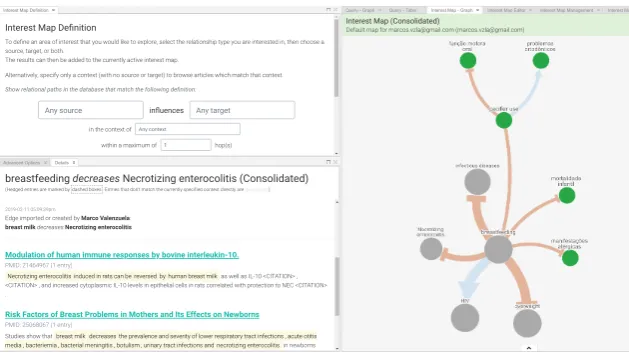
Figure 3:Screenshot showing some key functionality of our system’s user interface. In the upper left panel, users can search for direct or indirect causal statements found in the literature. The right panel has the multilingual interest map, collaboratively built by different users from multiple search results. The bottom left panel has the evidence for a selected causal interaction.
(2) It must allow the addition of background knowledge that is known to the domain experts, but is not published in literature.
(3) Most importantly, the above operations must be performed in acollaborativeenvironment that allows multiple experts to contribute to the same model, or interest map, in real time. The National Science Foundation has recognized that inter-disciplinary collaborations have become a funda-mental aspect of science and has called for “grow-ing convergence research” in its “10 big ideas”.8
To implement the above functionality, we added a module for collaborative model building, which incorporates: (a) the ability to incrementally save the results of causal searches in a user’s interest map, thus accumulating (a subset of) search results that capture the problem of interest; (b) operations to edit this interest map such as adding causal rela-tions (to account for the user’s background knowl-edge) and deleting them (to account for machine errors); and (c) real-time collaborative functional-ity, which allows users to share their interest maps, and edit them in parallel, in real time.
The real-time collaborative functionality is implemented using Operational Transfor-mations (OT), which is a conflict-free and non-blocking change propagation algorithm that
8https://www.nsf.gov/news/special_
reports/big_ideas/
allows individual users be able to edit without waiting on others even under high-latency (Sun
and Ellis,1998). Typically OT is applied to
doc-uments (e.g., as with Google Docs), but here we apply it to our interest maps that are represented as directed causal graphs.
Briefly, each client has a local copy of the shared interest map, which they are free to edit. The edits are represented asoperations(e.g., dele-tion of a node, or addidele-tion of a reladele-tion link). Oper-ations generated by different clients are each trans-formed according to the operations of the other clients in order to synchronize the interest maps. The result is an intuitively-built unified interest map that incorporates the input from all expert users, without requiring them to be concerned with manual synchronization or conflict resolution.
5 Discussion
As shown in Figure 3, the collaborative model builder summarized in the previous section en-ables users to aggregate influence statements from multiple searches, multiple domains, and multiple languages. This allows end users to make full use of any information complementarity (i.e., between different domains or different languages) that is in-herent in inter-disciplinary research.
[image:4.595.141.456.136.312.2]approx-English Portuguese
Documents 94,684 121,801
Concepts in causal interactions 1,550,912 772,470 Causal interactions 2,121,574 631,965
Precision 54% 62%
Table 1:Statistics of English and Portuguese document col-lections, including number of causal interactions, and number of concepts participating in such interactions. Precision was computed over a sample of 50 statements in each language. We considered an interaction to be correct if the sentence sup-ports the interaction, the polarity (promotes/inhibits) and di-rection of the interaction are both correct, and the spans of the two arguments overlap with the correct spans.
imately 100K documents (more for Portuguese, less for English), and the readers extracted 2.1M causal statements from the English documents with a precision of 54%, and 631K causal state-ments in Portuguese with a precision of 62%, which demonstrates the value of mining multi-lingual scientific information. In this evaluation, extracted causal relation arguments were consid-ered correct if the argument extracted overlapped with the correct argument. For example, in the sentence “IL-10 decreases epsilon transcript ex-pression,” the strictly correct extraction would be: (IL-10; decreases; epsilon transcript expression). Based on our evaluation criteria, the following ex-traction would be also considered correct (IL-10; decreases; epsilon transcript), as the span of the second argument overlaps with the strictly correct argument.
The difference in precision between Portuguese and English might be due to the fact that the Por-tuguese reader uses a smaller set rules that ex-tracts approximately 4 times fewer causal state-ments than the English reader. Additionally, the evaluation was performed on a sample of 50 ex-tractions, and so the difference may not be statis-ticaly significant.
6 Future work
Our future work efforts will focus on extending the multi-linguality of the proposed system. Given the architecture currently in place, we predict that extending it to other languages will not be too costly. We plan to use the corpora from the Uni-versal Dependencies effort9to train part-of-speech taggers and syntactic parsers for additional lan-guages. Our semantic causal grammars are mostly unlexicalized; most of the effort required to adapt them to other languages will be on translating the
9https://universaldependencies.org
causal triggers.
In order to merge knowledge graphs constructed using corpora from different languages, we will need to align of multilingual terminology. Some domains may already provide manually translated vocabularies, for example, within the medical do-main, UMLS (Bodenreider,2004) provides trans-lations of the controlled vocabulary MeSH (
Lip-scomb,2000) for several languages. For domains
in which manual translations are not available, we can take advantage of recent developments in unsupervised bilingual dictionary induction (
Con-neau et al.,2017;Kementchedjhieva et al.,2018)
to learn alignments.
Lastly, we will work on methods to mini-mize the spreading of accidental misinformation, which may be introduced by incorrect extraction or statements that are not factual. To mitigate the former issue, we found that extraction redun-dancy provides a strong signal, i.e., statements ex-tracted multiple times from different publications are more likely to be correct. For the latter, we will employ recently-proposed methods for factu-ality detection (Rudinger et al.,2018).
7 Conclusion
We introduced a novel system10that facilitates the search for multilingual and multi-domain causal interactions that are either direct or indirect. Fur-ther, the proposed system includes a framework for collaborative model building, which allows multiple domain experts to collaborate in real time on the construction of a causal model for a given problem, which aggregates the results of multiple searches as well as background knowledge manu-ally added by the experts.
Acknowledgments
This work was funded by the Bill and Melinda Gates Foundation HBGDki Initiative. Marco Valenzuela-Esc´arcega and Mihai Surdeanu de-clare a financial interest in LUM.AI. This inter-est has been properly disclosed to the University of Arizona Institutional Review Committee and is managed in accordance with its conflict of interest policies.
References
Michele Banko, Michael J Cafarella, Stephen Soder-land, Matthew Broadhead, and Oren Etzioni. 2007. Open information extraction from the web. In IJ-CAI, volume 7, pages 2670–2676.
Olivier Bodenreider. 2004. The Unified Medical Language System (UMLS): integrating biomed-ical terminology. Nucleic Acids Research, 32(suppl 1):D267–D270.
Sandra Hip´olito Cavalcanti, Maria de F´atima Costa Caminha, Jos´e Natal Figueiroa, Vilneide Maria San-tos Braga Diegues Serva, Rachel de S´a Barreto Luna Cruz, Pedro Israel Cabral de Lira, Malaquias Batista Filho, et al. 2015. Fatores associados `a pr´atica do aleitamento materno exclusivo por pelo menos seis meses no estado de pernambuco. Revista Brasileira de Epidemiologia, 18:208–219.
Alexis Conneau, Guillaume Lample, Marc’Aurelio Ranzato, Ludovic Denoyer, and Herv´e J´egou. 2017. Word translation without parallel data. arXiv preprint arXiv:1710.04087.
Angus Graeme Forbes, Kristine Lee, Gus Hahn-Powell, Marco Antonio Valenzuela-Esc´arcega, and Mihai Surdeanu. 2018. Text annotation graphs: Annotating complex natural language phenomena. In Proceedings of the Eleventh International Con-ference on Language Resources and Evaluation (LREC-2018). European Language Resources Asso-ciation (ELRA).
Gus Hahn-Powell, Marco A. Valenzuela-Esc´arcega, and Mihai Surdeanu. 2017. Swanson linking revis-ited: Accelerating literature-based discovery across domains using a conceptual influence graph. Pro-ceedings of ACL 2017, System Demonstrations, pages 103–108.
Sarah KG Jensen, Anne E Berens, and Charles A Nel-son 3rd. 2017. Effects of poverty on interacting bio-logical systems underlying child development. The Lancet Child & Adolescent Health, 1(3):225–239.
Yova Kementchedjhieva, Sebastian Ruder, Ryan Cot-terell, and Anders Søgaard. 2018. Generalizing pro-crustes analysis for better bilingual dictionary induc-tion. InCoNLL.
Carolyn E Lipscomb. 2000. Medical subject headings (mesh). Bulletin of the Medical Library Association, 88(3):265.
Ragnhild Maastrup, Bo Moelholm Hansen, Hanne Kronborg, Susanne Norby Bojesen, Karin Hallum, Annemi Frandsen, Anne Kyhnaeb, Inge Svarer, and Inger Hallstr¨om. 2014. Factors associated with exclusive breastfeeding of preterm infants. results from a prospective national cohort study. PloS one, 9(2):e89077.
Joakim Nivre, Marie-Catherine de Marneffe, Filip Gin-ter, Yoav Goldberg, Jan Hajic, Christopher D. Man-ning, Ryan McDonald, Slav Petrov, Sampo Pyysalo, Natalia Silveira, Reut Tsarfaty, and Daniel Zeman. 2016. Universal dependencies v1: A multilingual treebank collection. InProceedings of the Tenth In-ternational Conference on Language Resources and Evaluation (LREC 2016), Paris, France. European Language Resources Association (ELRA).
Davide Rasella, Rosana Aquino, Carlos A. T. Santos, Romulo Paes-Sousa, and Mauricio L. Barreto. 2013. Effect of a conditional cash transfer programme on childhood mortality: a nationwide analysis of brazil-ian municipalities. The Lancet, 382:57–64.
Rachel Rudinger, Aaron Steven White, and Benjamin Van Durme. 2018. Neural models of factuality. In
Proceedings of the 2018 Conference of the North American Chapter of the Association for Computa-tional Linguistics: Human Language Technologies, Volume 1 (Long Papers), volume 1, pages 731–744.
Rebecca Sharp, Adarsh Pyarelal, Benjamin M. Gyori, Keith Alcock, Egoitz Laparra, Marco A. Valenzuela-Esc´arcega, Ajay Nagesh, Vikas Yadav, John A. Bachman, Zheng Tang, Heather Lent, Fan Luo, Mithun Paul, Steven Bethard, Kobus Barnard, Clay-ton Morrison, and Mihai Surdeanu. 2019. Eidos, IN-DRA, & Delphi: From free text to executable causal models. InProceedings of the 2019 Conference of the North American Chapter of the Association for Computational Linguistics: Demonstrations. Asso-ciation for Computational Linguistics.
Chengzheng Sun and Clarence Ellis. 1998. Opera-tional transformation in real-time group editors: Is-sues, algorithms, and achievements. In Proceed-ings of the 1998 ACM Conference on Computer Sup-ported Cooperative Work, CSCW ’98, pages 59–68, New York, NY, USA. ACM.
Mihai Surdeanu and Christopher D. Manning. 2010. Ensemble models for dependency parsing: Cheap and good? In Proceedings of the North Ameri-can Chapter of the Association for Computational Linguistics Conference (NAACL-2010), Los Ange-les, CA.
Marco A. Valenzuela-Esc´arcega, ¨Ozg¨un Babur, Gus Hahn-Powell, Dane Bell, Thomas Hicks, Enrique Noriega-Atala, Xia Wang, Mihai Surdeanu, Emek Demir, and Clayton T. Morrison. 2018. Large-scale automated machine reading discovers new cancer driving mechanisms. Database: The Journal of Bi-ological Databases and Curation.