A Cross-language Study on Automatic Speech Disfluency Detection
Wen Wang
SRI International
Menlo Park, CA
[email protected]Andreas Stolcke
Microsoft Research
Mountain View, CA
[email protected]Jiahong Yuan, Mark Liberman
University of Pennsylvania
Philadelphia, PA
[email protected] [email protected]Abstract
We investigate two systems for automatic dis-fluency detection on English and Mandarin conversational speech data. The first system combines various lexical and prosodic fea-tures in a Conditional Random Field model for detecting edit disfluencies. The second system combines acoustic and language model scores for detecting filled pauses through constrained speech recognition. We compare the contri-butions of different knowledge sources to de-tection performance between these two lan-guages.
1
Introduction
Speech disfluencies are common phenomena in spontaneous speech. They consist of spoken words and phrases that represent self-correction, hesitation, and floor-grabbing behaviors, but do not add seman-tic information; removing them yields the intended, fluent utterance. The presence of disfluencies in conversational speech data can cause problems for both downstream processing (parsing and other nat-ural language processing tasks) and human readabil-ity of speech transcripts. There has been much re-search effort on automatic disfluency detection in recent years (Shriberg and Stolcke, 1997; Snover et al., 2004; Liu et al., 2006; Lin and Lee, 2009; Schuler et al., 2010; Georgila et al., 2010; Zwarts and Johnson, 2011), particularly from the DARPA EARS (Effective, Affordable, Reusable Speech-to-Text) MDE (MetaData Extraction) (DARPA Infor-mation Processing Technology Office, 2003) pro-gram, which focused on the automatic transcription
of sizable amounts of speech data and rendering such transcripts in readable form, for both conversa-tional telephone speech (CTS) and broadcast news (BN).
However, the EARS MDE effort was focused on English only, and there hasn’t been much research on the effectiveness of similar automatic disfluency detection approaches for multiple languages. This paper presents three main innovations. First, we extend the EARS MDE-style disfluency detection approach combining lexical and prosodic features using a Conditional Random Field (CRF) model, which was employed for detecting disfluency on En-glish conversational speech data (Liu et al., 2005), to Mandarin conversational speech, as presented in Section 2. Second, we implement an automatic filled pause detection approach through constrained speech recognition, as presented in Section 3. Third, for both disfluency detection systems, we compare side-by-side contributions of different knowledge sources to detection performance for two languages, English and Mandarin, as presented in Section 4. Conclusions appear in Section 5.
2
EARS MDE Style Automatic Disfluency
Detection
We focus on two types of disfluencies, Fillers and
Edit disfluencies, following the EARS MDE
disflu-ency types modeled in (Liu et al., 2006). Fillers in-clude filled pauses (FP), discourse markers (DM), and explicit editing terms (ET). FPs are words used by the speakers as floor holders to maintain con-trol of a conversation. They can also indicate hes-itations of the speaker. In this work, English FPs
comprise uh and um, based on English CTS cor-pora. For Mandarin, Zhao and Jurafsky found that Mandarin speakers intensively used both demonstra-tives zhege (literally ‘this’) and nage (literally ‘that’) and uh/mm as FPs based on a large speech corpus of Mandarin telephone conversation (Zhao and Juraf-sky, 2005). We study the same set of Chinese FPs in this study. DMs are words or phrases related to the structure of the discourse and help taking or keeping a turn, or serving as acknowledgment, for example,
I mean, you know. An explicit ET is an editing term
in an edit disfluency that is not an FP or a DM. For example, we have two action itemssorry three
ac-tion items from the meeting, where sorry is an
ex-plicit ET.
Edit disfluencies involve syntactically relevant content that is either repeated, revised, or aban-doned. The basic pattern for edit disfluencies has the form (reparandum)<editing term> correc-tion. The reparandum is the portion of the utterance that is corrected or abandoned entirely (in the case of restarts). An interruption point (IP), marked with ‘’ in the pattern, is the point at which the speaker breaks off the original utterance and then repeats, revises, or restarts the utterance. The editing term is optional and consists of one or more filler words. The correction is the portion of the utterance that corrects the original reparandum. Revisions denote the cases when a speaker modifies the original utter-ance with a similar syntactic structure, e.g., we have
two action itemssorry three action items from the
meeting. Restarts denote the cases when a speaker
abandons an utterance or a constituent and restarts all over again, e.g., HeI like this idea.
We used a CRF model to combine lexical features, shallow syntactic features, and prosodic features for joint detection of edit words and IP words. A CRF defines a global log-linear distribution of the state (or label) sequenceEconditioned on an observation sequence, in our case including the word sequence
W and the featuresF, and optimized globally over the entire sequence considering the context event in-formation for making decisions at each point. We used the Mallet package (McCallum, 2002) to im-plement the CRF model. We used a first-order model that includes only two sequential events in the fea-ture set. The CRF model is trained to maximize the conditional log-likelihood of a given training
setP(EjW;F). During testing, the most likely se-quenceE is found using the Viterbi algorithm. To avoid over-fitting, a zero-mean Gaussian prior (Mc-Callum and Li, 2003) was applied to the parame-ters, where the variance of the prior was optimized on the development test set. Each word is associ-ated with a class label, representing whether it is an edit word or not. We included IP in the target classes and used five states, as outside edit (O),
be-gin edit with an IP (B-E+IP), bebe-gin edit (B-E), in-side edit with an IP E+IP), and inin-side edit
(I-E) (Liu et al., 2006). State transitions are also the same as in (Liu et al., 2006). We built a Hidden Markov Model (HMM) based part-of-speech (POS) taggers for English conversational speech and Man-darin broadcast conversation data. After employing the co-training approach described in (Wang et al., 2007), we achieved 94% POS tagging accuracy for both data sets. The features for CRF modeling in-clude: n-grams from words and automatically gen-erated POS tags, speaker turns, whether there is a repeated word sequence ending at a word bound-ary, whether a word is a fragment, whether there is a predefined filler phrase after the word bound-ary, and the prosody model posterior probabilities from a decision tree model (Shriberg and Stolcke, 1997) and discretized by cumulative binning (Liu et al., 2006). The prosodic features were computed for each interword boundary from words and pho-netic alignments of the manual transcriptions. We extracted the same set of prosodic features for En-glish and Mandarin data, based on duration, funda-mental frequency (f0), energy, and pause informa-tion, and nonprosodic information such as speaker gender and speaker change, for training and apply-ing the decision-tree-based prosody model (Liu et al., 2006).
3
Constrained Speech Recognition for
Filled Pause Detection
We also propose an alternative approach for auto-matic detection of FPs given speech transcripts that omit FPs but are otherwise accurate. This approach is motivated by situations where only an edited, “cleaned-up” transcript is available, but where an accurate verbatim transcript is to be recovered au-tomatically. We treat this task as a constrained speech recognition problem, and investigate how ef-fectively it is solved by a state-of-the-art large vo-cabulary continuous speech recognition (LVCSR) system. Hence, this approach can be considered as combining LVCSR acoustic model (AM) and lan-guage model (LM) knowledge sources in a search framework for FP detection. Compared to the FP detection component in the disfluency detection sys-tems described in Section 2, this alternative ap-proach explores different knowledge sources. In particular, the AMs explore different front-end fea-tures compared to the lexical and prosodic feafea-tures explored in those disfluency detection systems pre-sented in Section 2. Details of the front-end features are illustrated below.
We evaluated this approach on both English and Mandarin conversational speech. For detecting FPs in English conversational speech, we used a mod-ified and simplmod-ified form of the recognition sys-tem developed for the 2004 NIST Rich Transcrip-tion ConversaTranscrip-tional Telephone Speech (CTS) eval-uations, described in (Stolcke et al., 2006). The first pass of the recognizer uses a within-word MFCC+MLP model (i.e, trained on Mel-frequency cepstral coefficient (MFCC) features augmented with Multi-Layer Perceptron (MLP) based phone-posterior features), while the second pass uses a cross-word model trained on Perceptual Linear Pre-diction (PLP) features adapted (by speaker) to the output of the first pass. For purposes of FP detec-tion, the recognition is constrained to a word lat-tice formed by the manually transcribed non-FP ref-erence words, with optional FP words inserted be-tween any two words and at the beginning and end of each utterance. Both first and second pass de-coding was constrained by the optional-FP lattices. In the second pass, HTK lattices were generated with bigram LM probabilities and rescored with a
4-gram LM. The consensus decoding output from the rescored lattices was used for scoring FP detec-tion. The system thus evaluates the posterior prob-ability of an FP at every word boundary using both acoustic model (AM) and language model (LM) ev-idence. The acoustic model for the English recog-nition system was trained on about 2300 hours of CTS data. The language models (which models FP like any other word) are bigram and 4-gram statisti-cal word n-gram LMs estimated from the same data plus additional non-CTS data and web data.
For detecting FPs in Mandarin broadcast con-versation speech, we used a modified form of the recognition system developed for the 2008 DARPA GALE (Global Autonomous Language Ex-ploitation) Speech-to-Text evaluation, described in (Lei et al., 2009). The system conducted a con-strained decoding on the optional-FP lattices, using a speaker-independent within-word triphone MPE-trained MFCC+pitch+MLP model and a pruned trigram LM. For the Mandarin ASR system, the MFCC+MLP front-end features were augmented with 3-dimension smoothed pitch features (Lei et al., 2006). HTK lattices were generated with probabil-ities from the pruned trigram LM and rescored by the full trigram LM. The consensus decoding output from the rescored lattices was used for scoring FP detection. The AMs for this system were trained on 1642 hours of Mandarin broadcast news and conver-sation speech data and the LMs were trained on 1.4 billion words comprising a variety of resources. De-tails of training data and system development were illustrated in (Lei et al., 2009).
En-glish, the optional FP words are a choice between
uh and um. For Mandarin, the optional FP words
are a choice between uh, mm, zhege, and nage. We assigned equal weights to FP words.
4
Experimental Results
Scoring of EARS MDE-style automatic disfluency detection output is done using the NIST tools 1, computing the error rate as the average number of misclassified words per reference event word. For English, the training and evaluation data were from the 40 hours CTS data in the NIST RT-04F MDE training data including speech, their transcriptions and disfluency annotations by LDC. We randomly held out two 3-hour subsets from this training data set for evaluation and parameter tuning respectively, and used the remaining data for training. Note that for Mandarin, there is no LDC released Man-darin MDE training data. We adapted the English MDE annotation guidelines for Mandarin and man-ually annotated the manual transcripts of 92 Man-darin broadcast conversation (BC) shows released by LDC under the DARPA GALE program, for edit disfluencies and filler words. We randomly held out two 3-hour subsets from the 92 shows for evalu-ation and parameter tuning respectively, and man-ually corrected disfluency annotation errors on the evaluation set.
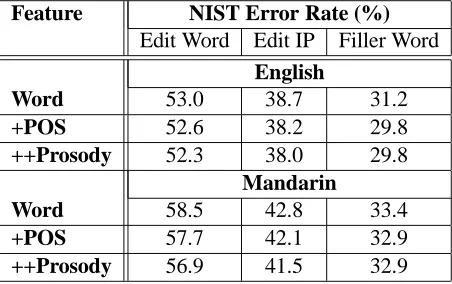
Table 1 shows the results in NIST error rate (%) for edit word, IP, and filler word detection. We ob-serve that adding POS features improves edit word, edit IP, and filler word detection for both languages, and adding a prosody model produced further im-provement (note that filler word detection systems did not employ prosodic features). The gains from combining the word, POS, and prosody model over the word n-gram baseline are statistically significant for both languages (confidence levelp<0:05using matched pair test). Also, adding the prosody model over word+POS yielded a larger relative gain in edit word+IP detection performance for Mandarin than for English data. A preliminary study of these re-sults has shown that the prosody model contributes differently for different types of disfluencies for En-glish and Mandarin conversational speech and we will continue this study in future work. We also plan
1
www.itl.nist.gov/iad/mig/tests/rt/2004-fall/index.html
[image:4.612.314.540.168.310.2]to investigate the prosodic features considering the special characteristics of edited disfluencies in Man-darin studied in (Lin and Lee, 2009).
Table 1: NIST error rate (%) for edit word, IP, and filler word detection on the English and Mandarin test set, using word n-gram features, POS n-gram features, and prosody model.
Feature NIST Error Rate (%)
Edit Word Edit IP Filler Word English
Word 53.0 38.7 31.2
+POS 52.6 38.2 29.8
++Prosody 52.3 38.0 29.8
Mandarin
Word 58.5 42.8 33.4
+POS 57.7 42.1 32.9
++Prosody 56.9 41.5 32.9
test set, adding LM scores degraded P
miss
but im-provedPfa
. However, on the Mandarin test set, in-creasing LM weight improved bothPmiss
andPfa
, suggesting that for the Mandarin LVCSR system in this study, the LM could provide complementary in-formation to the AM to discriminate FP and non-FP words.Table 2: Probabilities of false alarms (FAs) and misses in FP detection on the English and Mandarin test set w.r.t. acoustic model weightw
a, language model weight w
g, and pronunciation score weightw
p.
fw
a
;wg
;wp
g FAs (%) Misses (%) Englishf1,0,8g 1.76 3.23 f1,8,8g 1.18 4.73
Mandarin
f1,0,8g 1.19 19.68 f1,8,8g 0.76 16.76
5
Conclusion
In conclusion, we have presented two automatic dis-fluency detection systems, one combining various lexical and prosodic features, and the other com-bining LVCSR acoustic and language model knowl-edge sources. We observed significant improve-ments in combining lexical and prosodic features over just employing word n-gram features, for both languages. When combining AM and LM knowl-edge sources for FP detection in constrained speech recognition, we found increasing LM weight im-proved both false alarm and miss rates for Mandarin but degraded the miss rate for English.
Acknowledgments
The authors thank all the anonymous reviewers of this paper for valuable suggestions. This work is supported in part by NSF grant IIS-0964556.
References
DARPA Information Processing Technology Office. 2003. Effective,affordable, reusable speech-to-text (EARS). http://www.darpa.mil/ipto/programs/ears. Michael Finke and Alex Waibel. 1997. Flexible
tran-scription alignment. In IEEE Workshop on Speech Recognition and Understanding, pages 34–40.
K. Georgila, N. Wang, and J. Gratch. 2010. Cross-domain speech disfluency detection. In Proceedings of SIGDIAL, pages 237–240, Tokyo.
X. Lei, M. Siu, M.Y. Hwang, M. Ostendorf, and T. Lee. 2006. Improved tone modeling for Mandarin broad-cast news speech recognition. In Proceedings of Inter-speech.
X. Lei, W. Wu, W. Wang, A. Mandal, and A. Stolcke. 2009. Development of the 2008 SRI Mandarin speech-to-text system for broadcast news and conversation. In Proceedings of Interspeech, Brighton, UK.
C. K. Lin and L. S. Lee. 2009. Improved features and models for detecting edit disfluencies in transcrib-ing spontaneous mandarin speech. IEEE Transac-tions on Audio, Speech, and Language Processing, 17(7):1263–1278, September.
Yang Liu, Elizabeth Shriberg, Andreas Stolcke, and Mary Harper. 2005. Comparing HMM, maximum entropy, and conditional random fields for disfluency detec-tion. In Proc. Interspeech, pages 3313–3316, Lisbon, September.
Yang Liu, Elizabeth Shriberg, Andreas Stolcke, Dustin Hillard, Mari Ostendorf, and Mary Harper. 2006. Enriching speech recognition with automatic detec-tion of sentence boundaries and disfluencies. IEEE Transactions on Audio, Speech, and Language Pro-cessing, 14(5):1526–1540, September. Special Issue on Progress in Rich Transcription.
A. McCallum and W. Li. 2003. Early results for named entity recognition with conditional random fields. In Proceedings of the CoNLL.
Andrew McCallum. 2002. Mallet: A machine learning for language toolkit. http://mallet.cs.umass.edu. W. Schuler, S. AbdelRahman, T. Miller, and L. Schwartz.
2010. Broad-coverage incremental parsing using human-like memory constraints. Computational Lin-guistics, 36(1).
E. Shriberg and A. Stolcke. 1997. A prosody-only decision-tree model for disfluency detection. In Pro-ceedings of Eurospeech, pages 2383–2386.
M. Snover, B. Dorr, and R. Schwartz. 2004. A lexically-driven algorithm for disfluency detection. In Su-san Dumais, Daniel Marcu, and Salim Roukos, edi-tors, Proc. HLT-NAACL, Boston, May. Association for Computational Linguistics.
Pro-cess., 14(5):1729–1744, September. Special Issue on Progress in Rich Transcription.
W. Wang, Z. Huang, and M. P. Harper. 2007. Semi-supervised learning for part-of-speech tagging of Man-darin transcribed speech. In Proceedings of ICASSP, pages 137–140.
Y. Zhao and D. Jurafsky. 2005. A preliminary study of mandarin filled pause. In Proceedings of DISS, pages 179–182, Aix-en-Provence.