THE SEMANTIC LINK: ACTION & LANGUAGE
An investigation of relations between different cognitive
domains in early development
Katharina Kaduk, Dipl. Psych.
This thesis is submitted for the degree of Doctor of Philosophy
Department of Psychology
Lancaster University
Declaration
This thesis is my own work and no portion of the work referred to in this thesis has been
submitted in support of an application for another degree or qualification at this or any
other institute of learning.
Abstract
Acknowledgements
Firstly, I would like to express my appreciation to the Marie Skłodowska-Curie Action Training Network funded by the European Commission for giving me this unique opportunity to pursue my research projects. I have met some incredible people along the way from which fantastic research opportunities arose. Specifically, I would like to thank Prof. Gustaf Gredebäck and Prof. Denis Mareshal for giving me the opportunity to jointly work on different projects along with Marta, Claudia, Janna, and Livia. It was great working with you while having so much fun and laughter at the same time! Furthermore, this research would not have been possible without all those open-minded caregivers who entrusted me with their children. It was a pleasure meeting you all. One father of a participating child, Ben Tailor, was even involved in parts of my statistical analysis later down the line.
Numerous people from Lancaster have been very supportive and deserve to be mentioned: Eugenio (thank you for your patience in explaining WTools to me. I think I finally got it the 5th time round). Barrie & Dave (thank you with your technical support and help with my Matlab scripts. We had some lovely chats while programming). Gert (thank you especially with your help on study 1). Helen and Gavin (you have just been extremely understanding of my situation especially at the end stage of my PhD). The wider Babylab-Team (thank you for not burning down the Babylab while I was off duty during the last month of writing up.) Aíne (We were in this together. A perfect symbiosis if you ask me – thank you for your guidance and friendship and for actually reading parts of my thesis. I could have not wished for a better ACT partner in crime.) Uschi, Jo, Alison, Louah, Diana, Kirsty (Note: not in a particular order. I cannot list all the kind things you did for me in order to keep me sane. Thank you for absolutely everything!)
Vincent: I have known you now for more than a decade. Back in 2005, I came to work at the MPI, utterly unprepared, naïve, thinking I would work with primates. Instead, I discovered that my task was to code videos of infants. Infants? And this is how the story began… In all these years, you looked out for me, you challenged me, you believed in me when I could and simply would not. Thank you for your friendship first and foremost and for your guidance as my Doctor Father. I was under your protective wings for all this time and you taught me how to fly.
My parents: I have never seen anyone work so hard, and be so generous and loving. The feeling to be loved unconditionally and the reassurance I could always turn to you was the foundation upon which I had the confidence to take on this PhD.
Richard and my amazing daughter Isabelle: Good job team! We did this together. Rich when I needed you most – you were always there for me. Thank you for your support, I know it wasn’t always easy. Izzy, you were my greatest motivator. The prospect to have more time with you again kept me going. You are by far the best thing that ever happened to me.
Table of Contents
CHAPTER 1 ... 1
1.1 ACTION AND LANGUAGE DEVELOPMENT IN THE SOCIAL CONTEXT ... 3
1.1.1PRENATAL DEVELOPMENT ... 3
1.1.2POSTNATAL DEVELOPMENT ... 3
1.1.2a The Role of Imitation ... 4
1.1.2b The Role of Joint Attention ... 5
1.1.2c The Role of Infant-Directed Speech ... 6
1.1.3ACTION COMPREHENSION ... 7
1.1.4LANGUAGE COMPREHENSION ... 8
1.1.5MOTOR DEVELOPMENT ... 11
1.2 CURRENT MEASURES FOR ACTION AND LANGUAGE SEMANTICS .. 12
1.2.1ACCESSING SEMANTICS VIA THE N400ERP COMPONENT ... 15
1.2.1a Language-N400 ... 15
1.2.1b Action-N400 ... 16
1.2.2ACCESSING SEMANTICS VIA EVENT-RELATED OSCILLATIONS ... 17
1.2.2a The Indirect route of the Upper Band of the Alpha Range ... 17
1.2.2b The Direct route of Motor Resonance ... 18
1.2.3METHODOLOGICAL ISSUES ... 20
1.3 THESIS OBJECTIVES ... 23
CHAPTER 2 ... 26
ABSTRACT ... 26
2.1 INTRODUCTION ... 27
2.2 METHOD ... 31
2.2.1PARTICIPANTS ... 31
2.2.2EXPERIMENTAL STIMULI ... 32
2.2.3LANGUAGE MEASURE ... 34
2.2.4PROCEDURE ... 35
2.2.5EEG RECORDING AND ANALYSIS ... 37
2.3 RESULTS ... 39
2.3.1NC ERP COMPONENT ... 39
2.3.2a Nc: Language division from the SECDI w&g for language comprehension 40 2.3.2b Nc: Language division from the SECDI w&s for language production ... 41
2.3.3N400ERP COMPONENT ... 41
3.3.3a Analysis considerations ... 43
3.3.3b N400: Language division from the SECDI w&g for language comprehension ... 43
3.3.3c N400: Language division from the SECDI w&s for language production ... 44
2.4 DISCUSSION ... 45
2.5 CONCLUSION ... 49
PRELUDE TO CHAPTER 3 ... 51
CHAPTER 3 ... 55
ABSTRACT ... 55
3.1 INTRODUCTION ... 56
3.2 METHODS ... 65
3.2.1PARTICIPANTS ... 65
3.2.2STIMULI ... 65
3.2.3PROCEDURE ... 66
3.2.3a Learning phase ... 66
3.2.3b Retention phase ... 68
3.2.4EEG RECORDING AND ANALYSIS ... 70
3.3 RESULTS ... 72
3.3.1N400ERPCOMPONENT ... 72
3.3.2NC COMPONENT ... 75
3.3.3THETA BAND POWER ... 76
3.3.4ALPHA BAND POWER ... 78
3.3.5CORRELATION ANALYSIS ... 79
3.4 DISCUSSION ... 82
3.5 CONCLUSION ... 88
3.6 AUTHORS CONTRIBUTIONS ... 89
PRELUDE TO CHAPTER 4. ... 90
CHAPTER 4 ... 94
ABSTRACT ... 94
4.1 INTRODUCTION ... 95
4.2 METHODS ... 102
4.2.1PARTICIPANTS ... 102
4.2.2STIMULI ... 103
4.2.2a Auditory Stimuli ... 103
4.2.2b Visual Stimuli ... 105
4.2.2c Audio-Visual Stimuli ... 107
4.2.2d Training Videos ... 108
4.2.3PROCEDURE ... 109
4.2.3a Pre-Training Assessment ... 109
4.2.3b Home-Training ... 110
4.2.3c Post-Training Assessment ... 111
4.2.4EEG RECORDING AND ANALYSIS ... 113
4.2.4a Analysis considerations ... 114
4.3 RESULTS ... 115
4.3.2MOTOR MODULATION IN RESPONSE TO FAMILIAR,NOVEL &TRAINED AUDIO
-VISUAL MATERIAL ... 121
4.4 DISCUSSION ... 125
4.5 CONCLUSION ... 131
4.6 AUTHORS CONTRIBUTIONS ... 131
CHAPTER 5 ... 133
5.2 THEORETICAL IMPLICATIONS ... 137
5.2.1BIDIRECTIONAL ACCOUNT OF ACTION AND LANGUAGE ... 138
5.2.2NEUROPHYSIOLOGICAL MEASURES OF SEMANTICS WITHIN CONTEXT:THE INDIRECT ROUTE ... 139
5.2.2a Upper Alpha ... 139
5.2.2b Validity for Language and Action N400 ... 140
5.2.3THE ROLE OF INFANT DIRECTED SPEECH FOR SEMANTIC FORMATION ... 141
5.2.4THE ROLE OF IMITATION ... 143
5.2.5THE ROLE OF JOINT ATTENTION ... 143
5.2.6THE ROLE OF CONSOLIDATION FOR SEMANTIC FORMATION ... 144
5.2.7NEUROPHYSIOLOGICAL MEASURE OF CONTEXT INDEPENDENT SEMANTICS:THE DIRECT ROUTE OF MU DESYNCHRONIZATION. ... 145
5.2.7a The Role of Active Experience and Passive Experience ... 145
5.2.7b Hemispheric Specialization ... 147
5.3 LIMITATIONS AND DIRECTIONS FOR FUTURE RESEARCH ... 148
5.3.1SPECIFIC LIMITATIONS OF THIS THESIS ... 148
5.3.1a Theta Synchronization and Alpha Desynchronization ... 148
5.4.1b Complexity of Study Design ... 149
5.3.2GENERAL LIMITATIONS OF THE FIELD ... 150
5.3.2a Validity of Language Measures ... 150
5.3.2b Were the observed actions truly novel? ... 151
5.3.2c Consistency of channel inclusion for analysis ... 151
5.3.3FUTURE DIRECTIONS ... 152
5.3.3a The influence of action verbs within the learning context ... 152
5.3.3b Motor Resonance – Semantic Expectancy Paradigm ... 153
5.3.3c Additional concepts for future research ... 153
5.4 CONCLUSION ... 154
List of Figures and Tables
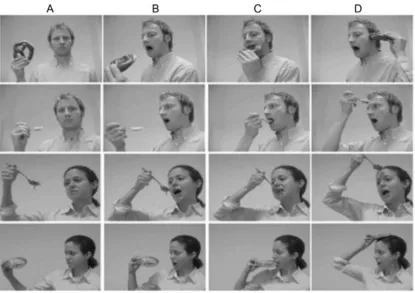
Figure 2.1: ERP stimuli: Three-image sequence depicting context (A), mid action (B), and action outcome (C/D). The N400 and Nc components were assessed for the last image of the sequence depicting the expected (C) or unexpected (D) action outcome.
Figure 2.2: Left: Averaged ERPs for all infants (N = 28) from 20 channels, 10 of the left central region (29, 30-C1, 35, 36-C3, 37, 40, 41-C5, 42, 46, and 47) and 10 of the right central region (87, 93, 98, 102, 103-C6, 104-C4, 105-C2, 109, 110, and 111), displaying the Nc. Right: Analyzed area of interest with reference to the 10–20 system.
Figure 2.3: Bottom left: Averaged ERPs for all infants (N = 28) from 16 channels within the parietal region for the N400 (52-P3, 53, 58, 59, 60, 61, 62-Pz, 67, 72, 77, 78, 85, 86, 91, 92-P4, and 96). Top right: Zoomed-in time window of interest indicating the N400 for the unexpected condition and the no N400 for the expected condition. Right: Analyzed area of interest with reference to the 10–20 system.
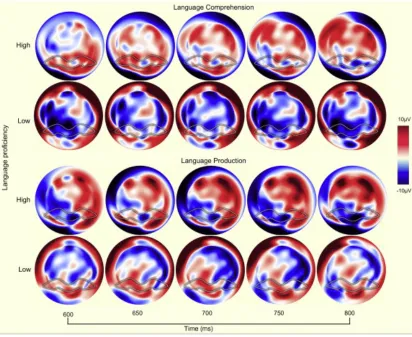
Figure 2.4: Difference wave (expected – unexpected) topographical maps for high and low language comprehension groups at 9 months of age (top two rows) and high and low language production group at 18 months of age (bottom two rows) displaying every 50 ms of the 200-ms time window of interest. The effect is clearly seen in high language posterior bilateral regions in the highlighted area, with a high intensity increase in microvoltage for the high language group from near the outset of the epoch, which continues for the duration of the epoch. In contrast, the low language group remains static and does not change in topography in terms of differential microvoltage for the entire epoch in the area of interest.
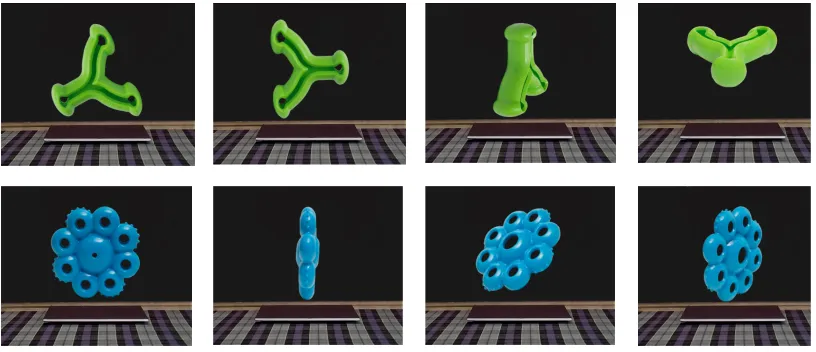
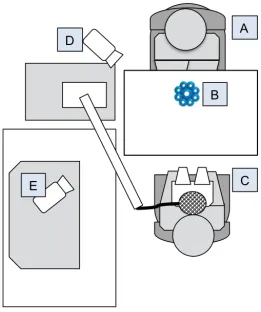
Figure 3.2: Paradigm depicting the initial learning phase with (A) experimenter, (B) novel object, (C) the infant participant sitting on the caregiver’s lap, and (D, E) video cameras.
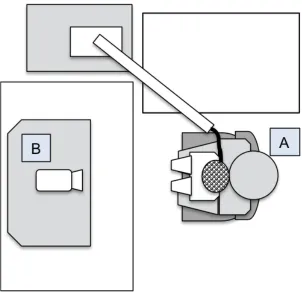
Figure 3.3: Experimental paradigm shortly after learning and 24-hours later. The infant participant sat on the caregiver’s lap (A) in front of an experimental monitor with video camera (B).
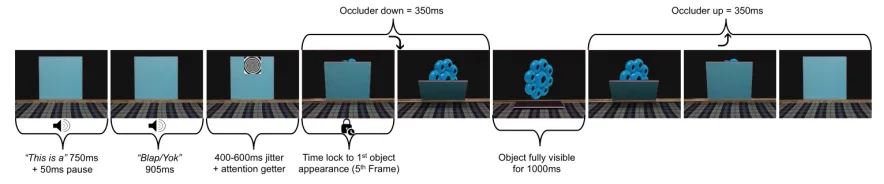
Figure 3.4: Experimental sequence depicting the 3-D occlusion scene. The sequence always started with an introductory phrase, followed by the word prime and ended with the object probe. Word-object pairs were either congruent or incongruent. All analyses were time locked to the first occurrence of the object.
Figure 3.5: Averaged ERPs for all infants (N = 20) from 12 channels within the left parietal region for the N400 (50, 51, 52-P3, 53, 54, 58, 59, 60, 61, 65, 66, 67) – top and bottom left and right parietal region (77, 78, 79, 84, 85, 86, 90, 91, 92-P4, 96, 97, 101) top and bottom right for day 1 (top) and 2 (bottom). Bottom right averaged channel group depicts the observed N400 for the incongruent condition only, within the time window of interest highlighted in grey.
Figure 3.6: Averaged ERPs for all infants (N = 20) from 26 channels collapsed across the two hemispheres with the analysed area highlighted in grey. Averaged ERP for day one is displayed on the top left and day 2 on the bottom left.
Figure 3.7: Theta power presented separately for day 1 and day 2 for the congruent (left) and incongruent (right) conditions for 9 frontal channels (4, 9, 10, 11, 15, 16, 18, 19, 22). A black frame ranging from 3-5 Hz from 400-1000 ms post stimulus presentation highlights the observed and analysed theta band. 3D Scalp Maps (superior view) were computed for each condition and day representing the mean of the time window and frequency range of interest. The analysed channels are highlighted in red.
highlights the observed and analysed alpha band. 3D Scalp Maps (posterior view) were computed for each condition and day representing the mean of the time window and frequency range of interest. The analysed channels are highlighted in blue.
Figure 3.9: Averaged ERP’s for (N = 20) subjects over right parietal channels on day 2. The framed area depicts the analysed time window of interest displaying a more pronounced N400 for the incongruent condition (red line). A line was drawn at the two points either side of the time window in which the ERP crossed the border for each individual, condition and day. A measure of deflection was computed from the response curve by summing the vertical difference between the curve and a straight line between the two end-points of the curve at each of the 75-recorded samples.
Figure 3.10: Correlation scatter plot depicting the two variables N400 deviation value difference (Incongruent - Congruent) on the x-axis and alpha band power difference (Congruent - Incongruent) on the y-axis. Larger relative values for the N400 represent the infant’s ability to detect word-object mismatches in the delayed retention phase. The same infants further displayed more negativity in the alpha range in the congruent relative to the incongruent condition.
Figure 4.1: Auditory presentation (Block 1) of the pre-training assessment. A still image was presented in the centre of the screen for the full duration of the auditory presentation of the novel verb and sound.
Figure 4.2: Block 1 at post-training assessment. Participants saw the same still image in the centre of the stimulus monitor during the presentation of the two trained, two novel and 1 familiar auditory stimuli. Within one completed block, the five auditory stimuli could be presented 25 times in total.
Figure 4.4: Left depicts the four blocks presented at pre-training and right the four blocks presented at post-training EEG assessment.
Figure 4.5: The top two rows depict activation for the perceived auditory sound and novel verb at pre-training assessment (A) and the three subsequent rows depict activation at post-training (B) for the now trained sound, trained verb and the control variable familiar action verb for the entire segment (-200 – 1000 ms) separate for the left and right hemisphere. Corresponding 3D Topographical Scalp Maps averaged for the analysed time window (600-800 ms) across all participants (N= 20) at 8 Hz are displayed in the middle. Area of channels included for the left and right are marked on the sensor layout to the left (C).
Figure 4.6: 3D Topographical Scalp Maps across all participants (N= 20) in 100 ms intervals for the segment length including a 200 ms baseline and post stimulus activation for 1000 ms duration post stimulus presentation at 8 Hz. The top two rows depict activation for the perceived auditory sound and novel verb at pre-training assessment and the three subsequent rows depict activation at post-training for the now trained sound, trained verb and the control variable familiar action verb.
Figure 4.7: Mu power for the left and right hemisphere separately over central electrodes to the familiar verb squeezing (grey), novel sound (blue), and novel verb yokking (red) pre-training (solid colour) and post-training (textured). Note the familiar verb derived from Block 1 at post-training. (** p < 0.01, * p < 0.05 - green highlights significance from baseline, black indicates significance between conditions).
averaged for the analysed time across all participants (N= 14) at 6-8 Hz. Area of channels included for analysis are marked on the sensor layout to the bottom left (E).
Figure 4.9: Mu power to familiar, novel (Pre-Training Assessment) and trained (Post-Training Assessment) audio-visual stimuli for each of the three analysed time windows of interest. Blue colour depicts actions paired with the non-verbal and red actions paired with the verbal referent (** p < 0.01, * p < 0.05 - green highlights significance from baseline, black indicates significance between conditions).
Chapter 1: General Introduction
To become part of the complex adult world, human infants need to be prepared to learn
from other people. The ability to understand others is crucial for the development of
early human social-cognitive skills. The first part of this introductory chapter aims to
highlight infants’ sensitivity to social aspects of their environment as a whole and as a
possible foundation for the ontogeny of action perception. However, in order to become
an active member of this complex adult world, human infants, who are immersed in this
environment of richly socially constructed symbolic factors, must first unravel and learn
to understand the meanings behind these abstract symbols. A longstanding debate in
developmental research and in developmental cognitive neuroscience is how the
meaning or semantics of action symbols emerge and what role language plays in this
process. When we refer to action symbols we refer to actions where there is semantic or
meaningful content beyond mere physical movement of the body. There is content in
the action that is symbolically present. For example, pointing in and of itself is
meaningless as an action unless it is understood that it contains information that is
symbolically encoded (Daum, Ulber, & Gredebäck, 2013). Action and language may be
closely related with evidence in the field pointing towards that notion. In early
development however, this relation is still unclear. Current neurophysiological
measures of semantics are also not well defined in the developmental literature.
Research on semantic processes generated by the N400 ERP for both cognitive domains
separately, provides largely robust but also confounded evidence for the link between
these two cognitive domains. A general question still to be answered is - do current
this thesis was to utilize additional measures to reflect semantic processing in
developmental cognitive neuroscience. Neurophysiological measures already provide
some evidence that the mirror system relies on stored semantic knowledge about actions
and events. Comparably little is known about motor involvement in relation to the
ontogeny of language and action systems in early development. To date, motor
resonance induced by linguistic material has not been investigated to the same extent as
action observation. It can be argued that a robust way to investigate the emergence of
semantic representation and involvement of motor systems during action observation
and language processing is to more closely examine early development.
To date, comparably little is known about the relation between language and
action and how these two conceptually different cognitive domains may or may not be
interwoven. Especially in terms of semantics, a possible relation of action and language
has not been fully and systematically explored. It has therefore been of primary focus
for the outlined doctoral thesis to investigate how semantic information develops and
how semantic representations are stored and accessed by two conceptually different
cognitive domains in early development. Furthermore, within the field of developmental
cognitive neuroscience, we aimed to examine a variety of semantic measures and as a
consequence, we explored complementary methods. This lead us to make use of a
variety of neurophysiological methods, primarily event-related brain potentials (ERP’s)
and event-related oscillations (ERO’s). Consequently, the last part of this general
1.1 Action and Language Development in the Social Context
1.1.1 Prenatal Development
The auditory system of a foetus becomes functional at around 25 weeks’ gestation.
Stimulation via speech, music and meaningful sounds from the environment are already
critical for the developing neurological basis of the auditory system at this particular
point in development. Thus, environmental stimulation impacts on the developing
auditory cortex very early on (Graven & Brown, 2008). Prosodic features are essential
for later language acquisition and evidence for prenatal learning (or formation of
memories) from these sensory inputs is, for instance, reflected in the newborns’ cry,
which follows the prosody of their mother tongue (Mampe, Friederici, Christophe, &
Wermke, 2009). A newborn’s ability to later recognize the face of their own mother is
theorised to have its roots in prenatal learning of their mother's voice (Sai, 2004). Zoia
and colleagues (2007) showed that movement patterns of fetuses reflect intentional
actions, and that advanced motor planning already occurs in utero. The observation of
fetal mouth opening prior to the hand making contact with the oral cavity suggests that
there is a rudimentary body schema in addition to these motor-planning capacities.
Marx and Nagy (2015) further proposed the possibility that fetal responses to the
external world (e.g., responses to voice or touch) serve a communicative purpose
similar to that of newborns. This indicates that a foetus is born into this world already
prepared to learn socially delivered information.
1.1.2 Postnatal Development
Evidence from developmental studies on infants’ acting upon objects and interactions
with people have shown that young infants are capable of distinguishing people from
that they prefer socially salient stimuli such as human faces when contrasted with other
stimuli (Morton & Johnson, 1991), with a specific preference for faces with direct gaze
(e.g., Farroni et al., 2002; Senju & Johnson, 2009), voices (Blasi et al., 2011) and
biological motion (e.g., Bertenthal et al., 1987; Bertenthal & Pinto, 1993). However,
mere auditory or visual observation of a socially salient stimulus would only provide an
infant with perceptual parameters. In order to grasp the intrinsic properties of observed
agents and their actions, for instance, and to understand what those actions really mean,
depends on the implementation of sensory input into one’s own motor specific semantic
knowledge system (e.g., Hommel, 2005; Prinz, 1990; Rizzolatti, 2005).
1.1.2a The Role of Imitation
Early imitation is thought to play a pivotal role as it provides first hand understanding
of how it feels to be someone else (Meltzoff & Decety, 2003). Early work on newborns’
ability to imitate facial expressions has consequently led to a re-evaluation of the stand
that perception and action are independent from one another (e.g., Meltzoff & Moore,
1997). For example, 5-week-olds are more likely to imitate tongue and mouth opening
gestures when performed by an adult model as compared to an object model (Legerstee,
1991). When 2-month-olds encounter objects in their visual scene, an increase in
grasping movements is likely to be observed. However, as soon as they are faced with
another person, infants start to respond by means of facial expressions and pre-speech
noises (Richards, 1974) and react with distress, when others pose a still-face, stopping
reciprocal interaction (see Mesman, van IJzendoorn, & Bakermans-Kranenburg, 2009
for a review). Meltzoff (1990) has further provided evidence for infants’ ability to
recognize that they themselves are being imitated by means of preferential looking and
an increase in positive affect towards the imitating experimenter. This highlights the
events in their environment (von Hofsten, 2004). This reciprocal imitation exchange is
to some extent similar to that of a communicative exchange (e.g., Meltzoff, 1990).The
above evidence consequently highlights a) that already very early on, a neonate and to
some extent the prenatal foetus is aware of people and inanimate objects and b) even
forms different expectations for these two classifications of environmental factors (for a
review see Legerstee, 1992). For instance, only if a human evidently operated a
mechanical claw, the expectancy from non-goal directed to goal directed intent shifted
in 9-month olds (Hofer, Hauf, & Aschersleben, 2005). Although there is no doubt that
newborn infants are indeed socially interactive individuals, newborn imitation data as
well as the “like me” hypothesis is viewed as controversial within the field of
developmental psychology (see, e.g., Meltzoff et al., 2017; Oostenbroek et al., 2016).
1.1.2b The Role of Joint Attention
Another important and fundamental aspect for social learning is the ability to
understand and be aware that another person is looking at the same object as oneself,
and that the social partner is doing so to share information (Farroni, Csibra, Simion, &
Johnson, 2002). This is seen as the highest level of joint attention, also known as triadic
joint attention (Tomasello, 1995). Nine month olds readily encode social cues such as
eye gaze referentially, with a bias to attend to the focal point of observed gaze (Senju,
Csibra, & Johnson, 2008). Joint attention has shown to be influential for object
processing (Striano, Chen, Cleveland, & Bradshaw, 2006). The ability to perform overt
joint attention behaviours with a social partner has also been linked to subsequent
language development (e.g., Baldwin, 1993; Kuhl, Tsao, & Liu, 2003). For instance, in
a longitudinal study Brooks and Meltzoff (2005) showed that gaze-following behaviour
of 10-11-month-old infants was predictive of later language abilities at 18 months.
to understand joint attention and later vocabulary development (e.g., Tomasello &
Farrar, 1986). Infants own abilities to produce pre-verbal actions such as gestures and
pointing were also linked to language development. Butterworth and Morissette (1996)
reported that an earlier onset of pointing correlated with the number of different
gestures and the amount of speech comprehension present at 14.4 months of age.
Camaioni and colleagues (1991) further added that the amount of pointing at 12 months
is predictive of speech production rates at 24 months (Camaioni, Caselli, Longobardi, &
Volterra, 1991). In summary, these studies illustrate the importance of understanding
others’ non-verbal but highly communicative acts and the infant’s own ability to make
use of these tools to pave the way for language development (e.g., Iverson &
Goldin-Meadow, 2005).
1.1.2c The Role of Infant-Directed Speech
Another highly social signal that indicates that the infant is being addressed within
social communicative actions is infant-directed speech (IDS). This type of speech has a
number of attention inducing properties (e.g., heightened intonation, speech, pitch),
which were shown to promote attention to speech and word-object mapping (Ma,
Golinkoff, Hourton, & Hirsch-Pasek (2011). Zangl and colleagues (2007) found
increased neural activity in 6- and 13-month-olds for familiar and unfamiliar words
when those words were presented in an ID, as opposed to adult-directed (AD) manner
despite the absence of other social cues such as eye gaze (Zangl & Mills, 2007). Singh
and colleagues (2009) tested whether IDS aided the recognition of newly acquired
words in 7.5-month-olds when compared to adult-directed speech (ADS). Their findings
support the notion that IDS is not just simply something infants prefer. Moreover, IDS
was found to be essential for word recognition and word processing. If IDS was used to
later) was evident regardless of how the words were presented during test (ID or AD).
However, at some point in development, young language learners will have to become
more attuned to ADS. At what time in development the influence of IDS reduces in
importance remains a subject for further investigation (Singh, Nestor, Parikh, & Yull,
2009).
1.1.3 Action Comprehension
Unsurprisingly, the influence of an infant’s social environment drives a large proportion
of an infant’s development (e.g., Pascalis et al., 2002). Consequently, within the first
postnatal year, an infant has learned to appreciate other peoples’ actions as goal-directed
with a readiness to construct action representations organized hierarchically, that is with
respect to an ultimate goal. These representations allow for the prediction of the
consequences of actions, including the ability to interpret and describe actions, and
categorize action sequences (Sommerville & Woodward, 2005). Furthermore, recent
work suggests that goal-based action representations, similar to language structures, are
hierarchically organized. Infants re-enact the final goal of a modelled action, but do not
necessarily reproduce the means (Gergely, Bekkering, & Kiraly, 2002). By 6 months of
age, infants can infer the goal of an uncompleted action without any cues of the goal
itself (Daum, Prinz, & Aschersleben, 2008) and by the time infants reach 10 months,
they are capable of parsing observed sequences of continuous everyday actions along
intentional boundaries in respect to the completion of an action (Baldwin, Braid, Saylor,
& Clark, 2001). The use of EEG methodology has furthered understanding of the
underlying neurological processes of goal-directed action perception. EEG Frequency
analyses in the mu band, for instance, suggest that motor representations of perceived
observers own motor expertise (e.g. Nyström, Ljunghammar, Rosander, & von Hofsten,
2011). However, it is important to note that there is not enough evidence that points to
the notion that higher cognitive abilities are exclusively dependent on the re-enactment
of sensory and motor representations (Caramazza, Anzellotti, Strnad, & Lingnau, 2014).
For example, how the motor system discriminates between actions that are unfamiliar or
those that are highly salient but lie outside an infant's motor repertoire is still unknown
factors (Ní Choisdealbha & Reid, 2014).
The presence or absence of an N400 ERP component to expected and
unexpected action sequences further indicates that infants’ interpretations about actions
are based on an early developing semantic framework (e.g., Reid et al., 2009). This
knowledge about actions must go beyond mere coupling of objects and outcomes due to
their consistent and simultaneous appearance (Ní Choisdealbha & Reid, 2014). These
findings indicate that the origins of processing and understanding hierarchical
representations are to be found in infancy and that the hierarchical nature of actions can
to some extent help facilitate action predictions by means of semantic rule use.
The emergence of action processing and their driving contributors are currently
not well understood. We can only speculate how or if across the lifespan action and
language interact with one another and ask ourselves if these processes develop in
tandem or separately from one another or whether their dependence or independence
fluctuates across the lifespan (Ní Choisdealbha & Reid, 2014).
1.1.4 Language Comprehension
If we were to draw an analogy to infants’ language development, we can further
conclude that just as actions are not separated by clear pauses, words are equally
seems apparent that verb acquisition appears to be far more complex and challenging
than acquiring nouns. This is, for example, reflected in a child’s first 50 words of
vocabulary, with nouns playing a predominant role (Ferson et al., 1994). In order to
conclude a concept from an event, infants first have to know which actions semantically
belong together. As verbs are not perceptually available in the same way as nouns, this
may hold a possible explanation as to why verb acquisition appears to be far more
complex and challenging than acquiring nouns. When looking at adult-child
interactions, for example, one can further observe that adults only use a small number of
verbs. Tomasello and colleagues (1992) reported that adults use verbs more frequently
to regulate a child’s behaviour, anticipate events or to comment on completed actions.
Typically, an infant would execute an action, which would in close temporal proximity
be commented upon by a caregiver using the correspondent verb of the performed
action. It has been conjectured that this simultaneous representation of both action
performance and auditory information will subsequently lead to a synaptic connection
between neurons in specific motor and language areas that will ultimately become
stronger with time (Pulvermüller, 2005). However, Pulvermüller's claims cannot fully
explain whether somatotopic activation is causal for semantic processing. It could be
argued that observed activation in premotor areas is elicited by semantic processing in
nonmotor specific regions independent of the motor system (Caramazza et al., 2014).
Motion verbs in particular such as fall, jump, or dance, are easier for children to
imagine, as they can be associated with particular routines or social events (Tardiff,
1996). Action words are therefore defined by abstract semantic links between language
elements and motor programs. Although motion verbs cover only a small percentage of
verbs from the adult vocabulary, they are yet amongst the first verbs that a child learns
linguistic, and social) meet, verb learning is being facilitated. Golinkoff and colleagues (2002) described three key steps that are needed for verb learning: a) attending towards actions and relations in the environment, b) forming categories of actions and relations without language, and c) mapping words to actions. Word mapping can of course only progress if the action has additionally been labeled. This gives the child a further cue, namely, that the action was purposeful. Such action analysis is conjectured to be central
to inferring intentions. In a related sense, Gampe and Daum (2014) investigated the
influence of language on action prediction in children between 12 and 24 months of age
by looking at their anticipatory gaze behaviour. Their results suggest that verbs already
produced by the majority of the 24-month-olds result in an enhanced action prediction,
while verbs that were produced by only a minority of the children at this age did not
result in any differences of the anticipation times from baseline. Because prior verb
knowledge led to a faster anticipation of events, Gampe and Daum’s (2014) findings are
in line with the view of shared representations of the language and action domain within
the first two postnatal years.
Evidence for the possible notion that sensorimotor experience for language
formation becomes increasingly independent with age, as postulated by (Piaget, 1952),
comes from Gampe and colleagues (2016). These authors investigated toddlers’ verb
learning success in two distinct conditions. Either a toddler solely observed an adult
perform an action or they had the chance to produce the actions themselves. Only
toddlers that imitated the adult during training of complex actions (e.g., rotating a
handle on a novel box, which left the box in a distinct end state) were able to learn the
corresponding action verb. Interestingly, verb learning success correlated with imitation
proficiency. The authors therefore proposed that the ability to generate an action will
36-month-olds benefited from action reproduction during the verb learning process,
which led the authors to conclude that this may only be a phenomenon for early
language development (Gampe, Brauer, & Daum, 2016).
1.1.5 Motor Development
Finally, the importance of infants’ developing motor skills on their domain general
cognitive development should not be ignored. New developmental milestones such as
sitting upright automatically enhance learning within motor-specific areas. For instance,
being able to judge a final end state of a grasp movement correlates with 6-month-olds
own grasping performance (Daum, Prinz, & Aschersleben, 2011). Those newly
mastered skills further impact on development in non-motor specific domains such as
learning about objects (Soska et al., 2010). Brandone (2015), for example, used eye
tracking to measure 8- to 11-month-old infants’ ability to visually predict the goal of an
on-going successful or failed intentional action. In addition, infants’ self-locomotion
and joint-attention abilities were assessed. Results support the view that joint-attention
increases with infants increased ability to crawl and walk, which on the other hand may
shape infants’ understanding of others as being intentional agents. Object knowledge
also impacts understanding on action effectors. Six-month-old infants are able to predict
that a cup would go to the mouth when contrasted with predictive looks to the ear
(Hunnius & Bekkering, 2010) or a spoon would be placed into a mouth (Kochukhova &
Gredebäck, 2010). Motor skill development such as sitting or walking can further
influence learning within the language domain (e.g., Oudgeneog-Paz et al., 2012; 2013;
Walle & Campos, 2014). Libertus and Violi (2016), for instance, found sitting to be
predictive of 10- and 14-month-olds subsequent receptive vocabulary size allocating
learning opportunities. In addition, developmental disorders such as language
impairment have been related to motor delays (see Leonard & Hill, 2014 for a review).
It is important to remember that object or action knowledge do not exclusively emerge
through motor development and active experience. Human infants are remarkably fast
when it comes to forming associations between events and thus observational
experience remains a stable source of information about the surrounding world until
such time that the infant is given the opportunity to actively perform previously
observed actions themselves (Hunnius & Bekkering, 2014).
1.2 Current Measures for Action and Language Semantics
The prior overview aimed to illustrate the importance of the social context for a
successful formation of language and action understanding. There is strong evidence to
suggest that both domains overlap to a certain extent and have an effect on one another.
To which extent these two cognitive domains are indeed dependent is currently under
debate in the developmental science literature. We can ask if the relation between the
two domains is unidirectional, with one domain temporarily or permanently driving the
development of the other, or whether the relation between the two domains is a
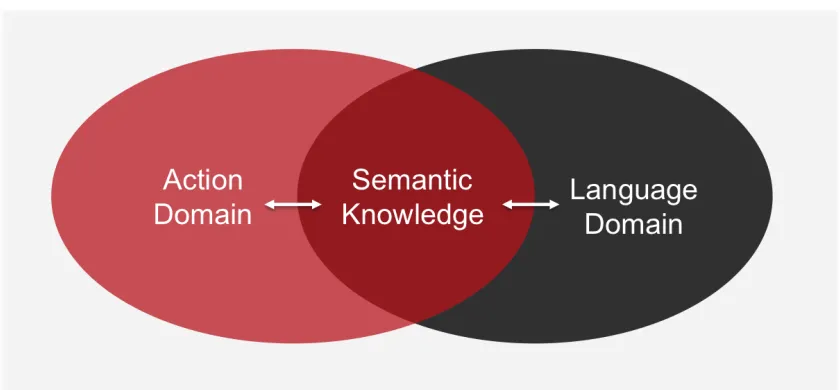
bidirectional one. Rüschemeyer and colleagues (2009) propose that both cognitive
domains share one common ground, namely semantics, in order to function (Figure
Figure 1.1: Domain specific overlap between action and language with each domain required to access the semantic knowledge system. Modified from Rüschemeyer et al. (2009).
Under this scenario, in order to investigate the functional properties of both domains,
one must a) first look at how meaning is represented in each of these domains and b)
make use of EEG methodology to investigate comprehension of the pre-verbal
population when studying the relation between the two developing domains as they
emerge during early development. The latter will also enable direct comparison with
current adult findings within the mirror neuron account.
In order to become a functional member of this world, it is essential to relate
incoming and outgoing abstract symbols into meaningful concepts. In the context of this
thesis, when we refer to the terminology semantics, we refer to the attribution of
meaning to linguistic and action content. In both cognitive domains, the recruitment of
semantic meaning from knowledge involves constructing a mental image or
representation and then comparing it with a given context (Rüschemeyer et al., 2009).
The retrieved semantic knowledge thus activates expectations, which is shaped and built
on past and individual experiences. These experiences, whether active (embodied
[image:25.595.101.521.68.263.2]related to semantics could be reflected in different factors and functions. For instance,
the activation of action related sensation/input could be reflected in different areas
across the brain via different mechanisms.
In cognitive neuroscience, semantics has previously been investigated via two
distinct routes. The first route will be referred to in this thesis as a more indirect route to
semantic knowledge using the semantic expectancy paradigm. In our interpretation, this
access is indirect as semantic recruitment is context dependent (i.e. context based on
previous perceptual information such as a word prime). This semantic congruency
pathway to semantics will be explored via event-related brain potentials, more
specifically via the N400 ERP component. In both cognitive domains (action and
language) this specific neural marker was found to be a sensitive indicator of the
semantic relationship between the target and context with the N400 ERP morphology
depicting a more negative deflection when target does not fit the expected context.
The other route infers a more direct access to stored semantics by means of
event-related oscillations (ERO’s). In comparison to the N400 literature, relatively little
is known about the semantic involvement of the motor system in early development
especially that of the language domain. Two distinct measures are thought to access
semantics via oscillatory measures - both of which can be extracted from the alpha
range of the recorded EEG. The first one represents the upper alpha (marker for
semantic congruency that is thought to reflect activation of the semantic knowledge
system) and the second mu rhythm (evoked by action perception or execution, typically
observed over the sensorimotor cortex). Both of these two alpha measures access
semantics differently. Upper alpha, similar to the N400, is in our interpretation more
context dependent and is therefore likely to be a more indirect form of measuring
resonance (mu desynchronization), as a single action stimulus can lead to the activation
of motor systems. The subsequent section will provide more information for each of the
neural correlates.
1.2.1 Accessing Semantics via the N400 ERP component
1.2.1a Language-N400Derived originally from language research more than thirty years ago, one specific
neural correlate was found to index processing of semantic information. For instance,
when reading sentences that ended either with a congruent word (e.g., I shaved off my
moustache and ‘beard’) when compared to incongruent endings (e.g., I take coffee with
cream and ‘dog’), adult participants in Kutas & Hillyard’s (1980) study displayed a
distinctly more negative deflection peaking at around 400 ms post stimulus onset for
incongruent words. This component was labelled the N400 (Kutas & Hillyard, 1980; for
a more in depth review, see Kutas & Federmeier, 2011). Since this discovery, the N400
event-related brain potential has been reliably replicated and linked to semantic
processing for a wide array of stimulus types.
Developmental research unitizing the N400 such as work by Friedrich and
Friederici (2010) found that infants with high early language word production displayed
an N400 semantic priming effect in a picture-word paradigm already at 12 months.
With respect to language proficiency, infants with low language production did not
show this effect, even if parents rated the words to be comprehended by their children at
that age. The results suggest that infants’ state of behavioural language development
can be reflected by the presence or absence of the N400. Thus, the N400 component is
useful for studying language comprehension and it can provide insights into the way
1.2.1b Action-N400
Perception of action (as outlined in section 1.1) also involves semantic processes.
Amoruso and colleagues (2013) suggest in their review article that both N400 measures
(action and language N400) are likely to possess a common source despite being
indexed by two different semantic systems (verbal in the left and image-based in the
right hemisphere) (Kutas & Federmeier, 2011). Consequently, the N400 neural
signature of present literature shifts toward the notion of a more boarder index for
processing. The focus of the N400 as a tool for studying action processing has
increasingly gained popularity in the field. In recent years, action research has made use
of this neural marker to investigate how expectancy from previous experience impacts
novel observed events and how they may be concluded (Reid & Striano, 2008). The
N400 component was linked to sequences of action that included violation of
expectation (e.g., Reid et al., 2009). Reid and colleagues (2009) found that 9-month-old
infants and adults, but not 7-month-olds, produced an N400-like response when
anticipating action conclusions. A speculative conclusion by the authors was that this
may lead to the suggestion that language processing may derive from understanding
action in early development. First, infants understand the structure of actions. Through
possessing this capacity, infants likely bootstrap learning about language through the
application of rules relating to the structure of action when processing language
structures later in development. Reid and colleagues (2009) suggested that infants’
inferences about action are based in an early developing semantic framework, which
goes beyond infants’ pairing of objects and outcomes simply because they always
appear simultaneously (Ní Choisdealbha & Reid, 2014). In congruence with this view,
van Elk and colleagues (2008) reported that planning a meaningful action as opposed to
preparation (van Elk et al. 2008).
1.2.2 Accessing Semantics via Event-Related Oscillations
1.2.2a The Indirect route of the Upper Band of the Alpha RangeFrom adult literature, the work from Klimesch and colleagues (1992) is of particular
interest as he argues for a distinction between lower alpha (7–10 Hz) and upper alpha
(10–13 Hz) range. The lower alpha in his view represents more global neural processes
mainly related to attentional demands and the latter, upper band within the alpha range
is thought to be more localized and related to specific task demands in adults. In his
later work, Klimesch (1999) postulates that alpha desynchronization in adults is
associated with semantic long-term memory performance and theta synchronisation1 with the encoding of new information, which is in close contact with long-term
memory. Even more recently, desynchronization within the upper alpha range has
further been related with the recruitment of the semantic knowledge system in adults.
More specifically, the retrieval of semantically well integrated information is thought to
elicits more cortical excitation when compared to less integrated information. In other
words, the more incorporated information is in the semantic knowledge system, the
larger the upper alpha band desynchronization (Klimesch, 2012).
In infant literature, evidence is emerging which indicates that a lower frequency
band (5-7 Hz) of the alpha range reflect early social object learning mechanisms as
alpha was evidently more suppressed in 4 and 9-month olds to faces with object
directed eye gaze when compared to averted eye gaze (Michel et al., 2015). Hoehl and
colleagues (2014) also reported desynchronization of this lower band when
1 Synchronisation of the theta band is associated with successful learning (e.g., Begus et al., 2015; Saby & Marshall,
olds and adults previously engaged in eye contact prior to turning to an object presented
on a computer screen when contrasted with a lack of direct eye contact. The authors
postulated that eye contact leads to increased brain activation in response to an object
(Hoehl et al., 2014). Whether the related brain response was related to information
processing about the object or was triggered by joint attention or a mere arousal caused
by the eye contact remains uncertain. To our knowledge, evidence that parallels upper
alpha in adults and in early development is still unexplored.
1.2.2b The Direct route of Motor Resonance
The theoretical framework of embodied cognition proposes that language is grounded in
perception and action systems (e.g., Fischer & Zwaan, 2008; Gallese, 2008; Glenberg &
Gallese, 2012) with the suggestion that the simultaneous representation of both action
performance and audio information consequently results in synaptic connectivity
between neurons in specific motor and language areas (Pulvermüller, 2005). The role of
mirror neurons 2in the parietal and premotor cortex (e.g., Gallese, Fadiga, Fogassi, &
Rizzalatti, 1996), are of specific importance as they activate during action execution as
well as action observation performed by others (Fogassi et al., 2005; Rizzolatti &
Craighero, 2004). Subcategories of mirror neurons could further be found in monkey
premotor cortex triggered by action sounds such as ripping a piece of paper independent
of the action being represented visually (Kohler, Keysers, Umiltà, Fogassi, Gallese, &
Rizzolatti, 2002).
The general position present in the literature is that the equivalent to the human
mirror neuron system is also reflected in mu rhythm of the recorded
2 Mirror neurons were originally discovered in the premotor cortex of the macaque monkey and are characterized by
electroencephalogram (EEG) (Gonzalez, Reeb-Sutherland, & Nelson, 2016). Mu
rhythm desynchronization is an electrical pattern linked to motor experience typically
measured over the sensorimotor cortex (Cuevas et al., 2014). Due to infants' sensitivity
for understanding goals as demonstrated by numerous behavioural studies (e.g.,
Sommerville & Woodward, 2005) and evidence from studies looking at motor
representations of perceived actions (e.g., Nyström, Ljunghammar, Rosander, & von
Hofsten, 2011), it is expected that mu rhythm decreases in power (desynchronizes)
when infants observe goal-directed actions or perform an action themselves when
compared to mu at rest (Marshall et al., 2011).Consequently, the measure of mu rhythm
is of relevance for action perception and action observation due to its responsiveness
predominantly to observed actions as a function of infants’ motor repertoire (e.g.,
Pineda, 2005; van Elk et al., 2008; Reid et al., 2011). More specifically, the suggestion
from the mirror neuron account is that observed actions can only be understood if they
can be mapped onto one’s own motor representations (e.g., Nyström et al., 2008).
Cannon and colleagues (2015) found infants with increased competencies of grasping a
toy to correspond with greater mu desynchronization when observing reaching actions
thus reflecting the link between perception and action systems. Nyström and colleagues
(2008) found 8-month old infants to display a similar pattern of motor activation to
goal-directed as opposed to non-goal-directed actions (Nyström et al., 2008). These
findings are in agreement with behavioral data, which indicate that the identification of
a goal from an action sequence was related to 10-month-old’s own performance
(Sommerville & Woodward, 2005) and that increased motor proficiency (e.g.,
pointing), leads to a better understanding of other’s actions (Tomasello, Carpenter, &
Liszkowski, 2007).
imitated via mu desynchronization. Immediately after 14-month-old infants executed
specific goal-directed actions (e.g., button press) they watched actions that were either
in accordance with the actions that they just performed (imitating the infant) or not.
Their results revealed mu desynchronization to be greater for actions that matched their
own. Mayer and colleagues (2011) report greater motor activation of 3-year-olds to
action observation when acting jointly in comparison to observing two others jointly
performs the same action task. These findings indicate that in early toddlerhood,
observing others’ actions are differentially processed as a function of joint attention and
are further thought to lead to more success in task performance. These findings suggest
that motor resonance has close links with social cognition.
Motor resonance could provide a useful tool to investigate the development and
integration of new actions and how actions and their verbal referents are learned. It is
consequently particularly intriguing to investigate how motor system develop for
actions that are currently outside a child’s motor repertoire.
1.2.3 Methodological Issues
Before we outline our objectives, it is essential to discuss at this point the difficulties
that researchers are facing when conducting EEG research. These difficulties are
concerned around data acquisition, analyses and subsequently interpretability as a
consequence. A general challenge for both behavioural and psychophysiological
developmental research is to adapt adult paradigms and procedures for use with a
developmental population. When focusing on neurophysiology, already at the stages of
data acquisition, inconsistencies in the literature derive based on a lack of replication in
the field and the different methods used across development. This is also seen via an
papers. The issues raised in this thesis link to studies from different periods over the
past decades. The differences between EEG and ERPs create added complexities in
terms of indexing perceptual and cognitive functions. For instance, differences are
noted between the infant N400 and the adult N400 even in studies where the same
paradigm was applied. Reid et al. (2009) report N400 differences in latency such that
the N400 appeared later for the developmental sample when compared to the adult
sample. Furthermore, the observed N400 effect was predominantly posterior within the
infant sample. The topological difference was explained with the presence of a second
overarching component, thought to reflect attentional processes in early development.
This component was prevalent in fronto-central region resulting in a potential masking
of the N400 component over central sites. Latency differences are often described in
developmental ERP research (see Hoehl & Wahl, 2012) and incomplete myelination in
the infant brain may be a contributing factor for slower neural responses (Picton &
Taylor, 2007). More recently Stets and Reid (2011) discussed how amplitudes change
over the course of an experimental session. These changes are not typically discussed
within the infant literature but should be considered as they may explain differences in
infant and adult responses (Ní Choisdealbha & Reid, 2014). Within EEG work,
event-related oscillations are comparably unexplored, however a rapid increase in this field
can now be observed – as can be seen in the alpha frequency literature. To this point,
developmental studies have not considered a systematic subdivision of this frequency
into upper and lower bands as reported in adults. These subbands are thought to reflect
different functional properties which are currently being overlooked in developmental
research efforts. The use of narrower frequency bands has however the potential to
reduce the possibility that frequency specific effects are being missed (e.g., Klimesch,
Another difficult area in infant EEG is that of data editing and analysis.
Researchers are required to find a good balance between guiding their analysis approach
on a priori regions or time windows of interest, that are in addition not always
consistent within the field, and satisfy the need to take a reasonable account of the data
as it presents itself. Reasons for this could stem from a large variety of brain imaging
methods used for adult and infant studies which make it difficult to signify which
channels on the differing sensor nets correspond to the ERP component of interest.
Unfortunately, various methodological issues can obstruct reported findings leading to
misconceptions across the field. Expertise in EEG practical techniques, such as the
correct application of the EEG net, for instance, is also a considerable factor very rarely
discussed in the field. One might argue that the application of the EEG nets per se
represents a margin of error. In other words, where the application of the net on the
infant scalp is already incorrectly placed, reported effects e.g. from so called frontal
sites, could in reality be central just by misplacing the net by a few increments. The
choices made during the data editing process are further influenced by the experience of
the researcher as well as the standards set by their laboratories. These standards can
largely vary from using certain algorithms for trial by trial analysis that can further be
followed up with a second round of manual rejection. In addition, the child’s behaviour
during the testing session is not always assessed. In other words, whether the child has
been paying attention to the stimulus material presented is not always considered and
consequently trials can enter the final analysis, which are not a direct neurological
response to the test stimuli.
For the present thesis, we have adopted current as well as the highest standards
in the field, and as a result we believe that we have made appropriate choices based on
of interest and thresholds for trials entering the final analysis. If we would have taken a
more disingenuous approach by including channels based on previous findings, we
would have not accurately reflected the data as it presents itself. Further, we adapted
new strategies by ignoring fixed band analyses and consequently implemented a
narrower frequency band approach. Lastly, each experimental chapter highlights the
minimum number of artifact-free trials for participant inclusion and justification for the
defined minimum.
We recommend that future infant EEG research should resolve these
methodological concerns by introducing standardised protocols. In addition, researchers
must report specific details in greater detail related to their procedures and analysis
approaches undertaken. In this thesis, we have attempted to report all methodological
decisions and approaches as fully as possible
1.3 Thesis Objectives
To date, comparably little is known about the relation between language and action and
how semantics is involved within this process in early development. Our primary focus
is therefore on the access of semantic meaning via different routes via the help of
neurophysiological measures. Three targeted studies were designed in order to better
understand the modulation of semantics at distinct points in development.
In Chapter Two, I will be examining semantic processing abilities of everyday
non-communicative actions by pre-verbal infants and explore how this relates to
language proficiency. My first study utilizes event-related potential methodologies
(ERP’s) to investigate how social-cognitive processes in pre-verbal infants relate to
later language capacities. Nine months old infants’ understanding of the semantic
contained expected and unexpected action outcomes. At 9 and 18 months, infants’
language abilities were measured using the Swedish Early Communicative
Development Inventory (SECDI). We propose that infants who show a selective N400
response to unexpected action outcomes are those who are better language
comprehenders and producers. The results will help us explore the notion that language
performance is related to the ability to detect and interpret human actions at 9 months of
age. They will also further our understanding related to the basic cognitive mechanisms
involved in the processing of sequential events that are shared between two
conceptually different cognitive domains.
In Chapter Three, semantic representations to newly acquired nouns in
10-11-month old infants were investigated. For this purpose, a combined event-related
oscillation (ERO) and ERP study was developed in which infants first experienced a
live social interaction for 6 minutes while an experimenter introduced and labeled two
novel objects. Immediately after learning and with a 24-hour delay, infants were first
primed with one of the two novel words from the learning phase via loudspeakers.
Shortly after the word presentation, one of the two objects seen in the learning phase
appeared from behind an occluder on a computer screen. The word–object pairing was
either congruent or incongruent. By subsequently presenting infants with the objects
from the learning phase, that were either in line with the infants’ referential expectation
(congruent condition) or not (incongruent condition) we postulated that mismatches
(incongruent condition) will be detected for the word-object pairs. Specifically, we
predicted a more negative N400 component to the incongruent word-object pairs as well
as suppression of the upper alpha band in response to congruent word-object couplings.
Further, a correlation of upper alpha band suppression with the N400 ERP component
knowledge system at 10- to 11-months. Theta band synchronisation as a representative
neural marker for encoding was further considered in this paradigm. Its relation to the
formation of new information during infancy was also investigated. Finally, we aimed
to contribute to our understanding of semantic formation trajectory by means of infants’
memory recall for novel words and objects at two points in time (immediately after and
24-hours later).
The aim of Chapter Four, containing the third experimental study of this thesis,
was to investigate the early link between language and motor systems in 24-month-old
children. We were specifically interested in examining the modulation of the
sensorimotor alpha frequency band before and after the acquisition of novel hand
actions, verbs and sounds. We proposed that this rarely performed pre-post training
paradigm would give new insight into the relation between motor activation and
language acquisition - specifically that of verb acquisition. Our study therefore
comprised a pre-training assessment, a 6-day observational home training phase, and a
post-training assessment with monolingual English children. We measured verb
comprehension as indexed by motor activation of the mu rhythm over frontal and
central sites. Further, we investigated whether mu desynchronization in response to
action-related verbal material can be distinguished from desynchronization triggered by
non-linguistic but equally familiar material. This final manipulation was aimed to
explore the notion that verb processing distinctly modulates motor activation in early
toddlerhood. Effects would inform us of the functional involvement of both action and
Chapter 2
Semantic processing of actions at 9 months is linked to language
proficiency at 9 and 18 months
Text as it appears in Kaduk, K., Bakker, M., Juvrud, J., Gredebäck, G., Westermann, G., Lunn, J., & Reid, V.M. (2016). Semantic processing of actions at 9 months is linked to language proficiency at 9 and 18 months. Journal of Experimental Child Psychology,
Volume 151, 96-108. Special Issue: Interrelations Between Non-Linguistic and Linguistic Representations of Cognition and Action in Development
Abstract
2.1 Introduction
Young infants show sophisticated abilities across an array of cognitive domains during
early development (Mandler, 2006). One example of this is the ability to determine
outcomes of actions, which is linked to the capacity to process other people’s goals and
their intentions (Baldwin, Baird, Saylor, & Clark, 2001). It is possible to conceptually
divide human action into two primary forms. On the one hand, actions can be
communicative in nature and are designed to directly engender social understanding of
information. Within this framework, infants’ preverbal social–communicative capacities
such as the ability to follow others’ eye gaze (e.g., Brooks and Meltzoff, 2005, Brooks
and Meltzoff, 2008 and Brooks and Meltzoff, 2015) and to process pointing (e.g.,
Brooks and Meltzoff, 2008, Butterworth and Morissette, 1996 and Tomasello et al.,
2007) and gestures (e.g., Kraljević et al., 2014, Rowe and Goldwin-Meadow,
2009a and Rowe and Goldwin-Meadow, 2009b) are well studied and have been related
to various aspects of later language abilities.
A second form of actions incorporates all of those actions that are
non-communicative in nature but still convey goal directedness. Such goal-directed actions
can be observed repeatedly in typical environments by infants during early
development, ranging from parents cleaning the home to the preparation and
consumption of food. In such scenarios, adults as well as young children readily
construct action representations that are organized with respect to this ultimate goal
(Baldwin et al., 2001 and Zacks et al., 2001). For example, infants from 6 months of age
can accurately predict that a cup (Hunnius & Bekkering, 2010) or a spoon (Kochukhova
and Gredebäck, 2010 and Reid et al., 2009) should go toward a person’s mouth rather
than toward a person’s ear. These representations allow for the prediction of the