© 2019, IRJET | Impact Factor value: 7.211 | ISO 9001:2008 Certified Journal | Page 151
Smart Mirror using Virtual Voice Assistant
Amit Dhavale
1, Saurabh Chavan
2, Mayuresh Supe
3, Pravin Rahate
41,2,3,4
Student, Department of Computer Engineering, Datta Meghe College of Engineering, Navi Mumbai,
Maharashtra, India,
---***---Abstract -
This paper describes the design andimplementation of a voice controlled wall mirror, called “Smart Mirror”. It is a device that can function both as a mirror and a useful source of interaction for getting daily updates about the weather, news as well as for playing audio and video files. In addition to this, the device can also be used for searching any type of information on the internet which could be useful to satiate our knowledge and curiosity. Tasks such as mathematical computations can be done thoroughly and ergonomically within fraction of seconds. Thus, the paper illustrates the construction and working of the Smart Mirror in full and also gives an overview of its vivid applications.
Key Words: Smart Mirror, Raspberry pi 3+, voice assistant, Internet of Things;
1. INTRODUCTION
In our day to day life, we make use of our smartphone to get updates about the various activities that go on in different parts of the globe. Often times we get drawn to our mobile phones for the usage of various applications, in most cases surfing the internet, getting news updates and playing video and audio files. When we are outdoors we cannot help but rely upon our smartphones to give us all the information that we need, but when we are indoors, the nuisance of handling a device in our hands could become tiresome at times. So, during those times, it is possible to construct a device which provides the benefit of operating itself with the help of voice commands in case we are too exhausted to operate it physically through instruments like keyboard and mouse. Through only our own voice we can tell the Smart Mirror to perform some of the basic but needful tasks that we require in our everyday life. And as far as the cost and space management is taken into consideration, the implementation of the Smart Mirror is very frugal and can be carried out by people of any financial class as the Smart Mirror does the work of both a smartphone and modern television. Such types of devices create an effortless and calm atmosphere and therefore ease our lives in many ways. [1]
1.1 THEORY
In the last ten to fifteen years, we have seen a considerable amount of development and innovation in the field of Artificial Intelligence, Machine Learning, and Internet of Things. Many software, as well as hardware components, have been developed for a lucid and user-friendly interface. It is only through this desire for a better interface with less physical and mental efforts that we are living in a connected
environment which has the capability of going through constant changes. Similarly, it is the human nature that craves for more facilities that pave the way for a life of ease. The concept of Smart Mirror is one of these facilities.[2]
Through the Internet of Things[3] concepts, we came to understand the positive effects of a voice controlled device in the form of a television and that too cost-effective, which could be useful in a residential environment to get the basic if not the most important tasks that are being performed in our day to day life and which require constant flow of various kinds of data for personal and professional use done.
By making use of hardware components such as a spare monitor, couple of cables of various types and a Raspberry Pi 3+ module by using it as a control processing unit, we developed a system which is equivalent to a home automation system, but which is used to perform some of the mundane tasks such as reading a newspaper, getting live news feeds, weather reports, and playing audio and video files. Along with these tasks we made the Smart Mirror worthy enough to be able to search any information on the internet by just aptly and precisely guiding the device through our voice. The main advantage of this concept is that all of the provided applications could be done simultaneously.
It is by keeping in mind the convenience factor that we were able to formulate a user-friendly and basic automation system which could be operated by a person’s voice for the common man. So instead of purchasing a brand new television, altogether, it would be better if for household purposes a person could build his or her own Smart Mirror by gathering a bunch of hardware resources and program the voice assistant functionalities according to one’s own need by investing a diminutive amount of monetary resources.
1.2 RELATED WORK
© 2019, IRJET | Impact Factor value: 7.211 | ISO 9001:2008 Certified Journal | Page 152
(weather reports). The project provided valuable feedbackon improving the workplace conditions of the employees.[4]
In addition to this, we also looked at the Smart Mirror developed by the students of the Sri Lanka Institute of Information Technology who had developed a similar prototype with the intention of monitoring children in a secure manner. Their model made the use of connecting various applications concerning childcare services which were installed on the Smart Mirrors in the vicinity of the children’s homes.[5]
Finally, we have thoroughly studied an Internet of Things (IoT) based Smart Mirror developed by the students of GSSSIETW, Mysuru, Karnataka, in which they have implemented sensors which possess the ability to detect an unknown person whose details have not been entered into the Smart Mirror database. The system was developed mainly for the purpose of the detection of a thief in a household. The Smart Mirror was connected to the alarm system of a home and thus proved to be a useful mechanism from a security perspective.[6]
2. PROPOSED SYSTEM AND COMPONENTS
The following information outlines the various components that we have made use of as well as the purpose for which they have been used.
2.1 SYSTEM OVERVIEW
In our Smart Mirror implementation, we have considered implementing various applications or widgets using web development technologies. We have used XML (Extensible Markup Language), CSS (Cascading Style Sheets), Javascript, and Bootstrap for designing a couple of our own widgets. The voice assistant feature through which the user can interact with the Smart Mirror is implemented using the Python programming language. Data is exported and imported using JSON (Javascript Object Notation). Since the implementation is devoid of any cloud service we have abandoned the RSS (Really Simple Syndication) feature in many of the applications. So the user will be getting a new news feed every time he or she logs into the Smart Mirror. For implementing the voice assistant functionalities, we have used Amazon Web Service’s Alexa as our project’s voice helper and developed our own voice assistant for various basic and easy-to-use widgets that we have implemented for the purpose of demonstration.
It is our intention that the human interaction with the Smart Mirror is on the same level of ease as that with a typical smartphone, but perhaps on a more casual level. The implemented system block diagram for the smart mirror which exemplifies the hardware and software connections is shown in Figure 1. The aim of designing this model is to create an interactive interface which can be conveniently used in a home environment on a large scale. Various services like weather, calendar, traffic, news stock updates etc. can be
accessed and controlled using voice commands. The Raspberry Pi 3+ module is connected to a Monitor via HDMI cable and a speaker is attached using a universal serial bus. The speakers can also be operated using the Bluetooth technology. Voice commands to the Smart Mirror are provided via a microphone which is, again, attached to the Raspberry Pi 3+ module. The Raspberry Pi 3+ is powered up using a 5V/2A DC supply.
The technologies used for Smart Mirror are:
1. Artificial Intelligence
2. Machine Learning
3. Bluetooth
4. Python
5. JSON
6. CSS (Cascading Style Sheets)
7. XML (Extensible Markup Language)
8. Bootstrap
[image:2.595.308.577.421.568.2]9. Javascript
Figure 1- Hardware components and their connections
2.2 RASPBERRY PI 3+
Raspberry Pi 3+ is the main component for this proposed model. The Raspberry Pi 3+ is used with micro SD card which is mounted on it. An operating system called Raspbian is booted with the help of the Raspberry Pi 3+ module and the Smart Mirror is initiated. Voice commands are to be given to the Smart Mirror through the microphone and the output is delivered through the speakers as well as displayed on the Smart Mirror.
2.3 DUAL PURPOSE MIRROR
© 2019, IRJET | Impact Factor value: 7.211 | ISO 9001:2008 Certified Journal | Page 153
When the monitor is turned on, the mirror will be used forthe purpose of Smart Mirror usage, and, when the monitor is turned off the mirror will be used as a general purpose mirror as it has reflective as well as non-reflective properties. Often in our households, we require a mirror, and therefore, we believe that it would be less time consuming that a single device be used for getting the routinely activities of our everyday life done and at the same time check for updates about the events and occurrences around us. By taking into consideration the dual purpose benefits of the mirror, we realized that the need for an additional general purpose domestic mirror could be eliminated. The concept of a dual purpose Smart Mirror was analyzed and implemented by referring to the work done in a similar fashion by the alumni of MacEwan University, Canada. [7]
2.4 FUNCTIONALITIES
The implemented model is capable of performing the following operations:
1. Work as a general purpose mirror which can be used as a regular mirror.
2. Provide the option of using the model as a smartphone based personal computer which is capable of working exactly like a smartphone without a touch functionality but a voice assistant as well as various other modes of operation such as keyboard and mouse.
3. The implemented Smart Mirror’s main objective function is to let the user interact with the proposed model with the help of voice commands. This means that with the help of some pre-determined set of voice commands, the user will be able to navigate his or her way through the various applications (widgets) installed in the operating system such as viewing stock updates, weather updates, news, in addition to playing audio and video files.
4. The features of the implemented Smart Mirror are:
I. Automatic Voice Recognition
II. Global Vocabulary
III. Natural Language Processing based text-to-speech processing
IV. Real time streaming and stored audio and video playback
[image:3.595.310.559.56.208.2]The Smart Mirror operations are based on the following entity relationship diagram represented in Figure 2.
[image:3.595.322.547.269.414.2]Figure 2- Smart Mirror Working
Figure 3 gives an understanding of the internal working of the Smart Mirror through a lucid flowchart.
[image:3.595.312.563.497.597.2]Figure 3 – Smart Mirror Internal Working
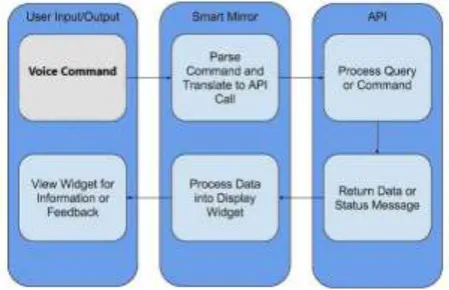
Figure 4 illustrates the sequence in which the voice assistant takes an input voice command and gives the desired output in an audio visual format.
Figure 4- Voice Assistant Internal Working
© 2019, IRJET | Impact Factor value: 7.211 | ISO 9001:2008 Certified Journal | Page 154
Figure 5 – Smart Mirror FrameworkFigure 6 shows the basic user interface of the Smart Mirror that will be used by the end user. The user interface will show the data on the mirror and the empty space in between will accommodate the reflection of the user. Initially, a black screen such as the one illustrated in Figure 6 will pop up and succeeding that the user can either control the Smart Mirror via voice commands or through conventional keyboard or mouse.
[image:4.595.93.228.492.696.2]The need for a voice assistant that we have developed can be felt useful when the user does not need to edit any documents and simply wants to search any type of information on the internet, since we have implemented the voice assistant functionalities only for certain widgets that were inbuilt in the Raspbian operating system and some of the widgets that we designed on our own. We decided to implement the voice assistant feature by studying the existing prototype developed by the students of the University Engineering College of Pune. [9]
Figure 6 – Smart Mirror User Interface
3. CONCLUSIONS
We have designed a Smart Mirror keeping in mind the avid interest taken by various large scale technological conglomerates which have focused their attention on providing user friendly devices which use various voice based commands as they are available in smartphones. However, our focus is concentrated on the benefits that will be experienced to the full by the common people who lack the financial resources to purchase branded products.
We have built a working model to demonstrate the basic applications which are used by the common man and the simple ways in which the user can interact with the Smart Mirror by giving input in the form of voice commands into the microphone and acknowledging the output via the speaker as well as the Smart Mirror itself.
It is our belief that for future work we would be able to implement a couple of additional functionalities such as build an entire home automation system using the Smart Mirror, make available the possibility of playing sport games and enable the user to interact with a number of other essential applications.
ACKNOWLEDGEMENT
We would like to thank our project guide Prof. Pravin Rahate in guiding and helping us towards achieving our project objectives.
REFERENCES
[1] M.S.Raisinghani, A. Benoit, J. Ding. M. Gomez, K. Gupta,
V.Gusila. D. Power, and 0.Schmedding, Ambient intelligence: Changing forms of human computer interaction and their social implications. Journal of Digital Information, 5(4), (2004).M. Young, The Technical Writer’s Handbook. Mill Valley, CA: University Science, 1989.
[2] Preeti Pannu, Vaibhav Khanna, Yash Vardhan, Dhruv
Nair, Design and Development of a Smart Mirror Using Raspberry PI, IJEEDC, Volume-5, Issue 1, January 2017.
[3] K.Ashton, “That 'Internet of Things' Thing” RFID Journal,
July 22, 2009.
[4] Gómez-Carmona, Oihane & Casado Mansilla, Diego.
(2017). SmiWork: An Interactive Smart Mirror Platform for Workplace Health Promotion.
[5] R.M.B.N. Siripala, M. Nirosha, P.A.D.A. Jayaweer4 ,
© 2019, IRJET | Impact Factor value: 7.211 | ISO 9001:2008 Certified Journal | Page 155
[6] Lakshmi N M, Chandana M S, Ishwarya P, Nagarur
Meena, Rajendra R Patil: IoT based Smart Mirror using Raspberry Pi (2018).
[7] Derrick Gold, David Sollinger, and Indratmo. Smart
Reflect: A Modular Smart Mirror Application Platform. IEEE Journal, Nov 2016.
[8] D.K. Mittal, V. Verma, R. Rastogi.: A Comparative Study
and New Model for Smart Mirror (2017).
[9] Prof. Sheetal Patil, Prathamesh S. More, Pratik P.