GO Corpomtion
GO Technical Library
,---PenPoinf Application
Writing Guide
em
GO Corpomtion GO Technical LibraryPenPoint Application Writing Guide, Expanded Second Edition provides a tutorial on writing PenPoint applications, including many coding samples. It also provides information about PenPoint 2.0 Japanese and how it supports internationalized applications. This is the first book you should read as a beginning PenPoint application developer.
PenPoint Architectural Reference, Volume I presents the concepts of the fundamental PenPoint classes. Read this book when you need to understand the fundamental PenPoint subsystems, such as the class manager, application framework, windows and graphics,. and so on.
PenPoint Architectural
Refer~~ce~;~yoiluitle
II presents the concepts of the supplemental PenPoint classes. You'sftqulsl
read this book when you need to understand the supplemental PenPoinr 's'rlbsystems, such as the text subsystem, the file system, connectivity, and so on.PenPoint API Reference, Volume I provides a complete reference to the fundamental PenPoint classes, messages, and data structures.
PenPoint API Reference, Volume II provides a complete reference to the supplemental PenPoint classes, messages, and data structures.
PenPoint User Interface Design Reference describes the elements of the PenPoint Notebook User Interface, sets standards for using those elements, and describes how PenPoint uses the elements. Read this book before designing your
application's user interface.
PenPoint
PenPoint Application
Writing Guide
EXPANDED SECOND EDITION
I'll)
GO CorpomtionGO Technical Library
..
TT
Addison-Wesley Publishing CompanyWarranty Disclaimer and Limitation of Liability
u.s. Government Restricted Rights
Many of the designations used by manufacturers and sellers to distinguish their products are claimed as trademarks. Where those designations appear in this book and Addison-Wesley was aware of a trademark claim, the designations have been printed in initial capital letters.
The authors and publishers have taken care in preparation of this book, but make no expressed or implied warranty of any kind and assume no responsibility for errors or omissions. No liability is assumed for incidental or consequential damages in connection with or arising out of the use of the information or programs contained herein.
Copyright © 1991-1993 GO Corporation. All rights reserved. No part of this publication may be reproduced, stored in a retrieval system, or transmitted, in any form or by any means, electronic, mechanical, photocopying, recording, or otherwise, without prior written permission of the publisher. Printed in the United States of America. Published simultaneously in Canada.
The following are trademarks of GO Corporation: PenPoint, the PenPoint logo, EDA, GO, GO Corporation, the GO logo, GOWrite, ImagePoint, MiniNote, MiniText, and NotePaper.
Words are checked against the 77,000 word Proximity/Merriam-Webster Linguibase, © 1983 Merriam Webster. © 1983. All rights reserved, Proximity Technology, Inc. The spelling portion of this product is based on spelling and thesaurus technology from Franklin Electronic publishers. All other products or services mentioned in this document are identified by the trademarks or service marks of their respective companies or organizations.
PenTOPS Copyright © 1990-1992, Sitka Corporation. All Rights Reserved.
PANOSE is a trademark of ElseWare Corporation, Seattle, Washington.
GO CORPORATION MAKES NO WARRANTIES, EXPRESS OR IMPLIED, INCLUDING WITHOUT LIMITATION THE IMPLIED WARRANTIES OF MERCHANTABILITY, FITNESS FOR A PARTICULAR PURPOSE AND NONINFRINGEMENT, REGARDING PENPOINT SOFTWARE OR ANYTHING ELSE. GO Corporation does not warrant, guarantee, or make any representations regarding the use or the results of the use of the PenPoint software, other products, or documentation in terms of its correctness, accuracy, reliability, currentness, or otherwise. The entire risk as to the results and performance of the PenPoint software and documentation is assumed by you. The exclusion of implied warranties is not permitted by some states. The above exclusion may not apply to you.
In no event will GO Corporation, its directors, officers, employees, or agents be liable to you for any consequential, incidental, or indirect damages (including damages for loss of business profits, business interruption, loss of business info.rmation, cost of procurement of substitute goods or technology, and the like) arising out of the use or inability to use the documentation or defects therein even if GO Corporation has heen advised of the possibility of such damages, whether under theory of contract, tort (including negligence), products liability, or otherwise. Because some states do not allow the exclusion or limitation of liability for consequential or incidental damages, the above limitations may not apply to you. GO Corporation's total liability to you from any cause whatsoever, and regardless of the form of the action (whether in contract, tort [including negligence], product liability or otherwise), will be limited to $50.
The PenPoint documentation is provided with RESTRICTED RIGHTS. Use, duplication, or disclosure by the U.S. Government is subject to restrictions as set forth in FAR 52.227-19 (Commercial Computer Software-Restricted Rights) and DFAR 252.227-7013 (c) (1) (ii) (Rights in Technical Data and Computer Software), as applicable. Manufacturer is GO Corporation, Suite 400, 919 East Hillsdale Boulevard, Foster City, CA 94404, USA.
ISBN 0-201-62299-8
123456789-AL-9796959493
Preface
The PenPoint Application Writing Guide: Expanded Second Edition is an updated version of the PenPoint Application Writing Guide printed in March 1992. This expanded edition includes new information that reflects GO Corporation's enhancements to the PenPoint™ operating system for PenPoint 2.0 Japanese and the PenPoint Software Development Kit (SDK) 2.0 Japanese.
This book is an up-to-date introduction to the PenPoint SDK 2.0 Japanese oper-ating system and contains errata and additional information for earlier PenPoint SDKs. Unless stated otherwise, discussions of the PenPoint operating system and the PenPoint SDK in this book are valid for PenPoint 1.0, PenPoint 1.01, and PenPoint 2.0 Japanese.
PenPoint 2.0 Japanese is a Japanese product with Japanese system resources (on-line help, menu choices, and so on). Developers who do not read Japanese can run the PenPoint SDK 2.0 Japanese with U.S. English resources, but there are some parts of the system that show Japanese text even with the U.S. English feature enabled.
Intended
audience
This book is intended for programmers who want to write applications for the PenPoint operating system. It assumes that you are familiar with the C program-ming language and related development tools such as MAKE utilities.
Document structure
This book contains several parts:
.. Part 1: PenPoint Application Writing Guide is an introduction to the PenPoint operating system and the PenPoint SDK. It introduces you to basic PenPoint programming concepts, then illustrates those concepts by examining some of the sample applications included with the PenPoint SDK.
• Part 2: PenPoint Internationalization Handbook describes the features PenPoint provides that allow you to write an application that is easy to port from one national locale to another.
• Part
3:
PenPoint Japanese Localization Handbook shows how to use features of the PenPoint SDK 2.0 Japanese that support Japanese-language application development.vi PENPOINT APPLICATION WRITING GUIDE Preface
• Part 5: PenPoint Architectural Reference Supplement provides new information about the architecture of the PenPoint operating system and the classes that it provides. This part is an update to PenPoint Architectural Reference originally published for the PenPoint SDK 1.0.
• Part 6: PenPoint User Interface Design Reference Supplement provides new information about user interface design and the user interface classes that PenPoint provides. This part is an update to PenPoint User Interface Design Reference originally published for the PenPoint SDK 1.0.
• Part 7: Sample Code provides descriptions and listings of the sample applica-tions used as examples in this book, and descripapplica-tions of the other sample code included with the PenPoint SDK.
Each of these parts was at one time intended to be a separate document, but they have been bound together into a single volume for your convenience. Be aware that you may still find some cross-references that refer to a part of this volume as though it were still a separate book.
Other sources
of information
Several parts of this book supplement existing books published for the PenPoint SDK 1.0. These books include PenPoint Development Tools, PenPoint Architectural Reference, and PenPoint User Interface Design Reference.
". Part 1/ PenPoint Application Writing Guide
1 / Introduction 5
2 / PenPoint System Overview 7
3 / Application Concepts 23
4/ PenPoint Class Manager 43
5 / Developing an Application 61
6 / A Simple Application (Empty Application) 91
7 / Creating Objects (Hello World: Toolkit) 111
8 / Creating a New Class (Hello World: Custom Window) 123
9/ Saving and Restoring Data (Counter) 133
10/ Handling Input (Tic-Tac-Toe) 145
II/Refining the Application (Tic-Tac-Toe) 155
12/ Releasing the Application 169
Part 2 / PenPoint Internationalization Handbook
13 / Introduction 175
14 / Overview 177
15 / PenPoint Support for International Software 183
16/ Procedures 209
17 / Porting to PenPoint 2.0 229
18/ Localization Guidelines 235
19 / Additional Resources 237
". Part 3/ PenPoint Japanese Localization
Handbook
20 / Introduction 243
21 / Japanese Characters 245
22/ Processing Japanese Text 255
23/ Development Environment 273
24 / Procedures 283
25/ Resources 301
26/ Japanese Character Set 303
". Part 4/ PenPoint Development Tools
Supplement
27 / Introduction 375
28 / Road Map 377
29 / Creating Applications and Services 381
30 / Debugging 395
31 / Tools and Utilities 403
32/ Miscellaneous 415
Part 5 / PenPoint Architectural Reference Supplement
33 / Overview 427
34/ Class Manager 433
35 / Application Framework 435
36 / Windows and Graphics 441
37 / UI Toolkit 445
38 / Input and Handwriting Recognition 451
39/ Text 463
40 / The File System 467
41 / System Services 471
42 / Utility Classes 479
43 / Connectivity 483
44 / Resources 495
45 / Installation API 499
46 / Writing PenPoint Services 503
47 / International Services and Routines 507
Part 6 / Pen Point User Interface Design Reference Supplement
48 / Introduction 517
49 / The Notebook 519
50/ The Bookshelf 523
51 / Overall System Changes 535
Part 7 / Sample Code 549
,.. List of Tables
3-1 Notebook organization and the file system 36
5-1 Generic status values 81
5-2 Status-checking macros 82
6-1 Common header files 99
10-1 Tic-Tac-Toe files 147
15-1 How to work with strings 186
15-2 Formatting differences between countries 196
15-3 PenPoint international functions 197
15-4 Some functions from ISR.H 198
15-5 International function structures 201
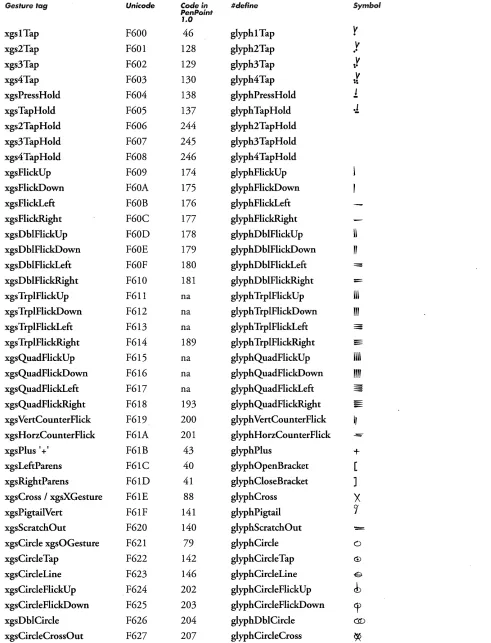
15-6 GO's gesture symbols 203
15-7 Makefile variables 206
16-1 8- and 16-bit functions 213
16-2 Resource utility functions 221
16-3 Converting to international functions 226
21-1 Japanese writing 247
21-2 Unicode encoding of Japanese characters 250
21-3 Japanese font files 251
22-1 Japanese punctuation marks 257
22-2 Japanese behavior of international functions 262
22-3 Default Japanese Formatting 267
22-4 Supported Japanese eras 268
22-5 Date formats 268
22-6 Time Formats 269
23-1 Debug CharSet variable values 274
23-2 GO's sample makefile variables 275
23-3 DOS utilities 276
23-4 Character sets in control files 278
24-1 Using VCONVERT 285
29-1 Attributes stamped by the makefile 385
29-2 Makefile variables 386
29-3 Sample distribution disk structure 390
30-1 DebugCharSet variable permissible values 398
30-2 Mini-debugger controls 402
31-1 Valid values for CHARSET 403
31-2 Attribute utilities 404
31-3 Attributes stamped on installable items 406
31-4 Attributes stamped on documents 406
31-5 Using VCONVERT 409
32-1 PenPoint Development Tools errata 422
. 33-1 New header files 430
33-2 Header files changed for resource strings 430
33-3 Some data name changes 431
34-1 Part 1 ( Class Manager) -typos 434
35-1 Part 2 (Application Framework)-typos 439
36-1 Part 3 (Windows and Graphics)-typos 443
37-1 clsAcetateLayout synchronization messages 447
37-2 Part 4 (VI Toolkit)-typos 449
38-1 clsKKC messages 452
38-2 clsCharTranslator messages 456
38-3 Changed gesture names 459
38-4 Obsolete gesture names 460
38-5 Part 5 (Input and Handwriting Translation)-typos 461
39-1 New gesture targets 463
39-2 Part 6 (Text)-typos 465
40-1 Stamped attributes-PenPoint 2.0 installable items 467
40-2 Stamped attributes-PenPoint 2.0 documents 467
40-3 Part 7 (File System)-typos 469
41-1 Compose Text format code types 472
41-2 Renamed counted string functions 474
41-3 Renamed WATCOM functions 475
41-4 Part 8 (System Services)-typos 477
43-1 Default I/O port state settings 485
43-2 MODEM_METRICS fields 486
43-3 Discrete modem initialization messages 487
43-4 Modem service creation and initialization messages 490
43-5 Modem service request messages 490
43-6 Client and observer notification messages 491
43-7 Predefined service managers 492
43-8 Part 10 (Connectivity)-typos 493
44-1 Resource file utility routines 495
47-1 Header files 507
47-2 Delimiting routines 509
47-3 Hyphenation routines 509
47-4 Time conversion functions 509
47-5 Formatting functions 510
47-6 Parsing functions 510
47-7 Sort and compare functions 511
47-8 Character set conversion functions 511
47-9 String compression functions 512
47 -10 CHARTYPE macros 512
49-1 Gestures used in the Table of Contents 520
51-1 Non-core gestures used in MiniText 537
51-2 Gestures that work in MiniNote 541
51-3 Gestures used in edit pads 544
51-4 Gestures used in Japanese edit pads 547
List of Figures
3-1 Application, view, and object classes 30
3-2 Application Framework and Notebook hierarchy 33
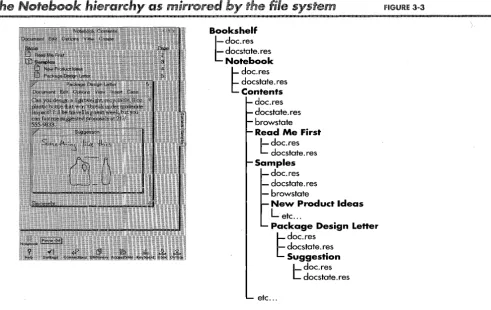
3-3 The Notebook hierarchy as mirrored by the file system 34
3-4 Notebook hierarchy and application processes 35
4-1 Message handling by a class and its ancestors 46
4-2 Sending msgListAddltemAt to a list 47
4-3 How messages to instances are processed by classes 49
6-1 Empty Application option sheet 94
7 -1 UI Toolkit components 115
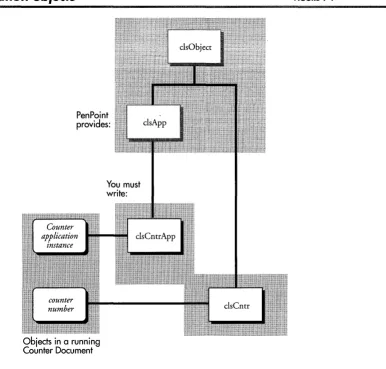
9-1 Counter Application objects 135
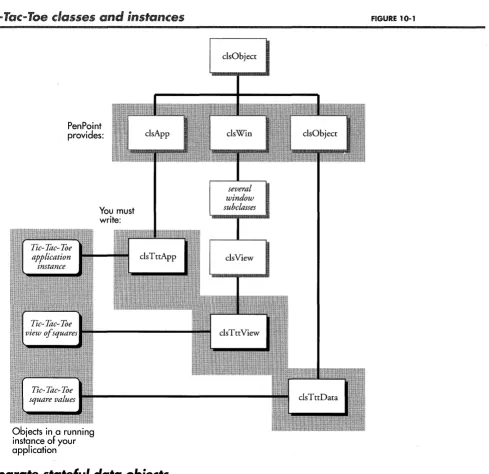
10-1 Tic-Tac-Toe classes and instances 146
11-1 Stationery notebook and Stationery menu 160
11-2 Quick Help 162
11-3 Application and document icons 167
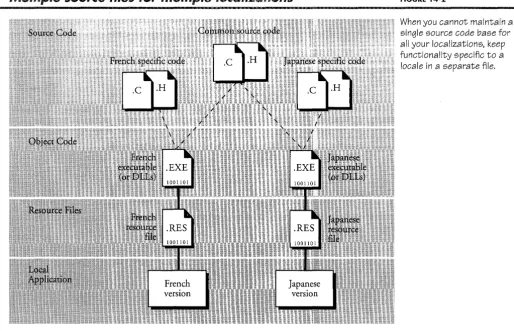
14-1 Common source code for multiple localizations 178
14-2 Multiple source files for multiple localizations 179
14-3 Japanese Text in MiniText 180
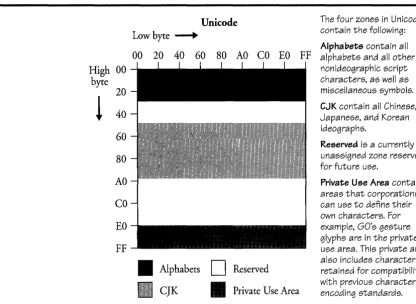
15-1 Unicode architecture 185
21-1 Character code spaces 253
22-1 Handling the KKC gesture 259
22-2 Displaying the translated characters 259
22-3 Handling a character alternatives request 260
22-4 Text with selected bunsetsu 263
22-5 Text with sentence selected 264
23-1 Unicode Browser 280
23-2 Japanese virtual keyboard 281
28-1 Creating an application 379
31-1 Specifying a resource with RESDEL 408
Part
1
I
~ Chapter 1 / Introduction Not all active documents are on-screen
5 Intended audience Application classes and instances
5 Other sources of information 28 PenPoint drives your application 29 Application objects
Chapter 2 / PenPoint System Overview A descendant of clsApp
7 Design considerations An instance of cls Win
7 User interface An instance of clsObject
The pen 31 Understanding the application hierarchy
Notebook metaphor The Notebook's own hierarchy
The Bookshelf 9 Object-oriented architecture
The Notebook
9 Architecture and functionality Page-level applications
10 Kernel layer Sections
Floating accessories
11 System layer Embedded applications
File system Application data
Resource manager
38 Activating and terminating documents Networking
Windowing Turning a page and msgAppClose
Graphics Restoring inactive documents
Printing Page-turning instead of closing
User Interface Toolkit Saving state (no quit)
Input and handwriting translation 40 Documents, not files and applications Selection Manager and data transfer No new, no save as ...
16 Component layer Stationery
16 Application Framework layer 41 Shutting down and terminating applications Conserving memory
17 Application layer Avoiding duplication
17 Software development environment Hot mode
Software development kit Components
Coding conventions
Chapter 4 / Pen Point Class Manager
Extensibili ty
18 PenPoint design guidelines 43 Objects instead of functions and data
Conserve memory 44 Messages instead of function calls
Think small
45 Classes instead of code sharing Use a modular design
Handling messages Your application must recover
Take advantage of object-oriented programming 47 Sending a message
Consider sharing code and data Message arguments
Use document orientation ObjectCallO parameters
Design for file format compatibility Returned values
Exploit the pen How objects know how to respond
Use the PenPoint user interface 49 Creating an object
Chapter 3 / Application Concepts An Classes and instances alternative explanation
24 PenPoint programming is unique The _NEW structure
24 How applications work Identifying _NEW structure elements
Installing and starting applications Code to create an object
MS-DOS installation Identifying the new object: UIDs
PenPoint installation 55 Creating a class
Installer responsibilities New class message arguments
Running a PenPoint application Method tables
Life cycle of a document Self
",. Chapter 5 / Developing an Application
61 Designing your application Designing the user interface Designing classes
Designing messages Designing message handlers Designing program units
63 Designing for internationalization and localization Porting from PenPoint 1.0 to PenPoint 2.0 Japanese Preparing for internationalization
66 Development strategy Application entry point Application instance data Creating stateful objects Displaying on screen Creating component classes
67 Development cycles Compiling and linking Installing the application Debugging
69 A developer's checklist
Checklist of required interactions Checklist of nonessential items
71 GO's coding conventions Typedefs
Variables Functions
Defines (macros and constants) Class manager constants Exported names
74 PenPoint file structure File header comment Include directives Defines, types, globals Function prototypes Message headers Indentation Comments
Some coding suggestions
77 PenPoint types and macros Data types
Basic constants Legibility
Compiler isolation
Data conversion and checking Bit manipulation
Tags
Return values
Return status debugging function Error-handling macros
84 Debugging assistance Printing debugging strings Assertions
Debugging flags Suggestions
87 The tutorial programs Empty Application Hello World (Toolkit)
Hello World (Custom Window) Counter Application
Tic-Tac-Toe
Template Application Other code available
Chapter 6 / A Simple Application (Empty Application)
91 Files used Not the simplest
92 Compiling and linking the code Compiling method tables
92 Installing and running Empty Application
92 Interesting things you can do with Empty Application
94 Code run-through
PenPoint source code file organization Empty Application's source code Libraries and header files Class UID
Class creation
Documents, accessories and stationery
101 Where does the application class come from? Installation and activation
104 Handling a message Method table msgDestroy
105 Message handler Parameters
Parameters in EmptyAppDestroyO Status return value
Message handlers are private
108 Using debugger stream output
108 The debugger stream Seeing debug output
Chapter 7 / Creating Obiects (Hello World: Toolkit)
111 HelloTK
Compiling and installing the application Interesting things you can do with HelloTK
112 Code run-through for HELLOTK1.C Highlights of HELLOTKI
Sending messages
Why did the wIndow appear? Possible enhancements
119 Highlights of the second Hello TK Only one client window per frame Layout
Possible enhancements
Chapter 8 / Creating a New Class (Hello World: Custom Window)
123 Hello World (Custom Window) Compiling the code
Highlights of clsHello World Highlights of clsHello Win
125 Graphics overview System drawing context Coordinates in drawing context When to paint
127 When to create things Instance data
Is it msgNew or msgInit? Window initialization
129 Using instance data No filing yet
130 Drawing in a window
131 Possible enhancements
131 Debugging Hello World (Custom Window)
Chapter 9 / Saving and Restoring Data (Counter)
133 Saving state
133 Counter application
Compiling and installing the application Counter Application highlights
Counter class highlights Instance data
Getting and setting values
138 Object filing Handling msgSave Handling msgRestore
140 Counter Application's instance data Memory-mapped file
Opening and closing the file Filing the counter object
143 Menu support Buttons
Chapter 10 / Handling Input (Tic-Tac-Toe)
145 Tic-Tac-Toe objects Application components Separate stateful data objects
146 Tic-Tac-Toe structure
147 Tic-Tac-Toe window Coordinate system
Advanced repainting strategy
148 View and data interaction Data object design
Instance data by value vs. by reference Saving a data object
Handling failures during msgInit and msgRestore
150 The selection and keyboard input How selection works
151 More on view and data interaction
152 Handwriting and gestures Input event handling Gesture handling Keyboard handling
Chapter 11 / Refining the Application (Tic-Tac-Toe)
155 Debugging Tracing
DebugfO statements and debug flags Dumping objects
Symbol names
159 Installation features
159 Stationery Creating stationery
How Tic-Tac-Toe handles stationery
160 Help notebook
Creating help documents
161 Quick Help
Creating Quick Help resources
164 Standard message facility Using StdMsgO facilities
Substituting text and defining buttons StdMsgO and resource files or lists StdMsgO customization function
166 Bitmaps (icons) Creating icons
Chapter 12 / Releasing the Application
169 Registering your classes
169 Documenting the application Writing manuals
Screen shots Gesture font
170 On-disk structure
Chapter
1 /
Introduction
The PenPoint™ operating system is an object-oriented, multitasking operating system that is optimized for pen-based computing. Writing applications for the PenPoint operating system will present you with some new challenges. However, PenPoint contains many features that make application development far easier than development in many other environments.
One feature that makes application development easier is the PenPoint Application Framework, which eliminates the need to write "boilerplate" code. In other oper-ating systems, programmers must write code to perform housekeeping functions, such as application installation, input and output file handling, and so on. These are provided automatically by the PenPoint Application Framework.
PenPoint also provides most of the on-screen objects used by the PenPoint Note-book User Interface (NUl). By using these objects, your application can conform to the PenPoint NUl, without a great amount of work on your part.
In this manual, you will learn about the PenPoint operating system, the PenPoint development environment, and, of course, how to write applications for the Pen-Point operating system. The PenPen-Point Software Development Kit (SDK) contains several sample applications that you can compile and run. These sample applica-tions are used throughout this manual to demonstrate concepts and programming techniques.
Intended
audience
This manual is intended for programmers who want to write applications for the PenPoint operating system. It assumes that you are familiar with the C program-ming language and related development tools, such as make utilities.
You should also be aware of the information in the companion volume, PenPoint Development Tools. Pay particular attention to Chapter 2, Roadmap to SDK Docu-mentation, which describes the organization of the PenPoint SDK documentation and recommends a path through the manuals.
Other sources
of information
For conceptual information about the various classes in PenPoint, see the PenPoint Architectural Reference.
For information on running PenPoint on a PC, see the Running PenPoint on a PC document that comes with the PenPoint SDK.
6 PENPOINT APPLICATION WRITING GUIDE
Part 1 / Application Writing Guide
To learn how to use the PenPoint development tools and utilities, such as the PenPoint source-level debugger, see PenPoint Development Tools.
Chapter 2
I
PenPoint
System
Overview
When GO Corporation undertook to build a mobile, pen-based computer system, we quickly recognized that existing standard operating systems were not adequate for the task. Those systems, designed for the very different needs of keyboard-based desktop computers, would require such extensive rewriting to support this new market that they would no longer run the installed base of applications that made them standard in the first place. We therefore determined that a new, general-purpose operating system would be needed, designed specifically for the unique requirements of pen-based computing. The result is the PenPoint™ operating system. This document is a brief introduction and overview of its design goals, architecture, and functionality.
Design
considerations
Mter extensive research and analysis, GO identified the following key requirements for pen-based system software:
.. A direct, natural, intuitive, and flexible graphical user interface .
.. Strong support for handwriting recognition and gesture based commands.
.. A richer organizational metaphor than the traditional file-system model.
.. A high degree of memory conservation through extensive sharing of code, data, and resources.
.. Priority-based, preemptive multitasking.
.. Detachable networking and deferred data transfer.
.. Hardware independence (ability to move to new processors quickly).
The PenPoint operating system was developed to satisfy these requirements.
User
interface
PenPoint's most distinctive feature is its innovative user interface. The user interface is the cornerstone on which the entire system is built; all other design consider-ations follow from it. The user interface, in turn, is based on two main organizing principles:
.. The use of a pen as the primary input device.
.. The use of a notebook metaphor that is natural and easy to use.
8 PENPOINT APPLICATION WRITING GUIDE
Part 1 / Application Writing Guide
The
pen
The pen naturally combines three distinct system control functions: pointing, data input, and command invocation. Like a mouse, it can point anywhere on the screen to designate an operand, specify a location, draw a picture, drag an object, or select from a menu. Through sophisticated handwriting recognition software, it can replace the keyboard as a source of text input. Finally, it can do something neither a mouse nor a keyboard can do: issue commands through graphical gestures.
Gestures
Gestures are simple shapes or figures that the user draws directly on the screen to invoke an action or command. For example, a cross out
X
gesture is used to delete, a circle 0 to edit, and a caret /\ to insert. A set of built-in core gestures form the heart of the PenPoint user interface:Caret /\ Check
v
Circle 0 Cross out
X
Flick left Flick right
Flick up Flick down
Insert space L Pigtail
J
Press
1
Tapy
Tap press
·1
Undo ~To exploit the unique properties of the pen, PenPoint provides strong support for gestural command invocation. The same handwriting translation subsystem that recognizes characters for text input also recognizes those shapes that constitute meaningful gestures. The form, location, and context of the gesture then determine the action to be performed and the data objects affected. Because a gesture can be made directly over the target object, it can specify both the operand and the opera-tion in a single act. This gives the pen-based interface a directness and simplicity that cannot be achieved with a mouse.
PenPoint control
The pen has one more notable property as a control device. Because it draws directly on the face of the screen (rather than on a physically separate working sur-face such as a mouse pad or graphics tablet), it eliminates a major source of diffi-culty among new computer users-the relationship between movement of the mouse and the movement of the cursor on the screen. With a pen, the user's eye is focused exactly where his or her hand is working. Most PenPoint applications can thus dispense with an on-screen cursor for tracking the pen, though one is available as an optional user preference.
Notebook metaphor
CHAPTER 2 / PENPOINT SYSTEM OVERVIEW 9 Object-oriented architecture
the notebook approach provides a rich variety of natural and intuitive techniques for organizing and accessing information:
• A bookshelf upon which multiple user notebooks may reside, as well as sys-tem notebooks for help information and stationery, an inbox and outbox, and various tools and accessories. A user can have any number of notebooks open at once; typical use involves one main notebook.
• A table of contents offering an overview of all available documents in the notebook, allowing easy manipulation and navigation at the global level. The table of contents can be organized in natural page number order, or sorted by name, size, type, or date.
• Sections and subsections for hierarchical organization.
• Page numbers and notebook tabs for direct random access.
• Page turning for sequential access.
Because the notebook is a familiar, physical, and stable model, a user can employ spatial memory of layout and juxtaposition to help find and organize their infor-mation.
Object-oriented architecture
To facilitate code sharing and overall memory conservation, PenPoint uses an object-oriented approach to system architecture. All application programming interfaces (APIs) above the kernel layer are implemented using object-oriented programming techniques of subclass inheritance and message passing. This helps to ensure that PenPoint and its APIs have these characteristics:
• They are compact, providing a body of shared code that need not be dupli-cated by all applications.
• They
ar~nsistent,
since all applications share the same implementation of common system and user interface functions.• They are flexible, allowing applications to modify PenPoint's behavior by sub-classing its built-in classes.
The event-driven, object-oriented nature of the system minimizes the need to "rein-vent the wheel" with each new application. Programmers can "code by exception," reusing existing code while altering or adding only the specific behavior and func-tionality that their own applications require. Because the object-oriented architec-ture is system-wide, these benefits are not restricted to single applications; in fact, applications can share code with each other just as readily as with the system itself.
Architecture
and
functionality
PenPoint's overall software architecture is organized into five layers:
10 PENPOINT APPLICATION WRITING GUIDE
Part 1 / Application Writing Guide
2 The system layer, which provides windowing, graphics, and user interface
support in addition to common operating system services such as filing and networking.
3 The component layer, which consists of general-purpose subsystems offering significant functionality that can be shared among applications.
4 The Application Framework, which serves as a "head start" for building applications .
.5 The applications themselves.
Each of these layers is discussed in detail below.
Kernel layer
The kernel is the portion of the PenPoint operating system that interacts directly with the hardware. Besides handling such low-level tasks as process scheduling and synchronization, dynamic memory allocation, and resource management, it also provides these services, which are needed to support the object-oriented software architecture:
• Priority-based, preemptive multitasking.
• Processes and threads (lightweight tasks sharing the same address space).
• Interprocess communication and semaphores .
.. Task-based interrupt handling.
.. 32-bit flat memory model.
• Protected memory management and code execution.
• Heap memory allocation with transparent relocation and compaction (no fixed-length buffers).
• Object-oriented message passing and subclass inheritance.
All hardware dependencies in the kernel are isolated into a library subset called the machine interface layer (MIL) to facilitate porting to a wide variety of hardware and processor architectures. The kernel runs on both PC and pen-based machines. All of PenPoint's APIs use full 32-bit addresses.
Other parts of the kernel layer support features that keep PenPoint small and effi-cient. These parts are defined below.
CHAPTER 2 I PENPOINT SYSTEM OVERVIEW 11
Power Conservation When running on battery-powered hardware, the ker-nel reduces power consumption by shutting down the CPU whenever there are no tasks awaiting processor time. Subsequent events such as pen activ-ity or clock-chip alarms generate interrupts that reactivate the CPU. The kernel also monitors the main battery and will refuse to run if power is too low, ensuring reliable protection of user data.
Class Manager PenPoint's Class Manager works closely with the kernel to support object-oriented programming techniques such as single-inheritance subclassing and message passing. The Class Manager also provides important protection and multitasking services not found in C++ or other object-oriented languages. These services safeguard the operating system against possible corruption arising from the use of object-oriented techniques. For example, instance data for system-defined classes is pro-tected so that the data cannot be altered by any subclasses. Applications thus derive the benefits of subclassing without jeopardizing the integrity of the system.
System layer
PenPoint's system layer provides a broader range of support services than a tradi-tional operating system. In addition to the usual system facilities such as filing and networking, it also provides such high-level services as windowing, graphics, printing, and user interface support. This helps keep application code compact and consistent while facilitating application development for the machine.
File system
PenPoint's file system is designed for compatibility with other existing file systems, particularly MS-DOS, and includes full support for reading and writing MS-DOS-formatted disks. It provides many of the standard features of traditional file sys-tems, including hierarchical directories, file handles, paths, and current working directories, as well as such extended features as 32-character file names, memory-mapped files, object-oriented APIs, and general, client-specified attributes for files and directories.
The PenPoint file system is a strict superset of the MS-DOS file system; all PenPoint-specific information is stored as an MS-DOS file within each MS-DOS directory. This approach is used when mapping to other file systems as well. Additional, installable volume types are also supported.
Resource
manager
PenPoint's Resource Manager and the resource files that it controls allow applica-tions to separate data from code in a clean, structured way. The Resource Manager can store and retrieve both standard PenPoint objects and application-defined data, in either a specific file or a list of files. Resources can be created directly by the application or by compiling a separate, text-based resource definition file:
12 PEN POINT APPLICATION WRITING GUIDE Part 1 / Application Writing Guide
Networking
PenPoint provides native support for smooth connectivity to other computers and networks. Multiple, "auto configuring" network protocol stacks can be installed on the fly. AppleTalk™ protocol is built in, enabling connection to other networks through a variety of AppleTalk-compatible gateways. With the appropriate TOPS software, users can configure their systems to connect directly to desktop
computers.
Through the use of these networking facilities, remote services such as printers are as easily accessible to PenPoint applications as if they were directly connected. Remote file systems on desktop computers and network file servers are also trans-parently available via a remote-system volume. A user can browse PC and file-server directories, for instance, using PenPoint's Connections notebook. Several remote volumes can be installed at once: for example, a PenPoint system can hook directly to a Macintosh and a DOS computer at the same time.
A typical user, while on an airplane, might mark up a fax, fill out an expense report to be electronically mailed to the payables department, draft a business letter to be printed, edit an existing document, and export it to a PC's hard disk. Upon connec-tion to the physical devices, convenconnec-tional operating systems would require that user to run each application, load each document and dispense with it. PenPoint's In box and Out box services allow the user to defer and batch data transfer operations for completion at a later time. Upon returning to the office and establishing the physical connection, the documents are automatically faxed, printed, and mailed. These services are extensible and can support a wide variety of transfer operations, including electronic mail, print jobs, fax transmissions, and file transfers.
Windowing
The window system supports nested hierarchies of windows with multiple coordi-nate systems, clipping, and protection. Windows are integrated with PenPoint's input system, so that incoming pen events are automatically directed to the correct process and window. Windows use little memory and can therefore be used freely by applications to construct their user interface.
Usually windows appear on screen, but they can also be created on other, off-screen image devices, such as printers.
CHAPTER 2 / PENPOINT SYSTEM OVERVIEW 13
'r
Graphics
PenPoint's built-in graphics facility, the ImagePoint™ imaging model, unifies text with other graphics primitives in a single, PostScript-like imaging model. ImagePoint™ graphics can be arbitrarily scaled, rotated, and translated, and can be used for both screen display and printing. ImagePoint's graphics capabilities include these elements:
Polylines
Rectangles
Rounded rectangles
Polygons
Sampled images
Text
Bezier curves
Ellipses
Arcs
Sectors
Chords
A picture segment facility allows ImagePoint messages to be stored and played back on demand, facilitating a variety of drawing and imaging applications. For
improved performance, the imaging system dynamically creates machine code when appropriate for low-level graphics operations such as direct pixel transfer. The ImagePoint API also supports the use of color, (specified in conventional RGB values) allowing PenPoint to run on grey-scale and color screens.
To conserve memory, ImagePoint uses outline fonts to render text at any point size. (Bitmap fonts are automatically substituted at low resolutions for improved visual clarity.) Fonts are heavily compressed and some character styles are synthesized to minimize memory requirements. If a requested font is not present, ImagePoint will find the closest available match. Text characters can be scaled and rotated in the same way as other graphical entities.
Printing
The ImagePoint imaging model is used for printing as well as screen display, allowing applications to use the same image-rendering code for both purposes, rebinding it to either a screen window or a printer as the occasion demands. PenPoint handles all printer configuration, and automatically controls margins, headers, and footers, relieving the application of these details. (As in most other areas of Pen Point, applications can override the default behavior.)
One key benefit of this approach is that documents to be faxed are rendered specif-ically for a 200-DPI output device. The resulting output will be of sufficiently high quality that mobile users may not require a portable printer at all, opting instead to use a nearby plain paper fax machine.
PenPoint supports Epson-compatible dot-matrix printers and HP Laserjet-compat-ible laser printers. When the printer does not have a requested font, the ImagePoint imaging model will render and download one from its own set of outline fonts, ensuring good WYSIWYG correspondence and shielding the user from the complex-ities of font management.
14 PENPOINT APPLICATION WRITING GUIDE Part 1 / Application Writing Guide
User Interface Toolkit
PenPoint's User Interface Toolkit offers a wide variety of on-screen controls:
Menu bars Nonmodal alerts
Pull down menus Pushbuttons
Section tabs
Window frames
Title bars
Scroll bars
Option sheets
Dialog boxes
Progress bar
Modal alerts
Trackers
Exclusive choice buttons
Nonexclusive choice buttons
Pop-up choice lists
List boxes
Editable text fields
Handwriting pads
Grabbers
Busy clock
A major innovation in PenPoint's User Interface Toolkit is automatic layout. Instead of specifying the exact position and size of controls, the application need only supply a set of constraints on their relative positions, and the Toolkit will dynamically calculate their exact horizontal and vertical coordinates. This makes it easy for programmers or users to resize elements of the user interface, change their fonts or other visual characteristics, or switch between portrait and landscape screen orientations, while preserving the correct proportions and positional relationships.
Input and handwriting translation
PenPoint's input subsystem translates input events received by the hardware into messages directed to application objects. The low-level pen events include:
In proximity Out of proximity
Tip down Tip up
Move down
Window enter
Move up
Window exit
These low-level events can be grouped into higher-level aggregates called scribbles,
which are then translated by the handwriting translation (HWX) subsystem into either text characters or command gestures. These characters or gestures in turn are dispatched to the appropriate objects via a rich input distribution model that includes filtering, grabbing, inserting, and routing of input up and down the window hierarchy.
The portion of the GOwrite handwriting translation engine that matches and recognizes character shapes is replaceable, allowing PenPoint to improve its HWX techniques as better algorithms become available. There are two parts to the hand-writing translation engine: the first part matches shapes, the second part uses con-text to improve the translation.
CHAPTER 2 I PENPOINT SYSTEM OVERVIEW 15
The current HWX engine recognizes hand-printed characters and has the following characteristics:
• Operates in real time (shape matcher operates at 60 characters per second on 33 Mhz 80486).
• Runs in a background process.
• Handles mixed upper- and lowercase letters, numerals, and punctuation.
• Tolerates characters that overlap or touch.
• Recognizes characters independently of stroke order, direction, and time order.
• Uses context to distinguish nonunique character forms such as the letter "0"
and the numeral "0".
• Tolerates inconsistency by same user (that is, the user may shape the same character in different ways at different times).
• Accepts optional context-sensitive aids (such as word lists, dictionaries, and character templates) provided by an application. Applications are given great control over this process; they may issue constraints that merely influence the result or force a match against a predefined list.
Although PenPoint is designed primarily for pen-based input, it is not limited to the pen. For high-volume data entry, PenPoint accepts input from a keyboard.
As an alternative, PenPoint also provides a software "virtual keyboard." Users can display the keyboard on the screen and input text by tapping on the keys with the pen.
Selection
Manager and data
transferThe Selection Manager subsystem maintains a system-wide selection, which is the target for all editing operations. The Selection Manager also implements a single-level stack for temporarily saving the current selection. Editing is based on a move-and-copy model, rather than a "clipboard" (cut-and-paste) model. The source and destination applications negotiate data transfers from one application to another. The destination application requests a list of available data formats from the source application. PenPoint supports a variety of standard transfer formats, including Rich Text Format (RTF), structured graphics, and Tagged Image File Format (TIFF); applications can extend this list to include other formats as well.
PenPoint's object-oriented architecture also makes possible the PenPoint EDATM or embedded document architecture. This is a unique form of "live" data transfer in which the transferred data carries with it an instance of its own source application. Through object-oriented message passing, this embedded application instance can then be used to display, edit, or otherwise manipulate the data from within the des-tination application. Although more conventional forms of "hot links" and
Dynamic Data Exchange (DDE) linking are still possible in PenPoint, such live application embedding obviates the need for most of them.
16 PENPOINT APPLICATION WRITING GUIDE
Part 1 / Application Writing Guide
Component
layer
Above and beyond the traditional kernel and system facilities, PenPoint adds a rich, powerful, and extensible component layer. Components are general-purpose code units with application-level functionality that can be shared and reused as building blocks by multiple client applications. They speed the development of applications, reduce memory consumption, and provide for more consistent user interfaces and tighter integration across diverse applications.
PenPoint includes several components, such as a multifont, WYSIWYG text editor and a scribble editing window that can be embedded within any application that needs them. You can include these components in your application without paying any license fee to GO.
Third-party developers may market components to other developers. Applications may also provide their own general-purpose components to be installed and shared in the PenPoint runtime environment.
Application Framework layer
The Application Framework is a set of protocols rigorously defining the structure and common behavior of a PenPoint application. Through the Application Frame-work, applications inherit a wide variety of standard behavior, including installation and configuration, creation of new documents, application stationery (template documents), on-line help, document properties, spell checking, search and replace, import! export file dialogs, and printing. New code is required only for added func-tionality or to modify or override specific aspects of the default behavior. Use of the Application Framework thus yields significant savings in programming time and code space.
An application developer creates the application code and any resources needed by the application. When a user installs an application, the PenPoint Application Framework takes care of:
.. Copying the application code and all other auxiliary files to the system.
.. Creating new documents.
• Creating and terminating tasks.
• Storing and retrieving user data in the file system.
.. Creating and destroying a main window for the application.
CHAPTER 2 / PENPOINT SYSTEM OVERVIEW 17
". Application layer
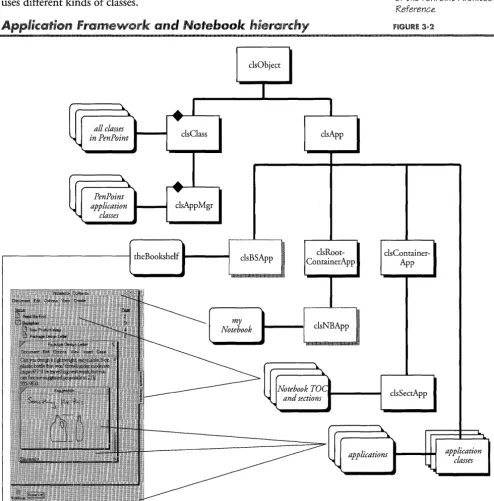
Using the "live" recursive embedding available through EDA, PenPoint's notebook metaphor and user interface are implemented as a set of bundled system applica-tions. Although the user simply perceives these collectively as "the Notebook," they are in fact distinct applications, providing a cleanly delineated and modular architecture.
The key bundled applications include Bookshelf, Notebook, and Section applica-tions that together constitute the core notebook metaphor. In addition:
• The Table of Contents (TOC) application provides a user interface for special-ized organization and retrieval at the front of the notebook.
• A bundled text editor provides end users with intuitive, pen-based Rich Text editing.
• A standard Send user interface and an Address List allow for the addressing of all electronic mail, fax, and file transfers.
• A file browser allows the user to point to files and directories and use standard gesture commands to manipulate them.
Multiple instances of the Notebook can be created; in fact, the Create, Help, Configuration, In box, and Out box applications are all instances of the notebook application. Developers benefit from this code sharing; users benefit from decreased memory requirements as well as greater consistency in the user interface. The Help notebook, for example, consists of help documents ordered by section (applica-tion), and therefore looks just like the standard table of contents. Users already know how to navigate through this notebook and can even create hyperlink refer-ences to important sections. Developers can simply write ASCII text to provide on-line documentation. Documents in the Help notebook can be any type of PenPoint application documents. Developers can also leverage existing application code to build very powerful help systems that can demonstrate real functionality.
Software development environment
With the exception of some hardware-dependent code, PenPoint and the applica-tions it supports are written in ANSI C, using current versions of leading pc-based development tools. Developers already acquainted with object-oriented concepts, and with the graphical user interfaces and multitasking found in operating systems like OS/2 and Macintosh System 7, will find the development environment familiar.
Software
development kit
The PenPoint SDK provides developers with the documentation and tools to develop applications. The kit includes a source-level symbolic debugger, as well as an outline font editor for creating scalable and rotatable application-specific glyphs. Because PenPoint runs on DOS 386 machines, the full application edit-compile-debug cycle can be accomplished solely on a PC, or on a combination of a PC and a pen computer running PenPoint. In the former configuration, you use a pen-driven digitizer tablet to simulate pen input. In the latter configuration, the PC serves as
18 PENPOINT APPLICATION WRITING GUIDE
Part 1 / Application Writing Guide
a debugging monitor, as well as a convenient repository of tp.e development system libraries, header files, on-line documentation, and source code.
Coding
conventions
All PenPoint code is written in accordance with modern software engineering stan-dards, including:
.. Consistent naming conventions for modules, functions, and variables .
.. Carefully designed modularity.
.. Proper commenting and formatting of source code.
Almost all of the C code is structured using object-oriented programming tech-niques. Classes are defined and objects are created and sent messages by making calls into a library of C routines called the C~ass Manager. These techniques are in the mainstream of currently evolving industry practices, but the details are unique to GO and are well documented in the SDK materials.
Extensibility
PenPoint is extensible in a variety of ways, allowing for th~ addition of new networking protocols, imaging models, font models, and file-system volumes. PenPoint can run on computer architectures ranging from solid-state, pocket pen computers to powerful disk-based workstations with pen-tablet screens.
The operating system is a working whole, with most modules integrated and tested as part of the full system since early 1988. Because of techniques such as hardware memory pr?tection, object-oriented programming, rigorous modularization, and extensive sharing of code, PenPoint is a highly reliable operating system.
PenPoint
design guidelines
To this point, this chapter has presented concepts that relate to the PenPoint oper-ating system as a whole. The remainder of the chapter describes important points that application developers will have to keep in mind while designing and coding PenPoint applications.
Conserve
memory
Do not squander memory. Your application should use little memory when active. It must be able to further reduce its memory usage when off-screen. An application that is packed with functionality but consumes a lot of memory is less likely to be successful than one that meets key needs and requires very little memory.
Think small
compo-CHAPTER 2 / PENPOINT SYSTEM OVERVIEW 19 Pen Point design guidelines
nents. Use existing classes and components where possible rather than writing your own from scratch.
PJr
Use a modular design
Consider writing your application as a set of separable components. A component is a separately loadable module (a dynamic link library or OLL) that provides soft-ware functionality. A component has a well-defined programmatic interface so that other software can reuse it or replace it. With modular design, your application becomes an organizing structure that ties together other components in a useful way. For example, an outliner application might use a drawing component, a charting component, and a table entry component; you could license these compo-nents to or from other developers. GO is working to develop a market for third-party components, and offers several components itself, including Text View™ and the TableServer™ .
Your
application must recover
Users may go for weeks or months without backing up their PenPoint computer's file system. If your application goes wrong, the PenPoint operating system will try to halt your application rather than the entire computer, but it is your responsi-bility to ensure that a new invocation of your application will be able to recover cleanly using whatever information it finds in the file system. This precept some-times conflicts with avoiding data duplication, because the memory file system is more bullet-proof than the address space of a running application. For this reason, filed state will usually survive a process crash.
Moreover, most users will not have the PenPoint computer boot disks on hand. That means you cannot rely on the user being able to press the reset switch in a jam. PenPoint uses hardware and software protection techniques to secure against applications unintentionally corrupting the kernel and/or file system, but it is not foolprooE
PJr
Take advantage
01
object-oriented programming
You don't get to vote on using object-oriented techniques. You must write a class for your application that inherits from clsApp. The windows your application dis-plays on the screen must be instances of clsWin (or instances of a class that inherits from clsWin). Of course, there are tremendous payoffs from PenPoint's object-ori-ented approach in program size reduction, code sharing, application consistency, programmer productivity, and elimination of boilerplate code (those large chunks of setup or housekeeping code that appear unchanged in every application).
PJr
Consider sharing code and data
20 PENPOINT APPLICATION WRITING GUIDE
Part 1 / Application Writing Guide
well-known objects, process or subtask execution, protecting shared data with semaphores and queued access, and so on.
PenPoint is a rich operating system that makes its kernel features available to appli-cations. A straightforward application may not need to concern itself with any of the kernel features. It just interacts with PenPoint subsystems, which make careful use of the kernel. For example, none of the sample programs use any advanced kernel features.
Use
document orientation
In the PenPoint operating system, the user sees documents, not separate programs and program files. Every document on a page is the conjunction of data and a pro-cess running an application. This leads to a document-centered approach to appli-cation design in place of a program-oriented approach. By comparison, on a Macintosh or IBM PC-compatible computer, the user tends to start a program and work on a succession of files. Under PenPoint, the user turns to a new document (or taps in a floating document) and the system unobtrusively turns control over to the right program for that document.
There are many ramifications of this orientation: applications have no Open ... or Save As ... commands; the PenPoint operating system, not the user, saves data and quits programs; you deliver application templates and defaults to the user as stationery.
Design
for
file
format
compatibility
The PenPoint application environment differs from that of other operating systems in that PenPoint saves your application data, along with information about objects in the document. Because of this filing method, your data formats within PenPoint will differ from their PC equivalents.
Most PenPoint users, however, will need to read and write application data in for-mats that are understood by other non-PenPoiht applications. Either your applica-tion should be able to read and write data in other formats, or you should create an import or export filter for your PenPoint files. PenPoint provides import and export filters for some common file formats. Because the import-export mechanism is class based, you or other application developers can create import-export filters for other file formats.
Exploit the
pen
CHAPTER 2 / PENPOINT SYSTEM OVERVIEW 21 Pen Point design guidelines
"., Use the
PenPoint user interlace
The Notebook User Interface (NUl) differs from other graphical user interfaces. If you are porting a DOS or Macintosh-based program to PenPoint, rather than create new user interface classes, try to create a user interface that takes advantage of the PenPoint UI Toolkit.
The PenPoint User Interface Design Reference describes the PenPoint user interface, its rationale, and how and when to use its components. You should not deviate from the PenPoint interface. Remember that a consistent user interface allows users to learn your application quickly; an inconsistent user interface will count against your application in product reviews (and acceptance in the marketplace).
Chapter 3 / Application Concepts
This chapter gives you the big picture of application development for the PenPoint™ operating system. It introduces the design issues you need to consider when writing an application for a mobile, pen-based computer, how applications work under PenPoint, and how you use the PenPoint classes.
This chapter also presents concepts in general terms to provide the fundamental understanding that puts the balance of this manual in context. You needn't have read any of the other documentation before reading this chapter. However, if you have the SDK software, you might want to read the "Getting Started" document in the Open Me First packet for detailed instruction on how to compile and run the tutorial programs.
If you want a basic look at how the PenPoint operating system works, without a focus on writing applications, read Chapter 2, PenPoint System Overview. If you need an introduction to object-oriented programming, read these industry publications:
Principles of Object-Oriented Design, Grady Booch, The Benjamin/Cummins Publishing Co., 1991.
Object-Oriented Programmingfor the Macintosh, Kurt Schmucker, Hayden Book Company, 1986.
Object-Oriented Programming: An Evolutionary Approach, Second Edition,
Brad
J.
Cox and AndrewJ.
Novobilski, Addison-Wesley Publishing Company, 1991.However you do it, make sure you come to understand the basics of object-oriented programming, because in PenPoint every application must be class-based.
This chapter points out some of the aspects of the PenPoint operating system that may have an notable effect on your approach to application design.
As you know, application development takes place at two levels:
• At the architectural level, where you design your application.
• At the implementation level, where you write and test program statements.
At the architectural level, this chapter assumes that you have basic familiarity with object-oriented programming. In developing a PenPoint application you'll be designing different kinds of objects and the interactions between them and PenPoint. The section "How Applications Work" introduces the PenPoint Application Framework, which influences and supports the structure of
all
24 PENPOINT APPLICATION WRITING GUIDE
Part 1 / Application Writing Guide
At the programming statement level, this chapter assumes that you are well-versed in C programming. You'll be writing C code that makes heavy use of the PenPoint Class Manager. Chapter 4, PenPoint Class Manager introduces the Class Manager and shows you what lines of code in PenPoint look like.
With some understanding of the Application Framework and the Class Manager, you'll have the tools necessary to understand both the architecture and implemen-tation of simple PenPoint programs and applications. Later chapters in this manual describe the SDK sample programs in PENPOINT\SDK\SAMPLE (the installation pro-cedure for the SDK creates the PENPOINT directory on your hard disk).
". PenPoint programming
is unique
Just as a PenPoint computer is used in work environments that differ from other computers, PenPoint applications execute in an environment that differs from con-ventional PC application environments. There are eight key differences found in PenPoint application environments:
., Stylus-based user interaction .
., Object-oriented programming .
., Disk storage unnecessary .
., Multitasking .
., Cooperating, simultaneously active, embeddable applications .
., Graphics-intensive user interface .
., Notebook metaphor .
., Document orientation instead of application and file orientation.
Dealing with these aspects of PenPoint requires you to observe a number of guide-lines, described in the following sections. The benefit is that the software architec-ture of PenPoint eliminates much of the work for you.
The Class Manager supports the pervasive use of classes and objects throughout PenPoint; not only in the user interface area, but also in areas such as the file system and the imaging model. These classes provide you with ready-made components that you can use as is or customize in your applications. These objects already con-serve memory, exploit the pen interface, cooperate with other processes, and so on. In particular, nearly all of the work your application needs to do to work within the PenPoint Notebook is already implemented by pre-existing classes that comprise the PenPoint Application Framework.
How applications work
In the PenPoint operating system, the environment in which your application runs and how it starts up are unlike any other operating system.