© 2019, IRJET | Impact Factor value: 7.211 | ISO 9001:2008 Certified Journal
| Page 4372
To Study Behavior of Pile in Liquefaction of Soil Using Ansys
Patil Gaurao Suresh
1, Joshi Swapnil
2, Sathe Pramod
31
ME Geotechnical Engineering, MCOERC, Nasik, India
2ME Coordinator, Civil Department, MCOERC, Nasik, India
3Head of Department, Civil Engineering, MCOERC, Nasik, India
---***---Abstract -
In modern construction, pile foundation is acomposite construction which consists of piles and raft is one of the alternatives over conventional pile or raft foundations. It is used not only for minimizing the settlement of soil, but also can handle large eccentric loading. Pile foundation analysis is very difficult and the design of piled raft with soil interaction effect is big issue as the behaviour of a structure is highly affected not only by the response of the superstructure, but also by the behaviour of the foundation and soil also. In this research, the piled raft foundation is analyzed using ANSYS Workbench, finite element software to study the load displacement response in a sand medium of various relative densities (loose, medium dense and dense) with interaction effects. Three different pile spacing - 3d, 4d and 5d were considered for the study (where d is the pile diameter or width of rectangular pile) with three different pile configuration (2x3, 2x4 and 2x2) with an objective of finding the optimum number of piles and pile spacing for various relative densities of sand. Lesser settlement is observed when the frictional angle of the sand is increased and increases when the number of piles are increasing. The rate of settlement of foundation decreases with the increase in relative density of the soil. The load settlement response of medium and dense sand is almost similar.
Key Words
:
Pile foundation; Liquefied Soil; ANSYS
Workbench; Static structural analysis,
1.INTRODUCTION
During earthquakes the shaking of ground may cause a loss of strength or stiffness that result in settlement of buildings, landslides, failure of earthen dams or other hazards. The process leading to such loss of stiffness or strength is called soil liquefaction. It is a phenomenon associated primarily, but not exclusively, with saturated cohesionless soils. Soil liquefaction has been observed in almost all large earthquakes, and in some cases it has caused much damage. The adverse effects of liquefaction take many forms. Some are catastrophic, such as flow failures of slopes or earth dams,
settling and tipping of buildings and piers of bridges, and total or partial collapse of retaining walls. Others are less dramatic, such as lateral spreading of slightly inclined ground, large deformations of the ground surface, and settlement and consequent flooding of large areas. Even these latter effects have in many earthquakes caused extensive damage to highways, railroads, pipelines, and buildings. The word liquefaction includes all phenomena involving excessive deformations or movements as a result of transient or repeated disturbance of saturated cohesionless soils. Liquefaction occurs when the structure of loose, saturated sand breaks down due to some rapidly applied loading. As the structure of a soil breaks down, the loosely packed individual soil particles attempt to move in a denser configuration. During an earthquake there is not enough time for the water in the pores of the soil to squeeze out. This water trapped in soil particles prevent them from moving closer. In an extreme case the pore water pressure become so high that many of the soil particles loose contact with each other. In such cases the soil will have little strength and will behave more like a liquid than a solid.
Liquefaction can be studied in following categories:
Liquefaction due to flow
Liquefaction due to chemical processes
Liquefaction due to cyclic mobility
Liquefaction due to flow is the result of excess pore water pressure generated in saturated granular soils, from rapid loading, and is often associated with earthquake shaking.
Liquefaction due to chemical process is as the result of the nature of cations in the pore water of the soil mass in this case dispersive soils are as a result of liquefaction due to a chemical process.
© 2019, IRJET | Impact Factor value: 7.211 | ISO 9001:2008 Certified Journal
| Page 4373
The pile raft foundation is mainly used to reduce the [image:2.595.306.535.116.646.2]settlement – particularly the differential settlement. It is an economical design without affecting the safety criteria. The behavior of piled raft foundation mainly depends on the complex soil structure interaction effects and an understanding of these effects is necessary for the reliable design of such foundation.
Fig-1: Soil liquefaction for stable soil and liquefied soil
1.1 Situations in which liquefaction is not
probable:
Cohesive soils with more than 50% fine-grained materials containing a significant amount of clay.
Soil mixtures of sand and cohesive fine materialswith considerable amount of fine-grained and fine materials.
Compact soils1.2 Situations in which liquefaction is probable
:
Loose and semi-dense sandy soils.
Mixture of gravel and sand, loose to semi-dense gravelly sands
Loose to semi-dense silty sands
2.AIM AND OBJECTIVES
Aim - To study behavior of pile in liquefaction of soil and its analysis using ANSYS software.
Objectives-
To study finite element modeling of pile foundation considering soil structure interaction.
To dynamic analysis of piles using ANSYS
To model group of pile for 3s spacing, 4s spacing, 5s spacing for loose, medium, dense sand.
During liquefaction, large ground displacements can take place on sloping ground or towards an open face such as a river bank. Displacements as large as 10m occurred towards the Shinano River. Such displacements were very damaging to pile foundations and caused the failure of two major bridges.
Fig-2: Location map of Niigata Earthquake (1964)
Fig-3: Damage to pile by 2m of lateral ground displacement during 1964 Niigata earthquake (Yoshida et al. 1990)
[image:2.595.53.269.195.348.2]© 2019, IRJET | Impact Factor value: 7.211 | ISO 9001:2008 Certified Journal
| Page 4374
Figure 4 showing failure of bridge due to liquefactioneffect caused due to Niigata earthquake.
Fig- 4: Bridge on undamaged pile foundations with failed approaches due to liquefaction (Finn and Fujita 2002)
3.METHODOLOGY
W.D.L.FINN studied behavior of piles in liquefiable soils during Earthquake. The main focus of study is kept on the current state of the art and the emerging technology for dealing effectively with the seismic design and analysis of pile foundations in liquefiable soils. The seismic design of pile foundations in liquefiable soils poses very difficult problems in analysis and design. Two distinct design cases are considered in this research and illustrated by case histories. First one is the static response of pile foundations to the pressures and displacements caused by lateral spreading of liquefied ground. The second one is the seismic response of piles to strong shaking accompanied by the development of high pore water pressures or liquefaction. Design for lateral spreading is examined in the context of developments in design practice and the findings from shake table and centrifuge tests. Response of piles to earthquake shaking in liquefiable soils is examined in the context of 1.5m cast in place reinforced concrete piles supporting a 14 storey apartment building.
The experimental program was carried out on following various groups as single pile, group of 2 piles, group of 3 piles, group of 4 piles, group of 5 piles, group of 6 piles. The test piles were installed in dense compacted sand. The sand was placed and compacted in fifteen centimeters layers using mechanical compactor.
This project includes study of pile analysis in liquefiable soils. It is necessary to perform deflection and settlement analysis of pile foundation in different types of soils in which liquefaction is possibly occurred. There are various methods of analysis of piles available either numerical analysis or software analysis. Many software are available for study. This research uses study of
deflection analysis using ANSYS software which shows deflection developed in piles and also point out stresses induced in pile due to applied loading.
3.1 Problem Statement:
The whole design of piles is taken as per norms of IS 2911-2010. Standard dimensions are takes for the analysis.
Following are the general specifications of pile:
Pile diameter = 0.5 m
Pile length = 5 m
Pile spacing = 3d, 4d and 5d , where d – diameter of the pile
Number of piles = 4,6 and 8
Configuration = Square - 2x2m, 2x3m & 2x4m Circular - 2x2m, 2x3m & 2x4m
Thickness of the raft = 0.5m
Type of Soil = loose sand and dense sand
3.2Theoretical Study of ANSYS:
Two dimensional plane strain analysis using finite element software ANSYS to find the ultimate load carrying capacity and settlement of a piled raft foundation. It is one of the non-linear analysis and in this project only deal with vertical loads. Here, pile and mat are taken as linear and isotropic while the soil-raft interface and soil-pile interface are treated as non-linear.
The following properties are taken for the analysis of pile and mat,
i) Young’s modulus (E), ii) Poisson’s ratio (μ) iii) Density for pile and raft.
Soil is treated as elasto-plastic and having the linear material properties and properties that describe non-linear behaviour are material cohesion strength (c), angle of internal friction (φ) and flow angle (ψ) are explained. For the design of piles, mat and underground soil, PLANE 82 is used as the type of element and the behaviour of the element is taken as plane strain behaviour.
[image:3.595.38.258.123.257.2]© 2019, IRJET | Impact Factor value: 7.211 | ISO 9001:2008 Certified Journal
| Page 4375
The load is applied on the centre of the upper raftsurface for the analysis. After giving all the inputs the model can be solved for the given boundary and loading conditions. The results will be in the form of contour diagram for the study on the settlement behaviour until failure under various loads. The nodal solutions and the contour graphs describe the results of the analysis indicating the load-settlement response of the structure.
This process should be tried for various combinations of spacing of pile (3d, 4d and 5d), where d is the pile diameter and for various number of piles (2x3, 2x4 and 2x2) in square configuration in different relative densities of sand (loose sand, medium sand and dense sand) by changing the material properties. The results for the various combinations are compared for the optimum results.
Following steps are involved in ANSYS software:
Data necessary for modeling of structure
Geometry of structure
Meshing of the structure
Applying support to the structure
Analysis of structure such as modal analysis, static structural analysis, transient analysis
Results of deformed shape of the structure The section of pile groups is as shown in following figure:
Fig-5: Pile Group Circular 2x4
Fig-6: Pile Group Rectangular 2x4
3.3 Analysis of the Circular and Rectangular
piles section in ANSYS (Group of 8 piles having
configuration 2x4):
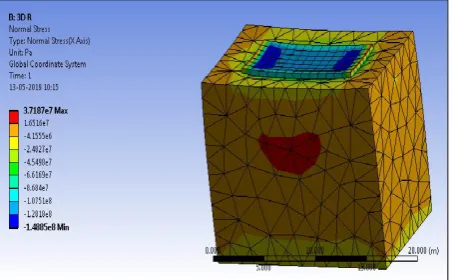
Draw the group of piles as per given dimensions along with pile cap having thickness 0.5m in a soil. Create a solid geometry of the structure for the analysis. Piles are arranged in a group having spacing of 3D (where D is Diameter of pile) Apply fixed support to the whole structure for static structural analysis. Apply vertical downward pressure to the structure. Generate meshing to the structure. Generation of meshing will be used for analyzing the structure at each possible location. After completion of meshing, solve the problem by clicking solve tab in Ansys software. Then find out the various results of analysis. Following results are mostly important for analysis: Total deformation, Strain energy, Shear stress, Normal stress
Compare values of these results with another group of pile having rectangular section
.
Fig-7: Geometrical sketch of group of circular piles having 3d spacing
© 2019, IRJET | Impact Factor value: 7.211 | ISO 9001:2008 Certified Journal
| Page 4376
Fig-9: Shear stress of circular piles having 3d spacingFig-10: Normal stress of circular piles having 3d spacing
Fig-11: Total Deformation of circular piles having 3d spacing
Fig-12: Geometrical sketch of group of rectangular piles
having 3d spacing
© 2019, IRJET | Impact Factor value: 7.211 | ISO 9001:2008 Certified Journal
| Page 4377
Fig-14: Shear stress of Rectangular piles having 3d spacin [image:6.595.53.269.303.466.2]Fig-15: Normal stress of Rectangular piles having 3d spacing
Fig-16:Total Deformation of Rectangular piles having 3d spacing
Table -1: Results analysis of Circular and Rectangular Piles with 3D spacing
3D Circular Piles 3D Rectangular Piles
Range Min Max Min Max
Strain Energy 9.228
e-19 1.8153 e6 75.867 1.409 e6
Shear Stress -1.1277
e8 1.4000 e8 -1.325 e8 1.236 e8
Normal Stress -1.5045
e8 3.8788 e7 -1.488 e8 3.718 e7
Total
deformation 0 0.09655 0 0.07236
4.CONCLUSION
From the analysis, it can be concluded that deformation of rectangular piles is more than circular piles. While strain energy, shear stress and normal stress is maximum in circular piles. Spacing of piles greatly affects load carrying capacity and settlement of piles. The spacing between the piles should be within the permissible range that depends upon the loading conditions. Increasing the number of piles decreases the total and ultimate settlement and increases the load carrying capacity up to certain limit that depends upon the loading condition. Dense sand produces better results when compared to the loose and medium sand. Use of optimum number of piles to reduce settlement.
REFERENCES
[1]
W. D. L. FINN Anabuki Komuten and Kagawa
University, Japan and N. FUJITA, (April 13-17,
2004), “Behavior of Piles in Liquefiable Soils
during Earthquakes”, Anabuki Komuten and
Kagawa University, Japan
.[2]
G.L. SIVAKUMAR, Assistant Professor, IISC
Bangalore,
(2004)
“Bearing
capacity
improvement using micro piles”.
[3]
Abdel-Salem Ahmed Mokhtar, Mohmed Ahmed
Abdel-Motaal, Mohmed Mustafa Wahidy, (2014),
“ Lateral displacement and pile instability due to
soil liquefaction using numerical model”, Ain
Shams Engineering Journal, Sciencedirect, Egypt.
[4]
ELARABI, ABBAS, (2014), “Piles for Structural
Support”, International Journal of Engineering
Sciences & Research Technology.
[5]
Asskar Janalizadeh, Ali Zahmatkesh (2015),
“Lateral response of pile foundations in
liquefiable soil”, Journal of Rock Mechanics and
Geotechnical Engineering, Iran.
[6]
Elsamny, M.K., Ibrahim, M.A., Gad S.A.,
Abdel-Mageed M.F. (August 2017), “Experimental
investigation on load sharing of soil around piles
and underneath raft on pile groups”,
International Journal of Research in Engineering
and Technology, eISSN: 2319-1163 | pISSN:
2321-7308
[7]
Y. Xu and L.M.Zang M.ASCE , (2007), “Settlement
© 2019, IRJET | Impact Factor value: 7.211 | ISO 9001:2008 Certified Journal
| Page 4378
Geoenvironmental Engineering © ASCE / August
2007
[8]
S.S.Chandrasekaran,
A.
Boominathan,
G.R.Dodagoudar,(2010), “ Group Interaction
Effects on Laterally Loaded Piles in Clay”, Journal
Of
Geotechnical
And
Geoenvironmental
Engineering © ASCE / April 2010
[9]
Bhavik S. Parsiya, Dr. S. P. Dave, (April-June
2012), “Analytical Study Of The Laterally Loaded
Pile Group”, International Journal of Advanced
Engineering Research and Studies, E-ISSN2249–
8974
,[10]
Kenji Ishihara, Yasusuki Koga, “Case studies of
liquefaction in the 1964 Niigata Earthquake”,
Japanese Society of Soil Mechanics and
Foundation Engineering, Japan.
BIBLIOGRAPHIES
Author 1
Mr. Patil Gaurao Suresh has completed BE in Civil Engineering from JSPM ICOER Pune. He worked as an assistant professor in Indira College of Engineering, Pune. He is currently pursuing ME in Geotechnical Engineering from MCOERC, Nasik, India.
Author 2
Mr. Joshi Swapnil is working as an Assistant Professor and PG coordinator in Matoshri College of Engineering and Research Centre, Nashik
Author 3