Original Article
Long non-coding RNA expression profile
in atrial fibrillation
Zhongbao Ruan1, Xiaohua Sun1, Haihui Sheng2,3,4, Li Zhu1
1Department of Cardiology, Taizhou People’s Hospital, Taizhou, Jiangsu, China; 2CMC Biobank and Translational
Medicine Institute, Taizhou, Jiangsu, China; 3National Engineering Center for Biochip at Shanghai, Shanghai,
China; 4Taizhou Outdo Clinical Laboratory, Taizhou, Jiangsu, China
Received May 3, 2015; Accepted June 22, 2015; Epub July 1, 2015; Published July 15, 2015
Abstract: To investigate the expression profiles of long non-coding RNAs (lncRNAs) in atrial fibrillation (AF), atrial tissues from 3 AF patients and 3 non-AF patients that were collected for lncRNA expression microarray analyses to explore the role of lncRNA in the pathogenesis of AF. Gene Ontology (GO) categories and Kyoto Encyclopedia of Genes and Genomes (KEGG) pathway enrichment analyses were performed to identify the main functions of the differentially expressed genes and AF-related pathways. A total of 219 lncRNAs was found to be differentially ex-pressed between AFs and controls. Among them, 156 were upregulated and 63 were downregulated. Eight out of 10 dysregulated lncRNAs such as uc001eqh.1 were validated by quantitative real-time PCR. GO categories, pathway analyses, and interaction network showed a consistent result that differentially expressed genes contribute to the pathogenesis of AF. In conclusion, the findings of our study provide a perspective on lncRNA in AF and the founda-tion for further study of the biological funcfounda-tions of lncRNAs in AF.
Keywords: Long non-coding RNA, atrial fibrillation, gene expression profile, pathway
Introduction
Atrial fibrillation (AF) is a highly prevalent dis-ease with a significant genetic component [1, 2], and is considered as the most common arrhythmia, which can cause or exacerbate heart failure and represents an important risk factor for ischemic stroke [3, 4]. From a patho-physiological point of view, AF is characterized by atrial electrical remodeling, mainly mediated by ion-channel alterations [5-7] and structural remodeling (fibrosis and apoptosis), which favors arrhythmia recurrence and maintenance [8, 9]. A noticeable feature of the electrical remodeling associated with AF is the abbrevia-tion of the effective refractory period favoring reentry [10-12], primarily due to shortening of atrial action potential duration (APD). Over the last decade, much attention focused on microR-NAs (miRmicroR-NAs), a class of small non-coding RNAs that are involved in various biological and pathological processes. Growing studies have presented interesting connections between miRNAs and AF, and most of these miRNAs pro-mote the electrical or structural remodeling in
More recently, long non-coding RNAs (lncRNAs), generally defined as non-coding RNAs of more than 200 nt in length without known protein-coding function [15], have risen to prominence, with central roles in a diverse range of func-tions in cell biology [16, 17]. In contrast to miR-NAs, although an increasing number of lncRNAs have been characterized, the role of lncRNAs in AF has not been investigated. In this study, we preliminary explore the role of lncRNA in the pathogenesis of AF by identifying differentially expressed lncRNAs in AF patients using an lncRNA microarray and subsequently validating the microarray results using real-time quantita-tive reverse transcription PCR (qRT-PCR) for specific differentially expressed lncRNAs.
Materials and methods
Specimens
patients before surgery, and the study protocol was approved by the Ethics Committee of Taizhou People’s Hospital. All tissues were fro-zen in liquid nitrogen immediately after surgical resection.
Construction of the lncRNA microarray
Total RNAs were isolated from the six samples using Trizol (Invitrogen, USA) and were quanti-fied using a NanoDrop spectrophotometer (NanoDrop, USA). Input of 100 ng of total RNA was used to generate Cyanine-3 labeled cRNA, according to the Agilent One-Color Microarray-Based Gene Expression Analysis Low for Input Quick Amp Labeling kit (v6.0). The hybridized arrays were washed, fixed and scanned using the Agilent DNA Microarray Scanner (Agilent, USA). Data were extracted using Agilent Feature Extraction software (version 11.0.1.1). Quantile normalization and subsequent data processing were performed using the GeneSpring GX v11.5.1 software package (Agilent, USA). Differentially expressed lncRNAs between the two groups were identified by Fold Change fil-tering. The threshold set for upregulated lncRNAs was more than five-fold and for down-regulated lncRNAs more than three-fold. The lncRNAs discussed in this article were carefully collected from the most authoritative databas-es, such as RefSeq, UCSC Knowngendatabas-es, Ensembl and many related literature.
Validation by qRT-PCR
Total RNA extraction and cDNA transcription were conducted as above. For real-time qRT-PCR, we added 1 µl of cDNA to 12.5 µl of SYBR-Green Gene Expression Master Mix (Applied Biosystems, USA), 10.5 µl of DEPC-treated
water and 0.5 µl of reverse and forward prim-ers. cDNA was amplified for 40 cycles on the ABI 7500 Real-Time PCR system (Applied Biosystems, USA). The primers sequences used are listed in Table 1. GAPDH was used as a ref-erence to obtain the relative expression of tar-get lncRNAs which was determined with the comparative cycle threshold (CT) (2-ΔCT) method, in which ΔCT = CTtarget lncRNA-CT GAPDH.
Gene ontology (GO) and pathway analysis for the differentially expressed lncRNAs
Differentially expressed mRNAs screened by Volcano Plot filtering were further analyzed with GO (http://www.geneontology.org) and KEGG (http://www.genome.jp/kegg) database to examine the functions of the genes and to find the pathways they participated.
Construction of lncRNA-transcription factor co-expression network
The lncRNA-transcription factor (TF) co-expres-sion regulatory network was constructed by using the test of hypergeometric distribution. The TF correlated with lncRNAs was calculated based on the enrichment. Pearson correlation coefficients between all aberrant lncRNAs and TFs were calculated.
Statistical analysis
All statistical analyses were performed using the Student’s t-test with SPSS software version 17.0 (SPSS Inc, USA). A P value less than 0.05 was considered statistically significant, and all the statistical tests were two-sided. False dis-covery rate (FDR) was calculated to correct the P value.
Results
LncRNA profile
[image:2.612.91.292.97.229.2]LncRNA microarrays are powerful tools for studying the biological function of lncRNAs. As showed in Figure 1, a total of 219 lncRNAs were identified to be differentially expressed with fold-change > 2. Among them, 156 and 63 lncRNAs were upregulated and downregulated in AF tissues compared with controls, respec-tively. According to the microarray data, we selected lncRNAs that were upregulated by more than five-fold and downregulated by more
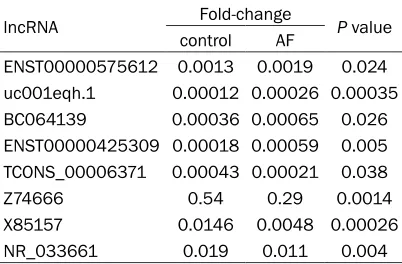
Table 1. Differentially expressed lncRNAs vali-dated by qRT-PCR
lncRNA Fold-change P value
control AF
ENST00000575612 0.0013 0.0019 0.024 uc001eqh.1 0.00012 0.00026 0.00035 BC064139 0.00036 0.00065 0.026 ENST00000425309 0.00018 0.00059 0.005
TCONS_00006371 0.00043 0.00021 0.038
Z74666 0.54 0.29 0.0014
X85157 0.0146 0.0048 0.00026
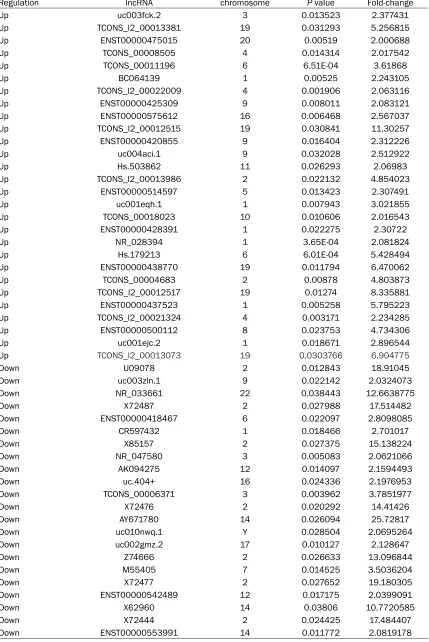
than three-fold. In addition, poorly conserved lncRNAs were excluded. The conservation of lncRNAs was determined using the online Basic Local Alignment Search Tool (http://blast.ncbi. nlm.nih.gov/Blast.cgi). Ultimately, 50 differen-tially expressed lncRNAs that were highly con-served were identified. Among them, 28 were upregulated and 22 were downregulated (Table S1). These results indicate that lncRNAs are involved in the pathogenesis of AF.
Gene ontology GO and pathway analysis
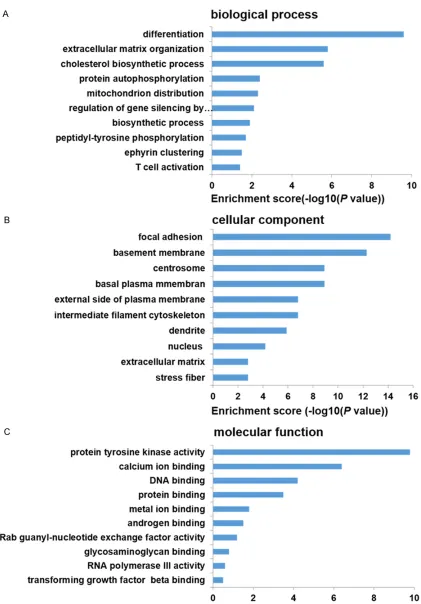
The GO project is a collaborative effort to con-struct and use ontologies to facilitate the bio-logically meaningful annotation of genes and their products in a wide variety of organisms. We performed GO analysis for mRNAs as shown in Figure 2. Differentially expressed transcripts in biological process were involved in differetia-tion, extracellular matrix organizadifferetia-tion, biosyn-thetic process, protein autophosphorylation, mitochondrion distribution, regulation of gene silencing by miRNA, peptidyl-tyrosine phos-phorylation, ephyrin clustering, and T cell acti-vation. Differentially expressed transcripts in cellular component were involved in focal
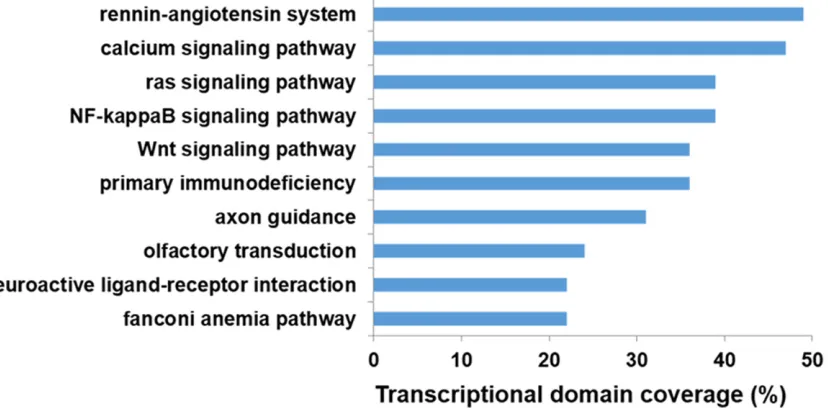
adhe-significant pathways were involved in rennin-angiotensin system, calcium signaling pathway, NF-kappa B signaling pathway, ras signaling pathway, primary immunodeficiency, Wnt sig-naling pathway, axon guidance, olfactory trans-duction, fanconi anemia pathway, and neuroac-tive ligand-receptor interaction (Figure 3). Construction of lncRNA-TF co-expression network
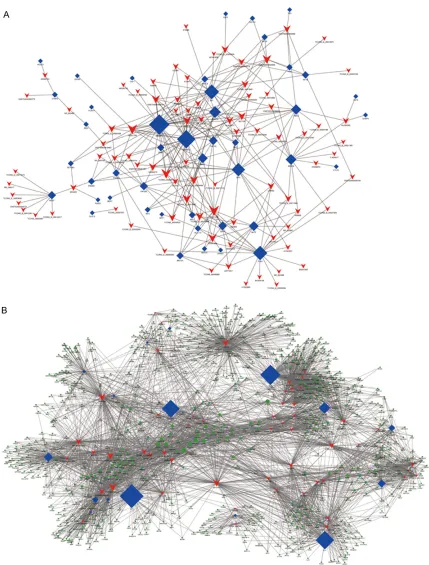
[image:3.612.94.377.73.332.2]By using cumulative hypergeometric test, each lncRNA could correlate with one to tens of TF and could get several pairs of lncRNA-TF and each pair of lncRNA-TF is the enrichment result of several genes. Using P-value < 0.001 and absolute value of correlation coefficient ≥ 0.99, each pair of lncRNA-TF was ranked according the P value. Then we selected the top 100 pairs of lncRNA-TF and constructed the binary net-work (Figure 4A), which descripted the relation-ship between lncRNAs and TFs and provided additional information for further studies. We further introduced target genes into the TF-lncRNA network to determine the TF-lncRNA-target genes ternary network based on the results of TF-lncRNA co-expression analyses. Figure 1. Volcano plot of lncRNAs between AF and controls. The vertical green
lines delimit 2.0-fold up-and down-regulation. Red plots represent lncRNAs with > 2.0 fold-change and corrected P value < 0.05.
sion, membrane, centroso- me, intermediate filament cytoskeleton, dendrite, nucl- eus, stress fiber, and extra-cellular matrix. Differentially expressed transcripts in mo- lecular function were invol- ved in protein tyrosine kinase activity, calcium ion binding, DNA binding, protein binding, metal ion binding, androgen binding, Rab guanyl-nucleo-tide exchange factor activity, glycosaminoglycan binding, RNA polymerase III activity, and transforming growth fac-tor beta binding.
We selected the top 300 pairs of lncRNAs, TFs and target genes and constructed the ternary network (Figure 4B).
Validation of differentially expressed lncRNAs
We randomly chose 5 upregulated lncRNAs (ENST00000575612, uc001eqh.1, BC0641- 39, ENST00000425309, ENST00000500112) and 5 downregulated lncRNAs (TCONS_000- 06371, Z74666, X85157, X72487, and NR_ 033661) for qRT-PCR validation to confirm the microarray results. Four out of 5 upregulated lncRNAs (P = 0.024, 0.00035, 0,026 and 0.005 for ENST00000575612, uc001eqh.1, BC064- 139, and ENST00000425309, respectively) and 4 out of the five downregulated lncRNAs (P = 0.038, 0.0014, 0.00026 and 0.004 for TCONS_00006371, Z74666, X85157, and NR_ 033661, respectively) showed a significantly different expression (Table 1).
Discussion
AF is the most common sustained arrhythmia, especially in the elderly, and has a significant genetic component. Recently, several indepen-dent investigators have demonstrated a func-tional role for microRNAs in the pathophysiolo-gy of this cardiac arrhythmia [13, 14]. In contrast to miRNAs, lncRNAs have not been fully investigated. Braveheart (Bvht), a heart-associated lncRNA in mouse, was identified as
a critical regulator of cardiovascular commit-ment from nascent mesoderm, representing the first example of an lncRNA with potential implications in cardiovascular development [18]. The human lncRNA ANRIL has been asso-ciated with a locus implicated in cardiovascular disease [19]. In addition, human MIAT was identified as an lncRNA associated with increased risk of myocardial infarction [20]. Although an increasing number of lncRNAs have been characterized, the role of lncRNAs in AF remains largely unknown.
[image:5.612.105.519.81.285.2]Figure 4. Co-expression networks of associated genes and co-regulated lncRNAs. A. lncRNA network. B. AF-lncRNA-target gene network. Blue diamonds represent as TFs, red plots represent as lncRNAs, and green plots represent as target genes.
anism of AF, which may further provide poten-tial therapeutic targets for prophylaxis and treatment of AF.
the main biological processes involving the dif-ferentially expressed lncRNAs included many closely connected to atrial remodeling, such as cell motility, protein autophosphorylation and extracellular matrix organization. However, per-haps the most important current challenge is that the knowledge embedded in pathways regarding how various genes interact with each other is not currently exploited. Microarray technology makes it possible to measure the expression levels of almost all the human genes and therefore facilitates the identifica-tion of genes and pathways that are related to disease initiation and development. Based on the findings of our study, many pathways are involved in AF, including atrial electrical remod-eling and renin-angiotensin system. For instance, the calcium signaling pathway plays an important role in the electrical remodeling of AF and may induce the recurrence of AF. The renin-angiotensin system seems to be involved in the genesis of arrhythmia by the following two mechanisms: 1) the induction of atrial fibro-sis and structural remodelling by mitogen-acti-vated protein kinase (MAPK) expression and reduction of collagenase activity; 2) the induc-tion of electrical remodelling by shortening of the atrial effective refractory period (AERP) and of the action potential duration [21].
It has been found that 80% of noncoding RNAs are lncRNAs, which are involved in gene expres-sion and function regulations. Not like mRNA, the functions of most lncRNAs are still not determined. Some of the lncRNAs are proved to be regulated by key TFs and defined a unique collection of functional lncRNAs that are highly conserved and implicated in diverse biological process. In order to investigate the function of lncRNAs in AF, we calculated the TF correlated with lncRNAs based on the enrichment by using cumulative hypergeometric test and further combined differentially expressed lncRNAs with TF to construct a coexpression network. We found that many lncRNAs were significantly correlated with multiple protein-coding genes and may participate in the pathogenesis of AF.
Although we have identified some differentially expressed lncRNAs in AF, it is too early for us to confirm their relationship. Therefore, subgroup analysis of lncRNAs should be performed to explore this relationship in the future. In addi-tion, most differentially expressed lncRNAs
have no official Human Genome Nomenclature Committee symbol and their function is still unclear. Further functional studies are required to elucidate their roles in AF.
Acknowledgements
This study was supported by The Six Talents Peak Project of Jiangsu Province, China (grant No. 2013-WSN-020). We thank Wenqi Li for his assistance with statistical analysis.
Disclosure of conflict of interest
None.
Address correspondence to: Dr. Li Zhu, Depart- ment of Cardiology, Taizhou People’s Hospital, Taizhou 225300, China. Tel: +8613401238518; E-mail: [email protected]
References
JS, Sharp S, Shin JT, Singleton AB, Smith AV, Soranzo N, Spector TD, Stewart C, Stringham HM, Tarasov KV, Uitterlinden AG, Vandenput L, Hwang SJ, Whitfield JB, Wijmenga C, Wild SH, Willemsen G, Wilson JF, Witteman JC, Wong A, Wong Q, Jamshidi Y, Zitting P, Boer JM, Booms-ma DI, Borecki IB, van Duijn CM, Ekelund U, Forouhi NG, Froguel P, Hingorani A, Ingelsson E, Kivimaki M, Kronmal RA, Kuh D, Lind L, Mar-tin NG, Oostra BA, Pedersen NL, Quertermous T, Rotter JI, van der Schouw YT, Verschuren WM, Walker M, Albanes D, Arnar DO, Assimes TL, Bandinelli S, Boehnke M, de Boer RA, Bouchard C, Caulfield WL, Chambers JC, Curhan G, Cusi D, Eriksson J, Ferrucci L, van Gilst WH, Glorioso N, de Graaf J, Groop L,Gyllensten U, Hsueh WC, Hu FB, Huikuri HV, Hunter DJ, Iribarren C, Isomaa B, Jarvelin MR, Jula A, Kähönen M, Kiemeney LA, van der Klauw MM, Kooner JS, Kraft P, Iacoviello L, Lehtimäki T, Lokki ML, Mitchell BD, Navis G, Nieminen MS, Ohlsson C, Poulter NR, Qi L, Raitakari OT, Rimm EB, Rioux JD, Rizzi F, Ru-dan I, Salomaa V, Sever PS, Shields DC, Sh- uldiner AR, Sinisalo J, Stanton AV, Stolk RP, Strachan DP, Tardif JC, Thorsteinsdottir U, Tu-omilehto J, van Veldhuisen DJ, Virtamo J, Viikari J, Vollenweider P, Waeber G, Widen E, Cho YS, Olsen JV, Visscher PM, Willer C, Franke L; Global BPgen Consortium; CARDIoGRAM Consortium, Erdmann J, Thompson JR; PR GWAS Consortium, Pfeufer A; QRS GWAS Con-sortium, Sotoodehnia N; QT-IGC ConCon-sortium, Newton-Cheh C; CHARGE-AF Consortium, Elli-nor PT, Stricker BH, Metspalu A, Perola M, Beckmann JS, Smith GD, Stefansson K, Ware-ham NJ, Munroe PB, Sibon OC, Milan DJ, Snie-der H, Samani NJ, Loos RJ. Identification of heart rate-associated loci and their effects on cardiac conduction and rhythm disorders. Nat Genet 2013; 45: 621-31.
[2] Santulli G, Iaccarino G, De Luca N, Trimarco B and Condorelli G. Atrial fibrillation and microR-NAs. Front Physiol 2014; 5: 15.
[3] Thomas IC and Sorrentino MJ. Bleeding risk prediction models in atrial fibrillation. Curr Car-diol Rep 2014; 16: 432.
[4] Conen D, Chae CU, Glynn RJ, Tedrow UB, Ever-ett BM, Buring JE and Albert CM. Risk of death and cardiovascular events in initially healthy women with new-onset atrial fibrillation. JAMA 2011; 305: 2080-2087.
[5] Brundel BJ, Van Gelder IC, Henning RH, Tuinen-burg AE, Wietses M, Grandjean JG, Wilde AA, Van Gilst WH and Crijns HJ. Alterations in po-tassium channel gene expression in atria of patients with persistent and paroxysmal atrial fibrillation: differential regulation of protein and mRNA levels for K+ channels. J Am Coll Cardiol 2001; 37: 926-932.
[6] Santulli G, D’Ascia SL and D’Ascia C. Develop-ment of atrial fibrillation in recipients of cardi-ac resynchronization therapy: the role of atrial reverse remodelling. Can J Cardiol 2012; 28: 245, e17; author reply 245, e17-8.
[7] Xie W, Santulli G, Guo X, Gao M, Chen BX and Marks AR. Imaging atrial arrhythmic intracel-lular calcium in intact heart. J Mol Cell Cardiol 2013; 64: 120-123.
[8] Perino A, Ghigo A, Ferrero E, Morello F, Santulli G, Baillie GS, Damilano F, Dunlop AJ, Pawson C, Walser R, Levi R, Altruda F, Silengo L, Lange-berg LK, Neubauer G, Heymans S, Lembo G, Wymann MP, Wetzker R, Houslay MD, Iaccari-no G, Scott JD and Hirsch E. Integrating cardiac PIP3 and cAMP signaling through a PKA an-choring function of p110gamma. Mol Cell 2011; 42: 84-95.
[9] Santulli G and D’Ascia C. Atrial remodelling in echocardiographic super-responders to cardi-ac resynchronization therapy. Heart 2012; 98: 517; author reply 517.
[10] D’Ascia SL, Santulli G, Liguori V, Marino V, Ar-turo C, Chiariello M and D’Ascia C. Advanced algorithms can lead to electrocardiographic misinterpretations. Int J Cardiol 2010; 141: e34-36.
[11] D’Ascia SL, D’Ascia C, Marino V, Lombardi A, Santulli R, Chiariello M and Santulli G. Cardiac resynchronisation therapy response predicts occurrence of atrial fibrillation in non-isch-aemic dilated cardiomyopathy. Int J Clin Pract 2011; 65: 1149-1155.
[12] Kapur S and Macrae CA. The developmental basis of adult arrhythmia: atrial fibrillation as a paradigm. Front Physiol 2013; 4: 221.
[13] Dawson K, Wakili R, Ordog B, Clauss S, Chen Y, Iwasaki Y, Voigt N, Qi XY, Sinner MF, Dobrev D, Kaab S and Nattel S. MicroRNA29: a mecha-nistic contributor and potential biomarker in atrial fibrillation. Circulation 2013; 127: 1466-75, 1475e1-28.
[14] McManus DD, Lin H, Tanriverdi K, Quercio M, Yin X, Larson MG, Ellinor PT, Levy D, Freedman JE and Benjamin EJ. Relations between circu-lating microRNAs and atrial fibrillation: data from the Framingham Offspring Study. Heart Rhythm 2014; 11: 663-669.
[15] Saxena A and Carninci P. Long non-coding RNA modifies chromatin: epigenetic silencing by long non-coding RNAs. Bioessays 2011; 33: 830-839.
[16] Kaikkonen MU, Lam MT and Glass CK. Non-coding RNAs as regulators of gene expression and epigenetics. Cardiovasc Res 2011; 90: 430-440.
of histone modification complexes. Science 2010; 329: 689-693.
[18] Klattenhoff CA, Scheuermann JC, Surface LE, Bradley RK, Fields PA, Steinhauser ML, Ding H, Butty VL, Torrey L, Haas S, Abo R, Tabebordbar M, Lee RT, Burge CB and Boyer LA. Braveheart, a long noncoding RNA required for cardiovas-cular lineage commitment. Cell 2013; 152: 570-583.
[19] Congrains A, Kamide K, Oguro R, Yasuda O, Mi-yata K, Yamamoto E, Kawai T, Kusunoki H, Ya-mamoto H, Takeya Y, YaYa-mamoto K, Onishi M, Sugimoto K, Katsuya T, Awata N, Ikebe K, Gon-do Y, Oike Y, Ohishi M and Rakugi H. Genetic variants at the 9p21 locus contribute to ath-erosclerosis through modulation of ANRIL and CDKN2A/B. Atherosclerosis 2012; 220: 449-455.
[20] Ishii N, Ozaki K, Sato H, Mizuno H, Saito S, Takahashi A, Miyamoto Y, Ikegawa S, Kamatani N, Hori M, Saito S, Nakamura Y and Tanaka T. Identification of a novel non-coding RNA, MIAT, that confers risk of myocardial infarction. J Hum Genet 2006; 51: 1087-1099.
Table S1. Dysregulated lncRNAs
Regulation lncRNA chromosome P value Fold-change
Up uc003fck.2 3 0.013523 2.377431
Up TCONS_l2_00013381 19 0.031293 5.256815
Up ENST00000475015 20 0.00519 2.000688
Up TCONS_00008505 4 0.014314 2.017542
Up TCONS_00011196 6 6.51E-04 3.61868
Up BC064139 1 0.00525 2.243105
Up TCONS_l2_00022009 4 0.001906 2.063116
Up ENST00000425309 9 0.008011 2.083121
Up ENST00000575612 16 0.006468 2.567037
Up TCONS_l2_00012515 19 0.030841 11.30257
Up ENST00000420855 9 0.016404 2.312226
Up uc004aci.1 9 0.032028 2.512922
Up Hs.503862 11 0.026293 2.06983
Up TCONS_l2_00013986 2 0.022132 4.854023
Up ENST00000514597 5 0.013423 2.307491
Up uc001eqh.1 1 0.007943 3.021855
Up TCONS_00018023 10 0.010606 2.016543
Up ENST00000428391 1 0.022275 2.30722
Up NR_028394 1 3.65E-04 2.081824
Up Hs.179213 6 6.01E-04 5.428494
Up ENST00000438770 19 0.011794 6.470062
Up TCONS_00004683 2 0.00878 4.803873
Up TCONS_l2_00012517 19 0.01274 8.335881
Up ENST00000437523 1 0.005258 5.795223
Up TCONS_l2_00021324 4 0.003171 2.234285
Up ENST00000500112 8 0.023753 4.734306
Up uc001ejc.2 1 0.018671 2.896544
Up TCONS_l2_00013073 19 0.0303766 6.904775
Down U09078 2 0.012843 18.91045
Down uc003zln.1 9 0.022142 2.0324073
Down NR_033661 22 0.038443 12.6638775
Down X72487 2 0.027988 17.514482
Down ENST00000418467 6 0.022097 2.8098085
Down CR597432 1 0.018466 2.701017
Down X85157 2 0.027375 15.138224
Down NR_047580 3 0.005083 2.0621066
Down AK094275 12 0.014097 2.1594493
Down uc.404+ 16 0.024336 2.1976953
Down TCONS_00006371 3 0.003962 3.7851977
Down X72476 2 0.020292 14.41426
Down AY671780 14 0.026094 25.72817
Down uc010nwq.1 Y 0.028504 2.0695264
Down uc002gmz.2 17 0.010127 2.128647
Down Z74666 2 0.026633 13.096844
Down M55405 7 0.014525 3.5036204
Down X72477 2 0.027652 19.180305
Down ENST00000542489 12 0.017175 2.0399091
Down X62960 14 0.03806 10.7720585
Down X72444 2 0.024425 17.484407