Original Article
Investigation on the DNA repaired gene polymorphisms
and response to chemotherapy and overall survival of
osteosarcoma
Wei-Ping Ji, Neng-Bin He
Department of Orthopedics, Shanghai Jiao Tong University Affiliated Sixth People’s Hospital, Shanghai, China
Received December 7, 2014; Accepted December 9, 2014; Epub January 1, 2015; Published January 15, 2015
Abstract: The aim of the present study was to evaluate the influence of polymorphisms in NER and HRR pathways
on the response to cisplatin-based treatment and clinical outcome in osteosarcoma patients. 214 osteosarcoma patients treated with cisplatin-based chemotherapy were collected between January 2008 and January 2011. Genotypes of ERCC1 rs11615, ERCC2 rs1799793 and rs13181, NBN rs709816, RAD51 rs1801320, and XRCC3 rs861539 were conducted by Polymerase Chain Reaction Restriction Fragment Length Polymorphism (PCR-RFLP) assay. By conditional logistic regression analysis, patients carrying CC genotype of ERCC1 rs11615 showed a
sig-nificant more good responder than TT genotype, and the OR (95% CI) was 2.51 (1.02-6.85). In the Cox proportional
hazards model, after adjusting for potential confounding factors, we found that individuals carrying CC genotype of
ERCC1 rs11615 was associated with decreased risk of death from osteosarcoma, and the HR (95% CI) was 0.43
(0.15-0.93). In conclusion, our results suggest that ERCC1 rs11615 polymorphism in the DNA repair pathways play an important role in the response to chemotherapy and overall survival of osteosarcoma.
Keywords: ERCC1 rs11615, polymorphism, response to chemotherapy, overall survival, osteosarcoma
Introduction
Osteosarcoma is a rare bone cancer, and is a more common in children and adolescents, with an annual incidence of about 3/105 [1, 2]. Despite recent advances in the therapies, the survival of osteosarcoma has significantly is still low and unsatisfactory [3]. Although many patients received similar therapies, interindi-vidual differences in treatment outcome are observed between patients. It is estimated that about 50% of patients have poor clinical out -come, and around 30% of patients relapse locally or develop metastases [3, 4]. Genetic polymorphisms involved in response to chemo-therapeutic agents could influence both surviv -al and treatment toxicity, therefore identifica -tion of predictive markers could lead to improve the drug selection and treatment outcomes. Cisplatin is a platinum analog and is frequently used as a common therapy method for many cancers. It binds to DNA and forms DNA adducts, and inhibits DNA replication [5]. Therefore, DNA repair mechanisms play an important role in determining response to
cis-platin. NER is a main DNA repair mechanism, which has a key role in repairing various distort-ing helix-distortdistort-ing lesions [6]. Two important enzymes in the NER pathway are associated with resistance to cisplatin, including the exci-sion repair cross-complementation group 2 (ERCC2) gene and excision repair crosscomple-mentation group 1 (ERCC1).
Homologous recombination repair (HRR) is part of the complex, which is involved in recognizing DNA damage. In the HRR pathway, nibrin (NBN) is involved in recognizing DNA damage, while RAD51 recombinase (RAD51) catalyses homol-ogous search and strand invasion with the aid of other proteins, including Xray complementing defective repair in Chinese hamster cells 3 (XRCC3).
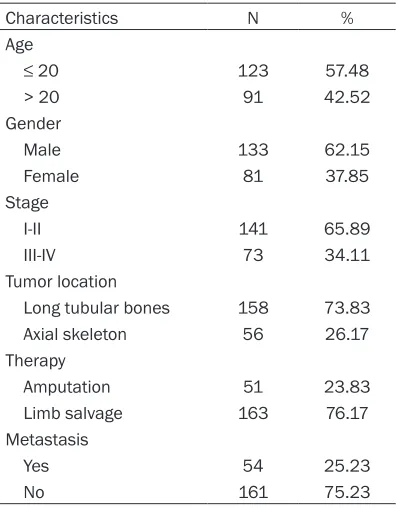
cisplatin-Table 1. Demographic and clinical character-istics of osteosarcoma patients
Characteristics N %
Age
≤ 20 123 57.48
> 20 91 42.52
Gender
Male 133 62.15
Female 81 37.85
Stage
I-II 141 65.89
III-IV 73 34.11
Tumor location
Long tubular bones 158 73.83 Axial skeleton 56 26.17 Therapy
Amputation 51 23.83
Limb salvage 163 76.17 Metastasis
Yes 54 25.23
No 161 75.23
based treatment and clinical outcome in osteo-sarcoma patients.
Patients and methods
Patients
Between January 2008 and January 2010, 214 osteosarcoma patients treated with cisplatin-based chemotherapy were included in our study from the Affiliated Sixth People’s Hospital of Shanghai Jiao Tong University between January 2008 and January 2011. The study was approved by the the Affiliated Sixth People’s Hospital of Shanghai Jiao Tong University. Assessment of treatment outcome
Demographic and clinical characteristics of included patients were obtained from the medi-cal records. Tumor response was evaluated his-tologically based on percentage of necrosis and more than 90% necrosis was considered good response, otherwise the response to che-motherapy was regarded as poor responders. Overall survival (OS) was defined as time from the beginning of treatment to an event or death, respectively. Patients without an event or death at the time of the analysis were censored at the date of the last follow-up.
All the patients were followed up until January 2014, with a median follow-up time of 36.5 months (ranged: 4 and 60 months). All patients were followed up by telephone every four weeks until death or the end of study.
Blood samples and genotyping
Each patient was asked to provide 5 ml periph-eral blood and kepted in -70°C until use. Genomic DNA was isolated from peripheral blood using the TIANamp Blood DNA Kit (Tiangen, Beijing, China) according to the man-ufacturer’s instructions. Genotypes of ERCC1 rs11615, ERCC2 rs1799793 and rs13181, NBN rs709816, RAD51 rs1801320, and XRCC3 rs861539 were conducted by Polymerase Chain Reaction Restriction Fragment Length Polymorphism (PCR-RFLP) assay. Probes and primers for ERCC1 rs11615, ERCC2 rs1799793 and rs13181, NBN rs709816, RAD51 rs18- 01320, and XRCC3 rs861539 were designed using Sequenom Assay Design 3.1 software (Sequenom®) according to the manufacturer instructions. The cycling programme involved preliminary denaturation at 94°C for 5 min, fol-lowed by 35 cycles of denaturing at 94°C for 45s, annealing at 62°C for 60s and extending at 72°C for 60s, and performing a final exten -sion at 72°C for 10 minutes. For quality control, 5% of subjects were randomly selected, and the results of repeated samples showed 100% concordance.
Statistical analysis
[image:2.612.90.289.93.347.2]were considered statistical difference. All sta-tistical analyses were conducted using the STATA version 9.0 statistical software.
Results
Patients and clinical characteristics
The distributions of selected general character-istics of study subjects were shown in Table 1. The mean age of the osteosarcoma subjects was 18.7 ± 11.5 years old (ranging from 11 to 39 years old). Of 214 osteosarcoma patients, 133 (62.15%) were males, 141 (65.89%) had tumor stage of I-II, 158 (73.83%) had tumor location of long tubular bones, 163 (76.17%) received limb salvage, and 54 (25.23%) showed metastasis.
Association between DNA repaired gene poly-morphisms and response to chemotherapy
At the end of the follow-up, 133 osteosarcoma patients showed good response to
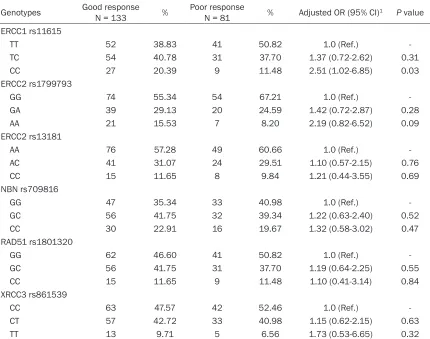
cisplatin-based chemotherapy, with a response rate of 62.15%. By conditional logistic regression anal -ysis, patients carrying CC genotype of ERCC1 rs11615 showed a significant more good responder than TT genotype, and the OR (95% CI) was 2.51 (1.02-6.85) (Table 2). However, we observed no significant difference between ERCC2 rs1799793 and rs13181, NBN rs709816, RAD51 rs1801320, and XRCC3 rs861539 polymorphisms and response to cis-platin-based chemotherapy.
Association between DNA repaired gene poly-morphisms and overall survival
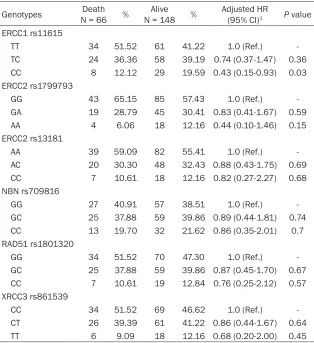
[image:3.612.92.522.97.436.2]At the end of January 2014, 66 died from all causes, and the five-year survival rate is 69.16%. In the Cox proportional hazards model, after adjusting for potential confounding fac-tors, we found that individuals carrying CC gen-otype of ERCC1 rs11615 was associated with decrea- sed risk of death from osteosarcoma, and the HR (95% CI) was 0.43 (0.15-0.93) (Table 3). By Table 2. Analysis of the association between DNA repaired gene polymorphisms and response to cisplatin-based chemotherapy in osteosarcoma patients
Genotypes Good responseN = 133 % Poor responseN = 81 % Adjusted OR (95% CI)1 P value
ERCC1 rs11615
TT 52 38.83 41 50.82 1.0 (Ref.)
TC 54 40.78 31 37.70 1.37 (0.72-2.62) 0.31
CC 27 20.39 9 11.48 2.51 (1.02-6.85) 0.03
ERCC2 rs1799793
GG 74 55.34 54 67.21 1.0 (Ref.)
GA 39 29.13 20 24.59 1.42 (0.72-2.87) 0.28
AA 21 15.53 7 8.20 2.19 (0.82-6.52) 0.09
ERCC2 rs13181
AA 76 57.28 49 60.66 1.0 (Ref.)
AC 41 31.07 24 29.51 1.10 (0.57-2.15) 0.76
CC 15 11.65 8 9.84 1.21 (0.44-3.55) 0.69
NBN rs709816
GG 47 35.34 33 40.98 1.0 (Ref.)
GC 56 41.75 32 39.34 1.22 (0.63-2.40) 0.52
CC 30 22.91 16 19.67 1.32 (0.58-3.02) 0.47
RAD51 rs1801320
GG 62 46.60 41 50.82 1.0 (Ref.)
GC 56 41.75 31 37.70 1.19 (0.64-2.25) 0.55
CC 15 11.65 9 11.48 1.10 (0.41-3.14) 0.84
XRCC3 rs861539
CC 63 47.57 42 52.46 1.0 (Ref.)
CT 57 42.72 33 40.98 1.15 (0.62-2.15) 0.63
TT 13 9.71 5 6.56 1.73 (0.53-6.65) 0.32
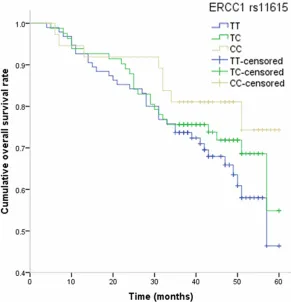
Kaplan-Meier method, individuals with CC gen-otype of ERCC1 rs11615 had a longer overall survival of osteosarcoma when compared with TT genotype (Figure 1). However, we observed no association between ERCC2 rs1799793 and rs13181, NBN rs709816, RAD51 rs1801320, and XRCC3 rs861539 polymor-phisms and overall survival in osteosarcoma patients.
Discussion
In the present study, we investigated the influ -ence of polymorphisms in NER and HRR path-ways on treatment response and overall sur-vival in osteosarcoma patients treated with cisplatin-based chemotherapy. Our study found that CC genotype of ERCC1 rs11615 was asso-ciated with better response to chemotherapy when compared with TT genotype, and this genotype could influence the OS of osteosar -coma patients.
which suggests that ERCC1 rs11615 polymor-phism can influence the clinical outcome of osteosarcoma patients.
[image:4.612.91.405.95.438.2]Previous studies showed that ERCC1 rs11615 was often associated with response and cispla-tin-based chemotherapy [11-15]. Metzger et al. conducted a study to identify association between ERCC1 rs11615 polymorphism and squamous esophageal cancer receiving a neo-adjuvant radiochemotherapy, and found that ERCC1 rs11615 can influence the response to chemotherapy and survival of squamous esophageal cancer [11]. However, some stud-ies did not find ERCC1 rs11615 did not influ -ence the response to chemotherapy. Rumiato et al. conducted a cohort study with 143 esoph-ageal cancer patients, and this study did not find ERCC1 rs11615 can be a predictive marker in the cisplatin/5-FU-based neoadjuvant set-ting [12]. Mathiaux et al. investigated the asso-ciation between ERCC1, ERCC2 and ERCC5 Table 3. Association between included gene polymorphisms and overall
survival in osteosarcoma patients
Genotypes N = 66Death % N = 148Alive % Adjusted HR (95% CI)1 P value
ERCC1 rs11615
TT 34 51.52 61 41.22 1.0 (Ref.)
TC 24 36.36 58 39.19 0.74 (0.37-1.47) 0.36 CC 8 12.12 29 19.59 0.43 (0.15-0.93) 0.03 ERCC2 rs1799793
GG 43 65.15 85 57.43 1.0 (Ref.)
GA 19 28.79 45 30.41 0.83 (0.41-1.67) 0.59 AA 4 6.06 18 12.16 0.44 (0.10-1.46) 0.15 ERCC2 rs13181
AA 39 59.09 82 55.41 1.0 (Ref.)
AC 20 30.30 48 32.43 0.88 (0.43-1.75) 0.69 CC 7 10.61 18 12.16 0.82 (0.27-2.27) 0.68 NBN rs709816
GG 27 40.91 57 38.51 1.0 (Ref.)
GC 25 37.88 59 39.86 0.89 (0.44-1.81) 0.74 CC 13 19.70 32 21.62 0.86 (0.35-2.01) 0.7 RAD51 rs1801320
GG 34 51.52 70 47.30 1.0 (Ref.)
GC 25 37.88 59 39.86 0.87 (0.45-1.70) 0.67 CC 7 10.61 19 12.84 0.76 (0.25-2.12) 0.57 XRCC3 rs861539
CC 34 51.52 69 46.62 1.0 (Ref.)
CT 26 39.39 61 41.22 0.86 (0.44-1.67) 0.64 TT 6 9.09 18 12.16 0.68 (0.20-2.00) 0.45
1Ajusted for age, tumor size, clinical stage, lymph mode metastasis and ER and PR status.
repair pathways play an important role in the response to chemotherapy and clinical out-come of osteosarcoma. In the future, these SNPs could contribute to identification of patients, less likely to achieve better response to cisplatin chemotherapy. Further multicenter studies involving various populations are required to confirm our results.
Address correspondence to: Neng-Bin He,
Department of Orthopedics, Shanghai Jiao Tong University Affiliated Sixth People’s Hospital, 600
Yishan Road, Xuhui District, Shanghai 200233, China. Tel: 64369181; Fax: +86-021-64701361; E-mail: [email protected]
References
[1] Mirabello L, Troisi RJ, Savage SA. Osteosarcoma
incidence and survival rates from 1973 to 2004: Data from the surveillance, epidemiolo-gy, and end results program. Cancer 2009; 115: 1531-43.
[2] Moore DD, Luu HH. Osteosarcoma. Cancer
Treat Res 2014; 162: 65-92.
[3] Chou AJ, Gorlick R. Chemotherapy resistance in osteosarcoma: current challenges and fu-polymorphisms and response to chemotherapy
in NSCLC, and this study did not find the ERCC1 rs11615 polymorphism can influence the plati -num-based chemotherapy treatment of adv- anced NSCLC [13]. The discrepancy of these results may be caused by differences in ethnici-ties, study design, tumor types, and sample size.
[image:5.612.93.384.74.376.2]For the association between ERCC1 rs11615 and treatment outcome of osteosarcoma, sev-eral previous studies report their association between them, but the results are inconsistent [16-19]. Hao et al. conducted a study with 267 consecutive osteosarcoma patients, and found that ERCC1 rs11615 can influence the res-ponse to chemotherapy and clinical outcome of osteosarcoma patients [16], which is consis-tent with our findings. However, the other three studies which were conducted in Spanish and Chinese populations found that ERCC1 rs11- 615 cannot influence the response to chemo -therapy and clinical outcome of osteosarcoma [17-19]. Therefore, the further studies with more subjects are needed to confirm our results.
Figure 1. Kaplan-Meier analysis on the influence of ERCC1 rs11615 polymor -phism on overall survival of osteosarcoma.
Several limitations should be considered in our study. First, cases were selected from one hospital, which may not be representative of the gen-eral osteosarcoma cases. Selection bias may exist in this study. Genetic variability of DNA repair mechanisms could also influence the response to other chemo-therapeutics, not only cispla-tin, which makes the interpre-tation of our findings difficult. As osteosarcoma is a rare disease, the number of cases analyzed in the present study was relatively small, which may reduce the statistical power to detect the associa-tion between ERCC1 rs11615 polymorphism and clinical outcome of osteosarcoma. Therefore, further studies are greatly needed to verify our results.
ture directions. Expert Rev Anticancer Ther 2006; 6: 1075-85.
[4] Quartuccio N, Treglia G, Salsano M, Mattoli MV, Muoio B, Piccardo A, Lopci E, Cistaro A. The role of Fluorine-18-Fluorodeoxyglucose positron emission tomography in staging and restaging of patients with osteosarcoma.
Radiol Oncol 2013; 47: 97-102.
[5] Marsh S, McLeod H, Dolan E, Shukla SJ, Rabik CA, Gong L, Hernandez-Boussard T, Lou XJ, Klein TE, Altman RB. Platinum pathway. Pharmacogenet Genomics 2009; 19: 563-4. [6] Costa RM, Chiganças V, Galhardo Rda S,
Carvalho H, Menck CF. The eukaryotic nucleo-tide excision repair pathway. Biochimie 2003; 85: 1083-99.
[7] Erčulj N, Kovač V, Hmeljak J, Franko A, Dodič-Fikfak M, Dolžan V. DNA repair polymorphisms
and treatment outcomes of patients with ma-lignant mesothelioma treated with gem-citabine-platinum combination chemotherapy.
J Thorac Oncol 2012; 7: 1609-17.
[8] Shen XY, Lu FZ, Wu Y, Zhao LT, Lin ZF. XRCC3 Thr241Met polymorphism and clinical out-comes of NSCLC patients receiving platinum-based chemotherapy: a systematic review and
meta-analysis. PLoS One 2013; 8: e69553.
[9] Xu JL, Hu LM, Huang MD, Zhao W, Yin YM, Hu ZB, Ma HX, Shen HB, Shu YQ. Genetic variants of NBS1 predict clinical outcome of platinum-based chemotherapy in advanced non-small cell lung cancer in Chinese. Asian Pac J Cancer Prev 2012; 13: 851-6.
[10] Wang QE, Milum K, Han C, Huang YW, Wani G, Thomale J, Wani AA. Differential contributory roles of nucleotide excision and homologous recombination repair for enhancing cisplatin sensitivity in human ovarian cancer cells. Mol Cancer 2011; 10: 24.
[11] Metzger R, Warnecke-Eberz U, Alakus H, Kütting F, Brabender J, Vallböhmer D, Grimminger PP, Mönig SP, Drebber U, Hölscher AH, Bollschweiler E. Neoadjuvant radiochemo-therapy in adenocarcinoma of the esophagus: ERCC1 gene polymorphisms for prediction of response and prognosis. J Gastrointest Surg 2012; 16: 26-34.
[12] Rumiato E, Cavallin F, Boldrin E, Cagol M, Alfieri
R, Basso D, Castoro C, Ancona E, Amadori A, Ruol A, Saggioro D. ERCC1 C8092A (rs321- 2986) polymorphism as a predictive marker in esophageal cancer patients treated with cisplatin/5-FU-based neoadjuvant therapy. Pharmacogenet Genomics 2013; 23: 597-604.
[13] Mathiaux J, Le Morvan V, Pulido M, Jougon J, Bégueret H, Robert J. Role of DNA repair gene
polymorphisms in the efficiency of
platinum-based adjuvant chemotherapy for non-small cell lung cancer. Mol Diagn Ther 2011; 15: 159-66.
[14] Gao R, Reece K, Sissung T, Reed E, Price DK, Figg WD. The ERCC1 N118N polymorphism does not change cellular ERCC1 protein ex-pression or platinum sensitivity. Mutat Res 2011; 708: 21-7.
[15] Park SR, Kong SY, Nam BH, Choi IJ, Kim CG, Lee JY, Cho SJ, Kim YW, Ryu KW, Lee JH, Rhee J, Park YI, Kim NK. CYP2A6 and ERCC1
poly-morphisms correlate with efficacy of S-1 plus
cisplatin in metastatic gastric cancer patients. Br J Cancer 2011; 104: 1126-34.
[16] Hao T, Feng W, Zhang J, Sun YJ, Wang G. Association of four ERCC1 and ERCC2 SNPs with survival of bone tumour patients. Asian Pac J Cancer Prev 2012; 13: 3821-4.
[17] Yang LM, Li XH, Bao CF. Glutathione S-trans-
ferase P1 and DNA polymorphisms influence
response to chemotherapy and prognosis of bone tumors. Asian Pac J Cancer Prev 2012; 13: 5883-6.
[18] Li J, Liu S, Wang W, Zhang K, Liu Z, Zhang C, Chen S, Wu S. ERCC polymorphisms and prog-nosis of patients with osteosarcoma. Tumour Biol 2014; 35: 10129-36.