Potato (Solanum tuberosum L.) is considered one of the most important crops for human consumption. It is surpassed only by rice, wheat and maize (Singh and Saldana 2011). The importance of this crop has resulted in a strong genetic selection process, deter-mining the current range of some 5 000 cultivars, of which the flesh and/or skin-coloured ones with preferred nutritional and cosmetic characteristics have attracted the interest of industry and consum-ers (Silveira et al. 2017). Among the most important micronutrients in potato are antioxidants, such as ascorbic acid and various polyphenols, which may play a partial role in preventing diseases related to ageing (Lachman et al. 2013). As a staple food, potatoes are a good source of vitamin C (11–40 mg/ 100 g fresh matter (FM)) (Navarre et al. 2010). The content of ascorbic acid in potato tubers can be
modified by genotype (Burgos et al. 2009, Valcarcel et al. 2015, Gutiérrez-Quequezana et al. 2018), flesh colour (Silveira et al. 2017), growing conditions (Licciardello et al. 2018), cultivation system and environmental conditions (Dale et al. 2003, Haase 2008, Lombardo et al. 2017) as well as postharvest storage (Dale et al. 2003, Haase 2008, Külen et al. 2013, Licciardello et al. 2018). In respect of the newly spreading type of potatoes with purple and red flesh, there is insufficient knowledge about the factors affecting the ascorbic acid content and some findings are contradictory. For this reason, our article focuses on evaluation of the influence of genotype, flesh colour, site and weather conditions of a given year, and also of the effect of long-term cold storage on the tubers ascorbic acid content in the potatoes with coloured flesh.
Ascorbic acid content in potato tubers with coloured flesh
as affected by genotype, environment and storage
Karel HAMOUZ*, David BEČKA, Ivana CAPOUCHOVÁ
Department of Plant Production, Faculty of Agrobiology, Food and Natural Resources, Czech University of Life Sciences Prague, Prague, Czech Republic
*Corresponding author: [email protected]
ABSTRACT
Hamouz K., Bečka D., Capouchová I. (2018): Ascorbic acid content in potato tubers with coloured flesh as affected by genotype, environment and storage. Plant Soil Environ., 64: 605–611.
The aim of the study was to evaluate the effect of genotype, tuber flesh colour, site conditions, year of cultivation and storage on the content of ascorbic acid (AAC) in the tubers of twelve potato cultivars with coloured flesh, compared with the yellow-flesh cv. Agria. AAC ranged from 88.6 to 282.0 mg/kg fresh matter (FM) and it was significantly influ-enced by genotype. A significantly highest AAC, on a three-year average, was achieved by cv. Rosemarie with red flesh (218.9 mg/kg FM; 1.10–1.84-fold more than the other cultivars). Position number two was achieved by the control cv. Agria (199.4 mg/kg FM). The purple or red colour of the cultivars with coloured flesh did not have a significant effect on the AAC. A significantly higher (1.17 times) AAC was determined at the Uhříněves site with warmer climate and drier weather before the harvest, compared with the other site in Valečov. The AAC was also significantly affected by year of cultivation. Cold storage (4°C, 180 days) resulted in a significant decrease in AAC, which varied in dependence on the genotype of the cultivars (34.6% to 65.1%). However, no link to the colour of the tuber flesh was found.
Keywords: Solanum tuberosum L.; growing conditions; pigmented fleshed clones; vitamins
MATERIAL AND METHODS
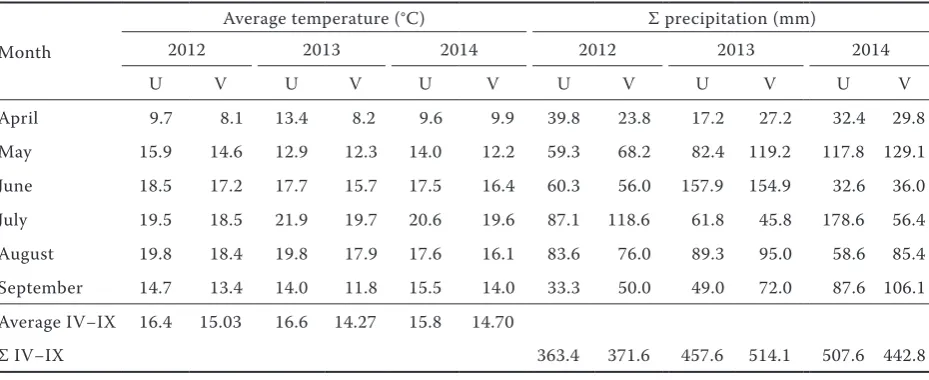
Plant material. Potatoes were grown in 2012– 2014 in the Czech Republic in field experiments (four replicates) in two locations with different altitudes. At Prague-Uhříněves location (50°1'50.302''N, 14°36'18.802''E; 298 m a.s.l.; soil type Luvisol) the experiment was carried out at the Research Station of the University of Life Sciences Prague. At Valečov location (49°38'39.28''N, 15°29'49.97''E; 460 m a.s.l.; soil type acid Cambisol) it was at the Experimental Station of the Potato Research Institute Havlíčkův Brod. The weather conditions in both locations in experimental years are given in Table 1. In the trials, thirteen cultivars in total were assessed: control yellow-fleshed cv. Agria and eight cultivars with purple and four cultivars with red flesh. Agrotechnology of trials is described in our previous article by Urban et al. (2018). After the harvest, fresh tubers were analysed for ascorbic acid content (AAC). In 2012, a long-term storage experiment with cv. Agria and eight cultivars of potatoes with coloured flesh tubers (5 purple- and 3 red-fleshed) was made. Samples weighing 25 kg were stored in four replicates. AAC was determined in the tubers of these cultivars immediately after the harvest, and then the tubers were stored for long-term period of 180 days at 4°C and then re-analysed for their AAC.
Determination of ascorbic acid. The ascorbic acid content was determined by the method of high performance liquid chromatography with a diode array detector (HPLC-DAD, Sunnyvale, USA) at
the Department of Chemistry, Czech University of Life Sciences Prague. The methodology ac-cording to Hajšlová et al. (2005) was adapted by Lachman et al. (2013). A detailed procedure of the determination is described in the publication by Lachman et al. (2013).
Statistical analysis. The obtained results were statistically evaluated by the analysis of variance (ANOVA) method. The differences between mean values were evaluated by the Tukey’s HSD (honestly significant difference) test in the SAS computer program (SAS Institute, Carry, USA), version 9.4. at the level of significance P = 0.05.
RESULTS AND DISCUSSION
Ascorbic acid content
[image:2.595.65.530.554.744.2]The effect of the cultivar and the tuber flesh colour. The genotype of a cultivar has proved to be the factor with a significant effect on the AAC. Differences between the AAC values of 13 experimental cultivars were significant in a number of cases every year, not only at each site (Table 2) but also in the average of all three years and both sites (Figure 1). The highest AAC in the three-year results averaged for both sites was at-tained by cv. Rosemarie with red flesh (218.9 mg/kg FM, a significant difference compared to all other cultivars), at 1.10 to 1.84 times the values of the other cultivars. It was followed by a yellow flesh cv. Agria (199.4 mg/kg FM). The lowest AAC
Table 1. Basic characteristics of weather in the vegetation period in experimental years
Month
Average temperature (°C) Σ precipitation (mm)
2012 2013 2014 2012 2013 2014
U V U V U V U V U V U V
April 9.7 8.1 13.4 8.2 9.6 9.9 39.8 23.8 17.2 27.2 32.4 29.8
May 15.9 14.6 12.9 12.3 14.0 12.2 59.3 68.2 82.4 119.2 117.8 129.1
June 18.5 17.2 17.7 15.7 17.5 16.4 60.3 56.0 157.9 154.9 32.6 36.0
July 19.5 18.5 21.9 19.7 20.6 19.6 87.1 118.6 61.8 45.8 178.6 56.4
August 19.8 18.4 19.8 17.9 17.6 16.1 83.6 76.0 89.3 95.0 58.6 85.4
September 14.7 13.4 14.0 11.8 15.5 14.0 33.3 50.0 49.0 72.0 87.6 106.1 Average IV−IX 16.4 15.03 16.6 14.27 15.8 14.70
Σ IV−IX 363.4 371.6 457.6 514.1 507.6 442.8
value was determined in the purple flesh cv. Bora Valley (118.7 mg/kg FM). There is a positive find-ing that some of the newly distributfind-ing cultivars
[image:3.595.67.531.126.400.2]with coloured flesh, whose significant advantage is the anthocyanins content in the tubers and a high antioxidant activity, also have a favourable Table 2. Ascorbic acid content (mg/kg fresh matter) in the flesh of thirteen potato cultivars at two localities and years 2012–2014
Cultivar colourFlesh Uhříněves Valečov
2012 2013 2014 2012–2014average 2012 2013 2014 2012–2014average Agria y 282.0a 152.8fg 160.7b 198.5bc 184.5bc 245.3b 171.0a 200.3b Blaue Anneliese p 225.3de 145.3g 145.2c 171.9d 148.5d 101.9h 106.0cde 118.8h Blaue Elise p 243.3c 180.4bcd 166.2b 196.6bc 225.3a 203.4c 151.6b 193.4b Blaue St. Galler p 158.8h 149.4fg 117.7de 142.0f 139.3d 148.6e 108.0cde 132.0g Blue Congo p 192.3f 165.6def 127.6d 161.8de 176.8c 133.0f 114.1cde 141.3ef Bora Valley p 123.0i 118.0h 115.0e 118.7g 121.5ef 116.6g 118.0cd 118.7h Salad Blue p 212.3e 188.4bc 104.4e 168.4de 116.8f 164.1d 99.1ef 126.7gh Valfi p 172.0gh 156.7efg 147.1c 158.6ef 139.0d 153.9de 105.7cde 132.9fg Vitelotte p 240.8cd 173.0cde 166.7b 193.5c 142.5d 212.4c 102.1def 152.3d Herbie 26 r 182.5fg 125.6h 140.6c 149.6f 106.8f 112.6gh 88.6f 102.7i Highland B. Red r 264.0b 159.6efg 187.7a 203.8b 143.0d 162.8d 120.7c 142.2e Rosemarie r 247.3c 241.5a 185.0a 224.0a 198.0b 276.3a 166.7ab 213.7a Red Emmalie r 251.0bc 145.7g 183.8a 193.5c 136.8de 251.4b 119.3c 169.2c Average 216.0Aα 161.7Aβ 148.9Aβ 175.5A 152.2βα 175.6Aα 120.8Bβ 149.6B
HSDcultivars 16.58 18.14 12.06 10.14 16.73 13.88 15.96 9.15
Significance of differences between cultivars in columns is marked with lower case letters, significance of differences between locations for a given year is marked with upper case letters, significance of differences between years in lines is marked with Greek letters; differences between averages with the same letter are statistically non-significant; loca-tions: HSD2012 = 13.38; HSD2013 = 15.78; HSD2014 = 7.64; HSD2012–14 = 7.12; years: HSDUhříněves = 13.35; HSDValečov = 23.59; HSD – honestly significant difference; flesh colour: y – yellow; p – purple; r – red
199.4b 145.4e
195.0b 137.0f
151.6e 118.7h
147.6e 145.8e
172.9d 126.2g
173.0d
218.9a 181.4c
0 50 100 150 200 250
Agria/y Blaue Anneliese/p Blaue Elise/p Blaue St. Galler/p Blue Congo/p Bora Valley/p Salad Blue/p Valfi/p Vitelotte/p Herbie 26/r Highland B. Red/r Rosemarie/r Red Emmalie/r
Ascorbic acid content (mg/kg FM)
[image:3.595.63.438.542.753.2]AAC which is comparable to that of the yellow flesh cultivars. The significant genotype effect on the AAC that was discovered in our experiments was also similarly determined by several other authors. For example, in experiments on 60 cul-tivars of potatoes by Valcarcel et al. (2015) in the Republic of Ireland the highest AAC was attained by cv. Nicola (798 mg/kg dry matter (DM)), while the lowest content was determined in cv. Pentland Ivory (81 mg/kg DM). The purple flesh cultivars results were as follows: cv. Salad Blue (332 mg/kg DM) and cv. Congo (121 mg/kg DM). On the basis of the above described experiments with 23 native Andean potato cultivars, Burgos et al. (2009) also showed a conclusive influence of the genotype. This is supported by the results of the experiments of Dale et al. (2003) with 33 cultivars grown at three geographically diverse sites in Europe. Other au-thors who showed the genotype effect on the AAC included were, for example, Gutiérrez-Quequezana et al. (2018), Lombardo et al. (2017), Valcarcel et al. (2015, 2016), Lachman et al. (2013), and Cho et al. (2013).
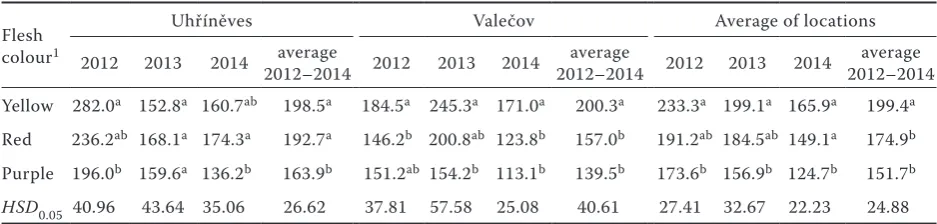
Considering the flesh colour effect using the average of three years and both sites, there was a significantly higher AAC in the yellow flesh control cv. Agria (199.4 mg/kg FM) compared with the groups of cultivars with the red flesh (1.14-times) and purple flesh (1.31-times) (Table 3). In the groups of cultivars with coloured flesh, there was a trend towards higher AAC values determined in the red-flesh cultivars group; however, compared to the purple-flesh cultivars the difference was non-significant. Yet, from more detailed results for individual cultivars with red or purple flesh as outlined in Table 2, it is clear that there are con-siderable differences in the AAC among some of
the cultivars. In the cultivars lined up in Table 2 according to their AAC, the red-flesh and purple-flesh cultivars vary in an irregular pattern. For example, in the three-year results average (Figure 1) the absolutely highest AAC in the red-flesh cultivars group was attained by cv. Rosemarie (218.9 mg/kg FM) and the lowest by cv. Herbie 26 (126.2 mg/kg FM), while the differences between all the red-flesh cultivars were statistically signifi-cant. In the cultivars with purple flesh, the highest AAC was attained by cv. Blaue Elise (195.0 mg/ kg FM) while the lowest AAC was recorded in cv. Bora Valley (118.7 mg/kg FM).
[image:4.595.63.532.614.726.2]It appears that the decisive effect on the AAC is not determined by flesh colour but by the geno-type of individual cultivars. This supports our previous findings from the experiments with five cultivars with coloured flesh, plus one yellow-flesh and one white-yellow-flesh cultivar (Lachman et al. 2013). The effect of the flesh colour on the AAC was investigated on five coloured as well as light-yellow-flesh potatoes by Silveira et al. (2017). They also discovered that vitamin C in coloured fleshed potatoes was about 1.5–3 times higher than in light-yellow potato. The highest content corresponded to purple-flesh potatoes followed by red- and purple-white-flesh cultivars. Nevertheless, these results, in our opinion, do not quite reveal the effect of the flesh colour on the AAC, as only one cultivar was evaluated for each flesh colour. Valcarcel et al. (2016) conducted an AAC analysis of 4 yellow-, 1 cream-, 1 white- and 1-blue-flesh cultivars. Cv. Salad Blue with blue flesh took a fifth position in this group of cultivars. In another experiment by Külen et al. (2013), twelve Colorado-grown specialty clones were evaluated for AAC; potato clones were categorized as pigmented (9),
Table 3. Effect of flesh colour on the ascorbic acid content (mg/kg fresh matter) in potato tubers
Flesh colour1
Uhříněves Valečov Average of locations
2012 2013 2014 2012–2014 2012average 2013 2014 2012–2014 2012average 2013 2014 2012–2014average
Yellow 282.0a 152.8a 160.7ab 198.5a 184.5a 245.3a 171.0a 200.3a 233.3a 199.1a 165.9a 199.4a Red 236.2ab 168.1a 174.3a 192.7a 146.2b 200.8ab 123.8b 157.0b 191.2ab 184.5ab 149.1a 174.9b Purple 196.0b 159.6a 136.2b 163.9b 151.2ab 154.2b 113.1b 139.5b 173.6b 156.9b 124.7b 151.7b
HSD0.05 40.96 43.64 35.06 26.62 37.81 57.58 25.08 40.61 27.41 32.67 22.23 24.88
yellow (1) and white flesh (2). Vitamin C content was higher in cv. Yukon Gold (yellow flesh) than in other clones.
The effect of location. Location significantly affected the AAC in potato tubers (Table 2) in our experiments. In the average of three years and thirteen experimental cultivars a significantly higher AAC value was determined at the Uhříněves location (1.17 times) compared to the Valečov location. Considering individual experimental years, a significantly higher AAC was found in Uhříněves in 2012 and 2014, while in 2013 the result was non-significant. Uhříněves locality with higher AAC has a warmer climate. Based on our previous findings (Hamouz et al. 2007) this could favourably affect the AAC. Above all, based on our current knowledge, the higher AAC could have been caused by drier climate and weather. This view is confirmed by our previous research (Hamouz et al. 2007). Valcarcel et al. (2015) also mention the conclusive effect of the climatic conditions at the site on AAC. Following an experiment at two sites in the Republic of Ireland, they concluded that lower rainfall produced higher AAC con-tent in tubers. In our case, in the first year with higher AAC in Uhříněves, the total rainfall dur-ing the growdur-ing period was lower by only 8.2 mm compared to the Valečov location (Table 1). However, the rainfall in Uhříněves was evenly distributed, but there was a drier period before
the harvest (33.3 mm at Uhříněves and 50.0 mm at Valečov in September). In the following year (2014) with a higher AAC obtained in Uhříněves, a higher total rainfall during the growing period, compared to Valečov, was recorded. However, significantly drier weather in Uhříněves during the pre-harvest period (August and September) was apparently the decisive factor. Burgos et al. (2009) have also found from the results of the varietal experiments of three sites of the central Peruvian Andes a significant effect due to the environment. However, the contribution of the genotype (60.3%) to the variance was three times higher than that of the environment (20.3%). Cho et al. (2013) ar-rived to the same finding (conclusive effect of the environmental conditions of the location on the AAC, but lower than the effect of the cultivar). A significant effect of the location on the ACC was also discovered by other authors who, however, do not mention specific associations of the AAC with climatic or soil conditions (Dale et al. 2003, Haase 2008, Lombardo et al. 2017).
The effect of the year of cultivation. The aver-age AAC in the tubers of all cultivars was affected by the weather in individual years of cultivation (Table 2). At the Uhříněves location, the year 2012 (216.0 mg/kg FM) with the highest AAC content significantly differentiated from both the following years (1.34 times higher content compared to 2013 and 1.45 times compared to 2014). The cause of
183a
143a 137a
198a
226a
139a
177a
139a 142a
165a
106b
62b 73b 77 b
79b
67b 73b 63b
92b
77b 42.3 56.4 46.6
61.2 65.1
52.0 58.7 54.8
35.5 53.4
0 50 100 150 200 250
(mg
/kg
F
M
, %
)
[image:5.595.87.509.496.703.2]harvest values stored 6 months decrease (%)
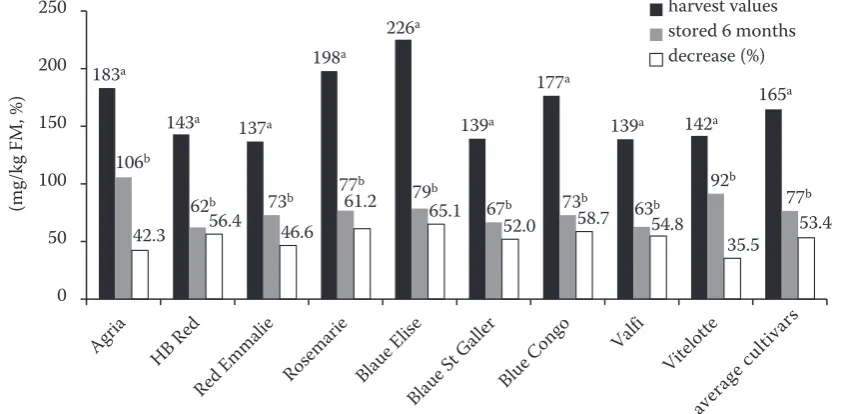
Figure 2. Effect of cold storage (4°C) on the ascorbic acid content (AAC, mg/kg fresh matter (FM)) and expression of AAC decreases in percentage points compared to postharvests values (100%) for the duration of 6 months in nine selected cultivars (4 replicates). The differences between the means marked by the same letters in individual cultivars are non-significant
avera ge cu
the lower AAC values in 2013 and 2014 compared with 2012 at Uhříněves could have been the higher rainfalls in September (49.0 mm and 87.6 mm) compared to 2012 (33.3 mm). By contrast, in Valečov a significant difference was determined between the years 2013 (175.6 mg/kg FM) and 2014 (120.8 mg/kg FM). Even in this case, the higher AAC was obtained in the year of 2013 with lower rainfalls in September (72.0 mm). This can be compared with the same month in 2014 (106.1 mm) which had a verifiably lower AAC. These results correspond with the above-presented findings on the effect of a site climatic conditions on the AAC and on the favourable effect of the drier conditions on the AAC in tubers (Hamouz et al. 2007, Valcarcel et al. 2015). It is indicated that, above all, the level of rainfalls during the final stage of the growing period has an effect on the AAC. The effect of a particular year on the AAC was also confirmed by other authors (Dale et al. 2003, Haase 2008, Burgos et al. 2009, Cho et al. 2013, Valcarcel et al. 2015, Lombardo et al. 2017).
The effect of storage. Cold storage (4°C) for a period of six months recorded a significant de-crease in the AAC in all cultivars (Figure 2) com-pared to the postharvest level at 53.4% on average. The AAC decrease differed among cultivars but it is clear that it was not affected by the colour of the tuber flesh. In the yellow-flesh control cv. Agria it was 42.3%, while in the red-flesh cultivars it ranged from 46.6% (cv. Red Emmalie) to 61.2% (cv. Rosemarie) and in the cultivars with purple flesh it ranged from 35.5% (cv. Vitelotte) to 65.1% (cv. Blaue Elise). The results clearly demonstrate that the distinct differences in the AAC between the cultivars as determined following the har-vest was quite levelled out (equalized) by the end of storage. Our results correspond well with the findings of other authors. The effect of storage for 7 months at 5 ± 1°C on the vitamin C contents of ten genotypes were evaluated by Stushnoff et al. (2008) who recorded a decrease of its content by 38–67% compared to the harvest levels. Even though a few promising genotypes had a higher vitamin C content than most at harvest, after several months of stor-age they all dropped to nearly the same level. Dale et al. (2003) also documented the large reduction in vitamin C content that occurs during storage, aver-aging 45%. In the experiment by Külen et al. (2013) the vitamin C content decreased in all potato clones during cold storage (4°C). After 7 months of storage
a non-significant difference was determined in the vitamin C content between cv. Yukon Gold (yellow flesh) and the clones with coloured flesh (at harvest time there was a significantly higher content in the cv. Yukon Gold). A significant reduction in the AAC during cold storage was also recorded by Galani et al. (2017), Licciardello et al. (2018). Delgado et al. (2001) noted a decrease by 78%. In the experiments by Keijbets and Ebbenhorst-Seller (1990) a total loss of AAC varied between 21–60%.
REFERENCES
Burgos G., Auqui S., Amoros W., Salas E., Bonierbale M. (2009): Ascorbic acid concentration of native Andean potato varieties as affected by environment, cooking and storage. Journal of Food Composition and Analysis, 22: 533–538.
Cho K.S., Jeong H.J., Cho J.H., Park Y.E., Hong S.Y., Won H.S., Kim H.J. (2013): Vitamin C content of potato clones from Korean breeding lines and compositional changes during growth and after storage. Horticulture, Environment, and Biotechnology, 54: 70–75. Dale M.F.B., Griffiths D.W., Todd D.T. (2003): Effects of genotype, environment, and postharvest storage on the total ascorbate content in potato (Solanum tuberosum) tubers. Journal of Agricultural and Food Chemistry, 51: 244–248.
Delgado E., Sulaiman M.I., Pawelzik E. (2001): Importance of chlorogenic acid on the oxidative potential of potato tubers of two German cultivars. Potato Research, 44: 207–218. Galani J.H.Y., Patel J.S., Patel N.J., Talati J.G. (2017): Storage of
fruits and vegetables in refrigerator increases their phenolic acids but decreases the total phenolics, anthocyanins and vitamin C with subsequent loss of their antioxidant capacity. Antioxidants, 6: UNSP 59.
Gutiérrez-Quequezana L., Vuorinen A.L., Kallio H., Yang B.R. (2018): Improved analysis of anthocyanins and vitamin C in blue-purple potato cultivars. Food Chemistry, 242: 217–224. Haase N.U. (2008): Healthy aspects of potatoes as part of the
human diet. Potato Research, 51: 239–258.
Hajšlová J., Schulzová V., Slanina P., Janné K., Hellenäs K.E., An-dersson Ch. (2005): Quality of organically and conventionally grown potatoes: Four-year study of micronutrients, metals, secondary metabolites, enzymic browning and organoleptic properties. Food Additives and Contaminants, 22: 514–534. Hamouz K., Lachman J., Dvořák P., Dušková O., Čížek M. (2007):
Effect of conditions of locality, variety and fertilization on the content of ascorbic acid in potato tubers. Plant, Soil and Environment, 53: 252–257.
Külen O., Stushnoff C., Holm D.G. (2013): Effect of cold storage on total phenolics content, antioxidant activity and vitamin C level of selected potato clones. Journal of the Science of Food and Agriculture, 93: 2437–2444.
Lachman J., Hamouz K., Musilová J., Hejtmánková K., Kotíková Z., Pazderů K., Domkářová J., Pivec V., Cimr J. (2013): Effect of peeling and three cooking methods on the content of selected phytochemicals in potato tubers with various colour of flesh. Food Chemistry, 138: 1189–1197.
Licciardello F., Lombardo S., Rizzo V., Pitino I., Pandino G., Strano M.G., Muratore G., Restuccia C., Mauromicale G. (2018): Inte-grated agronomical and technological approach for the quality maintenance of ready-to-fry potato sticks during refrigerated storage. Postharvest Biology and Technology, 136: 23–30. Lombardo S., Pandino G., Mauromicale G. (2017): The effect on
tuber quality of an organic versus a conventional cultivation system in the early crop potato. Journal of Food Composition and Analysis, 62: 189–196.
Navarre D.A., Shakya R., Holden J., Kumar S. (2010): The effect of different cooking methods on phenolics and vitamin C in developmentally young potato tubers. American Journal of Potato Research, 87: 350–359.
Silveira A.C., Falagán N., Aguayo E., Vilaró F., Escalona V.H. (2017): Compositional changes on colored and
light-yellow-fleshed potatoes subjected to two cooking processes. CyTA – Journal of Food, 15: 241–248.
Singh P.P., Saldaña M.D.A. (2011): Subcritical water extraction of phenolic compounds from potato peel. Food Research In-ternational, 44: 2452–2458.
Stushnoff C., Holm D., Thompson M.D., Jiang W., Thompson H.J., Joyce N.I., Wilson P. (2008): Antioxidant properties of cultivars and selections from the Colorado potato breeding program. American Journal of Potato Research, 85: 267–276. Urban J., Hamouz K., Lachman J., Pulkrábek J., Pazderů K. (2018):
Effect of genotype, flesh colour and environment on the gly-coalkaloid content in potato tubers from integrated agriculture. Plant, Soil and Environment, 64: 186–191.
Valcarcel J., Reilly K., Gaffney M., O’Brien N. (2015): Total carot-enoids and l-ascorbic acid content in 60 varieties of potato (Sola-num tuberosum L.) grown in Ireland. Potato Research, 58: 29–41. Valcarcel J., Reilly K., Gaffney M., O’Brien N. (2016): Levels of po-tential bioactive compounds including carotenoids, vitamin C and phenolic compounds, and expression of their cognate biosynthetic genes vary significantly in different varieties of potato (Solanum tuberosum L.) grown under uniform cultural conditions. Journal of the Science of Food and Agriculture, 96: 1018–1026.