Abstract—In this study, it is considered the case of chasing escapers using graph theory method with multi robots, which are connected to each other. In this simulation study the fugitives are trying to escape from a campus region which has five possible gates for entrance and exit. Because of not determining the possible escape ways of fugitives, it is hard to obtain useful results from police or security chase in a quick time. In this approach, some security robots are waiting in stand-by position to get a new command for positioning in a specified area. Happening of any undesired case, robots are informed by an operator which gate is the alarmed gate. At this point, multi-robots are positioned by using graph theory if the communication range is appropriate to connect each other. This imaginary scenario is supposed to take place in the campus of Selçuk University. There are five gates in the campus that are used for vehicle and pedestrian entrance and exit. For any unusual events similar to this simulation like shooting or robbery, security robots would be alarmed. After alarm case, the backup team would be sent to the gates to start the aerial chasing of escapers.
Index Terms— grapy theory; morphing robots; multi-robots; search and rescue
I. INTRODUCTION
S every research areas including robotics, studies are being made on using robots for search and rescue tasks. It has sample applications of multi robots usage such as putting out forest fire [1], 2D and 3D mapping of environment [2], real time object tracking [3]. With this thought, our paper ponders on the question whether or not to apply these multi robots in events like shooting, robbery, etc. In the incident of these attacks are occurred and after that, fugitives are trying to flee and kill some other hostages. Totally, there were many people killed and wounded including hostages. In the course of running away of Manuscript received July 09, 2015; revised August 08, 2015. This work was supported in part by Selçuk University BAP (Scientific Research Projects Office) .
K. Erdoğan is with the Electrical and Electronics Engineering Department, Selçuk University, 42075, Konya, TURKEY. (phone: +90-332-2232252; fax: +90-332-2410635; e-mail: kemalerdogan@ selcuk.edu.tr).
M. Korkmaz is with the Electrical and Electronics Engineering Department, Selçuk University, 42075, Konya, TURKEY. (e-mail: [email protected]).
A. Durdu is with the Electrical and Electronics Engineering Department, Selçuk University, 42075, Konya, TURKEY. (e-mail: [email protected]).
N. Yılmaz is with the Electrical and Electronics Engineering Department, Selçuk University, 42075, Konya, TURKEY. (e-mail: [email protected]).
S. Topal is with TUBITAK, Ankara, TURKEY. (e-mail: [email protected]).
fugitives, it has been observed that there are some problems with determining and following the runners. If the probable paths of escapers would be determined, the security forces could be manipulated through the possible escaping ways. If it would be applied successfully, time will not be wasted.
In the light of these events and problems, it was tried to develop an algorithm for multi-robots. An algorithm organizes fire-fighting robots has been adapted to a different approach as security robots. Graph theory method is used to make some decisions in this algorithm.
Graphs that are mathematical structures used to model relations between objects. It allows the representation of networks and their properties formally. Initially, it has developed as a branch of mathematics but later has been used by many researchers and has been widely used in many fields such as biological and social systems, computer science, chemistry, engineering etc. [4]. The basis of graph theory was formed by Leonhard Euler (1707-1783) who is a Swiss mathematician. Fundamentally the graph theory is developed for solving the Konigsberg Bridge Problem which is in a city that is settled with two large islands connected to each other and the mainland by seven bridges. According to this problem, it is pondered to find a path which starts from any point and cross each bridge only once before returning to the beginning point. In the study of Euler it has been proved that the problem has no solution and so this study has brought out valuable works. And then if there is a solution for the problem it is called Eulerian Circuit [5]. Beside to Konigsberg problem, travelling salesman and four color problems can also be accepted as an application of graph theory.
In graph theory, conceptually, a graph is most often thought as a set of vertices (alternative: nodes) and edges (alternative: links) which connects the vertices. A graph, is generally showed with the notation of G(E, V), which is a data structure of the set of vertices (V) and edges (E). V and E are usually taken to be finite and they represent different meanings. For example, vertices may have the meaning of locations of objects and edges may represent any relationship between vertices such as a flux of energy. As a mathematical viewpoint, graphs are often expressed with an adjacency matrix (A), which has size n by n. The matrix size n refers to the number of nodes in the network. The adjacency matrix is said to be symmetric when the graph is given undirected although building an adjacency matrix of directed graphs is non-symmetric [6].
It has benefit to create a new algorithm from graph theory provides less complexity and better comprehension to main flow model [7]. There is another study that is related with optimal design of water system operation. In that study,
Formation Morphing of Multi-Robots Using
Graph Theory: Fugitive Chasing
Kemal ERDOĞAN, Mehmet KORKMAZ, Akif DURDU, Nihat YILMAZ and Sebahattin TOPAL
water sources, junctions, tanks and consumers are represented by graph nodes, on the other hand pipes, pumping stations water tanks are represented by graph edges. According to the study results, based on graph theory successive shortest path (SSP) algorithm has given optimal operation cost and pump scheduling [8]. Another application area of graph theory is about clinical issues. There is a benefit of graph theory for diagnostic and prognostic purpose of seizure of temporal lobe epilepsy (TLE) [9]. Besides of all these applications, the graph theory is being in a very important side of robotic applications especially for multi-robot morphing when there is a new task is assigned. The study about multi robot positioning presents a leader follower scheme [10]. Another paper is about modular robots that change their geometry or configuration when the new modules are connected. According to the paper, there is a benefit from the property of graph theory which can portray the new configurations [11].
This paper organizes as follows; section two will give an introduction about graph theory with mathematical definitions; section three presents implementation of the graph theory to our fugitive determination and will provide and discuss about the simulation results and examples of the escape scenario and lastly, section four are related about conclusion of the study and future works.
II. GRAPH THEORY
An undirected graph is made of set of vertices (a finite set of elements);
An edge set which is subset of unordered pairs of V2; V2 = {(vi, vj)}, i=1, 2, …, N ; j = 1, 2, …, N ; i≠j
[image:2.595.380.475.242.298.2]If (vi, vj) E, then (vj, vi) E.
Fig. 1. Simple graph
Vertices can be shown in a way of numbers (1, 2, 3, …, n), sub-indices of v (v1, v2, v3, …, vn) or lower case (a, b, c,
…, n). For the given simple graph in Fig. 1 the vertex set and edge set can be defined as follows:
V={v1, v2, v3, v4, v5};
E={(v1, v2), (v2, v3), (v3, v5), (v4, v3), (v4, v5), (v2, v5)}
Due to the fact that G is undirected, it does not matter to
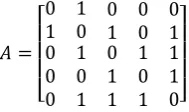
A, is defined A = (aij) of order n. Here the ij letters are associated with the pair of (vi, vj). According to the definition, A matrix can be written in the form of following:
.
The corollary of the definition is that A, adjacency matrix, is symmetric with respect to the main diagonal and all the elements of matrix which are consisting of number zero ore one for the simple graphs. When the G is digraph, which means direction is important, matrix A will be non-symmetric so that aij ≠ aji. For another point, if the A matrix is edges weighted, the connection between aij’s will be
different from zero or one principally non-integer. But in all cases, A is n by n matrix. Again, taking cognizance of Fig. 1 example A matrix will be remarked as following algebraic term:
[
]
There is another matrix used in graph theory which is called as incidence matrix. This matrix shows us the relation between the vertices and edges. In other words, if we choose the rows for representing the vertices, columns will represent the edges. So in an incidence matrix which is mentioned as has only two 1’s in a column if the edges are all connected to a vertex in both endings. Again let G=(V, E) to be a graph and to be shown by T. T is n by m matrix and symbolizes (for undirected graphs);
T(i, k) = T(j, k) = 1 if and only if ek = (vi , vj)
[
]
Other important parameter is degree of graphs. This parameter is defined as follows:
Let G = (V, E) be a graph and v V a vertex. The degree of v, d(v) to be number of vivj E. beside this minimum and
maximum degrees of graph G are represented ∂(G) and ∆(G), respectively.
In addition to this mathematical definition, it will be useful to mention some description about graph theory. A walk is a sequence of vertices v0v1v2 · · · vk such that v0v1,
v1v2, . . . , vk−1vk are all edges. A trail is a walk v0v1v2 · · · vk
such that the edges v0v1, v1v2, . . . , vk−1vk are distinct. A
cycle is a walk v0v1v2 · · · vk where v0 = vk, but all other
vertices are distinct. A circuit is a trail v0v1v2 · · · vk where
v0 = vk. An Eulerian circuit is a circuit that uses every edge.
III. IMPLEMENTED SYSTEM &SIMULATION RESULTS
the gates. This area is supposed to be the campus of Selçuk University and the robots are the guardians of this university campus. Selçuk University campus has got five gates as entrance and exit for vehicles. There are at least one security robot is located at each gate, beside of gates there are robots that are located inside of campus area. Before any alarm case, robots are located several places on the map and are waiting in standby mode for mission. If there would be a suddenly developing alarm case about any suspicious escapers from security department this algorithm needs to get information that which gate the escapers are going through. After this point the aim of security department is to chase the suspicious escapers until the police forces intervened to this pursuit.
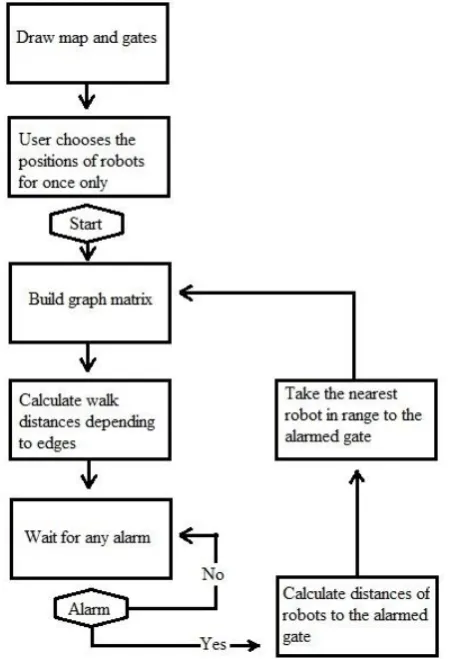
Fig. 2. Flow chart of the proposed system
Fig. 3. The first positions of the robots
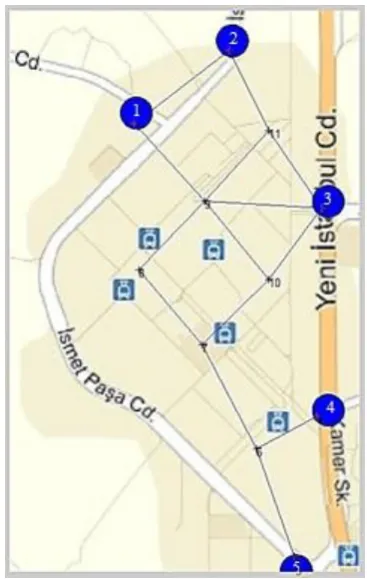
In this part of the complete simulation, this algorithm has an only aim of canalizing the robots to the gate of escape for a long chase, because more units you have means that you have more power for chasing successfully. Before an alarm case that is to say the standby case, positions of robots are known on the map by controlling algorithm as in Fig. 2. After the execution of the codes started map is drawn and algorithm starts to wait for user to choose the positions of the robots for only once. Blue circles show the gates of Selçuk University Campus, numbers and the red plus signs show the security robots. Fig.3
In an alarm case, algorithm calculates the distances between robots in case of “edge” terms in graph theory and after each positioning loop algorithm needs to determine the distances between the robots which are communicated each other again. Also algorithm makes a calculation for planning which robot to send to the defined gate. For this mentioned process, graph theory matrices and features have been used.
B. Related Positions of Robots:
Firstly it is required to determine the related positions of security robots to make the first action in case of escaping. Graph theory is used to determine the distances in term of edges between robots.
[image:3.595.59.285.229.559.2]Fig. 4. The networked graph of the robots before the alarm
Blue lines between the security robot points describe the distances between them, also these blue lines mean that a connection is established between the robots and they are in the range of radio frequency communication.
In order to obtain these communication and distance information, the adjacency matrix, the eigenvalues of this adjacency matrix and the related index values are used. Adjacency matrix shows the distance relation between robots which could establish communication link with each other. Security robots take the place of vertices and the shortest distances of neighbor robots take the place of edges of graph theory. The A matrix is formed with respect to these edges and vertices, then the eigenvalues are calculated from this A matrix. The greatest one of the eigenvalues gives us the index value and the related eigenvector is the principal eigenvector of the system. [12].
The index and principal eigenvector values give us the information as connection or neighbor numbers of robots with each other that these values are extracted by the use of algorithms which are get from the previous studies [1]. By using these it is understood which robots have the similar locations. So in this method, it is not possible to make any comments about the position of robot if that robot has not any connections to any other robot or robots. As a result of this property, robots that have no connection with any others could not to be used for the operation in this algorithm.
In the graph theory number of edges gives the index value, so in this algorithm number of connections between robots gives the index value as in graph theory. Again as in the graph theory, the number of neighbor robots connected to a robot forms the corresponding components in principal
of importance values are calculated by using the principal eigenvector components (1) [1].
(∑ ) ( ) (1)
It is examined in the simulation that if an alarm case occurred through the gate number 4, proposed algorithm gives the support mission to nearest robot to that gate which is the robot number 6 as seen in Fig. 5.
After this step of process algorithm waits for any other commands, if security department needs any other robots to any gate, algorithm calculates the nearest suitable robot and send a new one to desired gate in case of there is a connection between robots.
IV. CONCLUSION
[image:4.595.336.518.335.628.2]In this paper, it is aimed to support the security of big areas with the help of multi-robot team (security robots). In this study, it is benefited from the computer software. With this aim, the graph theory is used to connection of security robots and determination of the closest robot to intervene any alarm case. In the light of this information, the escaper scenario is thought on the Selçuk University Campus to see the effectiveness of the algorithm.
Fig. 5. The networked graph after the alarm case occurred in the fourth gate.
battery life, disconnection, lost in the connection range, breaking down of robots etc. will be added to the algorithm to get more reliable values for the real time applications.
ACKNOWLEDGMENT
Authors are thankful to RAC-LAB for providing the trial version of their commercial software for this study. The authors are also grateful to Selçuk University Scientific Research Projects Office.
REFERENCES
[1] S. Topal, I. Erkmen, A.M. Erkmen, “Morphing a Mobile Robot Network to Dynamic Task Changes over time and space”, International Conference on Automation Robotics and Control, ARCS-09, (2009), Orlando, Florida, USA.
[2] S. Thrun, W. Burgard, D. Fox, “A real-time algorithm for mobile robot mapping with applications to multi-robot and 3D mapping”, Robotics and Automation, 2000. Proceedings. ICRA '00. IEEE International Conference on , vol.1, no., pp.321,328 vol.1, 2000 [3] M. Mazo, A. Speranzon, K.H. Johansson, H. Xiaoming, “Multi-robot
tracking of a moving object using directional sensors”, Robotics and Automation, 2004. Proceedings. ICRA '04. 2004 IEEE International Conference on , vol.2, no., pp.1103,1108 Vol.2, April 26-May 1, 2004 [4] F. Riaz, K.M. Ali, “Applications of Graph Theory in Computer Science”, Computational Intelligence, Communication Systems and Networks (CICSyN), 2011 Third International Conference on , vol., no., pp.142,145, 26-28 July 2011
[5] L.B. Norman, E.K. Lloyd, R.J. Wilson, “Grapy Theory”, Clarendon Press, Oxford
[6] T. Heckmann, W. Schwanghart, J.D. Phillips, “ Graph theory - recent developments of its application in geomorphology”, Geomorphology (2014)
[7] M. Fortinia,, C. Bragalli, S. Artina, “Identifying the High-Level Flow Model of Water Distribution Networks Using Graph Theory”, Procedia Engineering, 89, ( 2014 ), 1192 – 1199.
[8] E. Price, A. Ostfeld, “Optimal Water System Operation Using Graph Theory Algorithms”, Procedia Engineering, 89, ( 2014 ), 502 – 508.
[9] Z. Haneef, S. Chiang, “Clinical correlates of graph theory findings in temporal lobe epilepsy”, Seizure, 23, (2014), 809– 818.
[10] J.C. Barca, A. Sekercioglu, and A. Ford, “Controlling Formations of Robots with Graph Theory”, Intelligent Autonomous Systems 12, AISC 194, pp. 563–574.
[11] J. Baca, A. Yerpes, M. Ferre, J.A. Escalera, and R. Aracil, “Modelling of Modular Robot Configurations Using Graph Theory”, HAIS 2008, LNAI 5271, pp. 649–656, 2008.