Cross-language Entity Linking Adapting to User’s
Language Ability
Jialiang Zhou, Fuminori Kimura, and Akira Maeda
Abstract—In this paper, we propose a method to
automatically discover valuable keyphrases in Japanese and link these keyphrases to related Chinese Wikipedia pages. The method that we propose has four stages. Firstly, we extract nouns from a Japanese document using a morphological analyzer and extract the candidates of keyphrases using a method called Top Consecutive Nouns Cohesion (TCNC) [1]. Then, we judge the degree of difficulty of the extracted keyphrases and tag them with different linguistic levels. Secondly, we translate extracted Japanese keyphrases into Chinese using a combination of three translation methods. Thirdly, we extract the corresponding Chinese articles of the translated keyphrases. Fourthly, we translate the original Japanese document into Chinese and make a vector of noun frequencies. Then, we calculate the cosine similarities of the translated original document and candidate Chinese Wikipedia articles. Finally, we create links from the Japanese keyphrases to the top-ranking Chinese Wikipedia articles.
Keywords—Entity linking; keyphrase extraction; Wikipedia;
Cross-language Link Discovery; linguistic difficulty level estimation
I. INTRODUCTION
ECENTLY, because of the wide use of tablets and smartphones, the Internet services have become even more popular all over the world. Enormous amount of information is stored in a variety of languages. In addition, the hyperlinks on the Web link to many related information. However, related information is not always available in the native languages of the users. This causes difficulties for users to understand the documents written in foreign languages.
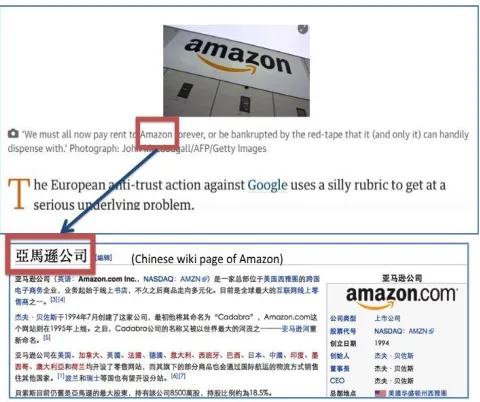
To solve this problem, it is desirable to find potential links automatically from documents written in their native languages (see Figure 1). Therefore, we propose a method to obtain Chinese encyclopedia articles that give the meaning of the keyphrases in a Japanese document.
Manuscript received January 8, 2017; revised February 7, 2017. This work was supported in part by JSPS KAKENHI Grant Numbers 24500300, 16K00452, and MEXT-Supported Program for the Strategic Research Foundation at Private Universities (S1511026).
J. Zhou is with Graduate School of Information Science and Engineering, Ritsumeikan University, Japan (e-mail: [email protected]). F. Kimura is with Faculty of Economics, Management and Information Science, Onomichi City University, Japan (e-mail: [email protected]).
A. Maeda is with College of Information Science and Engineering, Ritsumeikan University, Japan (e-mail: [email protected]).
[image:1.612.321.561.318.519.2]Such a mechanism is useful for Chinese students studying Japanese, and it could further enhance the utility of the online encyclopedia, such as Wikipedia. Our proposed method aims to support knowledge discovery using the online encyclopedia as a learning tool for Chinese students studying Japanese. Considering the difference of foreign students’ language proficiency, the system ought to recommend appropriate keywords. Therefore, the purpose of this research is to perform cross-language entity linking and provide appropriate information, adapting to each user’s language ability.
Figure 1: An example of cross-language entity linking
II. RELATED WORK
Wikipedia is a multilingual online encyclopedia in which anyone can use and edit on a Web browser. Articles for the same topic in different languages are usually linked via inter-language links. However, for some articles in some languages, there are no appropriate articles in different languages. A variety of previous research has been done so far, dealing with the same problem.
There are studies about Wikification [2] at NTCIR-9 and NTCIR-10 [3][4], which aims to reuse the Wikipedia resources effectively. According to Horita et al. [1], Wikification is a method for automatically extracting keyphrases from a document and linking them with an appropriate Wikipedia article. From NTCIR-9, one of the
related researches of Wikification is called CrossLink. CrossLink is a task aiming to automatically find potential links between online documents in different languages [2]. The linked text is called “anchor text” in the task of CrossLink. This task mainly focuses on extracting anchor texts from English Wikipedia and linking them to appropriate Wikipedia articles in languages of Japanese, Chinese, or Korean.
In the Text Analysis Conference (TAC) [5], the task of Cross-language Entity Linking (CLEL) was being performed. The purpose of this task is to extract PER (person), ORG (organization) and GPE (geopolitical entity) from Chinese or Spanish documents. Then, they link them to appropriate English documents. In this paper, the target entities are not limited to places or personal names, and it is the main difference of our proposed method from this task.
Wang et al. [6] proposed a cross-lingual knowledge linking approach for building cross-lingual links across Wikipedia knowledge bases. Their approach uses only language-independent features of articles and employs a graph model to predict new cross-lingual links.
Chen et al. [7] proposed an approach in which the first step is extracting n-grams from the query source documents as potential anchors. The next step is the anchor expansion and ranking. The final step of the anchor selection process is to re-rank anchors by computing the similarity between the title of the current query Wikipedia page and each element in the vector of expanded potential anchors using Wikipedia Miner [11]. Different from our work, they only use Google Translate to translate the potential anchors. In this paper, we translate the keyphrase using three methods and extract all the Chinese articles of the translated keyphrase. Finally, we make a ranking using cosine similarity comparison of the Japanese document and Chinese Wikipedia articles.
Liu et al. [8] divided their cross-language link discovery task into three sub-problems. Their approach has three steps: anchor mining, cross-lingual linking to related articles, and disambiguation. Similar with Chen et al.’s work, they choose Google Translate as the anchor translation tool. In this paper, we use three translation methods and make a ranking using a cosine similarity comparison of the Japanese document and Chinese Wikipedia articles. The difference between our approach and their work is that they use two different ways, which are Dice coefficient based and LDA model based measures to calculate the similarity of keyphrases. Furthermore, they apply the POS (part of speech) tag analysis module.
III. PROPOSED METHOD
In this section, we describe our method to detect an appropriate Chinese Wikipedia article for a keyphrase in a Japanese document. The proposed method consists of four processes, 1. Keyphrase extraction, 2. Translation, 3. Obtaining Chinese articles, and 4. Ranking Chinese candidate articles. We used Top Consecutive Nouns Cohesion (TCNC) method [1] for extracting keyphrase candidates. In this method, when consecutive nouns appear in a sentence, we adopt all possible binding patterns starting
from the first noun. In other words, TCNC obtains all compound words that are the same in number as the number of consecutive nouns.
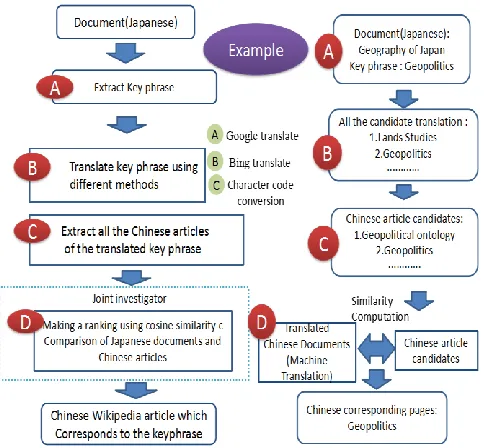
Figure 2 shows the overview of the proposed method. When extracting the keyphrase candidates, in order to extract new compound words, we use MeCab [12] to analyze Japanese document and by considering the surrounding contexts of the ketphrase, we can create links among nouns.
Figure 2: Overview of the proposed method
A. Keyphrase extraction
[image:2.612.323.565.162.386.2]Horita et al. [1] proposed a method for keyphrase extraction with two steps. Firstly, they conduct a morphological analysis and extract keyphrase candidates by Top Consecutive Nouns Cohesion (TCNC) method, which means combining the two characters and treating them as one compound word. Secondly, they rank the keyphrase candidates by Dice coefficient and Keyphraseness measures [1] (see Figure 3).
In this paper, we propose a method to extract appropriate keyphrases to users, considering user’s Japanese proficiency. In this method, we first refer to the vocabulary list of Japanese-Language Proficiency Test (JPLT) [13] to find out the nonexistent words or phrases in the list, and then judge the degree of difficulty for these keyphrases. The next procedure is to tag the keyphrases with different linguistic difficulty level.
[image:3.612.318.558.131.224.2]To be concrete, firstly, we use the vocabulary list of JPLT to categorize keyphrase candidates into different linguistic levels. For keyphrases that are not in the list, we try to estimate the linguistic level of them by using word2vec [9] trained on Japanese Wikipedia articles. Using word2vec, we can get vectors of the keyword’s meaning from the surrounding contexts of that keyword. The vectors of the words with closely related meanings also have similarity scores. By using that information, we can estimate the linguistic levels of the keyphrases that are not found in the vocabulary list of JPLT (See Figure 4). For example, we extract the word “オバマ (Obama)” from a news article, to give it a tag, we can make use of words from the vocabulary list of JPLT. By calculating words’ vector similarities, we can find out the word with the most similar meaning to the word “オバマ (Obama)”, like “アメリカ(America)” and “大 統領 (President)” with the score of 0.624 and 0.596. Then we know that Obama is the president of United States of America. Thus, we can label the word “オバマ(Obama)” with the same language proficiency level tag as Intermediate level.
Figure 4: An example of estimating the linguistic level of a keyphrase
B. Translation using multiple methods
In the proposed method, we translate the Japanese keyphrases into Chinese using a combination of three translation methods, i.e., two machine translation services (Google Translate [14], Bing Translator [15]) and the character code conversion method [16] (see Figure 5) [10]. We consider all the obtained Chinese translations from all of three translation methods (including incorrect translations) as
[image:3.612.323.561.392.542.2]the translation candidates for a Japanese keyphrase. The reason of using all translation methods is to prevent missing the appropriate translation for the Japanese keyphrase. Incorrect translations will be eliminated in the ranking process, which will be explained in the Section 3.D.
Figure 5: An example of keyphrase translation using different translation methods
C. Obtaining Chinese articles
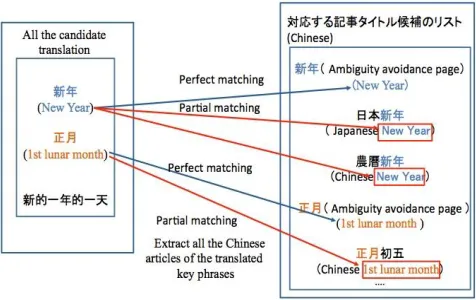
In this process, we obtain the corresponding Chinese Wikipedia articles for each translation candidate obtained in the previous process. We use partial string matching between each obtained translation candidate and the titles of Chinese Wikipedia articles [10].
Figure 6: An example of partial string matching of translation candidates and Chinese Wikipedia article titles
[image:3.612.48.283.413.593.2]D. Ranking of Chinese candidate articles
[image:4.612.49.284.56.263.2]
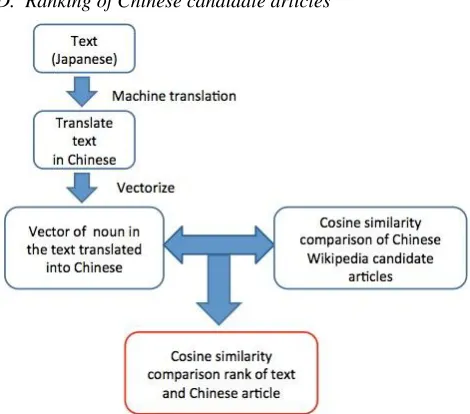
Figure 7: Processing flow of ranking of Chinese candidate articles
In this procedure, we rank obtained Chinese Wikipedia articles in order to figure out the most proper Chinese article for the Japanese keyphrase. Figure 7 shows the flow of this ranking procedure. First, we translate the original Japanese document of the keyphrase into Chinese. Second, we extract nouns from the translated Japanese document and obtain Chinese Wikipedia articles. Third, the frequencies of these nouns are regarded as a vector, and we calculate the cosine similarities of the original document and all the Chinese Wikipedia articles. Fourth, we adopt the highest ranked article as the corresponding Chinese article for the Japanese keyphrase. In this way, we can find the corresponding Chinese article for the Japanese keyphrase even if we obtain many Chinese articles as the candidates.
IV. EEPERIMENTS
To evaluate the effectiveness of the proposed method, we conducted a questionnaire survey with 15 Chinese students whose Japanese proficiency is N2 or N1 level. We selected 10 Japanese news articles from 5 different genres of Yahoo! Online News (see Table 1) and asked them to pick out words or phrases that they do not know as keyphrases. Next, we conducted an experiment to tag the linguistic level of the chosen keywords. From the results (see Table 2), we found that students whose Japanese proficiency are N1 level selected 63 words, and 6 words from the chosen words are found in the N1 vocabulary list of JPLT. As for the other 57 words, 35 words are tagged with level N1. Meanwhile, students whose Japanese proficiency are N2 level selected 84 words, and 4 of them are from the N1 vocabulary list of JPLT. Out of the other 80 words, 33 words are tagged with level N2. Then, we translated the selected 113 keyphrases and acquired 88 corresponding Chinese Wikipedia articles. Table 3 shows an example that has high similarity scores of tagging the keyphrase with similar meanings from level 1 vocabulary list. To evaluate proposed approach, we conduct
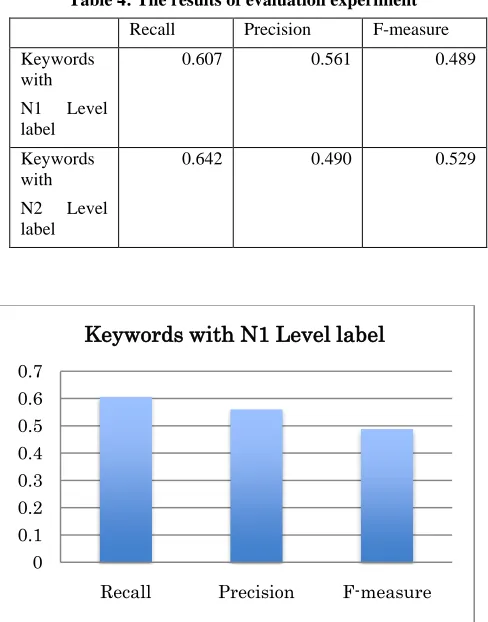
[image:4.612.311.546.132.315.2]experiment. The measurements of our experiment are recall, precision and F-measure. Table 4 shows the results of our experiment (see Figure 8 and Figure 9).
Table 1: Examples of news articles from each genre
The title of the news articles Genre
ネットストーカートラブル
(Internet stalker trouble)
IT
エコカー減税
(Tax reduction of using eco-cars)
地域
(Local News)
バース退団
(Bass left the baseball team)
スポーツ
(Sports News)
NZ地震の復興作業
(New Zealand Earthquake disaster reconstruction)
経営
(Business News)
ロヒンギャ迫害悪化
(Rohingya refugee problem)
国際
(International News)
Table 2: The results of the experimen
Chinese students’ Japanese proficiency level N1 N2
The number of Chinese students 15 15
Selected words 63 84
The words that are not in the vocabulary list of
JPLT 57 80
The words that are successfully tagged 41 33 The ratio of successful tagging 0.719 0.412
Table 3: The examples of successful tagging of the keyphrase with similar meanings
アイドルグループ
タレント
ソロ
レディー
Table 4: The results of evaluation experiment
Recall Precision F-measure Keywords
with N1 Level label
0.607 0.561 0.489
Keywords with N2 Level label
0.642 0.490 0.529
[image:5.612.315.563.71.152.2][image:5.612.319.561.254.387.2]
Figure 8: The results of evaluation experiment (1)
Figure 9: The results of evaluation experiment (2)
We classified the results into four categories based on the results of the translation and the acquired corresponding article candidates as shown in Table 5.
Table 5: The classification of the results of the acquired translation and article candidates
Category
Whether correct translation was extracted or not
Whether correct article was acquired
or not
1 Yes Yes
2 Yes No
3 No Yes
4 No No
The results of the correct ratio of acquiring relevant Chinese candidate articles for 113 Japanese keyphrases by the proposed method are shown in Table 6. The results are classified into one of the categories in Table 5.
Table 6: Experimental results of acquiring relevant Chinese corresponding articles from Japanese keyphrases
Translation methods
1 2 3 4
MT (Bing) 0.54 (62/113) 0.02 (3/113) 0.06 (7/113) 0.36 (41/113)
MT (Google) 0.59 (67/113) 0.03 (4/113) 0.06 (7/113) 0.30 (35/113) Character code conversion 0.28 (32/113) 0.03 (4/113) 0.0 (0/113) 0.68 (77/113) Combination of three translation methods 0.63 (72/113) 0.044 (5/113) 0.08 (9/113) 0.07 (4/55)
In the process of acquiring the corresponding Chinese articles, although we achieved results with high accuracy, we still got a lot of non-relevant articles. It is necessary to explore other methods to reduce the number of non-relevant articles.
V. CONCLUSION
In this paper, we proposed a method for keyphrase extraction from Japanese documents considering the user’s language ability in cross-language entity linking from Japanese to Chinese.
From the questionnaire survey, we found that Chinese students have difficulty in understanding keyphrases from popular phrases and topics in Japanese news articles. This makes it harder to find Chinese Wikipedia articles that are suitable for students with different linguistic proficiency levels. Further research is needed to solve this problem in the future. Furthermore, machine translation services are primarily designed for translating sentences, rather than translating individual keyphrases as our current method does. We are planning to consider the surrounding contexts of the extracted keyphrase for resolving the word ambiguity problem. 0 0.1 0.2 0.3 0.4 0.5 0.6 0.7
Recall Precision F-measure
Keywords with N1 Level label
0 0.1 0.2 0.3 0.4 0.5 0.6 0.7
[image:5.612.45.289.414.583.2]REFERENCES
[1] Horita, K., Kimura, F., and Maeda, A., “Automatic Keyword Extraction for Wikification of East Asian Language Documents,”
International Journal of Computer Theory and Engineering, Vol. 8,
No. 1, pp. 32-35, 2016.
[2] Mihalcea, R., and Csomai, A., “Wikify!: linking documents to encyclopedic knowledge,” in Proceedings of the 16th ACM Conference
on Information and Knowledge Management, pp. 233-242, 2007.
[3] Tang, L.X., Geva, S., Trotman, A., Xu, Y., and Itakura, K.Y., “Overview of the NTCIR-9 Crosslink Task: Cross-lingual Link Discovery,” in Proceedings of the 9th NTCIR Conference, pp. 437-463, 2011.
[4] Tang, L.X., Kang. I.S., Kimura, F., Lee, Y.H., Trotman, A., Geva, S., and Xu, Y., “Overview of the NTCIR-10 Cross-lingual Link Discovery Task,” in Proceedings of the 10th NTCIR Conference, pp. 8-38, 2013. [5] Heng, J., Nothman, J., and Hachey, B., “Overview of TAC-KBP2014
entity discovery and linking tasks,” in Proceedings of TAC2014, 2014. [6] Wang, Z., Li, J., Wang, Z., Tang, J., “Cross-lingual knowledge linking
across wiki knowledge bases,” in Proceedings of the 21st International
conference on World Wide Web, pp. 459-468, 2012.
[7] Chen, S., Jones, G.J.F., O’Connor, N.E., “DCU at NTCIR-10 Cross-lingual Link Discovery (CrossLink-2) Task,” in Proceedings of the 10th
NTCIR Conference, pp. 74-78, 2013.
[8] Liu, Y, Boisson, J, Chang, J.S., “NTHU at NTCIR-10 CrossLink-2: An Approach toward Semantic Features,” in Proceedings of the 10th
NTCIR Conference, pp. 62-68, 2013.
[9] Mikolov, T., Sutskever, I., Chen, K., Corrado, G., and Dean, J., “Distributed representations of words and phrases and their compositionality,” in Proceedings of Advances on Neural Information