http://wrap.warwick.ac.uk/
Original citation:
Shi, Lei (Researcher in Computer Science), Cristea, Alexandra I. and Hadzidedic,
Suncica (2014) The critical role of profiles in social E-learning design. In: 15th Annual
Conference on Information Technology Education (SIGITE 2014), Atlanta, Georgia,
15-18 Oct 2014. Published in: Proceedings of the 15th Annual Conference on Information
Technology Education (SIGITE 2014) 71-76 .
Permanent WRAP url:
http://wrap.warwick.ac.uk/62169
Copyright and reuse:
The Warwick Research Archive Portal (WRAP) makes this work of researchers of the
University of Warwick available open access under the following conditions. Copyright ©
and all moral rights to the version of the paper presented here belong to the individual
author(s) and/or other copyright owners. To the extent reasonable and practicable the
material made available in WRAP has been checked for eligibility before being made
available.
Copies of full items can be used for personal research or study, educational, or
not-for-profit purposes without prior permission or charge. Provided that the authors, title and
full bibliographic details are credited, a hyperlink and/or URL is given for the original
metadata page and the content is not changed in any way.
Publisher statement:
"© Shi, Lei, Cristea, Alexandra I. and Hadzidedic, Suncica .ACM 2014. This is the
author’s version of the work. It is posted here for your personal use. Not for
redistribution. The definitive version was published in ACM SIGITE 2014
http://dx.doi.org/10.1145/2656450.2656458
A note on versions:
The version presented here may differ from the published version or, version of record, if
you wish to cite this item you are advised to consult the publisher’s version. Please see
the ‘permanent WRAP url’ above for details on accessing the published version and note
that access may require a subscription.
The Critical Role of Profiles in Social E-Learning Design
Lei Shi
Department of Computer Science, University of Warwick CV4 7AL, Coventry, United Kingdom
+44 (0)24 765 73797
[email protected]
Alexandra I. Cristea
Department of Computer Science, University of Warwick CV4 7AL, Coventry, United Kingdom
+44 (0)24 765 73774
[email protected]
Suncica Hadzidedic
Department of Computer Science, University of Warwick CV4 7AL, Coventry, United Kingdom
+44 (0)24 765 73797
[email protected]
ABSTRACT
Evidence points to the fact that the introduction of Social Networking Sites (SNS) features, into e-learning environments has been highly accepted by students, because of its benefits of improving the learning experience. Yet, not enough attention has been paid to what role learners’ profiles play in the use of social e-learning environments, which does not match the importance of
profiles in SNS. This paper presents how profiles are implemented in the second version of Topolor, a social personalised adaptive e-learning environment (SPAEE), and learners’ perceived acceptance of the design and the implementation. To complement the findings, a case study is conducted to analyse the profile-related features of Topolor, which illustrates a generally high level of learner acceptance of these features. The analysis is finally concluded to suggest future research directions, in order to further analyse and improve these features.
Categories and Subject Descriptors
K.3.1 [Computers and Education]: Computer Uses in Education – Collaborative learning.
H.5.3 [Information Interfaces and Presentation]: Group and Organization Interfaces – Web-based interaction.
Keywords
Social E-Learning, Curriculum, Web-based Learning, Evaluation.
1.
INTRODUCTION
Social Networking Sites (SNS) are web-based services that allow users to construct public or semi-public profiles within a bounded system, articulate a list of other users with whom they share a connection, and view and traverse their list of connections and those made by others within the system [13]. Diverse technical features have been implemented in SNS, but the backbone is always based on profiles for self-presenting, and the visible connections among users within the system. As a central component of SNS, the profile a user is constructing is the staging of oneself for a particular audience or a particular task [20], which influences SNS-based relationships and interactions among users. Learning is intrinsically a social endeavour [34]. The social facets of learning have been described in various theoretical frameworks to explain how people learn [9]. A growing number of researchers have been working on facilitating e-learning environments by introducing a social dimension [29]. For instance, there is a great deal of research on social interaction tools for e-learning [27, 33], learning behaviour analysis [31] and open social student modelling [16]. The in-progress results have indicated that users
tend to be more motivated towards contributing to creating effective learning environment and enriching learning experiences in SNS-based e-learning [9]. Yet, further research needs to be performed to find the appropriate balance of features necessary in such environments.
While social interaction features drew on SNS have become widely accepted and heavily embedded in e-learning systems [8, 25], not enough attention has been paid to what role learners’
profiles play in the use of social e-learning environments, which does not match the importance of profiles in SNS. This study, therefore, aims to fill this void by investigating learners’ perceived acceptance of the use of profile-related features in a social personalised adaptive e-learning environment (SPAEE). Firstly, we introduce the second version of Topolor, a prototype of SPAEE, focusing on those profile-related features. We then present the pedagogical aspects of the design and implementation, and an experimental case study on the evaluation of the profile-related features. Finally, we draw the conclusion and suggest future research directions and further improvements.
2.
RELATED WORK
Connectivism argues that learning is the process of building networks of information, contacts, and resources that are applied to real problems [11]. Connectivist learning builds and maintains networked connections between people, digital artefacts, and content those are current and flexible enough to be applied to existing and emergent problems [2]. Connectivist pedagogy emphasises that learners are benefited from social activities such as sharing, comments and the insights of other past and current learners’ contributions and the knowledge relevant to the learning goals [2]. One of the essential characteristics of connectivist pedagogy is the need to gain high levels of skills using personal learning networks that provide ubiquitous access to infinite resources including learning materials and learning peers; the other one is the focus on the creation of information and knowledge resources [1]. In addition, information overload (IO) is frequently reported as one of the main problems that learners encounter in e-learning, yet connectivism assumes that although information is plentiful, it is not necessary to memorise or even understand everything, but to have the capacity to find, filter and apply knowledge when and where it is needed [1].
publishing, sharing, finding, filtering, sorting, commenting, rating, etc., of the learning resources in the connected networks. These competencies demand high-usability tools, while on the other hand, these tools need to be adaptive and adaptable in order to cater for learners’ personal needs, including their learning goals, knowledge background, preferences, skill levels of using such tools and so on.
In parallel with the research on learning environment that makes use of connectivist pedagogy, adaptive educational hypermedia (AEH) [3] systems, as another branch of educational platform research, focus on utilising adaptive hypermedia [4] techniques to tailor e-learning according to individual learner’s needs. Adaptation involves the definition and continual maintenance of a user model. AEH systems use such a user model to decide how to personalise the e-learning environment, according to a range of characteristics, taking into account aspects such as learning goals, background knowledge and preferences [21]. Moreover, an AEH system continually refines the user model according to the learner’s interactions within the system. These intelligent properties of AEH systems, on the one hand, optimise the knowledge network to support adaptive and personalised learning content and learning path, and on the other hand, optimise the tools to access the connected knowledge network so as to provide context-aware user interfaces and interaction methods [22]. Drawing lessons from both connectivist learning and AEH, social personalised adaptive e-learning environments (SPAEE) [23] have been proposed as novel SNS-based learning environments offering creative opportunities for improving learning experience. Several studies on the granularity of social interactions and how it can be supported by adaptations have been conducted, towards the ultimate goal of better learning experience, such as system architecture design [28], usage of the social interaction toolset [27], and learning behaviour patterns analysis [31]. The discussions and results from these studies have shown learners’ high interest and high satisfaction in using such learning environments as well as the further directions to improve them. For instance, Shi, et al. have proposed three ‘light gamification’ mechanisms [30] to reduce the ‘side effect’ brought by the wide access to social interaction features, such as learners’ abuse of such features for unrelated chatting, rather than for learning purposes only, which might lower the learning efficiency. Building on this, the research reported in this paper describes a novel investigation of the critical role that learners’ profiles play in SPAEE, which has not been addressed almost at all by the existing research.
3.
TOPOLOR – A SPAEE PROTOTYPE
Topolor is a social personalised adaptive personalised e-learning environment (SPAEE) prototype developed at the University of Warwick. It is implemented based on the requirement analysis studies [26], and built on Yii Framework (yiiframework.com) and Bootstrap (getbootstrap.com). The first version of Topolor was launched in November 2012, and has been used as an online learning environment for MSc level students at the University of Warwick. It has been evaluated from various perspectives [24]. Based on these prior evaluation results, the second version of Topolor has been designed and implemented. In the following sub-sections, first, we briefly introduce main features of the second version of Topolor, and then we present more details about the profile-related features.
3.1
Overview of the 2nd Version of Topolor
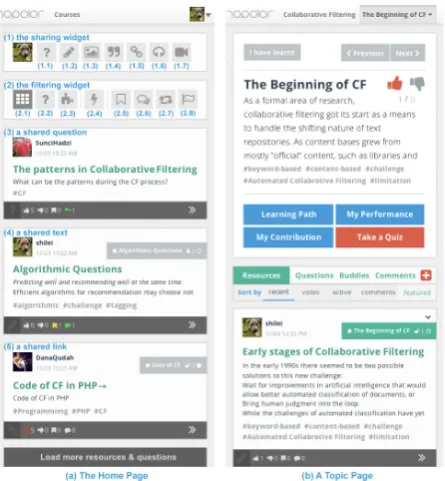
[image:3.595.311.534.298.539.2]Comparing with the first version, the second version of Topolor has more powerful tools for asking, sharing and filtering learning content as well as social interactions. As shown in Figure 1 (a), it has finer categories especially for sharing (Figure 1 (1)), i.e., a text (Figure 1 (1.2)), an image (Figure 1 (1.3)), a quote (Figure 1 (1.4)), a link (Figure 1 (1.5)), an audio (Figure 1 (1.6)) and a video (Figure 1 (1.7)), while in the first version, learners can only share a ‘learning status’ in a text format. Learners can specify related topics when they share a learning resource (Figure 1 (1.2) – (1.7)) or ask a question (Figure 1 (1.1)). It has also finer filters (Figure 1 (2)), i.e., only showing questions (Figure 1 (2.2)), learning resources (Figure 1 (2.3)), learning activities (Figure 1 (2.4)), those the learner bookmarked (Figure 1 (2.5)), those the learner participated (Figure 2 (2.6)), those the learner shared (Figure 1 (2.7)) and those are featured (Figure 1 (2.8)), while in the first version, learning resources, for instance, can only be filtered by their tags. In such way, the recommendations of learning resources and peers are more personalised and have more effective adaptability.
Figure. 1 User Interface: (a) The Home Page (b) A Topic Page
3.2
The Profile-Related Features
One of the major milestone-updates in the second version of Topolor, which is the focus of this paper, is that it provides profile pages as another information and interaction ‘hub’. This leads to various new features including social interaction and user model visualisation. In the following, we sketch up the main profile-related features.
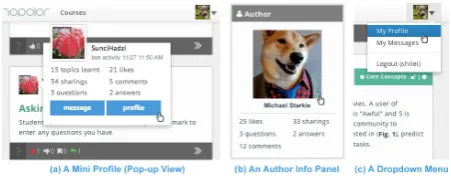
There are several ways of accessing the learners’ profiles. As shown in Figure 2, for instance, by clicking on a learner’s avatar on the home page, a pop-up view appears, with some statistics of learning status, the shortcuts to send a message and to go to the learner’s profile page (Figure 2 (a)). In a shared question or learning resource page, the webpage will be directed to the author’s (learner’s) profile page, by clicking on his avatar or name in the author information panel (Figure 2 (b)). In any page, a learner can always go to his own profile page, by clicking on ‘My Profile’ in the dropdown menu (appears when clicking on his avatar on the top menu bar) (Figure 2 (c)). On a profile page, there is a set of options for a learner to interact with the profile page’s owner such as commenting on his/her activity logs, liking a question s/he asked, bookmarking a video s/he shared.
Figure 2. (a) A pop-up view of mini profile in the Home Page; (b) an author information panel in a shared learning resource
page; (c) the dropdown menu in the top menu bar.
Learners’ user models are visualised in various ways. Figure 3 (a) shows a profile page presented in a smart phone client-side, presenting the information about the profile’s owner, such as the resources recently shared, the questions recently asked, the questions recently answered, the topics currently learning, the topics recently learnt and so on. By clicking on the button ‘PK.’ (‘Player Killer’, naming convention taken from games), a pop-up view shows (Figure 3 (c)), comparing the performance and contribution between its current viewer and the profile page owner. Figure 3 (b) shows the Activities sub-view in a profile page, presenting the actions the profile’s owner performed, which other learners can ‘like’ and comment on. This can capture learner motivation by arousing competitive instincts [17].
4.
PEDAGOGICAL CONSIDERATIONS
Both technical and pedagogical aspects determine the success of the e-learning implementations. Pedagogy is “the knowledge and skills that practitioners of the profession of teaching employ in performing their duties of facilitating desired learning in others”, as defined by Dunkin [12]. The pedagogy in e-learning incorporates this definition but goes beyond it, taking into consideration the instructional strategies for real-time learning resources personalisation and access adaptivity and adaptability.
Figure 3. (a) a profile page shown in a smart phone client-side; (b) the activity list in a profile page; (c) a pop-up view for the
visualised comparison of performance and contribution.
4.1
Social Constructivism
E-learning systems can support and improve highly effective interactions between learners based on social constructivist learning theory [15], which argues that learners can begin to grasp concepts and knowledge on their own, with the help from learning peers who are more advanced in understanding those concepts. On a profile page (Figure 3 (a)), learners can communicate instantly with one another, and contribute to discussions in-groups. For example, a learner can click on the button ‘send a message’, and then a pop-up view will show up, so that s/he can write to the profile’s owner. S/he can also discuss with the profile owner about the questions that the profile owner posted before. These features are able to foster collaborative learning that enables learners to acquire a deeper knowledge as well as experience a higher level of motivation [18].
4.2
Competitive Learning
Competitive learning can lead to a greater engagement of learners by arousing their competitive instincts [17], thereby capturing learners’ interest and increasing motivation, satisfaction and fun [5]. Many studies have been investigating the effects of competitive forms of learning, and indicated the benefits, such as the increase in performance, enjoyment, and motivation [14]. In Topolor, a profile page (Figure 3 (a)) enables a learner to check the comparison of performance and contribution between oneself and the profile owner (Figure 3 (c)), in order to compete with each other. Besides, competition is a common element of games, and the use of games to promote effective learning has been widely studied [7]. To take advantage of competitive learning, Topolor has also gamified some elements of user interface. For instance, in a profile page (Figure 3 (a)), when a learner click on the button ‘PK.’ (a typical label element in games), a comparison panel pop-ups, the bar charts appear with a growing animation (Figure 3 (c)).
4.3
Self-Regulated Learning
[image:4.595.309.535.96.269.2] [image:4.595.60.286.330.418.2]of comparison with learning peers, tree chart of topic completion rate in a course and so on. With these functionalities, learners are able to monitor and evaluate their own behaviours in terms of learning goals and achievement, so as to increase effectiveness, satisfaction, and motivation to continue learning.
4.4
Adaptive Learning
Adaptive learning uses techniques to interpret the activities of learners on the basis of domain-specific models, infers learner needs out of the interpreted activities, represents the needs in associated models appropriately, and acts upon the available knowledge on the learners and the subject matter at hand, in order to dynamically facilitate the learning process [19]. While the implementation of pedagogical theories of social constructivism, competitive learning and self-regulated learning have the potential to improve the learning experience, adaptive learning undoubtedly has the ability to enhance this potential. For example, it supports peer recommendation (for a learner to discuss with the most suitable peers); it can recommend adaptive tasks, when a learner finds her/his weakness and limitations via comparison with other peers’ performance. A personalised e-learning environment with adaptive learning resources can more easily raise learners’ interest, and therefore improve the learning experience.
5.
A CASE STUDY
The second version of Topolor is being evaluated from various perspectives such as motivation mechanisms, gamification, adaptation strategies and social interaction influences. To isolate research variables, this paper focuses exclusively on studying the
profile-related features, based on a case study of the usage of those features, with a survey that investigates learners’ perceived acceptance of the design and the implementation of those features. This case study was comprised of three consecutive phases: 1) the experiment of using Topolor, 2) the questionnaire survey about users’ perceived usefulness and ease of use, and 3) the analysis of the questionnaire results and some qualitative feedback from the learners. In the following, we detail the methodology and the experiment process, and report on the results.
5.1
Instruments and Measurements
Learners’ perception on technology is among the determining factors for successful e-learning environments. Technology acceptance model (TAM) [10] incorporating learners’ perception on the technology’s usefulness and ease of use has the ability to investigate learners’ intention to use a system as a result of a group of perceived qualities, hence interpreting learners’ desired outcomes and motivation. Learning environments that are useful and easy to use are expected to facilitate learner satisfaction and engagement [32]. Therefore, for the initial evaluation, this paper reports on the results of learners’ perceived usefulness and ease of use of the profile-related features, analysed using a survey instrument. The survey questionnaire includes a set of 23 questions, each of which applies a five Likert scale from 1 to 5 to evaluate selected features’ usefulness and ease of use separately.
5.2
Experiment and Survey
The experiment was carried out with the help of fifteen students from the Department of Computer Science at the University of Warwick, who were registered for a fourth year MSc level module ‘Dynamic Web-Based Systems’, and a lecturer who was leading this module. The students were asked to learn a lesson on ‘Collaborative Filtering’ using the second version of Topolor, as well as ensuring to familiarize themselves with the profile-related
features. The experiment was divided into four stages: two time-controlled one-hour learning stages, during which the students sat in the same classroom, one none time-controlled learning stage between the two time-controlled learning stages, during which the students accessed the system at a preferred time and location, and finally the survey stage, in which a coordinator led the students going through an optional questionnaire question by question, in order to make sure all the students knew clearly which question referred to which feature. (The latter was done as in our experience, when students are faced with very long questionnaires, with similar questions about different features, they may forget which one exactly is targeted.) Students were clearly told that their participation in the survey questionnaire (answering or not answering questions, or which answers they chose) had no impact on their results of the module. From the fifteen participants, ten of them submitted the optional questionnaire.
The questions were asked in a table format, as shown (partially) in Table 1, where for usefulness: 1 representing very useless to 5
representing very useful; and for ease of use: 1 representing very hard to use to 5 representing very easy to use.
Table 1. A sample of questions
Features Usefulness Ease of Use
… … 1 2 3 4 5 1 2 3 4 5
13 Checking my performance 1 2 3 4 5 1 2 3 4 5 14 Checking my contribution 1 2 3 4 5 1 2 3 4 5
… … 1 2 3 4 5 1 2 3 4 5
5.3
Results
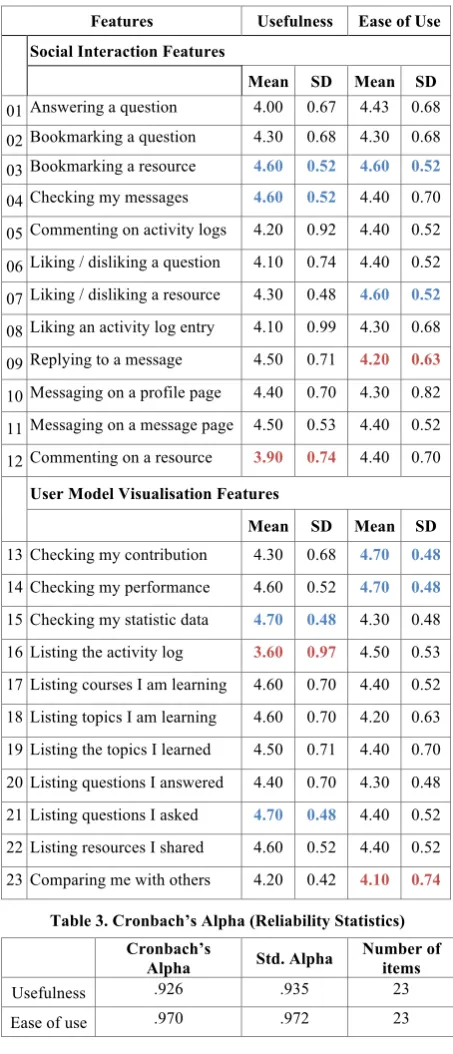
Table 2 presents the results of the usefulness and ease of use of each of the profile-related features from the questionnaire. For
usefulness, the means of the summative results rank between 3.60 and 4.70, and their standard deviations range between 0.42 and 0.99; for ease of use, the means of the overall results rank between 4.10 and 4.70, and their standard deviations are between 0.48 and 0.82. All the means are greater than 3 (the neutral response), suggesting students’ attitudes to be generally positive. We discuss these results in more detail in section 6.
Cronbach’s alpha is adopted to measure the reliability of the test. According to Carmines, a Cronbach’s Alpha of 0.8 is considered as highly reliable [6]. The values of Cronbach’s Alpha for each of the questions are shown in Table 3. The values for both usefulness
and ease of use are considerably larger than 0.8, suggesting a high level of reliability of the results.
6.
DISCUSSION
In addition to the questionnaire survey results collected from the students, we also received some qualitative feedback on the
profile-related features from both students and the lecturer. The general feedback was consistent with the quantitative results, but the responses also contained some specific suggestions for further improvement for some evaluated features that ranked relatively lower (whilst above average, i.e., mean ≥ 3) in terms of usefulness
and ease of use. Due to the space limitation, this section focuses on the quantitative results from the questionnaire survey, but some qualitative feedback is discussed when appropriate.
Consistently with the questionnaire, qualitative feedback included a description of the profile-related features, as “it is very useful to compare what I have done to what others have done”. Another student said, “There are lots of different ways to interact with the user when I am on his profile page”. Besides, the lecturer complimented on the ‘alterative paths’ to access the same material. In the following, the discussions focus on the highest and the lowest rated features of the two categories, i.e., social interaction and user model visualisation, separately.
Table 2. Usefulness and ease of use of profile-related features
Features Usefulness Ease of Use
Social Interaction Features
Mean SD Mean SD
01 Answering a question 4.00 0.67 4.43 0.68 02 Bookmarking a question 4.30 0.68 4.30 0.68 03 Bookmarking a resource 4.60 0.52 4.60 0.52 04 Checking my messages 4.60 0.52 4.40 0.70
05 Commenting on activity logs 4.20 0.92 4.40 0.52
06 Liking / disliking a question 4.10 0.74 4.40 0.52
07 Liking / disliking a resource 4.30 0.48 4.60 0.52
08 Liking an activity log entry 4.10 0.99 4.30 0.68
09 Replying to a message 4.50 0.71 4.20 0.63 10 Messaging on a profile page 4.40 0.70 4.30 0.82
11 Messaging on a message page 4.50 0.53 4.40 0.52
12 Commenting on a resource 3.90 0.74 4.40 0.70
User Model Visualisation Features
Mean SD Mean SD
13 Checking my contribution 4.30 0.68 4.70 0.48
14 Checking my performance 4.60 0.52 4.70 0.48
15 Checking my statistic data 4.70 0.48 4.30 0.48
16 Listing the activity log 3.60 0.97 4.50 0.53 17 Listing courses I am learning 4.60 0.70 4.40 0.52
18 Listing topics I am learning 4.60 0.70 4.20 0.63
19 Listing the topics I learned 4.50 0.71 4.40 0.70
20 Listing questions I answered 4.40 0.70 4.30 0.48
21 Listing questions I asked 4.70 0.48 4.40 0.52
22 Listing resources I shared 4.60 0.52 4.40 0.52
23 Comparing me with others 4.20 0.42 4.10 0.74
Table 3. Cronbach’s Alpha (Reliability Statistics) Cronbach’s
Alpha Std. Alpha
Number of items
Usefulness .926 .935 23
Ease of use .970 .972 23
6.1
Social Interaction
As shown in table 2, in the category of social interaction, the
usefulness of feature (03) bookmarking a resource and feature (04) checking my messages were ranked the highest (both mean = 4.6). Similar responses were found from the qualitative feedback, where the students mentioned the necessity of collecting and arranging the learning materials they were interested in, as well as communicating with each other. In terms of ease of use, the highest rated features including (03) bookmarking a resource and (07) liking / disliking a resource, were both scored as mean = 4.6, and the lowest rated feature is (09) replying to a message, scored as mean = 4.2. All the features categorised as social interaction were marked as easy to use (mean ≥ 4), indicating high-perceived acceptance of these features from ease of use point of view. However, the usefulness of feature (12) writing a comment on a resource was ranked the lowest (mean = 3.9, whilst still above average i.e. mean = 3) among the features categorised as social interaction. It is conjectured that, for one thing, before the students started learning the lesson ‘Collaborative Filtering’ using Topolor, the lecturer had already posted at least one resource (either a text, an image, a link, a quote, an audio or a video) for each topic of the lesson (a lesson consists of several tree-structured topics), and these resources were all high-quality learning content, which might make the students think that their complement would be unnecessary. For another, Topolor provides mutual-rating mechanisms, e.g., learners can rate (like or dislike) each other’s questions, answers and comments, aiming at improving the quality of UGC i.e. user generated content, but on the other hand, it might cause that the students to feel less confident in creating content including writing a comment. Hence, it is necessary to seek mechanisms for keeping the balance between producing more content and maintaining its high-quality.
6.2
User Model Visualisation
Table 2 also shows that the usefulness of feature (15) checking my statistic data and feature (21) listing the questions I recently asked
were both ranked the highest (mean = 4.7) among all the user model visualisation features. This result is further supported by the qualitative feedbacks. For instance, one student explicitly said it was veryuseful to see the overview of what learners had been doing. Similarly to those social interaction features, all the user model visualisation features were rated as easy to use i.e. mean ≥ 4, which allows us to conclude high-perceived acceptance of these features from the point of view of ease of use.
The rating for (16) listing the activity log was, whilst high, the lowest (mean = 3.6) with regards to its usefulness. The possible reason is that, as shown in Figure 3 (b), although the activity log demonstrates which topic it is related to, it does not provide further suggestions for what a learner should do accordingly. Therefore, it might be better if an activity log provides a button or a link to click on, as a recommended action to perform.
7.
Conclusions and Future Work
[image:6.595.60.289.205.720.2]results of the profile-related features’ usefulness and ease of use
from end-user point of view, which illustrates a generally high level of learner acceptance of the design and the implementation. The main limitation of this pilot investigation is the low number of participants, although the Cronbach’s Alpha suggests a high level of reliability of the results. However, the second version of Topolor has already been opened to the public (http://www.topolor.com), thus a larger cohort of users are expected in the near future, providing opportunities for collecting feedback, usage data and suggestions for the follow-up research. In addition to the larger-scale investigation, several other perspectives of evaluation are on our agenda, such as whether users feel in control in their interactions with profile-related
features, how profile pages lead learners to access various recommended learning resources and to communicate with their learning peers and so on, for further improvements.
8.
REFERENCES
[1] Anderson, T. and Dron, J. 2012. Learning Technology through Three Generations of Technology Enhanced Distance Education Pedagogy. European journal of open, distance and e-learning. (2012).
[2] Anderson, T. and Dron, J. 2010. Three generations of distance education pedagogy. The Intl Review of Research in Open and Distance Learning. 12, 3 (2010), 80–97. [3] Brusilovsky, P. 2004. Adaptive educational hypermedia:
From generation to generation. Proc. of 4th Hellenic Conf. on Information and Communication Technologies in Education, Athens, Greece (2004), 19–33.
[4] Brusilovsky, P. 2001.Adaptive hypermedia. User modeling and user-adapted interaction. 11, 1-2 (2001), 87–110. [5] Burguillo, J.C. 2010. Using game theory and
competition-based learning to stimulate student motivation and performance. Comp. & Edu. 55, 2 (2010), 566–575. [6] Carmines, E.G. and Zeller, R.A. 1979. Reliability and
validity assessment. Sage.
[7] Connolly, T.M. et al. 2012. A systematic literature review of empirical evidence on computer games and serious games. Computers & Education. 59, 2 (2012), 661–686. [8] Cristea, A.I. and Ghali, F. 2011. Towards adaptation in
e-learning 2.0. New Review of Hypermedia and Multimedia. 17, 2 (2011), 199–238.
[9] Dabbagh, N. 2012. Personal Learning Environments, social media, and self-regulated learning: A natural formula for connecting formal and informal learning. The Internet and higher education. 15, 1 (2012), 3–8.
[10] Davis, F.D. 1989. Perceived usefulness, perceived ease of use, and user acceptance of information technology. MIS quarterly. (1989), 319–340.
[11] Downes, S. 2008. Places to go: Connectivism & connective knowledge. Innovate: Journal of Online Education (2008). [12] Dunkin, M.J. Introduction to section 4: Classroom
processes. Pergamon Press. 313–326.
[13] Ellison, N.B. and others 2007. Social network sites: Definition, history, and scholarship. Journal of Computer-Mediated Communication. 13, 1 (2007), 210–230. [14] Fu, F.-L. et al. 2009. An investigation of coopetitive
pedagogic design for knowledge creation in Web-based learning. Computers & Education. 53, 3 (2009), 550–562. [15] Herrington, J. and Oliver, R. 2000. An instructional design
framework for authentic learning environments.
Educational technology research and development. 48, 3 (2000), 23–48.
[16] Hsiao, I.-H. et al. 2011. Open Social Student Modeling: Visualizing Student Models with Parallel IntrospectiveViews. User Modeling, Adaption and Personalization. Springer Berlin Heidelberg. 171–182. [17] Johnson, R.T. et al. 1986. Comparison of
computer-assisted cooperative, competitive, and individualistic learning. American Educational Research Journal. 23, 3 (1986), 382–392.
[18] Moreno, L. et al. 2007. Applying a constructivist and collaborative methodological approach in engineering education. Computers & Education. 49, 3 (2007), 891–915. [19] Paramythis, A. and Loidl-Reisinger, S. 2003. Adaptive learning environments and e-learning standards. Proc. of the 2nd European Conf. on e-Learning (2003), 369–379. [20] Richter, A. and Koch, M. 2008. Functions of social
networking services. Proc. Intl. Conf. on the Design of Cooperative Systems (2008), 87–98.
[21] Rosmalen, P.V. et al. 2006. Authoring a full life cycle model in standards-based, adaptive e-learning. Journal of Educational Technology & Society. 9, 1 (2006).
[22] Shi, L. et al. 2013. A social personalized adaptive e-learning environment: a case study in Topolor. IADIS Intl. Journal on WWW/Internet. 11, 2 (2013).
[23] Shi, L. et al. 2013. Designing Social Personalized Adaptive e-Learning. Proc. of the 18th ACM Conf. on Innovation and Technology in Computer Science Education, 341–341. [24] Shi, L. et al. 2013. Evaluating System Functionality in
Social Personalized Adaptive E-Learning Systems. Scaling up Learning for Sustained Impact. D. Hernández-Leo et al., eds. Springer Berlin Heidelberg. 633–634.
[25] Shi, L. et al. 2013. Evaluation of Social Interaction Features in Topolor-A Social Personalized Adaptive E-Learning System. Proc. of the 13th IEEE Intl. Conf. on Advanced Learning Technologies (2013), 15–18.
[26] Shi, L. et al. 2012. Exploring participatory design for SNS-based AEH systems. (Madrid, Spain, 2012), 242–249. [27] Shi, L. et al. 2013. Social e-learning in topolor: a case
study. Proc. of the 7th IADIS Conf. e-Learning 2013
(Prague, Czech Republic, 2013), 57–64.
[28] Shi, L. et al. 2013. Social Personalized Adaptive E-Learning Environment: Topolor - Implementation and Evaluation. Artificial Intelligence in Education. 708–711. [29] Shi, L. et al. Students as Customers: Participatory Design
for Adaptive Web 3.0. Evolution of the Internet in the Business Sector: Web 1.0 to Web 3.0. IGI Global.
[30] Shi, L. et al. 2013. To build light gamification upon social interactions: requirement analysis for the next version of Topolor. Proc. of the 6th York Doctoral Symposium on Computer Science and Electronics (2013).
[31] Shi, L. et al. 2013. Towards Understanding Learning Behavior Patterns in Social Adaptive Personalized E-Learning Systems. Proc. of The 19th Americas Conf. on Information Systems, 1–10.
[32] Shin, N. 2006. Online learner’s “flow” experience: an empirical study. British Journal of Educational Technology. 37, 5 (2006), 705–720.
[33] Wang, X. et al. 2012. Integration of E–learning 2.0 with Web 2.0. Journal of Information Technology in Construction. 17, (2012), 387–396.
[34] Wenger, E. 2000. Communities of practice and social learning systems. Organization. 7, 2 (2000), 225–246. [35] Zimmerman, B.J. 2002. Becoming a self-regulated learner: