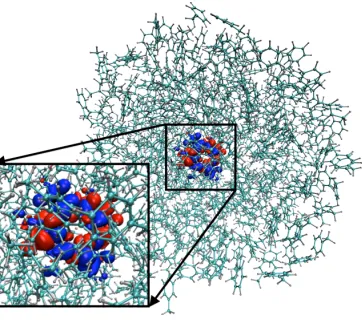
Original citation:
Zuehlsdorff, T. J., Hine, Nicholas, Payne, M. C. and Haynes, P. D.. (2015) Linear-scaling time-dependent density-functional theory beyond the Tamm-Dancoff approximation : obtaining efficiency and accuracy with in situ optimised local orbitals. The Journal of Chemical Physics, 143 (20). 204107.
Permanent WRAP url:
http://wrap.warwick.ac.uk/75015
Copyright and reuse:
The Warwick Research Archive Portal (WRAP) makes this work by researchers of the University of Warwick available open access under the following conditions. Copyright © and all moral rights to the version of the paper presented here belong to the individual author(s) and/or other copyright owners. To the extent reasonable and practicable the material made available in WRAP has been checked for eligibility before being made available.
Copies of full items can be used for personal research or study, educational, or not-for-profit purposes without prior permission or charge. Provided that the authors, title and full bibliographic details are credited, a hyperlink and/or URL is given for the original metadata page and the content is not changed in any way.
Publisher statement:
© (2015) AIP Publishing. This article may be downloaded for personal use only. Any other use requires prior permission of the author and AIP Publishing.
The following article appeared in (citation above) and may be found at http://dx.doi.org/10.1063/1.4936280
A note on versions:
The version presented here may differ from the published version or, version of record, if you wish to cite this item you are advised to consult the publisher’s version. Please see the ‘permanent WRAP url’ above for details on accessing the published version and note that access may require a subscription.
Linear-scaling time-dependent density-functional theory beyond
the Tamm-Dancoff approximation: obtaining efficiency and
accuracy with
in situ
optimised local orbitals
T. J. Zuehlsdorff,1,∗ N. D. M. Hine,2 M. C. Payne,1 and P. D. Haynes3, 4, 5 1Cavendish Laboratory, J. J. Thomson Avenue, Cambridge CB3 0HE, UK
2Department of Physics, University of Warwick, Coventry, CV4 7AL
3Department of Materials, Imperial College London,
Exhibition Road, London SW7 2AZ, UK
4Department of Physics, Imperial College London,
Exhibition Road, London SW7 2AZ, UK
5Thomas Young Centre for Theory and Simulation of Materials,
Imperial College London, Exhibition Road, London SW7 2AZ, UK
Abstract
We present a solution of the full time-dependent density-functional theory (TDDFT) eigenvalue equation in the linear response formalism exhibiting a linear-scaling computational complexity with system size, without relying on the simplifying Tamm-Dancoff approximation (TDA). The implementation relies on representing the occupied and unoccupied subspace with two different sets ofin situ optimised localised functions, yielding a very compact and efficient representation of the transition density matrix of the excitation with the accuracy associated with a systematic basis set. The TDDFT eigenvalue equation is solved using a preconditioned conjugate gradient algorithm that is very memory-efficient. The algorithm is validated on a small test molecule and a good agreement with results obtained from standard quantum chemistry packages is found, with the preconditioner yielding a significant improvement in convergence rates. The method developed in this work is then used to reproduce experimental results of the absorption spectrum of bacteriochlorophyll in an organic solvent, where it is demonstrated that the TDA fails to reproduce the main features of the low energy spectrum, while the full TDDFT equation yields results in good qualitative agreement with experimental data. Furthermore, the need for explicitly including parts of the solvent into the TDDFT calculations is highlighted, making the treatment of large system sizes necessary that are well within reach of the capabilities of the algorithm introduced here. Finally, the linear-scaling properties of the algorithm are demonstrated by computing the lowest excitation energy of bacteriochlorophyll in solution. The largest systems considered in this work are of the same order of magnitude as a variety of widely studied pigment-protein complexes, opening up the possibility of studying their properties without having to resort to any semiclassical approximations to parts of the protein environment.
I. INTRODUCTION
The study of optical properties of large complex systems is of increasing interest in
com-putational biology, with most efforts being focused on understanding large pigment-protein
complexes (PPCs)[1–5]. These systems turn up in a variety of different roles in nature, from
biosensors to light-harvesting and linker complexes in photosynthetic bacteria andab-initio
computational studies can play a key role in gaining a deeper insight into the mechanisms
governing them. However, PPCs are generally characterised by the fact that the protein
en-vironment plays an important role in influencing the absorption properties of the pigment,
creating the need for large-scale quantum mechanical calculations that are
computation-ally challenging[2–4]. In general, time-dependent density-functional theory (TDDFT)[6],
the time-dependent extension to ground-state density-functional theory (DFT)[7, 8], is
con-sidered the method of choice when treating this class of systems, mainly due to the good
balance between computational cost and achievable accuracy for most common choices of
exchange-correlation functionals.
In recent years there have been a number of developments in computational algorithms[9–
11] that have helped to make medium-sized systems routinely accessible to TDDFT.
How-ever, most common approaches to solving the low energy spectrum of a system using TDDFT
show a computational complexity of at least O(N3) with system size, imposing an upper
limit on the system sizes that can be realistically studied and effectively ruling out a full
treatment of the PPCs mentioned above. To treat these large biological systems explicitly
in TDDFT, it is necessary to make use of computational approaches that scale linearly with
system size.
TDDFT is generally considered in two different flavours. The time domain approach,
where the Kohn-Sham equations are propagated explicitly in time[12], and the linear
re-sponse approach[13], where the excitation energies of the system can be recast as the
so-lutions to an effective eigenvalue equation[14, 15]. The time-domain approach can yield
the entire spectrum of the system via a Fourier transform to the frequency domain, is
non-perturbative and can thus be applied to problems beyond the linear response regime.
However, it comes with the disadvantage that the Kohn-Sham equations have to be
propa-gated sufficiently long to obtain narrow line-widths and dark states cannot be resolved. The
dark states and triplet transitions that are of interest in some photochemical processes. For
this reason, we focus on the linear response flavour of TDDFT for the purpose of this work.
In the time-domain TDDFT approach, an O(N) computational effort with system size can
be achieved by extending linear-scaling techniques known from ground-state DFT to the
time-dependent Kohn-Sham equations[16–18]. In the linear response approach, algorithms
capable of solving for the lowest eigenvalues of the TDDFT eigenvalue equation are also
known[19–21], opening up the possibility of a direct computation of excited states in large
pigment-protein complexes without relying on additional semi-classical approximations.
The linear response TDDFT equation is a non-Hermitian eigenvalue problem, causing it
to be difficult to solve using standard off-the-shelf eigenvalue solvers. A simplifying
approx-imation, known as the Tamm-Dancoff approximation (TDA)[22, 23], recasts the problem
into an Hermitian one but its effect on excitation energies and oscillator strengths is not
straightforwardly understood. In this work, we introduce a linear-scaling implementation of
full TDDFT in the framework of the ONETEP code[24], without relying on the TDA, as was
required in a previous approach[20]. We test the performance of the algorithm on a number
of large scale systems and specifically investigate the quality of the full TDDFT eigenstates
to those obtained within the TDA. The largest systems considered explicitly in this work are
of similar size as a number of widely studied PPCs (see for example [2, 3]), thus highlighting
the capabilities of the algorithm developed here to enable a fullyab-initio treatment of this
class of systems.
This work is organised as follows: Section II focuses on providing a short overview of the
theoretical background necessary for the main results presented in this work, with sections
II A and II B introducing the linear response formalism to TDDFT, both in the form of a
matrix eigenvalue equation and an effective variational principle. Section II C then provides
a short summary of theONETEPcode in which the algorithm presented is implemented, as well
as an overview over a solution to the Tamm-Dancoff eigenvalue problem[20]. In section III,
the linear-scaling solution to the full TDDFT eigenvalue equation is outlined, with a special
focus being placed on the appropriate choice of preconditioner (III B) for the conjugate
gradient algorithm. The power of the methodology developed here is demonstrated on a
small test system by comparison to accurate benchmark results (IV A), before moving on
to a realistic system of bacteriochlorophyll a in an organic solvent. It is shown that the
systems inaccessible by conventional approaches.
II. THEORETICAL BACKGROUND
In this section we briefly introduce the theoretical background of linear response TDDFT.
We consider a Kohn-Sham system with ground-state density ρ{0} and occupied and unoc-cupied Kohn-Sham states{ψKS
vσ}and {ψcσKS}respectively, where σ denotes a spin index. We
limit the discussion to isolated systems, such that the Kohn-Sham eigenstates can be chosen
to be real. Furthermore, only semi-local exchange-correlation functionals in the adiabatic
approximation will be considered, thus ignoring any long-range and memory effects. While
memory effects are routinely ignored in standard TDDFT implementations, long-range
in-teractions can be included in form of hybrid functionals and are known to yield a better
description for excitations in infinite systems and charge-transfer states, where semi-local
exchange correlation functionals are known to fail[15, 25]. However, for the purpose of this
work the main focus is on excitations that retain a localised character and that are thus well
described by semi-local functionals.
A. Linear response TDDFT
In linear response TDDFT, the individual excitation energies of the system can be
ob-tained by solving a non-Hermitian eigenvalue equation of the form[14, 15]
A B
−B −A
X
Y =ω
X
Y
(1)
Here, A and B denote block matrices that can be conveniently expanded in a basis of
unoccupied and occupied eigenstates of the ground state Kohn-Sham system:
Acvσ,c′v′σ′ = δσσ′δcc′δvv′(ϵKSc′σ′ −ϵ KS
v′σ′) +Kcvσ,c′v′σ′ (2)
Bcvσ,c′v′σ′ = Kcvσ,c′v′σ′. (3)
where{ϵKS
cσ}and {ϵKSvσ} denote the eigenvalues associated with the unoccupied and occupied
Kohn-Sham states respectively. The eigenvectors are made up of two different components
X and Y that can be thought of as excitation and de-exitation contributions to the
eigenvalue matrix can be characterised by a diagonal part consisting of Kohn-Sham
tran-sitions between occupied and unoccupied states and off-diagonal coupling terms described
through the coupling matrixK. The exact form ofKdepends upon the exchange-correlation
functional used. Here, we will limit our attention to (semi)-local functionals in the adiabatic
approximation, in which case the matrix elements of K can be expressed as
Kcvσ,c′v′σ′ = ∫
d3rd3r′ψcσKS(r)ψvσKS(r)
×
[
1 |r−r′| +
δ2E xc δρσ(r)δρσ′(r′)
ρ{0}
]
ψcKS′σ′(r′)ψvKS′σ′(r′) (4)
where Exc is the exchange-correlation energy. In the remaining part of this work, all spin
indices will be dropped for convenience.
From the structure of Eq. 1 it can be seen that the TDDFT eigenvalue equation has
solutions in the positive and negative frequency domain. These positive and negative
fre-quencies can be interpreted as excitation and de-excitation energies [15]. Note that due to
the structure of the equation, the positive and negative eigenvalue solutions are coupled via
the block matrix B. Assuming that the coupling of excitations to the de-excitation part
of the full TDDFT spectrum is small, one can set the coupling matrices B to zero, which
causes a complete decoupling of the excitation and de-excitation part of the spectrum. The
positive excitation energies can then be solved for via the Hermitian eigenvalue equation
AX=ωX. (5)
Solving Eq. 5 instead of Eq. 1 is referred to as the Tamm-Dancoff approximation
(TDA)[22, 23]. While the TDA is often reported to yield reliable excitation energies in
many situations[23], the structure of the equation violates both time-reversal symmetry and
important sum rules related to the oscillator strengths[26] of the excitations. Furthermore,
there are known cases where the TDA yields to significant errors in excitation energies[27],
making a treatment of the full eigenvalue problem desirable. However, as will be discussed
in more detail in the next section, the main disadvantage of a full treatment of the TDDFT
eigenvalue equation originates from the fact that Eq. 1 constitutes a non-Hermitian
eigen-value problem, meaning that a variety of standard numerical methods for computing the
B. Iterative solutions to the TDDFT equation
The dimensions of the TDDFT eigenvalue equation grow as O(N2) with system size,
making a direct diagonalisation of the matrices in Eq. 1 or Eq. 5 undesirable for larger
systems. Furthermore, one is often interested in a relatively small number of low energy
excited states in the visible or ultraviolet energy range of a system, such that the computation
of high energy excited states is unnecessary. The best approach to tackle the TDDFT
eigenvalue problem for real systems of interest is thus to use iterative methods in order to
calculate the lowest few excited states.
Within the TDA, such an iterative scheme is straightforwardly defined, since the
Hermi-tian properties of the block matrix A allow for the definition of the lowest excitation of the
system via a variational principle:
ωminTDA = min
X ΩTDA(X) = minX
X†AX
X†X . (6)
From this definition, the gradient of the Rayleigh-Ritz functional ΩTDA(X) with respect to X can then be straightforwardly computed
∂ΩTDA(X)
∂X =gTDA=
2
X†X [
AX− X †AX
X†X X ]
. (7)
This gradient can be used as a steepest-descent search direction in a conjugate gradient
algorithm to optimise a random starting vector Xguess until the lowest eigenstate ωTDAmin has
been obtained. Note that in order to compute the gradient in Eq. 7, it is only required to
evaluate the matrix-vector product AX. This means that A does not have to be explicitly
calculated or stored during the calculation, which is prohibitive for large systems.
The definition of the lowest eigenvalue of the Tamm-Dancoff TDDFT equation via the
variational principle relies on the fact that it constitutes an Hermitian eigenvalue problem
and is thus not generally possible for the full TDDFT equation. It was however pointed out
by Thouless[28] that since the blocks A and B of the full TDDFT equation are Hermitian,
a variational principle can be formulated for its lowest positive eigenstate via:
ωmin = min (X Y)
ΩThou(X,Y)
= min
(X Y) (
X† Y† )
A B B A
X
Y
The numerator of the above expression is guaranteed to be positive semi-definite for
(semi)-local exchange-functionals, while the denominator is forced to be positive by taking the
absolute value.
While it is possible to use the above variational principle to directly obtain the lowest
excited state of the full TDDFT equation, the Thouless functional is not the most ideal
formulation of the problem in the context of semi-local exchange-correlation functionals (see
Sec. III A). A more computationally efficient reformulation was introduced by Tsiper [29] by
noticing the equivalence of the full TDDFT eigenvalue problem to that of a set of classical
harmonic oscillators. As a first step, one introduces the effective vectors p = X−Y and
q=X+Y. It can then be easily shown that the Thouless functional can be rewritten as:
ωmin = min
(p q)ΩTsip(p,q)
= min
(p q) (
p† q† )
A−B 0
0 A+B
p
q
|p†q+q†p| . (9)
Here, the variational principle is again only defined for the lowestpositive excitation of the
system. Just like in the Thouless functional, the numerator of the functional is guaranteed
to be positive-semidefinite. The denominator has to be forced to stay positive by taking the
absolute value, since p†q+q†p is not guaranteed to be positive-semidefinite.
While the variational principles in Eqns. 6 and 9 are written in terms of the lowest
excitation of the system only, the concept can be straightforwardly extended to higher
excitations. In order to converge the second-lowest excitation ω2 of the system, the same
effective functional of Eqn. 9 can be used in full TDDFT, with the additional constraint that
p2 and q2, the trial vectors associated withω2 obey an effective orthogonality constraint of
the form
p†1q2+q†1p2= 0 (10)
wherep1 and q1 are taken to denote the vectors associated withωmin, the lowest excitation
of the system. The principle can be extended to an arbitrary number of excited states to be
C. Tamm-Dancoff TDDFT in the ONETEP code
The linear-scaling solution to the full TDDFT equation developed in this work (see
Sec. III) is implemented in the ONETEP code[24]. As with other linear-scaling DFT
ap-proaches, any reference to individual Kohn-Sham states {ψKS
i } is given up in favour of a
collective representation in the form of the single particle density matrixρ{v}(r,r′) such that
ρ{v}(r,r′) =
N∑occ
v
ψvKS(r)ψKSv (r′)
= ∑
αβ
ϕα(r)P{v}αβϕβ(r′) (11)
where {ϕα(r)} denotes a set of in situ optimised[24] localised atom-centered support
func-tions referred to as non-orthogonal generalised Wannier funcfunc-tions (NGWFS)[33] and P{v} is
the single particle density matrix in the representation of those NGWFs. Linear scaling of
computational cost with system size is then obtained by exploiting the fact that the
ground-state density matrix decays exponentially for any system with a band gap, causing P{v} to
be sparse for sufficiently large system size[34, 35].
Thein situoptimisation of the support functions{ϕα}means that only a minimal number
of functions is required to accurately span the occupied subspace, but the unoccupied
sub-space is generally badly represented[30]. This issue is overcome by optimising a second set
of NGWFs {χα} for a low energy subset of the unoccupied subspace that is represented by
the effective density matrix P{c}[30]. It has been demonstrated[20] that the compact sets of
support functions{ϕα} and {χβ} provide a very good representation for low energy excited
states as calculated in the TDA. Defining an effective response density ρ{1}(r) associated
with a TDA eigenvectorX such that
ρ{1}(r) = ∑
c,v
ψKSc (r)XcvψvKS(r)
= ∑
αβ
χα(r)P{1}αβϕβ(r) (12)
it becomes clear that the effective response density matrix P{1} is the representation of X
in mixed unoccupied-occupied NGWF space[20]. The matrix-vector product f = AX can
then be directly constructed in NGWF space as
fχϕTDA = P{c}HχP{1}−P{1}HϕP{v}
+P{c} (
V{SCF1}χϕ [
P{1} ])
Here, Hχ and Hϕ denote the ground state Kohn-Sham Hamiltonian in the {χα} and {ϕβ}
representation respectively. V{SCF1}χϕ [
P{1} ]
is the self-consistent field response of the system
due to a perturbation ρ{1}(r) in the ground state density[20] and is the result of X acting
on the coupling matrix K in mixed unoccupied-occupied NGWF space. Note that fχϕTDA
represents a contravariant tensor quantity and has to be multiplied by Sχ and Sϕ from the
left and right respectively to obtain a covariant quantity (see [20] for further details). The
lowest excitation energy of the system can then be written as
ωminTDA = min
P{1}ΩTDA
[ P{1}
]
= Tr
[
P{1}†SχfχϕSϕ ]
Tr
[
P{1}†SχP{1}Sϕ
] (14)
where Sχ and Sϕ denote the overlap matrices of the {χα} and {ϕβ} NGWF representation
respectively. Higher excited states can be obtained from the same variational principle
by enforcing an orthogonality constraint between all excited states. If all involved density
matrices P{1}, P{v} and P{c} can be treated as sparse for sufficiently large system size[52], evaluating Eqs. 13 and 14 scales as O(N) with system size and ωTDA
min can be computed in
linear-scaling effort using standard iterative approaches.
The above formulation yields accurate excitation energies if X is well-represented by
the low energy subset of unoccupied states for which P{c} is optimised. However, in many
scenarios it is desirable to include higher energy unoccupied states in an approximate manner
to achieve convergence[20, 31]. One straightforward way of doing so is to introduce the joint
unoccupied-occupied representation{φα}={ϕβ}⊕{χγ}and to redefineP{c} via a projector
onto the entire unoccupied subspace representable by {φα}[31]:
P{c} = (Sφ)−1−(Sφ)−1SφϕP{v}Sϕφ(Sφ)−1. (15)
Here, the elements of Sφϕ are given by Sαβφϕ=⟨φα|ϕβ⟩. While using the joint representation
for the unoccupied subspace instead of {χα} roughly doubles the computational cost
com-pared to using {χα}, it yields consistently good TDDFT excitation energies[31, 32] and will
be used throughout in Sec. IV. However, for the purpose of clarity in outlining the
linear-scaling TDDFT algorithm in Sec. III, we shall use{χα}to label the unoccupied space, noting
III. FULL TDDFT IN ONETEP
In this section, we will outline a conjugate gradient algorithm to compute the lowest
Nω excited states of the full TDDFT equation. While other iterative eigensolvers like the
Lanczos and Davidson algorithms and multishift methods have been applied to this
prob-lem, both in the framework of standard cubic scaling[9, 11] and O(N)[19] approaches, the
conjugate gradient method is chosen here for both its good performance in the TDA[20] and
its low memory requirements suitable for large scale applications. A special focus will be put
on an effective preconditioning scheme, as well as the linear-scaling properties of the
algo-rithm. As in the previous section, the discussion is limited to semi-local exchange-correlation
functionals only.
A. The Tsiper functional in mixed {χα}-{ϕβ} NGWF space
The key to obtaining a linear-scaling implementation of the full TDDFT equation is to
rewrite the Tsiper functional in the same compact, localised NGWF representation that has
been used to rewrite the Tamm-Dancoff functional in Eq. 14. For this purpose, we define
fTsip as
fTsip=
fp
fq =
A−B 0
0 A+B
p
q =
Ap−Bp Aq+Bq
(16)
Following analogous steps to the derivation of the linear-scaling solution to the TDA
eigen-value equation[20], we define the effective response density matrices P{p} and P{q} and
response densities ρ{p}(r) and ρ{q}(r) such that
ρ{p}(r) = ∑
c,v
ψKSc (r)pcvψvKS(r)
= ∑
αβ
χα(r)P{p}αβϕβ(r) (17)
with ρ{q}(r) following an analogous definition. Thus P{p} and P{q} are the matrices p and
q in {χα}-{ϕβ} NGWF representation. Just like P{1}[20], P{p} and P{q} have to follow an
effective invariance constraint in order to be valid response density matrices, which originates
from the orthogonality between the unoccupied and occupied Kohn-Sham spaces in which
p and q are represented. For P{p}, the invariance constraint can be written as
with an identical statement forP{q}.
From Sec. II C, the action of A acting on some vector X written in {χα}-{ϕβ} NGWF
space is already known. Using Eq. 13, it is straightforward to rewritefTsip in{χα}and {ϕβ}
representation such that
fχϕTsip =
fχϕ{p}
fχϕ{q} =
P{c}HχP{p}−P{p}HϕP{v} P{c}HχP{q}−P{q}HϕP{v}
+
0
2P{c} (
V{SCF1}χϕ [
P{q} ])
P{v}
. (19)
The advantage of the reformulation of the Tsiper functional in terms ofpandqnow becomes
apparent. In order to evaluate Eq. 19 for any semi-local exchange-correlation functional, it
is sufficient to evaluate V{SCF1}χϕ only once. Since calculating V{SCF1}χϕ is generally the most expensive part of applying the TDDFT operator, it follows that computing Eq. 19 is not
significantly more expensive than evaluating Eq. 13, suggesting that a full solution of to
the TDDFT equations can be of similar computational complexity to the solution to the
TDA[36].
Using Eq. 19, the lowest excitation energy of the system as specified by the Tsiper
func-tional (9) can then be rewritten in {χα}and {ϕβ} representation
ωmin = min
{P{p},P{q}}
Tr
[
P{p}†Sχfχϕ{p}Sϕ ]
2Tr
[
P{p}†SχP{q}Sϕ]
+ Tr
[
P{q}†Sχfχϕ{q}Sϕ ]
2Tr
[
P{p}†SχP{q}Sϕ]
(20)
where the minimisation is carried out under the normalisation constraint
Tr
[
P{p}†SχP{q}Sϕ ]
= 1. (21)
Specifying the normalisation constraint allows us to drop the absolute value from the
de-nominator of the Tsiper functional when computing the gradient of Eq. 20 with respect to
changes in
(
P{p} P{q} )
can be, in close analogy to the gradient in the TDA (7), written as
gχϕ Tsip =
gχϕ{p}
gχϕ{q} =
fχϕ{p}
fχϕ{q}
−{Tr
[
P{p}†Sχfχϕ{p}Sϕ ]
+ Tr
[
P{q}†Sχfχϕ{q}Sϕ ]}
P{q} P{p}
. (22)
This result exploits the fact that P{p} and P{q} follow the normalisation constraint. The
above gradient can be used as a steepest-descent search direction in a conjugate gradient
algorithm[37]. Note however, that since the TDDFT operator in the TDA can be computed
in linear-scaling effort[20], the evaluation of both fχϕTsip and gχϕ
Tsip also scales fully linearly
with system size, as long as all involved density matrices P{c}, P{v}, P{p} and P{q} can be
treated as sparse for sufficiently large system sizes. Furthermore, it is worth pointing out
that for any matrix pair P{p} and P{q} obeying the invariance constraint of Eq. 18, the
gradient gχϕ
Tsip follows the invariance constraint by construction. This condition is vital as
it means that any pair of trial response density matrices updated with a search direction
derived from gχϕ
Tsip will also obey the appropriate invariance constraint by construction.
It should be noted, that once a truncation of the density matrices P{q} and P{q} is
intro-duced, the invariance constraint of Eqn. 18 can only hold approximately. While it is possible
to iteratively apply the projection at the end of each conjugate gradient step until some
mea-sure of the violation of the invariance constraint is kept below a certain threshold[20, 32],
in practice this can lead to convergence problems as it destroys the variational nature of
the algorithm presented here. This problem is overcome by introducing a set of auxiliary
density matricesL{q} andL{q}[32] in the spirit of ground state linear-scaling approaches[38].
The auxiliary matrices can be arbitrarily truncated and are used to define the real density
matrices P{q} and P{q} used in the algorithm via
P{p} =P{c}SχL{p}SϕP{v} (23)
at every step of the calculation. While this scheme comes at a computational cost as P{p}
is less sparse than L{p}, it guarantees that every point in the algorithm,P{q} and P{q} fulfil
their respective invariance constraints to the degree that P{v} and P{c} fulfil their
respec-tive idempotency constraint[32]. Since linear-scaling DFT calculations employ a number
near-idempotency[38], the above scheme yields a robust convergence of TDDFT calculations when
truncations are applied to the respective response density matrices.
B. Preconditioning
The TDDFT eigenvalue problem generally has a large condition number associated with
it, causing iterative eigensolvers to show a relatively slow convergence. This is most easily
appreciated by considering that the elements of the coupling matrix K are generally small
compared to the diagonal elements of Kohn-Sham eigenvalue differences and the condition
number of the full TDDFT matrix is reasonably well approximated by the condition number
of
D 0
0 D
, where the elements of the block matrix D are given by
Dcv,c′v′ =δcc′δvv′(ϵKSc′ −ϵ KS
v′ ). (24)
Clearly, D has a condition number that is much larger than 1, resulting in relatively slow
convergence of iterative eigensolvers.
For these reasons, it has long been appreciated that
D 0
0 D
should form an efficient
pre-conditioner for the full TDDFT eigenvalue problem. However, applying the prepre-conditioner
requires the computation of D−1, which can only easily be constructed in a Kohn-Sham eigenstate representation where D is diagonal. In linear-scaling TDDFT, a diagonal
repre-sentation of D is not available and the explicit construction of D−1 via matrix inversion is undesirable.
In order to obtain a linear-scaling preconditioner, we consider the Tsiper functional of
Eq. 9 when preconditioned from the left:
ΩTsip(p,q) = (
p† q† )
D−1(A−B) 0 0 D−1(A+B)
p q (
p† q† )
0 D−1 D−1 0
p q (25)
-{ϕβ} NGWF space, the action of D is trivially known. Denoting GχϕTsip = Gχϕ{p}
Gχϕ{q}
as the
preconditioned version of the gradient gχϕ
Tsip of Eq. 22, it can be seen that applying the
preconditioner D−1 to the Tsiper functional is equivalent to solving the linear system
P{c}HχGχϕ{p}−G χϕ {p}H
ϕ P{v}
P{c}HχGχϕ{q}−Gχϕ{q}HϕP{v} =gχϕ
Tsip (26)
for GχϕTsip. This linear system can be solved iteratively to a chosen degree of numerical accuracy using a standard conjugate gradient algorithm (see algorithm 2 detailed in [37]).
While applying the preconditioner in NGWF space is therefore not as straightforward as in
Kohn-Sham space, it scales fully linearly with system size and only requires a number of
com-paratively inexpensive matrix-matrix multiplications. If the computational overhead from
solving the linear system in every step of the conjugate gradient calculation is significantly
less than the time saved by constructing gχϕ
Tsip fewer times due to a faster convergence rate,
the preconditioning proposed here becomes highly efficient. This point will be addressed in
more detail in Sec. IV A.
C. Optimising multiple excited states
In most situations, we are not interested in converging only the lowest excited state of
the full TDDFT equation, but rather the subspace spanning the lowestNω excitations{ωi}.
Following the considerations in Sec. II B regarding the convergence of higher excited states,
we introduce a set of Nω TDDFT trial vectors {P Tsip
i ; i= 1,· · ·Nω}, where
PTsipi =
P{ip}
P{iq}
. (27)
In order to span the appropriate subspace, {PTsipi } is required to follow an orthonormality condition that is written as
1 2
(
Tr
[
P{ip}†SχP{jq}Sϕ ]
+ Tr
[
P{jp}†SχP{iq}Sϕ ])
=δij. (28)
In the algorithm presented here, in close analogy to the way the Tamm-Dancoff
eigen-value problem is treated[20], the orthonormality condition is enforced using a
Tr
[
P{ip}†SχP{iq}Sϕ ]
is not required to be positive-semidefinite. Following the convention
established in Ref. [19], prior to orthogonalising the set{PTsipi }, Tr
[
P{ip}†SχP{iq}Sϕ ]
is
com-puted for all i and, if found negative, the vectorPTsipi is transformed according to
P{ip}
P{iq} →
P{ip}
−P{iq}
. (29)
Once an orthonormal set {PTsipi ; i = 1,· · ·Nω} has been obtained, it can be used to
construct
{
(fχϕTsip)i; i= 1,· · ·Nω }
from Eq. 19. It is then possible to write down an effective
functional for the sum of the lowest Nω excitations of the system, such that
min {
PTsipi }
ΩNω
Tsip ({
PTsipi })
=
Nω
∑
i
ωi (30)
where
ΩNω
Tsip ({
PTsipi }) = Nω ∑ i Tr [
P{ip}†Sχ (
fχϕ{p} )
iS ϕ]
2Tr
[
P{ip}†SχP{iq}Sϕ]
+ Tr
[
P{iq}†Sχ (
fχϕ{q} )
iS ϕ]
2Tr
[
P{ip}†SχP{iq}Sϕ]
. (31)
and the minimisation in Eqn. 30 is to be carried out under the effective orthonormality
constraint placed on
{ PTsipi
}
.
Differentiating the above expression with respect to PTsipi , it is possible to construct a contravariant gradient ( gχϕ Tsip ) i
that is orthogonal to all current subspace vectors {PTsipi }. The gradient can be written as
( gχϕ Tsip ) i = ( fχϕTsip
) i − Nω ∑ j Tr [
P{jp}†Sχ (
fχϕ{p} ) i Sϕ ] 2Tr [
P{jp}†SχP{jq}Sϕ ]
+ Tr
[
P{jq}†Sχ (
fχϕ{q} ) i Sϕ ] 2Tr [
P{jp}†SχP{jq}Sϕ ]
P{jq}
P{jp}
. (32)
The fact that
( gχϕ
Tsip )
i is orthogonal to all current subspace vectors {P Tsip
i } is crucial for
the correct performance of the algorithm. It ensures that when using
( gχϕ
Tsip )
i
as a steepest
descent direction to update PTsipi such that
PTsipi →PTsipi +λ (
gχϕ Tsip
)
for some given line step λ, there is no violation of the orthonormality constraint of Eq. 28
to first order in λ.
The above outline contains all of the basic ingredients to construct a preconditioned
conjugate gradient algorithm capable of solving for the lowestNω TDDFT excitations of the
system in linear-scaling effort. The exact algorithm used in the implementation discussed in
this work is adapted from [39] for the purpose of solving the full TDDFT eigenvalue problem
(See algorithm 1 in [37]). Here we limit ourselves to the comment that while minimising
the Tsiper functional of Eq. 31 yields a set of vectors spanning the same subspace as the
TDDFT eigenvectors corresponding to the lowest Nω eigenvalues, these eigenvalues can
only be obtained through a subspace diagonalisation that scales as O(N3
ω). However, since
Nω is generally taken to be small, this single cubic scaling step is not considered to be a
bottleneck in any practical calculation. The subspace diagonalisation can be carried out by
diagonalising the Nω×Nω dimensional matrixQ with matrix elements
Qij =
Tr
[
P{jp}†Sχ (
fχϕ{p} )
i Sϕ
]
+ Tr
[
P{jq}†Sχ (
fχϕ{q} )
i Sϕ
]
2 . (34)
While the subspace diagonalisation only has to be carried out at the end of the calculation,
the Gram-Schmidt orthonormalisation has anO(N2
ω) scaling associated with it and thus, like
the TDA implementation[20], the algorithm only shows a linear-scaling with system size for
a constant number of excitations. However, we point out that for many systems, especially
the large pigment-protein complexes mentioned as the main focus of this work, low energy
absorption properties are dominated by a small number of excitations of interest that stays
constant with system size and for this class of systems, the method presented here allows
for truly linear-scaling calculations.
IV. RESULTS
In this section we will present some of the strengths of the algorithm developed in Sec. III
and specifically address the question of whether full TDDFT produces significantly more
accurate results compared to the TDA for a certain class of systems. We will first focus on
trans-azobenzene, a molecule small enough to be easily treatable with standard cubic-scaling
implementations of TDDFT. After comparing the linear-scaling TDDFT approach presented
full TDDFT eigenvalue equation in order to speed up convergence. Section IV B then aims at
reproducing experimental results of bacteriochlorophyll a in an organic solvent, addressing
again the question of whether full TDDFT provides a significant advantage over the TDA
in this system, as well as the influence of an explicit treatment of solvent molecules on the
spectrum. Finally, it is demonstrated that the algorithm is capable of obtaining low energy
excitations in linear-scaling effort by computing the excitations in system sizes of up to ≈
7000 atoms.
All calculations performed in this section are done using the PBE functional[40].
Norm-conserving pesudopotentials[41], as well as the projection operator and the joint NGWF set
of Eq. 15 are used throughout for theONETEP TDDFT calculations.
A. Trans-azobenzene
As a first test system, we choose trans-azobenzene (C12H10N2) as its moderate size allows
for detailed benchmark comparisons to conventional TDDFT implementations showing an
O(N3) scaling. Furthermore, the optical spectrum of this system has already been studied
to a high degree of accuracy using the GW approximation and the Bethe-Salpeter equation
(BSE), where it was found that the TDA generated considerable errors compared to a full
solution to the Bethe-Salpeter equation[27]. While no straightforward comparison can be
drawn between the GW+BSE and TDDFT, the similar structure of the equations leads us
to expect that TDDFT in the TDA and full TDDFT will also yield significantly different
results for this system, making it an ideal test case.
First the ionic positions oftrans-azobenzene are optimised[42] inONETEP, after which the
lowest eight excitations are computed both in the TDA and in full TDDFT. The TDA results
are obtained using the algorithm introduced in Ref. [20], while the full TDDFT results are
computed using the algorithm introduced in this work. Calculations are performed using a
kinetic energy cutoff of 1000 eV and a box size of 56.69×56.69×56.69 ˚A3. In order to avoid
any interaction between periodic images, the TDDFT calculations are carried out in open
boundary conditions[43]. A minimal set of one NGWF per H and four NGWFs for each C
and N atom is used both for{χα}and {ϕβ}. A localisation radius of 10a0 is applied to{ϕβ}
representing the occupied subspace, while the localisation is relaxed to 13a0 for{χα}in order
ONETEPTDA NWChem TDA ONETEPRPA NWChem RPA 1 2.233 2.192 2.184 2.149 2 3.520(0.047) 3.524(0.091) 3.516(0.286) 3.518(0.186) 3 3.536(0.001) 3.546(0.001) 3.489(0.002) 3.499(0.003) 4 3.720(1.094) 3.681(1.025) 3.408(0.499) 3.379(0.751) 5 3.822 3.866 3.821 3.865 6 3.875(0.003) 3.923(0.001) 3.874 3.922 7 4.234(0.001) 4.268(0.001) 4.229(0.001) 4.262(0.001) 8 4.315 4.305 4.241 4.230
TABLE I: Lowest eight excited states of azobenzene, as computed with ONETEP and NWChem. Energies are given in eV, oscillator strengths are shown in brackets. States without specified oscillator strengths are dark. Where necessary, the states have been reordered according to their character, such that the order is the same as for the ONETEP TDA results. For the NWChem calculations, an aug-cc-pVTZ Gaussian basis set is used. Here, TDA denotes the Tamm-Dancoff approximation, while RPA is used to denote a solution to the full TDDFT equation.
excitations can be found that are of very delocalised Rydberg-state character and provide a
challenge for localised basis set representations. However, tests performed using TDA have
shown that these states can be systematically converged by increasing localisation radius
of {χα}, and converged values are generally found to be in good agreement with results
obtained from real-space methods[20]. For the purpose of this work, we have performed a
number of convergence tests, increasing the localisation radius to 18a0 and found the lowest
eight excitations of alizarin to be well converged at the localisation radius of 13 a0.
The TDDFT results from ONETEP are compared to results obtained using NWChem[44].
The NWChem calculations are performed using the same ionic positions as in ONETEP and
an aug-cc-pVTZ Gaussian basis set containing diffuse functions that are designed to yield a
good description of weakly bound unoccupied states[45]. In order to make the all-electron
calculations more comparable to the pseudopotential calculations inONETEP, the Kohn-Sham
states corresponding to the core electrons are excluded from the occupied subspace when
calculating the TDDFT excitation energies.
-5 -4 -3 -2 -1 0 1
0 10 20 30 40 50 60 70 80
lo
g1
0
h
Ω
−
Ωc
o
n
v
Ωc
o
n
v
i
Number of iterations No Precond
Precondǫtol= 10−
2
Precondǫtol= 10−4
[image:21.612.193.410.75.229.2]Precondǫtol= 10−8
FIG. 1: Convergence of the 2 lowest states of Azobenzene for different degrees of preconditioning applied. “Precond ϵtol” describes the tolerance to which the linear system (26) is solved in order
to apply the preconditioning.
usingONETEPin comparison to the NWChem results can be found in Table I. As can be seen,
there is a generally good agreement between theONETEP and the NWChem results, both in
terms of the excitation energy and the oscillator strength. The largest discrepancy is found
in the the sixth excited state, with theONETEPresults being 48 meV lower in energy for both
the TDA and full TDDFT. Most other results show a significantly smaller discrepancy.
Generally, the full TDDFT results compare very similarly to the NWChem benchmark
as the TDA results, showing that the algorithm indeed performs correctly. Remaining
discrepancies are most likely due to the all-electron treatment in NWChem compared to
the pseudopotential treatment in ONETEP, as well as basis set differences (see Ref. [20] for
a detailed comparison between NWChem and ONETEP regarding TDA results). It is thus
evident that the minimal NGWF representation is capable of obtaining excitation energies
of a comparable quality to those from considerably larger Gaussian basis set representations,
highlighting the advantages of using an in situ optimised representation when performing
TDDFT calculations.
Regarding the impact of full TDDFT on the low energy excited states of trans
-azobenzene, it becomes apparent that when solving the full TDDFT equations, the
domi-nant low energy excited state, which is mainly made up of a HOMO-1→LUMO transition,
decreases in energy by more than 0.31 eV as compared with the TDA results. The peak
stays almost constant in energy. In the full TDDFT, a significant part of spectral weight
is shifted from the dominant peak to the second peak. This result is in good qualitative
agreement with the GW+BSE results, where it was found that the TDA blue-shifts the
dominant peak by 0.2 eV and overestimates its oscillator strength[27]. It is thus clear that
solving the full TDDFT equation instead of the TDA can lead to significant changes in the
computed optical spectrum, with bright peaks being shifted by tenths of electronvolts and
a significant redistribution of spectral weight occouring.
The small size of trans-azobenzene makes it an ideal system verify the effectiveness of
the preconditioning introduced in this work. For this purpose, the we compute the two
lowest excited states of the system for a number of different convergence tolerances ϵtol of
the iterative preconditioner[37], as well as the case when no preconditioning is applied to
the conjugate gradient algorithm. The convergence rate of the two lowest excited states
with respect to different levels of preconditioning applied can be found in Fig. 1. Note that
iteratively applying the preconditioner to a tolerance of 10−4 cuts the number of iterations
needed to reach convergence by almost a factor of four compared to the case where no
preconditioning is applied. This highlights the ill-conditioning of the TDDFT eigenvalue
equation mentioned in section III B and shows that preconditioning is vital in achieving good
convergence rates. However, note that even when the iterative preconditioning tolerance is
set as high as 10−2, corresponding to only applying the preconditioner approximately at each
iteration, the number of iterations needed to reach convergence is decreased by a factor of
two. This finding is vital as solving the linear system of Eq. 26 iteratively in each conjugate
gradient step has a computational overhead associated with it, which can be minimised if the
solution is only obtained approximately rather than to a high degree of numerical accuracy.
It should be pointed out however, that the computational overhead with associated with
the preconditioning is negligible for the system at hand, making up 0.17% and 0.53% of
the total calculation time for ϵtol = 10−2 and ϵtol = 10−4, which can again be attributed
to the compact size of the NGWF representation. Furthermore, it is found that the total
calculation time is reduced by a factor of 2.86 when comparing the unconditioned system to
a preconditioned system with ϵtol = 10−4, thus showing that the preconditioner introduced
here indeed leads to significant reductions in computational effort.
We note that the convergence of the preconditioned system with the high convergence
FIG. 2: Structure of bacteriochlorophyll a, as obtained from a geometry optimisation in vacuum (left) and a single snapshot from an MD simulation in toluene (right). This figure was created using VMD[50].
of ϵtol = 10−8 for the first ten iterations. This suggests that the convergence tolerance
of the preconditioner can be chosen adaptively. Starting off with a high tolerance for the
first few iterations and tightening it closer to convergence has the potential to provide
the ideal balance between reducing the computational overhead of the preconditioning and
increasing the convergence rate. In conclusion it is demonstrated that the preconditioned
conjugate gradient algorithm introduced in this work yields a very good agreement with
existing TDDFT implementations and shows excellent convergence rates.
B. Bacteriochlorophyll
We now shift the focus to bacteriochlorophyll a (MgN4O6C55H74), a chromophore that is
of great interest in computational biology due to its role in light-harvesting complexes[1–3].
Bacteriochlorophyll (BChl) is a medium-sized system still within the range of conventional
cubic scaling TDDFT implementations. Therefore, the focus in this section is not to
demon-strate the linear-scaling capabilities of the algorithm developed in this work but rather to
address the question of whether full TDDFT yields a better description of the low energy
absorption spectrum than the TDA when compared to experimental results.
All TDDFT calculations performed in this section are carried out using a minimal set
of NGWFs for all atomic species involved and a localisation radius of 10 a0 and 13 a0 for
the NGWFs representing the occupied and unoccupied space respectively. A kinetic energy
cutoff of 1020 eV is used in all calculations.
We aim to compare to the experimental results for the low energy absorption spectrum
of BChl a in a toluene organic solvent[46, 47]. As a first step, we take the atomic positions
0 0.2 0.4 0.6 0.8 1
1.2 1.4 1.6 1.8 2 2.2 2.4 2.6 2.8 3
A
b
so
rp
ti
on
S
tr
en
gt
h
(a
rb
.
u
n
it
s)
Energy (eV)
[image:24.612.194.408.76.229.2]TDA Full TDDFT Experimental
FIG. 3: Absorption spectrum of bacteriochlorophyll in implicit solvent as calculated with both the TDA and full TDDFT in comparison to experimental data of bacteriochlorophyll in toluene. A Lorentzian broadening of 0.025 eV is used for the TDDFT results and the experimental data is scaled such that the peak height of the Qy transition agrees with that of the Qy peak obtained from full TDDFT.
how the input structure was obtained from X-ray diffraction results), optimise the atomic
positions in vacuum and then calculate the TDA and full TDDFT spectra of the system
within an implicit solvent model[48], where the static dielectric function ϵ is chosen to be
2.38 in order to match the dielectric function of toluene at room temperature. The final
structure of BChl ain vacuum can be found in Fig. 2. As can be seen, the porphine ring is
entirely flat in this configuration, while the alkane tail folds underneath the ring structure.
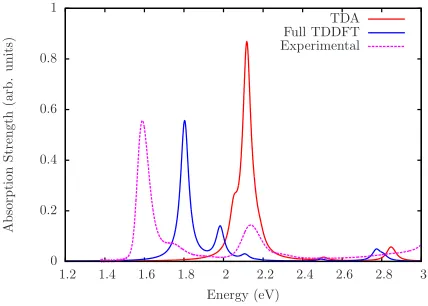
The results of the TDDFT calculation as compared with the experimental results[53] can
be found in Fig. 3. As can be seen the experimental spectrum shows three main features: A
main absorption peak at around 1.6 eV, a shoulder between 1.65 and 1.75 eV and a second
peak at around 2.1 eV. The first and second peaks are commonly referred to as the Qy
and Qx transitions respectively and can be characterised as HOMO→LUMO and
HOMO-1→LUMO transitions in a single-particle picture. As can be seen from Fig. 3, the TDA
results generate only a single main peak at 2.12 eV that is of Qy character. This main peak
shows a shoulder at 2.05 eV that is mainly of HOMO-1→LUMO and HOMO-2→LUMO
character. The full TDDFT spectrum on the other hand produces a Qy peak at 1.80 eV
that is the lowest excitation of the system, as well as a second peak of Qx character at
1.98 eV, but fails to reproduce a shoulder to the Qy peak. It also shows a third peak with
It can therefore be concluded that the TDA fails in correctly reproducing the absorption
spectrum of BChl a in toluene. Not only is the Qy transition overestimated by 0.47 eV
compared to the experimental results, it does not correspond to the lowest excitation of the
system and there is no clean Qx transition. The full TDDFT results show a considerable
improvement. While the Qy transition is still overestimated by 0.2 eV, it now corresponds
to the lowest excitation of the system and there is a considerable splitting between the Qy
and Qx transitions. However, the full TDDFT results underestimate the energy of the Qx
transition by around 0.14 eV compared to experimental results and fail to exhibit a shoulder
to the Qy transition.
The origin of some of the failures of the TDA can be traced by breaking down the
excitations into individual Kohn-Sham transitions. In full TDDFT, the Qy transition is
almost exclusively (to 95%, as compared to 60% in the TDA) a transition between the
HOMO and the LUMO. In Bacteriochlorophyll, this transition has a strong dipole moment
associated with it, which in turn causes V{SCF1} to be large and the TDDFT energy to show a large increase compared to the HOMO-LUMO energy difference. In full TDDFT, this
large dipole is screened by the de-excitation vector Y which is almost entirely made up of
the same HOMO-LUMO transition, thus significantly lowering both the excitation energy
and the oscillator strength. In the TDA, Y = 0 and instead the large dipole moment of
the HOMO-LUMO transition is screened by mixing in smaller fractions of higher energy
transitions, including fractions of Qx transition. This causes the Qy transition to have a
significantly higher energy and larger oscillator strength in the TDA and also contributes to
the absence of a clean Qx transition.
Since optimising the atomic positions of BChlain vacuum might have lead to a structure
that is unrealistic for the system solvated in toluene, it is not clear how much of the failure
of full TDDFT to reproduce the experimental results is due to the choice of
exchange-correlation functional used in this work. In order to obtain a more realistic structure of
BChl a in toluene, we make use of the classical molecular dynamics package AMBER[49].
We solvate BChla in 704 molecules of toluene (corresponding to 10,700 atoms for the total
system) and equilibrate the system to 300 K and a pressure of 1 atm, followed by a 300 ps
simulation in the NVE ensemble. From this MD run we take 8 snapshots 10 ps apart that
are then used as input atomic positions in the TDDFT calculations. In order to include
0 0.1 0.2 0.3 0.4 0.5 0.6 0.7 0.8
1.2 1.4 1.6 1.8 2 2.2 2.4 2.6 2.8 3
A
b
so
rp
ti
on
st
re
n
gt
h
(a
rb
.
u
n
it
s)
Energy (eV)
[image:26.612.194.408.76.229.2]TDA Full TDDFT Experimental
FIG. 4: Absorption spectrum of bacteriochlorophyll a in 15 ˚A of toluene as calculated on 8 MD snapshots with both the TDA and full TDDFT in comparison to experimental data of bacteri-ochlorophyllain toluene. A Lorentzian broadening of 0.025 eV is used for the TDDFT results and the experimental data is scaled such that the peak height of the Qy transition agrees with that of the Qy peak obtained from full TDDFT.
within a 15 ˚A radius from the Mg atom in the calculation, while representing the rest of
the solvent by an implicit solvation model. This process yields a system size of 700-800
atoms depending on the snapshot, which is closer to the limit of sizes that can be treated
by conventional O(N3) methods. The structure of the BChla molecule as obtained from a single MD snapshot can be found in Fig. 2. As can be seen, the alkane tail extends away
from the porphine ring in this configuration, while the ring itself is no longer perfectly flat.
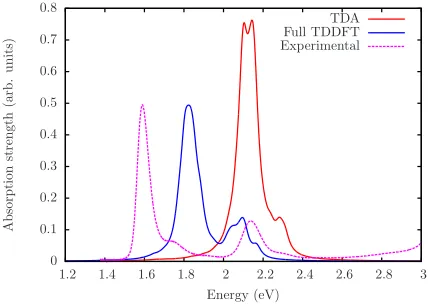
The averaged full TDDFT and TDA spectra of the solvated MD snapshots as compared
with the same experimental dataset are shown in Fig. 4. Note that the full TDDFT results
now show the Qy transition at 1.83 eV and the Qx transition at 2.10 eV. While the Qy
transition is still overestimated by 0.2 eV, the shape of the feature is considerably improved,
as the Qx transition is now in very good agreement with experimental results, both in its
positioning and in its intensity. It is worth pointing out that a number of snapshots also
show a shoulder to the main Qy transition that is of HOMO-2→LUMO character. However,
in the averaged spectrum this feature is not as pronounced as in the experimental spectrum,
which can be due to the fact that the splitting between the Qx and Qy transitions is too
small compared to experiment. The TDA results on the other hand still fail to reproduce
0 0.1 0.2 0.3 0.4 0.5 0.6
1.2 1.4 1.6 1.8 2 2.2 2.4 2.6 2.8 3
A
b
so
rp
ti
on
st
re
n
gt
h
(a
rb
.
u
n
it
s)
Energy (eV)
[image:27.612.194.408.76.229.2]Full TDDFT explicit solvent Full TDDFT implicit solvent Experimental
FIG. 5: Comparison between the full TDDFT spectrum of bacteriochlorophyll in 15 ˚A of toluene, averaged over 8 snapshots, and the averaged spectrum from 8 implicit solvent calculations using the same atomic positions for the bacteriochlorophylls. A Lorentzian broadening of 0.025 eV is used for the TDDFT results. Both spectra are plotted against experimental data that is scaled such that the peak height of the Qy transition agrees with that of the Qy peak obtained from full TDDFT in explicit toluene.
present in Fig. 3 has disappeared. The spectrum shows a new peak at approximately 2.3 eV
that does however have a different character to the Qx transition in full TDDFT. A clearly
identifiable Qx transition is still absent from the TDA results. It can therefore be summarised
that full TDDFT yields a much improved representation of the experimental results at the
PBE level as long as a realistic structure for the solute and the solvent environment is
obtained. The main failure of full TDDFT for this system is the overestimation of the Qy
transition by 0.2 eV which can most likely be ascribed to errors in the exchange-correlation
functional used.
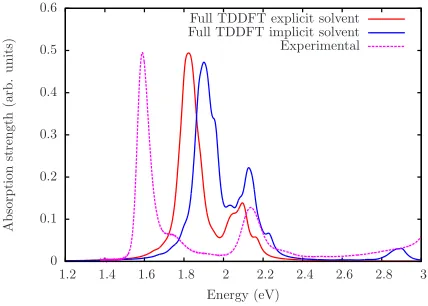
While the 700-800 atom systems obtained from classical MD yield a relatively good
spec-tral shape for full TDDFT at the PBE level, they are considerably larger than the 140 atoms
of the solute alone. It is therefore worth investigating how much of the improvement of the
spectrum from Fig. 3 to Fig. 4 is due to the different ionic positions of the solute and how
much is due to an explicit quantum mechanical treatment of solvent molecules in the
calcu-lation. For this purpose we take the atomic positions of BChl a from the 8 MD snapshots
and compute the absorption spectrum in implicit solvent, without including any explicit
0 500 1000 1500 2000
0 1000 2000 3000 4000 5000 6000 7000 8000
T
im
e
(s
)
Number of atoms Linear-response operator
[image:28.612.194.412.76.227.2]V{SCF1}
FIG. 6: Time taken for applying the TDDFT operator and calculating V{SCF1} for different sys-tem sizes of bacteriochlorophyll a in toluene. The lines shown are linear fits. Calculations were performed on eight SandyBridge nodes containing 16 cores each.
the positioning of the Qx transition in implicit solvent is in very good agreement with the
experimental data. However, its oscillator strength is significantly overestimated.
Further-more, the explicit solvent environment causes the Qy transition to red-shift by about 0.1 eV.
It can be concluded that while most of the improvements in spectral features compared to
Fig. 3 are due to the more realistic atomic positions of the Bacteriochlorophyll in toluene,
the explicit inclusion of the toluene environment at the TDDFT level yields a spectrum that
is in closest agreement with experimental results.
In conclusion it can be summarised that full TDDFT at the PBE level reproduces
ex-perimental results to a satisfactory degree, while the TDA completely fails in this system.
The best agreement between experiment and calculation is obtained when taking the atomic
positions of an MD snapshot of BChl in toluene and including the local solvent environment
explicitly in the TDDFT calculation. While an explicit treatment of the solvent molecules
requires large scale TDDFT calculations, it is demonstrated that the method presented in
this work is well suited for tackling these systems, opening up the possibility of more detailed
studies of solvent effects on chromophores.
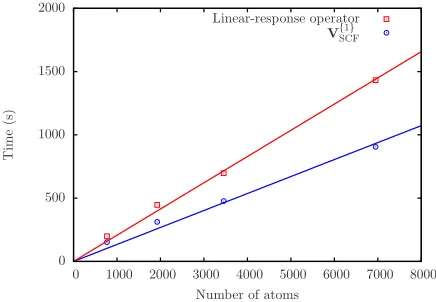
C. Linear-scaling capabilities
We now focus on demonstrating the linear-scaling capabilities of the TDDFT method