A Modified Replication of the Semantic Priming
Stroop Task: is efficient mind reading possible?
Kira C. Choinski
Bachelor Thesis
Supervisor: Dr. Martin Schmettow
Second Supervisor: Simone Borsci
Faculty of Behavioral, Management and Social Sciences (BMS)
Abstract
In the present study, the Semantic Priming Stroop Task (SPST; a variation of the original Stroop task), was put to a test because it could potentially pose a useful implicit measurement tool for research as well as diagnostic purposes. It found application only two times before and therefore needs verification. Two conditions were created to show whether the SPST works under optimal conditions or not. In a repeated-measures within-subject design,
participants were therefore exposed to a picture, followed by a word. The picture-word pairs were designed to be either semantically unrelated or related, provided the participant
possessed the demanded knowledge and thus made the demanded association. Participants were requested to respond to the ink color of the word as quick as possible, like in the original Stroop task. It was assumed that longer response times indicate that the demanded association was made. The validity of the conditions was tested by means of a questionnaire and the conditions were reclassified accordingly for the statistical analysis. Deviating from the prior studies, no effect was found. It was concluded that the SPST does not work in general. However, one of the prior studies observed the effect with a slightly different but more limited study design. Thus, further research could show that the SPST works under different, more limited conditions, as it presumably did before.
3
1. Motivation Behind the Study
As the study of the mind, Psychology tries to understand human thought more than any other
science, often in form of attitudes or opinion. To measure these, psychologists have the
possibility to utilize explicit measures (i.e. self-reports), which aim to determine thoughts by
asking questions. Thus, research questions of explicit measures are often transparent to the
assessed individuals. This way, responses go through a conscious validation process in which
motivations like social desirability considerations potentially bias outcomes of self-reports.
To avoid this problem, scientists can employ implicit methods which provide results
not by asking questions directly, but by measuring the cognitive processes in question through
tasks. Like this, implicit methods generally do not expose their research question to
participants and thus circumvent the conscious assessment process by participants, thereby
avoiding bias.
This advantage is also assumed to be present in the paradigm called Semantic Priming
Stroop Task (SPST). It is a variation of the original Stroop task and involves apart from
color-naming a semantic priming aspect. Before the color-color-naming task, participants are exposed to a
priming stimulus. In the modified Stroop task that is implemented afterwards, the color-words
are replaced by target words and unrelated words. The target words are semantically related
with the prime, provided the participant knows the aspect in question. Just as in the original
Stroop task, participants are then asked to name the ink color of the words as quick as
possible. A longer response time in the condition with prime and target word in comparison to
unrelated words is then assumed to indicate that the particular participant has the association/
knows about the aspect in question. Essentially, one could say that with the SPST researchers
can ‘read minds’ because on the basis of the response times it could be said whether the
specific participant had the association in question or not (i.e. if the participant has the
specific knowledge or not), without asking them directly.
The SPST is a rather novel paradigm, only applied two times to this point, introduced
by Sparrow Liu and Wegner (2011). Since the publication of the Open Science study by
AArts et al. in 2015, paradigms with a low replication rate should be treated with even more
caution. With the large-scale replication project, it was unfortunately found out that many
previous studies must have made mistakes, considering that the majority of the phenomena
did not replicate. Among these problematic cases included also many priming paradigms. As
these results further fueled the replication crisis in social sciences, there is a heated debate
going on about the factors that possibly contributed to its origin, best summarized as
4
et al. exhibit some weaknesses or at least opacities that leave room for speculation about its
strength
With respect to the threatening replication crisis of also many priming paradigms and
the low number of applications of the SPST, a replication of the proposed paradigm seems
necessary. Therefore, the present study aims to investigate the paradigm of the SPST by
putting it to a test, employing two optimal conditions that should show a delay in response
time in an association condition compared to a non-association condition, provided the SPST
works. The following section will give further insight into the issue as well as the goals and
approach of the present study.
1.1 Implicit Methods
A possible solution to the above explained problems with explicit methods are so-called
implicit methods that aim to assess thoughts by circumventing validation processes and hence
bias. To achieve this, the research question in implicit methods is nontransparent but assessed
through tasks that stimulate and measure the activation of specific mental constructs
(associations, attitudes, beliefs etc.). There is still some disagreement between scientists about
whether implicit methods measure unconscious mental constructs but the fact that implicit
methods avoid a validation process that is present in explicit measures is largely
uncontroversial (Gawronski, LeBel, & Peters, 2007). Nevertheless, this advantage is the
reason why implicit methods are currently used, to achieve unbiased results.
1.1.1 Semantic Priming Stroop Task. One such implicit method, as introduced by Sparrow et al. (2011), is the Semantic Priming Stroop Task (SPST). In this task, participants
first get provided with some sort of prime. In the thereupon following modified Stroop task,
the color-words of the original Stroop are replaced by a proportion of target words and a
proportion of unrelated words. The target words are semantically related with the prime, for
participants that have the demanded association/ know about the construct in question. As in
the classical version of the Stroop task, the subjects are then asked to name the ink color of
the words as quick as possible. It is assumed that when a word strongly captures the attention
of the participant (presumably due to exposure to the preceding prime), the response time is
longer. A delay in response time is thus understood as indicating a strong association between
the prime and the word. With the use of two classes of words (one class= target words; other
5
certain association/ has a certain knowledge or not. In the specific case of the paper by
Sparrow et al., the prime consisted of trivia-questions.
Under this assumption, Sparrow et al. conclude that longer response times of the
participants in the study represent stronger associations between trivia-questions and words in
the subject. This way, Sparrow et. al employed the SPST to test the hypothesis that people
tend to think about technology when they need information. This assumption is accounted for
by the idea that our society largely uses the internet as a sort of extended memory, i.e. looks
up information in the internet rather than having all the information available in their minds.
Another application of the SPST was published by Schmettow, Noordzij and Mundt
(2013). Here, the task was implemented utilizing picture-word pairs as associations. In order
to understand what individuals associate with a picture of a computing device, words of three
different categories were presented to the participants together with the pictures. The results
were as expected, i.e. longer response times were observed for participants that were
predicted to have a certain association when viewing a computing device.
So, it can be summarized that the SPST has been applied only two times at this point.
1.1.2 Theoretical background. To understand the theoretical background behind the SPST, its components will be shortly explained here.
1.1.2.1 Classical Stroop task. The SPST is a variation of the well-known Stroop task. In that task, subjects are asked to name the ink color of color-words, not the words
themselves. Thereby, the word and its color are either compatible (‘red’ in red ink) or
incompatible (‘red’ in blue ink). In the incompatible condition, people usually experience a
disruption/ interference in naming the color instead of reading the word, presumably because
the latter process is inevitably automatized (Monahan, 2001). This phenomenon is called the
Stroop effect. The effect can be observed in a delay of response time. This way, the Stroop
task found application in experimental research as a measure of attention for example
(MacLeod, 1992), as well as in diagnostics (Sergeant, Geurts & Oosterlaan, 2002). The
paradigm of the original Stroop task, as just described, has been replicated hundreds of times,
as can be seen in a literature review of MacLeod for instance (1991).
1.1.2.2 Semantic priming. Priming describes the influence of the provision of a cue on the subsequent processing of another stimulus, in a task that entails some sort of cognitive
performance. This influential effect consists either in facilitation or inhibition of a response
6
associative priming) that depends on semantic relation, as in for example: prime= bread,
target= butter. With such a prime, reduced response times are usually observed for primes that
facilitate a response to a stimulus because it is semantically related to it. In contrast to that,
with primes that inhibit a response to a stimulus because it is semantically unrelated with it,
increased response times are commonly observed (Heyman, van Rensbergen & Storms,
2015). Semantic priming (facilitative as well as inhibitory) is what is also suggested to occur
in the SPST.
1.2 Replication Crisis of Social Sciences
In 2011, a series of unpleasant events, including instances of research fraud, started to lay
doubt upon psychological research results (Pashler & Wagenmakers, 2012). In a following
extensive joint work of the Open Science Collaboration from 2015, a team of 270
international researchers reconducted 100 psychological studies that had been published in
journals in 2008, of which only 39% could be replicated (Aarts et al.).
1.2.1 Priming paradigms that could not be replicated. Taking a closer look at the Open Science study, it attracts attention that also many priming studies did not replicate. For
instance, the study by Schnall, Benton & Harvey (2008) which presumably found evidence
for the hypothesis that priming people with cleanliness would decrease the severity of their
moral judgements, could not be replicated by the researchers (Johnson, Cheung, Donnellan,
2014). Also, for the prior found positive effect of spatial distance primes on feelings of affect
and emotional closeness by Williams and Bargh (2008), the Open Science researchers could
not find this effect in a replication of the study (Lynott et al., 2014). The hypothesis here was
that people primed with close distances would have stronger emotional closeness to their kin
and hometown than when primed with long distances.
Moreover, a study that addressed semantic interference effects, similar to the one that
is suggested to be at work in the SPST, also failed to replicate (Galak, 2015). This study’s
hypothesis was that the response time to a naming-task would be slower for semantically
related picture-word pairs than for semantically unrelated ones (Janssen, Schirm, Mahon, &
Caramazza, 2008).
Since the Open Science study is highly alarming information for at least most social
scientists, it broke loose the replication crisis and with it hot debates about possible triggers
7
1.2.2 Contributing factors of the crisis. The first question arising in regards to the crisis is why it happened or what factors enabled it. Several aspects were identified as
possible contributors of the crisis that will be addressed in turn here.
To start with, the value and meaning of replication appears to be commonly
misunderstood. In practice unfortunately researchers gain greater economic advantages from
providing new results than replicating ‘already known effects’, as journals will rather report on new insights than presenting an ‘already known phenomenon’ (Aarts et al., 2015; Bakker,
van Dijk & Wichters, 2012). This is a bad state of affairs because the probability that results
are true-positive depends among many other aspects on the number of replications. As a
consequence, replications are of great value but are not rewarded as such.
Perhaps partly due to this pressure on practitioners to find hitherto unknown effects to
get published, the indications amass that a big part of psychological research does not provide
new insights but possibly often produce false-positive results (Ioannidis, 2019). Reasons and
means by which this gets possible exist in the often-called researcher’s degrees of freedom.
1.2.2.1 Researcher’s degrees of freedom. When scientists come to the point to analyze their collected data, they have a certain not insignificant amount of freedom in how to
approach and conduct it. They choose which data to define as ‘outlier’ and exclude, they
decide whether more data shall be collected, they decide which control variables to consider,
which conditions are combined and which compared, and perhaps most strikingly, they decide
on the analytical method (Simmons, Nelson, & Simonsohn, 2011). This freedom of choice in
cleaning and analyzing data is what Gelman and Loken refer to as ‘The Garden of Forking
Paths’ (2013). They state that researchers have a nearly infinite number of ‘paths’ they can
follow when they did not specify a concrete data analysis plan beforehand and instead fit the
analytical method to the observed data. Consequently, they urge the importance of a prior
established analysis plan. In contrast to that, it unfortunately seems to be common practice for
scientists to probe many analytical alternatives and report only on those that yielded statistical
significance (Simmons et al., 2011).
The issue becomes clearer when taking a closer look on p-values as they are typically
consulted as indicators for the confidence of data. Relying on p-values means that results are
considered significant when statistical models provide a 95% chance that the outcome
occurred not at random (i.e. the 5% hurdle is generally recognized as sufficient). But
regarding the shocking outcome of the replication study by Aarts et al. (2015), this approach
8
hypothesis but allow researchers to state that this means strong evidence for the alternative
hypothesis.
Overall, with this information it becomes clear that a practitioner can easily arrive at the required 5% with data that is just noise, as long as they ‘fish’ their data extensively enough using different statistical tests until they come across some pattern. The claim that such questionable research practice takes place is also supported by a survey conducted in
2016. Nearly 50% of the asked members of the German Psychological Association stated to
have employed HARKing (=hypothesizing after the results are known) at least once in their
career (Fiedler & Schwarz, 2016).
However, this does not necessarily mean to accuse all researchers for ‘fishing’ and ascribe bad intentions to them, but to emphasize the importance of understanding the ambiguity that the garden of forking paths inevitably results in if researchers do not understand their methods well enough. Moreover, this emphasizes again the urgency for a greater appreciation of the value of replications, since replications would quickly reveal such mistakes.
1.3 Doubts Concerning the SPST
As already explained above, many psychological studies cannot be replicated, presumably
due to several mistakes in data analysis made by researchers in the past. Further, the
replication crisis lays doubt on many priming paradigms, as well as semantic interference
effects as they are suggested to be involved in the Stroop task for example. This leads back to
the SPST, which found application only two times at this point.
The study by Sparrow et al. (2011) raises the question, whether a stronger association
actually results in a delayed response in the color naming task. Since the classical Stroop
effect seems to be widely replicable, such a hypothesis appears intriguing. Nevertheless, the
study design as implemented by Sparrow et al. was rather weak. To facilitate understanding,
the employed procedure is explained here in short: Each participant was made to answer an
easy question block and a hard question block, each of 16 items. After each block, the
modified Stroop task with 24 words was provided (8 target words and 16 unrelated words),
thereby having to hold a 6-digit number in mind.
Coming back to the weaknesses of the study design, first of all, the small amount of
only 24 repetitions makes the design appear less strong. Compared to other studies that
measured response time in relation to the Stroop task, where numbers like 480 (Mewhort,
9
Whitebread, 2009) trials are employed, 24 seems a very small number of observations. Also,
there were no practice trials, at least not mentioned.Further, no validity test was conducted
that could assure that the questions were truly perceived as strong or easy respectively for the
individuals. Moreover, the study introduced a memory task but did not test for recall later.
Additionally, the response times were analyzed assuming a normal distribution, despite the
fact that response times are not normally distributed. Another point that draws attention is the
non-transparency of the stimuli development, as it is not explained how they were created or
selected. But most strikingly is the fact that employing this method, that has never been used
before, the researchers assumed to find the appealing association between searching
information and thinking about computers.
Taken together, as useful as the SPST could be, to this point, there is only very little
evidence of its functionality. Valid replications need to be done in order to proof whether such
an effect exists or not.
1.4 The Aim of this Study
In light of the current serious replication crisis and considering the weak evidence for the
potential effect, the present study aims to replicate the SPST effect in an ‘optimal condition approach’ to counteract the crisis in this particular case.In specific, the present study
investigates whether the suggested effect of the Semantic Priming Stroop Task works under optimal conditions, observable by means of a delayed response time in a semantic priming condition, as compared to a control condition.
The ‘optimal conditions’ consist of one condition that employs stimuli that
presumably trigger associations in the participants in comparison to another condition where
the stimuli will likely not trigger associations. Further, an independent check for validity will
find out whether the participants had the associations or not, which ensures a correct
classification of the stimuli into the conditions per participant for the data analysis (explained
in detail in ‘Methods’).
Regarding the lack of transparency in the Sparrow et al. (2011) study, it is difficult to
conduct an exact replication. Thus, the design and procedure of the present study are slightly
modified in that pictures instead of questions are employed as semantic primes, no additional
cognitive load is introduced and a subsequent validity check is added, which disqualifies it to
be declared a literal replication. Consequently, the current study is a modified replication of
the mentioned study, according to the definition of the American Psychological Association
10
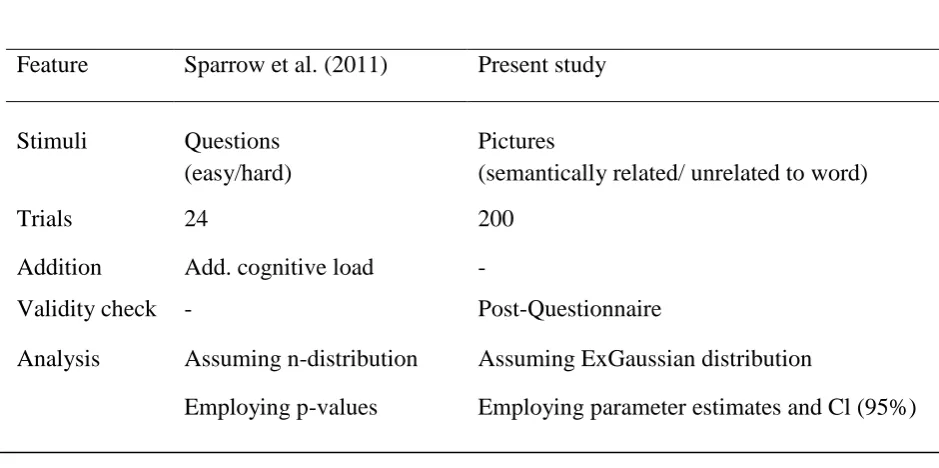
Since the present study is not an exact replication of the Sparrow et al. study, the
features are contrasted in Table 1 for clarification. The differences further include that the
analysis is done utilizing parameter estimates and credibility limits (95%). The response times
are measured by 200 trials to be able to filter for noise. Lastly, an appropriate statistical model
for response times (i.e. ExGaussian) is employed for the analysis of the response time
measures.
If the results show the effect as assumed by the study of Sparrow et al. (i.e. strong
association= delay in response time), there might be more certainty about the effect of the
SPST. If in this optimal condition, no such results can be observed, this should cast serious
[image:10.595.68.538.333.567.2]doubt on the functionality of this novel paradigm.
Table 1
Comparison between the study by Sparrow et al. (2011) and the present study.
Feature Sparrow et al. (2011) Present study
Stimuli Questions (easy/hard)
Pictures
(semantically related/ unrelated to word)
Trials 24 200
Addition Add. cognitive load -
Validity check - Post-Questionnaire
Analysis Assuming n-distribution Assuming ExGaussian distribution
Employing p-values Employing parameter estimates and Cl (95%)
2. Methods
To facilitate understanding on the following explanations regarding the two conditions of this
study, this is a short description on how they need to be understood. In paragraph 2.1.2, the
development of the conditions of the intended design are explained. These are the items the researchers assume to induce associations and non-associations respectively, referred to as
pre-questionnaire-classification. In important contrast to that, in paragraph 2.1.4 the
establishment of the ‘true conditions’ through the post-questionnaire is pointed out. These
post-11
questionnaire-classification. To ensure validity, the data analysis is based on the individual
post-questionnaire-classification conditions.
2.1 Stimuli
As explained above, for the present study picture-word pairs were utilized as stimuli to
observe the suggested effectof the SPST, i.e. a disruption indicated by a delay of response
time. Therefore, two conditions were created. For the purpose of correctly understanding the
conditions, first the meaning of association in this context is briefly explained.
2.1.1 Forms of association. An association can be of two kinds in this case. One is that
the picture and the word are associated with each other, implying a simple connection
between the words. For example, as with the picture ‘Yogurt’ and the word ‘Spoon’. The
association is that one usually eats a yoghurt with a spoon. Another kind of association is that
the picture in combination with the word evokes a third construct. For instance, seeing a
picture of a wolf and the word ‘grandma’ would evoke the construct of ‘Red Riding Hood’ for
participants who know the fairytale.
Regarding that the latter form of association is more complex than the former, for this
study the complex form of association was employed. Considering that the purpose is to
observe an effect that is suggested to be indicated by response time, this form of association
should be observed more easily than a less complex association (provided such an effect
exists). To clarify: since ‘wolf’ and ‘grandma’ presumably evoke rather a complex narrative,
namely the fairy tale ‘Red Riding Hood’, it should be more attention-grabbing than a simple
association like ‘eating a yoghurt with a spoon’.
2.1.2 Intended design (pre-questionnaire-classification). One intended condition consisted of association picture-word pairs (AC), meaning that the combination of the picture
and the word would induce an association. The other intended condition involved
non-association picture-word pairs (NC), namely the combination of the picture and the word
would not induce an association. As described before, this study is aimed at the observation of
the purposive effect of the SPST.
2.1.3 Stimuli development. To reduce the probability that an association is invalid and not induced for the participants to a minimum, the stimuli were carefully developed and
tested as will be described in detail now.
The pairs were first developed without pictures, as word-word pairs, to provide a
12
came up with topics and the desired associations that are probably known by almost every
person, including a great age-range and a great international range. The latter was achieved
through the collaboration between the German and the Dutch researcher. To achieve a great
age-range, thereby attending to various individual-differences, the design of the stimuli
concentrated on widely known fairy tales, movies, events and persons.
Considering that response times usually provide very noisy data, the stimuli
development was already aimed at creating enough pairs for both conditions to be later able to
clean the data for noise.
First, both researchers developed 30 association pairs and 25 non-association pairs
separately, then exchanged the stimuli and like this tested them on each other. This way, the
check for cross-cultural validity, as well as a first check for individual differences was given.
From this task, 50 association word pairs and 50 non-association word pairs emerged. Next,
the pictures were added to create the complete stimuli as intended as picture-word pairs.
Afterwards, the stimuli were given to the third researcher who also eliminated some invalid or
weak items. A discussion within the context of all three researchers brought to light some
rules for the stimuli, as described in the following criteria section. Thus, some associations or
their picture-word pairs had to be substituted by some that adhere to the criteria. Lastly, the
set of stimuli was tested on three external persons that were presented with the pictures and
the words and requested to answer as quick as possible what strikes their minds at that point.
This way, two non-working stimuli were removed and like this, the final set of 50 association
stimuli and 50 non-association stimuli was obtained (Appendix 1).
Eventually, the stimuli were duplicated, providing the study with 100 AC and 100 NC
stimuli (plus 15 NC for a practical trial prior to the actual study trial). This was done to
acquire a greater number of stimuli to be able to reach a greater reliability. Additionally, this
way the study simultaneously tests whether the effect still holds (if it holds) when stimuli are
presented twice. In the end, the items were translated into German and Dutch by native
speakers because the test presumably may not work when words are not read and understood
automatically.
2.1.3.5 Criteria for the stimuli. The words that were chosen to evoke a certain association in combination with the picture, had to fulfill certain criteria to be accepted as
stimuli. First, only single words (no compound words) were employed, as there are single
13
Second, the words could not be color-words because it could thoroughly disturb the
data, since this would probably yield the original Stroop effect which is already known to
exist. In this study, the original Stroop effect would bias the priming effect that is aimed to be
observed, i.e. a disruption due to the evoked association. For this reason, the same no-color
rule holds for the pictures. The pictures were still presented in color, but it was refrained from
pictures where the color was explicitly decisive. For example, a green hat could not be
employed to (in combination with the word ‘Ireland’) evoke the association ‘Leprechaun’
because the color of the head in particular induced the association. In contrast, a wolf can still
be grey to (in combination with ‘grandmother’) evoke the association ‘Red riding hood’
because the color of the wolf is not crucial to the association. Also, the association was tried
to be designed far from any color at best, to rule out any possible unwanted disturbances with
the color-naming task.
A third important criterion for the stimuli was that both, the word and the picture,
would not evoke the association on their own. Only in interaction they can induced the third
construct. For instance, a picture of ‘Santa Clause’ already induces the association Christmas without the word ‘winter’. For the same reason, the words were not allowed to include names,
considering that those often already are too narrative by themselves and would thus pose the
danger to induce an association on their own where it is not intended. In contrast to that, the
associations deliberately needed to be narrative as in e.g. ‘Harry Potter’ or ‘Unicorn’.
Associations like ‘School’ were excluded due to the fact that they may not need notably more
cognitive effort.
Additionally, the pictures were kept as clear as possible and not too rich in content,
showing only the object in question. In sum, all these measures were taken to ensure a clear
difference between NC and AC items, so it is nearly ruled out that a potential delay in
response time in the AC was due to inconsistent choice of stimuli and thereupon resulting
noisy data.
2.1.4 Establishing the ‘true conditions’ (post-questionnaire-classification). The intended design as explained above was checked by a post-questionnaire to find out how the
stimuli were truly perceived by the participants. This way, the ‘true conditions’ for the
statistical model could be established.
The validity test was administered through the use of a multiple-choice questionnaire
that involved all 50 AC items. Therefore, the AC items were presented with four answer
14
to indicate if the association was not known at all. The two wrong answer options were
chosen in a way that if one does not know about the association, the other options could be a
logical choice, too, as with e.g. ‘skyscraper’ and ‘airplane’ the option ‘holidays’ was
provided. In the end, also the questionnaires were translated into German and Dutch by native
speakers.
Most importantly, the thereupon resulting reclassified conditions are much stronger
than those based on the pre-questionnaire-classification. This is the case because the
questionnaire can ensure the validity of the two conditions individually per participant. That is
why the post-classification conditions were used as the basis on which the data analysis would
rest.
2.1.5 Apparatus. For the implementation of the experiment, the open source program ‘PsychoPy2’ was utilized.
2.2 Procedure
Participants could sign up via the SONA System’s test subject pool of the University of
Twente or were recruited via the researchers’ wider social network.
1. Participants received a printed information sheet that roughly explained what activities
they would perform in the study (a color-naming task and a questionnaire) and got a
short overview about the theoretical background of the original Stroop task.
Information about the two conditions and a potential association between the pictures
and the words was withheld from the participants to avoid bias.
2. Participants gave their informed consent to take part in the study by signing the
consent form.
3. Age and gender of the participant were recorded and entered into a table.
4. The software ‘PsychoPy’, entailing the items of both conditions in a random order,
was run in the participant’s native language. Instructions for the task were provided by
a text on the screen, telling participants to name the color of the word as quick as
possible by pressing the arrow keys to indicate the color (left=red, down=green,
right=blue). The instruction was supported by a picture of the arrow keys
and fingers on it, because the finger position was standardized for all participants.
5. A practice trial of 15 NC items was provided first, with the purpose to make the
participant learn the keys. This way disruption due to learning curves that could distort
15
6. The actual trial of 200 items (100 AC and 100 NC) was provided in eight blocks of 25
items each. Every participant was exposed to both conditions which were mixed
randomly by the program to avoid patterns that could possibly give respondents an
idea about the study’s assumption. For each trial, the response time of the respondents
to each item was measured by the program.
7. Participants filled out the printed post questionnaire, to test the validity of the
employed stimuli. Here, the respondents were asked to indicate what they think about,
when seeing picture and word together.
2.3 Participants
The research involved a convenience sample of 40 people, consisting of undergraduate
students from the University of Twente and people from the researchers wider social network
(Mage= 32.33, SDage= 13.97; 47.5% female, 52.5% male). Exclusion criteria were minors and
people who are not German, Dutch or English native speakers. The age range spanned from
20 to 63 years. The student participants were offered SONA Credits for their participation. All
respondents took part in the study voluntarily, which was ensured by an informed consent.
The Ethics Committee BMS approved this research as ethically justifiable.
2.4 Design and Data Analysis
The present study employed the SPST in a repeated measures within-subject design with two
conditions. Accordingly, each participant was exposed to the intended association condition
as well as to the intended non-association condition (pre-questionnaire-classification), which
are explained above in detail. Through the subsequent validity check, the ‘true conditions’ on
which the data analysis rests were established (post-questionnaire-classification).
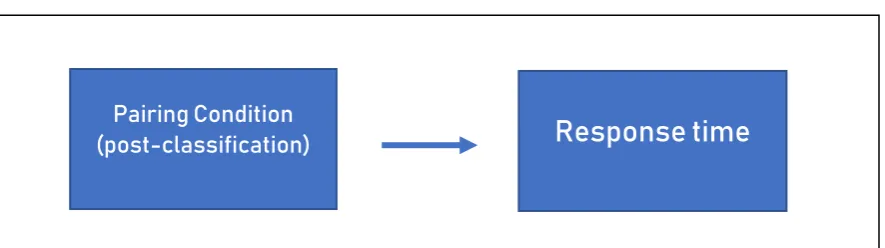
Consequently, the independent variable in the present experiment was the Pairing Condition reclassified by the questionnaire with two levels (AC; NC). The dependent variable that was measured was the response time (Figure 1). The conditions were presented in
random order, where one picture-word pair constituted one stimulus. So, the complete pairs
16
Figure 1: The present study investigated the Semantic Priming Stroop Task by observing the response times to the two pairing conditions in the post-questionnaire-classification.
As the first step of the data analysis, the collected response time measures were
screened to determine the final dataset. Incorrect answers that were given by participants in
the SPST were eliminated, so only correct answers would count into the data.
2.4.1 Multilevel model. The employed within-subject, repeated measures design is translated into a multilevel model. Since each participant was exposed to both conditions, it is
not only possible to estimate the difference in mean RT on a population level but also on the
participant level. The resulting provision with a population estimate as well as one submodel
per participant, enables us to gather further insight into details of the collected data such as
potential effects in single individuals, that might be missed when regarding only the general
result on the population level. Moreover, the fact that subjects act as their own control provides a way of reducing the amount of error arising from natural variance between individuals.
2.4.2ExGaussian distribution. Considering that the present study measures the dependent variable on the basis of response times, it is pointless to use models that assume a
normal-distribution (e.g. t-tests) because response times are not normally distributed
(Schmettow, 2018). This is the case because any activity takes at least a certain minimum
amount of time to execute, so that response times can logically not be negative or close to
zero, which results in a strong skew.
But not only the Gaussian distribution is inappropriate to plot response time measures.
Since response times cannot be close to zero, also a Gamma distribution does not work well
to plot this kind of data, because it assumes that response times of zero are possible. This way,
moving right in direction, the gamma distribution is more stretched/ there is a reduction in
Response time
17
skewness that makes the graph more symmetrical, often overdoing the left tail (Schmettow,
2018). In other words, response time data is generalized by Gaussian or Gamma distributions
because their assumptions divert from the characteristics of this kind of data, which can
consequentially lead to the introduction of serious bias (Marmolejo-Ramos, Cousineau,
Benites & Maehara, 2015).
What better presents the strong left offset of response time measures is the ExGaussian
distribution. This is the case because it is composed of a normal distribution and an
exponential distribution. The normal distribution describes the many factors that make up the
response selection and motor processes that partly comprise response time, whereas the
decision mechanisms are (according to neurological studies) best described by an exponential
distribution. The sum of both of these time sets thus has a distribution best described by a
combination of a Gaussian distribution (n-distribution) and an exponential distribution, which
is called the ExGaussian distribution (Marmolejo-Ramos et al., 2015). Like this, the
ExGaussian distribution shows realistically the response times with a steep left climb at an
arbitrary point different from zero and a long right tail. Hence, for this study’s data analysis,
an ExGaussian distribution is assumed, therefore an ExGaussian regression equation is
employed.
For the data analysis the statistics software ‘R’ was used. For the results, parameter
estimates and credibility limits (95%) were utilized to observe the effect on the response time
directly.
3. Results
The present study investigated whether the suggested effect of the SPST (i.e. that true
associations cause a delay in response time in comparison to no associations) works under
optimal conditions. If the SPST works, thus a positive difference in response times from the
non-association condition to the association condition is expected. First, the population-level
was regarded.
3.1 Population-level Analysis
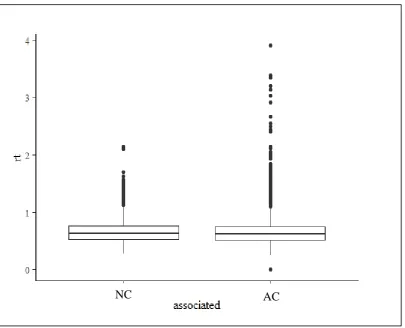
To get a first impression of the difference in response times (RT) between the association
condition and the non-association condition, a boxplot of the data was compiled, based on the
original classification of the stimuli (pre-questionnaire-classification). As can be seen, the
distribution of the RT in the AC is scattered wider than those in the NC, which again supports
18
emerge (Figure 2). Nevertheless, the central value of RT appears to show nearly no difference
[image:18.595.73.479.117.445.2]between the two conditions.
Figure 2: RT distributions in the association condition and in the non-association condition (pre-questionnaire-classification)
Next, a comparison of groups model (CGM) was conducted. The following values are based
on the reclassification of the AC stimuli as identified by the questionnaire
(post-questionnaire-classification). As can be seen in the table, the NC has an average RT of 0.684
seconds (Table 2). Since the respective credibility limits between 0.656 and 0.71 are tight
around the center value, one can be rather sure that the group mean quite accurately describes
the true average RT in the NC in the population.
Further, the coefficients reveal that on average in the population, the difference in RT
between the two conditions amounts to -0.003 seconds, which is a value in the opposite
direction (negative) than hypothesized. Thus, participants took on average 0.003 seconds less time in the AC than in the NC. However, it is still practically zero. The credibility limits here
are considerably tight around zero, so that one can be quite sure that the true difference in RT
is practically zero.
AC
19 Table 2
Average response time to SPST on population level in the non-association condition (NC) and the difference in RT between the two conditions (post-questionnaire-classification; invalid AC items taken out)
Parameter Center (CI 95%) lower (CI 95%) upper
Intercept 0.6836951 0.6556274 0.7100678
associated -0.0031483 -0.0148912 0.0094687
Deviating from what was expected, a positive difference in RT from NC to AC could not be
observed, but a minimal negative one. It can be concluded that the difference in RT between
the conditions is practically zero. This supports the conclusion that there is no effect.
However, granted that the upper credibility limit of about 0.012 seconds would be the
true value for the difference in RT between the conditions and one would claim that the SPST
works (even though the value is extremely small), the test is just impractical. When the
difference value is so very small, one would need to make endless trials to come to a useful
result.
3.2 Participant-level Analysis
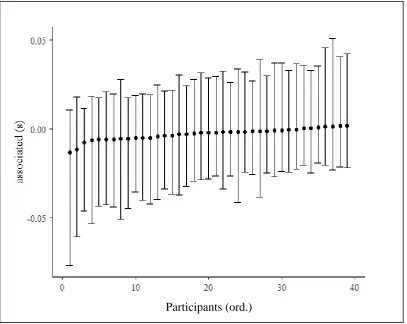
Second, it was zoomed in on the participant-level to see whether the SPST works for single
individuals. This was done by means of error bars that take into account the credibility limits
(Figure 3). As visible here, with credibility limits tight around zero, the center estimates show
a difference between both conditions close to zero. For no single participant it can be said
20
Figure 3: Center estimates and credibility limits of the difference in RT between the conditions per participant.
Nevertheless, even when assuming that the SPST works for single individuals, the test again
becomes clearly impractical. Researchers who want to employ this test would first have to
find out whether their participant is suitable for the test or not.
In sum, the results show that there is no population-level effect, as well as no
participant-level effect.
4. Discussion
As already noted at the beginning of this paper, implicit methods such as the SPST can help
researchers avoid bias in regards to a transparent research question. With the SPST in
specific, one could potentially assess participants knowledge about a specific topic or even
simply whether someone possesses a specific association (e.g. opinions, values), maybe even
for diagnostic purposes. It can be concluded that the SPST would without question be a useful
utility for many study designs as well as for diagnostic purposes.
However, in contrast to what was expected, no semantic priming Stroop effect was
21
on the paradigm. In other words, the question is why Sparrow et al. (2011) found an effect
and we could not find one.
An issue that strikes attention is their use of t-tests that assume normal distributed
data, when the data consists of response times (which are not normally distributed as
explained above), as well as their use of p-values. Consequentially, Sparrow et al. only found
strong evidence against the null-hypothesis with a p-value of p < .001. As explained before
and supported by the paper of Gelman and Loken (2013), P-values and the assumption of a
0.05 alpha-level are problematic. When considering the response time group means, there is a
difference of 0.12 seconds between the conditions. This is not a very strong effect regarding
that the original Stroop effect was observed to have a value of 0.52 seconds, 0.46 seconds or
0.22 seconds in prior studies (Hatukai & Algorn, 2017; Linnman, Carlbring, Åhman,
Andersson & Andersson, 2006). However, the effect is still much stronger than what was
observed for the present study. Hence, P-values stay a problematic object but this is not an
explanation for not finding an effect of the SPST at all in our study.
Of course, since the experiment has not been replicated until now, there is always a
small chance that the results of Sparrow et al. consist of random noise, but this is rather
unlikely. Therefore, we will first take a look at possible limitations of the present study.
4.1 Limitations
As mentioned before, the current study is not an exact but a modified replication of the study
by Sparrow et al. (2011). One could thus criticize that our study may not be as optimal a
replication of the SPST paradigm as it was proposed in the Sparrow et al. paper. This is
especially the case because we used pictures instead of the trivia-question blocks.
To make the most crucial difference of the study designs clear again: Sparrow et al.
made use of trivia-questions (easy and hard) that would potentially cause the participants to
think about computers for help, resulting in a longer response time in the thereupon following
modified Stroop task when the word was a computer word in comparison to when it was
another word. In contrast, the present study utilized pictures that would potentially prime
participants to think about the respective association, resulting in a longer response time in the
modified Stroop task when the word induced an association in comparison to a word that did
not. As can be seen clearly now, there is a notable difference in how the priming was initiated,
as well as a clear similarity in the total process.
So, the underlying assumption stays the same in both studies. Namely, that a semantic
22
Stroop task, visible in an increased RT. Nevertheless, what constitutes one important
difference in the Sparrow et al. study is that questions in contrast to pictures are a task. It is
common sense that looking at a picture will set a different mental process in motion than
being requested to do something (answering a question). So, the first critique is that the
present study failed to employ a task for the semantic priming as Sparrow et al did, which
might be necessary for the SPST to work.
However, if the task only works with a task or more specifically questions, it puts
severe limits upon its usability. Not everything you want to find out with help of the SPST
might be possible to prime semantically in the form of questions. Following the assumption of
Sparrow et al., questions are a reasonable measure for the purpose of priming some sort of
information finding process. But it is questionable if you can prime a lot of other potential
research topics with questions like fairy tales or personal traits.
Another aspect that was credited only as a side note in the study, is the fact that the
experiment by Sparrow et al. (2011) built in an additional cognitive workload for the
participants. After the priming process with the trivia-questions, the participants were to
perform the modified Stroop task, thereby holding a 6-digit number in mind. The reason for
this is not further explained but it could be a possible explanation why the SPST effect did not
work in the present experiment, assuming that this extra amount of cognitive load plays a
major role for the working of the task. Tracking down the argument for this additional
treatment, we found that prior studies investigating the workings of the Stroop task build in an
extra cognitive load.
In a study that investigated the effect of working memory load on selective attention
by Gao, Chen and Russell (2007), a similar study design concerning the additional cognitive
load was employed. Participants were exposed to either a single number or a 6-digit number
before conducting a Stroop task consisting of congruent and incongruent color-words in
regards to meaning and color. After the Stroop, a digit was shown and the participant had to
decide whether the digit present or absent in the number they had seen before the Stroop.
They found a reliable Stroop interference effect, but the effects magnitude did not change as a
function of the additional cognitive load. They suggest that working memory load plays a
negligible role for the outcome of the Stroop effect and concluded that working memory load
showed no relevant effect on the degree of Stroop interference.
On the other hand, in an experiment by Kim, Kim and Chun (2005) observed that the
cognitive loads influence on the Stroop task interference depends on the type of cognitive
23
the type of required information for the target overlapped. When for instance the participant
retains a set of nonsense-syllables (verbal) in mind and then implements a Stroop trial that
involves to decide whether the meaning of a color-word (verbal) is the same as an also
provided color patch, cognitive load and target are from the same type. They explain it with a
limited capacity mechanism that are available for verbal target processing. Additionally, the
study observed that when the type of cognitive load overlapped with the distractor of the
Stroop task, Stroop interference decreased.
Coming back to the study of Sparrow et al. (2011), they utilized digits as additional
cognitive load, which is (=verbal) and the modified Stroop consisted of a colored word. The
required information here was the color (=non-verbal) and the distractor was the
word-meaning (=verbal). According to the results of Kim et al. (2005) we would assume that the
Stroop interference was decreased because the cognitive load was of the same type as the
distractor (i.e. verbal). What this means for the Sparrow et al. study is that the RT might have
been measured shorter in both conditions equally because the target was always the ink color
of the words and the cognitive load remained the 6-digit number for hard, as well as for easy
trivia-questions. Consequently, the additional cognitive load should not have interfered here
in general but the reason for utilizing this extra task here stays unclear.
However, the recall rates on these numbers are not tested in the Sparrow et al. paper
(2011) or at least this is not reported. Thus, it might be that some participants did not actually
retain the number when others did, which would obviously introduce a serious bias.
Another point that one could criticize about the present study is that we tested the
associations for validity but missed out on checking the non-associations for validity, i.e.
whether these items did unintentionally evoke an association when they should not. But
considering that the difference in response time is so close to zero, a change in results due to
this second validity check seems very unlikely and leaves little space for debate.
4.2 Publication Process
Disregarding the issue of whether the SPST effect works or not, it is surprising that a
high-ranked journal like ‘Science’ published a method that has never been used before and is (at
least partly) not designed in a transparent way. The manuscript selection as well as the
reviewing process are described quite strict by ‘Science’ themselves (“Science: Information
for authors”, n.d.). Notwithstanding, the study was published this way.
As already mentioned earlier, researchers experience a high pressure to find significant
24
interesting publications (Bakker et al., 2012). The reason might be ‘sensationalism’ which
scientific journals are accessible and vulnerable to even more than it is the case in regular
journalism (Nature, 2017). As reported in a study by Song et al. (2010) the so-called
publication bias, that significant results are favored over non-significant ones, is very likely in
the dissemination process of research findings. Other studies confirm the existence of
publication bias (Dickersin, Chan, Chalmers, Sacks & Smith, 1987).
Howsoever the publication process was implemented with the study of Sparrow et al.
(2011) and neglecting the justness of the results, it is inexplicable how the reviewers did not
question the poor design (i.e. few trials, no validity check for the prime, no check of the
memory task) and the unexplained aspects (i.e. additional cognitive load) of the study. This
leads to another point, namely the obviousness with which the results are treated.
The main claim of the study by Sparrow et al. was the change in strategy of thinking.
The idea seems plausible and very appealing: People use computers to search for information
so very regularly, at any place and time that whenever we do not know something by
ourselves immediately, we would obviously think about computers. But taking a step back
and thinking about it from a scientific perspective, it becomes clear that it is not very likely
that a very recent technology like the internet would really fundamentally change the way
people approach problems. Consulting prior brain research elucidates that fundamental brain
processes are often thousands if not millions of years old (Nairne & Pandeirada, 2008), which
implies that a few decades old invention like the internet presumably does not show in human
brains in such a fundamental way already.
The point is that we do not want to deny Sparrow et al. their conclusion; the SPST
effect might exist. But regarding the small amount of evidence and most of all the appealing
nature of the claim, which potentially makes a researcher be biased against the outcome from
the very beginning of the study, it seems grossly negligent to treat the results with the
obviousness as was done in this case, also by the publishers. Results, especially appealing
ones, should thus always be regarded with caution.
4.3 Future Research
To further investigate the functionality of the SPST and to find out whether the use of a task
in form of questions is necessary for the test to work, the present study should be replicated
with pictures as a first condition and trivia questions as a second condition. Even though the
reason for the additional cognitive load that was built in to the study by Sparrow et al. (2011)
25
can be investigated whether the retaining of a number in working memory indeed yields the
needed but still unknown component to make the SPST work.
4.4 Conclusion
In this study, we did not find an effect of the Semantic Priming Stroop Task. Regarding the
legitimate point of criticism that the present study utilized a picture instead of a question as
prime, as was done by Sparrow et al., it can be claimed that we might have observed an effect
if we used questions. Similarly, perhaps the additional cognitive load is for a yet unknown
reason an important factor to produce the SPST effect.
Nevertheless, if the SPST works only with questions as a prime (and the reason for
adding cognitive load to the task remains unexplained), the paradigm is thoroughly limited in
its area of application. In conclusion we can thus say: No, in general the SPST does not work
26 References
Aarts, A., Anderson, J., Anderson, C., Attridge, P., Attwood, A., Axt, J., et al. (2015). On the Reproducibility of Psychological Science. Science, 349(6251). doi:10.1126/science.aac4716 American Psychological Association (n.d.). Retrieved from https://dictionary.apa.org/replication Bakker, M., van Dijk, A., & Wicherts, J. (2012). The Rules of the Game Called Psychological
Science. Perspectives on Psychological Science, 7(6), 543-554. doi:10.1177/1745691612459060
Dickersin, K., Chan, S., Chalmers, T., Sacks, H., & Smith, H. (1987). Publication Bias and Clinical Trials. Controlled Clinical Trials, 8(4), 343-353.
Fiedler, K., & Schwarz, N. (2016). Questionable Research Practices Revisited. Social Psychological and Personality Science, 7(1), 45-52. doi:10.1177/1948550615612150
Galak, J. (2015). Replication of Study 1 by Janssen, Schirm, Mahon, & Caramazza (2008, JEP:LMC). OSF. Retrieved from osf.io/uhpyr
Gao, Q., Chen, Z., & Russell, P. (2007). Working memory load and the stroop interference effect. New Zealand Journal of Psychology, 36(3), 146-153.
Gawronski, B., LeBel, E., & Peters, K. (2007). What Do Implicit Measures Tell Us? Scrutinizing the Validity of Three Common Assumptions. Perspectives on Psychological Science, 2(2), 181-193. doi: 10.1111/j.1745-6916.2007.00036.x
Gelman, A., &. Loken, E. (2013). The garden of forking paths: Why multiple comparisons can be a problem, even when there is no “fishing expedition" or “p-hacking" and the research hypothesis was posited ahead of time.
Hatukai, T., & Algom, D. (2017). The Stroop Incongruity Effect: Congruity relationship reaches beyond the Stroop task. Journal of Experimental Psychology: Human Perception and Performance, 43(6), 1098-1114. doi:10.1037/xhp0000381
Heyman, T., Van Rensbergen, B., Storms, G., Hutchison, K., & De Deyne, S. (2015). The influence of working memory load on semantic priming. Journal of Experimental Psychology: Learning Memory and Cognition, 41(3), 911-920. doi:10.1037/xlm0000050
Ioannidis, J. (2019). Why Most Published Research Findings Are False. CHANCE, 32(1), 4-13. doi:10.1371/journal.pmed.0020124
Janssen, N., Schirm, W., Mahon, B., & Caramazza, A. (2008). Semantic Interference in a Delayed Naming Task: Evidence for the Response Exclusion Hypothesis. Journal of Experimental Psychology: Learning Memory and Cognition, 34(1), 249-256.
doi:10.1037/0278-7393.34.1.249
Johnson, D., Cheung, F., & Donnellan, M. (2014). Does Cleanliness Influence Moral Judgments? A Direct Replication of Schnall, Benton, and Harvey (2008). Social Psychology, 45(3), 209-215. doi:10.1027/1864-9335/a000186
Kim, M.-S., Min, S.-j., Kim, K., & Won, B.-Y. (2010). Concurrent working memory load can reduce distraction: An fMRI study. Journal of Vision, 6(6), 125-125. doi:10.1073/pnas.0505454102 Linnman, C., Carlbring, P., Åhman, Å., Andersson, H., & Andersson, G. (2006). The Stroop effect on
27
Lynott, D., Corker, K., Wortman, J., Connell, L., Donnellan, M., Lucas, R., & O'Brien, K. (2014). Replication of "experiencing physical warmth promotes interpersonal warmth" by Williams and Bargh (2008). Social Psychology, 45(3), 216-222. doi:10.1027/1864-9335/a000187 Macleod, C.M. (1991). Half a Century of Research on the Stroop Effect: An Integrative Review.
Psychological Bulletin, 109(2), 163-203. doi:10.1037/0033-2909.109.2.163
MacLeod, C.M. (1992). The Stroop task: The "gold standard" of attentional measures. Journal of Experimental Psychology: General, 121(1), 12-14. doi:10.1037/0096-3445.121.1.12 Marmolejo-Ramos, F., Cousineau, D., Benites, L., & Maehara, R. (2015). On the efficacy of procedures to normalize Ex-Gaussian distributions. Frontiers in Psychology, 5, 1548. doi:10.3389/fpsyg.2014.01548
Mewhort, D.J.K., Braun, J.G., & Heathcote, A. (1992). Response Time Distributions and the Stroop Task: A Test of the Cohen, Dunbar, and McClelland (1990) Model. Journal of Experimental Psychology: Human Perception and Performance, 18(3), 872-882, doi:0096-1523/92/S3.00 Monahan, J. (2001). Coloring single stroop elements: Reducing automaticity or slowing color
processing? Journal of General Psychology, 128(1), 98-112. doi:10.1080/00221300109598901
Nairne, J., & Pandeirada, J. (2008). Adaptive Memory: Remembering with a Stone-Age Brain. Current Directions in Psychological Science, 17(4), 239–243. doi:10.1111/j.1467-8721.2008.00582.x
Pashler, H., & Wagenmakers, E.-J. (2012). Editors’ Introduction to the Special Section on Replicability in Psychological Science: A Crisis of Confidence? Perspectives on Psychological Science, 7(6), 528-530. doi:10.1177/1745691612465253
Pothos, E.M., & Tapper, K. (2010). Inducing a Stroop Effect. Applied Cognitive Psychology, 24, 1021–1033. doi:10.1002/acp.1603
Schmettow, M. (2018). New statistics for the design researcher A Bayesian course in tidy R. Schmettow, M., Noordzij, M., & Mundt, M. (2013). An Implicit Test of UX: Individuals Differ in
What They Associate with Computers. CHI Extended Abstracts. Paris, FR: ACM Schnall, S., Benton, J., & Harvey, S. (2008). With a Clean Conscience Cleanliness Reduces the
Severity of Moral Judgments. Psychological Science, 19(2), 1219-1222. doi:10.1111/j.1467-9280.2008.02227.x.
Science: Information for authors (n.d.). Retrieved from https://www.sciencemag.org/authors/science-information-authors
Science journalism can be evidence-based, compelling - and wrong. (2017). Nature, 543(7644), 150-150. doi:10.1038/543150a Science journalism can be evidence-based, compelling - and wrong. (2017). Nature, 543(7644), 150-150. doi:10.1038/543150a
Sergeant, J., Geurts, H., & Oosterlaan, J. (2002). How specific is a deficit of executive functioning for Attention-Deficit/Hyperactivity Disorder? Behavioural brain research, 130(1-2), 3-28. Simmons, J., Nelson, L., & Simonsohn, U. (2011). False-Positive Psychology: Undisclosed Flexibility
28
Song, F., Parekh, S., Hooper, L., Loke, Y., Ryder, J., Sutton, A., . . . Harvey, I. (2010). Dissemination and publication of research findings: An updated review of related biases. Health Technology Assessment, 14(8), 1-220. doi:10.3310/hta14080
Sparrow B., Liu J., Wegner, D., M. (2011). Google Effects on Memory: Cognitive Consequences of Having Information at Our Fingertips. Science, 333(6043), 773-776.
doi:10.1126/science.1207745
Szűcs, D., Soltész, F., Bryce, D., & Whitebread D. (2009). Real-time Tracking of Motor Response Activation and Response Competition in a Stroop Task in Young Children: A Lateralized Readiness Potential Study. Journal of Cognitive Neuroscience, 21(11), 2195-2206. doi:10.1162/jocn.2009.21220
Tulving, E., Schacter, D., & Stark, H. (1982). Priming Effects in Word-Fragment Completion Are Independent of Recognition Memory. Journal of Experimental Psychology: Learning, Memory, and Cognition, 8(4), 336-342. doi:10.1037/0278-7393.8.4.336
Williams, L., & Bargh, J. (2008). Keeping One's Distance: The Influence of Spatial Distance Cues on Affect and Evaluation. Psychological Science, 19(3), 302-308.
doi:10.1111/j.1467-9280.2008.02084.x.
29 Appendix 1: Catalog of Stimuli
Association condition items (50)
Disease Physics Trilogy Brain
Romance Thriller Poisoned Pretzels
Man Tower Apple Astronaut
Plantation Grandmother Snake Egg
Gingerbread Fire Records Stepsisters
30
Mouse Crown Greenhouse President
Exit Monarchy Winter Christmas
Ship Chocolates Meerkat Wizard
USA Germany Sweden Wolf
Rainbow Martini Man Princess
31
Park Airplane
Non-association condition Items (50)
Trash Alphabet Percent Clock
Backpack Burger Chocolate Motorcycle
Silence Street Politics Goodbye
Email Forest Lamp Maths
Shop Box Poster Advice
32
Police Dog Fish Window
Car Cup Book Pen
Letter Dance Switchboard Doctor
Spotlight Cap Hospital Alcohol
Floorboards Weather Statistics Flag
33
Music Bird Cat Bag
Zoo Phone Joke Fruit
Smartphone Song Europe
Language Hairdryer Library Parrot